



Neil Macdonald, senior Washington correspondent for CBC News, writes: In 2001, when Israel started killing militant Palestinian enemies (and, often, innocent bystanders) with missiles fired from helicopters hovering so high you could barely see them, foreign reporters were urged by the Israeli government to call the practice “targeted killing.”
Most of us, including many of my American colleagues, preferred the term “extrajudicial assassination.” We felt we were in the news business, not the euphemism business.
Today, 12 years later, the Washington Post carries a front-page headline about the U.S. drone program titled, “Targeted killings face new scrutiny.”
Yet another government document has been leaked, this time a so-called “white paper” in which the U.S. Department of Justice lays out the administration’s justification for killing American citizens it suspects of belonging to Al-Qaeda.
U.S. media outlets, it seems, are perfectly comfortable with the term “targeted killing,” now that it is a major tool for the Pentagon and CIA.
It’s also clear American media outlets are comfortable suppressing news the government does not want published. [Continue reading…]
A PublicMind poll published yesterday declares: “By a two-to-one margin (48%-24%) American voters say they think it is illegal for the U.S. government to target its own citizens living abroad with drone attacks”.
“The public clearly makes an assumption very different from that of the Obama administration or Mr. Brennan: the public thinks targeting American citizens abroad is out of bounds,” said Peter Woolley, professor of political science at Fairleigh Dickinson University and analyst for PublicMind.
The question is, among those who think that targeting Americans is out of bounds, how many are actually aware that Americans have indeed been targeted?
Republicans are more likely than Democrats to say that they’ve heard a lot about drones (45% compared to 29%) and overall, by a three-to-one margin, those polled support the CIA’s use of drone attacks abroad.
The way I would interpret these numbers is that they indicate that most Americans are unaware that drones have been used to kill Americans, most assume that these attacks help keep America safe and that on the basis of these two assumptions see no reason to investigate the issue more deeply.
The complicity is not simply between the media and the government; it also involves the broad-based indifference that Americans have for what happens outside this country. This is what makes drone warfare such a politically low-cost option for the Obama administration.
Noura Erakat writes: The Senate Armed Services Committee did not mention drones a single time during Senator Chuck Hagel’s confirmation hearings last week. That oversight, however, says a lot more about the politics surrounding the hearings than it does about the enduring salience of drone technology to U.S. national security policy. The Department of Justice’s “white paper” obtained by NBC on Monday affirms that.
The paper, drafted for some members of Congress and a less detailed analysis than the official, still unreleased, legal memo, provides the most robust legal analysis of the Obama administration’s targeted killing policy to date. Although it makes no mention of any particular target, the white paper is clearly responsive toAnwar Al-Awlaki, the U.S.-born Muslim cleric killed by a U.S. drone strike in Yemen in September 2011. The 16-paged document explores the lawfulness of killing of a U.S. citizen who is a senior operational leader of Al-Qaeda or an Associated force on foreign soil in an area outside of active hostilities, who poses an imminent threat, and whose capture is not feasible.
The memo is woefully insufficient as a legal analysis. Even its title, “Lawfulness of a Lethal Operation Directed Against a U.S. Citizen Who is a Senior Operational Leader of Al-Qa’ida or an Associated Force,” makes assumptions that merit thorough examination. Who, for example, qualifies as a Senior Operational Leader? Al-Awlaki never commanded any attacks but was a propagandist who arguably inspired them. Is an associated force a group that shares Al Qaeda’s ideology or must it be a part of a central command structure? Al-Awlaki’s Yemen-based non-state group, Al Qaeda Arabian Peninsula (AQAP) was developed independently in the south of Yemen and has national goals distinct from the aims of the transnational Al Qaeda network. [Continue reading…]
Judith Butler, speaking at Brooklyn College, New York City, on Thursday night: Usually one starts by saying that one is glad to be here, but I cannot say that it has been a pleasure anticipating this event. What a Megillah! I am, of course, glad that the event was not cancelled, and I understand that it took a great deal of courage and a steadfast embrace of principle for this event to happen at all. I would like personally to thank all those who took this opportunity to reaffirm the fundamental principles of academic freedom, including the following organizations: the Modern Language Association, the National Lawyers Guild, the New York ACLU, the American Association of University Professors, the Professional Staff Congress (the union for faculty and staff in the CUNY system), the New York Times editorial team, the offices of Mayor Michael Bloomberg, Governor Andrew Cuomo and Brooklyn College President Karen Gould whose principled stand on academic freedom has been exemplary.
The principle of academic freedom is designed to make sure that powers outside the university, including government and corporations, are not able to control the curriculum or intervene in extra-mural speech. It not only bars such interventions, but it also protects those platforms in which we might be able to reflect together on the most difficult problems. You can judge for yourself whether or not my reasons for lending my support to this movement are good ones. That is, after all, what academic debate is about. It is also what democratic debate is about, which suggests that open debate about difficult topics functions as a meeting point between democracy and the academy. Instead of asking right away whether we are for or against this movement, perhaps we can pause just long enough to find out what exactly this is, the Boycott, Divestment and Sanctions movement, and why it is so difficult to speak about this.
I am not asking anyone to join a movement this evening. I am not even a leader of this movement or part of any of its governing committee, even though the New York Times tried to anoint me the other day—I appreciated their subsequent retraction, and I apologize to my Palestinian colleagues for their error. The movement, in fact, has been organized and led by Palestinians seeking rights of political self-determination, including Omar Barghouti, who was invited first by the Students for Justice in Palestine, after which I was invited to join him. At the time I thought it would be very much like other events I have attended, a conversation with a few dozen student activists in the basement of a student center. So, as you can see, I am surprised and ill-prepared for what has happened. [Continue reading…]
Amnesty International [PDF]:
“These [drone] strikes are legal, they are ethical and they are wise.”
White House Press Secretary, press briefing, 5 February 2013A newly released document outlining the legal framework relating to an aspect of the US administration’s “targeted killing” programme is silent on human rights and does nothing to alleviate Amnesty International’s concern that the programme as a whole allows for the use of lethal force that violates the right to life under international law.
The US Department of Justice “white paper”, which “sets forth a legal framework for considering the circumstances in which the US government could use lethal force in a foreign country outside the area of active hostilities against a US citizen who is a senior operational leader of al-Qa’ida or an associated force of al-Qa’ida”, was first made public by NBC News. The document adds little new substance to what various administration officials have already said publicly on this issue. It again ignores the USA’s international human rights obligations, and expands the notion of
“imminent attack” to which the USA might respond with lethal force. It provides no case detail, and considers the lethal force question mainly under US constitutional and statutory law.The fact that the document makes no express reference to international human rights law is unsurprising – this has become the norm for officials outlining policy and practice under the USA’s notion of a global armed conflict with al-Qa’ida. The silence on human rights is no less regrettable by its predictability.
The Justice Department paper, “an unclassified document prepared for some members of Congress”, apparently summarizing a longer legal memorandum that remains classified and undisclosed, addresses specifically the legality of the “targeted” killing in a “foreign country” of US citizens by the USA. It should not be forgotten that the vast majority of those killed by US forces in such operations in recent years, principally in drone attacks, have been foreign nationals. While the white paper concludes that “the US citizenship of a leader of al-Qa’ida or its associated forces…does not give that person constitutional immunity from attack”, it is not clear whether the case of a US citizen assessed as the possible target for lethal force would receive a greater degree of scrutiny and caution from decision-makers than an identically placed foreign national. As outlined below, there is certainly greater domestic political pressure on the administration to make clear its full legal opinions on the “targeted killing” of US nationals. Amnesty International reminds the US government not to allow the domestic focus on US nationals to distract from a fundamental concept of universal human rights, namely that the right to life, to liberty, and to fair trial of every human being is to be respected without discrimination on the basis of their nationality.
While the White House has responded to the release of the white paper by stressing that it is an unclassified document that contains a set of “general principles” already in the public domain, Amnesty International calls on the US administration to adopt an approach of far greater transparency than it has to date in relation to its use of lethal force in policy and practice. Such an approach should be one that facilitates independent assessment of the lawfulness of particular attacks, accountability for any attacks that are unlawful, and full reparations for victims of violations and their families. [Continue reading – PDF]
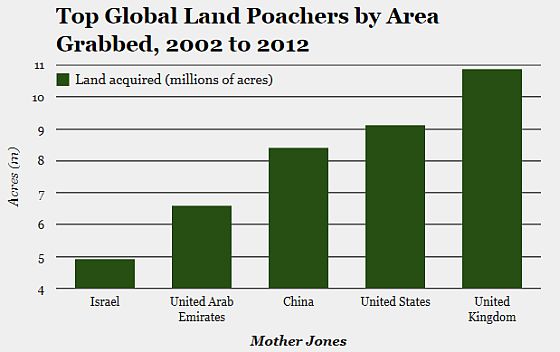
Mother Jones reports: In 2010, a former Wall Street trader flew into war-torn Sudan to negotiate a deal with a thuggish general. He had his eye on a 1 million acre tract of fertile land fed by a tributary of the Nile in the southern section of the country, a region that later claimed its independence as South Sudan. The investor, who planned to profit by developing and exporting agricultural commodities, boasted about how the region’s instability was a principal variable in his financial model: “This is Africa,” he told reporter McKenzie Funk, who shadowed him for a riveting piece in Rolling Stone (PDF). “The whole place is like one big mafia. I’m like a mafia head.”
Over the last decade (and especially during the last four years) wealthy nations have increasingly brokered deals for huge swathes of agricultural land at bargain prices in developing countries, installed industrial-scale farms, and exported the resulting bounty for profit. According to the anti-hunger group Oxfam International, more than 60 percent of these “land grabs” occur in regions with serious hunger problems. Two-thirds of the investors plan to ship all the commodities they produce out of the country to the global market. And droughts, spikes in food and oil prices, and a growing global population have only made the quest for arable land more urgent, and the investments that much more alluring.
In what a recent study in the Proceedings of the National Academy of Sciences (PNAS) characterizes as a “new form of colonialism,” investors from the US, UK, and China are gobbling up foreign farmland at “alarming rates” and often with little consultation and compensation of poor small-scale farmers and local populations. [Continue reading…]

Rami G Khouri writes: We will find out in coming months whether the second term of the Obama administration will herald any significant changes in United States policies in the Middle East. Four main issues should be monitored for any signs of change: the Palestine-Israel and wider Arab-Israeli conflicts; tensions with Iran; the Arab uprisings, revolutions, and constitutional transformations; and socio-economic conditions across the region.
Each of these issues is important in itself. However, viewed from Washington they often get conflated and confused, so American government responses to the various Arab uprisings, for example, often are shaped by officials’ concerns about Iran and Israel.
On a short visit to Washington this week where I had discussions with specialists on the Middle East, my sense is that little has changed in the U.S. capital in the past two years. While the ordinary men and women of the Arab world have launched the most dramatic and consequential change ever in the political configuration of their region, officials and experts in Washington appear to be living in the past, intellectually and politically immobilized, pursuing more or less the same policies of the past several decades. [Continue reading…]
Alireza Nader writes: The Iranian regime is hardly cheering Hagel on, despite what some of his critics say. Yes, Hagel sounds cautious about a U.S. bombing campaign against Iran’s nuclear facilities, but such a campaign isn’t what keeps the Iranian supreme leader, Ayatollah Ali Khamenei, up at night. An American strike would spur the Iranian public to rally around the flag and buck up a wobbling, wheezing theocracy — and an Israeli strike would do so in spades.
The Iranian leadership’s real worry is not American planes but Iranian protesters. Their deepest anxieties revolve around a Persian version of Tahrir Square, a replay of the 2009 Green uprising that wasn’t ended by the regime’s violent repression. Strange as it may sound, the Islamic Republic is a lot more frightened of the imprisoned Iranian human rights activist Nasrin Sotoudeh than it is of Israeli Prime Minister Benjamin Netanyahu.
As such, Hagel’s nomination was greeted in Tehran with a shrug, not a sigh of relief. The Islamic Republic hardly thinks that with Hagel nominated, it’s off the nuclear hook. Iran’s leaders see U.S. “hostility” as institutionalized and systematized, not produced by partisan politics or individual appointments. As Hossein Salami, a top-ranking Revolutionary Guards officer, said of Hagel, “We view the United States as a political and ideological system driven by its strategic interests rather than by individual politicians.”
That was true even in the transition from George W. Bush to Barack Obama. The Islamic Republic greeted Obama’s election in 2008 with mixed emotions. On the one hand, the Iranian regime worried that Obama’s barrier-breaking achievement and inspiring life story might appeal to the average Iranian in a way unmatched by any previous U.S. president.
On the other, the Iranian regime continued to believe that its lifelong rivalry with the United States is the result of flatly irreconcilable differences: what it sees as Washington’s unshakable opposition to the Iranian revolution, unqualified and limitless support for Israel, and insistence on competing with Iran for influence over the Middle East.
If Obama’s election didn’t change Tehran’s view of U.S. policy, it’s hard to see how Hagel’s nomination could. After all, America’s war-weariness is no secret, and it’s hardly limited to Vietnam veterans such as Hagel. Iranian decision-makers can read The New York Times and watch CNN like anyone else, and they understand the reluctance, both among America’s people and elites, to go to war against Iran over its nuclear program.
The New York Times reports: The White House on Wednesday directed the Justice Department to release to the two Congressional Intelligence Committees classified documents discussing the legal justification for killing, by drone strikes and other means, American citizens abroad who are considered terrorists.
The White House announcement appears to refer to a long, detailed 2010 memo from the Justice Department’s Office of Legal Counsel justifying the killing of Anwar al-Awlaki, an American-born cleric who had joined Al Qaeda in Yemen. He was killed in a C.I.A. drone strike in September 2011. Members of Congress have long demanded access to the legal memorandum.
The decision to release the legal memo to the Intelligence Committees came under pressure, two days after a bipartisan group of 11 senators joined a growing chorus asking for more information about the legal justification for targeted killings, especially of Americans.
The announcement also came on the eve of the confirmation hearing scheduled for Thursday afternoon for John O. Brennan, President Obama’s choice to be director of the C.I.A., who has been the chief architect of the drone program as Mr. Obama’s counterterrorism adviser.
Critics accused Mr. Obama of hypocrisy for keeping the legal opinions on targeted killing secret, noting that in 2009 he had ordered the public release of the classified memos governing C.I.A. interrogations under President George W. Bush. Administration officials replied that the so-called enhanced interrogations had been stopped, while drone strikes continue.
Until Wednesday, the administration had refused to even officially acknowledge the existence of the documents, which have been reported about in the press. This week, NBC News obtained an unclassified, shorter “white paper” that detailed some of the legal analysis about killing a citizen and was apparently derived from the classified Awlaki memorandum. The paper said the United States could target a citizen if he was a senior operational leader of Al Qaeda involved in plots against the country and if his capture was not feasible.
Administration officials said Mr. Obama had decided to take the action, which they described as extraordinary, out of a desire to involve Congress in the development of the legal framework for targeting specific people to be killed in the war against Al Qaeda. Aides noted that Mr. Obama had made a pledge to do that during an appearance on “The Daily Show” last year.
“Today, as part of the president’s ongoing commitment to consult with Congress on national security matters, the president directed the Department of Justice to provide the Congressional Intelligence Committees access to classified Office of Legal Counsel advice related to the subject of the Department of Justice white paper,” said an administration official who requested anonymity to discuss the handling of classified material.
The official said members of the Intelligence Committees would now get “access” to the documents.
Christopher Anders, senior legislative counsel for the American Civil Liberties Union, called the president’s move “a small step in the right direction.” But he noted that the legal memo or memos were not being shared with either of the Armed Services Committees, which have jurisdiction over Pentagon strikes, or the Judiciary Committees, which oversee the Justice Department.
The public should be permitted to see at least a redacted version of the relevant memos, Mr. Anders said. “Everyone has a right to know when the government believes it can kill Americans and others,” he said. [Continue reading…]
On April 29, 2003, two days before George Bush’s famous “mission accomplished” speech declaring the end to major combat operations in Iraq, Donald Rumsfeld announced that U.S. troops would be withdrawn from Saudi Arabia. The presence of these troops in the Islamic kingdom was one of the catalysts for 9/11.
An al Qaeda fatwa issued in 1998 had said: “for over seven years the United States has been occupying the lands of Islam in the holiest of places, the Arabian Peninsula, plundering its riches, dictating to its rulers, humiliating its people, terrorizing its neighbors, and turning its bases in the Peninsula into a spearhead through which to fight the neighboring Muslim peoples.”
As we now learn that two years ago the Obama administration turned Saudi Arabia into a spearhead for its targeted killing operations across the region, it seems reasonable to wonder how long it might be before history repeats itself.
If two decades ago overseas military bases were the preeminent symbol of American domination, in much of the world now the most despised expression of American power is surely the drone.
The Washington Post reports: The Obama administration’s targeted-killing program has relied on a growing constellation of drone bases operated by the CIA and the U.S. military’s Joint Special Operations Command. The only strike intentionally targeting a U.S. citizen, a 2011 attack that killed al-Qaeda operative Anwar al-Awlaki, was carried out in part by CIA drones flown from a secret base in Saudi Arabia.
The base was established two years ago to intensify the hunt against al-Qaeda in the Arabian Peninsula, as the affiliate in Yemen is known. Brennan, who previously served as the CIA’s station chief in Saudi Arabia, played a key role in negotiations with Riyadh over locating an agency drone base inside the kingdom.
The Washington Post had refrained from disclosing the specific location at the request of the administration, which cited concern that exposing the facility would undermine operations against an al-Qaeda affiliate regarded as the network’s most potent threat to the United States, as well as potentially damage counterterrorism collaboration with Saudi Arabia.
The Post learned Tuesday night that another news organization was planning to reveal the location of the base, effectively ending an informal arrangement among several news organizations that had been aware of the location for more than a year.
The New York Times reports: Late last August, a 40-year-old cleric named Salem Ahmed bin Ali Jaber stood up to deliver a speech denouncing Al Qaeda in a village mosque in far eastern Yemen.
It was a brave gesture by a father of seven who commanded great respect in the community, and it did not go unnoticed. Two days later, three members of Al Qaeda came to the mosque in the tiny village of Khashamir after 9 p.m., saying they merely wanted to talk. Mr. Jaber agreed to meet them, bringing his cousin Waleed Abdullah, a police officer, for protection.
As the five men stood arguing by a cluster of palm trees, a volley of remotely operated American missiles shot down from the night sky and incinerated them all, along with a camel that was tied up nearby.
The killing of Mr. Jaber, just the kind of leader most crucial to American efforts to eradicate Al Qaeda, was a reminder of the inherent hazards of the quasi-secret campaign of targeted killings that the United States is waging against suspected militants not just in Yemen but also in Pakistan and Somalia. Individual strikes by the Predator and Reaper drones are almost never discussed publicly by Obama administration officials. But the clandestine war will receive a rare moment of public scrutiny on Thursday, when its chief architect, John O. Brennan, the White House counterterrorism adviser, faces a Senate confirmation hearing as President Obama’s nominee for C.I.A. director.
From his basement office in the White House, Mr. Brennan has served as the principal coordinator of a “kill list” of Qaeda operatives marked for death, overseeing drone strikes by the military and the C.I.A., and advising Mr. Obama on which strikes he should approve.
“He’s probably had more power and influence than anyone in a comparable position in the last 20 years,” said Daniel Benjamin, who recently stepped down as the State Department’s top counterterrorism official and now teaches at Dartmouth. “He’s had enormous sway over the intelligence community. He’s had a profound impact on how the military does counterterrorism.”
Mr. Brennan, a former C.I.A. station chief in Riyadh, Saudi Arabia, has taken a particular interest in Yemen, sounding early alarms within the administration about the threat developing there, working closely with neighboring Saudi Arabia to gain approval for a secret C.I.A. drone base there that is used for American strikes, and making the impoverished desert nation a test case for American counterterrorism strategy.
In recent years, both C.I.A. and Pentagon counterterrorism officials have pressed for greater freedom to attack suspected militants, and colleagues say Mr. Brennan has often been a restraining voice. The strikes have killed a number of operatives of Al Qaeda in the Arabian Peninsula, the terrorist network’s affiliate in Yemen, including Said Ali al-Shihri, a deputy leader of the group, and the American-born cleric Anwar al-Awlaki.
But they have also claimed civilians like Mr. Jaber and have raised troubling questions that apply to Pakistan and Somalia as well: Could the targeted killing campaign be creating more militants in Yemen than it is killing? And is it in America’s long-term interest to be waging war against a self-renewing insurgency inside a country about which Washington has at best a hazy understanding?
Several former top military and intelligence officials — including Stanley A. McChrystal, the retired general who led the Joint Special Operations Command, which has responsibility for the military’s drone strikes, and Michael V. Hayden, the former C.I.A. director — have raised concerns that the drone wars in Pakistan and Yemen are increasingly targeting low-level militants who do not pose a direct threat to the United States.
In an interview with Reuters, General McChrystal said that drones could be a useful tool but were “hated on a visceral level” in some of the places where they were used and contributed to a “perception of American arrogance.” [Continue reading…]
Think Progress: Former Vice-Chairman of the Joint Chiefs of Staff James Cartwright today said that military strikes on Iran would not completely end its nuclear program.
Appearing at a conference of the Center for Strategic and International Studies titled “Dealing with a Nuclear Iran,” Cartwright laid out what he saw as the difficulties inherent in launching a military strike on Iran’s nuclear program. Topping the former General’s list: the inability of any attack to wipe out the intellectual capital developed by Iran during its research.
An attack on Iran then would be one of delay, according to Cartwright, rather than denying Iran the ability to conduct further uranium enrichment. “You will not kill all of the intellectual capital,” Cartwright said, indicating that would take “tens of years” of occupation if that was the goal of a military strike. “If we want somebody to ‘uninvent’ [knowledge], that’s pretty unrealistic,” Cartwright said. [Continue reading…]
Center for Public Integrity: Republican mega-donor Sheldon Adelson isn’t just interested in political giving.
Since 2007, the casino mogul has given into the hundreds of millions of dollars to pro-Israel causes through a Massachusetts-based foundation he and his wife operate, according to a Center for Public Integrity review of Internal Revenue Service filings.
The top recipient of tax-exempt gifts by the Adelson Family Foundation is by far a foundation called Birthright Israel. It has received $123 million from Adelson since 2007, IRS filings indicate.
Birthright offers free 10-day trips to Israel to Jews between age 18 and 26. The goal of the trips, according to Birthright, is to “send tens of thousands of young Jewish adults from all over the world to Israel as a gift” and is made possible through a “unique partnership” between the government of Israel and private philanthropists.
Foremost among those philanthropists is Adelson, whose support accounts for fully 40 percent of the money raised by the Birthright Foundation since 2007.
In 2008, Adelson’s $27.5 million gift to Birthright constituted 57 percent of all money raised by the organization. His patronage accounted for 19 percent of the group’s revenue in 2011, the most recent year IRS records are available. [Continue reading…]