Hicham Ben Abdallah El Alaoui writes: The Arab Spring is not an outcome, it is a process. For those countries at the forefront of regional transformation, the fundamental question is can democracy become institutionalised? Though progress has been uneven and the outcomes of many state-society struggles have yet to be resolved, the answer is a cautious yes. In at least a few countries, we are witnessing the onset of democratic institutionalisation: whether the process of reform and transformation spreads to other parts of the Middle East depends on many factors — religious tensions, political mobilisation, regime adaptations, geopolitics. Meanwhile North Africa provides the most promising preview of the future.
Democratic institutionalisation means the healthy convergence of politics around three arenas of competition: elections, parliaments and constitutions. When these institutions are robust and durable, then the democratic governments they engender are relatively safe from radical groups, reactionary forces and authoritarian backsliding (due to alternation: democracies that uphold the rule of law and hold regular elections require that power alternates between competing parties).
In Tunisia, Libya and Egypt, this process is unfolding, if at an unsteady pace. All three have had founding legislative elections that were far more competitive and pluralistic than those held in their authoritarian past. In Tunisia, the project to re-craft the national constitution nears completion by the Constituent Assembly, which itself was the product of electoral competition. The crisis there has two dimensions: the new government’s passivity in response to Salafist violence (which came to an end after the attack on the US embassy in Tunis) and the delay in getting economic reform under way, especially in the poorest regions. In spite of often acute tensions and conflicts between different political interest groups, all but the tiniest minority have accepted that democracy is now the name of the game. [Continue reading…]
Category Archives: Issues
The torturers roam free while the whistleblower goes to jail
Scott Shane reports: Looking back, John C. Kiriakou admits he should have known better. But when the F.B.I. called him a year ago and invited him to stop by and “help us with a case,” he did not hesitate.
In his years as a C.I.A. operative, after all, Mr. Kiriakou had worked closely with F.B.I. agents overseas. Just months earlier, he had reported to the bureau a recruiting attempt by someone he believed to be an Asian spy.
“Anything for the F.B.I.,” Mr. Kiriakou replied.
Only an hour into what began as a relaxed chat with the two agents — the younger one who traded Pittsburgh Steelers talk with him and the senior investigator with the droopy eye — did he begin to realize just who was the target of their investigation.
Finally, the older agent leaned in close and said, by Mr. Kiriakou’s recollection, “In the interest of full disclosure, I should tell you that right now we’re executing a search warrant at your house and seizing your electronic devices.”
On Jan. 25, Mr. Kiriakou is scheduled to be sentenced to 30 months in prison as part of a plea deal in which he admitted violating the Intelligence Identities Protection Act by e-mailing the name of a covert C.I.A. officer to a freelance reporter, who did not publish it. The law was passed in 1982, aimed at radical publications that deliberately sought to out undercover agents, exposing their secret work and endangering their lives.
In more than six decades of fraught interaction between the agency and the news media, John Kiriakou is the first current or former C.I.A. officer to be convicted of disclosing classified information to a reporter.
Mr. Kiriakou, 48, earned numerous commendations in nearly 15 years at the C.I.A., some of which were spent undercover overseas chasing Al Qaeda and other terrorist groups. He led the team in 2002 that found Abu Zubaydah, a terrorist logistics specialist for Al Qaeda, and other militants whose capture in Pakistan was hailed as a notable victory after the Sept. 11 attacks.
He got mixed reviews at the agency, which he left in 2004 for a consulting job. Some praised his skills, first as an analyst and then as an overseas operative; others considered him a loose cannon.
Mr. Kiriakou first stumbled into the public limelight by speaking out about waterboarding on television in 2007, quickly becoming a source for national security journalists, including this reporter, who turned up in Mr. Kiriakou’s indictment last year as Journalist B. When he gave the covert officer’s name to the freelancer, he said, he was simply trying to help a writer find a potential source and had no intention or expectation that the name would ever become public. In fact, it did not surface publicly until long after Mr. Kiriakou was charged.
He is remorseful, up to a point. “I should never have provided the name,” he said on Friday in the latest of a series of interviews. “I regret doing it, and I never will do it again.”
At the same time, he argues, with the backing of some former agency colleagues, that the case — one of an unprecedented string of six prosecutions under President Obama for leaking information to the news media — was unfair and ill-advised as public policy.
His supporters are an unlikely collection of old friends, former spies, left-leaning critics of the government and conservative Christian opponents of torture. Oliver Stone sent a message of encouragement, as did several professors at Liberty University, where Mr. Kiriakou has taught. They view the case as an outrage against a man who risked his life to defend the country.
Whatever his loquaciousness with journalists, they say, he neither intended to damage national security nor did so. Some see a particular injustice in the impending imprisonment of Mr. Kiriakou, who in his first 2007 appearance on ABC News defended the agency’s resort to desperate measures but also said that he had come to believe that waterboarding was torture and should no longer be used in American interrogations.
Bruce Riedel, a retired veteran C.I.A. officer who led an Afghan war review for Mr. Obama and turned down an offer to be considered for C.I.A. director in 2009, said Mr. Kiriakou, who worked for him in the 1990s, was “an exceptionally good intelligence officer” who did not deserve to go to prison.
“To me, the irony of this whole thing is, very simply, that he’s going to be the only C.I.A. officer to go to jail over torture,” even though he publicly denounced torture, Mr. Riedel said. “It’s deeply ironic under the Democratic president who ended torture.” [Continue reading…]
Obama to nominate Hagel for defense secretary
Reuters reports: President Barack Obama will nominate former Republican Senator Chuck Hagel to be his defense secretary and an announcement could come on Monday, a Democratic congressional aide said.
The choice will likely set up a confirmation battle in the Senate over whether the former Nebraska senator and Vietnam veteran is a strong enough supporter of key U.S. ally Israel and over his past calls for military cuts.
The Obama administration backed down from a tough Senate confirmation battle over Susan Rice, the U.S. Ambassador to the United Nations, who was Obama’s first pick to replace Hillary Clinton as secretary of state. Rice withdrew her name from consideration after drawing heavy fire from Republicans for remarks she made in the aftermath of a September 11 attack on the U.S. mission in Benghazi, Libya.
“The administration has a lot of work to do on Hagel,” a Democratic Senate aide said.
“He is in a weaker position now than Rice ever was because Rice would have rallied Democrats behind her. The administration floated Hagel’s name, then neglected to defend him effectively when his critics started taking shots,” the aide said.
However, the White House is confident it can weather criticism of Hagel’s record and garner enough votes from both sides of the political aisle to get his nomination through committee and win confirmation in the Democratic-led Senate.
“The president wants him, because he trusts him and he’s an independent voice,” a source close to the situation said.
The source said Hagel had received high-level messages of reassurance in recent days that his nomination was on track despite a campaign by his critics aimed at derailing it.
The gravest threat to the Middle East: Israel’s nuclear arsenal
Noam Chomsky writes: Reporting on the final U.S. presidential campaign debate, on foreign policy, The Wall Street Journal observed that “the only country mentioned more (than Israel) was Iran, which is seen by most nations in the Middle East as the gravest security threat to the region.”
The two candidates agreed that a nuclear Iran is the gravest threat to the region, if not the world, as Romney explicitly maintained, reiterating a conventional view.
On Israel, the candidates vied in declaring their devotion to it, but Israeli officials were nevertheless unsatisfied. They had “hoped for more ‘aggressive’ language from Mr. Romney,” according to the reporters. It was not enough that Romney demanded that Iran not be permitted to “reach a point of nuclear capability.”
Arabs were dissatisfied too, because Arab fears about Iran were “debated through the lens of Israeli security instead of the region’s,” while Arab concerns were largely ignored – again the conventional treatment.
The Journal article, like countless others on Iran, leaves critical questions unanswered, among them: Who exactly sees Iran as the gravest security threat? And what do Arabs (and most of the world) think can be done about the threat, whatever they take it to be?
The first question is easily answered. The “Iranian threat” is overwhelmingly a Western obsession, shared by Arab dictators, though not Arab populations. [Continue reading…]
America’s real criminal element: lead
Kevin Drum writes: When I started research for this story, I worked my way through a pair of thick criminology tomes. One chapter regaled me with the “exciting possibility” that it’s mostly a matter of economics: Crime goes down when the economy is booming and goes up when it’s in a slump. Unfortunately, the theory doesn’t seem to hold water — for example, crime rates have continued to drop recently despite our prolonged downturn.
Another chapter suggested that crime drops in big cities were mostly a reflection of the crack epidemic of the ’80s finally burning itself out. A trio of authors identified three major “drug eras” in New York City, the first dominated by heroin, which produced limited violence, and the second by crack, which generated spectacular levels of it. In the early ’90s, these researchers proposed, the children of CrackGen switched to marijuana, choosing a less violent and more law-abiding lifestyle. As they did, crime rates in New York and other cities went down.
Another chapter told a story of demographics: As the number of young men increases, so does crime. Unfortunately for this theory, the number of young men increased during the ’90s, but crime dropped anyway.
There were chapters in my tomes on the effect of prison expansion. On guns and gun control. On family. On race. On parole and probation. On the raw number of police officers. It seemed as if everyone had a pet theory. In 1999, economist Steven Levitt, later famous as the coauthor of Freakonomics, teamed up with John Donohue to suggest that crime dropped because of Roe v. Wade; legalized abortion, they argued, led to fewer unwanted babies, which meant fewer maladjusted and violent young men two decades later.
But there’s a problem common to all of these theories: It’s hard to tease out actual proof. Maybe the end of the crack epidemic contributed to a decline in inner-city crime, but then again, maybe it was really the effect of increased incarceration, more cops on the beat, broken-windows policing, and a rise in abortion rates 20 years earlier. After all, they all happened at the same time.
To address this problem, the field of econometrics gives researchers an enormous toolbox of sophisticated statistical techniques. But, notes statistician and conservative commentator Jim Manzi in his recent book Uncontrolled, econometrics consistently fails to explain most of the variation in crime rates. After reviewing 122 known field tests, Manzi found that only 20 percent demonstrated positive results for specific crime-fighting strategies, and none of those positive results were replicated in follow-up studies.
So we’re back to square one. More prisons might help control crime, more cops might help, and better policing might help. But the evidence is thin for any of these as the main cause. What are we missing?
Experts often suggest that crime resembles an epidemic. But what kind? Karl Smith, a professor of public economics and government at the University of North Carolina-Chapel Hill, has a good rule of thumb for categorizing epidemics: If it spreads along lines of communication, he says, the cause is information. Think Bieber Fever. If it travels along major transportation routes, the cause is microbial. Think influenza. If it spreads out like a fan, the cause is an insect. Think malaria. But if it’s everywhere, all at once — as both the rise of crime in the ’60s and ’70s and the fall of crime in the ’90s seemed to be — the cause is a molecule.
A molecule? That sounds crazy. What molecule could be responsible for a steep and sudden decline in violent crime?
Well, here’s one possibility: Pb(CH2CH3)4. [Continue reading…]
Secret and lies of the bailout
Matt Taibbi writes: It has been four long winters since the federal government, in the hulking, shaven-skulled, Alien Nation-esque form of then-Treasury Secretary Hank Paulson, committed $700 billion in taxpayer money to rescue Wall Street from its own chicanery and greed. To listen to the bankers and their allies in Washington tell it, you’d think the bailout was the best thing to hit the American economy since the invention of the assembly line. Not only did it prevent another Great Depression, we’ve been told, but the money has all been paid back, and the government even made a profit. No harm, no foul – right?
Wrong.
It was all a lie – one of the biggest and most elaborate falsehoods ever sold to the American people. We were told that the taxpayer was stepping in – only temporarily, mind you – to prop up the economy and save the world from financial catastrophe. What we actually ended up doing was the exact opposite: committing American taxpayers to permanent, blind support of an ungovernable, unregulatable, hyperconcentrated new financial system that exacerbates the greed and inequality that caused the crash, and forces Wall Street banks like Goldman Sachs and Citigroup to increase risk rather than reduce it. The result is one of those deals where one wrong decision early on blossoms into a lush nightmare of unintended consequences. We thought we were just letting a friend crash at the house for a few days; we ended up with a family of hillbillies who moved in forever, sleeping nine to a bed and building a meth lab on the front lawn.
But the most appalling part is the lying. The public has been lied to so shamelessly and so often in the course of the past four years that the failure to tell the truth to the general populace has become a kind of baked-in, official feature of the financial rescue. Money wasn’t the only thing the government gave Wall Street – it also conferred the right to hide the truth from the rest of us. And it was all done in the name of helping regular people and creating jobs. “It is,” says former bailout Inspector General Neil Barofsky, “the ultimate bait-and-switch.” [Continue reading…]
Is a deal with Iran in the offing?
Trita Parsi writes: It is now almost exactly four years ago since President Barack Obama famously offered Iran America’s hand of friendship if Tehran would unclench its fist. Though no one is speaking of friendship today — or even mutual respect — a deal may finally be in the making. Both sides appear to be preparing the ground, in their own ways, for a compromise. The precipitating factors are a combination of realizing that the escalation game has reached a dead end and the quiet signaling of acceptance of the other’s red line.
The marginal utility of further escalation is rapidly declining. The White House is on the record opposing additional sanctions at this point, arguing that it will undercut their strategy. Sanctions have had a devastating effect on the Iranian economy and helped create medicine shortages, but there are no clear signs yet that sanctions have softened Tehran’s nuclear stance. Similarly, the Iranians appear to have realized that further escalating and accelerating their nuclear activities by increasing enrichment levels beyond 20 percent, for instance, will not provide Iran with added leverage. Rather, such measures would risk transforming a chicken race into a street fight with no honorable exit options.
Behind the tough rhetoric emanating from both sides, veiled hints at a major compromise can be found. In just the last few days, editorials in both the New York Times and the Washington Post have argued that a deal should be made which accepts limited enrichment in Iran under five percent and the lifting of some sanctions in return for unhindered inspections. The Obama administration has also hinted at this. If implemented, this would be an acceptance of Iran’s red line and the most compelling force generating a reciprocal step from Tehran (far more so than the pinch of sanctions). [Continue reading…]
Obama expected to pick Hagel as opponents prepare for a fight
The Cable: President Barack Obama is expected to name Chuck Hagel as his choice for defense secretary as early as Monday, as critics of the former Nebraska senator prepare to go to war to fight his expected nomination.
White House officials and sources close to Hagel declined to confirm to The Cable that Hagel is the president’s choice to be the replace Leon Panetta at the helm of the Pentagon, but several sources close to the process said have told The Cable that the White House and Hagel have been in touch on a regular basis and that Hagel is indeed the expected pick. Decisions about the timing and logistics of the announcement are being finalized now.
The Cable had previously confirmed that Hagel successfully complete the vetting process, as have Deputy Defense Secretary Ash Carter and former Under Secretary of Defense for Policy Michele Flournoy.
Meanwhile, Hagel’s detractors are moving forward with their campaign against the nomination, which has been expanding ever since The Cable first reported in November that Hagel was in consideration for the Pentagon post. That campaign has included anonymous Senate aides calling Hagel an anti-Semite, the Washington Post editorial board writing that, “Chuck Hagel is not the right choice for defense secretary,” and the Emergency Committee for Israel, which counts among its board members Weekly Standard editor Bill Kristol, running a television ad criticizing Hagel’s opposition to unilateral sanctions against Iran. “For secretary of defense, Chuck Hagel is not a responsible option,” the ad claims.
“Even if one left aside Chuck Hagel’s dangerous views on Iran and his unpleasant distaste for Israel and Jews, a dispassionate analyst would have to conclude that the case for Hagel is extraordinarily weak,” Kristol wrote in an editorial Friday, in which he urged Obama to choose Carter, Flournoy, or Navy Secretary Ray Mabus. [Continue reading…]
The promise of the Arab Spring
Sheri Berman writes: Two years after the outbreak of what has come to be known as the Arab Spring, the bloom is off the rose. Fledgling democracies in North Africa are struggling to move forward or even maintain control, government crackdowns in the Persian Gulf and elsewhere have kept liberalization at bay, and Syria is slipping ever deeper into a vicious civil war that threatens to ignite the Middle East. Instead of widespread elation about democracy finally coming to the region, one now hears pessimism about the many obstacles in the way, fear about what will happen next, and even open nostalgia for the old authoritarian order. Last June, when the Egyptian military dismissed parliament and tried to turn back the clock by gutting the civilian presidency, The Wall Street Journal‘s chief foreign policy columnist cracked, “Let’s hope it works.” (It didn’t.) And Egyptian President Mohamed Morsi’s attempted power grab in November made such nostalgia commonplace.
The skepticism is as predictable as it is misguided. Every surge of democratization over the last century — after World War I, after World War II, during the so called third wave in recent decades — has been followed by an undertow, accompanied by widespread questioning of the viability and even desirability of democratic governance in the areas in question. As soon as political progress stalls, a conservative reaction sets in as critics lament the turbulence of the new era and look back wistfully to the supposed stability and security of its authoritarian predecessor. One would have hoped that by now people would know better — that they would understand that this is what political development actually looks like, what it has always looked like, in the West just as much as in the Middle East, and that the only way ahead is to plunge forward rather than turn back.
The first error critics make is treating new democracies as blank slates, ignoring how much of their dynamics and fate are inherited rather than chosen. Turmoil, violence, and corruption are taken as evidence of the inherent dysfunctionality of democracy itself, or of the immaturity or irrationality of a particular population, rather than as a sign of the previous dictatorship’s pathologies. Because authoritarian regimes lack popular legitimacy, they often manipulate and deepen communal cleavages in order to divide potential opponents and generate support among favored groups. So when democratization occurs, the pent-up distrust and animosity often explode. And because authoritarian regimes rule by command rather than consensus, they suppress dissent and block the creation of political and social institutions that allow for the regular, peaceful articulation and organization of popular demands. So citizens in new democracies often express their grievances in a volatile and disorganized way, through a dizzying array of parties, extremist rhetoric and behavior, and street protests and even battles. [Continue reading…]
Will there be an independent Kurdistan?
Will the losers in the region’s post-WWI upheavals be the winners of the ‘Arab Spring’?
David Hirst writes: The Baghdad newspaper Sabah published a surprising article a few weeks ago. Its editor, Abd Jabbar Shabbout, suggested it was time to settle the “age-old problem” between Iraq’s Arabs and Kurds by establishing a “Kurdish state.” Never before had I heard such a once-heretical view so publicly expressed in any Arab quarter. And this was no ordinary quarter: Sabah is the mouthpiece of Iraqi Prime Minister Nouri Maliki. Shabbout went on to suggest a negotiated “ending of the Arab-Kurdish partnership in a peaceful way.”
He called his proposal Plan B, Plan A being the “dialogue” between Iraq’s central government and the Kurdish regional government in northern Iraq that emerged after the fall of Saddam Hussein.
But Plan A, he said, was getting nowhere. Differences over power and authority, oil and natural resources, territory and borders were so deep that the dialogue repeatedly failed. In December the Iraqi army and Kurdish peshmerga faced off in an atmosphere so tense, according to Shabbout, that hostilities could have broken out at any moment as a result of the slightest miscalculation.
And it wasn’t only Shabbout, but Maliki himself, who warned that if war did break out it wouldn’t be just a war between Kurdish rebels and Baghdad, as it used to be under Hussein, but an “ethnic war between Arabs and Kurds.”
Could it be that the “Kurdish question” has reached another critical stage in its history, one that is intimately bound up with the region-wide cataclysm that is the “Arab Spring”?
The Kurds’ destiny has always been shaped less by their own struggles than by the vagaries of regional and international politics, and the great Middle Eastern upheavals they periodically produce. With World War I and the fall of the Ottoman Empire, Britain and France promised the Kurds a state of their own, but then reneged. They fetched up as minorities, more or less severely repressed, in the four countries — Iran, Iraq, Turkey and Syria — among which their vast domains were divided. They repeatedly rebelled, especially in Iraq. But their rebellions were always crushed, the last one, under Hussein with the genocidal use of gas.
But the Kurds never ceased to dream of independent statehood. Their first breakthrough came after Hussein’s megalomaniacal invasion of Kuwait in 1990, when an internationally protected Kurdish “safe haven” was established in northern Iraq, which enabled them to take their first state-building steps in the shape of a regional assembly and a degree of self-government.
Then, after the U.S.-led invasion of Iraq in 2003, the Kurds consolidated their autonomy with broad new legislative powers, control of their own armed forces and some authority over Iraqi oil resources. But from the outset, they made it clear that they would remain committed to the “new Iraq” only if it treated them as an equal partner. [Continue reading…]
Turkey’s new thinking on Iraqi Kurdistan
Semih Idiz writes: The idea of an independent Kurdistan bordering Turkey’s predominantly Kurdish southeast, which has been wracked with separatist violence from the outlawed Kurdistan Workers Party (PKK) for over quarter of a century, would have raised official hackles only a few years back.
During those days, Kurdish leaders Jalal Talabani, the current president of Iraq, and Massoud Barzani, the current head of the Kurdistan Regional Government (KRG), were objects of Turkish vilification for their alleged backing of the PKK, and its seemingly endless campaign for separation from Turkey in a war that has resulted in over 30,000 deaths to date.
Far from ceasing, PKK attacks have escalated today due to the crisis in Syria and the turmoil in the Middle East. Based on traditional assumptions this should have driven a bigger wedge between the Iraqi Kurds and Turkey. Meanwhile, nationalist Turks still believe the Iraqi Kurdish authorities are providing refuge and logistical support to the PKK lodged in the mountains of Northern Iraq.
However, the official position of Ankara towards the Iraqi Kurds has changed so fundamentally that many are left wondering why Turkey did not come around to its current position much earlier. The change in Ankara’s stance is so significant that Massoud Barzani, in his capacity of Kurdistan Region President, was one of the honored guests at the ruling Justice and Development Party (AKP) Congress in Ankara at the end of September.
In the meantime, Prime Minister Recep Tayyip Erdogan’s March 2011 visit to Erbil, the regional Kurdish capital, was a watershed event amounting to recognition by Ankara of the KRG as a separate political entity, and resulting in the rapid normalizing of ties between Turkey and the Iraqi Kurds. So what was the driving force behind this dramatic “volte-face” by Turkey, which once had 200,000 troops on the border threatening to move into Northern Iraq, and in fact going on to do so on a number of occasions?
An irony during the period of high tension between Ankara and the Iraqi Kurds is that this tension never prevented individual Turks or Turkish companies from moving into the region and beginning to invest there heavily. One of the masterminds of this economic cooperation, which today is clearly working to mutual advantage, was KRG Prime Minister Nechirvan Barzani. [Continue reading…]
Map of ‘Syrian Kurdistan’ releases cautiously marked borders
Al Arabiya reports: The Kurdish Centre for Legal Studies and Consultancy, also known as YASA, released a map of what it described as “Syrian Kurdistan” which marks the borders of the Kurdish territories inside Syria.
According to the map, Syrian Kurdistan, also labeled Western Kurdistan by the Bonn-based center, starts from the village of Ain Diwar in the governorate of Hasakah in the northeast and extends across the Turkish borders till the far northwest near the city of Iskenderun.
The map features major cities in the northern Syria like Dêrik, Rmêlan, Tirbespiyê, Kobanî, and Afrin and the percentage of Kurds, Arabs, and Christians in each of them.
The map does not, however, specify the exact area of Syrian Kurdistan, which, according to the center, is not possible at the moment for security reasons. A second study is tp offer more accurate figures.
Based on YASA statistics, the number of Kurds in Syria is estimated at three million, mostly living in the north together with Arab and Christian minorities.
Obama and the Kurdish question: Drones are not the answer
Kevin McKiernan writes: The role of the Obama administration in suppressing the long-running Kurdish uprising in Turkey is largely unknown. But a few weeks ago a U.S. diplomat dropped an intriguing clue. Francis J. Ricciardone, Jr., Obama’s ambassador to Turkey, revealed that the U.S. had secretly offered Turkey what was, in effect, a bin Laden-style assassination of the top leadership of the PKK (Kurdistan Workers Party), the rebels who have been fighting the U.S.-equipped Turkish army since 1984.
“Your enemies are our enemies,” Ricciardone told Turkish reporters at a news conference in Ankara. “The power of the multidisciplinary approach is what got bin Laden in the end, and we would like to share that and exploit that intimately.”
When I heard the ambassador’s remarks, I had just left Syria, where a different Kurdish group is struggling for its own autonomy. I was en route at the time to Mt. Qandhil, one of the highest mountains in neighboring Iraq, where PKK rebels have a sanctuary. I was seeking reaction to news that Turkey was quietly negotiating with Abdullah Ocalan, the notorious PKK founder who was captured in 1999 with U.S. assistance, and who since then, has become a cause célèbre with many Kurds in the Middle East.
The 28-year-old Kurdish uprising in Turkey has resulted in 40,000 deaths, most of them Kurds. The U.S. considers the PKK a terrorist group, but experts say both the rebels and Turkish troops have committed human rights abuses. Today, the struggle goes beyond military conflict. Since 2009, some 8,000 Kurdish civilians have been arrested in Turkey. That includes lawyers and at least 100 journalists — more than in Iran or China.
This fall, some 700-1,000 prisoners went on hunger strike in Turkey, demanding that Ocalan be removed from solitary confinement and that Kurds receive broadcasting rights, education in their native tongue and ethnic recognition in the Turkish constitution. Turkey claims that most of the prisoners have ties to the PKK, but according to Human Rights Watch, many Kurds were arrested in a “crackdown on legal pro-Kurdish politics.”
Against this backdrop came Ambassador Ricciardone’s startling disclosure: the administration’s misguided proposal to target the Kurdish rebel leadership. In fact, the PKK is not al-Qaeda, nor has it targeted Americans — and Turkey wisely rejected the U.S. offer. [Continue reading…]
How to talk to Iran
Seyed Hossein Mousavian and Mohammad Ali Shabani write: there are any two words in Persian that President Obama should learn, they are “maslahat” and “aberu.” Maslahat is often translated as expediency, or self-interest. Aberu means face — as in, saving face. In the nearly 34 years since the Islamic revolution in Iran, expediency has been a pillar of decision making, but within a framework that has allowed Iranian leaders to save face. If there is to be any resolution of the nuclear standoff, Western leaders must grasp these concepts.
Two examples illustrate this point. In 1988, after eight years of devastating war with Saddam Hussein’s Iraq, Iran’s first supreme leader, Ayatollah Ruhollah Khomeini, accepted a United Nations-brokered cease-fire agreement, deeming it to be in Iran’s maslahat. It was crucial that Iraqi forces had been pushed off Iranian soil, so Tehran could claim a victory.
Thirteen years later, after the 9/11 attacks, the United States overthrew the Taliban regime in Afghanistan, which had sheltered Al Qaeda, in a matter of weeks. American troops would never have made it to Kabul and Mazar-i-Sharif with such speed had Iran’s leaders not acquiesced to the toppling of their enemies to the east. But the George W. Bush administration squandered an opportunity for dialogue by spurning this potential diplomatic overture by Iran.
For thousands of years, Persian culture has been distinguished by customs that revolve around honor and esteem. Preserving one’s aberu is tantamount to maintaining one’s dignity. There are almost no instances in modern Iranian history when maslahat has trumped aberu. The West has poorly understood these concepts. This was particularly true under President Bush, who rewarded Iran’s tacit acceptance of the American invasion of Afghanistan by labeling Iran a member of an “axis of evil.”
Following the 2003 allied invasion of Iraq, the Swiss ambassador to Iran reached out to Washington with an unofficial outline for a “grand bargain” with Tehran that would cover everything from Iran’s nuclear program to its support for militant groups in the region. Despite this bold step, Iran was left out in the cold. Vice President Dick Cheney is said to have dismissed the initiative, reportedly asserting that “we don’t talk to evil.”
We now know, thanks to a recent memoir by the former Iranian nuclear negotiator Hassan Rowhani, that the Bush administration reached out to Tehran a year after dismissing the proposal. Not surprisingly, partly because of the blow to its pride, the Iranian government rejected the offer of direct, high-level talks as insincere. In the nine years since, Iran’s nuclear program — a major symbol of prestige for Iranians — has grown immensely. Things have gotten a lot more complicated.
The pattern of missed opportunities has persisted for more than three decades now. The result is that Barack Obama is the sixth consecutive president who has been led to view Iran as a threat rather than an opportunity. It is time for America to exit this vicious cycle and disregard irrational voices intent on sabotaging efforts to reach an understanding. [Continue reading…]
The GOP’s anti-Muslim wing is in retreat

Tim Murphy and Adam Serwer report: Over the last four years, a die-hard cadre of activists and their allies in Congress have dragged the Republican Party into a fever swamp of Islamophobia and barely-concealed anti-Muslim bigotry. In their paranoid scenario, Islamic Shariah law is creeping into American courts; the Department of Justice has come under the sway of the Muslim Brotherhood; and the president’s engagement ring includes secret writing that indicates Muslim loyalties.
But after a November election that saw three of the party’s loudest voices on “creeping Shariah” defeated — and the GOP presidential nominee ignore the issue entirely — the anti-Islam movement within the Republican party may have peaked. Wary of further alienating a once-promising conservative constituency, mainstream Republican leaders have sought, publicly and behind closed doors, to distance themselves from the loudest of the Muslim-bashers in their midst.
“They have gotten a bit of bad odor,” says GOP powerbroker Grover Norquist, who has pushed to change his party’s tone on Islam.
Randa Fahmy Hudome, a former Bush administration official, Washington lobbyist, and prominent Muslim Republican, notes: “There is a self-policing factor in the Republican Party, when some members get a little off base on some of these issues. That’s the state of play right now.”
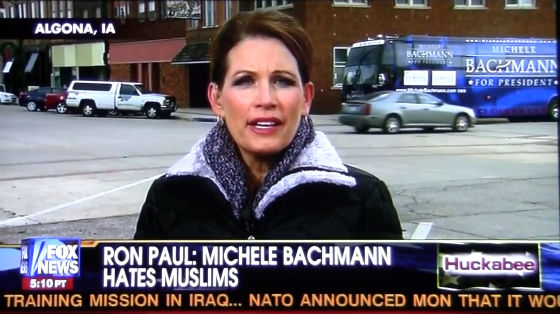
A turning point came in July, when Rep. Michele Bachmann (R-Minn.), along with four Republican colleagues, signed a letter demanding an investigation into the Muslim Brotherhood’s supposed infiltration of the State Department. The letter singled out a top aide to Secretary of State Hillary Clinton, Huma Abedin. Bachmann and her colleagues, deploying tenuous evidence and guilt-by-association, charged that Abedin should not have been given a security clearance because of alleged ties to Muslim radicals.
Days later, Sen. John McCain (R-Ariz.) had condemned Bachmann’s letter from the floor of the Senate, calling it “unwarranted and unfounded” and “scurrilous.” Speaker of the House John Boehner piled on, calling the letter “dangerous.” The chair of the House intelligence committee, Rep. Mike Rogers (R-Mich.), emphasized to USA Today that though she served on his committee, Bachmann’s allegations did not have the committee’s imprimatur. Sen. Marco Rubio, the Florida senator and tea party favorite widely touted as a potential 2016 contender, publicly denounced the allegations promoted by Bachmann and her allies, like former Reagan official and longtime anti-Shariah activist Frank Gaffney. [Continue reading…]
New guns for a new year: American anthropology and gun violence
Jason Antrosio writes: Lynyrd Skynyrd had gun violence figured out in 1975:
Hand guns are made for killin’
Ain’t no good for nothin’ else
And if you like your whiskey
You might even shoot yourself
So why don’t we dump ’em people
To the bottom of the sea
Before some fool come around here
Wanna shoot either you or me
–Lynyrd Skynyrd, Saturday Night SpecialIf they can make gun control palatable for that audience, why can’t we do it now?
As of 19 December 2012, even David Brooks and Gail Collins were in rare agreement that we were headed for some sensible gun regulations, Brooks speculating that the NRA would “get out in front of this by making some immediate concessions on gun rights, and they should promote a practical agenda on mental health and gun access” (The Newtown Aftermath). There seemed to be consensus clamor for strengthening gun laws. But as Frank Rich wisely put it, “let’s see what happens when the circus folds its tent and we are back in the bitter winds of January, redirecting our attention to the Inauguration and the Super Bowl” (America’s Other Original Sin).
We do not need to wait that long. Although many people, even Republicans, thought the NRA stance was unhelpful, disgusting, disastrous, and a thirty-round magazine of crazy, plenty of support remains for NRA-type arguments, especially in districts controlled by House Republicans. This was something I already noted before the NRA announcement, that not a single sitting House Republican had announced any change in position. The rhetoric from many places, including my own Republican representatives, had hardly budged (see Semi-Automatic Anthropology). Truthfully, for most of these representatives there is hardly any political gain from supporting even the mildest gun control regulations, and substantial backlash risk for not holding the line. [Continue reading…]
The Emancipation Proclamation and the politics of self-liberation
Priyamvada Gopal writes: On a cold bright New Year’s Day 150 years ago, Abraham Lincoln finally signed the document which underlies his controversial reputation as “the Great Emancipator”. Although the Emancipation Proclamation did not, in fact, result in the overnight liberation of millions of enslaved people, it enabled black men to fight on the Union side and has long been seen as a milestone in the unconscionably slow attainment by African-Americans of full citizenship, social equality and meaningful freedom.
On New Year’s Eve, many African-American congregations will have commemorated the “Watch Night” services of the last night of 1862 when many gathered in churches to “watch” for the long-awaited issuance of the proclamation – which will also be read out at anniversary ceremonies across the United States today. Long queues of people are waiting to see the original document on rare and brief display at the National Archives in Washington DC.
Given that the proclamation was a largely symbolic gesture based on a canny military calculus that transformed the civil war into a war ostensibly about supporting or abolishing slavery, and that it would be two more years before the 13th Amendment would legally prohibit enslavement, why commemorate it? Does it, moreover, have relevance beyond the borders of the US and for a different global moment a century and a half later? The answer is yes, if the occasion functions as an opportunity to evaluate history more honestly.
It is possible to acknowledge, as one abolitionist did, that the Emancipation Proclamation gave “liberty a moral recognition” if there is also an understanding that no liberation, whether from colonialism or slavery, takes place without the participation of those who are at the receiving end of oppression. The former slave and great abolitionist Frederick Douglass, who was both critical of and worked alongside Lincoln, famously reminded his fellow blacks that “power concedes nothing without a struggle”. Tyranny’s limits, he noted, “are prescribed by the endurance of those whom they oppress”. [Continue reading…]
How many slaves work for you?
Louis P. Masur writes: In a speech delivered in September at the Clinton Global Initiative, President Obama declared that the time had come to call human trafficking by its rightful name: modern slavery. “The bitter truth is that trafficking also goes on right here, in the United States,” he declared. “It’s the migrant worker unable to pay off the debt to his trafficker. The man, lured here with the promise of a job, his documents then taken, and forced to work endless hours in a kitchen. The teenage girl, beaten, forced to walk the streets. This should not be happening in the United States of America.”
That same month the president signed an executive order that stated the United States would “lead by example” and take steps to ensure that federal contracts are not awarded to companies or nations implicated in trafficking. “We’re making clear that American tax dollars must never, ever be used to support the trafficking of human beings,” he said.
Still, the invisibility of modern slavery makes it all the more pernicious and difficult to eradicate. The organization Slavery Footprint asks on its Web site, “How many slaves work for you?” A survey poses a series of seemingly innocuous questions such as what do you eat, what do you wear, what medicine do you take, and what electronics do you use? Upon completion, a number is revealed: I discovered that 60 slaves work for me — cutting the tropical wood for my furniture, harvesting the Central Asian cotton in my shirts or mining the African precious metals used in my electronics.
Video: Are trolls killing the internet?
On early warning signs of rapid change
George Sugihara writes: At a closed meeting held in Boston in October 2009, the room was packed with high-flyers in foreign policy and finance: Henry Kissinger, Paul Volcker, Andy Haldane, and Joseph Stiglitz, among others, as well as representatives of sovereign wealth funds, pensions, and endowments worth more than a trillion dollars — a significant slice of the world’s wealth. The session opened with the following telling question: “Have the last couple of years shown that our traditional finance/risk models are irretrievably broken and that models and approaches from other fields (for example, ecology) may offer a better understanding of the interconnectedness and fragility of complex financial systems?”
Science is a creative human enterprise. Discoveries are made in the context of our creations: our models and hypotheses about how the world works. Big failures, however, can be a wake-up call about entrenched views, and nothing produces humility or gains attention faster than an event that blindsides so many so immediately.
Examples of catastrophic and systemic changes have been gathering in a variety of fields, typically in specialized contexts with little cross-connection. Only recently have we begun to look for generic patterns in the web of linked causes and effects that puts disparate events into a common framework — a framework that operates on a sufficiently high level to include geologic climate shifts, epileptic seizures, market and fishery crashes, and rapid shifts from healthy ecosystems to biological deserts.
The main themes of this framework are twofold: First, they are all complex systems of interconnected and interdependent parts. Second, they are nonlinear, non-equilibrium systems that can undergo rapid and drastic state changes.
Consider first the complex interconnections. Economics is not typically thought of as a global systems problem. Indeed, investment banks are famous for a brand of tunnel vision that focuses risk management at the individual firm level and ignores the difficult and costlier, albeit less frequent, systemic or financial-web problem. Monitoring the ecosystem-like network of firms with interlocking balance sheets is not in the risk manager’s job description. Even so, there is emerging agreement that ignoring the seemingly incomprehensible meshing of counterparty obligations and mutual interdependencies (an accountant’s nightmare, more recursive than Abbott and Costello’s “Who’s on first?”) prevented real pricing of risk premiums, which helped to propagate the current crisis.
A parallel situation exists in fisheries, where stocks are traditionally managed one species at a time. Alarm over collapsing fish stocks, however, is helping to create the current push for ecosystem-based ocean management. This is a step in the right direction, but the current ecosystem simulation models remain incapable of reproducing realistic population crashes. And the same is true of most climate simulation models: Though the geological record tells us that global temperatures can change very quickly, the models consistently underestimate that possibility. This is related to the next property, the nonlinear, non-equilibrium nature of systems. [Continue reading…]
Capitalism and the good life
Gary Gutting asks: Is capitalism an enemy of the good life? Marxists and other radicals think so. Toward the end of How Much Is Enough?, Robert and Edward Skidelsky (an economist father and his philosopher son) quote one such thinker:
Working men have been surrendered, isolated and helpless, to the hard-heartedness of employers and the greed of unchecked competition…so that a small number of very rich men have been able to lay upon the teeming masses of the laboring poor a yoke little better than that of slavery.
Readers of Commonweal will be more likely than most to recognize the firebrand cited as Leo XIII in Rerum novarum.
The Skidelskys’ own rhetoric is usually more restrained. The sober line of thought that underlies their engaging, informative, and stimulating book goes roughly as follows. Under capitalism, businesses sell us goods and service that are essential for living well, and most of us get the money to buy these things by working for businesses or, less often, profiting from investments in them. We need capitalism because no other economic system can produce sufficient goods to meet our essential material needs such as food, shelter, clothes, and medical care. But these goods are not enough. A good life mainly depends on intangibles such as love, friendship, beauty, and virtue — things capitalism cannot produce and money cannot buy. Given a sufficient minimum of material goods, the good life does not depend on the world of commerce.
Nonetheless, for most of us, work takes up the bulk of our time and energy, leaving comparatively little for living a good life. Some see their work itself as a pursuit of beauty, truth, or virtue. But most find what they do valuable primarily as a means of earning money to buy material necessities. And capitalist society itself insists that a good life requires much more than a minimum of material goods. A truly good life, it urges, requires fine food, a large and well-furnished home, stylish clothing, and a steady diet of diverting and enriching experiences derived from sports, culture, and travel — all of which are expensive.
We all agree that there’s a limit beyond which more material goods would make little difference to the goodness of our lives. But almost all of us think we are considerably below that limit. In general, then, capitalism works against the good life from two directions. It requires us to engage in work that makes little contribution to our living well, beyond supplying our material necessities, and it urges us to believe, falsely, that a good life is mainly a matter of accumulating material possessions. The Skidelskys sum it up this way: “The irony is that…now that we have achieved abundance [in advanced capitalist countries], the habits bred into us by capitalism have left us incapable of enjoying it properly.”
Their view of capitalism is critical rather than revolutionary. They decry its tendency to sacrifice the human good to the goods of the market, but think we can curb this tendency and harness capitalism’s productive power for our pursuit of the good life. For them, the core problem with capitalism is “economic insatiability” — the intrinsic drive for increasing production (and therefore profits) without limit. The limitless demand for more can even lead, as we have recently seen, to economic catastrophe. More important, capitalism is morally deficient because its drivers are the vices of “greed and acquisitiveness,” which pile up “goods” that take us away from the good life. [Continue reading…]