The Telegraph reports: Britain and France are spearheading a new peace proposal for the Middle East that could put the Israel’s leaders on the defensive by pushing them to resolve the conflict with the Palestinians within a year, Israeli officials reportedly said on Sunday.
The initiative is expected to be tabled by March following the formation of a new Israeli government after next week’s general election. It will include a provision for a Palestinian state with its capital in east Jerusalem – a major sticking point in past negotiations.
The Yedioth Ahronoth newspaper said the plan was being spearheaded by Britain and France with Germany’s support. It could eventually be adopted as a pan-European initiative by the EU’s foreign policy chief, Baroness Ashton, the newspaper reported.
Disclosure of the initiative follows international condemnation of Prime Minister Benjamin Netanyahu’s Right-wing government over a recent wave of plans to expand West Bank settlements, which the EU and US fear could kill off prospects for a two-state solution.
“We do know that the EU is planning to come up with something after the elections, when the new government has been formed,” one Israeli official told The Daily Telegraph.
“We don’t know if it’s going to be a fully-fledged plan, or an idea or something more or less ambitious because we have not been consulted. We believe they may want to put forward some sort of deal with parameters but they are perfectly conscious of the fact that an agreement can only be negotiated between the two sides.”
Category Archives: Issues
On the so-called crimes of Aaron Swartz
Alex Stamos would have served as the expert witness on Aaron Swartz’s side in a trial which won’t now happen, following Swartz’s suicide. (Swartz had been charged by the federal government with having “stolen” over 4 million academic papers from the online archives operated by JSTOR.)
Stamos is no champion of a free internet and his testimony would not have been the expression of an ideological affiliation with Swartz.
I have led the investigation of dozens of computer crimes, from Latvian hackers blackmailing a stock brokerage to Chinese government-backed attacks against dozens of American enterprises. I have investigated small insider violations of corporate policy to the theft of hundreds of thousands of dollars, and have responded to break-ins at social networks, e-tailers and large banks. While we are no stranger to pro bono work, having served as experts on EFF vs Sony BMG and Sony vs Hotz, our reports have also been used in the prosecution of at least a half dozen attackers. In short, I am no long-haired-hippy-anarchist who believes that anything goes on the Internet. I am much closer to the stereotypical capitalist-white-hat sellout that the antisec people like to rant about (and steal mail spools from) in the weeks before BlackHat.
Had Stamos testified in the case against Swartz, it’s hard not to wonder whether as a result, the prosecution’s case would have fallen apart.
If I had taken the stand as planned and had been asked by the prosecutor whether Aaron’s actions were “wrong”, I would probably have replied that what Aaron did would better be described as “inconsiderate”. In the same way it is inconsiderate to write a check at the supermarket while a dozen people queue up behind you or to check out every book at the library needed for a History 101 paper. It is inconsiderate to download lots of files on shared wifi or to spider Wikipedia too quickly, but none of these actions should lead to a young person being hounded for years and haunted by the possibility of a 35 year sentence.
Professor Lessig will always write more eloquently than I can on prosecutorial discretion and responsibility, but I certainly agree that Aaron’s death demands a great deal of soul searching by the US Attorney who decided to massively overcharge this young man and the MIT administrators who decided to involve Federal law enforcement.
For the Electronic Frontier Foundation, Peter Eckersley writes: Aaron did more than almost anyone to make the Internet a thriving ecosystem for open knowledge, and to keep it that way. His contributions were numerous, and some of them were indispensable. When we asked him in late 2010 for help in stopping COICA, the predecessor to the SOPA and PIPA Internet blacklist bills, he founded an organization called Demand Progress, which mobilized over a million online activists and proved to be an invaluable ally in winning that campaign.
Other projects Aaron worked on included the RSS specifications, web.py, tor2web, the Open Library, and the Chrome port of HTTPS Everywhere. Aaron helped launch the Creative Commons. He was a former co-founder at Reddit, and a member of the team that made the site successful. His blog was often a delight.
Aaron’s eloquent brilliance was mixed with a complicated introversion. He communicated on his own schedule and needed a lot of space to himself, which frustrated some of his collaborators. He was fascinated by the social world around him, but often found it torturous to deal with.
For a long time, Aaron was more comfortable reading books than talking to humans (he once told me something like, “even talking to very smart people is hard, but if I just sit down and read their books, I get their most considered and insightful thoughts condensed in a beautiful and efficient form. I can learn from books faster than I can from talking to the authors.”). His passion for the written word, for open knowledge, and his flair for self-promotion, sometimes produced spectacular results, even before the events that proved to be his undoing.
Iran and the fallacy of saber-rattling
Paul Pillar writes: Among several broadly held misconceptions about Iran is that to get Iranians to make concessions we want them to make at the negotiating table the United States must credibly threaten to inflict dire harm on them—specifically, with military force—if they do not make the concessions. Some in the United States (and some in Israel) who are especially keen on promoting this notion would welcome a war. If war preparations and brinksmanship used to communicate such a threat lead the two nations to stumble into an accidental war—and there is a real danger they might—so much the better from their point of view. But the belief in saber-rattling as an aid to gaining an agreement in the negotiations over Iran’s nuclear program extends to many who actually want an agreement and are not seeking a war. We have heard more about this lately in connection with Chuck Hagel’s nomination to be secretary of defense. People ask whether this nominee, who has evinced an appreciation of the huge downsides of a war with Iran, would be able to rattle the saber as convincingly as the same people think a secretary of defense ought to rattle it.
Even the usually thoughtful David Ignatius has adopted this line of thought. In his latest column he makes a comparison with nuclear deterrence in the time of Dwight Eisenhower. Under the doctrine of mutual assured destruction, a “bluff” of “frightening the Soviets with the danger of Armageddon” was used to dissuade them from overrunning Western Europe. “Obama,” says Ignatius, “has a similar challenge with Iran.”
No, he doesn’t. One situation was deterrence of what would have been one of the most epic acts of aggression in history. The other is an effort to compel a far lesser country to curtail or give up an avowedly peaceful program, and to do so by threatening what itself would be an act of aggression. [Continue reading…]
Video: Israel forces Palestinians from ‘tent city’
Video — Noam Chomsky: The responsibility of privilege
Video: Matt Taibbi and William Black on bailout secrets and how new foreclosure deal spares banks from justice
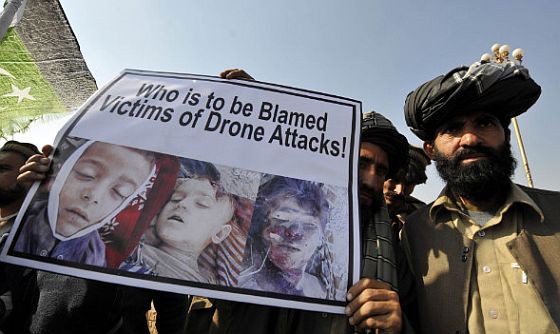
Drones are fool’s gold: they prolong wars we can’t win
Simon Jenkins writes: The greatest threat to world peace is not from nuclear weapons and their possible proliferation. It is from drones and their certain proliferation. Nuclear bombs are useless weapons, playthings for the powerful or those aspiring to power. Drones are now sweeping the global arms market. There are some 10,000 said to be in service, of which a thousand are armed and mostly American. Some reports say they have killed more non-combatant civilians than died in 9/11.
I have not read one independent study of the current drone wars in Afghanistan, Pakistan and the horn of Africa that suggests these weapons serve any strategic purpose. Their “success” is expressed solely in body count, the number of so-called “al-Qaida-linked commanders” killed. If body count were victory, the Germans would have won Stalingrad and the Americans Vietnam.
Neither the legality nor the ethics of drone attacks bear examination. Last year’s exhaustive report by lawyers from Stanford and New York universities concluded that they were in many cases illegal, killed civilians, and were militarily counter-productive. Among the deaths were an estimated 176 children. Such slaughter would have an infantry unit court-martialled. Air forces enjoy such prestige that civilian deaths are excused as a price worth paying for not jeopardising pilots’ lives.
This week President Obama appointed two drone “enthusiasts” as his new defence secretary, Chuck Hagel, and his new CIA chief, John Brennan. Drone war is now the flavour of the month and the military-industrial complex is licking its lips. If Obama, himself a lawyer, had any reservations about the legality of these weapons, he has clearly overcome them. [Continue reading…]
Death of a prisoner
Laura Poitras writes: When President Obama pledged to close the Guantánamo Bay prison on his first day in office as president in 2009, I believed the country had shifted direction. I was wrong. Four years later, President Obama has not only institutionalized Guantánamo and all the horrors it symbolizes, but he has initiated new extrajudicial programs, like the president’s secret kill list.
In September 2012 I read the news that another prisoner at Guantánamo had died, and I knew I had probably met his family. I traveled to Yemen in 2007 with the idea of making a film about a Guantánamo prisoner. I went there with the Guantánamo lawyer David Remes. He met with families and delivered the news of their sons, brothers, fathers and husbands. I had hoped to film the journey of someone being released from Guantánamo and returning home. Five years later, I find myself making that film, but under tragic circumstances.
Adnan Farhan Abdul Latif recently died in solitary confinement at Guantánamo at age 36, after nearly 11 years of imprisonment there, despite never having been charged with a crime. Last month his body was returned to his family in Yemen, but we are left with many unanswered questions about his imprisonment and death.
Mr. Latif’s death is under investigation by the United States military, which claims he committed suicide from an overdose of prescription medication complicated by acute pneumonia. But that’s hard to take at face value. Why was he placed in solitary confinement when he was suffering from acute pneumonia? How could he have overdosed on medication, given the strict protocols at Guantánamo? Why did it take three months for the body to be returned to Yemen? And finally, why are his autopsy and toxicology report classified and being withheld from his family?
These questions are not just about Adnan Latif. They also address the injustices that our government has instituted and normalized in the war on terror.
What John Brennan’s support for CIA torture meant for Sami al-Hajj
Amy Goodman writes: It takes courage to enter a warzone willingly, armed with a microphone and a camera as a journalist. That is what al-Jazeera cameraman Sami al-Hajj was doing in December 2001, as he was entering Afghanistan from Pakistan to cover the US military operations there.
While his colleague was allowed in, al-Hajj was arrested, in what was to be a harrowing, nightmarish odyssey that lasted close to seven years, most of it spent as prisoner 345, the only journalist imprisoned at Guantánamo Bay – without charge. Al-Hajj is out now, back at work at al-Jazeera and reunited with his family. His recollections of the horror of detention by the United States should be front and center in the forthcoming confirmation hearings for President Barack Obama’s choice to lead the CIA, John Brennan.
It has been 11 years since the Guantánamo prison was opened, and four years since President Obama promised to close it within a year.
“He speaks very eloquently [about] what many hundreds of other detainees suffered, who cannot tell their story,” Baher Azmy, legal director of the Center for Constitutional Rights, told me:
“The brutality he suffered in Afghanistan, the fact that he was turned over for political reasons or for a bounty, the arbitrariness of his detention in Guantanamo and the brutality of his treatment there.”
I sat down with Sami al-Hajj last month at al-Jazeera’s headquarters in Doha, Qatar. [Continue reading…]
Pull back the curtain on drones
Micah Zenko writes: This week, President Obama nominated his homeland security adviser and deputy national security adviser for counterterrorism, John Brennan, to become the next director of the Central Intelligence Agency.
In the coming weeks, a Senate committee will hold hearings, followed by a full Senate vote, that will likely confirm the appointment. The Senate must seize this narrow window of opportunity to publicly discuss, for the first time, the Obama administration’s policy of targeted killings by drones.
Though many ordinary Americans are understandably uneasy with these secret attacks, the politicians we elect have so far subjected the program to almost no official scrutiny.
There have been more than 400 drone strikes killing more than 3,000 people in Pakistan, Yemen and Somalia over the past decade. Yet Congress has refused to assess or even question the effectiveness, legality and sustainability of this lethal tactic, which has increasingly come to define U.S. foreign policy.
Brennan, more than any other single official, represents the program. [Continue reading…]
Can a collapse of global civilization be avoided?

On the Midway Islands, near the heart of the Pacific Trash Gyre, thousands of birds die after consuming the detritus of modern civilization. Photo: Chris Jordan
Paul R. Ehrlich and Anne H. Ehrlich write: Virtually every past civilization has eventually undergone collapse, a loss of socio-political-economic complexity usually accompanied by a dramatic decline in population size. Some, such as those of Egypt and China, have recovered from collapses at various stages; others, such as that of Easter Island or the Classic Maya, were apparently permanent. All those previous collapses were local or regional; elsewhere, other societies and civilizations persisted unaffected. Sometimes, as in the Tigris and Euphrates valleys, new civilizations rose in succession. In many, if not most, cases, overexploitation of the environment was one proximate or an ultimate cause.
But today, for the first time, humanity’s global civilization – the worldwide, increasingly interconnected, highly technological society in which we all are to one degree or another, embedded — is threatened with collapse by an array of environmental problems. Humankind finds itself engaged in what Prince Charles described as ‘an act of suicide on a grand scale’, facing what the UK’s Chief Scientific Advisor John Beddington called a ‘perfect storm’ of environmental problems. The most serious of these problems show signs of rapidly escalating severity, especially climate disruption. But other elements could potentially also contribute to a collapse: an accelerating extinction of animal and plant populations and species, which could lead to a loss of ecosystem services essential for human survival; land degradation and land-use change; a pole-to-pole spread of toxic compounds; ocean acidification and eutrophication (dead zones); worsening of some aspects of the epidemiological environment (factors that make human populations susceptible to infectious diseases); depletion of increasingly scarce resources, including especially groundwater, which is being overexploited in many key agricultural areas; and resource wars. These are not separate problems; rather they interact in two gigantic complex adaptive systems: the biosphere system and the human socio-economic system. The negative manifestations of these interactions are often referred to as ‘the human predicament’, and determining how to prevent it from generating a global collapse is perhaps the foremost challenge confronting humanity.
The human predicament is driven by overpopulation, overconsumption of natural resources and the use of unnecessarily environmentally damaging technologies and socio-economic-political arrangements to service Homo sapiens’ aggregate consumption. How far the human population size now is above the planet’s long-term carrying capacity is suggested (conservatively) by ecological footprint analysis. It shows that to support today’s population of seven billion sustainably (i.e. with business as usual, including current technologies and standards of living) would require roughly half an additional planet; to do so, if all citizens of Earth consumed resources at the US level would take four to five more Earths. Adding the projected 2.5 billion more people by 2050 would make the human assault on civilization’s life-support systems disproportionately worse, because almost everywhere people face systems with nonlinear responses, in which environmental damage increases at a rate that becomes faster with each additional person. Of course, the claim is often made that humanity will expand Earth’s carrying capacity dramatically with technological innovation, but it is widely recognized that technologies can both add and subtract from carrying capacity. The plough evidently first expanded it and now appears to be reducing it. Overall, careful analysis of the prospects does not provide much confidence that technology will save us or that gross domestic product can be disengaged from resource use. [Continue reading…]
Obama’s ‘light footprint’ masks a war fueling deep hatred of the U.S.

Since President Obama was re-elected on November 6, there have been 15 drone strikes in Pakistan and Yemen, including five strikes since New Year’s Day. This is the White House’s definition of a “light footprint” — a euphemism designed to imply that if the United States refrains from sending armies of occupation to foreign lands, then its military impact on the rest of the world is fundamentally benign.
Neoconservatives who seem to prefer the blunt force of American power and have a nostalgia for “shock and awe” are not impressed with light footprints. The idea that Obama employs a light touch seems designed to appeal to mainstream Democrats who like to believe that if America’s military actions pose no risk to American troops, then America is not at war. Drone strikes can continue, largely ignored by the press, and a public happy to remain ignorant can delude itself that the only people getting killed are “bad guys” and that Obama has a smarter approach to national security than his predecessor.
Assuming their nominations are confirmed, the two new pillars of Obama’s national security policy, John Brennan and Chuck Hagel, will likely further reinforce Obama’s approach which has much more to do with method than doctrine. Hagel will ensure that the troops stay at home while Brennan sends the drones overseas, effectively placing a light footprint on American consciousness and fostering an illusion of peace.
In an interview with Reuters, retired General Stanley McChrystal, who devised the U.S. counterinsurgency strategy in Afghanistan, voiced his concerns about the Obama administration’s practice of remote warfare.
“What scares me about drone strikes is how they are perceived around the world,” he said in an interview. “The resentment created by American use of unmanned strikes … is much greater than the average American appreciates. They are hated on a visceral level, even by people who’ve never seen one or seen the effects of one.”
McChrystal said the use of drones exacerbates a “perception of American arrogance that says, ‘Well we can fly where we want, we can shoot where we want, because we can.'”
Drones should be used in the context of an overall strategy, he said, and if their use threatens the broader goals or creates more problems than it solves, then you have to ask whether they are the right tool.
The Bureau of Investigative Journalism reports: CIA drones killed up to 12 people near Mir Ali, North Waziristan, hours after President Obama announced his nominee for Director of the Agency was John Brennan, his chief counterterrorism advisor and a leading proponent of the drone programme. It was the fourth CIA drone attack in 2013 and the fifth in 12 days. If reports are correct it is the third consecutive attack on a TTP compound. However there were conflicting accounts of the strike. Several agencies said a single target was hit, with Associated Press reporting several missiles ‘slammed into a compound near the Afghan border’ killing eight. However multiple sources said targets in different villages were hit in quick succession. The first strike hit Khasso Khel shortly after midnight, according to Xinhua. Five were killed when eight missiles ‘completely levelled’ a building that subsequently caught fire. Witnesses said the casualty count could rise as they feared people were trapped in the rubble.
New questions over CIA nominee Brennan’s denial of civilian drone deaths
The Bureau of Investigative Journalism reports: Claims by the Central Intelligence Agency’s new director-designate that the US intelligence services received ‘no information’ about any civilians killed by US drones in the year prior to June 2011 do not appear to bear scrutiny.
John Brennan, President Obama’s nominee to take over the CIA, had claimed in a major speech in summer 2011 that there had not been ‘a single collateral death’ in a covert US strike in the past year due to the precision of drones. He later qualified his statement, saying that at the time of his comments he had ‘no information’ to the contrary.
Yet just three months beforehand, a major US drone strike had killed 42 Pakistanis, most of them civilians. As well as being widely reported by the media at the time, Islamabad’s concerns regarding those deaths were also directly conveyed to the ‘highest levels of the Administration’ by Washington’s then-ambassador to Pakistan, it has been confirmed to the Bureau.
This confirmation suggests that senior US officials were aware of dozens of civilian deaths just weeks before Brennan’s claims to the contrary.
The CIA drone strike in Pakistan on March 17, which bombed the town of Datta Khel in North Waziristan and killed an estimated 42 people, has always seemed a contradiction of Brennan’s official statement.
The attack was later justified by an anonymous US official as a so-called ‘signature strike’ where the identities of those killed was unknown. They insisted that ‘a large group of heavily armed men, some of whom were clearly connected to al Qaeda and all of whom acted in a manner consistent with AQ-linked militants, were killed.’
In fact the gathering was a jirga, or tribal meeting, called to resolve a local mining dispute. Dozens of tribal elders and local policemen died, along with a small number of Taliban. [Continue reading…]
Japan and China step up drone race as tension builds over disputed islands
The Guardian reports: Drones have taken centre stage in an escalating arms race between China and Japan as they struggle to assert their dominance over disputed islands in the East China Sea.
China is rapidly expanding its nascent drone programme, while Japan has begun preparations to purchase an advanced model from the US. Both sides claim the drones will be used for surveillance, but experts warn the possibility of future drone skirmishes in the region’s airspace is “very high”.
Tensions over the islands – called the Diaoyu by China and the Senkaku by Japan – have ratcheted up in past weeks. Chinese surveillance planes flew near the islands four times in the second half of December, according to Chinese state media, but were chased away each time by Japanese F-15 fighter jets. Neither side has shown any signs of backing down.
Japan’s new conservative administration of Shinzo Abe has placed a priority on countering the perceived Chinese threat to the Senkakus since it won a landslide victory in last month’s general election. Soon after becoming prime minister, Abe ordered a review of Japan’s 2011-16 mid-term defence programme, apparently to speed up the acquisition of between one and three US drones.
Under Abe, a nationalist who wants a bigger international role for the armed forces, Japan is expected to increase defence spending for the first time in 11 years in 2013. The extra cash will be used to increase the number of military personnel and upgrade equipment. The country’s deputy foreign minister, Akitaka Saiki, summoned the Chinese ambassador to Japan on Tuesday to discuss recent “incursions” of Chinese ships into the disputed territory.
Hagel and the neo-McCarthyite Israel lobby
Bernard Avishai writes: I think it is time to acknowledge, bluntly, that certain major Jewish organizations, indeed, the Conference of Presidents of Major Jewish Organizations — also, the ADL, AIPAC, the American Jewish Committee, political groups like the Republican Jewish Coalition, along with their various columnists, pundits, and list-serves — are among the most consistent purveyors of McCarthyite-style outrages in America today. Are there greater serial defamers of public officials in fake campaigns against defamation? Starting with Andrew Young and the late Charles Percy, and on to Chas Freeman and (now) Chuck Hagel, the game has been to keep Congresspeople and civil servants who might be skeptical of Israel’s occupation and apologetics in a posture that can only be called exaggerated tact.The Emergency Committee for Israel launched a website to attack Hagel's nomination.
Fault Israel and you are accused of faulting Jews in our collective state, or, the same thing, overlooking the venality of our enemies — things only an anti-Semite would do and, of all times, in the wake of the Holocaust. This is not a charge anyone in public life wants to suffer or try to deny. My Israeli friends love that old Borsch-belt joke, that anti-Semitism means disliking Jews more than necessary. For American Jewish organizations, the very idea that dislike is ever warranted is proof of bigotry, like Philip Roth’s early novels were proof of “self-hatred.”
AIPAC et al know that if American politicians — and especially those fighting routinely for Florida, Pennsylvania and Ohio — are not cowed by the fear of being branded as anti-Semitic they may not be embarrassed into backing Israeli actions ritualistically. Where is the shame and who is our Murrow?
I won’t presume to go through the credentials that make Chuck Hagel fit for appointment as Defense Secretary; I saw and heard him in person only once. I also won’t repeat, or defend him against, all the fatuous charges leveled against him. Others have done this better than I could. (If you want a comprehensive list of the AIPAC-inspired letters Hagel refused to sign, you can find it here.)
Suffice it to say that Hagel is a man of independent judgment whose views on the Israeli-Palestinian conflict track pretty much exactly with those of Haaretz. He was distinguished guest at J Street’s first national conference. Nothing he’s said has not been said by leaders like Ehud Olmert and intelligence chief Ephraim Halevy. Hagel is also a man, like George McGovern, who having served with distinction in the military knows the unknown dangers of resorting to military force without a clear diplomatic strategy and except as a last resort. So he refuses to speak glibly about using force against Iran the same way he refused to endorse war with Iraq. A Vietnam purple heart, he would in retrospect have engaged with the Viet Cong. Should he not now endorse engagement with the Taliban or Hamas, for that matter?
Why should this stance be thought anathema to Jewish organizations? Let’s get real. The latter throw their weight around, presumably on behalf of us Israelis, but really on behalf of the Israeli right, whose orthodoxy and pathos they relate to more readily than to Israeli peace advocates. The weight they have derives from their being able to hold American politicians to endorsing a “special relationship” with Israel, where special means unconditional, so that (as James Baker and Howard Dean discovered) even the desire for “even-handedness” is treachery. [Continue reading…]
Yousef Munayyer notes: What the debate on Hagel is sorely missing is a loud public voice akin to Colin Powell’s on Obama’s faith in 2008, who would respond to allegations that Hagel isn’t pro-Israel by simple stating, So what if he’s not? Hagel is, after all, an American nominated for the role of U.S. Defense Secretary and shouldn’t be pro-Israel or pro-any-country-other-than-the-United-States. If he was, that should lead to controversy.
This debate, however, has it the other way around because it is grounded in the notion that American support for Israel is as American as our Constitution. It isn’t, and it can’t and should never be.
Yet, this type of debate, framed around “pro-Israel” interests, dominates mainstream discussions about U.S. foreign policy in the Middle East and specifically as it relates to Israel/Palestine. For as long as that is the case, Washington is only kidding itself if it thinks it can ever successfully mediate Israeli-Palestinian peace.
Jewish groups showed cavalier disregard for the welfare of American troops

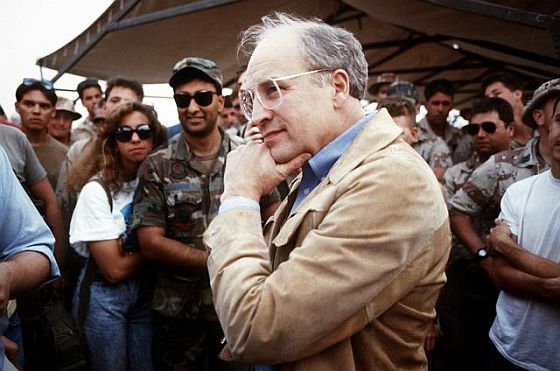
Advice from Defense Secretary Dick Cheney to American troops stationed in Saudi Arabia in 1990: keep quiet about the "Jewish lobby."
In 1990, American troops deployed to Saudi Arabia in advance of the Gulf War against Iraq, were advised by the Pentagon — then under Dick Cheney’s control — that they should not make pro-Israel, anti-Arab remarks while stationed in the Islamic kingdom.
That might sound like a no-brainer — clearly it was advise crafted for the purpose of making sure that young American soldiers lacking knowledge about the Middle East might avoid getting themselves in trouble or alienating themselves from their hosts.
But that’s not how organizations such as the American Jewish Committee, the World Jewish Congress, and the Simon Wiesenthal Center responded to the advice laid out in the Defense Department’s “Troop Information Handbook.”
In a letter to Cheney, Sholom Comay, AJ Committee president, and David Harris, its executive vice president, made it clear that they regarded the presence of American troops in the Gulf as being primarily to serve the interests of Israel.
The Jewish Telegraph Agency reported:
“No one can be under the illusion that our presence in Saudi Arabia is intended to protect a fellow democracy,” Comay and Harris wrote, dismissing the kingdom and its neighbors as “current allies” of the United States.
Perhaps the most egregious element in the Pentagon handbook — the part that most offended these Jewish organizations — was that they were included as one of the taboo topics of conversation and referred to as the “Jewish lobby.” Troops were advised not to discuss the “Jewish lobby” or “U.S. intelligence given to Israel.”
The Associated Press reported:
Writing to Secretary of Defense Dick Cheney, the World Jewish Congress said it wishes to convey “our sense of distress at what appears to be a capitulation to bigotry and a surrender of our democratic values…”
The letter, from WJC Vice President Kalman Sultanik, urges that the material be withdrawn from circulation.
The American Jewish Committee, expressing to Cheney its “deep sense of hurt and anger,” says U.S. troops should not be asked to “submerge entirely those values of tolerance, pluralism, and open-mindedness that have made the U.S. a unique democratic society.”
Cheney neither withdrew the handbook nor apologized for its contents.
During the current hullabaloo over Chuck Hagel’s use of the term “Jewish lobby“, it’s reasonable to ask: given the level of loyalty to Israel which so many members of the Senate seem to expect from America’s top civilian defense official, would Dick Cheney also face strong opposition from his own party if he was once again nominated as defense secretary?
Hagel’s independence will serve Obama as the Israel lobby pushes for war on Iran
Politics rewards creeps — individuals whose desire to please others makes them willing to sacrifice any principal in the pursuit of power. The more pliable the politician, the more useful he is to the lobbies he serves.
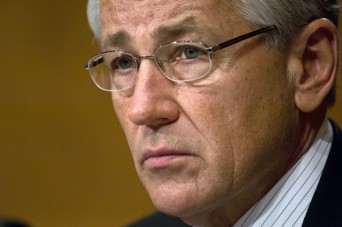
This is why Chuck Hagel has made enemies in Washington — not because of any specific views he holds, but because he lacks the servile disposition that has become the norm. As former deputy secretary of state Richard Armitage puts it: Hagel “doesn’t care if people like him or not.”
Bloomberg reports: If Hagel wins confirmation, he will face challenges such as the increasing threat of cyber warfare, readying military contingency plans for the volatile Middle East and jockeying with China for naval influence in the Asia-Pacific region.
The former enlisted combat veteran is uniquely equipped to take on four-star generals over how fast to withdraw troops from Afghanistan and how to cut forces and weapons in a time of restricted defense spending, according to friends such as Richard Armitage.
“He’s got proven guts,” Armitage, who was deputy secretary of state in the Bush administration, said in an interview before the appointment. “He doesn’t care if people like him or not. He knows who he is.”
Hagel, whose father died when he was 16, dropped out of college and worked as a radio disc jockey before going to serve in Vietnam with his brother Tom. When their armored personnel carrier hit a mine in 1968, Chuck, suffering burns to his body, dragged his brother from the vehicle to safety.
He came back from that war with two Purple Hearts and a conviction that, as he put it in a 2002 interview, “War is the last resort that we, a nation, a people, call upon to settle a dispute.”
“The horror of it, the pain of it, the suffering of it — people just don’t understand it unless they’ve been through it,” Hagel said in the interview for the Veterans History Project of the American Folklife Center. “There’s no glory, only suffering in war.”
Hagel’s uncommon honesty
It is widely reported that President Obama will nominate former Nebraska senator Chuck Hagel as secretary of defense today.
Peter Beinart writes: Hagel says in public what others only say in private. In his 2005 book, The Much Too Promised Land, former Clinton administration Middle East hand Aaron Miller notes that “of all my conversations [about the Israel debate in Congress], the one with Hagel stands apart for its honesty and clarity.” That’s because when Hagel told Miller that “the Jewish lobby intimidates a lot of people up here,” he was saying the same thing that people who work in Congress and the executive branch say all the time. As Thomas Friedman has noted, “I am certain that the vast majority of U.S. senators and policy makers quietly believe exactly what Hagel believes on Israel.” But the operative word is quietly. I’ve also heard many government officials, some of them Jewish, say things similar to what Hagel is now being flayed for having told Miller. The difference is that those other officials first confirmed that they were speaking off the record. One even lowered his voice and closed the door.
Hagel’s uncommon honesty isn’t restricted to Israel. Among the statements that critics now decry is Hagel’s 2007 declaration that “People say we’re not fighting for oil [in Iraq]. Of course we are.” In The Weekly Standard, Bill Kristol calls Hagel’s statement “vulgar and disgusting.” What Kristol doesn’t note is that the same article that quotes Hagel also quotes noted radical Alan Greenspan saying virtually the same thing. The difference: Greenspan said it in his memoir, published once he was safely retired from government service.
As John Judis notes, Hagel was considered a plausible Republican presidential candidate in 2008 until his blunt criticism of the Bush administration’s Iraq policies ended his career in the GOP. He is, therefore, one of the very few public figures in recent memory — Joe Lieberman, whose blunt support for the Bush administration’s Iraq policies ended his career in the Democratic Party, is another — to have forfeited a national role in his political party because of his policy views. In the process, Hagel has incurred the wrath of the same hawkish “pro-Israel” forces whose influence he was rash enough to acknowledge. He has done, in short, exactly what people who aspire to jobs like secretary of defense in Democratic administrations learn not to do.