Tony Karon writes: “Israel is in discussions with the United States over this issue and I am confident that we can chart a path forward together,” said Israeli Prime Minister Benjamin Netanyahu in his United Nations speech on Thursday, referring to the question of Iran’s nuclear program, to which he devoted almost all of his remarks. The Israeli prime minister broke from his recent habit of tacitly, but obviously, criticizing President Barack Obama‘s handling of Iran by hailing his achievements in putting together the most comprehensive sanctions package ever faced by any nation. Netanyahu also emphasized that the two governments are working together in pursuit of the common objective of preventing Iran from obtaining a nuclear weapon, a message the White House was happy to affirm via National Security Council spokesman Tommy Vietor, who said that the U.S. and Israel “will continue our close consultation and cooperation toward achieving that [shared] goal.”
Although Netanyahu also maintained that sanctions have failed to stop Iran’s program and that time was running out, the Israeli leader has clearly dialed things down from his previous habit of presenting Obama — to the delight of the Romney campaign — as naive and feckless in the face of a grave and gathering danger. Netanyahu may have, at one point, hoped to pressure Obama into taking a tougher stand, but the White House had resisted Israeli demands that it state stronger “red lines” on Iran, with Netanyahu finding himself increasingly isolated at home in his threat to take unilateral military action, and sharply criticized even by President Shimon Peres for appearing to interfere in U.S. electoral politics. Other Israeli commentators had been more blunt, warning that Netanyahu was recklessly gambling on a Romney victory, which appeared, they said, to be increasingly unlikely. [Continue reading…]
Kenan Malik writes: Salman Rushdie’s memoir, Joseph Anton, has hit the bookshelves just as the world has become embroiled in a new controversy over Islamic sensibilities. The extraordinary violence unleashed across the Muslim world by Innocence of Muslims, an obscure US-made video, has left many bewildered and perplexed.
Rushdie was, of course, at the centre of the most famous confrontation over the depiction of the Prophet Muhammad. The publication in 1988 of his fourth novel, The Satanic Verses, launched a worldwide campaign against the supposed blasphemies in the book, culminating in the Ayatollah Khomeini’s fatwa on 14 February 1989 condemning Rushdie to death, and forcing him into hiding for a decade.
Joseph Anton is Rushdie’s account of the fatwa and the years that followed. So, what does the battle over The Satanic Verses tell us about the current controversy over The Innocence of Muslims?
The Rushdie affair is shrouded in a number of myths that have obscured its real meaning. The first myth is that the confrontation over The Satanic Verses was primarily a religious conflict. It wasn’t. It was first and foremost a political tussle. The novel became a weapon in the struggle by Islamists with each other, with secularists and with the West. The campaign began in India where hardline Islamist groups whipped up anger against Rushdie’s supposed blasphemies to win concessions from politicians nervous about an upcoming general election and fearful of alienating any section of the Muslim community. The book subsequently became an issue in Britain, a weapon in faction fights between various Islamic groups.
Most important was the struggle between Saudi Arabia and Iran for supremacy in the Islamic world. From the 1970s onwards Saudi Arabia had used oil money to fund Salafi organisations and mosques worldwide to cement its position as spokesman for the umma. Then came the Iranian Revolution of 1979 that overthrew the Shah, established an Islamic republic, made Tehran the capital of Muslim radicalism, and Ayatollah Khomeini its spiritual leader, and posed a direct challenge to Riyadh. The battle over Rushdie’s novel became a key part of that conflict between Saudi Arabia and Iran. Saudi Arabia made the initial running, funding the campaign against the novel. The fatwa was an attempt by Iran to wrestle back the initiative. The campaign against The Satanic Verses was not a noble attempt to defend the dignity of Muslims, nor even a theological campaign to protect religious values. It was part of a sordid political battle to promote particular sectarian interests. [Continue reading…]
Satellite data reveal how the new record low Arctic sea ice extent, from Sept. 16, 2012, compares to the average minimum extent over the past 30 years (in yellow). NASA/Goddard Scientific Visualization Studio
THE TRUTH, as Winston Churchill put it, is incontrovertible. “Malice may attack it, ignorance may deride it, but in the end, there it is.” Scrape away the layers of denial, obfuscation and spin that cloud climate change and one unvarnished truth emerges: the Arctic ice cap is dying – and, with it, humanity’s best hopes for a prosperous, predictable future.
In the most dramatic reconfiguration of the map of the world since the end of the last Ice Age, the Arctic ice cap is now committed to accelerated collapse.
In 2007, the intergovernmental panel on climate change warned that, unless emissions were drastically curbed globally, the Arctic ocean could be clear of summer sea ice towards the end of this century.
They were hopelessly optimistic. On September 16th last, Arctic sea ice hit its lowest level ever recorded, at 3.41 million sq km, barely half the 1979-2000 average. The area of sea ice lost is 41 times larger than the island of Ireland. While the drop in sea ice extent is alarming, the 72 per cent decline in its volume is worse. Not only is ice cover shrinking, the surviving ice is thinning precipitously.
Prof Peter Wadhams of the Polar Ocean Physics Group described the September 2012 figures as a “global disaster”. He now projects the destruction of Arctic summer sea ice by 2015-16 – more than half a century ahead of the IPCC’s projections. “The final collapse towards that state is now happening and will probably be complete by those dates,” he added.
It is difficult to overstate the magnitude of what is now unfolding in the Arctic region. The Arctic ice cap used to cover 2 per cent of the Earth’s surface, and the ice albedo effect meant vast amounts of solar energy were bounced back into space from the bright white ice mass.
Losing this ice, and replacing it with dark open ocean, creates a dramatic tipping point in planetary energy balance. [Continue reading…]
Reuters reports: More than 100 million people will die and global economic growth will be cut by 3.2 percent of gross domestic product (GDP) by 2030 if the world fails to tackle climate change, a report commissioned by 20 governments said on Wednesday.
As global average temperatures rise due to greenhouse gas emissions, the effects on the planet, such as melting ice caps, extreme weather, drought and rising sea levels, will threaten populations and livelihoods, said the report conducted by humanitarian organisation DARA.
It calculated that five million deaths occur each year from air pollution, hunger and disease as a result of climate change and carbon-intensive economies, and that toll would likely rise to six million a year by 2030 if current patterns of fossil fuel use continue.
More than 90 percent of those deaths will occur in developing countries, said the report that calculated the human and economic impact of climate change on 184 countries in 2010 and 2030. It was commissioned by the Climate Vulnerable Forum, a partnership of 20 developing countries threatened by climate change.
Huffington Post reports: Facing mounting doubts over the legitimacy of a business card-sized Coptic papyrus fragment that appears to quote Jesus Christ discussing his wife, the Harvard professor who acquired the artifact said Wednesday that she stands behind her findings, but is “open to questions about authenticity.”
Karen L. King, the Harvard Divinity School professor whose announcement at a Coptic studies conference in Rome last week about a 1½-by-3-inch fragment inspired “Jesus’ Wife” headlines worldwide, said the badly damaged artifact has been sent for testing. She said the tests should determine if it is from the fourth century as originally proposed, or if parts of it are a modern forgery, as an increasing number of scholars of Coptology and papyrology have suggested.
The fragment, which has eight mostly legible dark lines on the front side and six barely legible faded lines on the back, was never meant to prove Jesus was married, King said, since its writing dates back to hundreds of years after his death. It was intended to highlight that some early Christians may have believed he was married. That would be significant because debates over sexuality and marriage have dominated contemporary discussions about Christianity; the Catholic Church cites Jesus’ celibacy as one reason its priests must not have sex or marry. [Continue reading…]
Nazila Fathi reports: Nobel Laureate Shirin Ebadi has a lot on her mind these days. She’s spent her life working for the defense of human rights in her home country of Iran, but the reformists she sympathizes with are on the defensive, reeling from years of harsh repression. For the past three years she’s been living in virtual exile in an undisclosed location in Western Europe, unable to return home without fear of arrest. The government has seized her property (including her Nobel Prize medal) and subjected her family members to harassment and detention. Now she spends her days traveling the world, fighting to draw attention to the abuses of human rights by the government in Tehran. “I feel it’s my duty to help bring the voices of activists, and my comrades who are in prison, to the world,” she says.
But now she has something even more serious to worry about: What if Israel launches a military strike against Iran? What if the crisis over Iran’s nuclear program escalates out of control and spreads across the region?
The Israeli media have warned in recent weeks that a military attack may be imminent, since a presumed window allowing Israel to strike at Iran’s nuclear program may close soon. The Israeli government claims that Iran’s quest to continue with its nuclear program poses a serious threat, especially now that Iran seems to have expedited its efforts to enrich uranium — a key stop on the path to building a nuclear bomb. The Iranian regime has maintained a hostile position toward Israel since the founding of the Islamic Republic in 1979.
Iran contends that its nuclear program is peaceful, intended solely for power generation to bolster up a beleaguered economy. In any case, analysts have warned that a military strike is unlikely to halt the program and may only delay it for a few years. Iran has sheltered its nuclear facilities deep underground to protect from any possible military strikes, and has vowed that it would retaliate harshly if it comes under attack.
But Ebadi points to another problem. War with Israel, she says, may rescue the Iranian regime at a time when it is extremely unpopular at home and is clinging to power with an iron fist. “It is the only thing that can save the regime,” she said. “A war will stir nationalistic feelings and rally the people behind the government to defend the country. It will be catastrophic for the [Iranian] people, the country, and the region, but it will save Iran’s rulers.” [Continue reading…]
Amy Zegart writes: A quarter of all Americans are willing to use nuclear weapons to kill terrorists. No joke. This was among many surprising findings in a new national poll that YouGov recently ran for me on hot-button intelligence issues. (The poll, conducted between Aug. 24 and 30, 2012, surveyed 1,000 people and has a margin of error of +/- 4 percentage points).
To be honest, I threw in the nuclear bomb question on a lark, not expecting to find much. Boy, was I wrong. Aside from learning that 25 percent of Americans would stop the next terrorist plot with a several-hundred-kiloton atomic bomb, the poll numbers suggest that Americans have become more hawkish on counterterrorism policy since Barack Obama became president.
Consider this: In an October 2007 Rasmussen poll, 27 percent of Americans surveyed said the United States should torture prisoners captured in the fight against terrorism, while 53 percent said it should not. In my YouGov poll, 41 percent said they would be willing to use torture — a gain of 14 points — while 34 percent would not, a decline of 19 points.
Sure, the devil is in the details. Poll responses are highly susceptible to question wording. So I had the pollsters ask some of the exact same questions in the exact same way that appeared in a January 2005 USA Today/CNN/Gallup poll, the most detailed pre-Obama poll on interrogation techniques that I could find. It turns out that Americans don’t just like the general idea of torture more now. They like specific torture techniques more too.
Respondents in 2012 are more pro-waterboarding, pro-threatening prisoners with dogs, pro-religious humiliation, and pro-forcing-prisoners-to-remain-naked-and-chained-in-uncomfortable-positions-in-cold-rooms. [Continue reading…]
Christian Science Monitor reports: Casino mogul Sheldon Adelson grabbed the spotlight in the US earlier this year for making multi-million dollar campaign contributions to Republican presidential candidates on the bet that their policies would better jibe with those of Israeli Prime Minister Benjamin Netanyahu than with President Obama’s.
In Israel, Mr. Adelson is better known as the force behind the five-year-old free newspaper, “Yisrael Hayom” (Israel Today), which is seen by some as the Israeli print equivalent of Fox News. Touting Israeli patriotism, it is among the most widely read newspapers in the country and has a reputation for its fiercely loyal coverage of Mr. Netanyahu – and now Republican presidential nominee Mitt Romney.
Adelson rejects accusations of bias, insisting in a previous interview that his paper is a “fair and balanced” alternative to other newspapers more critical of the government and that he is breaking rival newspaper Yediot Ahranot’s monopoly on the market. Many Israelis nonetheless see the paper as a political vehicle to support the prime minster, and now, American Republican politicians. And with other newspapers floundering financially while Adelson puts his substantial wealth behind Yisrael Hayom, some worry that he is squeezing other political ideologies out of the market.
“You can see completely biased coverage always emphasizing good news for the Republicans, or always hiding or eliminating bad news for the Republicans,” says Oren Persico, who writes a daily analysis of print news coverage for Israel’s media magazine “The Seventh Eye.” “It’s one-sided, so Israelis will stand behind Romney.”
An opinion poll conducted by Hebrew University and released yesterday showed Mr. Romney with an eight percentage point advantage over Mr. Obama among Israelis – 34 percent to 26 percent, with 20 percent undecided. Another opinion poll from earlier this month suggested that the gap was more than two to one.
Since Israel is clearly not a swing state, there’s no need for the Obama campaign to waste its resources. Let Romney take the delegates. Oh, right. There are no delegates. I was forgetting that most Israelis don’t have the right to vote in U.S. elections. But seriously, are there any other countries outside the U.S. where anyone is running polls on the presidential race? Probably not. And there’s almost certainly only one country in the world where Romney has an eight point lead.
Stanford International Human Rights and Conflict Resolution Clinic (Stanford Law School) and the Global Justice Clinic (NYU School of Law) have released a new 182-page report, Living Under Drones: Death, injury, and trauma to civilians from U.S. drone practices in Pakistan. Here are the report’s executive summary and recommendations:
In the United States, the dominant narrative about the use of drones in Pakistan is of a surgically precise and effective tool that makes the US safer by enabling “targeted killing” of terrorists, with minimal downsides or collateral impacts.[1]
This narrative is false.
Following nine months of intensive research—including two investigations in Pakistan, more than 130 interviews with victims, witnesses, and experts, and review of thousands of pages of documentation and media reporting—this report presents evidence of the damaging and counterproductive effects of current US drone strike policies. Based on extensive interviews with Pakistanis living in the regions directly affected, as well as humanitarian and medical workers, this report provides new and firsthand testimony about the negative impacts US policies are having on the civilians living under drones.
Real threats to US security and to Pakistani civilians exist in the Pakistani border areas now targeted by drones. It is crucial that the US be able to protect itself from terrorist threats, and that the great harm caused by terrorists to Pakistani civilians be addressed. However, in light of significant evidence of harmful impacts to Pakistani civilians and to US interests, current policies to address terrorism through targeted killings and drone strikes must be carefully re-evaluated.
It is essential that public debate about US policies take the negative effects of current policies into account.
First, while civilian casualties are rarely acknowledged by the US government, there is significant evidence that US drone strikes have injured and killed civilians. In public statements, the US states that there have been “no” or “single digit” civilian casualties.”[2] It is difficult to obtain data on strike casualties because of US efforts to shield the drone program from democratic accountability, compounded by the obstacles to independent investigation of strikes in North Waziristan. The best currently available public aggregate data on drone strikes are provided by The Bureau of Investigative Journalism (TBIJ), an independent journalist organization. TBIJ reports that from June 2004 through mid-September 2012, available data indicate that drone strikes killed 2,562-3,325 people in Pakistan, of whom 474-881 were civilians, including 176 children.[3]TBIJ reports that these strikes also injured an additional 1,228-1,362 individuals. Where media accounts do report civilian casualties, rarely is any information provided about the victims or the communities they leave behind. This report includes the harrowing narratives of many survivors, witnesses, and family members who provided evidence of civilian injuries and deaths in drone strikes to our research team. It also presents detailed accounts of three separate strikes, for which there is evidence of civilian deaths and injuries, including a March 2011 strike on a meeting of tribal elders that killed some 40 individuals.
Second, US drone strike policies cause considerable and under-accounted-for harm to the daily lives of ordinary civilians, beyond death and physical injury. Drones hover twenty-four hours a day over communities in northwest Pakistan, striking homes, vehicles, and public spaces without warning. Their presence terrorizes men, women, and children, giving rise to anxiety and psychological trauma among civilian communities. Those living under drones have to face the constant worry that a deadly strike may be fired at any moment, and the knowledge that they are powerless to protect themselves. These fears have affected behavior. The US practice of striking one area multiple times, and evidence that it has killed rescuers, makes both community members and humanitarian workers afraid or unwilling to assist injured victims. Some community members shy away from gathering in groups, including important tribal dispute-resolution bodies, out of fear that they may attract the attention of drone operators. Some parents choose to keep their children home, and children injured or traumatized by strikes have dropped out of school. Waziris told our researchers that the strikes have undermined cultural and religious practices related to burial, and made family members afraid to attend funerals. In addition, families who lost loved ones or their homes in drone strikes now struggle to support themselves.
Third, publicly available evidence that the strikes have made the US safer overall is ambiguous at best. The strikes have certainly killed alleged combatants and disrupted armed actor networks. However, serious concerns about the efficacy and counter-productive nature of drone strikes have been raised. The number of “high-level” targets killed as a percentage of total casualties is extremely low—estimated at just 2%.[4] Furthermore, evidence suggests that US strikes have facilitated recruitment to violent non-state armed groups, and motivated further violent attacks. As the New York Times has reported, “drones have replaced Guantánamo as the recruiting tool of choice for militants.”[5] Drone strikes have also soured many Pakistanis on cooperation with the US and undermined US-Pakistani relations. One major study shows that 74% of Pakistanis now consider the US an enemy.[6]
Fourth, current US targeted killings and drone strike practices undermine respect for the rule of law and international legal protections and may set dangerous precedents. This report casts doubt on the legality of strikes on individuals or groups not linked to the terrorist attacks of September 11, 2011, and who do not pose imminent threats to the US. The US government’s failure to ensure basic transparency and accountability in its targeted killing policies, to provide necessary details about its targeted killing program, or adequately to set out the legal factors involved in decisions to strike hinders necessary democratic debate about a key aspect of US foreign and national security policy. US practices may also facilitate recourse to lethal force around the globe by establishing dangerous precedents for other governments. As drone manufacturers and officials successfully reduce export control barriers, and as more countries develop lethal drone technologies, these risks increase.
In light of these concerns, this report recommends that the US conduct a fundamental re-evaluation of current targeted killing practices, taking into account all available evidence, the concerns of various stakeholders, and the short and long-term costs and benefits. A significant rethinking of current US targeted killing and drone strike policies is long overdue. US policy-makers, and the American public, cannot continue to ignore evidence of the civilian harm and counter-productive impacts of US targeted killings and drone strikes in Pakistan.
This report also supports and reiterates the calls consistently made by rights groups and others for legality, accountability, and transparency in US drone strike policies:
The US should fulfill its international obligations with respect to accountability and transparency, and ensure proper democratic debate about key policies. The US should:
Release the US Department of Justice memoranda outlining the legal basis for US targeted killing in Pakistan;
Make public critical information concerning US drone strike policies, including as previously and repeatedly requested by various groups and officials:[7] the targeting criteria for so-called “signature” strikes; the mechanisms in place to ensure that targeting complies with international law; which laws are being applied; the nature of investigations into civilian death and injury; and mechanisms in place to track, analyze and publicly recognize civilian casualties;[8]
Ensure independent investigations into drone strike deaths, consistent with the call made by Ben Emmerson, UN Special Rapporteur on the promotion and protection of human rights and fundamental freedoms while countering terrorism in August 2012;[9]
In conjunction with robust investigations and, where appropriate, prosecutions, establishcompensation programs for civilians harmed by US strikes in Pakistan.
The US should fulfill its international humanitarian and human rights law obligations with respect to the use of force, including by not using lethal force against individuals who are not members of armed groups with whom the US is in an armed conflict, or otherwise against individuals not posing an imminent threat to life. This includes not double-striking targets as first responders arrive.
Journalists and media outlets should cease the common practice of referring simply to “militant” deaths, without further explanation. All reporting of government accounts of “militant” deaths should include acknowledgment that the US government counts all adult males killed by strikes as “militants,” absent exonerating evidence. Media accounts relying on anonymous government sources should also highlight the fact of their single-source information and of the past record of false government reports.
………..
[1] The US publicly describes its drone program in terms of its unprecedented ability to “distinguish … effectively between an al Qaeda terrorist and innocent civilians,” and touts its missile-armed drones as capable of conducting strikes with “astonishing” and “surgical” precision. See, e.g., John O. Brennan, Assistant to the President for Homeland Security and Counterterrorism, The Efficacy and Ethics of U.S. Counterterrorism Strategy, Remarks at the Woodrow Wilson International Center for Scholars (Apr. 30, 2012), available athttp://www.wilsoncenter.org/event/the-efficacy-and-ethics-us-counterterrorism-strategy.
[2] See Obama Administration Counterterrorism Strategy (C-Span television broadcast June 29, 2011), http://www.c-spanvideo.org/program/AdministrationCo; see also Strategic Considerations, infra Chapter 5: Strategic Considerations; Contradictions Chart, infra Appendix C.
At Open Democracy, Trita Parsi writes: There are three ways war between US and Iran can begin: through a deliberate decision by either Washington, Tehran or Tel Aviv; through a naval incident in the Persian Gulf that escalates out of control; or through the gradual elimination of all other policy options – the dead end path to war.
Of these three, it is the last one that is most worrisome and likely.
The Obama administration is not seeking war with Iran. Obama’s push back against the Netanyahu Government’s campaign for war with Iran and the harsh statements from the US military against such reckless adventurism demonstrates this lack of desire for war.
While neoconservative elements within the US foreign policy elite may differ, they remain dangerous but are in minority. A very timely report published by the Iran Project last week showed that the center of the US foreign policy establishment not only opposes war, it views it as a grave mistake.
The report was signed by close to 30 prominent foreign policy hands in Washington, including former National Security Advisers Zbigniew Brzezinski and Brent Scowcroft, former Undersecretary of State Thomas Pickering, president of the Ploughshares Foundation Joe Cirincione, and former chairman of the Federal Reserve bank, Paul Volcker. [Continue reading…]
Juan Cole writes: Comedian Bill Maher puts himself in the company of “9/11 liberals” who believe that Islam as a religion is different and decidedly worse than all other religions. He said Friday that “at least half of all Muslims believe it is all right to kill someone who insults the Prophet.” His bad faith is immediately apparent in the reference to 9/11, not the work of mainstream Muslims but of a political cult whose members often spent their time in strip clubs.
Now, it may be objected that Maher has made a career of attacking all religions, and promoting irreverence toward them. So Islam is just one more target for him. But that tack wouldn’t entirely be true. He explicitly singles Islam out as more, much more homocidal than the other religions. He is personally unpleasant to his Muslim guests, such as Keith Ellison. His reaction to the youth of the Arab Spring gathering to try to overthrow their American-backed dictators was “the Arabs are revolting.” Try substituting “Jews” to see how objectionable that is.
Maher ironically has de facto joined an Islamophobic network that is funded by the Mellon Scaife Foundation and other philanthropies tied to the American Enterprise Institute, etc. which is mainly made up of evangelical Christians, bigoted American Jews who would vote for the Likud Party if they could, and cynical Republican businessmen and politicians casting about for something with which to frighten working class Americans into voting for them. [Continue reading…]
Pankaj Mishra writes: The murder of four Americans in Libya and mob assaults on the United States’ embassies across the Muslim world this month have reminded many of 1979, when radical Islamists seized the American mission in Tehran. There, too, extremists running wild after the fall of a pro-American tyrant had found a cheap way of empowering themselves.
But the obsession with radical Islam misses a more meaningful analogy for the current state of siege in the Middle East and Afghanistan: the helicopters hovering above the roof of the American Embassy in Saigon in 1975 as North Vietnamese tanks rolled into the city.
That hasty departure ended America’s long and costly involvement in Indochina, which, like the Middle East today, the United States had inherited from defunct European empires. Of course, Southeast Asia had no natural resources to tempt the United States and no ally like Israel to defend. But it appeared to be at the front line of the worldwide battle against Communism, and American policy makers had unsuccessfully tried both proxy despots and military firepower to make the locals advance their strategic interests.
The violent protests provoked by the film “Innocence of Muslims” will soon subside, and American embassies will return to normal business. But the symbolic import of the violence, which included a Taliban assault on one of the most highly secured American bases in Afghanistan, is unmistakable. The drama of waning American power is being re-enacted in the Middle East and South Asia after two futile wars and the collapse or weakening of pro-American regimes.
In Afghanistan, local soldiers and policemen have killed their Western trainers, and demonstrations have erupted there and in Pakistan against American drone strikes and reported desecrations of the Koran. Amazingly, this surge in historically rooted hatred and distrust of powerful Western invaders, meddlers and remote controllers has come yet again as a shock to many American policy makers and commentators, who have promptly retreated into a lazy “they hate our freedoms” narrative.
It is as though the United States, lulled by such ideological foils as Nazism and Communism into an exalted notion of its moral power and mission, missed the central event of the 20th century: the steady, and often violent, political awakening of peoples who had been exposed for decades to the sharp edges of Western power. [Continue reading…]
At Open DemocracySara Azmeh Rasmussen argues that commentary on the protests triggered by the anti-Islam film, Innocence of Muslims, has focused on the political and economic dimensions of the protests while side-stepping religious questions and specifically the issue of the infallibility of the prophet.
The tradition and collective experience of Islam has been shaped by a multitude of influences – and I believe that is grounds for cautious optimism. The explosive rage on behalf of the prophet is inextricably connected to dogma and doctrine developed in a phase of Islam long after the death of the prophet himself. The orthodox dogma of the Quran an eternally existing, rather than created, message, and the doctrine of the infallibility of the messenger of God, is a theological-philosophical pairing constructed in a time when civil war raged under the caliph Ali ibn Abi Talib. In the year 827 the dogma was consolidated by the caliph al-Ma´mun, after one of two rival factions, the Umayyads (today’s Sunnis), had marginalised Ali’s followers (the Shias). In other words, centralizing political power in the newly established Islamic empire went hand in hand with the cementing of the holy texts and elimination of all theological challenges. A significant school at the time, Mu´tazila, distanced itself from these irrational doctrines, and for that reason had to go into hiding.
But what has history from eight and ninth century Arabia to do with the attacks on embassies and widespread violence in response to a film critical of Islam produced in 21st century USA? Everything! To attack the ”sacredness” of the prophet was, logically, interpreted as an attack on the fundaments of the classical faith. In this rigid theological context, a caricature that humanises and reduces the prophet is an outright attack on the very underpinnings of the faith.
I’ve spent a lot of time pondering this in recent years. It has become apparent to me that this dogma must be challenged, not only to resolve the current conflict between speech versus faith, but to free the Islamic tradition from the cage that has led to intellectual and philosophical stagnation for centuries. This is the most significant barrier to a reform theology, and to the introduction of liberal ideas into Muslim culture and society.
A simple feat of logic should be what is needed to break this wall of dogma, on which such a large volume of classical theological literature is based. But as we know, logic isn’t the optimal way to counter what resides in the spiritual and religious sphere. Nevertheless, it is my moral duty to present this challenge to my own. I keep within the Islamic tradition, and will not support my argument with a single non-Muslim source. I adamantly believe we Muslims have the knowledge and tools we need for analysis within our own tradition. All we need is to read with new eyes.
The following story is found in classical Islamic history books and is known to most Muslims: shortly before the battle at Badr in the western park of the Arabian peninsula (624), and after the prophet Muhammad had placed his troops in formation, a disciple, Hubab, asks if this choice of military position is revealed by God, or is a tactical choice by the prophet himself. The prophet replies it was his own choice, to which Hubab replies: “Prophet, this isn’t the right position.” In the story, the prophet follows the advice of Hubab and orders the troops to march to the nearest source of water and block the enemy from accessing it. Only due to this new tactic do the Muslims win the battle, considered the turning point in the Muslim fight against the heathen tribes.
The prophet made a serious miscalculation in a critical war situation, in a crucial phase of Islamic history. The guidance that corrected it came from an individual in the Muslim community, not directly from God.
Rami G. Khouri identifies five genuinely historic, new and meaningful developments in many of the Arab states in transformation, after 21 months of the Arab uprisings:
1. New legitimacies are coming into play, including legitimate governance structures, leaders and political actors, replacing their former counterparts that enjoyed incumbency but had long ago lost legitimacy. The transition from mass public humiliation to newfound legitimacy in national governance and the exercise of power is the single most important foundational change that is taking place in these Arab uprisings and national reconfigurations. These new legitimacies provide the foundation on which all other new developments occur, especially new national systems of governance and citizen rights.
2. New actors now participate in the process of contested politics that will shape national governments systems and policies at home and abroad; these include most notably revolutionary and other youth, individual citizens with the power to choose and change governments and presidents, Muslim Brothers and more hard-line Salafist Islamists (some of whom lead or participate in coalition governments), tribes (some with militias), secular-nationalist political parties, the armed forces that now engage in open rather than secret politics, the judiciary, civil society groups, and private sector interests.
We should note three important aspects of these new players. They all emanate from these Arab societies and did not parachute in from abroad, and they now operate in public and with populist democratic legitimacy, rather than working in the shadows as many of them did before, including the military, tribal forces, the private sector, and some Islamists. They reflect the important development that very few people are now excluded or marginalized, as was the case previously when the vast majority of citizens were shut out from the decision-making process. And, they evolve and change, as they share or seek power via the consent of the governed; they soften or harden positions and clarify their policies in response to citizen demands, and so they act in a political manner, reflecting their need to remain legitimate and credible in the eyes of their supporters and the public at large. [Continue reading…]
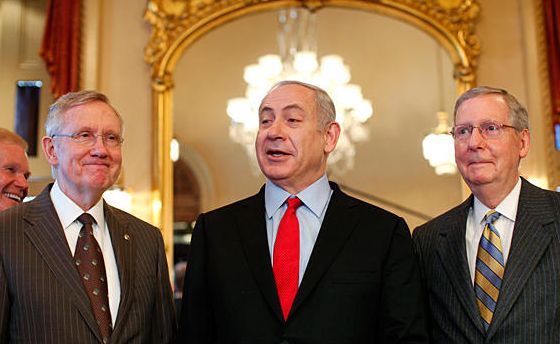
Benjamin Netanyahu flanked by Congressional courtiers Reid and McConnell.
Ali Gharib writes: After midnight yesterday, the Senate voted 90 to 1 to express the “sense of the Congress” as weighing in on the debate about what red lines the U.S. should declare against Iran. You’ll remember this issue as the one roiling the relationship between Benjamin Netanyahu and President Obama at the moment. On the Hill, almost everyone — including most of the Democrats — just sided with Netanyahu.
The resolution, initially introduced by Sen. Lindsey Graham (R-SC) in the Spring, laid out a non-binding position that “strongly supports United States policy to prevent the Government of the Islamic Republic of Iran from acquiring a nuclear weapons capability” and “rejects any United States policy that would rely on efforts to contain a nuclear weapons-capable Iran.” Obama has set his red line at Iran producing nuclear weapons rather than the “capability” to do so, a phrase loaded with a special yet ill-defined meaning in proliferation matters.
This month, an unprecedented campaign by Benjamin Netanyahu to get Obama to shift his Iran red line drew jeers from liberals and even Members of Congress. Sen. Barbara Boxer (D-CA) upbraided Netanyahu for interjecting himself in American politics. AIPAC took notice, e-mailing its members last week with articles on Obama’s refusal to lower his threshold for war and Netanyahu’s denials of interference. The debate seemed, for now, over, with Obama victorious. Then this week, Majority Leader Reid surprised everyone by re-introducing the Graham resolution.
This website or its third-party tools use cookies, which are necessary to its functioning. By closing this banner, you agree to the use of cookies.