Ma’an News Agency reports: Mahmoud al-Sarsak, on hunger strike in an Israeli jail for 92 days, agreed to start eating on Monday in a deal that will see him released on July 10, his lawyer said.
Mohammad Jaberein said al-Sarsak signed the agreement during his visit to the prisoner on Monday. Israeli prison authorities asked al-Sarsak to eat something in their presence to ratify the deal, after which he took a piece of chocolate from the lawyer, Jaberein said.
An Israeli prisons spokeswoman could not be reached for comment.
Under the deal al-Sarsak will visit a civilian hospital for treatment on Tuesday, but the same day will return to Ramle prison clinic until his release on July 10, the lawyer added.
Physicians for Human Rights – Israel say the clinic is not equipped to treat long-term hunger strikers or manage the health risks when they return to eating, and has called for transfer of hunger strikers to civilian facilities.
The 25-year-old soccer player from the Gaza Strip has been imprisoned by Israel without charge or trial since July 2009.
Category Archives: Palestinians
Nearly three months without food, as Israel looks away
Richard Sudan writes: Akram Rikhawi, one of many Palestinian political prisoners said to be held by the Israeli government, without charge and without seeing a trial, today will enter his 64th day on hunger strike. 64 days without food. As he does, 25 year old former Palestinian national team footballer Mahmoud Sarsak enters his 88th day on hunger strike, the longest any detainee has gone through such an ordeal in an Israeli jail. That’s nearly 3 months without food.
Once a star athlete and now according to physicians, having lost 33 percent of his body weight, Sarsak has been detained since 2009, but without having seen any judicial proceedings. It’s also nearly 3 years since he saw any family members. Sarsak is from the village of Rafah, in the southern part of the Gaza strip. Having seen no trial, instead, for Sarsak, he has been subjected to a continued process of administrative detention, which the state has the discretion to continue indefinitely, but which has no legal precedent according to international law. It’s what led him to begin a hunger strike in the first place. Now both mens’ health is in dire condition. Their defiance and steadfastness in the face of such brutal and psychological oppression may ignite another mass hunger strike similar to the one which came to an end last month. Such is the seriousness of the situation facing the men, that when Palestinian and Israeli human rights organisations, upon visiting the men last week, issued a statement calling for immediate international intervention in order to save the men.
After Sarsak’s condition deteriorated rapidly at the weekend, it was reported yesterday that he had agreed to take milk upon advice from his lawyer Mohammad Jabarein, to keep him alive until at least today when a judicial review is due to take place. According to Jabarein “The 25-year-old prisoner has decided that if the Supreme Court does not agree to release him he will refuse all supplements until his death”.
While most of the Football World is focusing on the European competition right now, there have been some statements of support for Mahmoud Sarsak at least. This week footballing icon Eric Cantona and head of Fifa Sepp Blatter sent a letter Uefa’s Michel Platini reportedly signed by other individuals including Noam Chomsky and Michael Mansfield QC, making clear their support for Sarsak calling for his release.
But it is hard to imagine the same outpouring of sympathy for Sarsak, or any of the hunger strikers, equal to the outpouring of concern that was shown when footballer Patrice Muamba’s life hung in the balance recently following his collapse on the pitch. If these alleged human rights abuses were taking place anywhere else there would simply be a greater level of attention paid to them. It is not hard to see what evokes such desperation. [Continue reading…]
Palestinian prisoners to launch solidarity hunger strike
Ma’an News Agency reports: Palestinian prisoners are planning a one day hunger strike on Monday in solidarity with three prisoners who are still refusing food in protest against Israeli policies, a PA official said Saturday.
Prisoners affairs minister Issa Qaraqe said that all prisoners would return their meals in a gesture of solidarity with Mahmoud al-Sarsak, Akram al-Rekhawi and Samer al-Barq.
Prisoners announced the action in a statement, Qaraqe said, and Israeli prison authorities have also been also notified.
Mahmoud al-Sarsak, 25, from Rafah in southern Gaza, has been on hunger strike for 83 days. A soccer player on Palestine’s national team, he has been detained by Israel for nearly three years without charge and is demanding his release.
Al-Rekhawi, 38, has been held at Ramle prison clinic since his arrest in 2004 and suffers chronic illnesses including diabetes and asthma. He has refused food for 59 days.
Samer al-Barq, 38, joined the mass hunger strike on April 17, but ended the strike on May 14 along with around 2,000 other prisoners when Israel agreed to “facilitate” the detainees’ demand to end its policy of detention without charge or trial.
He relaunched his hunger strike after Israel renewed his administrative detention order on May 21.
Segregating Gazans has made them easier to demonise
Amira Hass writes: A stout sense of humour and self-irony is the least most Israelis expect of Gazans. It is certainly true today, when they are spoken of almost solely through the hyperbole of military commentators who jump frantically from discussing the Iranian threat to the danger that the tiny, overcrowded, impoverished and besieged enclave poses to the state of Israel, a global military power.
But that sense of humour is also lost in the victim-oriented Palestinian media reports or the militant statements of anonymous veiled speakers and lower-tier Hamas politicians of which the meagre Israeli media diet ordinarily consists.
Now we would struggle to understand stories such as the following anecdote, relayed to me by the Fatah activist Abu Mustafa. Thirty years ago, Mustafa was being tortured by an Israeli interrogator. “You must be getting a double salary,” Mustafa told the oversized interrogator, who was stepping on his back and squeezing his arms. “How come?” The Israeli was surprised. “Because of your weight,” said Mustafa, as he was struggling with the pain. According to this thin and shy man, the interrogator burst out laughing, was unable to continue his chore and left the room. Did Mustafa want to mellow his own memory of the torture when he shared that story with me, or did his humour indeed reach home with his tormentor?
Even 25 years ago, the relationship between Gazans and Israelis was very different. Back then, Gazans were a reservoir of cheap labour and still flocked to the streets of Israeli towns – to be found in every restaurant, clothing factory, garage and construction site. How were they seen then by the ordinary Israeli? Were they mere functional shadows who disappeared in their dorm shanties? Dispensable ghosts? Savages? An Uncle Tom? [Continue reading…]
A war on Palestinian soccer: Free Mahmoud al-Sarsak
Ramzy Baroud writes: Palestinian national soccer team member Mahmoud al-Sarsak completed 81 days of a grueling hunger-strike. He has sustained the strike despite the fact that nearly 2,000 Palestinian inmates had called off their own 28-day hunger strike weeks ago.
Although the story of Palestinian prisoners in Israel speaks to a common reality of unlawful detentions and widespread mistreatment, al-Sarsak’s fate can also be viewed within its own unique context. The soccer player, who once sought to take the name and flag of his nation to international arenas, was arrested by Israeli soldiers in July 2009 while en route to join the national team in the West Bank.
Al-Sarsak was branded an ‘illegal combatant’ by Israel’s military judicial system, and was since imprisoned without any charges or trial.
Al-Sarsak is not alone in the continued hunger strike. Akram al-Rekhawi, a diabetic prisoner demanding proper medical care, has refused food for 57 days.
Both men are in dire medical condition. Al-Sarsak, once of unmatched athletic build, is now gaunt beyond recognition. The already ill al-Rekhawi is dying.
According to rights groups, an Israeli court on May 30 granted prison doctors 12 days to allow independent doctors to visit the prisoners, further prolonging their suffering and isolation.
Physicians for Human Rights – Israel, which has done a remarkable job battling the draconian rules of Israeli military courts, petitioned the court to meet with both al-Sarsak and al-Rekhawi.
Sadly, the story here becomes typical. PHRI, along with other prisoners’ rights groups, are doing all that civil society organizations can do within such an oppressive legal and political situation.
Families are praying. Social media activists are sending constant updates and declaring solidarity. Meanwhile, the rest of the world is merely looking on — not due to any lack of concern for human rights, but due to the selective sympathy of Western governments and media.
Think of the uproar made by US media over the fate of blind Chinese political activist Chen Guangcheng. When he took shelter in the US embassy in Beijing, a near-diplomatic crisis ensued.
Guangcheng was finally flown to the US on May 19, and he recently delivered a talk in New York before an astounded audience.
“The 40-year-old, blind activist said that his lengthy detention (of seven years) demonstrates that lawlessness is still the norm in China,” reported the New York Post.
“Is there any justice? Is there any rationale in any of this?” Chen asked. Few in the US media would contend with the statement. But somehow the logic becomes entirely irrelevant when the perpetrator of injustice is Israel, and the victim is a Palestinian. [Continue reading…]
The negation of the Palestinian state
Uri Avnery writes: On May 15, the anniversary of the founding of the State of Israel, its Arab citizens observed a day of mourning for the victims of the Naqba (“catastrophe”) – the mass exodus of half the Palestinian people from the territory which became Israel.
Like every year, this aroused much fury. Tel Aviv University allowed Arab students to hold a meeting, which was attacked by ultra-right Jewish students. Haifa University forbade the meeting altogether. Some years ago the Knesset debated a “Naqba Law” that would have sent commemorators to prison for three years. This was later moderated to the withdrawal of government funds from institutions that mention the Naqba.
The Only Democracy in the Middle East may well be the only democracy in the world that forbids its citizens to remember a historical event. Forgetting is a national duty.
Trouble is, it’s hard to forget the history of the “Palestinian issue”, because it dominates our life. 65 years after the foundation of Israel, half the news in our media concern this one issue, directly or indirectly.
Just now, the South African government has decreed that all products of the West Bank settlements sold there must be clearly marked. This measure, already in force in Europe, was roundly condemned by our Foreign Minister, Avigdor Lieberman, as “racist” (looks who’s talking!). However, it joins a boycott initiated 15 years ago by my Israeli friends and me. [Continue reading…]
Imagining myself in Palestine
Randa Jarrar writes: Trouble began weeks before I boarded my flight to Tel Aviv’s Ben Gurion Airport. I had heard horror stories about a detention area there, dubbed The Arab Room, and in my anxious and neurotic style, I had emailed a dozen people—American academics and artists of Arab, Indian, Jewish, and European descent— and asked them what I was supposed to tell the immigration officers at Ben Gurion once I arrived. They all wanted to know if I was using my American passport, and I assured them that I was. The vast majority told me not to tell the officers I would be staying at my sister’s in Ramallah. They said this would cause trouble, and offered up the names of friends and family for my use. The generosity of people poured in, and I was advised to say that I was staying with this writer, or that visual artist, or this former-IDF soldier—people I had never met, but who had volunteered themselves to be my proxy hosts. A friend of mine, who is a phenomenal photojournalist, gave me her phone number and said to tell the officers I would be staying with her, and I agreed. She told me to prepare for the officers to call her themselves once I gave them her number, as this is something they are known to do.
I was so afraid of facing the guards at the airport that I had a difficult time imagining the rest of my trip. I would picture myself walking around Ramallah with my sister, or attending a concert, or visiting my aunts, or seeing the separation wall, or staying at the American Colony Hotel for an evening, and I would draw a blank. There was a wall there, too, between my thoughts and Palestine.
Growing up, my Palestinian identity was mostly tied to my father. He was the Palestinian in the family, and when we went back to the West Bank it was to see his brothers and sisters and parents. We always entered Palestine through Amman, crossing the Allenby Bridge over the river Jordan and waiting in endless inspection lines. I remember these trips dragging on through morning and midday and well into the afternoon. My father would sit quietly, and when I complained my Egyptian mother would tell me that the Israelis made it difficult for us to cross into the West Bank. She told me that they wanted us to give up, that they would prefer we never go back. “We must not let them win,” she’d said. My relationship with my Palestinian identity was cemented when I enrolled in a PLO-sponsored girls’ camp as a tween. We learned nationalistic songs and dances and created visual art that reflected our understanding of the occupation. After my family and I moved to America in 1991, my Palestinian identity shifted again, and I began to see myself as an Arab-American. My father’s fiery rants on Palestine died out when Yitzak Rabin was murdered by a Jewish-Israeli extremist. I remember my father weeping in our American wood-paneled den. He said that Rabin had been the Palestinians’ last chance.
When my sister got a job in Ramallah last year, teaching music to children, I knew I would want to visit her. I had not been to Palestine since 1993. I had planned to go back in the summer of 1996, but I was pregnant and unmarried. My parents did not want to speak to me, let alone take me with them, in such a shameful condition, to the West Bank. I never went back with family after that. I led my own life. I moved about a dozen times over the following fifteen years—an American nomad. I didn’t want to visit the West Bank and be at the mercy of family. If I ever visited, I would do so independently. When my sister moved to Ramallah she found an apartment of her own, and it had an extra room. It was the perfect time to go. My husband booked my flight, and, thrilled, I told my sister I was coming.
I felt uneasy as soon as I arrived at the gate in Philadelphia. There weren’t, as far as I could see, any other Arabs boarding US Airways flight 796 to Tel Aviv. On the airplane, I found myself surrounded by Christian missionaries and Evangelicals and observant Jewish men. The group across the aisle had their bibles out, the man sitting next to me read from a miniature Torah, and as the flight took off, I found myself reciting a verse from the Quran, almost against my will. I am an atheist, but all the praying was contagious. [Continue reading…]
Erasing the Nakba

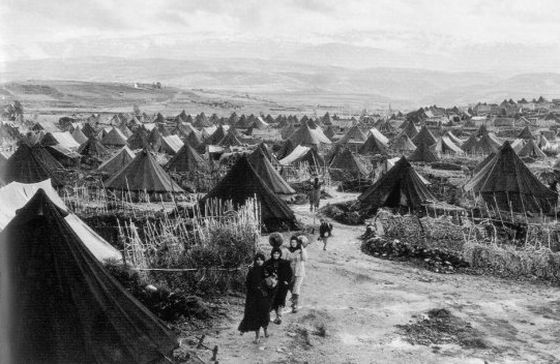
A refugee crisis that has lasted for 64 years following the ethnic cleansing of Palestine in 1948 in which the indigenous population was driven out by Zionists.
Neve Gordon writes: I first heard about the Nakba in the late 1980s, while I was an undergraduate student of philosophy at Hebrew University. This, I believe, is a revealing fact, particularly since, as a teenager, I was a member of Peace Now and was raised in a liberal home. I grew up in the southern city of Be’er-Sheva, which is just a few kilometres from several unrecognised Bedouin villages that, today, are home to thousands of residents who were displaced in 1948. I now know that the vast majority of the Negev’s Bedouin population was not as lucky, and that, in the late 1940s and early 1950s, most Bedouin either fled or were expelled from their ancestral lands to Jordan or Gaza.
How is it possible that a left-leaning Israeli teenager who was living in the Negev during the early 1980s (I graduated from high-school in 1983) had never heard the word “Nakba”?
How, in other words, is collective amnesia engendered?
There are many explanations of how master narratives are created and how they suppress and marginalise competing historical accounts. In addition to the work carried out by state institutions and apparata, this careful erasure also demands the ongoing mobilisation of scholars, novelists and artists – as well as other producers of popular culture.
When I was growing up, the history depicted in Israeli high-school textbooks, as well as the historical narrative promulgated by the mass media (there was only one television channel in Israel at the time, which was government run), was validated by famous novelists and public intellectuals. According to a PhD thesis written by Alon Gan from Tel Aviv University, Amos Oz, for example, interviewed soldiers after the 1967 war and used his editorial prerogative to excise descriptions of abuse in order to produce an image of the moral Israeli combatant.
Thinking back to the days when I was involved in Peace Now, I now realise that, even for most Israeli doves at the time, a conflicted history only emerged post-1967 – with the occupation of the Sinai, West Bank, Gaza Strip and the Golan Heights. Accordingly, the solution offered by Peace Now addressed the wrongs created in 1967, but had nothing to say about 1948. Indeed, I do not recall any reference to the Palestinian refugees in their publications. The seamless way in which the state had managed to completely suture the happenings of 1948, even among the Israeli peace camp, was indeed remarkable. [Continue reading…]
Top 10 facts you probably didn’t know about the Nakba
Yousef Munayyer writes:
1. Nakba is the Arabic word for catastrophe. It is used to describe the Palestinian loss of land and property during the depopulation of Palestine from 1947-1949 and does not refer simply to the declaration of a state of Israel.
Residents of Yaffa Pushed Into The Sea Prior to May15th, 19482. 212 localities depopulated and at least half of the refugees created during the Nakba were created prior to May 15th, which is, prior to the entry of armies of other Arab states. The largest Palestinian cities at the time, Yaffa and Haifa, were emptied of the vast majority of their inhabitants before May 15th, 1948. The idea that refugee creation happened only after, or only as a result of, the mobilization of Arab armies is patently false.
3. At every stage of the war, the Yishuv/Israeli forces were superior in training, equipment and numbers to the combined Arab armies.
4. The Zionists prepared extensive data collection efforts to map out intelligence relating to the Palestinian villages for a decade prior to the war. Detailed information about each village was kept including information on the number of inhabitants, the village’s resources, the potential activists that resided within it and what its political affiliations were. [Continue reading…]
Video: The Great Book Robbery
When the Arab-Israeli war raged in 1948, librarians from Israel’s National Library followed soldiers as they entered Palestinian homes in towns and villages. Their mission was to collect as many valuable books and manuscripts as possible. They are said to have gathered over 30,000 books from Jerusalem and another 30,000 from Haifa and Jaffa.
Officially it was a ‘cultural rescue operation’ but for Palestinians it was ‘cultural theft’.
It was only in 2008 when an Israeli PhD student stumbled across documents in the national archive that the full extent of the ‘collection’ policy was revealed.
Using eyewitness accounts, this film tries to understand why thousands of books appropriated from Palestinian homes still languish in the Israeli National Library vaults and why they have not been returned to their rightful owners. Was it cultural preservation or robbery?
Palestinian hunger-striking detainees sign deal with Israeli prison authority
Update: Numerous tweets from Ali Abunimah et al claim the hunger strike of Bilal Diab and Thaer Halahleh has not ended. Awaiting further reports.
2nd update — @muiz: At 2am in #Palestine, almost 2 hours into their national record-breaking 78th day of #PalHunger-strike, THAER & BILAL agreed to end protest.
Ma’an News Agency reports: Detainees on Monday signed a deal with the Israeli prison authority to end their mass hunger strike, officials told Ma’an.
Prisoner representatives from each of the factions agreed to the deal in Ashkelon jail, prisoners society chief Qaddura Fares said in a statement.
Israel’s internal security service Shin Bet confirmed the deal, and prison authorities said detainees would halt their hunger strike within hours, the Israeli news site Ynet reported.
Senior Hamas official Saleh Arouri, who was a member of the negotiations team, said Israel agreed to provide a list of accusations to administrative detainees, or release them at the end of their term.
In comments to the Hamas-affiliated new site Palestine Information Center, he said that under the Egypt-brokered deal Israel agreed to release all detainees from solitary confinement over the next 72 hours.
Israel will also lift a ban on family visits for detainees from the Gaza Strip, and revoke the so-called Shalit law, according to the official. [Continue reading…]
Israel warned of volatile situation as Palestinian hunger strikers near death
The Guardian reports: Demonstrations in the West Bank and Gaza in support of about 2,000 Palestinian prisoners on hunger strike are escalating amid efforts by Egyptian mediators to broker a deal to avoid protests spiralling out of control if a detainee dies.
Two prisoners, who have refused food for 77 days, are thought to be close to death with another six in a critical condition, say Palestinian groups. The Israeli prison service (IPS) says no one’s life is at risk.
In an unusual intervention, Tony Blair, the representative of the Middle East quartet, urged Israel to “take all necessary measures to prevent a tragic outcome that could have serious implications for stability and security conditions on the ground”. He said he was “increasingly concerned about the deteriorating health conditions” of hunger strikers.
Earlier, Mahmoud Abbas, the Palestinian president, said the situation was “very dangerous”. He told Reuters: “If anyone dies … it would be a disaster and no one could control the situation.” Abbas has appealed to Hillary Clinton, the US secretary of state, to intervene.
Jamal Zahalka, a member of the Israeli parliament, told a solidarity rally in Jaffa: “If one of the striking prisoners dies, a third intifada [uprising] will break out.”
According to Physicians for Human Rights, there is no previous recorded case of anyone surviving without food or supplements for more than 75 days. IRA hunger strike Bobby Sands died after 66 days in 1981.
Palestinian hunger strikers: fighting ingrained duplicity
Richard Falk and Noura Erakat write: On his seventy-third day of hunger strike, Thaer Halahleh was vomiting blood and bleeding from his lips and gums, while his body weighs in at 121 pounds — a fraction of its pre-hunger strike size. The thirty-three-year-old Palestinian follows the still-palpable footsteps of Adnan Khader and Hana Shalabi, whose hunger strikes resulted in release. He also stands alongside Bilal Diab, who is also entering his seventy-third day of visceral protest. Together, they inspired nearly 2,500 Palestinian political prisoners to go on hunger strike in protest of Israel’s policy of indefinite detention without charge or trial.
Administrative detention has constituted a core of Israel’s 1,500 occupation laws that apply to Palestinians only, and which are not subject to any type of civilian or public review. Derived from British Mandate laws, administrative detention permits Israeli Forces to arrest Palestinians for up to six months without charge or trial, and without any show of incriminating evidence. Such detention orders can be renewed indefinitely, each time for another six-month term.
Ayed Dudeen is one of the longest-serving administrative detainees in Israeli captivity. First arrested in October 2007, Israeli officials renewed his detention thirty times without charge or trial. After languishing in a prison cell for nearly four years without due process, prison authorities released him in August 2011, only to re-arrest him two weeks later. His wife Amal no longer tells their six children that their father is coming home, because, in her words, “I do not want to give them false hope anymore, I just hope that this nightmare will go away.”
Twenty percent of the Palestinian population of the Occupied Palestinian Territories have at one point been held under administrative detention by Israeli forces. Israel argues these policies are necessary to ensure the security of its Jewish citizens, including those unlawfully resident in settlements surrounding Jerusalem, Area C, and the Jordan Valley—in flagrant contravention of the Fourth Geneva Convention’s Article 49(6), which explicitly prohibits the transfer of one’s civilian population to the territory it occupies. [Continue reading…]
As Palestinian hunger strikers starve, a mother waits
NBC News reports: Im Hisham, 65, spends her days sitting in her home in Kufur Raei village near here waiting for news about her 27-year-old son, Bilal Diab.
“I haven’t seen my son since the day Israeli Special Forces raided our home in the middle of the night and arrested him in front of my eyes,” she said of the incident on Aug. 16, 2011. “They gave him administrative detention for six months and when the six months ended they extended his detention for six more without charges or trial.”
Diab has since become one of the faces of a mass hunger strike by Palestinian prisoners in Israeli jails.
On Friday, Diab and Thaer Halahleh, another prisoner, entered their 74th day without food. They are demanding that the Israeli courts either charge them or set them free.
Israel’s practice of administrative detention allows the military to hold prisoners indefinitely based on secret information without charging them or allowing them to stand trial. Israeli officials defend its use as a way to hold Palestinians who pose an immediate threat to the country’s security. Israel says they keep the evidence secret from lawyers and the accused because it would expose their intelligence-gathering networks if released.Attention to Diab and Halahleh’s protest escalated on April 17 when an estimated 1,600 inmates launched their own mass hunger strike in solidarity, a move that led to Palestinians taking to the streets in the West Bank and Gaza almost daily to rally in support of the prisoners’ protest.
On Friday, a spokesperson for Physicians for Human Rights, a humanitarian organization in Israel, said he fears for Diab and Halahleh’s lives.
Yael Marom complained that the last time the Israeli Prison Service allowed one of their doctors to visit Diab was on April 30. “The Israeli Prison Service is still denying regular access to [Diab] and the other hunger strikers by independent physicians and do not update us or the families, which is a blatant breach of medical ethics,” she said.
Israel says all prisoners receive adequate medical attention, including care civilian hospitals if required. “As of now, I know that those who should be receiving extra care are receiving it,” a spokeswoman, Sivan Weizman, told Reuters.
Mark Regev, the Israeli government’s spokesman, also claimed that Israel was providing adequate medical treatment for the prisoners and said they were free to choose their own doctors.
“But ultimately, this is not about medical facilities,” he said, “this is about hard-core activists, from Hamas and Islamic Jihad, who through this protest are trying to instigate violence.”
Meanwhile, Palestinian President Mahmoud Abbas warned Israel that the death of one of the prisoners could result in chaos.
“If anybody dies today or tomorrow or after a week it would be a disaster and no one could control the situation,” Abbas said in an interview with Reuters at his office in Ramallah. “I told the Israelis and the Americans if they do not find a solution for this hunger strike immediately, they will be committing a crime.”
Video: Palestinian hunger strikers ‘in immiment danger’
Video: Two of mass Palestinian prisoner’s hunger strike ‘on verge of death’
UN News Service: Secretary-General Ban Ki-moon today stressed the importance of averting any further deterioration in the condition of Palestinian prisoners in Israeli custody who are on hunger strike, and urged everyone concerned to reach a solution to their plight without delay.
“The Secretary-General continues to follow with concern the ongoing hunger strike by Palestinian prisoners in Israeli custody, in particular those held in what is known as administrative detention,” according to information provided by his spokesperson.
“He stresses the importance of averting any further deterioration in their condition,” the spokesperson added. “He reiterates that those detained must be charged and face trial with judicial guarantees, or released without delay.”
The emperor has no clothes: Palestinians and the end of the peace process
International Crisis Group, Middle East Report #122, executive summary: Does anybody still believe in the Middle East Peace Process? Nineteen years after Oslo and thirteen years after a final settlement was supposed to be reached, prospects for a two-state solution are as dim as ever. The international community mechanically goes through the motions, with as little energy as conviction. The parties most directly concerned, the Israeli and Palestinian people, appear long ago to have lost hope. Substantive gaps are wide, and it has become a challenge to get the sides in the same room. The bad news is the U.S. presidential campaign, Arab Spring, Israel’s focus on Iran and European financial woes portend a peacemaking hiatus. The good news is such a hiatus is badly needed. The expected diplomatic lull is a chance to reconsider basic pillars of the process – not to discard the two-state solution, for no other option can possibly attract mutual assent; nor to give up on negotiations, for no outcome will be imposed from outside. But to incorporate new issues and constituencies; rethink Palestinian strategy to alter the balance of power; and put in place a more effective international architecture.
For all the scepticism surrounding the ways of the past, breaking with them will not come easily. Few may still believe in the peace process, but many still see significant utility in it. Ongoing negotiations help Washington manage its relations with the Arab world and to compensate for close ties to Israel with ostensible efforts to meet Palestinian aspirations. Europeans have found a role, bankrolling the Palestinian Authority and, via the Quartet, earning a seat at one of the most prestigious diplomatic tables – a satisfaction they share with Russia and the UN Secretary-General. Peace talks are highly useful to Israel for deflecting international criticism and pressure.
Palestinians suffer most from the status quo, yet even they stand to lose if the comatose process finally were pronounced dead. The Palestinian Authority (PA) might collapse and with it the economic and political benefits it generates as well as the assistance it attracts. For the Palestinian elite, the peace process has meant relative comfort in the West Bank as well as constant, high-level diplomatic attention. Without negotiations, Fatah would lose much of what has come to be seen as its raison d’être and would be even more exposed to Hamas’s criticism.
But the reason most often cited for maintaining the existing peace process is the conviction that halting it risks creating a vacuum that would be filled with despair and chaos. The end result is that the peace process, for all its acknowledged shortcomings, over time has become a collective addiction that serves all manner of needs, reaching an agreement no longer being the main one. And so the illusion continues, for that largely is what it is.
More than any others, Palestinians have become aware of this trap, so have been the first to tinker with different approaches. But tinker is the appropriate term: their leadership, in its quest to reshuffle the deck, has flitted from one idea to another and pursued tracks simultaneously without fully thinking through the alternatives or committing to a single one. For a time, it seemed that President Mahmoud Abbas’s September 2011 speech at the UN General Assembly – resolute and assertive – might presage a momentous shift in strategy. But after the Security Council buried Palestine’s application for UN membership in committee, the logical follow-up – an effort to gain support for statehood at the General Assembly – was ignored. After admittance to one UN agency, the leadership froze further efforts. After refusing negotiations unless Israel froze settlements and without clear terms of reference, Abbas consented to talks. After threatening to dissolve the PA, central figures waved off the idea and declared the PA a strategic asset. After reaching a reconciliation agreement with Hamas, the two parties reverted to bickering.
One can fault the Palestinian leadership for lack of vision, yet there is good reason for its irresoluteness. Whatever it chooses to do would carry a potentially heavy price and at best uncertain gain. Negotiations are viewed by a majority of Palestinians as a fool’s errand, so a decision to resume without fulfilment of Abbas’s demands (settlement freeze and agreed terms of reference) could be costly for his movement’s future. His hesitation is all the stronger now that he has persuaded himself that Prime Minister Netanyahu’s positions are incompatible with a two-state solution. A decisive Palestinian move at the UN (whether at the General Assembly or in seeking agency membership) likely would prompt a cut-off in U.S. aid and suspension of tax clearance revenue transfers by Israel. A joint government with Hamas could trigger similar consequences without assurance that elections could be held or territorial unity between the West Bank and Gaza restored. Getting rid of the PA could backfire badly, leaving many public employees and their families penniless while also leading to painful Israeli counter-measures.
The trouble with all these domestic and international justifications for not rocking the boat is that they are less and less convincing and that perpetuating the status quo is not cost-free. A process that is turning in circles undermines the credibility of all its advocates. It cannot effectively shelter the U.S. from criticism or Israel from condemnation. Europe can fund a PA whose expiration date has passed only for so long. The Palestinian leadership is facing ever sharpening questioning of its approach. Most of all, the idea that to end the existing process would create a dangerous vacuum wildly exaggerates the process’s remaining credibility and thus assumes it still serves as a substitute for a vacuum – when in reality it widely is considered vacuous itself.
Finding an alternative approach is no mean feat. Contrary to what some say, or hope, it is not a one-state solution – which is championed, in very different versions, by elements of both the Israeli and Palestinian political spectrums. A one-state reality already is in place, but as a solution it almost certainly would face insurmountable challenges – beginning with the fact that it is fiercely opposed by a vast majority of Jewish Israelis, who view it as antithetical to their basic aspiration. By the same token, even though alternatives to the current process should be pursued, a solution ultimately will be found only through negotiations.
What should be explored is a novel approach to a negotiated two-state solution that seeks to heighten incentives for reaching a deal and disincentives for sticking with the status quo, while offering a different type of third-party mediation. In this spirit, four traditionally neglected areas ought to be addressed:
New issues. At the core of the Oslo process was the notion that a peace agreement would need to deal with issues emanating from the 1967 War – the occupation of the West Bank and Gaza – as opposed to those that arose in 1948 from the establishment of Israel, the trauma of the accompanying war and the displacement of the vast majority of Palestinians. But if that logic was ever persuasive, it no longer is. On one side, the character of the State of Israel; recognition of Jewish history; regional security concerns extending beyond the Jordan River; and the connection with the entire Land of Israel have been pushed to the fore. On the other, the issue of the right of return and the Nakba (the “catastrophe” that befell Palestinians in 1948); the place of the Arab minority in Israel; and, more broadly, the Palestinian connection to Historic Palestine have become more prominent. Within Jewish and Muslim communities alike, religion has become more prevalent in political discussions, and its influence on peacemaking looms larger than before.
As difficult as it is to imagine a solution that addresses these issues, it is harder still to imagine one that does not. If the two sides are to be induced to reach agreement, such matters almost certainly need to be tackled. Israelis and Palestinians, rather than refusing to deal with the others’ core concerns, both might use them as a springboard to address their own.
New constituencies. The process for most of the past two decades has been led by a relatively narrow array of actors. But the interests of those who have been excluded resonate deeply with their respective mainstreams. In Israel, this includes the Right, both religious and national, as well as settlers. Among Palestinians, it includes Islamists, Palestinian citizens of Israel and the diaspora. That needs to be rectified. A proposed deal that is attractive to new constituencies would minimise opposition and could attract support from unexpected quarters.
New Palestinian strategy. The Palestinian leadership has tested various waters but is apprehensive about taking the plunge. That approach appears less sustainable by the day, eroding the leadership’s credibility and international patience. Rather than ad-hoc, shifting tactical moves, the entire Palestinian national movement needs to think seriously through its various options – including reconciliation, internationalisation, popular resistance and fate of the PA – and decide whether it is prepared to pay the costs for pursuing them fully. If the answer is “no”, then it would be better to stop the loose talk that has been surrounding them of late.
New international architecture. Palestinian recourse to the UN is a symptom, at base, of international failure to lead and provide effective mediation. The body responsible for doing so, the Quartet, has delivered precious little since its 2002 inception; by creating an international forum whose survival depends on perpetuation of the process and whose mode of operation entails silencing individual voices in favour of a mushy, lowest-common-denominator consensus, it arguably has done more harm than good. Whether the body should be entirely disbanded or restructured – and if so, how – is a question with which the international community needs to grapple. Whatever the form, it ought to address the profound changes taking place in the Middle East, the opportunities they present and the risks they pose.
The inescapable truth, almost two decades into the peace process, is that all actors are now engaged in a game of make-believe: that a resumption of talks in the current context can lead to success; that an agreement can be reached within a short timeframe; that the Quartet is an effective mediator; that the Palestinian leadership is serious about reconciliation, or the UN, or popular resistance, or disbanding the PA. This is not to say that the process itself has run its course. Continued meetings and even partial agreements – invariably welcomed as breakthroughs – are possible precisely because so many have an interest in its perpetuation. But it will not bring about a durable and lasting peace. The first step in breaking what has become an injurious addiction to a futile process is to recognise that it is so – to acknowledge, at long last, that the emperor has no clothes.

Read the complete report, The Emperor Has No Clothes: Palestinians and the End of the Peace Process [PDF].
Hunger strikers shake foundations of Israeli justice system
Omar H Rahman writes: As midnight approached on April 17, Khader Adnan, a Palestinian political prisoner who made headlines around the world after going on hunger strike for 66 days, was given a hero’s welcome as he returned to his home. Fireworks coloured the night sky, horns blared and people on foot, in cars, and on tractors rushed off to receive Adnan at the gates of his village.
“I won’t believe he is out of prison until I see him for myself,” said his visibly anxious wife, Randa, who had borne a heavy burden during her husband’s four-month ordeal. Yet, in a gesture indicative of the leader Adnan has recently become, he refused to be taken to his own home before visiting relatives of those other political prisoners from his village who remained in prison and on hunger strike.
Adnan, who had been detained for four months, was never charged with a criminal offence or presented any evidence of wrongdoing. In addition, as part of the agreement that eventually led to his release, Israel had the ability to bring new evidence against him and put him on trial. By failing to do so in the nearly two months between the end of his hunger strike and his release, Israel tacitly admitted that it lacked such evidence to begin with. It has also exposed once more the ease with which a Palestinian can be taken from his or her home without charge and incarcerated for months or, in the worst cases, even years.
His hunger strike set off a wave of similar protests in Israeli prisons and on the day he gained his freedom, approximately 1,500 Palestinian prisoners began a collective, open-ended hunger strike to protest Israel’s continued policy of wide-scale detention and its treatment of prisoners. What has been billed the “War of Empty Stomachs” now has all the makings of a movement. [Continue reading…]