Category Archives: Egypt

Egypt’s rulers declare ‘one month’ state of emergency

Is this the sign that Egypt’s experiment with democracy is well and truly over?

Al Jazeera reports: A state of emergency has been declared across Egypt, as security forces and supporters of deposed president Mohamed Morsi continue to clash around the country.

The announcement on Wednesday came amid a deadly crackdown by security forces on two pro-Morsi protest camps in Cairo.

The health ministry said at least 149 people had been killed in clashes around the country, but some members of Morsi’s Muslim Brotherhood said the death toll was much higher.

Is the United States about to take any punitive measures against Egypt’s military rulers? Not likely. President Obama is “monitoring what’s happening” — translation: he has no intention of taking any action.

The Wall Street Journal reports: The White House once again called for “restraint” in Egypt and said the administration opposes the state-of-emergency law and continues to review U.S. aid to the country.

“The United States strongly condemns the use of violence against protesters in Egypt,” White House spokesman Josh Earnest said on Wednesday. “The violence will only make it more difficult to move Egypt forward.”

Mr. Earnest said the U.S. will hold the interim government accountable for its promise to speed up the transition to a democratic government. Senior U.S. officials are in touch with their counterparts in Egypt, he said.

“The world is watching what’s happening in Cairo,” Mr. Earnest said, adding that U.S. officials are still trying to determine the specifics of events.

President Barack Obama, on vacation on Martha’s Vineyard, was briefed Wednesday morning on developments by National Security Adviser Susan Rice.

“He is closely monitoring what’s happening,” Mr. Earnest said.

Facebooktwittermail

Egypt security forces launch deadly assault to crush Cairo protests


The Guardian: Egyptian security forces have launched a deadly assault on protest sites backing the ousted president Mohamed Morsi, clearing one and besieging another.

The crackdown on Wednesday has left scores of people dead and many more wounded, and has sparked clashes in other parts of the country.

The dawn raids in Cairo at the sites on either side of the Nile came after two weeks of ever more bellicose warnings from the military-led government that replaced Morsi after he was toppled almost six weeks ago.

Sky News cameraman Mick Deane has been shot and killed in Egypt this morning. Mick had worked for Sky for 15 years, based in Washington and then Jerusalem.

Facebooktwittermail

Egypt’s military will not get away with human rights abuses

Michael Mansfield and Tayab Ali write: Just over a year ago, Egypt threw off the shackles of its military dictatorship and took on the mantle of a civil democracy, becoming for a short period, the torchbearer of liberty and equality throughout the Arab world. On 24 June 2012, Mohamed Morsi of the Muslim Brotherhood’s Freedom and Justice party won the country’s first contested election. It was the first time that an Egyptian president had been freely elected from outside of the military establishment.

By 3 July 2013, President Morsi had been ousted in a coup d’etat. The uprising against the previous Mubarak regime resulted in the free and fair election of President Morsi – a new dawn of democracy and human rights for Egypt. The current spate of protests have seen the rapid destruction of that new promise and an excuse for the military to regain control.

The immediate aftermath of the July coup reminds us what Egypt is without its democracy and that cannot have been what the many who were angry at President Morsi’s government had in mind when they chose to (and were allowed to) vocalise their discontent in street protests.

Everyone in Egypt should now be concerned about the legality and consequences of the military overturning its first democratically elected government. Whatever the stated justification, disenchantment with a democratically elected leader cannot legitimise the use of force and should never be used to remove a democratically elected government.

We can see where Egypt has descended to in the aftermath of the coup. The new military-installed regime does not appear to be interested in safeguarding Egypt’s democracy. The hallmarks of a democratic state have vanished almost immediately. Morsi has been detained in a secret location along with much of his administration. Suddenly dubious and historic criminal charges have surfaced and been levelled against them. So far these detainees have not had access to their families or legal teams. How they are being treated is anyone’s guess. [Continue reading…]

Facebooktwittermail

Military rule advances throughout Egypt

Reuters reports: Egypt’s interim president named at least 18 new provincial governors on Tuesday, half of them retired generals, in a shake-up that restored the influence of men from army and police backgrounds and flushed out Muslim Brotherhood members.

Deposed President Mohamed Mursi had appointed a number of civilians as provincial governors during his one year in office. Many of them were members of the Brotherhood. That marked a break with the Hosni Mubarak era, when the posts typically went to retired army and police officers.

The new appointees were sworn in by interim President Adli Mansour, head of the army-backed government which replaced the Mursi administration that was removed from power last month after mass protests against Brotherhood rule.

Critics said the line-up announced on Tuesday was a step backwards.

“It is Mubarak’s days,” prominent blogger Alaa Abd El Fattah wrote on his Twitter feed. “Down down with every Mubarak. Sisi is Mubarak,” he added, referring to General Abdel Fattah al-Sisi, the army chief who deposed Mursi.

Facebooktwittermail

In Cairo camps, protesters dig in and live on

The New York Times reports: Reaching the heavily sandbagged entrance to the sprawling protest camp in the northeast of this city requires navigating past makeshift brick walls and stepping around circles of stone marking the places where “martyrs” shot by the government fell dead.

Once there, visitors must submit to ID checks and pat-downs by bearded men with orange vests, hard hats and clubs. Signs on a towering new tent read “Children against the coup.”

And then, stretching into the distance is the camp, where tens of thousands of people have built what amounts to a well-equipped community in what was once a traffic-clogged intersection. There are tents with electricity, televisions and Internet access, some of them two stories tall. There are a hospital, communal kitchens, latrines and showers.

This and a smaller camp across town are the front lines in Egypt’s dangerous political stalemate between a military-installed government and the Muslim Brotherhood and its Islamist allies who support the ousted president, Mohamed Morsi. The new government accuses them of gathering weapons and says they must leave or it will evict them by force.

But breaking up the camps will be difficult because of the crowds they have amassed, the infrastructure they have built, and the religious fervor the protesters bring to the fight. The military and the police have already killed dozens of people, and human rights groups have reported cases in which Mr. Morsi’s supporters have detained and tortured opponents. But instead of scaring the protesters into going home, the crackdowns have reinforced their conviction to stay. [Continue reading…]

Facebooktwittermail

Marx’s lesson for the Muslim Brothers

Sheri Berman writes: Karl Marx wrote that history repeats itself, first as tragedy, then as farce. He had in mind the Revolution of 1848, when a democratic uprising against the French monarchy collapsed into a Bonapartist dictatorship just as the French Revolution had six decades earlier.

In 1848, workers joined with liberals in a democratic revolt to overthrow the French monarchy. However, almost as soon as the old order collapsed, the opposition fell apart, as liberals grew increasingly alarmed by what they saw as “radical” working class demands. Conservatives were able to co-opt fearful liberals and reinstall new forms of dictatorship.

Those same patterns are playing out in Egypt today — with liberals and authoritarians playing themselves, and Islamists playing the role of socialists. Once again, an inexperienced and impatient mass movement has overreached after gaining power. Once again, liberals have been frightened by the changes their former partners want to enact and have come crawling back to the old regime for protection. And as in 1848, authoritarians have been happy to take back the reins of power. [Continue reading…]

Facebooktwittermail

Egypt’s rulers says diplomacy phase is over

Al Jazeera reports: Efforts by foreign envoys to solve the crisis in Egypt have failed and the Muslim Brotherhood is responsible, the interim government has said.

The presidency announced that Wednesday marks the end of the first phase of diplomatic attempts to resolve the turmoil, which has been spiralling since July 3 when the military removed president Mohamed Morsi.

In a statement carried on state news agency MENA, it said: “Today ends the phase of diplomatic efforts, which began more than 10 days ago.

“The Egyptian state … holds the Muslim Brotherhood fully responsible for the failure of those efforts [by foreign envoys] and what may be the consequences of this failure.” [Continue reading…]

Facebooktwittermail

In Orwellian Egypt, a state of denial rules

Deepak Tripathi writes: A society in which important actors live in denial of each other’s interests and legitimacy is a society threatened by the abyss. There is ample evidence of this destructive phenomenon through the history of the Middle East, as elsewhere.

One of the biggest casualties of the phenomenon of Arab awakening was Egypt’s ruler Hosni Mubarak, whose fall in February 2011 looked like a pivotal event strong enough to accelerate democratic change across the region. Two years on, the prospects are bleak. After the recent military coup, Egypt is in the midst of a civil conflict which is bloodier and more repressive. The continuing violence and schism are more depressing than the final weeks and months of the Mubarak regime.

Authoritarian rule, rebellion and repression have shaped mindsets throughout Egypt’s social hierarchy. The collapse of Mubarak’s autocratic rule had sparked new hopes of an open and enlightened era, free of corruption and mismanagement. But those with power to control and coerce have a strong instinct to reassert themselves when they see their grip weakening. An essential feature of that instinct is to dismiss the legitimate existence and interests of others. It is by denying the legitimacy of the others that powerful actors’ claim their own legitimacy. [Continue reading…]

Facebooktwittermail

American aid makes the U.S. complicit in the Egyptian army’s massacres

Robert Kagan writes: Twice last month, the Egyptian military opened fire on supporters of ousted president Mohamed Morsi, killing more than 100 people. A few days ago, the military’s leader, Gen. Abdel Fatah al-Sissi, asked Egyptians to go into the streets and give him a popular “mandate” to fight “terrorism.” On Wednesday, the military-backed government ordered security forces to break up protests in Cairo.

The stage is set for a deadly government assault not only against the Muslim Brotherhood but also against the millions of Egyptians who voted for the Brotherhood in elections over the past two years. Combined with the arrests on trumped-up charges of Morsi and others linked to the Brotherhood, the military appears intent on eradicating the organization from Egypt’s politics, jailing its leaders and followers or driving them underground.

Through its continued support of the Egyptian military, the United States is complicit in these acts. Despite our repeated claims of neutrality and our calls for reconciliation, in reality we have taken sides in the burgeoning violent confrontation. We winked at the coup against a democratically elected government, and, most important, we remain the leading provider of assistance to Egypt’s military: Even as violent and undemocratic intentions have become increasingly clear, the administration and Congress are pressing ahead with the annual provision of $1.3 billion in military assistance.

Some supporters of the aid claim that it gives us leverage over the military’s behavior — that fear of an aid cutoff will curb Sissi’s more extreme inclinations and lead the government to moderation. Recent events suggest the opposite. Why should military leaders fear losing aid when the Obama administration did not even abide by U.S. law requiring it to cut off that aid after the coup? The recent delay of F-16 deliveries had no effect. [Continue reading…]

Facebooktwittermail

Egypt restores feared secret police units

The Guardian reports: Egypt’s interim government was accused of attempting to return the country to the Mubarak era on Monday, after the country’s interior ministry announced the resurrection of several controversial police units that were nominally shut down following the country’s 2011 uprising and the interim prime minister was given the power to place the country in a state of emergency.

Egypt’s state security investigations service, Mabahith Amn ad-Dawla, a wing of the police force under President Mubarak, and a symbol of police oppression, was supposedly closed in March 2011 – along with several units within it that investigated Islamist groups and opposition activists. The new national security service (NSS) was established in its place.

But following Saturday’s massacre of at least 83 Islamists, interior minister Mohamed Ibrahim announced the reinstatement of the units, and referred to the NSS by its old name. He added that experienced police officers sidelined in the aftermath of the 2011 revolution would be brought back into the fold.

Police brutality also went unchecked under Morsi, who regularly failed to condemn police abuses committed during his presidency. But Ibrahim’s move suggests he is using the ousting of Morsi – and a corresponding upsurge in support for Egypt’s police – as a smokescreen for the re-introduction of pre-2011 practices. [Continue reading…]

Facebooktwittermail

Egypt’s new dictator

Gen. Abdel-Fattah el-Sissi

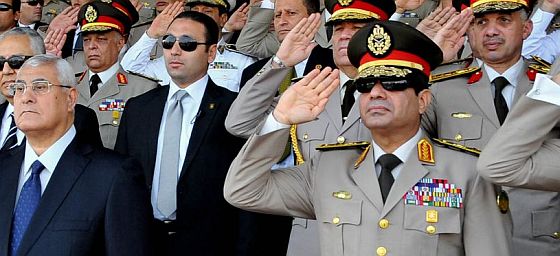
The Associated Press reports: In dark sunglasses and a uniform studded with medals, Egypt’s top general is everywhere, looking down from posters and banners proclaiming him “lion of the nation.” Adoring songs vow “We are behind you.”

Barely a month after he removed the elected president, Gen. Abdel-Fattah el-Sissi is riding a wave of adulation, drawing comparisons between him and modern Egypt’s first charismatic strongman, former President Gamal Abdel-Nasser. State media and pro-military TV channels and newspapers have done everything they can to fuel the fervor.

But some warn that the personality cult could pave the way to new authoritarianism after a coup that the army and its supporters insist was aimed at promoting democracy.

“I worry about el-Sissi and the possible arrogance of the victor. And I fear him if he decides that the army is stronger than any future president that he will control like a puppet,” wrote Mohammed Fathy, a columnist in the newspaper Al-Watan. “The admiration for him has gone beyond normal levels and is now more like deifying him.”

The hype has swelled to the point that some are convinced el-Sissi will take off his uniform and run for president in elections due to take place early next year. A military spokesman denied el-Sissi has any intention to do so. That has done nothing to end the speculation by those for and against the idea.

“Bottom line, el-Sissi will be president because he has no choice but to be. People have already started treating him as such and because he is de facto ruler,” Fathy wrote in a column on Monday, adding that media are depicting the general as “Nasser 2013.”

The raving over el-Sissi is rooted in the satisfaction many Egyptians took from his July 3 coup removing President Mohammed Morsi. It came after four days of massive protests by millions nationwide demanding the president step down, accusing him of failing to manage the country and handing power over to his Islamist allies. [Continue reading…]

Facebooktwittermail

EU foreign policy chief meets Morsi under detention

The Washington Post reports: The European Union’s Catherine Ashton has met with deposed Egyptian president Mohamed Morsi. The Monday night meeting marked the first visit that Morsi has had from an outside official since he was ousted from power in a July 3 coup.

The visit signaled for the first time that Egypt’s military, which is holding Morsi, may be willing to work with him towards a political solution to the country’s ongoing crisis, which has seen waves of violence between security forces and Morsi’s supporters since his ouster.

Last week, prosecutors announced that Morsi was being investigated for allegations of espionage and murder; charges that his supporters in the Muslim Brotherhood have dismissed as politically motivated, but which could carry the death penalty.

Ashton would not go into detail about her two-hour conversation with Morsi on Monday night, but she said Tuesday that the deposed president had access to newspapers and television, and was in good condition.

“He’s well, and we had a friendly and open and very frank discussion,” Ashton said at a brief press conference on Tuesday. She did not say where Morsi, who has been held incommunicado for four weeks, was being held. [Continue reading…]

Facebooktwittermail

After the police massacre of pro-Morsi supporters, survivors say: ‘We either have freedom or we die.’

The Guardian reports: The sand-filled forecourt outside the Zeinhom morgue, Cairo’s main mortuary, was a carousel of coffins. From the left-hand door, out came families carrying dead relatives to their funerals, stray dogs sniffing at their heels. Through the door on the right, in went still more bodies for their autopsies. By the end of Sunday, officials had assessed 82 corpses, as the death toll from Saturday’s police massacre of pro-Morsi supporters kept rising.

So too did the mourners’ feelings of isolation. “If this was animals being killed, people would care,” said one of those outside the morgue, lawyer Islam Taher, alluding to the indifference of mainstream Egyptian opinion to the death of Morsi supporters. “But because it’s us, they don’t.”

On Friday 28 June, Taher had pitched camp with his childhood friend Mohamed Fahmy, a 28-year-old unemployed commerce graduate from a small village in eastern Egypt, at the Rabaa Adawiya sit-in in east Cairo, near where Saturday’s massacre took place. On Sunday, exactly a month later, both arrived together at the the Zeinhom morgue – but this time Fahmy was dead in a battered brown coffin, shot through his right temple by a police marksman, after a night-time pro-Morsi march on Saturday morning turned into a massacre.

“Suddenly, he had a bullet through the front of his head, and a hole out the other side,” said Taher, holding out a picture taken on his phone of a brain-dead Fahmy breathing his last hours earlier. “He didn’t have any weapons. He just had his bare chest.”

State officials said Saturday’s deaths took place after pro-Morsi protesters fired first – and even claimed that police only used teargas to disperse them. But protesters told of a state-initiated bloodbath and a subsequent cover-up. “We asked them to record his death as a murder by police,” said Ashraf Mamdouh, loading the body of his brother-in-law, Hegazy Zakaria, into a van that would take him to his funeral in a village outside Cairo. “But they forced us to accuse anonymous sources.”

Inside the morgue, the scene had been one of mayhem. “We didn’t have enough places in the fridges to fit all the bodies,” said Dr Hazem Hossam, an official at Zeinhom.

“We had to do autopsies on the floor. At some points we had to ask families to help us with the process. It was chaos.”

Five miles away at Rabaa al-Adawiya – the ground-zero of pro-Morsi support over the last month, the Islamist equivalent of Tahrir Square – protesters said the attack had strengthened their resolve. [Continue reading…]

Facebooktwittermail

In Egypt’s Sinai, insurgency taking root

The Washington Post reports: More than three weeks after the military coup that ousted this nation’s first democratically elected — and Islamist — president from power, the roots of a violent insurgency are burrowing fast into the sands of Egypt’s Sinai Peninsula.

The rapid thud of machine-gun fire and the explosions of rocket-propelled grenades have begun to shatter the silence of the desert days and nights here with startling regularity, as militants assault the military and police forces stationed across this volatile territory that borders Israel and the Gaza Strip.

The emerging Sinai crisis gives Egypt’s military a pretext to crack down on Islamist opponents across the country, including in Cairo, where at least 72 people were killed over the weekend when security forces opened fire on demonstrators rallying in support of ousted president Mohamed Morsi.

Egypt’s interim government issued a decree Sunday that granted the military the power to detain civilians, state media reported. Analysts and rights activists said the decree suggested that a state of emergency, a tool that the regime of now-deposed autocrat Hosni Mubarak had used for decades to silence opponents, might soon follow.

But in the Sinai, where the re­action to Morsi’s ouster turned deadly within days of the coup, such state-sponsored violence and repression is likely to only feed the conviction of militants, who see themselves as waging a war against a despotic and irreligious military regime. [Continue reading…]

Facebooktwittermail

Many of 74 pro-Morsi protesters shot in Cairo were targeted killings

Human Rights Watch: Many of the at least 74 pro-Morsy protesters killed in clashes with Egypt’s riot police and plain clothed men who stood alongside were shot in the head or chest. They were killed on July 27 over a period of several hours during clashes on a road near the Muslim Brotherhood’s sit-in at Rabaa al-Adawiya in eastern Cairo.

Human Rights Watch interviewed seven witnesses to the violence and reviewed extensive video footage of the events. Medical staff interviewed by Human Rights Watch judged some of the deaths to be targeted killings because the position of the shots would likely result in death.

The New York Times reports: In the attack on Saturday, civilians joined riot police officers in firing live ammunition at the protesters as they marched toward a bridge over the Nile. By early morning, the numbers of wounded people had overwhelmed doctors at a nearby field hospital.

One doctor sat by himself, crying as he whispered verses from the Koran. Nearby, medics tried to revive a man on a gurney. When they failed, he was quickly lifted away to make room for the many others.

McClatchy reports: A brief visit to a field hospital – one of three treating casualties – showed the brutality of what had taken place. A McClatchy reporter counted 27 dead laid out on the hospital’s floor, and as she left, three more bodies arrived, adding to a frantic and horrific scene. At least three of the dead had been shot in the head, and the gaping wounds left the victims’ brains exposed.

Over and over, hospital workers would move a body to the ground and search the pockets for an identification card. When they found one, they wrote the deceased’s name on an arm. They then tied the body’s hands and toes together, to prevent arms and legs from flopping around as the corpse was moved. Often the workers had put a white wrap around the head to cover the gunshot wounds. Piles of national identification cards and personal belongings, like bloodied shirts and pants, were piled up nearby.

The only movement was that of doctors who seemed to jump around the corpses, reaching for bandages and the plaster needed to prepare shrouds, where the deceased’s name would be written again. One man who’d been assigned to clean blood from the floor shuffled through the scene, armed with a mop and a bucket that appeared to hold more blood than water. Over and over he went over the same spot near one head, as the blood kept pouring out.

Doctors said the injuries could only have come from professional marksmen. Ebtesan Zain, a gynecologist, said she came to help her fellow doctors only to discover she was not needed – everyone she encountered was dead.

“Those injuries had to be done by snipers. It couldn’t be anything else,” Zain said. “They were shooting directly in the head between the eyes and in the chest.”

Reuters reports: Thousands of supporters of Egypt’s Muslim Brotherhood stood their ground in Cairo on Sunday, saying they would not leave the streets despite “massacres” by security forces who shot dozens of them dead.

Facebooktwittermail

From Tahrir Square to Tiananmen Square

Sarah Carr writes: Every time I go to the Rab3a sit-in I think that it would be an almost impossible task to clear the people crammed into it; surely not even the Interior Ministry and armed forces would want to take on that task, not because they are concerned about loss of life but because of the logistical difficulty, and the political fallout internationally (the July 26 protests demonstrated that the anti-terrorism crowd seem to care about what the international community thinks).

So I did some cursory reading (Wikipedia, what else) on how Tiananmen Square was cleared of the pro-democracy protesters on June 4 1989 and so far there have been close parallels between the events that led up to that clearing, and events in Egypt. [Continue reading…]

The Washington Post reports: The bloodied and mangled bodies of more than a dozen supporters of ousted president Mohamed Morsi lined the floors of an improvised hospital in eastern Cairo on Saturday after a night of clashes between security forces and demonstrators calling for Morsi’s reinstatement left at least 46 people dead and hundreds wounded, according to the Ministry of Health.

Medics at a field hospital embedded in a pro-Morsi sit-in in eastern Cairo said they had received 37 bodies and treated hundreds of wounded in rooms that were crowded Saturday with wailing relatives and strewn with battered equipment and bloodied sheets.

Saturday’s violence erupted hours after Egypt’s interior minister and interim president warned that a nearly month-long sit-in by Morsi’s supporters and others “blocking” roads and bridges would soon be broken up.

“These sit-ins will be ended soon, within the limits of the law,” Interior Minister Mohamed Ibrahim told the al-Hayat television station.

“We cannot accept this security chaos, and the road blocking and the bridge blocking,” interim president Adly Mansour said in a separate call to the station. “We can’t accept the attacks on public property. The state has to enforce its sovereignty.” He urged Morsi’s supporters to “go back to your homes,” adding that if they did, “no one will pursue you.”

On Friday, millions of Egyptians took to the streets, heeding a call by the nation’s military chief to support the security forces’ “mandate” to confront violence and “terrorism” — words that rights groups and Morsi’s supporters in the Muslim Brotherhood interpreted as signaling an imminent crackdown.
[…]
Grief and shock mingled with outrage in the chaotic rooms of the makeshift hospital at the Brotherhood-led protest camp in eastern Cairo on Saturday.

“Tell everyone in the village he is a martyr,” one man sobbed into a cellphone while waiting to take the body of his brother from a room that had been converted into a morgue.

Doctors and witnesses said the wounded began streaming in around 11 p.m. on Friday, as separate groups of protesters on a nearby highway and outside Cairo’s al-Azhar University came under attack.

At first, most of the victims were suffered from the suffocating effects of tear gas, then later, birdshot wounds, doctors said. By 4 a.m., a flood of people with gunshot wounds arrived, as security forces and plainclothes “thugs” clashed with pro-Morsi demonstrators on roads leading to the protest camp, witnesses and doctors said. Many victims were afraid to go to official hospitals because they feared arrest, doctors said.

Mohamed Elatfy, an emergency room doctor who practices in Britain but was visiting family in Egypt, said he hurried to help after he saw an appeal for doctors at the field hospital while watching al-Jazeera late at night.

At the time of Morsi’s ouster, he said, he was “totally against the regime.”

“It was a failing regime,” he said. But Abdel Fatah al-Sissi, the chief of the armed forces, “is calling for a civil war,” he said. “And to be honest, I can’t understand why some Egyptians are calling for a bloodbath. I was watching the marches yesterday, and I was in shock.”

Facebooktwittermail

Civil society coups are bad for democracy

Omar Encarnación writes: To understand the swift and dramatic demise of Egypt’s first democratically elected leader and what it might portend for the country’s future, it helps to take a broad comparative perspective. The manner in which the country’s military deposed President Mohamed Morsi, of the Muslim Brotherhood–affiliated Freedom and Justice Party, is by no means an isolated case. In fact, it fits rather perfectly within the model of a civil society coup, a concept I first described in a 2002 World Policy Journal essay that explained the brief removal from power of Venezuela’s Hugo Chávez by a coalition of business, labor, and civic groups. Other scholars have subsequently applied the idea to other coups, such as those in the Philippines in 2001, in Ecuador in 2002, in Thailand in 2006, and in Honduras in 2009. All of these cases show that civil society coups are not the fix for democracy that they purport to be, which looks to be true in Egypt as well.

Endemic to new democracies, civil society coups entail the removal from power of an elected leader through sustained protest, usually with the aid of the military. Indeed, it is the partnership between civil society and the military — not usually known for acting in concert — that distinguishes a civil society coup from an ordinary one. More often than not, those behind the coup justify it by claiming that they intend to rescue democracy, which is paradoxical since they are, in fact, uprooting it. This is Tocqueville’s civil society gone rogue; rather than working patiently and discreetly toward improving the quality of democracy, it turns angry and restless and plots for sudden and radical political change.

In my original essay on Chávez’s removal from office, I identified three preconditions for a civil society coup. The first is the rise to power of a leader whose commitment to democracy is at best suspect. The second is a political apparatus that fails to meet public expectations about economic growth and stability, usually because of its corruption, incompetence, and neglect of the country’s basic needs. The third is the emergence of civil society actors — trade unions, religious associations, and civic groups — rather than formally organized political forces, which have either disintegrated or which never fully developed in the first place, as the main opposition to the government. The combined result of these conditions is the emergence of an adversarial relationship between an invigorated civil society and a delegitimized political system against a background of widespread societal discontent and the collapse of the rule of law. Under such conditions, disputes and political crises are solved on the streets rather than in the legislature.

All of these conditions materialized in Egypt. [Continue reading…]

Facebooktwittermail