Category Archives: Iran

Signs of Iraqi national unity begin to tone down the sectarian character of the fight against ISIS

The New York Times reports: Iraqi government forces and allied militias continued on Friday to battle Islamic State militants who defended their remaining positions in the city of Tikrit with snipers and roadside bombs.

As officials called for unity against the militant group, which swept into much of Iraq’s north and west last year, and declared that the fight was an Iraqi national objective, rather than a Shiite or Iranian one, new factions showed their readiness to join the conflict, albeit in relatively small numbers.

That signaled not only a broadening of the Iraqi fight against the Islamic State, but also probably an expansion of the maneuvering by rival groups to share a measure of credit for an expected victory and to position themselves to take part in the even more crucial battle farther north for Mosul, the self-declared capital of the Islamic State.

Around 700 fighters loyal to the Shiite cleric Moktada al-Sadr arrived to take part in the operation south of Tikrit, joining a force of more than 30,000 pro-government fighters, two-thirds of them members of a mainly Shiite militia known as popular mobilization forces.

And in the southern city of Basra on Thursday, a new Sunni militia organized by the religious establishment declared it was joining the popular mobilization effort, officials said.

Kurdish pesh merga and Sunni tribal fighters were continuing on Friday to advance on Islamic State territory from the northern city of Kirkuk, military officials said, on a front that would also be important in the battle for Mosul.

Mr. Sadr’s loyalists had sat out recent battles after he said he was “freezing” their participation, in part because of allegations of atrocities committed by Shiite militias in Diyala and Anbar Provinces after driving out Islamic State militants.

But last week, the cleric called on his militias, known as the Peace Brigades, to prepare to mobilize for possible participation in a campaign to take back Mosul. He declared that they had a better reputation than other militias and that their participation would tone down the sectarian flavor of the fight. [Continue reading…]


Facebooktwittermail

250 Iraqi Sunnis join Iranian-backed Shiite militia to battle ISIS

AFP reports: Wearing a camouflage uniform with militia patches and a green headband, Nawar Mohammed is the image of an Iraqi Shiite fighter except for one detail: he is Sunni.

Mohammed is one of some 250 Sunni residents of Al-Alam who joined Asaib Ahl al-Haq, an Iranian-backed Shiite militia with a fearsome reputation for kidnappings and killings targeting their community, to battle the Islamic State group after it seized their town.

It would once have been all but unthinkable for a member of Iraq’s Sunni Arab minority to join a Shiite militia, but opposition to IS, which overran large areas north and west of Baghdad last June, is transcending deep-seated sectarian divisions.

“The whole world is surprised by this — it’s the first time in the history of Asaib that they formed a Sunni unit,” said Mohammed, standing with a Kalashnikov assault rifle hanging at his side.

“Asaib trained us, and we became part of Asaib,” he said.

“Asaib, Sunni or Shiite, there is no difference — these circumstances united Iraq,” Mohammed said. “God willing, there will not be any more sectarianism.”

The formation of the unit, which some call “Asaib al-Alam,” is a positive sign and its fighters seem genuine when praising Asaib Ahl al-Haq. [Continue reading…]

Facebooktwittermail

CIA director suggests Iraq functions as interlocutor in U.S.-Iran fight against ISIS

The Guardian reports: The director of the CIA came the closest of any US official so far to acknowledging cooperation between the US and Iran in their current war against the Islamic State in Iraq.

Asked during a Council on Foreign Relations appearance on Friday afternoon if the US was formally coordinating its airstrikes in Iraq with Iranian forces and proxies on the ground, CIA director John Brennan did not bat away the notion, as Obama administration officials typically do.

Instead, Brennan suggested that such coordination is laundered through the Iraqi government, Washington and Tehran’s mutual partner – something widely suspected as the Iraqi military and Shia militias attempt to claw back the city of Tikrit from Isis.

“There’s an alignment of some interests between ourselves and Iran, clearly, in terms of what Isil [Isis] has done there,” Brennan told moderator Charlie Rose. [Continue reading…]

Facebooktwittermail

In Iraq, whatever the officials say, the U.S. is providing air support for Iran

Nancy A. Youssef writes: Forces loyal to Iran are threatening to break ISIS’s grip on the key Iraqi city of Tikrit. Officially, the American military isn’t helping these Shiite militias and Iranian advisers as they team up with Iraqi forces to hit the self-proclaimed Islamic State. But U.S. officials admit that American airstrikes are a major reason Iran’s proxies are advancing on Tikrit, Saddam Hussein’s hometown.

The U.S.-led air campaign has not only crippled ISIS’s ability to move freely. It’s also providing air cover for Iraqi troops and the Iranian forces fighting alongside of them. It is a perilous, yet unspoken, military alliance between the U.S. and its top regional foe that some said could lead to an ISIS defeat in the short term and ethnic cleansing of Sunni Iraqis in the long run.

“Like it or not, right now [the U.S. and Iran] are on the same side,” said Vali Nasr, dean of Johns Hopkins School of Advanced International Studies and longtime Iranian expert.

U.S. officials have repeatedly stated their concerns about the sectarianism that could emerge even as the strategy now decisively helps one side, the Shiite, in the push to defeat ISIS.

But two U.S. officials concede that the effect of the airstrikes helps Shiite forces — while swearing that there is no strategy to help Iran. Rather, as one explained, “the goal is to provide Iraqi forces the operational space to take back territory.” [Continue reading…]

Facebooktwittermail

Iran’s expanding influence in Iraq

Joyce Karam writes: While the invasion in 2003 and the shortsighted policies by the U.S. disbanding the Iraqi army and propping up the sectarian rule of Nouri al-Maliki, opened the door for Iranian meddling and militia-building in Iraq, ISIS has invited a more aggressive role for Iran along the Euphrates.

“Iran has taken full advantage of the collapse of the Iraqi army in Mosul” says Phillip Smyth, a researcher at the University of Maryland and author of a policy paper on Shiite Jihad. The rise of ISIS as an existential threat to Shiites whom it considers heretics and apostates, drove many in that community to carry arms and defend themselves while the Iraqi state continued to crumble. Grand Ayatollah Ali Sistani’s Fatwa last summer “to defend the country, its people, the honor of its citizens, and its sacred places” was exploited to set the stage for the formation of the Popular Mobilization Forces, made up of disciplined Shiite recruits and a much smaller component of Sunni tribal and Kurdish forces.

Smyth sees Iranian influence in funding, training and equipping Shiite militias at an all time high. He estimates the number of Shiite militia fighters in Iraq today between 70,000 [to] 100,000, a volume that “is both astounding and strategic to the way that Iran has constructed them.” The expert sees Iran as player whose influence is only rising in Iraq, “they run ministries in Iraq today with their own security apparatus.” This new dynamic was front and center in appointing Mohammad Ghabban from the Iranian funded militia Badr as the new Iraqi interior minister. [Continue reading…]

Facebooktwittermail

U.S.-trained Iraqi forces investigated for war crimes

ABC News reports: U.S.-trained and armed Iraqi military units, the key to the American strategy against ISIS, are under investigation for committing some of the same atrocities as the terror group, American and Iraqi officials told ABC News. Some Iraqi units have already been cut off from U.S. assistance over “credible” human rights violations, according to a senior military official on the Pentagon’s Joint Staff.

The investigation, being conducted by the Iraqi government, was launched after officials were confronted with numerous allegations of “war crimes,” based in part on dozens of ghastly videos and still photos that appear to show uniformed soldiers from some of Iraq’s most elite units and militia members massacring civilians, torturing and executing prisoners, and displaying severed heads.

The videos and photos are part of a trove of disturbing images that ABC News discovered has been circulating within the dark corners of Iraqi social media since last summer. In some U.S. military and Iraqi circles, the Iraqi units and militias under scrutiny are referred to as the “dirty brigades.”

“As the ISF [Iraqi Security Forces] and militias reclaim territory, their behavior must be above reproach or they risk being painted with the same brush as ISIL [ISIS] fighters,” said a statement to ABC News from the U.S. government. “If these allegations are confirmed, those found responsible must be held accountable.” [Continue reading…]

Facebooktwittermail

IRGC official: Iran indoctrinating Syria youth

NOW reports: A top Iranian Revolutionary Guards officer boasted about Tehran’s role in Syria and revealed that his country has been indoctrinating youths in the war-torn country to fight under the IRGC.

“The IRGC has begun to establish new religious groups in Syria called ‘Kashab’ among young Alawites, Sunnis, Christians and Ismailis,” Al-Arabiya on Tuesday cited Hussein Hamdani as saying.

These groups aim to carry out what Hamdani called “ideological education” for the “recruitment of teenagers in Syria to fight in militias under [the command] of the IRGC.”

The advisor to the Revolutionary Guards commander-general did not elaborate further on the youth groups, but did boast that Iran had formed 42 brigades and 138 battalions fighting for the Bashar al-Assad regime in Syria.

Hamdani added that the “establishment of the Basij in Syria was one of Iran’s most important achievements in recent years.” [Continue reading…]

Facebooktwittermail

Why a ‘bad’ deal with Iran is better than no deal at all

Jeffrey Lewis writes: I am old enough to remember when, back in 2006, I argued that the United States should let Iran keep 164 centrifuges in standby mode during talks. Do you know what people said? “164 centrifuges? Are you mad? You are giving away the store to the Iranians!” Well, now Iran has more than 15,000 centrifuges (that we know about) in at least two sites.

One of the most frustrating things about following the past decade of negotiations is watching the West make one concession after another — but only after the Iranians had moved so far forward that the concession had no value. The people arguing now for a “better” deal at some later date are the same people who in 2006 said 164 centrifuges was way too many and, that if we just held out long enough, we’d haggle the Iranians down to zero. Look what that got us.

This is a fantasy, a unicorn, the futile pursuit of which ends with a half-assed airstrike against Iran, a region in flames, and eventually an Iranian nuclear weapon. And let’s be clear: If negotiations collapse, the United States will take the blame from Europe and the sanctions regime will unravel. And here’s the best-case scenario:

Any military action against Iran will set its nuclear program back, at best, a couple of years. But the anger will last generations. [Continue reading…]

Facebooktwittermail

Celebrity status of General Soleimani coincides with rise in Iranian nationalism

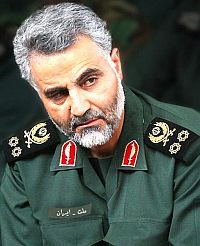
Qassem-SuleimaniMahan Abedin writes: His photos are everywhere in the Iranian media and his name is mentioned on a daily basis by the national broadcaster. Major General Qasem Soleimani, the commander of the Quds force of the Islamic Revolutionary Guards Corps (IRGC), is officially a national hero.

This extreme publicity is all the more surprising in view of Soleimai’s command of the most secretive and sensitive branch of the IRGC. The Quds force is the expeditionary wing of the Revolutionary Guards and spearheads Iran’s engagement with pro-Iranian armies, militias and political factions across the region.

To the outside world, in particular to Iran’s enemies and opponents in the region and beyond, Soleimani is the potent face of Iran’s political and ideological offensive in the Middle East.

This portrait of Soleimani is being increasingly adopted at home as well, fed by a daily diet of the Quds force commander’s exploits on the Iraqi battlefield, most recently in the offensive to re-take Tirkrit from the so-called Islamic State.

Whilst Soleimani’s leading role in Iran’s counter-insurgency efforts in Iraq and Syria is undoubtedly pivotal to the Islamic Republic’s regional policy, there are huge questions marks regarding the extreme publicity that now surrounds him.

One plausible explanation is that Soleimani’s adoption as a national hero heralds a change of political culture in Iran with significant long-term ramifications for the country’s domestic and foreign policy.

Qasem Soleimani’s transformation from a secretive commander to national celebrity is unprecedented in modern Iranian culture, and his enormous popularity notwithstanding, it is not entirely without controversy. [Continue reading…]

Facebooktwittermail

Hardliner wins key post to influence choice of Iran’s next leader

Reuters reports: A prominent hardliner was elected on Tuesday to head the influential body that will pick Iran’s next Supreme Leader.

The surprise choice of Ayatollah Mohammad Yazdi as head of the Assembly of Experts took place at a highly sensitive time, as Iran and six world powers face a March 31 deadline to reach the outline of an agreement over Tehran’s disputed nuclear program.

Supreme Leader Ayatollah Ali Khamenei, 75, underwent prostate surgery last year and rumors have recently resurfaced about his health, although he was shown on television last Sunday meeting a group of environmental activists.

In the internal election, Yazdi, a hardline cleric who headed the judiciary through much of the 1990s, defeated former president Ayatollah Ali Akbar Hashemi Rafsanjani by 47 votes to 24, according to Fars news agency.

“This was unexpected,” said Mashallah Shamsolvaezin, an Iranian journalist and political analyst based in Tehran. “I was genuinely surprised that Yazdi won.”

The result suggested that hardliners within the Assembly had closed ranks at a sensitive time when a new Supreme Leader could soon be chosen – a decision in which the Islamic Revolutionary Guard Corps, the most powerful military force in the country, could also play a role. [Continue reading…]

Facebooktwittermail

Did 47 U.S. senators just commit treason by attempting to sabotage Iran deal?

Bloomberg: The backlash continued Tuesday after 47 Republican senators sent a signed letter to Iran’s leaders warning them against cutting a nuclear deal with the Obama administration.

The letter, organized by Senator Tom Cotton, a freshman from Arkansas, warned Iran that “we will consider any agreement regarding your nuclear-weapons program that is not approved by the Congress as nothing more than an executive agreement between President Obama and Ayatollah Khamenei. The next president could revoke such an executive agreement with the stroke of a pen and future Congresses could modify the terms of the agreement at any time.”

The New York Daily News on Tuesday put photos of Cotton, Senator Rand Paul of Kentucky, Senator Ted Cruz of Texas, and Senate Majority Leader Mitch McConnell on its front page along with the boldfaced headline “TRAITORS.” [Continue reading…]

Facebooktwittermail

Iran responds to the letter from Republican senators

Iran’s Ministry of Foreign Affairs: Asked about the open letter of 47 US Senators to Iranian leaders, the Iranian Foreign Minister, Dr. Javad Zarif, responded that “in our view, this letter has no legal value and is mostly a propaganda ploy. It is very interesting that while negotiations are still in progress and while no agreement has been reached, some political pressure groups are so afraid even of the prospect of an agreement that they resort to unconventional methods, unprecedented in diplomatic history. This indicates that like Netanyahu, who considers peace as an existential threat, some are opposed to any agreement, regardless of its content.

Zarif expressed astonishment that some members of US Congress find it appropriate to write to leaders of another country against their own President and administration. He pointed out that from reading the open letter, it seems that the authors not only do not understand international law, but are not fully cognizant of the nuances of their own Constitution when it comes to presidential powers in the conduct of foreign policy.

Foreign Minister Zarif added that “I should bring one important point to the attention of the authors and that is, the world is not the United States, and the conduct of inter-state relations is governed by international law, and not by US domestic law. The authors may not fully understand that in international law, governments represent the entirety of their respective states, are responsible for the conduct of foreign affairs, are required to fulfil the obligations they undertake with other states and may not invoke their internal law as justification for failure to perform their international obligations.

The Iranian Foreign Minister added that “Change of administration does not in any way relieve the next administration from international obligations undertaken by its predecessor in a possible agreement about Iran`s peaceful nuclear program.” He continued “I wish to enlighten the authors that if the next administration revokes any agreement with the stroke of a pen, as they boast, it will have simply committed a blatant violation of international law.

He emphasized that if the current negotiation with P5+1 result in a Joint Comprehensive Plan of Action, it will not be a bilateral agreement between Iran and the US, but rather one that will be concluded with the participation of five other countries, including all permanent members of the Security Council, and will also be endorsed by a Security Council resolution. [Continue reading…]

Facebooktwittermail

Iran: The Senate strikes back

Elizabeth Drew writes: Ever since Hurricane Bibi blew through Washington last week, advocates and opponents of a possible nuclear agreement with Iran have been assessing the damage. It’s clear that the traditional bipartisan approach toward Israel has been smashed. But the essential question is what effect Netanyahu’s visit will have on the the nuclear deal and above all, whether Congress, by bringing it to a direct vote as it now threatens, will reject it, thus ending a long effort to rein in Iran’s nuclear ambitions and raising a long-term question as to whether US negotiators’ word amounts to anything.

Because the agreement — being negotiated by the Obama administration and fellow members of the P5+1 group –– isn’t a treaty, it doesn’t have to be approved by the Senate by a two-thirds vote. But since the existing strict economic sanctions on Iran were imposed by Congress, many members insist that they should have a voice in whether they can be lifted, as they would be in the agreement, in exchange for tight controls designed to prohibit Iran from developing nuclear weapons. What this is really about is whether Congress will have veto power over the agreement itself—a power that has become Netanyahu’s and other opponents’ chosen route for sinking a deal.

Hours after Netanyahu’s speech, Senate Majority Leader Mitch McConnell, apparently eager to capitalize on its rapturous reception by the mostly Republican audience, announced that he’d shortly move that the Senate immediately take up a resolution requiring a congressional vote on any agreement with Iran. This went against McConnell’s earlier pledge that the Senate would proceed according to the “regular order,” which would have meant that legislation had to be considered by the relevant committee, in this case Foreign Relations, before it could be brought to the floor; and two days later, he backed down after Democrats threatened to block the move. But this is most likely a temporary retreat on McConnell’s part. [Continue reading…]

Facebooktwittermail

Why American public opinion is often not worth measuring

Five years ago, a CNN opinion poll of adult Americans asked:

Do you think Iran currently has nuclear weapons, or not?

71% of the respondents answered “Yes.” Only 3% expressed no opinion, which is to say, acknowledged that they didn’t know.

In the intervening period, as news of ongoing negotiations between Iran and the U.S. (and the rest of the P5+1) has occasionally captured the headlines, I guess a number of those who believed that Iran already has nuclear weapons have since deduced that there would be no negotiations taking place if indeed Iran was already nuclear armed.

The results of a poll released earlier this month indicated that a majority of Americans (Democrats, Republicans, and Independents) now “support an agreement that would limit Iran’s enrichment capacity and impose additional intrusive inspections in exchange for the lifting of some sanctions.”

And yet, another recent poll shows that an even larger majority of Americans believe a nuclear deal with Iran would make little difference in preventing Iran from acquiring nuclear weapons.

Perhaps that’s because there are still a lot of Americans who believe Iran already possesses nuclear weapons.

As much as anything, the information opinion polls gather says as much about the questions as the answers.

If I was a pollster, I’d be tempted to ask questions like this:

Have you tried the new energy drink, P5+1?

Do you think it tastes better than P5?

I’d also present a questionnaire to all members of Congress, asking:

What does the “P” in P5+1 refer to?
a) Peerless
b) Protestant
c) Permanent
d) Piquant
e) Don’t know

And who is the 1?
a) Israel
b) North Korea
c) Germany
d) United States
e) Don’t know

But seriously, the professional pollsters could provide a valuable public service if they simply prefaced every attempt to gather public opinion by underlining the value of answering, “don’t know,” when that’s really the truth.

With some gentle coaxing, we might find that Americans are not as delusional as they often appear. They’re simply afraid of revealing how little they know.

If people were less embarrassed about intentionally exposing their ignorance, then polls might more than anything else highlight the degree to the United States is a dysfunctional democracy in which the media, political, and educational systems are failing to sustain an informed citizenry.

Facebooktwittermail

The rapidly closing window for national reconciliation in Iraq

National Journal reports: When his three-car convoy pulled up to a police checkpoint in Baghdad on Friday the 13th of February, Sheikh Qassem al-Janabi had little reason for concern. An influential Sunni moderate who was assisting the Iraqi government’s efforts to draw Sunni tribes away from the orbit of the Islamic State of Iraq and Syria, the charismatic Sheikh Janabi had many friends in high places.

He was in the capital, supposedly far away from any likely ISIS assassins. And he was a longtime friend of the United States, which in the past year had sent military forces back to Iraq to counter the ISIS terrorist group. Sheikh Janabi was riding with seven bodyguards and his son Mohamed, recently returned to Iraq from earning a law degree from the University of Glasgow. They were traveling from their tribal homeland south of Baghdad on the Muslim day of prayer.

The men at the police checkpoint were impostors and suspected Shiite militiamen, and they bundled up Janabi and his entourage at gunpoint, quickly driving them away. Their bodies were later found across town in the ramshackle Shiite slum of Sadr City. Janabi was slumped in the back of one of the cars, his hands tied behind his back with his own belt, a bullet in his head. The bodies of his son Mohamed and seven bodyguards lay nearby, all of them shot execution style. To reach Sadr City, the gunmen would likely have passed through several police checkpoints, raising questions of possible official collusion in the murders.

When the history of the second Iraq civil war is written, the death of Sheikh Qassem al-Janabi may prove notable for what it said about the rapidly closing window for national reconciliation, and for foreshadowing the ominous turn toward outright sectarianism that the fighting in Iraq has taken. Certainly the Sunni lawmakers who walked out of parliament in mass protest on learning of his murder understood his importance, both real and symbolic. Along with other moderate Sunni tribal leaders who first turned against al-Qaida in 2006-07 and took part in the “Anbar Awakening” during Iraq’s first civil war, Janabi rejected the terrorists’ vision of a purifying civil war between Sunnis and Shiites. Instead he continued to embrace the U.S. vision of a unified and democratic Iraq until the day of this death. [Continue reading…]

Facebooktwittermail

Iran blinds an acid attacker

The Guardian: In a literal application of the sharia law of an eye for an eye, an Iranian man convicted of blinding another man in an acid attack has been blinded in one eye, marking the first time Iran has carried out such a punishment.

The convicted acid attacker, who has not been identified, was rendered unconscious in Rajai-Shahr prison in the city of Karaj on Tuesday as medics gouged out his left eye, according to the state-owned Hamshahri newspaper.

Mahmood Amiry-Moghaddam, from Iran Human Rights (IHR), an independent NGO based in Norway, condemned the blinding as barbaric. “Medical staff who cooperate with the Iranian authorities in this act have broken the Hippocratic oath and cannot call themselves doctors,” he said.

The man had been found guilty of throwing acid in the face of his unnamed victim five years ago in the city of Qom, blinding and disfiguring him for life. He was subsequently sentenced to be blinded in both eyes, paying a fine and 10 years imprisonment.

Although the convict was sentenced to lose sight in both eyes on Tuesday, the victim – who, under Iranian law, has the final say in the punishment – decided at the last minute to postpone the blinding of his right eye for six months. The attacker will be able to plead with the plaintiff to spare him from being blinded fully.

Facebooktwittermail

Iran gains influence in Iraq as Shiite forces fight ISIS

The New York Times reports: All along the green irrigated plains in the heart of what American occupying troops used to call the Sunni triangle, lampposts and watchtowers are flying the flags of the Badr Organization, a Shiite militia long hated and feared by many Iraqi Sunnis.

The road from Baghdad to Tikrit is dotted with security checkpoints, many festooned with posters of Iran’s supreme leader and other Shiite figures. They stretch as far north as the village of Awja, the birthplace of Saddam Hussein, on the edge of Tikrit, within sight of the hulking palaces of the former ruler who ruthlessly crushed Shiite dissent.

More openly than ever before, Iran’s powerful influence in Iraq has been on display as the counteroffensive against Islamic State militants around Tikrit has unfolded in recent days. At every point, the Iranian-backed militias have taken the lead in the fight against the Islamic State here. Senior Iranian leaders have been openly helping direct the battle, and American officials say Iran’s Revolutionary Guards forces are taking part.

Iraqi officials, too, have been unapologetic about the role of the militias. They project confidence about their fighting abilities and declare that how to fight the war is Iraq’s decision, as militia leaders criticize American pressure to rely more on regular forces. [Continue reading…]

Facebooktwittermail

Capitol Hill — still Israeli-occupied territory

Philip Weiss writes: In the Emperor’s New Clothes, only the little boy can say that the emperor is naked. The good news about yesterday’s speech by Netanyahu to a joint meeting of Congress is that lots of media are taking on that boy’s role, and pointing out the nudity: exclaiming over the fact that a foreign leader came into our house of government to try and overrule our president on foreign policy. Chris Matthews was especially forceful, describing it as a takeover. While a New York Times article said that Democrats have to choose between “loyalty to the Jewish state” and the president.

But journalists have a bigger job than merely exclaiming. They must explain to readers why this outrage took place. Why did Netanyahu get this platform? The answer is the power of the Israel lobby inside our politics. And while there was some talk about the Christian Zionist component of the lobby compelling Republicans to show up, no one could explain why so many Democrats– about 175 of them– sat still for this insult to the president. They did so because of the importance of the Jewish part of the lobby inside the Democratic Party, epitomized by Alan Dershowitz in the gallery. This was surely obvious to viewers. But the media were silent on that score. [Continue reading…]

Netanyahu addressing Congress in 2002 and 2015 — same script, but then it was Iraq, now Iran.

Facebooktwittermail