Category Archives: Iraq

ISIS has turned Mosul into a fortress

Reuters reports: In a government building in Mosul, a handful of Iraqi contractors gathered to compete for a tender last month.

It was the kind of routine session that happens in cities everywhere — except here the contract was for fortifications ordered by the new rulers in town, Islamic State.

One member of the radical Islamist group grabbed a map and explained to those present what was required.

“Under Islamic State’s tender document, a trench two meters in depth and two meters in width needs to be dug around Mosul,” said a source in the city close to the tendering process.

The winning contractor will be paid the equivalent of $4,000 for each kilometer of trench, the source said.

The tender demonstrates Islamic State’s determination to defend the city that it conquered in June, as the extremists grabbed a large area of territory from Baghdad. Rich in Muslim history, Mosul stands at the center of the group’s aim to carve out a modern caliphate from large parts of Syria and Iraq.

Interviews with 11 Mosul residents, several of whom fled this month, reveal how Islamic State has created a police state strong enough to weather severe popular discontent and military setbacks, including the deaths of senior leaders.

Along with the planned trench, the militants have sealed Mosul’s western entrance with giant cement walls.

They also blew up a bridge that Kurdish fighters could use to attack Mosul.

“They will fight to the last drop of blood defending Mosul, and for them this battle could define their existence. Losing Mosul means a final defeat for Islamic State in Iraq,” said a retired army general living in Mosul. [Continue reading…]


Facebooktwittermail

ISIS has now ruled Fallujah for a year

The Associated Press reports: Nearly every night for a year, mortar and sniper fire from Islamic State group militants has pinned down outgunned Iraqi troops on the edge of Fallujah.

The city, the first to fall to the Sunni extremists a year ago this month, exemplifies the lack of progress in Iraq’s war against the Islamic State group, which holds a third of the country. U.S.-led airstrikes and Iranian aid have helped Iraqi troops, militiamen and Kurdish fighters take back bits around Islamic State-held territory, but recapturing it all remains far out of reach.

“We are constantly on alert and don’t sleep very much,” said Saad al-Sudani, an Iraqi soldier among the beleaguered troops outside of Fallujah. “We are waiting for any kind of support.”

The fall of Fallujah in January 2014 started the Islamic State group’s dramatic blitz across Iraq. In June, the extremists captured Iraq’s second-largest city, Mosul, then swept south toward Baghdad in a march that put almost all the Sunni-majority regions of northern and western Iraq into its hands. The Iraqi military crumbled, with troops often dropping their weapons and fleeing. [Continue reading…]

Facebooktwittermail

ISIS launches dawn attack on Samarra

BBC News reports: Islamic State militants have attacked Iraqi security forces in the central city of Samarra, killing two people and injuring 28 others, officials say.

They reportedly carried out five suicide bomb attacks on checkpoints along a motorway west of Samarra.

The bombings were followed by mortar attacks on the city itself.

IS surrounded Samarra, a predominantly Sunni city that is home to one of Shia Islam’s holiest sites, after launching an offensive in northern Iraq in June.

Soldiers and allied Shia militiamen have managed to stop the jihadists overrunning the city, and have recently retaken towns and villages to the south with the help of US-led coalition air strikes.

The latest assault on Samarra by IS militants, who regard Shia as heretics who should be killed, began before sunrise on Thursday. [Continue reading…]

Facebooktwittermail

Wars and instability prompt biggest migrant wave since World War Two

The Guardian reports: The two “ghost ships” discovered sailing towards the Italian coast last week with hundreds of migrants – but no crew – on board are just the latest symptom of what experts consider to be the world’s largest wave of mass-migration since the end of the second world war.

Wars in Syria, Libya and Iraq, severe repression in Eritrea, and spiralling instability across much of the Arab world have all contributed to the displacement of around 16.7 million refugees worldwide.

A further 33.3 million people are “internally displaced” within their own war-torn countries, forcing many of those originally from the Middle East to cross the lesser evil of the Mediterranean in increasingly dangerous ways, all in the distant hope of a better life in Europe.

“These numbers are unprecedented,” said Leonard Doyle, spokesman for the International Organisation for Migration. “In terms of refugees and migrants, nothing has been seen like this since world war two, and even then [the flow of migration] was in the opposite direction.”

European politicians believe they can discourage migrants from crossing the Mediterranean simply by reducing rescue operations. But refugees say that the scale of unrest in the Middle East, including in the countries in which they initially sought sanctuary, leaves them with no option but to take their chances at sea. [Continue reading…]

Facebooktwittermail

Iraqi general warns of military woes in fighting ISIS

The Associated Press reports: Lt. Gen. Abdul-Wahab al-Saadi had 225 fighters, a single Abrams tank, a pair of mortars, two artillery pieces and about 40 armored Humvees when he set out to retake a strategic city in northern Iraq captured by Islamic State militants over the summer.

It took 30 days as his force made an agonizingly slow journey for 40 kilometers (25 miles) through roadside bombs and suicide car attacks, then successfully laid siege to the oil refinery city of Beiji. The campaign earned al-Saadi the biggest battlefield victory by Iraqi forces since Islamic State fighters swept over most of northern and western Iraq in a summer blitz, prompting the collapse of the military.

Yet al-Saadi is deeply pessimistic. In a two-hour interview with The Associated Press, he said Iraq’s military lacks weapons, equipment and battle-ready troops and complained that U.S. air support was erratic. Both the military and the government remain riddled with corruption, he said. Most of the senior generals serving when the military fell apart had skills “more suited to World War II,” he said.

“If things don’t get better,” warned the general, “the country could end up divided” between its Shiite, Sunni and Kurdish populations.

The extremists are beatable when confronted with a proper force, he said. But he worries that the military’s multiple woes prevent it from doing so. Already, there is a danger the jihadis could retake Beiji, he said. [Continue reading…]

Facebooktwittermail

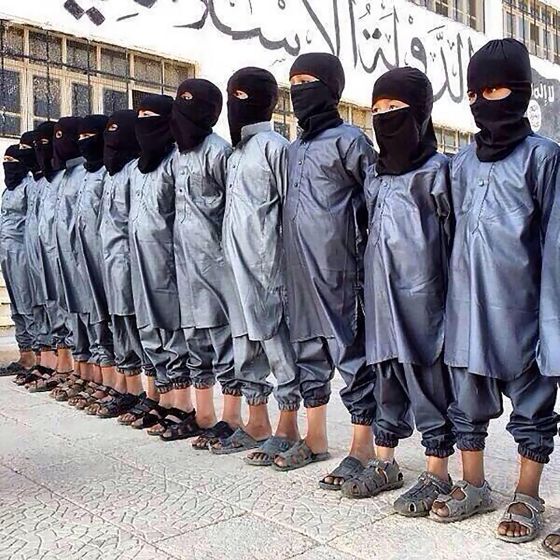
A war against childhood

isis-children

The Wall Street Journal reports: Jomah, a 17-year-old Syrian who joined Islamic State last year, sat in a circle of trainees for a lesson in beheading, a course taught to boys as young as 8.

Teachers brought in three frightened Syrian soldiers, who were jeered and forced to their knees. “It was like learning to chop an onion,” Jomah said. “You grab him by the forehead and then slowly slice across the neck.”

A teacher asked for volunteers and said, “Those who behead the infidels will receive gifts from God,” recalled Jomah, who didn’t want his full name revealed. The youngest boys shot up their hands and several were chosen to participate. Afterward, the teachers ordered the students to pass around the severed heads.

“I’d become desensitized by that time,” said Jomah, who has since defected to Turkey with his family. “The beheading videos they’d shown us helped.”

The enrollment of hundreds of boys in such militant training camps is another tragic facet of Syria’s nearly four-year-long civil war — and its impact could trouble the Middle East for years to come. Parents worry their boys will be forever lost to the indoctrination of Islamic State. [Continue reading…]

A TSG IntelBrief concludes:
• Through systemic indoctrination, intimidation, and extermination, violent extremist groups such as the Islamic State, Boko Haram, and both Afghan and Pakistan Taliban, are targeting children with unprecedented ferocity

• Children are no longer accidental casualties in extremist conflicts but rather they are a primary target

• Extremists are trying to steal the future away from vulnerable regions by stealing the future generation through relentless messaging and violence that separates the youth from their society, government, and culture

• The damage already done by the Syrian civil war, the Islamic State, Boko Haram, and violent extremist groups in in Pakistan pales in comparison to what is yet to come if even a small percentage of their focus on youth pays off.

In the midst of pervasive war-weariness and deeply felt opposition to military intervention following the war in Iraq, social media has not only desensitized children living under ISIS’s rule, serving as a primer on brutality, but it has also desensitized opponents of war.

Images which provoke instinctive revulsion, trigger a desire not only to look away, but also turn away in every way possible, such that both ISIS and those who have become its victims can be cloaked in otherness.

When we see children in masks, it’s easier to see the masks than see the children.

Paradoxically, among the many who readily acknowledge that ISIS came into existence primarily as a result of the war in Iraq and that in this sense, ISIS is an American creation, far fewer are willing to admit that the U.S. has a huge responsibility in now trying to thwart the monster that it unwittingly released.

At the same time, even if we acknowledge that we are part-owners of the problem, no one will be served well by casting America in its traditional self-ascribed role as rescuer.

Now, as has long been the case, the U.S. needs to break out of its bipolar relationship with the rest of the world, neither seeking to dominate, nor retreat.

Facebooktwittermail

U.S. troops return to Iraq to train force to fight ISIS

The New York Times reports: The United States has begun training a first wave of Iraqi Army recruits, in recent days putting them through morning fitness exercises and instructing them in marksmanship and infantry tactics, in an effort to gather enough forces to mount a spring offensive against the extremists of the Islamic State.

Military officials here say the first of the American-trained recruits, who answered the call to arms by Iraqi religious leaders over the summer and have completed some basic training under the Iraqis, will be ready to join the fight against the Islamic State, also known as ISIS or ISIL, by mid-February. Pushing forward, officials say the goal is to train 5,000 new recruits every six weeks.

“These are new patriots of Iraq, that have actually signed up, have been through basic training and are now ready to go through some advanced training,” said Maj. Gen. Paul E. Funk II, the American commander who is overseeing the training program.

More than six months after the Islamic State’s lightning advance through northern Iraq forced a reluctant President Obama to order a new United States military mission here, an American training program for the Iraqi security forces has begun to take shape. In recent days, the first recruits, about 1,600 men in four battalions, have been received by American instructors at Camp Taji, a base north of Baghdad. Others have begun arriving at Al Asad Air Base in Anbar Province, joining roughly 200 American Marines and Special Forces soldiers.

The American presence in Iraq is expected to grow in the coming weeks, to more than 3,000 personnel from about 1,800. The American military already has a presence in Baghdad and Erbil, the Kurdish capital in the north, and has plans for two more training sites: one for Special Forces in Baghdad and another in Besmaya, south of the capital. [Continue reading…]

Facebooktwittermail

Shi’ite militias expand influence, redraw map in central Iraq

Reuters reports: Behind black gates and high walls, Iraqi national security agents watch 200 women and children.

Boys and girls play in the yard and then dart inside their trailers, located in a former U.S. military camp and onetime headquarters for Saddam Hussein’s officials in Babel province’s capital Hilla.

The women and children are unwilling guests, rounded up as they fled with their male relatives in October from Jurf al-Sakhr, a bastion of Islamic State, during a Shi’ite militia and military operation to clear the farming community.

Once they were arrested, security forces separated out the men, accusing them of being Islamic State fighters. They have not been heard from since.

Security forces say the women and children are being investigated, but have not been brought to court.

Their status shows how central Iraq’s mixed Shi’ite and Sunni regions are being altered.

As Shi’ite forces push into territories held by Islamic State, many Sunnis have fled for fear of both the Shi’ite-led government and the Sunni jihadists.

Shi’ite leaders insist Islamic State must never be allowed to strike them again, nor return to areas now abandoned.

Shi’ite groups now decide who can stay in a community and who should leave; whose houses should be destroyed and whose can stand. [Continue reading…]

Facebooktwittermail

Deaths in Iraq show two sides of Iran’s role in sectarian conflict

The Guardian reports: Thousands of Revolutionary Guards gathered in Tehran on Sunday for the funeral of Iranian Brigadier General Hamid Taqavi, who was reportedly killed by a sniper while organising the defence of the Iraqi city of Samarra against Islamic State (Isis) militants.

According to Fars News, Iran’s top security official Ali Shamkhani told mourners that if “people like Taqavi do not shed their blood in Samarra, then we would shed our blood [within Iran] in Sistan [-Baluchestan], [East and West] Azerbaijan [provinces], Shiraz and Esfahan [to defend the country]”.

Mehr News reported the funeral was also attended by General Qassem Soleimani, commander of the Quds brigade, the overseas arm of the IRGC (Islamic Revolutionary Guard Corps), which has been active in Iraq. The Iranian Labour News Agency relayed condolences from Ali Larijani, the parliamentary speaker, “to the Lord of the Age [the 12th Shia Imam, believed to be in occultation], the Supreme Leader, the honourable Iranian nation, his comrades and respected and patient family members.”

Taqavi, 55, was the most senior Iranian military commander killed in Iraq, where Tehran calls its role “advisory” in assisting the Iraqi army, Kurdish forces and Shia militias against Isis. While Taqavi’s funeral illustrated the clear official Iranian commitment to its armed forces, the murkier dimensions of Tehran’s growing role in the brutal sectarian conflict engulfing Iraq and Syria were highlighted by the death of Wathiq al-Battat, an Iraqi militant with long links to Iran and leader of one of Iraq’s several Shia militias.

The Mukhtar Army, the Iraqi militia, recently announced its leader Wathiq al-Battat had been killed in Diyala province. Battat had been a player in the shady war between Iraqi Shia militias and the Sunni militants of Isis. [Continue reading…]

Facebooktwittermail

Has the Kurdish victory at Sinjar turned the tide of ISIS war?

Khales Joumah writes: Extremist fighters from the group known as the Islamic State have left the Sinjar area the same way they came in during August this year: without any real combat or pitched battles.

“I feel as if I’m watching the same thing I saw five months ago,” says Maizar al-Shammari, standing in front of his house, which is on the road into Sinjar, watching Iraqi Kurdish troops move forward. “At that time the Peshmerga [Iraqi Kurdish forces] withdrew without a fight. Today the Islamic State group is doing the same thing. It’s as if they just decided to swap roles,” he says.

Ever since the Iraqi Kurdish military began to fight with the self-proclaimed Islamic State, widely known as ISIS or ISIL, Sinjar has been an important piece of terrain for all comers in the conflict.

For ISIS it involves a major supply route. For the Iraqi Kurds the Sinjar region holds a lot of what is described as disputed territory—that is, land that is supposedly part of Iraq proper but which the Iraqi Kurds believe should belong to their semi-autonomous zone. They also believe that the Yazidi, an ethno-religious group, that live in Sinjar and have been particularly targeted by ISIS, are Kurds directly related to them.

Meanwhile the international coalition that is fighting against ISIS, mostly by airstrikes, sees the Sinjar area as having strategic importance; if blocked, the potential is there to separate ISIS in Iraq from ISIS in Syria. [Continue reading…]

Facebooktwittermail

ISIS executed nearly 2,000 people in six months, says monitoring group; executes more doctors in Mosul

Reuters reports: The Islamic State jihadist group has killed 1,878 people in Syria during the past six months, the majority of them civilians, a British-based Syrian monitoring organization said on Sunday.

Islamic State also killed 120 of its own members, most of them foreign fighters trying to return home, in the last two months, according to the Syrian Observatory for Human Rights.

The jihadist group has taken vast parts of Iraq and Syria and declared a caliphate in territory under its control in June. Since then it has fought the Syrian and Iraqi governments, other insurgents and Kurdish forces. [Continue reading…]

Rudaw reports: Islamic State (ISIS) authorities executed two more doctors in the city of Mosul, the latest in a campaign against physicians who refuse to join field hospitals or treat wounded fighters, a top health official said.

“Elements of the organization (ISIS) executed physicians Tareq Jassim and Adil Ayham, working in the Department of Surgery of the Republican General Hospital in Mosul,” said Dr. Firas al-Hamdani, head of the hospital’s emergency section.

“The bodies of the doctors arrived at the hospital morgue this evening after being executed by ISIS firing squad,” he added.

Facebooktwittermail

The U.S. and Iran are aligned in Iraq against ISIS — for now

The Washington Post reports: Iranian military involvement has dramatically increased in Iraq over the past year as Tehran has delivered desperately needed aid to Baghdad in its fight against Islamic State militants, say U.S., Iraqi and Iranian sources. In the eyes of Obama administration officials, equally concerned about the rise of the brutal Islamist group, that’s an acceptable role — for now.

Yet as U.S. troops return to a limited mission in Iraq, American officials remain apprehensive about the potential for renewed friction with Iran, either directly or via Iranian-backed militias that once attacked U.S. personnel on a regular basis.

A senior Iranian cleric with close ties to Tehran’s leadership, who spoke on the condition of anonymity to discuss security matters, said that since the Islamic State’s capture of much of northern Iraq in June, Iran has sent more than 1,000 military advisers to Iraq, as well as elite units, and has conducted airstrikes and spent more than $1 billion on military aid.

“The areas that have been liberated from Daesh have been thanks to Iran’s advice, command, leaders and support,” the cleric said, using the Arabic acronym for the group.

At the same time, Iraq’s Shiite-led government is increasingly reliant on the powerful militias and a massive Shiite volunteer force, which together may now equal the size of Iraq’s security forces. [Continue reading…]

Long War Journal reports: An Islamic State sniper gunned down a general in Iran’s Qods Force who was advising Iraqi troops and Shiite militias in the battleground city of Samarra in central Iraq.

The Iranian Revolutionary Guards Corps (IRGC) announced that Brigadier General Hamid Taqavi was “martyred” while serving in Samara, close to the “shrine of Imam Hassan Askari” on Dec. 27, 2014, Jahan News, a hard-line Iranian media outlet reported. Taqavi was killed by an Islamic State “sniper,” ABNA noted.

Taqavi served as an “adviser to the [Iraqi] Army and the popular mobilization of the Iraqi people,” a reference to the Shiite militias that fight alongside the Iraqi military.

Facebooktwittermail

Boy risks his life to escape from ISIS

The New York Times reports: Before war convulsed his hometown in Syria, Usaid Barho played soccer, loved Jackie Chan movies and adored the beautiful Lebanese pop singer Nancy Ajram. He dreamed of attending college and becoming a doctor.

His life, to say the least, took a detour.

On a recent evening in Baghdad, Usaid, who is 14, approached the gate of a Shiite mosque, unzipped his jacket to show a vest of explosives, and surrendered himself to the guards.

“They seduced us to join the caliphate,” he said several days later in an interview at a secret Iraqi intelligence site where he is being held.

Usaid described how he had been recruited by the Sunni extremists of the Islamic State from a mosque in his hometown, Manbij, near Aleppo. He said he joined the group willingly because “I believed in Islam.”

“They planted the idea in me that Shiites are infidels and we had to kill them,” he said in the interview, which took place in the presence of an Iraqi intelligence official.

If he did not fight, he was told, Shiites would come and rape his mother.

He soon found himself in Iraq, but he quickly had misgivings and wanted to escape. His best chance, he decided, was a risky deception: volunteer to be a suicide bomber so he could surrender to security forces. [Continue reading…]

Facebooktwittermail

ISIS is failing at being a state

The Washington Post reports: The Islamic State’s vaunted exercise in state-building appears to be crumbling as living conditions deteriorate across the territories under its control, exposing the shortcomings of a group that devotes most of its energies to fighting battles and enforcing strict rules.

Services are collapsing, prices are soaring, and medicines are scarce in towns and cities across the “caliphate” proclaimed in Iraq and Syria by the Islamic State, residents say, belying the group’s boasts that it is delivering a model form of governance for Muslims.

Slick Islamic State videos depicting functioning government offices and the distribution of aid do not match the reality of growing deprivation and disorganized, erratic leadership, the residents say. A trumpeted Islamic State currency has not materialized, nor have the passports the group promised. Schools barely function, doctors are few, and disease is on the rise.

In the Iraqi city of Mosul, the water has become undrinkable because supplies of chlorine have dried up, said a journalist living there, who spoke on the condition of anonymity to protect his safety. Hepatitis is spreading, and flour is becoming scarce, he said. “Life in the city is nearly dead, and it is as though we are living in a giant prison,” he said.

In the Syrian city of Raqqa, the group’s self-styled capital, water and electricity are available for no more than three or four hours a day, garbage piles up uncollected, and the city’s poor scavenge for scraps on streets crowded with sellers hawking anything they can find, residents say. [Continue reading…]

Facebooktwittermail

Senior Kurdish rebel leader warns Iraq must stay united to defeat ‘savage’ ISIS

The Guardian reports: Iraq must remain a united country in order to defeat the jihadis of the Islamic State, a senior leader of the rebel Kurdistan Workers’ Party (PKK) has insisted.

Cemil Bayik, co-founder of the PKK and field commander of the organisation warned that it would be “very dangerous” if Iraq were partitioned. Unless Iraq’s Shia, Sunni and Kurdish communities worked together to counter the threat of Isis, the “fascist” group would benefit, he told the Guardian in an exclusive interview.

“If it (Iraq) is divided, the war will intensify and the threat of Da’esh (Isis) to smaller communities will become greater,” said Bayik, speaking in the group’s Qandil mountain stronghold in northern Iraq. “But if they stay united against Da’esh, they can sort out their differences at a later stage through dialogue.”

Bayik also made clear that the PKK hoped that its cooperation with the US-led international coalition fighting Isis would lead to it being de-listed as a terrorist organization by western countries. [Continue reading…]

Facebooktwittermail

Escape from hell — torture, sexual slavery in ISIS captivity in Iraq

Amnesty International: Torture, including rape and other forms of sexual violence, suffered by women and girls from Iraq’s Yezidi minority who were abducted by the armed group calling itself the Islamic State (IS), highlights the savagery of IS rule.

Escape from Hell – Torture, Sexual Slavery in Islamic State Captivity in Iraq provides an insight into the horrifying abuse suffered by hundreds and possibly thousands of Yezidi women and girls who have been forcibly married, “sold” or given as “gifts” to IS fighters or their supporters. Often, captives were forced to convert to Islam.

The women and girls are among thousands of Yezidis from the Sinjar region in north-west Iraq who have been targeted since August in a wave of ethnic cleansing by IS fighters bent on wiping out ethnic and religious minorities in the area.

The horrors endured in IS captivity have left these women and girls so severely traumatized that some have been driven to end their own lives. Nineteen-year-old Jilan committed suicide while being held captive in Mosul because she feared she would be raped, her brother told Amnesty International.

One of the girls who was held in the same room as Jilan and 20 others, including two girls aged 10 and 12, told Amnesty International: “One day we were given clothes that looked like dance costumes and were told to bathe and wear those clothes. Jilan killed herself in the bathroom. She cut her wrists and hanged herself. She was very beautiful; I think she knew she was going to be taken away by a man and that is why she killed herself.” The girl was among those who later escaped.

Wafa, 27, another former captive, told Amnesty International how she and her sister attempted to end their lives one night after their captor threatened them with forced marriage. They tried to strangle themselves with scarves but two girls sleeping in the same room awoke and stopped them.

“We tied the scarves around our necks and pulled away from each other as hard as we could, until I fainted…I could not speak for several days after that,” she said.

The majority of the perpetrators are Iraqi and Syrian men; many of them are IS fighters but others are believed to be supporters of the group. Several former captives said they had been held in family homes where they lived with their captors’ wives and children. [Continue reading…]

Facebooktwittermail

Inside ISIS-controlled Mosul

BBC News reports: Juergen Todenhoefer spent six days in the IS city of Mosul in Iraq, travelling there via Raqqa, in Syria.

Mr Todenhoefer said he found IS followers highly motivated and supportive of the group’s brutality.

He said the spread of fighters meant they were hard targets for air strikes.

A former German politician, Juergen Todenhoefer is the only outsider to have travelled deep into IS territory and back. And, considering that several Westerners have recently been beheaded, he did so at terrifying risk.

Facebooktwittermail

Yazidi women tell of being used as sex slaves by ISIS

Paul Wood reports: The Yazidi religious minority community in Iraq says 3,500 of its women and girls are still being held by the so-called Islamic State (IS), many being used as sex slaves. A few have managed to escape and here tell their harrowing stories.

One day in August, Hannan woke to find her family frantically packing. She was taken aback: she had not realised the jihadists calling themselves “the Islamic State” were so close.

Outside, the main street in her hometown of Sinjar was choked. Her family joined other Yazidis “running and crying”, bullets flying overhead, she says.

Rain drums on the tent as she tells me her story, nervously twisting her fingers.

“Hannan” is not her real name. None of the former captives I spoke to could bear to be identified. Hannan is 18 and wants to be a nurse, a future almost snatched away by IS. [Continue reading…]

Facebooktwittermail