Category Archives: Iraq

Iranian dissidents’ fate in Iraq shows limits of U.S. sway

Iranian dissidents’ fate in Iraq shows limits of U.S. sway

Last September, Gen. David H. Petraeus told reporters in Baghdad that the United States had been assured by the Iraqi government that the 3,400 Iranian dissidents in a camp in eastern Iraq would continue to be protected after the Americans turned over responsibility for the camp to Iraqi forces.

Last week’s bloody melee between Iraqi police officers and the residents of the camp has not only raised fresh doubts in Washington about the worth of these assurances, but has also exposed just how little leverage American officials now have in a country they largely controlled for almost six years.

It has also forced the Obama administration to confront some of the thorny issues that bedeviled its predecessor: how to prevent Iraq from falling deeper under Tehran’s influence, and how to fashion a tough Iran policy amid delicate negotiations to dismantle the country’s burgeoning nuclear program. [continued…]

Iraqis fear latest bombings signal return of al Qaida in Iraq

Bombings at five Shiite Muslim mosques killed 29 worshippers Friday in a series of attacks that Iraqi army and police officers are interpreting as a sign that insurgents are determined to destabilize the country now that American forces have withdrawn from Iraqi cities and towns.

“You will see them attempting to start the sectarian violence again,” said a high-ranking Iraqi army officer who commands a unit in western Baghdad. He asked not to be named because he isn’t authorized to speak to the media.

Iraqi army and police officers told McClatchy that the pattern of attacks against the armed forces and civilians resembles the tactics that the extremist Sunni group al Qaida in Iraq used before 2006. The increase in car bombs, roadside bombs and death threats indicates that the Islamic extremist group is attempting to restore ground it lost during the “surge” of American forces in 2008, the officers said. [continued…]

Facebooktwittermail

It’s time for the US to declare victory and go home

It’s time for the US to declare victory and go home

As the old saying goes, “guests, like fish, begin to smell after three days.” Since the signing of the 2009 Security Agreement, we are guests in Iraq, and after six years in Iraq, we now smell bad to the Iraqi nose. Today the Iraqi Security Forces (ISF) are good enough to keep the Government of Iraq (GOI) from being overthrown by the actions of Al Qaeda in Iraq (AQI), the Baathists, and the Shia violent extremists that might have toppled it a year or two ago. Iraq may well collapse into chaos of other causes, but we have made the ISF strong enough for the internal security mission. Perhaps it is one of those infamous paradoxes of counterinsurgency that while the ISF is not good in any objective sense, it is good enough for Iraq in 2009. Despite this foreboding disclaimer about an unstable future for Iraq, the United States has achieved our objectives in Iraq. Prime Minister (PM) Maliki hailed June 30th as a “great victory,” implying the victory was over the US. Leaving aside his childish chest pounding, he was more right than he knew. We too ought to declare victory and bring our combat forces home. Due to our tendency to look after the tactical details and miss the proverbial forest for the trees, this critically important strategic realization is in danger of being missed. [continued…]

Iraqi raid poses problem for U.S.

Violent clashes continued for a second day Wednesday between Iraqi troops and members of an Iranian opposition group whose camp the Iraqis stormed Tuesday, presenting the first major dilemma for the U.S. government since Iraq proclaimed its sovereignty a month ago.

At least eight Iranians have been killed and 400 wounded since Tuesday, when hundreds of Iraqi police and soldiers in riot gear plowed into Camp Ashraf, northeast of Baghdad, using Humvees donated by the U.S. military, according to group leaders and Abdul Nasir al-Mahdawi, the governor of Diyala province.

Camp residents described the day’s events as a massacre and the aftermath as a tense stalemate. [continued…]

Iraq in throes of environmental catastrophe, experts say

You wake up in the morning to find your nostrils clogged. Houses and trees have vanished beneath a choking brown smog. A hot wind blasts fine particles through doors and windows, coating everything in sight and imparting an eerie orange glow.

Dust storms are a routine experience in Iraq, but lately they’ve become a whole lot more common.

“Now it seems we have dust storms nearly every day,” said Raed Hussein, 31, an antiques dealer who had to rush his 5-year-old son to a hospital during a recent squall because the boy couldn’t breathe. “We suffer from lack of electricity, we suffer from explosions, and now we are suffering even more because of this terrible dust.

“It must be a punishment from God,” he added, offering a view widely held among Iraqis seeking to explain their apocalyptic weather of late. “I think God is angry with the deeds of the Iraqi people.”

The reality is probably scarier. Iraq is in the throes of what some officials are calling an environmental catastrophe, and the increased frequency of dust storms is only the most visible manifestation. [continued…]

Facebooktwittermail

Iran hard-liners warn Ahmadinejad he could be deposed

Iran hard-liners warn Ahmadinejad he could be deposed

Political hard-liners warned President Mahmoud Ahmadinejad on Tuesday that he could be deposed like past Iranian leaders if he continued to defy the country’s supreme religious leader.

The implied threat was the latest evidence of the rift within Iran’s conservative camp and could serve to further sap the authority of a president already considered illegitimate by reformists.

The Islamic Society of Engineers, a political group close to parliamentary speaker Ali Larijani, warned in an open letter to Ahmadinejad that he could suffer the same fate as Prime Minister Mohammed Mossadegh, who was deposed in 1953 in a CIA-backed coup with the acquiescence of the clergy.

The letter also cites the experience of President Abolhassan Bani-Sadr, who was ousted in 1981 and fled the country after he fell out with the Islamic Republic’s founder, Ayatollah Ruhollah Khomeini. Both leaders had been elected by huge margins.

“It seems you want to be the sole speaker and do not want to hear other voices,” the group’s letter says, noting that recent actions by Ahmadinejad have frustrated his own supporters. “Therefore it is our duty to convey to you the voice of the people.” [continued…]

Iran: the tragedy & the future

Nasser Hadian, a political scientist, told me [in early 2009]: “I say to my students, it’s hard to wait but you should be patient. The laws of the country cannot forever lag behind the reality, and Iran’s reality today is that women have been empowered and secularism has spread.” Nor, I thought, in an election year, could politics forever lag behind these facts.

The June 12 election offered a potential bridge between this youthful Iran in rapid evolution, curious about the world and increasingly connected to it online, and revolutionary institutions that had veered in a conservative direction under Ahmadinejad. Presidential votes have served as safety valves in the past. They have provided modest course corrections that have made the term “Republic” not altogether meaningless. Iran was distinguished in a despotic region by its unpredictable elections, as when the reformist Mohammad Khatami won in a landslide in 1997.

Khatami, who ended up changing more tone than substance, said he would stand again this year, before desisting in favor of Moussavi, a former prime minister of impeccable revolutionary credentials, a distant relative of Ayatollah Khamenei, a staunch nationalist, and seemingly the very embodiment of unthreatening change. Khamenei, as president, had worked with Moussavi in the war-ravaged 1980s. Their relationship was uneasy but survived eight years. Allergic to another Khatami presidency, the supreme leader appeared to have made his peace with Moussavi, even if his preference for Ahmadinejad was clear.

But Khamenei’s acquiescence was to the Moussavi of early May: drab, detached, and dutiful. By early June, he had become the energized anti- Ahmadinejad. Apathy among Iranians had yielded to the activism that would produce the 85 percent turnout. Moussavi had been propelled in part by his charismatic wife, Zahra Rahnavard, whom I saw just before the election at a big Tehran rally where, in floral hijab, she began with a resounding “Hello Freedom!” and proceeded to warn that “if there is rigging, Iran will have a revolution.” [continued…]

Reports of prison abuse and deaths anger Iranians

Some prisoners say they watched fellow detainees being beaten to death by guards in overcrowded, stinking holding pens. Others say they had their fingernails ripped off or were forced to lick filthy toilet bowls.

The accounts of prison abuse in Iran’s postelection crackdown — relayed by relatives and on opposition Web sites — have set off growing outrage among Iranians, including some prominent conservatives. More bruised corpses have been returned to families in recent days, and some hospital officials have told human rights workers that they have seen evidence that well over 100 protesters have died since the vote.

On Tuesday, the government released 140 prisoners in one of several conciliatory gestures aimed at deflecting further criticism. President Mahmoud Ahmadinejad issued a letter urging the head of the judiciary to show “Islamic mercy” to the detainees, and on Monday Iran’s supreme leader, Ayatollah Ali Khamenei, personally intervened and closed an especially notorious detention center.

But there are signs that widespread public anger persists, and that it is not confined to those who took to the streets crying fraud after Mr. Ahmadinejad’s landslide victory last month. Several conservatives have said the abuse suggests a troubling lack of accountability, and they have hinted at a link with Mr. Ahmadinejad’s recent willingness to defy even the venerated Ayatollah Khamenei. [continued…]

Iraq raids camp of exiles from Iran

Iraqi troops and police carried out a bloody raid Tuesday on the camp of an Iranian opposition group that the United States has long sheltered, marking the Iraqi government’s boldest move since it declared its sovereignty a month ago and offering the latest sign that American influence is waning as Iranian clout rises.

The operation, which caught U.S. officials off guard, coincided with a visit by Defense Secretary Robert M. Gates, and analysts said it appeared designed to send a message of Iraqi independence.

The Mujaheddin-e Khalq, or MEK, has supplied information about Iran’s nuclear program to the United States, but the group has long been an irritant to the Islamic republic, which has repeatedly asked the government of neighboring Iraq to expel MEK members. The way Baghdad deals with the group is widely seen as a signal of whether Iraq is more heavily swayed by Iran or by the United States.

Leaders of the group said Iraqi troops fatally shot four residents Tuesday night and wounded scores. U.S. officials have long opposed a violent takeover of the camp northeast of Baghdad, and the Iraqi government’s willingness to carry out the raid while Gates was in the country startled some American officials. [continued…]

Facebooktwittermail

After Kurdish vote, Talabani pledges to rebuild party

After Kurdish vote, Talabani pledges to rebuild party

Facing what could prove a turning point in tumultuous Kurdish politics, Iraqi President Jalal Talabani vowed Tuesday that he would lead the revival of his party after a surprisingly successful challenge by opponents in last week’s election led some to speculate that it might be the beginning of the party’s end.

In an interview, Talabani, the 75-year-old politician and former guerrilla who founded the Patriotic Union of Kurdistan (PUK) more than 30 years ago, sought to cast the election results in the best light. But the success of the Change list, led by former Talabani colleagues , against an alliance of the PUK and the other leading Kurdish party clearly surprised him.

More than a contest among parochial groups in a relatively quiet region, the struggle for political power in the Kurdish north could have sweeping repercussions for Iraq’s mercurial politics. The alliance between Talabani’s party and Kurdish President Massoud Barzani’s Kurdistan Democratic Party has held for years, though no one has really forgotten the civil war they fought in the 1990s. Their claim to represent Kurdish consensus is crucial, too, in negotiations with Baghdad over today’s most pressing issues: a law to share Iraq’s oil revenue and a resolution to the disputed border between Iraq’s Arab and Kurdish regions. [continued…]

Iraq force soon to be a coalition of one

Commanders of the Multi-National Force-Iraq, as the American-led coalition is formally called, have a looming nomenclature problem.

Two days from now, there will no longer be any other nations with troops in Iraq — no “multi” in the Multi-National Force. As Iraqi forces have increasingly taken the lead, the United States is the last of the “coalition of the willing” that the Bush administration first brought together in 2003.

That is partly because the Iraqi Parliament left suddenly for summer recess without voting to extend an agreement for the British military to keep a residual training force of 100 soldiers in Iraq. As a result, those troops must withdraw to Kuwait by Friday, according to a British diplomat, who declined to be identified in keeping with his government’s practice.

As for the other two small remnants of the coalition, the Romanians and Australians, the Australians will be gone by July 31, too, and the Romanians left last Thursday, according to the Romanian chargé d’affaires, Cristian Voicu. NATO will keep a small training presence in Iraq, but its troops were never considered part of the Multi-National Force because of opposition to the war from many NATO countries. [continued…]

Gates: Some US troops may be leaving Iraq early

The United States is considering speeding up its withdrawal from Iraq because of the sustained drop in violence there, Defense Secretary Robert Gates said Wednesday following discussions with his top commanders in the war.

“I think there’s at least some chance of a modest acceleration,” this year, Gates said.

It was the first suggestion that the Obama administration might rethink its difficult choice to leave a heavy fighting force in Iraq long past the election of an American president who opposed the war. [continued…]

Facebooktwittermail

The rise of Ayatollah Moqtada al-Sadr

The rise of Ayatollah Moqtada al-Sadr

When Iraqi cleric Moqtada al-Sadr was a young seminary student during the country’s Baathist era, he preferred playing video games to attending theological courses. Now several years and a U.S. occupation later, that same Sadr is a major Iraqi political figure, studying to become an ayatollah at Shiite Islam’s most prominent religious center of Qom, Iran. Sadr reportedly resides in Tehran and travels weekly to the Iranian shrine-city to study major works of Shiite jurisprudence under an unknown but certainly high-ranking cleric. He will exit his studies as a mujtahid, or learned scholar, with the recognized ability to issue religious decrees.

Behind this remarkable transformation — from disinterested student to occupation-opposing cleric to serious scholar — are big ambitions. And if all goes according to plan, Sadr will have a golden opportunity to return and take Iraq’s political stage by storm. [continued…]

Facebooktwittermail

Worries about a Kurdish-Arab conflict move to fore in Iraq

Worries about a Kurdish-Arab conflict move to fore in Iraq

Louis Khno is a city councilman whose city is beyond his control. In his barricaded streets are militiamen — in baseball caps and jeans, wielding Kalashnikov rifles, with the safeties switched off. They answer to someone else. Leaders of his police force give their loyalty to their ethnic brethren — be they Kurd or Arab. Clergy in the town pledge themselves to the former. Khno and his colleagues to the latter.

“We’re far from the conflict, but now we’ve become the heart of the conflict between Kurds and Arabs,” Khno said. “We’re now stuck in between them.”

Khno called the town “the line of engagement,” one stop along an amorphous frontier in northern Iraq shaped by contested history, geography and authority. Dividing the Kurdish autonomous region from the rest of the country, that frontier represents the most combustible fault line in Iraq today, where Arab and Kurd forces may have come to blows last month along hills of harvested wheat. Kurdish officials suggest that another confrontation is inevitable, with halfhearted negotiations already stalled, and U.S. officials acknowledge that only their intervention has prevented bloodshed.

Since 2003, when U.S. forces barreled into Baghdad, toppling Saddam Hussein, inspiring a Shiite revival and unleashing a Sunni insurgency that drew on a communal sense of siege, the war in Iraq has been in large part a sectarian conflict that pitted Sunni Arab against Shiite Arab. That war has subsided, even if bitterness remains.

For months, there were fears that the sectarian battle might reignite, as the United States withdrew its combat forces. Today, that looks less likely. Rather, U.S. officials say, the biggest threat to Iraq in the years ahead is the ethnic conflict, Kurds in the north against the Arab-dominated government in Baghdad, a still-unresolved struggle that has helped shape Iraq’s history since the British inherited the land after World War I. [continued…]

Now it’s a census that could rip Iraq apart

When Iraqis were drafting their Constitution in 2005, the parties could not agree on who would control Kirkuk, the prized oil capital of the north. They couldn’t even agree on who lived in Kirkuk, which is claimed by the region’s Kurds, but also by its Turkmen minority and Sunni Arabs. For that matter, they couldn’t even agree on where Kirkuk was — in Tamim, Erbil, or Sulaimaniya Province.

So the Iraqis punted, inserting Article 140, a clause that called for a national census, followed by a referendum on the status of Kirkuk, all to be held by the end of 2007. What followed were a succession of delays, against a backdrop of sectarian violence and warnings that Kirkuk could blow apart the Shiite-Kurdish alliance that has governed Iraq since the Americans invaded.

Massoud Barzani, president of the Kurdish regional government, warned two years ago that if “Article 140 is not implemented, then there will be a real civil war.” He’s still waiting.

But so is the threat of civil war, which lurked quietly in the polling places this weekend as residents of Iraq’s Kurdish-dominated areas voted for their regional president and Parliament. Until the status of Kirkuk is clear, nobody really knows how much power those regional officials can wield within the national government, or even whether the Kurds will want to remain part of Iraq. [continued…]

Facebooktwittermail

High turnout in Iraqi Kurds’ elections

High turnout in Iraqi Kurds’ elections

Voters in Iraq’s semiautonomous Kurdistan region cast their ballots on Saturday in local presidential and parliamentary elections as a hunger for political reform clashed with a desire to maintain stability.

Turnout was high — 78.5 percent according to the Electoral Commission — and voting was extended by an hour to accommodate the crowds.

Preliminary results were not expected until Sunday, but by Saturday night an opposition party was already charging fraud and the governing coalition was claiming a regionwide lead.

There was little doubt here that the governing coalition would maintain its ironclad grip on this region of 4.5 million people. Many Kurds credit the regional government for the relative security and prosperity the region enjoys compared with the rest of Iraq. [continued…]

Facebooktwittermail

Iraq’s reluctant leader emerges as unlikely force

Iraq’s reluctant leader emerges as unlikely force

Iraqi Prime Minister Nouri al-Maliki, reluctantly thrust three years ago into a job few expected him to hold onto, arrives in Washington this week as a transformed leader — with widening popularity among Iraqis, grudging respect of some political foes and a more even footing with his U.S. hosts.

The quiet former Arabic-literature scholar has demonstrated surprising resilience, establishing himself as Iraq’s first national leader since Saddam Hussein. His three years of consistent leadership, a prospect that initially seemed remote, augurs more stability for Iraq as U.S. involvement diminishes.

Though he still faces formidable problems at home, Mr. Maliki is positioning himself as the person capable of moving Iraq beyond the security concerns that have consumed the country since the U.S.-led invasion in 2003. In meetings Wednesday with President Barack Obama and other officials, he will seek foreign investment and stronger ties to the U.S. in education, culture and trade. [continued…]

American troops under ‘house arrest’ after Iraq pullout

When American troops pulled out of Iraqi cities this month they did not realise quite how final their departure would be. The Iraqi military has since barred them from re-entering areas they previously controlled and all but locked them out of towns and cities.

US convoys can no longer pass through checkpoints in Baghdad without prior approval and an Iraqi escort. American night-time raids in pursuit of insurgents have also been curtailed by Iraqi officials who gained the right to veto all such missions on July 1.

In several cases, the Iraqis took action themselves; in others the suspected insurgents slipped away. [continued…]

Facebooktwittermail

Iraq – 7/18

Iraq government faces claims of prisoner abuse

Iraqi officials outraged by the abuse of prisoners at the U.S.-run Abu Ghraib prison are trying to contain a scandal of their own as allegations continue to surface of mistreatment inside Iraqi jails.

Accounts of Iraqis being beaten with clubs, blindfolded and coerced into signing false confessions are attracting increased attention partly because the United States is getting out of the prison business in Iraq. Since a security agreement took effect Jan. 1, the U.S. has transferred 841 detainees into Iraq’s crowded prison system and more are on the way.

Allegations of mistreatment have persisted since 2005, when U.S. troops raided an Interior Ministry lockup in a predominantly Shiite area of southeastern Baghdad and found scores of emaciated prisoners. The matter returned to the spotlight after the June 12 assassination of Sunni lawmaker Harith al-Obeidi, an outspoken advocate of prisoner rights.

The issue is a test of Prime Minister Nouri al-Maliki’s commitment to the rule of law and to reconcile with the Sunni minority, who account for most of the prisoners held in security cases. Sunnis claim they are being unfairly targeted by security forces run by al-Maliki’s Shiite-dominated government. [continued…]

Facebooktwittermail

Iraq – 7/17

Kurdish leaders warn of strains with Maliki

Iraq’s autonomous Kurdish region and the Iraqi government are closer to war than at any time since the U.S.-led invasion in 2003, the Kurdish prime minister said Thursday, in a bleak measure of the tension that has risen along what U.S. officials consider the country’s most combustible fault line.

In separate interviews, Prime Minister Nechirvan Barzani and the region’s president, Massoud Barzani, described a stalemate in attempts to resolve long-standing disputes with Iraqi Prime Minister Nouri al-Maliki’s emboldened government. Had it not been for the presence of the U.S. military in northern Iraq, Nechirvan Barzani said, fighting might have started in the most volatile regions.

The conflict is one of many that still beset Iraq, even as violence subsides and the U.S. military begins a year-long withdrawal of most combat troops from the country. There remains an active sectarian conflict, exacerbated by insurgent groups that seem bent on reigniting Sunni-Shiite carnage. There is also a contest underway in Baghdad to determine the political coalition that will rule the country after next year’s elections. But for months, U.S. officials have warned that the ethnic conflict pitting Kurds against Arabs, or more precisely the Kurdish regional government against Maliki’s federal government in Baghdad, poses the greatest threat to Iraq’s stability and could persist for years. [continued…]

A Shiite schism on clerical rule

As Iran simmers over its disputed presidential election, Shiite clerics in Iraq are looking across the border with a sense of satisfaction that they have figured out a more durable answer to a question that has beset Shiite Islam for centuries: What role should religion play in politics?

No one in this city, which stands as the world’s most venerable seat of Shiite scholarship, is boasting. Nor is there any swagger among the most senior clerics and their retinue of turbaned students and advisers. Befitting the ways of the tradition-bound Shiite seminary, points are made in whispers and hints, through allegories and metaphor.

But three decades after the Iranian revolution brought to power one notion of clerical rule — and six years after the fall of Saddam Hussein helped enshrine another version of religious authority here — the relationship between religion and the state in Iraq, clerics here say, seems more enduring than the alternative in neighboring Iran. [continued…]

Facebooktwittermail

NEWS ROUNDUP: January 22

U.S. falls short on new Iran sanctions
The five permanent members of the U.N. Security Council and Germany agreed Tuesday to impose new sanctions on Iran over its suspect nuclear program, yet the measures appeared to fall short of what the Bush administration had wanted.

Budgetary spat in Iran
Supreme leader Khamenei sides with the parliament speaker in his standoff with President Ahmadinejad. What the move means is up for debate.

Padilla sentenced to more than 17 years in prison
Jose Padilla, the Brooklyn-born convert to Islam who was once accused by the government of plotting to detonate a “dirty bomb” in the United States, was sentenced on Tuesday to 17 years and four months in prison for his role in a conspiracy to help Islamic jihadist fighters abroad.

Tom Ridge: Waterboarding is torture
The first secretary of the Homeland Security Department says waterboarding is torture. “There’s just no doubt in my mind – under any set of rules – waterboarding is torture,” Tom Ridge said Friday in an interview with the Associated Press. Ridge had offered the same opinion earlier in the day to members of the American Bar Association at a homeland security conference.

Bush officials narrow foreign horizons
In the final year, Bush administration officials are scaling back ambitious diplomatic goals, and appear more intent on managing crises than on reaching legacy milestones.

Gazans fear crisis after four days of blockade
Four days into an Israeli blockade that has cut off food and fuel to the Gaza Strip, residents of the strip contemplated Monday how long it would be until disaster hit. One family of 13, shivering in the cold, counted its eight remaining candles. A bakery that normally feeds thousands had three days’ worth of flour.

Next target was US consulate: Bhutto killing suspect
A teenaged boy arrested last week on suspicion of involvement in former Pakistan premier Benazir Bhutto’s assassination has told investigators that his next target was the US consulate in the southern Pakistani city of Karachi.

U.S. commander in Pakistan as Taliban attack fort
A top U.S. commander met with Pakistan’s army chief General Ashfaq Kayani on Tuesday as the Pakistani military said it had repulsed an attack by Taliban fighters on a fort near the Afghan border, killing 37 of them.

Britain ‘as inept as US’ in failing to foresee postwar Iraq insurgency
The government’s top foreign policy advisers were as inept as their US counterparts in failing to see that removing Saddam Hussein in 2003 was likely to lead to a nationalist insurgency by Sunnis and Shias and an Islamist government in Baghdad, run by allies of Iran, the Guardian has learned.

Facebooktwittermail

NEWS ROUNDUP: January 20

Israel test-fires ballistic missile after Iran warning
Israel successfully test-fired a long-range ballistic missile on Thursday, a senior official told AFP, days after warning “all options” were open to prevent archfoe Iran from obtaining atomic weapons.

U.S. plays down chance of Iran resolution soon
The United States on Friday played down the chance of major powers agreeing on new U.N. sanctions against Iran when ministers meet in Berlin next week, underlining discord over how to proceed with Tehran.

Discontent Surges in Iraq
In the depths of a strangely cold winter in the Middle East, Iraqis complain that the lights are not on, the kerosene heaters are without fuel and the water doesn’t flow — and they blame the government.

Violence increases and tensions rise among Iraqi Shiites
A police raid Saturday on an extremist Shiite Muslim mosque thought to be the headquarters of an extremist cult capped a weekend of violence in southern Iraq, while elsewhere tensions between Iraq’s Shiite-led government and renegade Shiite cleric Moqtada al Sadr continued to escalate.

Hamas police force recruits women in Gaza
The policemen of Hamas now have company: since the Islamic group took over here last June it has been recruiting policewomen as well.

Hezbollah taunts Israel with claims of soldiers’ remains
Hezbollah’s leader, Sheik Hassan Nasrallah, on Saturday made his first public appearance here since the 2006 war with Israel, restating his claim that the militant group possessed the remains of several Israeli soldiers left on the battlefields of southern Lebanon.

Israel closes all Gaza border crossings, citing Palestinian rocket attacks
Israel closed all border crossings with the Gaza Strip on Friday, cutting off at least one aid shipment, and bombed the empty Interior Ministry building of the Palestinian Authority, which was already a ruin after a previous Israeli bombing.

Right-wing party quits Israeli coalition
A right-wing party quit Israeli Prime Minister Ehud Olmert’s governing coalition Wednesday in protest of the revived peace talks with the Palestinians, but the move poses no immediate threat to his rule.

Facebooktwittermail

NEWS & EDITOR’S COMMENT: In Iraq, division will undermine reconciliation

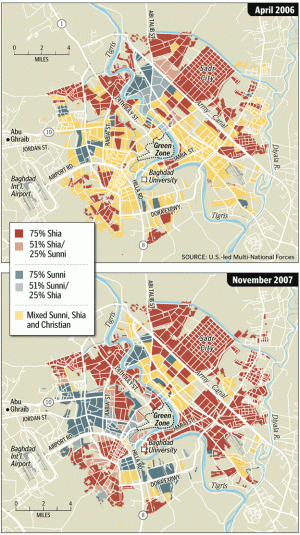
Editor’s Commentchanging-baghdad.gif — The good news coming out of Iraq is that most Iraqis see an end to the U.S. occupation as being the key to national reconciliation. The bad news is that the damage done to Iraq’s social frabric over the last five years is going to be extremely difficult to repair. The problem is starkly depicted in these two maps of Baghdad. In the space of eighteen months, the city has transformed from being predominently made up of mixed neighborhoods (depicted in yellow), to being sharply divided between Shia and Sunni sectors. Now, colliding with this division are returning refugees:

A small fraction of the millions of refugees who fled Iraq have come back. While the government trumpeted their return as proof of newfound security, migration experts said most of them were forced back by expired visas and depleted savings…

The American military has expressed deep concerns about the Iraqi government’s ability to feed and house its returnees, or manage people who wish to reclaim their homes. It is widely feared that property disputes or efforts to return to newly homogenized neighborhoods could set off fresh waves of sectarian attacks.

For most Iraqi refugees, the trip home is just the beginning of their troubles. Many return to find their homes destroyed or filled with squatters, most of them displaced people themselves. But the government committee that decides property disputes is charged with hearing only cases that predate the invasion of 2003.

Strategy that is making Iraq safer was snubbed for years

[A] USA TODAY investigation shows that the strategy now used to defeat the bombmaking networks and stabilize Iraq was ignored or rejected for years by key decision-makers. As early as 2004, when roadside bombs already were killing scores of troops, a top military consultant invited to address two dozen generals offered a “strategic alternative” for beating the insurgency and IEDs.

That plan and others mirroring the counterinsurgency blueprint that the Pentagon now hails as a success were pitched repeatedly in memos and presentations during the following two years, at meetings that included then-Defense secretary Donald Rumsfeld, Secretary of State Condoleezza Rice and Vice President Cheney’s chief of staff, Lewis “Scooter” Libby.

The core of the strategy: Clear insurgents from key areas and provide security to win over Iraqis, who would respond by helping U.S. forces break IED networks and defeat the insurgency.

Bush administration officials, however, remained wedded to the idea that training the Iraqi army and leaving the country would suffice. Officials, including Cheney, insisted the insurgency was dying. Those pronouncements delayed the Pentagon from embracing new plans to stop IEDs and investing in better armored vehicles that allow troops to patrol more freely, documents and interviews show.

Even after the Pentagon began committing substantial resources to combat IEDs, USA TODAY found, its spending focused mostly on high-tech devices with limited utility. Some silver-bullet solutions, such as microwave beams designed to destroy IEDs before they blew up, never worked.

By the time the Pentagon moved to a counterinsurgency strategy at the end of last year, the bombs had been the top killer of U.S. troops for three years, claiming more than 1,160 lives. To date, they are responsible for more than 60% of combat deaths. [complete article]

Facebooktwittermail

NEWS: Madhi Army makeover; Kirkuk’s Arab-Kurdish divide

Sadr militia moves to clean house

Militia commander Abu Maha had studied his quarry carefully, watching as the man acquired fancy suits, gold watches and the street name “Master.” Now, heavily armed and dressed in an Adidas track suit, Abu Maha told his followers it was time to act against one of their comrades.

A dozen of them gripped their assault rifles and headed out. The Master, accused of sliding into immoral behavior after stoutly defending Shiite Muslims in Iraq’s sectarian violence, was about to learn that justice in the Mahdi Army could be very rough.

Fighters such as Abu Maha have taken on a new role in recent months in the militia of Shiite cleric Muqtada Sadr. Instead of battling Sunni insurgents and U.S. troops, they are now weeding out what they consider to be black sheep within their ranks. [complete article]

As Iraqis vie for Kirkuk’s oil, Kurds become pawns

Even by the skewed standards of a country where millions are homeless or in exile, the squalor of the Kirkuk soccer stadium is a startling sight.

On the outskirts of a city adjoining some of Iraq’s most lucrative oil reserves, a rivulet of urine flows past the entrance to the barren playing field.

There are no spectators, only 2,200 Kurdish squatters who have converted the dugouts, stands and parking lot into a refugee city of cinder-block hovels covered in Kurdish political graffiti, some for President Jalal Talabani’s Patriotic Union of Kurdistan.

These homeless Kurds are here not for soccer but for politics. They are reluctant players in a future referendum to decide whether oil-rich Tamim Province in the north and its capital, Kirkuk, will become part of the semiautonomous Kurdish regional government or remain under administration by Baghdad.

Under the Iraqi Constitution the referendum is due before Dec. 31. But in a nation with a famously slow political clock, one of the few things on which Kirkuk’s Kurdish, Arab and Turkmen communities agree is that yet another political deadline is about to be missed. [complete article]

Facebooktwittermail

ANALYSIS: A unified front in Iraqi Shiite politics

The Hakim-Sadr pact: A new era in Shiite politics?

The recent “pact of honor” made by two of Iraq’s most influential Shiite clerics, Moqtada al-Sadr and Abdul Aziz al-Hakim—aimed at preventing violence and helping to maintain the “Islamic and national interest” of Iraq—appears to signal a significant shift toward stability in Iraq. The two leaders have pledged to enhance relations between their respective groups, merging media and cultural projects, and to refrain from launching negative propaganda against each other (Fars News Agency, October 6). Yet, more importantly, the pact calls for promotion of the legal-political order of post-Baathist Iraq, a major move that could give new life to Nuri al-Maliki’s government and curtail potential violence in the south. As the first official agreement between these two prominent leaders, the forged pact can also be recognized as a huge step in improving intra-Shiite relations. Not since the formation of the United Iraqi Alliance, which brought together a number of Shiite political parties under the spiritual leadership of Ayatollah Ali al-Sistani in 2003, has Shiite politics seen such a unified front. [complete article]

Facebooktwittermail

OPINION: “I’m tired of being branded a terrorist: tired that a human life lost in my county is no loss at all.”

To be a journalist in Iraq

“To be a journalist in violence-ridden Iraq today, ladies and gentlemen, is not a matter lightly undertaken. Every path is strewn with danger, every checkpoint, every question a direct threat.

“Every interview we conduct may be our last. So much is happening in Iraq. So much that is questionable. So much that we, as journalists, try to fathom and portray to the people who care to know.

“In every society there is good and bad. Laws regulate the conduct of the society. My country is now lawless. Innocent blood is shed every day, seemingly without purpose. Hundreds of thousands have been killed for seemingly no reason. It is our responsibility to do our utmost to acquire the answers, to dig them up with our bare hands if we must.

“But that knowledge comes at a dear price, for since the war started, four and half years ago, an average of about one reporter and media assistant killed every week is something we have to live with.” [complete article]

Facebooktwittermail

ANALYSIS: Scenarios for a post-occupation Iraq

Post-U.S. Scenarios: the bad, the worse, and the ugly

Let’s just get the wishful thinking out of the way first. Peace won’t break out if and when the United States leaves Iraq; violence will continue, and possibly get worse. That’s not a rationale for leaving the troops in place, just a hard reality. How bad, exactly, will it be? Here are four scenarios, ranging from the horrific to the somewhat hopeful. [complete article]

Facebooktwittermail

NEWS: Iraqi contracts with Iran and China concern U.S.; Putin pledges to complete Iranian nuclear reactor

Iraqi contracts with Iran and China concern U.S.

Iraq has agreed to award $1.1 billion in contracts to Iranian and Chinese companies to build a pair of enormous power plants, the Iraqi electricity minister said Tuesday. Word of the project prompted serious concerns among American military officials, who fear that Iranian commercial investments can mask military activities at a time of heightened tension with Iran.

The Iraqi electricity minister, Karim Wahid, said that the Iranian project would be built in Sadr City, a Shiite enclave in Baghdad that is controlled by followers of the anti-American cleric Moktada al-Sadr. He added that Iran had also agreed to provide cheap electricity from its own grid to southern Iraq, and to build a large power plant essentially free of charge in an area between the two southern Shiite holy cities of Karbala and Najaf.

The expansion of ties between Iraq and Iran comes as the United States and Iran clash on nuclear issues and about what American officials have repeatedly said is Iranian support for armed groups in Iraq. American officials have charged that Iranians, through the international military wing known as the Quds Force, are particularly active in support of elite elements of the Mahdi Army, a militia largely controlled by Mr. Sadr. [complete article]

Vladimir Putin pledges to complete Iranian nuclear reactor

President Putin forged an alliance with Iran yesterday against any military action by the West and pledged to complete the controversial Iranian nuclear power plant at Bushehr.

A summit of Caspian Sea nations in Tehran agreed to bar foreign states from using their territory for military strikes against a member country. Mr Putin, the first Kremlin leader to visit Iran since the Second World War, insisted that the use of force was unacceptable.

“It is important… that we not only not use any kind of force but also do not even think about the possibility of using force,” he told the leaders of Iran, Azerbaijan, Kazakhstan and Turkmenistan. [complete article]

Putin calls war in Iraq ‘pointless’

President Vladimir Putin, in his latest jab at Washington, suggested Thursday that the U.S. military campaign in Iraq was a ”pointless” battle against the Iraqi people, aimed in part at seizing the country’s oil reserves.

Putin has increasingly confronted U.S. foreign policy in recent months, deepening the chill between Washington and Moscow. Among other things, he has questioned U.S. plans for a missile defense system in Europe and the U.S. push for sanctions against Iran for its nuclear programs. [complete article]

Olmert urges Putin to back new Iran sanctions

Prime Minister Ehud Olmert met Tuesday with President Vladimir Putin, pressing Moscow to support new sanctions on Tehran over its nuclear activities and urging Russia not to sell arms to Iran or Syria.

Hosting Olmert for a brief, abruptly announced visit, Putin promised to brief the Israeli leader on his talks with Iranian leaders this week and acknowledged his guest’s dismay over Tehran’s nuclear program, which Israel and the United States say is aimed at developing atomic weapons. [complete article]

Facebooktwittermail