Human Rights Watch: Saudi Arabia-led coalition airstrikes using United States-supplied bombs killed at least 97 civilians, including 25 children, in northwestern Yemen on March 15, 2016, Human Rights Watch said today. The two strikes, on a crowded market in the village of Mastaba that may have also killed about 10 Houthi fighters, caused indiscriminate or foreseeably disproportionate loss of civilian life, in violation of the laws of war. Such unlawful attacks when carried out deliberately or recklessly are war crimes.
Human Rights Watch conducted on-site investigations on March 28, and found remnants at the market of a GBU-31 satellite-guided bomb, which consists of a US-supplied MK-84 2,000-pound bomb mated with a JDAM satellite guidance kit, also US-supplied. A team of journalists from ITV, a British news channel, visited the site on March 26, and found remnants of an MK-84 bomb paired with a Paveway laser guidance kit. Human Rights Watch reviewed the journalists’ photographs and footage of these fragments.
“One of the deadliest strikes against civilians in Yemen’s year-long war involved US-supplied weapons, illustrating tragically why countries should stop selling arms to Saudi Arabia,” said Priyanka Motaparthy, emergencies researcher at Human Rights Watch. “The US and other coalition allies should send a clear message to Saudi Arabia that they want no part in unlawful killings of civilians.” [Continue reading…]
Category Archives: Lands
Before Zionism: The shared life of Jews and Palestinians
Noam Rotem writes: Menachem Klein’s book, Lives in Common: Arabs and Jews in Jerusalem, Jaffa and Hebron, is a depressing one. Originally released in English, the book — which is being published in Hebrew — paints a picture of a shared life between Palestinians and Jews at the end of the 19th and the beginning of the 20th centuries, bringing us face to face with daily life, commerce, education, celebrations, and sadness. It shows that us this kind existence, despite everything we were taught by the Israeli education system, is possible. And then Klein goes on and destroys this delicate balance, burning everything left of it today.
As the Ottoman Empire, which ruled Palestine at the time, began losing its power toward the end of the 19th century, a new, local identity began developing out of the lived experiences of Jews and Arabs. This identity, which took precedence over religion, was shared by Muslims, Jews, and Christians.
Israel’s education minister wants to reduce Jewish history to pogroms By Gil Gertel | March 12, 2016
Following the collapse of the Ottoman Empire during the First World War, both the Zionist movement and the Palestinian national movement began trying to take control of that identity and define the people of the land as either Jewish Zionists or Palestinian Arabs. There were those who called for unity, such as Jerusalem Mayor Raghib al-Nashashibi, who wanted not to speak of Arabs and Jews, but of Palestinians. Klein debunks the myth according to which the residents of the country before the advent Zionism or the Arab national movement lacked all identity. Instead, he describes a lively and vivacious community with its own traditions and customs, bringing testimonies from Jews, Muslims and foreigners as proof. [Continue reading…]
Distract, deceive, destroy: Putin at war in Syria

Atlantic Council: A new Atlantic Council report uses open-source data to debunk Russian claims that its military mostly struck Islamic State of Iraq and al-Sham (ISIS) targets, and links Russia to attacks on civilian facilities and the use of cluster bombs in Syria. So why haven’t Western governments that have more sophisticated intelligence capabilities employed similar technologies and techniques to counter Russian propaganda?
“Just as we saw an abuse of intelligence under the [George W.] Bush administration to make a case for specific action [in Iraq], I think you are seeing not as large an abuse but not proper use of intelligence right now because if they were to put this stuff out this would push their policy in a direction in which I don’t think they want to go,” said John E. Herbst, Director of the Atlantic Council’s Dinu Patriciu Eurasia Center.
Eliot Higgins, a Nonresident Senior Fellow at the Council’s Future Europe Initiative, said he didn’t think that the US government is using open-source data as much as one would assume. “In any bureaucratic establishment, it is going to take a long time for the wheels to turn and for this to be actually something that they do on a regular basis,” he said.
Herbst and Higgins are co-authors of the Atlantic Council report “Distract, Deceive, Destroy: Putin at War in Syria,” which was launched in Washington on April 5. [Continue reading…]
Andrew Bacevich: Presidential wars
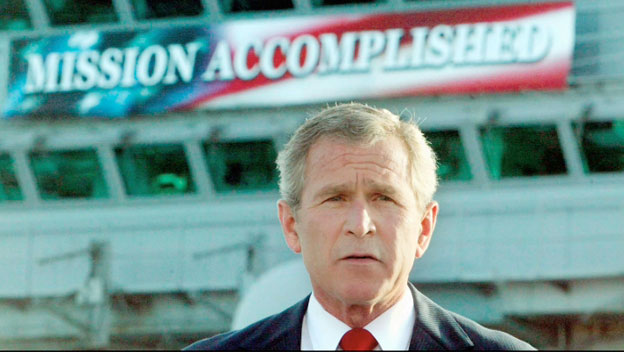
It was a large banner and its message was clear. It read: “Mission Accomplished,” and no, I don’t mean the classic “mission accomplished” banner on the USS Abraham Lincoln under which, on May 1, 2003, President George W. Bush proudly proclaimed (to the derision of critics ever since) that “major combat operations in Iraq have ended.” I’m actually referring to a September 1982 banner with those same two words (and an added “farewell” below them) displayed on a landing craft picking up the last Marines sent ashore in Beirut, Lebanon, to be, as President Ronald Reagan put it when they arrived the previous August, “what Marines have been for more than 200 years — peace-makers.” Of course, when Bush co-piloted an S-3B Viking sub reconnaissance Naval jet onto the deck of the Abraham Lincoln and made his now-classic statement, major combat had barely begun in Iraq (and it has yet to end) — nor was it peace that came to Beirut in September 1982: infamously, the following year 241 Marines would die there in a single day, thanks to a suicide bomber.
“Not for the last time,” writes Andrew Bacevich in his monumental new work, America’s War for the Greater Middle East: A Military History, “the claim proved to be illusory.” Indeed, one of the grim and eerie wonders of his book is the way in which just about every wrongheaded thing Washington did in that region in the 14-plus years since 9/11 had its surprising precursor in the two decades of American war there before the World Trade Center towers came down. U.S. military trainers and advisers, for example, failed (as they later would in Iraq and Afghanistan) to successfully build armies, starting with the Lebanese one; Bush’s “preventive war” had its predecessor in a Reagan directive called (ominously enough given what was to come) “combating terrorism”; Washington’s obsessive belief of recent years that problems in the region could be solved by what Andrew Cockburn has called the “kingpin strategy” — the urge to dismantle terror organizations by taking out their leadership via drones or special operations raids — had its precursor in “decapitation” operations against Muammar Gaddafi, Saddam Hussein, and Somali warlord Mohamed Farrah Aidid with similar resulting mayhem. The belief that “an additional increment of combat power might turn around a failing endeavor” — call it a “surge,” if you will — had its Iraq and Afghan pretrial run in Somalia in 1993. And above all, of course, there was Washington’s unquenchable post-1980 urge to intervene, military first, in a decisive way throughout the region, which, as Bacevich writes, only “produced conditions conducive to further violence and further disorder,” and if that isn’t the repetitive history of America’s failed post-2001 wars in a nutshell, what is?
As it happened, the effects of such actions from 1980 on were felt not just in the Greater Middle East and Africa, but in the United States, too. There, as Bacevich writes today, war became a blank-check activity for a White House no longer either checked (in any sense) or balanced by Congress. Think of it as another sad tale of a surge (or do I mean a decapitation?) that went wrong. Tom Engelhardt
Writing a blank check on war for the president
How the United States became a prisoner of war and Congress went MIA
By Andrew J. BacevichLet’s face it: in times of war, the Constitution tends to take a beating. With the safety or survival of the nation said to be at risk, the basic law of the land — otherwise considered sacrosanct — becomes nonbinding, subject to being waived at the whim of government authorities who are impatient, scared, panicky, or just plain pissed off.
The examples are legion. During the Civil War, Abraham Lincoln arbitrarily suspended the writ of habeas corpus and ignored court orders that took issue with his authority to do so. After U.S. entry into World War I, the administration of Woodrow Wilson mounted a comprehensive effort to crush dissent, shutting down anti-war publications in complete disregard of the First Amendment. Amid the hysteria triggered by Pearl Harbor, Franklin Roosevelt issued an executive order consigning to concentration camps more than 100,000 Japanese-Americans, many of them native-born citizens. Asked in 1944 to review this gross violation of due process, the Supreme Court endorsed the government’s action by a 6-3 vote.
More often than not, the passing of the emergency induces second thoughts and even remorse. The further into the past a particular war recedes, the more dubious the wartime arguments for violating the Constitution appear. Americans thereby take comfort in the “lessons learned” that will presumably prohibit any future recurrence of such folly.
Dilip Hiro: Flashpoint for the planet
Once upon a time, if a war was going to destroy your world, it had to take place in your world. The soldiers had to land, the planes had to fly overhead, the ships had to be off the coast. No longer. Nuclear war changed that equation forever and not just because nuclear weapons could be delivered from a great distance by missile. To use a term that has become commonplace in our world when discussing commerce, the prospect of nuclear conflict has globalized war and it’s a nightmare of the first order.
In the post-Cold War world, Exhibit A in that process would certainly be the unnerving potential for a nuclear war to break out between India and Pakistan. As TomDispatch regular Dilip Hiro, author most recently of The Age of Aspiration: Money, Power, and Conflict in Globalizing India, makes clear today, there is no place on the planet where a nuclear war is more imaginable. After all, those two South Asian countries have been to war with each other or on the verge of it again and again since they were split apart in 1947.
Of course, a major nuclear war between them would result in an unimaginable catastrophe in South Asia itself, with casualties estimated at up to 20 million dead from bomb blasts, fire, and the effects of radiation on the human body. And that, unfortunately, would only be the beginning. As Alan Robock and Owen Brian Toon wrote in Scientific American back in 2009, when the Indian and Pakistani arsenals were significantly smaller than they are today, any major nuclear conflagration in the region could hardly be confined to South Asia. The smoke and particulates thrown into the atmosphere from those weapons would undoubtedly bring on some version of a global “nuclear winter,” whose effects could last for at least 10 years, causing crop shortfalls and failures across the planet. The cooling and diminished sunlight (along with a loss of rainfall) would shorten growing seasons in planetary breadbaskets and produce “killing frosts in summer,” triggering declines in crop yields across the planet. Robock and Toon estimate that “around one billion people worldwide who now live on marginal food supplies would be directly threatened with starvation by a nuclear war between India and Pakistan.”
To say the least, it’s a daunting prospect at the very moment when the Obama White House has just ended the president’s final Nuclear Security Summit with fears rising that Pakistan’s new generation of small, front-line tactical nuclear weapons are “highly vulnerable to theft or misuse.” Hiro, an expert on the South Asian region, suggests just why a nuclear war is all too conceivable there and would be a catastrophe for us all. Tom Engelhardt
The most dangerous place on Earth
A nuclear Armageddon in the making in South Asia
By Dilip HiroUndoubtedly, for nearly two decades, the most dangerous place on Earth has been the Indian-Pakistani border in Kashmir. It’s possible that a small spark from artillery and rocket exchanges across that border might — given the known military doctrines of the two nuclear-armed neighbors — lead inexorably to an all-out nuclear conflagration. In that case the result would be catastrophic. Besides causing the deaths of millions of Indians and Pakistanis, such a war might bring on “nuclear winter” on a planetary scale, leading to levels of suffering and death that would be beyond our comprehension.
Alarmingly, the nuclear competition between India and Pakistan has now entered a spine-chilling phase. That danger stems from Islamabad’s decision to deploy low-yield tactical nuclear arms at its forward operating military bases along its entire frontier with India to deter possible aggression by tank-led invading forces. Most ominously, the decision to fire such a nuclear-armed missile with a range of 35 to 60 miles is to rest with local commanders. This is a perilous departure from the universal practice of investing such authority in the highest official of the nation. Such a situation has no parallel in the Washington-Moscow nuclear arms race of the Cold War era.
Panama Papers firm linked to over 1,000 U.S. companies mostly in Nevada and Wyoming
USA Today reports: The law firm at the hub of a global financial scandal has links to more than 1,000 U.S. companies, formed mostly in Nevada and Wyoming since 2001, but appears to have largely escaped the scrutiny of U.S. financial regulators — at least in public.
The leak this week of more than 11 million records from the Panamanian firm, Mossack Fonseca, has led to a global uproar that prompted Iceland’s prime minister to step aside Tuesday. An international consortium of journalists has reported the documents tie the firm, which specializes in shell companies that can be used to conceal assets, to Russian oligarchs, former heads of state and world soccer’s scandal-plagued governing body.
Yet despite those apparent dealings and its operations in the United States, the firm has appeared in only a scattering of court cases and regulatory filings. Most involve government attempts to track money the authorities believed had been concealed behind overseas shell companies the firm helped establish.
The Justice Department is “reviewing the reports” published by international journalists, the head of its Criminal Division, Leslie Caldwell, said Tuesday, but declined to elaborate.
The firestorm around Mossack Fonseca has been tied mostly to its work for foreign customers. But state incorporation records show the firm helped set up nearly 1,100 business entities in the United States since 2001.
The majority of U.S.-based companies linked to Mossack Fonseca were formed in Nevada by M.F. Corporate Services (Nevada) Limited, a one-employee company based out of a low-slung tile-roofed office building 20 miles from the Las Vegas strip. MF Nevada has served as the registered agent for 1,026 business entities since 2001, according to USA TODAY’s review of Nevada business documents. [Continue reading…]
Italian official warns Egypt over inquiry into Giulio Regeni’s death
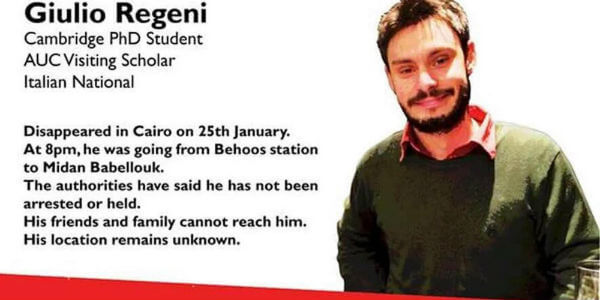
The New York Times reports: The foreign minister of Italy said Tuesday that his government would take “immediate and proportional” measures against Egypt if it failed to help uncover the truth behind the death of an Italian graduate student in Cairo two months ago.
“We will stop only when we will find the truth, the real one,” Foreign Minister Paolo Gentiloni told Parliament, adding that he would not accept any “fabrication.”
The threat by Mr. Gentiloni came the day before a team of Egyptian investigators was scheduled to land in Rome for meetings on the case of the student, Giulio Regeni, 28, a doctoral candidate, whose brutalized body was discovered on a roadside in February in Cairo. [Continue reading…]
Saudi Arabia passes Russia as world’s third biggest military spender
The Washington Post reports: Global military spending reached almost $1.7 trillion in 2015, marking a year-on-year increase for the first time since 2011, according to the Stockholm International Peace Research Institute, which tracks arms expenditure around the world.
The United States remained far and away the top spender, which despite a dip from 2014, accounted for more than a third of total global spending. It was followed by China and then, perhaps surprisingly, Saudi Arabia, which supplanted Russia in third place. [Continue reading…]
One of Libya’s rival governments steps down as new UN-brokered unity government is installed
The Associated Press reports: One of Libya’s rival governments has resigned, a step that helps efforts by a new, UN-brokered unity government to assert itself in the capital Tripoli despite opposition from some local militias.
In a statement, the Tripoli-based National Salvation government said it would “cease duties” as executive authority, and therefore absolve itself of responsibility for the country’s fate.
“We put the interests of the nation above anything else, and stress that the bloodshed stop and the nation be saved from division and fragmentation,” the statement read.
Western nations view the new unity government as the best hope for ending Libya’s chaos and uniting all factions against an increasingly powerful Islamic State affiliate, which has seized the central city of Sirte. Another government, based in the eastern city of Tobruk, still opposes the UN-backed body. [Continue reading…]
The Washington Post reports: The United States and European allies, including Italy, France and Britain, have made the unity government’s establishment a key precondition for launching twin missions to begin an international stabilization effort and help combat a growing Islamic State affiliate there.
Each of those tasks will be strained by tensions among militia factions that Western nations hope will form a unified front against terrorist groups and by strong reluctance among European nations to wade into Libya’s chaos — even among those countries most threatened by the Islamic State’s growth across the Mediterranean.
The tentative political progress comes as the United States moves forward with plans to launch intensified attacks against the Islamic State’s Libyan branch, which has up to 8,000 fighters and is the group’s strongest affiliate outside Iraq and Syria. [Continue reading…]
The Panama Papers: Where are the Americans?
Politico reports: The Panama Papers sent ripples across the globe Monday after revealing that 140 politicians from more than 50 countries, including Russian President Vladimir Putin and Iceland President Sigmundur David Gunnlaugsson, were linked to offshore accounts set up by the Panamanian law firm Mossack Fonseca.
Despite its breadth, the scandal so far has barely touched American individuals and companies. There were no mass protests, as occurred in Iceland where protesters demanded the resignation of Gunnlaugsson; no U.S. leaders were forced to deny accusations of tax evasion as Putin did.
How have Americans so far escaped the biggest leak of financial data of all time? It’s not because wealthy Americans don’t use offshore bank accounts to avoid U.S. taxes: they do — to the tune of $1.2 trillion in 2014, according to one estimate. Some professors have suggested that Americans may have disguised their accounts at Mossack Fonseca behind another party. But there’s also a more structural answer, tax experts say — one that has to do with shifts in global financial policy — and, to an extent, taste.
Tax evasion overall is a far larger problem in developing countries, where norms around paying taxes are weak and rules designed to stop such evasion are ineffective. And when wealthy Americans do want to evade taxes, they turn to Bermuda, or the Cayman Islands, or Singapore. They don’t park their money in Panama. [Continue reading…]
Why Vladimir Putin will hardly flinch at Panama paper cut
By Anastasia Nesvetailova, City University London
The world remains gripped by the revelations made in the papers leaked from Panamanian law firm Mossack Fonseca. But Moscow has greeted the coverage with what might be characterised as calm indifference.
Aware that president Vladimir Putin would be linked to offshore schemes, the people around him began their PR manoeuvres ahead of time. The week before the papers were released, the Kremlin was forewarning the public about an imminent “information attack aimed at destabilising Russia in light of its success in Syria”.
The reaction of the Russian individuals mentioned in the Panama Papers – at least those who have gone on record so far – has also been calm. Some have denied knowledge of ownership of any offshore accounts. Considering the way offshore structures operate and set up, is not an implausible proposition.
Others queried the authenticity of the documents (which is easy, as not all of the original documents have been presented). Some have admitted an earlier relationship with an offshore business but have said the company in question had been sold or shut down. Again, that’s not an odd claim considering that many offshore shells survive as empty, or fossil corporations after their corporate parents have no further use for them and don’t want to go to the expense of shutting them down.
Mossack Fonseca serviced Rami Makhlouf, Assad’s cousin and ‘poster boy for corruption’
The Guardian reports: The firm at the centre of the Panama Papers leak serviced a string of companies for a top financier in Bashar al-Assad’s government in the face of international concern about corruption within the Syrian regime.
Documents show Mossack Fonseca’s links to Rami Makhlouf, a cousin of the Syrian president, who was described in US diplomatic cables as the country’s “poster boy for corruption”.
Washington imposed sanctions on Makhlouf in February 2008, saying he was a regime insider who “improperly benefits from and aids the public corruption of Syrian regime officials”. It blacklisted his brother Hafez Makhlouf in 2007.
The documents show, however, that the Panamanian firm continued to work with the Makhloufs, and in January 2011 it rejected the advice of its own compliance team to cut ties with the family as the crisis in Syria began to unfold.
Documents show a Mossack Fonseca compliance officer wrote: “I believe if an individual is found on a sanction list then this is a serious red flag and we should make every effort to disassociate ourselves from them.” [Continue reading…]
Hundreds of Israelis exposed in Panama Papers financial scandal
Haaretz reports: Some 600 Israeli companies and 850 Israeli shareholders are listed in the leaked documents of Panamanian law firm Mossack Fonseca, a leader in creating shell companies that often serve to conceal ownership of assets.
The leaked files, which were obtained by the German newspaper Süddeutsche Zeitung and shared by the International Consortium of Investigative Journalists with Haaretz and other media organizations, provide a glimpse of the economy that until now had been hidden from the Israeli public.
There is a number of prominent names among the shareholders. It is important to note that as long as holdings in the companies and their revenues — if any — are reported as required to Israeli tax authorities, owning the company is not against the law.
Mossack Fonseca’s branch in Israel is headed by attorney Amir Maor. Callers to the branch are informed by a voicemail message that they have reached the offices of “The Company for Establishing Companies.”
Reached by telephone, Maor stated that Mossack Fonseca informed its Israeli branch last week that files had been stolen after its computer systems were breached. “Any information you use [from these files] is like using stolen data,” he said, refusing to give further comment.
The leaked files mention Sapir Holdings, a company registered in 2002 in the Virgin Islands. The owner and its only director was top-ranking lawyer Jacob Weinroth. He was indicted for money laundering in late 2009 and acquitted two years later of all charges against him. During the trial, it emerged that the company had received 30 million shekels ($7.95 million) for services rendered from Uzbek-Israeli entrepreneur Michael Cherney and Russian-Israeli businessman Arcady Gaydamak.
The fraudulent real estate deal of 2002 with the Greek Orthodox Patriarchate was also brought up in the trail. The failed deal, in which expensive lands in Jerusalem were offered to the State of Israel for a 999-year lease, was intended to be carried out by Christian Lands of Israel, a company created by Mossack Fonseca, which Weinroth represented. Company documents, like those requesting power of attorney for Weinroth, are among those found in the leaked files. [Continue reading…]
Islamist rebel groups press offensive in northern Syria
The Wall Street Journal reports: A tenuous cease-fire in Syria unraveled further over the past few days, with rebel groups that signed on joining the al Qaeda-linked Nusra Front in a new offensive against regime forces near the northern city of Aleppo.
Amid the offensive in its fourth day on Monday, Nusra supporters were mourning a top figure in the group and nearly two dozen of his associates killed in airstrikes in northwestern Idlib province on Sunday.
Nusra supporters blamed the airstrike on the U.S., which has previously targeted the group’s fighters in Idlib, its stronghold.
A spokesman for the American-led coalition that is mainly battling Islamic State wouldn’t immediately confirm nor deny the allegation. Russia and the Syrian regime also conduct airstrikes on opponents in the area.
The truce has been imperiled by an escalation of regime airstrikes on rebel-held suburbs of the capital Damascus over the past week. Despite a rapidly rising toll of alleged violations, both sides appear reluctant to call off the agreement which has reduced violence and deaths after all.
“The cessation of hostilities agreement is about to take its last breath and effectively be declared finished,” Riad Hijab, an opposition leader, warned in a letter to United Nations Secretary General Ban Ki-moon on Friday. Mr. Hijab heads the main opposition delegation to the Geneva peace talks.
Continuing regime restrictions on humanitarian assistance to several besieged rebel-held areas around Damascus are further straining the shaky truce. Residents of one such town, Madaya, said a sick teenager died Monday because of lack of medical care.
Regime airstrikes on a rebel-held community near Damascus on Thursday killed 33 people, almost half of them children, according to a tally by local emergency responders. [Continue reading…]
Does ISIS even have a European strategy?

Benjamin H. Friedman writes: With the bombers dead and investigations just a week old, the motives behind last week’s bombings in Brussels’ airport and metro will remain murky for some time. Of course, reporters and terrorism analysts have offered lots of speculation, much of it focused on how the attacks serve the agenda of ISIS’s leaders. That approach, I believe, overstates ISIS’s coherence and wisdom. If “ISIS” means the would-be state in Syria in Iraq, plus affiliated groups and clandestine networks of sympathizers, then it doesn’t have a strategy; it has strategies, often foolish ones.
Statements claiming responsibility for the attack, attributed to ISIS’s leadership in Syria, blame Belgium for joining in the war in Syria and Iraq and threaten coalition members with similar treatment. The attack, in other words, was meant to coerce foreign powers to quit making war on ISIS.
Those statements are indications that ISIS’s leaders didn’t know the particulars of the attack in advance, let alone direct it. Like some prior ISIS’s claims of reasonability for attacks, the statements seem to crib from media reports; they arrived hours after attacks without any detail unavailable in public. By claiming that the airport attackers “opened fire” with “automatic rifles,” the statements even repeat errors in initial reporting. [Continue reading…]
In Nagorno-Karabakh, a bloody new war with Putin on both sides
The Daily Beast reports: Nagorno-Karabakh, an enclave in Azerbaijan that became breakaway republic backed by Armenia in all spheres of life, has been living in a not-quite-frozen state of war since 1994. Every schoolboy in the mountainous little republic has grown up knowing that after graduation he will put on a uniform and join the military to police the unstable cease-fire. The republic’s 150,000 people, mostly ethnic Armenians, remember rockets destroying apartment buildings in the fighting more than 20 years ago, and have long feared that their worst nightmare of full-scale war would return.
Now it looks like it has.
The war woke up on Saturday night with both sides of the front using armored vehicles, battle tanks, and aviation, launching multiple rockets, and shooting artillery at each other. Over 30 people were killed and dozens wounded in the worst combat in the last two decades.
The regional implications are hard to miss. Armenia is one of Russia’s closest allies and Turkey immediately backed up Azerbaijan at a time when relations between Moscow and Ankara are bitter and vindictive. Given the war in Syria, where Russia and Turkey back opposing sides, and Turkey shot down a Russian warplane in November, the current eruption between Armenia and Azerbaijan is even more geopolitically dangerous than two decades ago. [Continue reading…]
Giulio Regeni murder: Egypt postpones Italy meeting as criticism mounts

The Guardian reports: Egypt has postponed a meeting in Rome at which a Cairo delegation was due to hand over evidence relating to the torture and murder of the Italian researcher Giulio Regeni.
The highly anticipated meeting was scheduled for Tuesday but is now expected later this week. There is a growing perception in Italy that cracks are beginning to emerge in Egypt over how the government of President Abdel Fatah al-Sisi has handled the murder investigation.
Italy’s foreign minister, Paolo Gentiloni, will outline the government’s position on the case in a parliamentary statement on Tuesday, his ministry said.
Regeni’s body was found in a ditch off a desert road on 3 February, more than a week after the 28-year-old – a Cambridge PhD student researching labour unions in Egypt – disappeared. [Continue reading…]
Afghan spy agency arms villagers to hold off ISIS
The Wall Street Journal reports: n Afghan spy agency is recruiting villagers for militias to hold back Islamic State fighters seeking to expand their foothold in this opium heartland in eastern Afghanistan.
The program, which one top official says the government hopes to roll out across the country and may later use against the Taliban, is President Ashraf Ghani ’s riskiest attempt to defend rural villages—and also a part of his much larger counterinsurgency strategy.
The government has closely guarded the program, and news of it essentially hasn’t been reported since its establishment in August 2015. Details of the program came from Afghan government officials, local village leaders and Western officials who have been monitoring its progress.
The militia groups that are part of the pilot project, known as the People’s Uprising Program, are being called on to hold territory the army has recaptured from Islamic State in three districts.
More than a thousand men, mostly village farmers who turned against the extremist group’s harsh rule in areas it seized in the past year, are on the payroll of the spy agency, the National Directorate of Security, which receives funding from the U.S. Central Intelligence Agency. So far, the militias in Kot, with the backing of the army and police, have repelled six Islamic State attacks. [Continue reading…]