The Guardian reports: The Neil Armstrong of the Arab world has an office in a ramshackle building in Istanbul’s Fatih or “Little Syria”. Muhammed Faris is a refugee, just like the people milling outside, facing up to the hardest challenge in his life; one that has already seen the roles of fighter pilot, spaceman, military advisor to the Assad regime; protester, rebel and defector.
In Syria, Faris is a national hero, with a school, airport and roads named after him. Medals on the wall of his office honour his achievements as an astronaut (or, strictly speaking, a cosmonaut). Here, hundreds of miles from his birthplace, Aleppo, he campaigns for democratic change in Syria, “through words, not weapons”.
In 1985, he was one of four young Syrian men vying to join the Interkosmos training programme, for allies of the Soviet Union, at Star City just outside Moscow. There had been one Arab in space before, Sultan Bin Salman Al Saud, a member of the Saudi royal family, but never a professional Arab spaceman. Despite the thawing of the cold war, US relations with Iran and its ally Syria were deteriorating. Syrian ties to the Soviet Union were strong: Russia supported Bashar’s father, Hafez Assad, in his rise to power in a coup in 1970. In return, the Soviets were allowed to open a naval base in Tartus, which remains in Russian hands today. [Continue reading…]
Category Archives: Lands
Syrian government forces open new battle with rebels in northwest
Reuters reports: Syrian government forces launched an attack on Wednesday to capture a rebel-held hill in north-western Syria, a rebel official and the Syrian Observatory for Human Rights reported, an expansion of operations that have continued in that area despite a deal to cease fighting.
Rebels said the assault on Kabani hill in the province of Latakia was supported by Russian air strikes.
Both the government and rebels have accused each other of violating the truce, which came into effect on Saturday. The agreement does not include Islamic State or the Nusra Front, an al Qaeda-linked group that has a wide presence in northwestern Syria. [Continue reading…]
Regime warns residents of besieged Damascus suburbs
NOW reports: The Syrian regime has dropped leaflets over rebel-held suburbs of Damascus bearing a warning of further destruction, despite the beginning of a fragile cessation of hostilities over the weekend.
The foreboding leaflets delivered Tuesday morning and over the past few days by military helicopters flying above the besieged eastern Ghouta suburbs of Syria’s capital called on residents to give up arms in return for an amnesty.
“It is far better for you to choose the path of safety and peace than the path of war and destruction,” one of the leaflets warned. [Continue reading…]
Once I saw light in Iran — now it’s mostly shadows

Azadeh Moaveni writes: I remember vividly the first time I ever voted in an Iranian election. It was a balmy summer day in June 2001, in the election that won the reformist president Mohammad Khatami a second term. The blue stamp was the first on the voting page of my identification card, and I felt a sharp, exhilarating pride.
That election is much on my mind now, as I watch the results of Friday’s voting with my family, disagreeing on what it might mean for the future.
Back in 2001, Iran was heading down an irrevocable path toward internal reform, a process untainted by any Western intrusion, with citizens and progressive-minded leaders showing the way. Those leaders seemed, at the time, as exciting as Vaclav Havel and the revolutionary cleric Musa al-Sadr rolled into one. Elections felt — unlike the vote this past weekend — full of consequence, a genuine chance to recast political power rather than an exercise in slightly recalibrating it.
Tehran then was a naïve young intellectual’s paradise. There were Islamist reformers and secular reformers, women’s rights campaigners who went door to door in villages, and urban activists working to save everything from the Iranian cheetah to the rapidly evaporating Lake Urmia. You could sit at the feet of an ayatollah in the morning and hear a Koran-backed strategy for gender equality; by afternoon, you could be with the radical student opposition in a decaying house in the center of the city, still strewn with shredded documents removed from the United States embassy during the 1979 hostage-taking. There were literary readings almost every night, and subversive theater that lampooned the system, using metaphors from baseball to Moliere.
The reformists in those days were punchy; they invoked Karl Popper, and said one day freedom would come to Iran, and we would all support the Palestinians and thumb our noses at the West and be a beacon of progress for the rest of the Middle East, which in those days was a political wasteland, the kind of place that “didn’t have politics.” [Continue reading…]
Turkey’s lack of confidence in Arab countries
Semih Idiz writes: Speaking a few days after Saudi Arabia’s Foreign Minister Adel al-Jubeir put to rest speculation that Turkey and his country were preparing for a ground operation in Syria, [Turkey’s Prime Minister Ahmet] Davutoglu made several remarks that are bound to go down badly in Moscow and Tehran, suggesting that Ankara is betting on a defeat of the Syrian regime and its principal allies Russia and Iran, much like the defeat of the Soviet Union in Afghanistan. He also said Turkey would not actively intervene in Syria because it was not confident of support from Arab countries, citing the condemnation by the Arab League of the deployment of Turkish troops in Bashiqa near Mosul on Dec. 3.
Davutoglu’s remarks revealed that the Arab League’s reaction to the Bashiqa deployment, the complaint lodged at the UN Security Council by the Iraqi government and the lack of support from Arab countries for this deployment still rankle in Ankara.
Jubeir told Agence France-Presse on Feb. 18 that any special forces sent by Saudi Arabia to Syria would only fight the Islamic State, underlining that they would not get involved in unilateral operations against the Syrian regime unless an international coalition was established for this purpose. Jubeir’s remark deflated growing expectations in some quarters of the Islamist and pro-government Turkish media that Turkey and Saudi Arabia, with their own “coalition of the willing,” were preparing to intervene in Syria. [Continue reading…]
Ideological forces and divisions growing across China
Taisu Zhang writes: From the early 1980s to the 2000s, democracy, the rule of law, and free market reform were the political lingua franca not merely of most Chinese intellectuals, but also of most business leaders, and even some officials, who paid at least regular lip service — and probably more than that — to these aspirational ideals. During this period, Chinese elites appeared to share the consensus that China should, in a word, Westernize. To a large extent, both the New Left and neo-Confucianism were intellectual backlashes against this consensus, driven partly by perceived incompatibilities between Western thought and Chinese socioeconomic and political realities; partly by frustration at (perceived) Western hostility and ideological discrimination towards China; and partly by the nationalist urges that came naturally with economic takeoff.
More recently, these movements have shown signs of convergence. Neo-Confucianism appears to be latching on to New Leftism, and not without reciprocity from the leftist camp. Several prominent scholars, particularly Sun Yat-sen University’s Gan Yang, now self-identify as both leftist and Confucian. The linchpin of that joint-identity is the strong nationalism shared by both ideological camps, which allows these scholars to argue that resources from “traditional culture” should play a prominent role in the crusade against Western liberalism — if not as a necessary component of national identity, then at least as an ideological alternative to Western intellectual hegemony.
Recent statistical studies suggest that these trends go well beyond the sheltered confines of China’s top universities and halls of power. An oft-quoted 2015 paper by Harvard and MIT researchers, for example, found that Chinese Internet users have largely coalesced around two poles: a “Leftist-Confucian” pole that advocates an expansive socialist state, limited civil rights, aggressive foreign policy, and some rehabilitation of traditional culture; and a “Western liberal” — or “rightist,” if one prefers that term — pole that supports free market principles, constitutional democracy, civil rights, international cooperation, and some hostility towards traditional culture. The high levels of homogeneity within these camps suggest, moreover, that ideological awareness and commitment is already quite deep, and deepening, across the board.
Liberal-leftist conflicts now seem to color and shape the online population’s consumption of almost any popular news item, ranging from major geopolitical issues–such as China’s newly assertive foreign policy in the South China Sea — to minor public scandals, such as a recent administrative conflict at Sun Yat-sen University, in which a junior faculty member accused Gan Yang of blocking his promotion path, and physically assaulted him.
Of course, there are other possible explanations for why these nationalist movements gained force. Some might argue that they simply took advantage of China’s growing social and economic problems over the past decade, in particular skyrocketing inequality. A more sympathetic take might be that they actually offer potential solutions to some of these problems – by promoting, for example, a group-oriented social morality that helps alleviate the urban economy’s apparent lack of social trust. Others might argue that they represent the kind of intellectual self-reflection and anxiety that comes naturally after societies reach a basic level of economic prosperity, and are therefore a kind of middle income nationalism.
Whatever its causes, the current ideological landscape likely has serious consequences for Chinese policymaking: ideological resurgence dramatically alters the social and political landscape in which the party-state operates. The sources of legitimacy are very different in a pragmatically materialist society than in an ideologically charged and polarized one. Whereas robust economic growth was the key to popular support in the former, it is probably insufficient, and perhaps not even necessary, in the latter. At the moment, it’s profoundly uncertain which side — liberals, leftists, or cultural conservatives — will eventually gain the upper hand in these ideological wars. If one side does emerge on top, the government may find itself forced, or at least strongly incentivized, to seek sociopolitical legitimacy via redistributionist policies, civil rights reform, or perhaps a full-scale swing towards some reconstructed notion of traditional cultural values. This could be either a curse or a blessing: it might force the party-state into uncomfortable ideological positions, but it could also provide alternative sources of social support in times of economic or geopolitical turmoil. [Continue reading…]

Hezbollah sees new struggle in Lebanon, denounces Saudi Arabia
Reuters reports: Hezbollah said on Tuesday that Lebanon had been pushed into a new phase of political conflict by Saudi Arabia but was not on the brink of civil war and its government of national unity should survive.
Sayyed Hassan Nasrallah, head of the Iranian-backed group, also stepped up criticism of Saudi Arabia, accusing it of directing car bombings in Lebanon, an arena for sectarian-tinged Iranian-Saudi rivalry that is escalating across the Middle East.
Saudi Arabia had no immediate response to the accusation.
Relations between Lebanon and Saudi Arabia have been plunged into crisis since Riyadh halted $3 billion in aid to the Lebanese army – a response to the Beirut government’s failure to condemn attacks on Saudi diplomatic missions in Iran. [Continue reading…]
Riyadh’s wrath towards Lebanon
Alex Rowell writes: Beginning with its surprise suspension of $4 billion in pledged aid to the Lebanese army and Internal Security Forces on February 19, Saudi Arabia has undertaken an extraordinary set of punitive measures against Lebanon and Lebanese nationals, including warning its own citizens against traveling to the country (a step later emulated by the UAE, Qatar, Bahrain, and Kuwait); designating several Lebanese companies and individuals as “terrorists;” and firing at least 90 Lebanese expatriates from their jobs in the Kingdom.
Most recently, speculation has mounted that Saudi and other Gulf states could also withdraw their deposits in Lebanon’s central bank (said to amount to around $900 million out of Lebanon’s total foreign reserves of over $37 billion), while Saudi sources told NOW investment from the Kingdom in Lebanon had likely ceased already.
“I’m sure a Saudi businessman, even without receiving a telephone call from his government […] is very much reluctant to invest more in Lebanon right now,” said Jamal Khashoggi, a veteran Saudi journalist and former advisor to then-ambassador Prince Turki al-Faisal.
Officially, the trigger for this sudden deterioration in Riyadh-Beirut ties was the refusal by Lebanese Foreign Minister Gebran Bassil to sign a recent Arab League statement condemning Iran and Hezbollah in the wake of the January attack on the Saudi embassy in Tehran. The anti-Hezbollah March 14 coalition subsequently blamed the loss of Saudi’s $4 billion donation on the Party of God, which it accused of forcing its ally Bassil’s hand. Hezbollah has substantially escalated its rhetoric in general against the Kingdom in recent weeks, with leader Hassan Nasrallah calling it a “takfiri and terrorist” state and mass-murdering agent of Western imperialism and Zionism in a January speech, drawing repeated chants of “Death to the Saud family!” from the audience. Responding to calls for an apology to Saudi Friday, Hezbollah’s deputy leader Naim Qassem said it was Saudi who ought to apologize to Lebanon: “Saudi Arabia is the one that attacked us, we did not attack it.” [Continue reading…]
Mapped: Russian airstrikes in Syria post-cease-fire
The Washington Post reports: Russian airstrikes continued in Syria despite a shaky truce between factions fighting on the ground, according to a report published Monday. Though said to be hitting terrorist factions, some strikes have reportedly struck U.S.-backed opposition groups.
The report, written by the Institute for the Study of War, compiles data based on open-source data including “local Syrian activist networks, Syrian state-run media, and statements by Russian and Western officials.”
According to the report, there was a lull in strikes Saturday — the day the cessation of hostilities was supposed to go into affect — but they began again in earnest Sunday. In the hours leading up to the pause, reports on the ground indicated that there were more than 100 airstrikes in northern Aleppo as Russian and Syrian government forces attempted to consolidate last-minute gains. [Continue reading…]
Syrian opposition says government wrecking truce deal
Reuters reports: A senior official from Syria’s main opposition group said on Monday that a fragile international attempt to halt nearly five years of fighting was in danger of collapse because of attacks by government forces.
The cessation of hostilities drawn up by Washington and Moscow faced “complete nullification” because Syrian government attacks were violating the agreement, the official of the Saudi-backed opposition High Negotiations Committee (HNC) said.
France said there were reports of attacks on opposition forces in breach of the deal, which came into force on Saturday, and countries backing the Syrian peace process met to try to clarify the situation. [Continue reading…]
Italian student killed in Egypt was tortured for days
Reuters reports: An Egyptian forensics official has told the public prosecutor’s office the autopsy he conducted on an Italian student showed he was interrogated for up to seven days before he was killed, two prosecution sources said.
The findings are the strongest indication yet that Giulio Regeni was killed by Egyptian security services because they point to interrogation methods such as burning with cigarettes in intervals over several days, which human rights groups say are the hallmark of the security services.
In the past, the Interior Ministry has rejected accusations about human rights abuses. [Continue reading…]
How much change do Iranians really want?
Hooman Majd writes: Wash, rinse, repeat. If you’re a politician in Iran running for election or re-election, your best bet is to have the endorsement of Khatami. Mohammad Khatami, that is. In another era, Khatami was twice elected president, but today he is banned from leaving the country and his name and face are banned from the domestic media. No matter, his hands suffice these days: Election posters for the Reform and moderate list of candidates running for parliament last week showed only them, recognizable from the ring on his finger. People knew what that meant. Simultaneously, a reminder that he was backing the candidates and a “bilakh” (the finger) by the Reformists to those who insist he is so dangerous that his very features must remain hidden from the public.
Iranians are good at giving the finger: They collectively raised it almost three years ago, too. The same Khatami, only days before the 2013 presidential election — enough time for a message to register, but not enough time for hard-liners to counter it — endorsed the lesser-known Hassan Rouhani and urged the electorate to make their voices heard. They followed, if only to give the finger to those, inside and outside Iran, who claim Iranian elections don’t matter. This time, he endorsed a long list of candidates — whose names would have to be handwritten on ballots by voters — via video on the popular messaging app Telegram. To be safe, the video was also uploaded to YouTube, which is censored in Iran but available to those who want to access it via VPN. Wash, rinse, repeat.
There was always something unclean (haram) about certain members of parliament. Members who Iranians and outsiders alike call hard-liners, some who even threatened Rouhani’s Cabinet members — not with censure for making a nuclear deal with the West, but with death, buried in concrete, as one member of parliament, perhaps channeling Tony Soprano, suggested, and not in jest. As of this writing and where the vote count stands, parliament appears to have been washed and rinsed of that particular stain. Representing Tehran province, which has 30 seats in the parliament, the hard-liners have all but disappeared. There will be quite a few left in the body, of course, but they are somewhat defanged, if not fully declawed. And as with any bad stain, repeated washing and rinsing will eventually fade even the most stubborn. That is what voters seem to want, judging by how they also approached voting for the other state body — the Assembly of Experts. [Continue reading…]
‘We know what the U.S. can do with bombs,’ a Libyan student said. ‘What else can you do?’
In a 12,000-word two-part report for the New York Times on the U.S. intervention in Libya and Hillary Clinton’s role in it, Jo Becker and Scott Shane write: President Obama has called failing to do more in Libya his biggest foreign policy lesson. And Gérard Araud, the French ambassador to the United Nations during the revolution, is deeply troubled by the aftermath of the 2011 intervention: the Islamic State only “300 miles from Europe,” a refugee crisis that “is a human tragedy as well as a political one” and the destabilization of much of West Africa.
“You have to make a moral choice: a blood bath in Benghazi and keeping Qaddafi in power, or what is happening now,” Mr. Araud said. “It is a tough question, because now Western national interests are very much impacted by what is happening in Libya.”
It was late afternoon on March 15, 2011, and Mr. Araud had just left the office when his phone rang. It was his American counterpart, Susan E. Rice, with a pointed message.
France and Britain were pushing hard for a Security Council vote on a resolution supporting a no-fly zone in Libya to prevent Colonel Qaddafi from slaughtering his opponents. Ms. Rice was calling to push back, in characteristically salty language. Continue reading
Russia says federal model is possible for Syria in future
Reuters reports: Syria could become a federal state if that model works in the country, Russian Deputy Foreign Minister Sergei Ryabkov told a news briefing on Monday.
A fragile cessation of hostilities, drawn up jointly by the United States and Russia, has led to a dramatic reduction of violence in Syria over the weekend, though rebels are accusing the government of numerous violations including air strikes.
The United Nations’ Syria mediator, Staffan de Mistura, has said he intends to reconvene peace talks between the Syrian government and opposition on March 7, provided the halt in fighting largely holds and allows for greater delivery of humanitarian relief.
“If as a result of talks, consultations and discussions on Syria’s future state order … they come to an opinion that namely this (federal) model will work to serve the task of preserving Syria as a united, secular, independent and sovereign nation, then who will object to this?” Ryabkov said. [Continue reading…]
In the fight against ISIS, the effectiveness of the YPG gets overstated
Hassan Hassan writes: A week after ISIL was reportedly expelled from its last stronghold in Hasaka, it launched an assault in Tal Abyad in northern Raqqa in the early hours of Saturday.
The militant group clashed with Kurdish militias affiliated to the People’s Protection Units (YPG), who drove ISIL from this border city in June last year. The attack on Saturday was ISIL’s second infiltration of the city since its defeat there.
During the clashes, ISIL fighters reportedly stormed the house of a tribal sheikh from Deir Ezzor living in Tal Abyad and beheaded him. Khaled Dahham Al Bashir – from the Baggara tribal confederation, one of the largest in Syria – was said to have been working with the YPG as part of the tribal component in the Syrian Democratic Forces, and was therefore an obvious target for ISIL. The ISIL assault on several different locations seemed carefully planned with specific targets.
Of particular significance was the fact that the YPG had to immediately call in US air strikes to repel the attack. The episode reveals a fault line in the way that the United States, the main backer of the YPG, fights ISIL in Syria.
The YPG’s victories against ISIL – in Kobani, Tal Abyad and southern Hasaka – were made possible largely because of intensive US firepower. According to military sources, the YPG lacks the capacity to defeat ISIL without close US air support. One source said that American air strikes account for “more than 90 per cent” of the ISIL defeats in those battles.
This is important if one contrasts the YPG with other forces in northern Syria that have defeated ISIL or repulsed its assaults for more than two years without any air support. Those forces would typically be fighting on two fronts at the same time. Rebel forces in Idlib, for instance, have kept the province free from ISIL despite repeated attempts to infiltrate it since 2014 – including at the peak of ISIL’s strength and morale after it defeated the Iraqi army in Mosul. [Continue reading…]
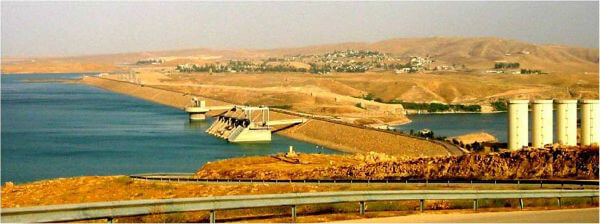
Iraq issues warning of ‘catastrophic’ Mosul dam collapse

Middle East Eye reports: Authorities in Iraq have issued a contingency plan for the possible collapse of the Mosul dam amid fears that the lives of almost 1.5 million people along the Tigris river could be at risk from catastrophic flooding.
The statement is the first public acknowledgment by the Iraqi government of the danger posed by the dam, which is in a poor state of repair after years of neglect and its brief capture by Islamic State (IS) fighters in 2014.
The government earlier this month awarded a contract to Italian engineering firm TREVI to undertake emergency repairs on the 3.4km dam, which is the fourth largest in the Middle East and lies 40km north of Mosul, Iraq’s second city which is currently controlled by IS.
Many other Iraqi cities including Baghdad, the capital, Shirqat, Baiji, Tikrit, Samarra, Balad and Dujail could be flooded if the dam breaks down, Iraqi and US officials warned.
“The collapse of the dam is very unlikely, especially with the technical and administrative precautions taken by the authorities, but the serious consequences if it did happen necessitate the alert,” Iraqi Prime Minister Haider al-Abadi’s office said in a statement on Sunday.
“We have developed a package of precautionary recommendations, in order to avoid any potential risk, God forbid. They [the recommendations] have to be taken into consideration by all people.”
The US embassy in Baghdad on Sunday also issued an alert to US citizens warning them of the dangers of a possible collapse. [Continue reading…]
Hezbollah is learning Russian
Alexander Corbeil writes: Hezbollah has suffered several setbacks since it began its involvement in the Syrian war — over 1,300 of its fighters have been killed and thousands injured, it has had to cut back on social services it provides to its constituency and had to resort to recruiting teenagers for the fight in Syria. However, the Syrian civil war, especially the recent Russian involvement is also helping enhance the group’s fighting capabilities which is likely to have significant political and security implications in Lebanon and beyond.
Hezbollah has proven to be a forward-thinking and malleable fighting force. In 2012, when the group began to engage more robustly in Syria, it quickly learned that its defensive tactics were not applicable to the fight. Instead of a modern Israeli army, Hezbollah faced an insurgency. These rebel groups applied similar tactics to Hezbollah’s against regime soldiers and further benefited from local knowledge of the terrain in areas crucial to Bashar al-Assad’s survival. For instance, during the capture of Qusayr in 2013 Hezbollah reportedly lost around one-tenth of its fighters, with estimates ranging from 70 to 120 dead and 200 wounded, up to two dozen of whom were killed in a rebel ambush on the first day of that offensive; what Hezbollah leaders thought would be a quick victory instead turned into a drawn-out fight. Fast-forwarding to 2016, Hezbollah has refined its offensive capabilities and—under the cover of a new powerful ally, Russia—continued to help the Syrian regime take back crucial territory with lower casualty rates. [Continue reading…]
The mysterious fate of the dissident Italian priest snatched by ISIS
Michael Weiss writes: The last time Hind Aboud Kabawat saw her mentor Father Paolo Dall’Oglio alive, she felt her heart “squeeze in pain.”
The Italian priest who had for 30 years made his home and clerical reputation in Syria was depositing her at Ataturk International Airport, in Istanbul, when he forgot the spiritual form their physical leave-taking always took: prayer. Father Paolo would place his crucifix on Kabawat’s head and chin, and then they would ask the divine to guide them in their daily struggles. Perhaps he was in haste to get her onto her return flight to her hometown of Toronto, but the rite this time slipped his mind. So Kabawat, an Orthodox Christian, reminded the gray-bearded Jesuit and hero of the Syrian people of the valedictory benediction. Father Paolo lovingly obliged. That was three years ago.
The priest was snatched by ISIS not long thereafter while walking through the streets of the caliphate’s capital of Raqqa. He had smuggled himself back into Syria after being kicked out by Bashar al-Assad, Kabawat says, to try and negotiate the release of captive journalists, and was convinced he could reason with the jihadists.
Kabawat is a natural-born worrier, and Father Paolo used to call her “Martha,” after the sister described in the Gospel of Luke as “cumbered about many things” whom Jesus visits at her home. Unlike her attentive sibling Mary, Martha neglects the savior’s counsel. But now the roles were somewhat reversed, and the emissary of Christ was the one who wouldn’t listen.
One needn’t have been especially preoccupied or put-upon to fear an audience with ISIS. “This was 2013—we didn’t really know who they were. But still I told him, ‘Don’t do it face to face.’ He said, ‘No, no, no. If, after three days, you don’t hear from me, then something bad will have happened.’”
Something bad did.
The echo here with the resurrection may have been intentional, though it’s hard to associate Father Paolo with the megalomania of one comparing himself to his avowed role model. On this score, Kabawat is definitive: “He was always telling me, ‘Hind, we can’t be sitting and lecturing others. We need to go to the people. Because this is freedom and democracy, from the people to the people. This is exactly what Jesus wants and what Jesus did. He did not sit in his home.’” [Continue reading…]