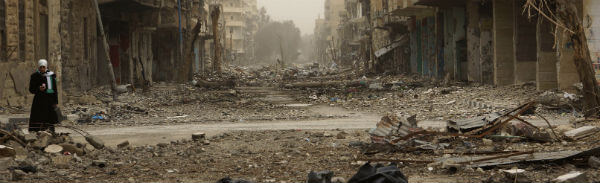
Kyle Orton writes: From the outset of the Syrian uprising, the regime of Bashar al-Assad and the Isis have been united on their strategic goal: eliminate the moderate opposition and make Syria a binary choice between themselves. This is why on the battlefield Assad and Isis largely leave one-another alone and the Assad regime’s propaganda—that the whole rebellion is composed of Islamist terrorists—reinforces Isis’s propaganda claim that it is the only effective protection for Sunnis against the regime. Both IS and the Assad regime are led by military and intelligence officers trained in the KGB and both rely on propaganda as a means of internal control, not only of controlling their international image, which is why both so virulently repress independent media that contradicts their officially sanctioned version. Last night, IS again struck down a member of an activist group that has tried to bring the truth about life under its rule to the outside world. [Continue reading…]
Category Archives: Lands
Russia’s family business
Reuters reports on the rewards Kirill Shamalov gained after marrying Vladimir Putin’s daughter, Katerina, in February, 2013: Within 18 months, Kirill acquired a large chunk of shares in a major Russian oil and petrochemical processor called Sibur – a stake now worth an estimated $2.85 billion, based on the value of recent share deals. He also quit his job as a business manager and set up a company to run his personal investments.
How did such a young businessman go so far, so fast? A Reuters examination of Shamalov’s career shows that in the summer of 2013, months after he married Putin’s daughter, Kirill opened discussions about buying shares in Sibur from one of the president’s wealthiest friends.
A year later, he was able to borrow more than $1 billion, judging by the published accounts of his investment company. The loan came from a bank headed by another longtime associate of Putin, and where Shamalov’s brother holds a senior position. The money was used to make an investment in Sibur that within months proved highly profitable for Kirill.
Asked about his business deals and the wedding, Kirill Shamalov and Sibur declined to comment.
The trajectory of Kirill’s fortunes sheds new light on how people close to Putin have taken commanding positions in key companies – and how such opportunities are now being extended to a new generation. [Continue reading…]
Israel and Turkey agree to restore diplomatic ties
The New York Times reports: Israel and Turkey have reached a preliminary agreement to begin restoring full diplomatic relations after years of deep freeze, Israeli officials said on Thursday.
The two countries, once close regional allies, fell out after a deadly confrontation in 2010 between Israeli commandos and Turkish activists on a passenger vessel seeking to breach Israel’s naval blockade of the Gaza Strip.
The ship, the Mavi Marmara, was part of a flotilla carrying aid to Gaza when Israeli naval commandos rappelled onto the ship’s deck and killed nine activists after being met with violent resistance. A 10th activist died of his wounds much later.
A senior Israeli official, speaking on the condition of anonymity because the reconciliation deal had not been finalized, said that Israel would create a compensation fund for the families of those killed on the Mavi Marmara. The Israeli news media reported that the compensation would be about $20 million, but Emmanuel Nahshon, a spokesman for the Israeli Ministry of Foreign Affairs, said the amount had not been set. [Continue reading…]
Conspiracy America — where Trump already rules
Ben Judah writes: Trump is a son and hero to Conspiracy America, a country where academic studies show 40 per cent of citizens believe the US government is covering up the cure for cancer, a republic where 25 per cent believe the “Birther” conspiracy he helped to create, and nearly 20 per cent believe the “Truther” conspiracy that al-Qaeda fanatics were not responsible for the 2001 attack on the Twin Towers. Why do so many Americans believe such fabrications? This is the most urgent question for America today.
The paranoia fuelling Trump’s rise is the curse of the Bush era. Conspiracy America is a delayed reaction to the twin Bush disasters: the War on Terror and the banking collapse. History warns us that fear of demonic plots builds slowly after confusing, traumatic events. And once a conspiracy theory is born – The Protocols of the Elders of Zion, for example, or the power of the Freemasons – it is nearly impossible to kill.
Conspiracies about the Kennedy assassination built slowly, peaking in the 1980s. Germany’s “stab-in-the-back” myth grew only slowly after the Treaty of Versailles, peaking in the 1930s. History warns that paranoia about plots thrives in states which are being delegitimised: whenever they are unable to fulfil their promises – of empire, welfare, or the American Dream – the pattern of history is those losing out see plots, not systems, stealing what was theirs.
America’s shifting racial structure and social-media addiction may be far less to blame for Trump’s popularity than the rightists of Washington would like to admit. Conspiracy theories are able to thrive in atmospheres where the government has embraced the rhetoric of “us and them” – just as the War on Terror produced. Above all, the history books tell us, conspiracy theorists such as Trump thrive in societies that are growing poorer, weaker, more unequal, and where their citizens do not understand why that is happening. And that is America today. [Continue reading…]
Donald Trump gets strong endorsement from Vladimir Putin
CNN reports: Donald Trump has said that he would “get along very well” with Russian President Vladimir Putin.
The feeling is apparently mutual.
Putin offered high praise for the billionaire businessman-turned-Republican presidential front-runner on Thursday during an annual news conference with reporters.
“He is a bright and talented person without any doubt,” Putin said, adding that Trump is “an outstanding and talented personality.”
And in remarks closely mirroring Trump’s assessment of the campaign, the Russian leader called Trump “the absolute leader of the presidential race,” according to the Russian TASS news agency. [Continue reading…]
Five years after Bouazizi, the Arab Spring isn’t over
Faisal Al Yafai writes: Without a doubt no one expected this. Five years ago this week, when Mohamed Bouazizi set himself on fire in a small Tunisian town, no one, absolutely no one, could have imagined the Middle East would look like it does today.
The Middle East has been living with the reality of the Arab Spring and, in some countries, the post-Arab Spring for nearly half a decade, to the point where it has become the new normal. It can be hard to remember what it was like before.
Hardly surprising, then, that the Arab Spring divides opinion. The progression of the revolutions in each of the five countries have gone in very different directions. Some, like Egypt, have found themselves back on track. Tunisia, where it started, is doing well. Libya, Yemen and Syria, much less so.
In situations of such cruelty and complexity, it is easy to imagine that what existed before was better. That the revolutions, as some would have it, “failed”.
And, certainly, looking at the dire situation for ordinary Syrians, watching as ISIL attacks Kurds and Yazidis, or as ordinary Libyans and Yemenis suffer in countries without the rule of law, looking back to a period of stability is seductive.
But it is worth recalling that the Arab Spring wasn’t an event. It wasn’t a single, static moment. It was months and years of decisions, of responses, of actions and reactions.
If the Arab Spring revolutions didn’t always turn out better for the people, that isn’t the fault of those who revolted for a better world. It’s often the fault of those who spent money, manpower and bullets to prevent that world coming about. [Continue reading…]
On the need to listen to Arab public opinion
Commenting on the results of a recent Zogby poll of over 7,400 adults in six Arab countries (Egypt, Lebanon, Jordan, Iraq, Saudi Arabia, and the UAE), Turkey, and Iran, Rami G. Khouri writes: As expected, people in Iraqi are divided on their views of their own national institutions and regional players’ actions in their country. Sunnis mostly lack confidence in the Iraqi military, Iran’s involvement, or the Popular Mobilization Units that are fighting “Islamic State” (ISIS), while Iraqi Shiites support the actions of all these. The more significant finding, however, is the “remarkable consensus” on two important issues: that the cause of the conflict in Iraq is that, “the government in Baghdad does not represent all Iraqis,” and that, “the best way to ultimately resolve the conflict…is forming a more inclusive representative government” — and not partition, with the Kurds also supporting such a representative central government.
I would guess that this Iraqi desire for inclusive, representative governance within a unified national framework is mirrored in most Arab countries that are wracked by war and sectarian tensions, like Libya, Yemen, Bahrain, Lebanon, and Syria. Ordinary citizens probably hold much more rational and constructive views on how to resolve those conflicts than the warlords and officials, not to mention foreign powers that now mostly shape policy.
The poll found that ISIS was mentioned as the most serious extremist problem facing the region in every country except Jordan, where Al-Qaeda is ranked first. More interestingly — and significant for counter-terrorism purposes — is that in most countries polled citizens identified, “corrupt, repressive, and unrepresentative governments” and, “religious figures and groups promoting extremist ideas” as the most important causes of religious extremism. [Continue reading…]
Extinguishing the flames of the Arab Spring
Al Jazeera reports: Five years ago today, Mohamed Bouazizi, a 26-year-old street vendor, set himself on fire outside a local municipal office in his hometown of Sidi Bouzid to protest against police corruption – a solitary act that would set off a stunning chain of events throughout the Arab world.
In the years since Bouazizi’s death, Tunisia has gone through tremendous change. After street protests forced President Zine El Abidine Ben Ali into exile after two decades of his rule, Tunisia adopted a new constitution and held national elections in 2014.
Earlier this month, the country’s National Dialogue Quartet was awarded the Nobel Peace Prize for assisting Tunisia’s transition to democracy.
But despite the changes that have taken place around them, residents of Sidi Bouzid say their lives are no better than they were before the uprising.
“Before the toppling of the regime of Ben Ali, we had hopes,” Ramzi Abdouli, 29, a graduate from Sidi Bouzid, told Al Jazeera. “We thought that maybe when Ben Ali left our reality would change. Unfortunately, it was not the case.”
Like many of Tunisia’s youth, Abdouli participated in the 2010-2011 protests, hoisting banners against the regime. Even after Ben Ali was deposed, Abdouli marched more than 250km from Sidi Bouzid to Tunis in April 2012 to reiterate demands for social justice and employment.
Today, via social media, he remains a relentless critic of the current government and its political affairs – and is pessimistic about the years ahead. [Continue reading…]
Iran’s pivotal elections could be decided next week — two months before anyone votes
Bobby Ghosh writes: With barely more than two months to go before what may be the Islamic Republic’s most important elections in a generation, there are no visible signs of campaigning in the streets of Tehran. One reason: the Iranian political cycle is, perhaps mercifully, much shorter than the American one. But another reason emerges in my conversations with politicians, clerics, and businessmen. There’s no electioneering, at least not the kind you see in most democracies, because nobody can be entirely certain who is running.
Registration of candidates opens tomorrow, Dec 17. But the fate of many aspirants will be decided within a week — long before the voting begins — by a small group of clerics and jurists, known as the Guardian Council, who are constitutionally tasked to ensure that the Islamic Republic remains true to its religious ideals.
Under the Iranian system, candidates for any election must first be vetted by this 12-member body, which has, since the founding of the Islamic Republic, been controlled by the country’s Supreme Leader—first ayatollah Ruhollah Khomeini, and now ayatollah Ali Khamenei. The Guardians also have veto power over any legislation enacted by parliament, and most of the decisions of the country’s president.
This makes the Council a powerful instrument by which the Supreme Leader can head off political and social reforms at the pass, by preventing reformists from standing for elections, or perform an end-run around any attempted reforms by the legislative or executive branches.
Iran’s February elections are for two powerful institutions: the 290-member Majlis, or parliament, and the highly influential, 86-member Assembly of Experts. The latter is especially important this time around because its mandate is to select, supervise, and, at least in theory, remove the Supreme Leader. It has an eight-year term, twice the duration of parliament, so this particular Assembly will likely play the pivotal role of deciding who gets to succeed Khamenei. [Continue reading…]
Russia’s goals in Syria
Joseph Bahout writes: it would be premature to assume that there is a grand design behind Russia’s Syrian intervention. It is more realistic to envision what Putin has in mind as a series of incremental endgames, a succession of contingency plans, and a cascade of defense lines, in a Russian nesting doll fashion, that are adaptable and playable as events unfold on the ground and on the diplomatic battlefield.
The first and most highly valued of these objectives would be the restoration, to the greatest extent possible, of the central Syrian state such as it existed before 2011. Putin bets on a revamping of the Syrian army, which relies on cadres trained (and sometimes married) in Russia or the ex-Soviet bloc. This objective does not exclude a whitewashing of the regime’s façade through early elections, the formation of a “national unity government,” and cosmetic revisions of the president’s prerogatives. That is probably what Putin discussed with Assad during his recent and very odd visit to the Kremlin.
If this proves impossible or too costly, a second option is to fall back to the defensible parts of useful Syria after guaranteeing the safety of the Alawi canton. This is perhaps already a consideration, as the majority of Russian airstrikes concentrate on the contours of this area. From there on, Putin, like in Ukraine and Crimea, could freeze the conflict and embark on a long war of attrition. The rest of Syria would fragment and fall into chaos. The central desert would be left for the West and the Gulf States to sort out, fought over by various rebel groups and the Islamic State, which would prosper in such a scenario. Russia’s expectation is that its rivals would ultimately be exhausted and come back to Putin begging for a solution—the one that he always had in mind.
The last contingency scenario is to seek to make the second option quasi-permanent. Useful Syria would be solidified as an enclave into which minorities would progressively flow, seeking protection or shelter from the chaotic rest of the country. This would become the launching pad of a negotiated long-term solution that would consolidate the partition of Syria, granting Moscow influence over a statelet on the coast, where its military bases lie. While the economic viability of such a region would be uncertain, it could potentially be ensured by the exploration and exploitation of undersea gas fields. [Continue reading…]
Video: Debating Syria’s future
Panel discussion held on November 23, 2015 in Denver at the Annual Meeting of the Middle East Studies Association (MESA), featuring (in order): Sarah Leah Whitson of Human Rights Watch, James Gelvin of UCLA, Joshua Landis of the University of Oklahoma, and Najib Ghadbian of the National Coalition of Syrian Revolution and Opposition Forces, moderated by Danny Postel of the University of Denver.
Mass deaths and torture in Syria’s detention facilities
Human Rights Watch reports: Nine months of research reveals some of the human stories behind the more than 28,000 photos of deaths in government custody that were smuggled out of Syria and first came to public attention in January 2014.
The 86-page report, “If the Dead Could Speak: Mass Deaths and Torture in Syria’s Detention Facilities,” lays out new evidence regarding the authenticity of what are known as the Caesar photographs, identifies a number of the victims, and highlights some of the key causes of death. Human Rights Watch located and interviewed 33 relatives and friends of 27 victims whose cases researchers verified; 37 former detainees who saw people die in detention; and four defectors who worked in Syrian government detention centers or the military hospitals where most of the photographs were taken. Using satellite imagery and geolocation techniques, Human Rights Watch confirmed that some of the photographs of the dead were taken in the courtyard of the 601 Military Hospital in Mezze.
“Just about every detainee in these photographs was someone’s beloved child, husband, father, or friend, and his friends and family spent months or years searching for him,” said Nadim Houry, deputy Middle East director at Human Rights Watch. “We have meticulously verified dozens of stories, and we are confident the Caesar photographs present authentic – and damning – evidence of crimes against humanity in Syria.”
Countries meeting about possible peace negotiations in Syria – including Russia, as the Syrian government’s biggest backer – should make the fate of the thousands of detained people in Syria a priority, Human Rights Watch said. Concerned countries should insist that the Syrian government give international monitors immediate access to all detention centers and that Syria’s intelligence services must stop forcibly disappearing and torturing detainees. [Continue reading…]
Life in Raqqa: Bombed by the government during the day, then bombed by the coalition at night
A paediatric doctor describes his flight from the ISIS stronghold of Raqqa: One day ISIS came to me and put pressure on me to join the hospital that they controlled in the city. Most doctors had left Syria and they needed me. But I refused. As a result, I received threats. There was nowhere to hide from them – not in the small villages around Raqqa, nor in the city itself. I began to realise that my only way out was to leave Syria. I thought, ‘I’d prefer to go on one of the death boats than risk staying here’.
Life in Raqqa was terrifying. During the day we lived with the government’s airstrikes; at night there were coalition airstrikes. The sound of the jets was so loud it was like an earthquake. A close friend was killed by a government airstrike.
I realised that life had stopped for me, and the one thing I had to do was save my family. I worried that in Syria my children wouldn’t have a life or even get an education. I wanted to protect my life to save my children’s lives.
I started to plan my departure. I planned to travel to Turkey then take the boat to Europe, heading for Holland. My wife was in the final month of her pregnancy with our third child. She was so exhausted by the pregnancy that it was difficult for her to travel. So the idea was that I would go with a friend, and once I had immigration papers, my family would follow me.
I decided to sleep that last night with my children. Although they didn’t know I was leaving, they felt it somehow. I wish I could have brought them with me.
Leaving Raqqa was not easy, with fighting going on between ISIS, Kurdish fighters, Al Nusra and the FSA. I had to pass through three checkpoints between Raqqa and Efreen – it was like passing through three separate countries.
When I reached Turkey, I heard that the government was arresting people going to Izmir [a city on the coast]. Deep inside me, there was a voice hoping that this trip would fail and I’d have to return to Syria. [Continue reading…]
Assad, thanks to Russia and Iran, is too strong for a political settlement to be made right now in Syria

Aron Lund writes: Wrapped up on time, on December 10, the event [the Syrian opposition conference held in Riyadh] was met with widespread and unsurprising acclaim from the organizing governments and other nations sympathetic to the Syrian opposition. “We welcome the positive outcome of the gathering of the Syrian opposition in Riyadh,” wrote the U.S. State Department in a congratulatory message, hailing the “broad and representative group of 116 participants.”
At the meeting, a final statement was adopted that laid out the principles for the upcoming negotiations with the government of Syrian President Bashar al-Assad. Among them, according to a widely circulated draft, was “faith in the civilian nature of the Syrian state and its sovereignty over all of Syria’s territory, on the basis of administrative decentralization.” The document also expressed a commitment to “a democratic mechanism through a pluralistic system that represents all segments of the Syrian people, men and women, without discrimination or exclusion on a religious, sectarian, or ethnic basis,” organized by way of “free and fair elections.” The delegates promised to “work to preserve the institutions of the Syrian state, although it will be necessary to reorganize the structure and formation of its military and security institutions.” There would be a state monopoly on armed force. They condemned terrorism and stressed their refusal of “the presence of any foreign fighters.”
Regarding the upcoming talks, the delegates expressed their readiness to engage in a UN-supervised political process such as that described in the November 14 Vienna communiqué, which calls for Syrian-Syrian negotiations by January 2016 and a ceasefire by June of the same year. However, they asked the international community to “force the Syrian regime to perform measures ascertaining its good faith before the start of the negotiating process,” such as an end to death sentences and starvation tactics and a release of prisoners. The start of a ceasefire was linked to the creation of a transitional government, as sketched out in the Geneva Communiqué of 2012. Regarding the most crucial question of all, the conference stated that “Bashar al-Assad and his clique” have to leave power at the start of the transition — not at the end of it.
Last but not least, the delegates also agreed to create a High Negotiations Committee, tasked with electing and overseeing a team of 15 negotiators who will face the government delegation and decide the future of the country. And that, of course, was where it got tricky. [Continue reading…]
Kyle Orton writes: The opposition now has some diplomatic clout because it has a reasonably credible return address, but “as soon as negotiations in Vienna begin they will falter over the central issue: Iran and Russia will insist that Assad stays,” says Thomas Pierret, a lecturer on contemporary Islam at Edinburgh University and author of Religion and State in Syria: The Sunni Ulama from Coup to Revolution. “The United States is unable to change the Iranian and Russian demands,” Pierret adds, “so will face the choice of either accepting the failure of the negotiating process they’ve invested in, or pressuring the opposition — whom the U.S. can effect—into a ‘creative solution,’ which is to say allowing Assad to stay.”
The removal of Assad and his instruments of repression is key to ending the civil war and defeating ISIS, but unless Assad is military checkmated he and his Iranian and Russian supporters will have no reason to negotiate his departure. At the present time Assad is simply too secure and there is little sign of a Western appetite to make him less so. This means the Vienna process offers many more potential costs than benefits for the opposition. [Continue reading…]
Kerry in Moscow says Syrian opposition should not push for Assad’s immediate departure
The New York Times reports: The United States, Russia, the European Union and Middle Eastern countries had agreed in Vienna last month on a timeline of two years to hold new elections in Syria but left the question of Mr. Assad’s fate unsettled.
Last week, a wide range of Syrian opposition figures formed a new body to oversee peace negotiations and insisted that Mr. Assad step down.
Mr. Kerry appeared, more carefully than on previous occasions, to couch America’s insistence that Mr. Assad leave office as a recondition of any settlement.
The United States, he said, was not seeking Mr. Assad’s ouster per se, but rather considers it unlikely that he could preside over a successful settlement.
“The United States and our partners are not seeking regime change in Syria,” Mr. Kerry said. Syrian opposition groups arriving for talks Friday in New York should not demand as a condition of sitting down that Mr. Assad depart immediately, Mr. Kerry said, a position Russia calls a nonstarter for negotiations.
“We see Syria fundamentally very similarly,” Mr. Kerry said. “We want the same outcomes, we see the same dangers, we understand the same challenges.” He added that the countries are “honest with differences.” [Continue reading…]
Pakistan learns from news reports that it’s now part of new Saudi ‘coalition’ against ‘terrorism’
The Express Tribune reports: Saudi Arabia’s inclusion of Pakistan in a 34-nation military alliance against terrorism sparked much confusion on Tuesday after officials in Islamabad said they were unaware of any such development.
In a rare news conference in Riyadh, Saudi Crown Prince and Defence Minister Mohammed bin Salman announced the formation of new military alliance of Islamic countries, including Pakistan. He said the alliance will coordinate efforts against terrorism in Iraq, Syria, Libya, Egypt and Afghanistan, but offered few concrete indications of how the military efforts might proceed.
The announcement cited “a duty to protect the Islamic nation from the evils of all terrorist groups and organisations whatever their sect and name which wreak death and corruption on earth and aim to terrorise the innocent.”
Asked if the new alliance would focus just on the Islamic State, the Saudi minister said it will confront “any terrorist organisation that appears in front of us.”
The Saudi state new agency, SPA, mentioned Egypt, Qatar, the United Arab Emirates, Turkey, Malaysia and Pakistan among the 34 Islamic countries which are part of the military alliance – Iran, Syria and Iraq are not part of it. It added the coalition will have a joint operations centre in Riyadh to coordinate and support military operations.
When contacted, a senior official of Pakistan’s Foreign Office said they were gathering details about the newly formed alliance. “We came to know about it (the alliance) through news reports. We have asked our ambassador in Saudi Arabia to get details on it,” he said, suggesting that Pakistan has been caught off guard by the Saudi announcement. [Continue reading…]
PKK and Muslim Brotherhood reportedly among "terrorist organisations" #Saudi's new coalition will confront https://t.co/V4IU12CZec
— Alex Rowell (@disgraceofgod) December 16, 2015
Libya’s rival governments reject delayed UN-brokered national unity deal
The Guardian reports: Libya’s future is on hold ahead of a national unity agreement brokered by the United Nations but rejected by the rival governments that have presided over months of chaos in a country witnessing the growing strength of Islamic State.
The UN said that the signing had been delayed for logistical reasons but would go ahead in Morocco on Thursday. Libya-watchers expressed doubts that it would happen, but warned that if it did it could mean the country had three governments instead of two.
Britain hopes that a unity government, to be run by a nine-strong presidency, will invite western powers to mount air strikes against Isis positions, allowing David Cameron to avoid another Commons vote before dispatching RAF jets. Agreement, hammered out in Rome last weekend, was hailed as “historic” by the US and Italy.
The long-awaited deal was supposed to have been signed on Wednesday after months of wrangling and opposition from hardliners in the opposing administrations that have claimed power since the overthrow of Muammar Gaddafi by Nato-backed rebels in 2011. [Continue reading…]
Turkey will set up a military base in Qatar to face ‘common enemies’
Reuters reports: Turkey will establish a military base in Qatar as part of a defence agreement aimed at helping them confront “common enemies,” Turkey’s ambassador to Qatar said on Wednesday.
Establishment of the base, part of an agreement signed in 2014 and ratified by Turkey’s parliament in June, intensifies the partnership with Qatar at a time of rising instability and a perceived waning of U.S. interest in the region.
The two countries, both economic heavyweights, have provided support for the Muslim Brotherhood in Egypt, backed rebels fighting to overthrow Syrian President Bashar al-Assad and raised the alarm about creeping Iranian influence in the region. [Continue reading…]