AFP: The military chief and several top commanders of the Al-Qaeda-affiliated Al-Nusra Front have been reported killed in northwestern Syria, where the jihadist militia has been making major gains in recent months.
Syrian state media, a monitoring group and a local activist reported that Abu Hammam al-Shami had been killed but information on the circumstances of his death was contradictory.
Official Nusra sources did not announce the death of the jihadist, who is believed to have fought with Al-Qaeda in Afghanistan.
Category Archives: Lands
U.S. presses U.N. on Syria chlorine attacks
The New York Times reports: The United States is pushing the United Nations Security Council to condemn the use of chlorine as a chemical weapon in Syria, and impose unspecified measures against those who use it in the future.
A draft resolution written by the United States, obtained by The New York Times on Wednesday evening, does not specify who used chlorine as a weapon in Syria’s civil war, except to remind the government of Syria that it had agreed to destroy its chemical-weapons arsenal under a resolution adopted in September 2013.
The Organization for the Prohibition of Chemical Weapons, the global group that monitors compliance with a treaty banning these munitions, concluded in a report this year that chlorine had been used to make bombs, which witnesses said were dropped from helicopters.
That report also did not say who was to blame, although the Syrian military is the only faction in the conflict that has helicopters. Activists have previously collected video of aerial bomb attacks, in which yellow gas is seen being released. [Continue reading…]
What Netanyahu left out of his speech to Congress
Gary Sick lists five significant omissions: 1. Iran has dramatically reduced its stockpile of enriched uranium. Remember Bibi’s cartoon bomb that was going to go off last summer? Well, it has been drained of fuel, and that will probably continue to be true indefinitely. No mention.
2. Inspections will continue long after the nominal 10-year point, contrary to his claim that everything expires in ten years. No mention.
3. The heavy water reactor at Arak will be permanently modified, so it produces near zero plutonium. Not only did he not mention it, but he listed the reactor and plutonium as one of his threats.
4. His repeated assertion that Iran is actively seeking nuclear weapons ignores the judgment “with high confidence” of both American and Israeli intelligence that Iran has taken no decision to build nuclear weapons. It also contradicts the repeated findings of the IAEA that no materials have been diverted for military purposes.
5. All the major countries of the world are co-negotiators with the United States, so a U.S. congressional intervention that killed the deal will not only affect us but all of our major allies. If we stiff them, there is no reason to believe the international sanctions will hold for long. No mention.
Libya declares 11 oil fields closed after ISIS attacks
The Associated Press: Libya’s state-run oil corporation has declared 11 oil fields in the country non-operational after attacks by suspected Islamic State militants, opting for a force majeure clause that exempts the state from contractual obligations.
The National Oil Corporation blamed Islamist-backed authorities in the capital Tripoli for failing to protect the oil fields. The statement, issued late Wednesday, said “theft, looting, sabotage and destruction” of the oil fields have been on the rise despite pleas for the authorities to ensure the safety of Libya’s oil installations.
“If security deteriorates, the corporation will be forced to close all fields and ports, which will result in a total deficit in state revenues and directly impact people’s live, including with power outage,” the statement said. It urged the country’s feuding political factions to “put state interest above all and stand together against destruction.”
Russian soldiers ‘dying in large numbers’ in Ukraine, says NATO
BBC News: Nato’s deputy chief says Russian leaders are less and less able to conceal the deaths of “large numbers” of Russian soldiers in eastern Ukraine.
Alexander Vershbow said Russia’s involvement was becoming more unpopular with the Russian public as a result.
Russian officials dismissed on Thursday a US claim that Moscow had sent “thousands and thousands” of troops to fight alongside separatists.
Capitol Hill — still Israeli-occupied territory
Philip Weiss writes: In the Emperor’s New Clothes, only the little boy can say that the emperor is naked. The good news about yesterday’s speech by Netanyahu to a joint meeting of Congress is that lots of media are taking on that boy’s role, and pointing out the nudity: exclaiming over the fact that a foreign leader came into our house of government to try and overrule our president on foreign policy. Chris Matthews was especially forceful, describing it as a takeover. While a New York Times article said that Democrats have to choose between “loyalty to the Jewish state” and the president.
But journalists have a bigger job than merely exclaiming. They must explain to readers why this outrage took place. Why did Netanyahu get this platform? The answer is the power of the Israel lobby inside our politics. And while there was some talk about the Christian Zionist component of the lobby compelling Republicans to show up, no one could explain why so many Democrats– about 175 of them– sat still for this insult to the president. They did so because of the importance of the Jewish part of the lobby inside the Democratic Party, epitomized by Alan Dershowitz in the gallery. This was surely obvious to viewers. But the media were silent on that score. [Continue reading…]
Netanyahu addressing Congress in 2002 and 2015 — same script, but then it was Iraq, now Iran.
Rouhani: people are too clever to listen to ‘war-mongering’ Netanyahu
The Guardian: The Iranian president, Hassan Rouhani, has reacted to Binyamin Netanyahu’s speech to the US Congress by saying that the world and the American people are too intelligent to take advice from “an aggressive and occupier regime” that has itself developed an arsenal of nuclear weapons.
“The world is happy with the progress in the negotiations between Iran and the P5+1,” Rouhani said in a cabinet meeting on Wednesday, speaking about the nuclear talks between Iran and the US, France, Germany, China, Russia and Britain. “Only one aggressive and occupier regime [Israel] is angry with the talks because it sees its existence tied with war and occupation.”
Rouhani said: “People of the world and America are too smart to take advice from such a war-mongering regime … which has pursued, produced and stockpiled a large number of atomic bombs in violation of international laws and away from the eyes of international inspectors.” Rouhani was referring to the fact that Israel, unlike Iran, has not signed the treaty on non-proliferation of nuclear weapons.
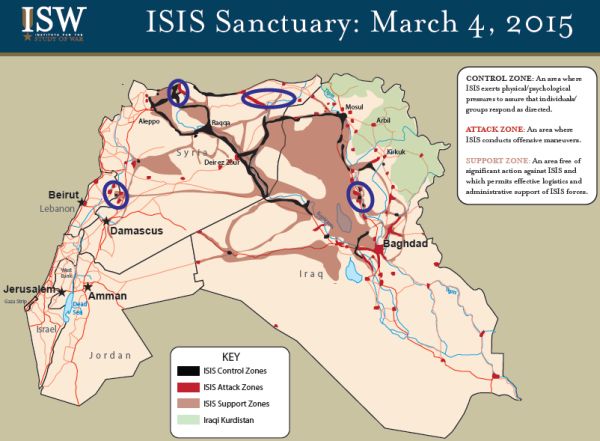
ISIS-controlled territory in Iraq and Syria has not significantly diminished since June 2014
U.S. strategy in Iraq increasingly relies on Iran
The New York Times reports: At a time when President Obama is under political pressure from congressional Republicans over negotiations to rein in Tehran’s nuclear ambitions, a startling paradox has emerged: Mr. Obama is becoming increasingly dependent on Iranian fighters as he tries to contain the Islamic State militant group in Iraq and Syria without committing American ground troops.
In the four days since Iranian troops joined 30,000 Iraqi forces to try to wrest Saddam Hussein’s hometown of Tikrit back from Islamic State control, American officials have said the United States is not coordinating with Iran, one of its fiercest global foes, in the fight against a common enemy.
That may be technically true. But American war planners have been closely monitoring Iran’s parallel war against the Islamic State, also known as ISIS or ISIL, through a range of channels, including conversations on radio frequencies that each side knows the other is monitoring. And the two militaries frequently seek to avoid conflict in their activities by using Iraqi command centers as an intermediary.
As a result, many national security experts say, Iran’s involvement is helping the Iraqis hold the line against Islamic State advances until American military advisers are finished training Iraq’s underperforming armed forces.
“The only way in which the Obama administration can credibly stick with its strategy is by implicitly assuming that the Iranians will carry most of the weight and win the battles on the ground,” said Vali R. Nasr, a former special adviser to Mr. Obama who is now dean of the School of Advanced International Studies at Johns Hopkins University. “You can’t have your cake and eat it too — the U.S. strategy in Iraq has been successful so far largely because of Iran.” [Continue reading…]
Airstrikes starting to take toll on ISIS’s money flow
McClatchy reports: The Islamic State might be the best-funded radical Islamist group, perhaps in history, but the coalition air campaign that’s targeting its oil-refining operations and military assets has begun to damage its ability to earn.
And by denying the group additional territorial expansion, the airstrikes have limited the opportunities for it to profit from capturing new infrastructure and banks, according to a recent report by a money-laundering watchdog group, as well as U.S. officials and residents of Islamic State territory.
The Islamic State, a self-styled modern caliphate that controls much of northern and western Iraq and eastern Syria, turned itself into perhaps the richest and best-equipped military non-state actor last June after seizing tremendous amounts of money and equipment from the Iraqi government as it swept through Mosul and to the western and northern outskirts of Baghdad while the Iraqi army collapsed.
The Islamic State is thought to have at least 30,000 combatants and 5 million to 6 million people under its control, leaving a huge economy to be taxed and extorted.
Thousands of armored vehicles and thousands of tons of military equipment, much of it modern weaponry supplied to Iraq by the United States, were seized in the rout last June, along with cash reserves from government banks, mostly in local currency, of at least $500 million, according to the Financial Action Task Force, an international money-laundering body that examined the group’s complex financial operations in a report released in late February.
That windfall came as the group was already making millions of dollars a day pumping and refining oil and petroleum products from previously captured oil fields, mostly in eastern Syria, where the group has wrested control of at least 50,000 barrels per day of oil and refined petroleum output, according to the task force’s report, a number widely supported by reports from the area.
Although the task force notes recent efforts by Turkish and Kurdish officials to limit the Islamic State’s ability to export these products by smuggling, not all the exporting has been stopped. Even the group’s rudimentary oil-refining ability — a process commonly targeted by coalition airstrikes — while damaged, is probably sufficient to at least support the group’s huge military operation and provide some income stream. [Continue reading…]
Iran’s ‘Supermani’: fabled general, Internet sensation
The Los Angeles Times reports: In one image he calmly rubs elbows with Iran’s top leaders. In another, he bestows an avuncular gaze on a gaggle of militia fighters.
No matter where he appears, Gen. Qassem Suleimani, commander of Iran’s elite Quds force, remains the stuff of U.S. policymakers’ nightmares: a murky yet seemingly ubiquitous figure with a penchant for turning up in Middle Eastern trouble spots and proxy wars — often at several battlegrounds simultaneously, it would seem, judging by his outsized and at times fictitious presence on the Web and in breathless international press reports.
“Supermani” is the handle one wag has bestowed upon Tehran’s inscrutable point man.
His mission? Thwarting the goals of Washington and its allies at every turn, while adding to the revolutionary glory of the Islamic Republic of Iran.
The actual effectiveness of Tehran’s fabled emissary may be open to question. But in cyberspace, Suleimani — with a graying beard, steady mien and passing resemblance to “The Most Interesting Man in the World” of Dos Equis fame — has emerged as a kind of Iranian master manipulator, schemer and super-spy. His presence on any battlefield, according the ever-expanding if often apocryphal legend, is tantamount to victory for fighters fortunate to bask in his presence. [Continue reading…]
Iranian special operatives free diplomat abducted in Yemen
The Associated Press: Iran said Thursday that a team of special operatives has freed an Iranian diplomat abducted more than 19 months ago in Yemen, a rare acknowledgement by Tehran of an intel operation carried out on foreign soil.
The official IRNA news agency quoted deputy Foreign Minister Hossein Amirabdolahian as saying that intelligence officers undertook a “difficult and complicated operation” to secure Nour Ahmad Nikbakhat’s freedom from the “hands of terrorists.”
Amirabdollahian added that the operation took place “in a very special area in Yemen,” without elaborating or providing further details.
‘Assad-controlled’ Syria is controlled by militias
Aron Lund writes: In a recent report for Open Democracy, Dutch journalists Robert Dulmers and Teun Voeten tell of a recent trip through the parts of Syria still held by President Bashar al-Assad’s forces. Embedded with the Syrian military, they traveled by car from the capital Damascus via the reconquered city of Homs to Aleppo in the north, and back.
These cities, the country’s three largest, are at the core of Syria in every way: politically, culturally, economically, and, of course, demographically. Assad’s dominance over the Damascus-Homs-Aleppo axis, in addition to the coastal areas, Hama City, large parts of the south, and even a few small pockets in the northeast (Qamishli, Hasakah, and Deir ez-Zor), underscores that he remains the central actor of this war. He is the ruler of not exactly Syria, but of “useful Syria,” a potentially economically viable region encompassing at least two-thirds of the country’s population.
But what about the state of the regime itself? The most interesting part of Dulmers and Voeten’s account is their brief insider view of the pro-Assad forces. “In 12 days travelling some 1,200 km, except for special forces in Aleppo we hardly saw anything of the regular army,” they write, noting that most of the many checkpoints and bases along the road were manned by locally recruited militias.
The slow “militiafication” of Assad’s Syrian state has been going on since the start of the conflict in 2011, when so-called Popular Committees spawned spontaneously or were recruited by intelligence services and pro-Assad businessmen all over Syria, mirroring the mobilization of anti-government demonstrators. The opposition (and much of the international media, which at the time listened to no one else) called these militias “shabiha,” a vague term meaning approximately pro-Assad thugs, and dismissed them as a few thousand paid gangsters or members of the Alawite sect, the minority group to which Assad also belongs. But this was an underestimation of the Assad regime’s social roots. The “shabiha” phenomenon was no mere Alawite militia, but representative of a genuine popular mobilization of a significant minority of Syria’s population in favor of the regime, partly — but by no means exclusively — on a sectarian basis. [Continue reading…]
Evidence mounting of Russian troops in Ukraine
Deutsche Welle reports: It was a surprising confession. In an interview with the opposition Russian newspaper, Nowaja Gaseta, (from Monday, March 2) a wounded Russian tank operator confirmed what many have long assumed: That contracted Russian soldiers are fighting alongside the separatists in Eastern Ukraine against the Ukrainian army.
And not just a few soldiers. A day after the interview was published, US General Ben Hodges said in Berlin that the US military was working on the assumption of 12,000 Russian troops in the region.
It’s not the first time such reports have surfaced. On Feb. 19, the Russian newspaper Kommersant published a surprisingly frank feature about the deployment of Russian soldiers in Eastern Ukraine. The article appeared in the online version of the paper, which belongs to oligarch Alisher Usmanov, known to be loyal to the Kremlin. Reporter Ilja Barabanov recounts how he met three Russians who had until recently been professional soldiers. In the second half of January, they went to Eastern Ukraine to fight.
The men said they had fought since Jan. 20 on the front in various units of the separatist army of the “People’s Republic of Donetsk.” Before they left, they applied to end their army contracts and be officially discharged.
Whether or not they were actually discharged, and what their current status is, is unknown. [Continue reading…]
The East India Company: The original corporate raiders
William Dalrymple writes: One of the very first Indian words to enter the English language was the Hindustani slang for plunder: “loot”. According to the Oxford English Dictionary, this word was rarely heard outside the plains of north India until the late 18th century, when it suddenly became a common term across Britain. To understand how and why it took root and flourished in so distant a landscape, one need only visit Powis Castle.
The last hereditary Welsh prince, Owain Gruffydd ap Gwenwynwyn, built Powis castle as a craggy fort in the 13th century; the estate was his reward for abandoning Wales to the rule of the English monarchy. But its most spectacular treasures date from a much later period of English conquest and appropriation: Powis is simply awash with loot from India, room after room of imperial plunder, extracted by the East India Company in the 18th century.
There are more Mughal artefacts stacked in this private house in the Welsh countryside than are on display at any one place in India – even the National Museum in Delhi. The riches include hookahs of burnished gold inlaid with empurpled ebony; superbly inscribed spinels and jewelled daggers; gleaming rubies the colour of pigeon’s blood and scatterings of lizard-green emeralds. There are talwars set with yellow topaz, ornaments of jade and ivory; silken hangings, statues of Hindu gods and coats of elephant armour.
Such is the dazzle of these treasures that, as a visitor last summer, I nearly missed the huge framed canvas that explains how they came to be here. The picture hangs in the shadows at the top of a dark, oak-panelled staircase. It is not a masterpiece, but it does repay close study. An effete Indian prince, wearing cloth of gold, sits high on his throne under a silken canopy. On his left stand scimitar and spear carrying officers from his own army; to his right, a group of powdered and periwigged Georgian gentlemen. The prince is eagerly thrusting a scroll into the hands of a statesmanlike, slightly overweight Englishman in a red frock coat.
The painting shows a scene from August 1765, when the young Mughal emperor Shah Alam, exiled from Delhi and defeated by East India Company troops, was forced into what we would now call an act of involuntary privatisation. The scroll is an order to dismiss his own Mughal revenue officials in Bengal, Bihar and Orissa, and replace them with a set of English traders appointed by Robert Clive – the new governor of Bengal – and the directors of the EIC, who the document describes as “the high and mighty, the noblest of exalted nobles, the chief of illustrious warriors, our faithful servants and sincere well-wishers, worthy of our royal favours, the English Company”. The collecting of Mughal taxes was henceforth subcontracted to a powerful multinational corporation – whose revenue-collecting operations were protected by its own private army.
It was at this moment that the East India Company (EIC) ceased to be a conventional corporation, trading and silks and spices, and became something much more unusual. Within a few years, 250 company clerks backed by the military force of 20,000 locally recruited Indian soldiers had become the effective rulers of Bengal. An international corporation was transforming itself into an aggressive colonial power. [Continue reading…]

U.S. commander says some 12,000 Russian soldiers in Eastern Ukraine
RFE/RL reports: The U.S. military estimates some 12,000 Russian soldiers are supporting pro-Moscow separatists in eastern Ukraine.
U.S. Army Europe Commander Ben Hodges said the Russian forces are made up of military advisers, weapons operators and combat troops.
Hodges also said some 29,000 Russian troops are in Crimea, which Moscow annexed from Ukraine last year.
Hodges said in Berlin on March 3 that helping Ukraine with weapons would increase the stakes for Russian President Vladimir Putin at home.
He added that “when mothers start seeing sons come home dead, when that price goes up, then that domestic support begins to shrink.”
Hodges said what Ukraine wants “is intelligence, counterfire capability and something that can stop a Russian tank.”
The White House still hasn’t decided whether to send arms to Ukraine, and Hodges reiterated Washington wanted a diplomatic solution. [Continue reading…]
Alexey Navalny on the murder of Boris Nemtsov
Alexey Navalny, the opposition leader and anti-corruption blogger, writes (translation by Catherine A. Fitzpatrick): 1. I believe that Nemtsov was killed by members of a government (intelligence) or pro-government organization on orders from the political leadership of the country (including Vladimir Putin).
It is a question only of how this order was formulated:
– You must kill Nemtsov.
– You must do a hugely sensational action.2. That’s enough repeating the nonsense about how “Boris was killed by an atmosphere of hatred.” What atmosphere, exactly, eh? We’ve had the atmosphere of hatred since 2007, and in recent months, we have seen the organized construction of pro-government extremist-terrorist groups, directly declaring as their goal combating the opposition where the police cannot. [Continue reading…]
Syria’s Nusra Front may leave Qaeda to form new entity
Reuters reports: Leaders of Syria’s Nusra Front are considering cutting their links with al Qaeda to form a new entity backed by some Gulf states trying to topple President Bashar al-Assad, sources said.
Sources within and close to Nusra said that Qatar, which enjoys good relations with the group, is encouraging the group to go ahead with the move, which would give Nusra a boost in funding.
The exercise could transform Nusra from a weakened militia group into a force capable of taking on Islamic State at a time when it is under pressure from bombing raids and advances by Kurdish and Iraqi military forces.
It could also boost the influence of Qatar and its allies in the campaign to oust Assad, in line with the Gulf state’s growing diplomatic ambitions in the region. [Continue reading…]