Category Archives: Lands

Iraqi general warns of military woes in fighting ISIS

The Associated Press reports: Lt. Gen. Abdul-Wahab al-Saadi had 225 fighters, a single Abrams tank, a pair of mortars, two artillery pieces and about 40 armored Humvees when he set out to retake a strategic city in northern Iraq captured by Islamic State militants over the summer.

It took 30 days as his force made an agonizingly slow journey for 40 kilometers (25 miles) through roadside bombs and suicide car attacks, then successfully laid siege to the oil refinery city of Beiji. The campaign earned al-Saadi the biggest battlefield victory by Iraqi forces since Islamic State fighters swept over most of northern and western Iraq in a summer blitz, prompting the collapse of the military.

Yet al-Saadi is deeply pessimistic. In a two-hour interview with The Associated Press, he said Iraq’s military lacks weapons, equipment and battle-ready troops and complained that U.S. air support was erratic. Both the military and the government remain riddled with corruption, he said. Most of the senior generals serving when the military fell apart had skills “more suited to World War II,” he said.

“If things don’t get better,” warned the general, “the country could end up divided” between its Shiite, Sunni and Kurdish populations.

The extremists are beatable when confronted with a proper force, he said. But he worries that the military’s multiple woes prevent it from doing so. Already, there is a danger the jihadis could retake Beiji, he said. [Continue reading…]

Facebooktwittermail

The crude reality of declining crude oil prices

Hisham Melhem writes: The crashing price of oil, which dominated the world of energy in the last six months, and promises to stay with us for much of 2015, has brought cheers to American consumers and tears to the oil tsars of Russia, Iran and Venezuela in particular. If the price of oil remains in the neighborhood of $60 per barrel (bbl) for much of this year, the economic impact on Russia, Iran, Venezuela and maybe Iraq, Algeria, Nigeria and Libya could be ruinous. The sharp decline in oil revenues could force both Russia and Iran to review and maybe reduce their financial and material support for the Assad regime in Syria. Some optimists speculated that the crude reality brought about by the changing energy landscape may force Iran to show more flexibility in its nuclear negotiations with the P 5 + 1 in return for a quicker process of sanction relief. The precipitous fall in the price of oil has forced governments all over the world as well as the international financial institutions to review their investments and risk assessments for 2015 and beyond.

The foreign currency reserves that Saudi Arabia, the United Arab Emirates and Kuwait have accumulated will help them navigate the turbulent markets in the immediate future, but even these economies will be forced to adjust their balance payments and maybe cut back on subsidies and social programs, in the absence of a market “correction” that would restore the price range that prevailed in the last 5 years. A sustained low price of oil could lead a country like Venezuela to default on its debts, a severe contraction in the Russian economy, and dramatic and unprecedented consequences on the Iranian economy, which is – like Russia’s economy- already teetering because of painful international sanctions. In Iraq, Libya and Yemen, very low oil prices could plunge these countries deeper into violence. So far, the three largest economies in the world; the United States, China and Japan (two major importers of oil) have benefitted from the decline of oil prices. However, if the current low price prevails for some time, this could impact those American companies that have invested large resources in the production of shale oil in States like Texas and North Dakota, who incur higher production costs.

The story of energy, specifically the production of oil and gas in the last 20 years has been one of wild transient fluctuations in global oil prices. Prices swung from a record high of $145 bbl in July 2008 to a precipitous low of $30 bbl in December of the same year in the wake of the financial crisis. The price of oil completely collapsed in 1998 to an incredible low of $10 in the middle of the Asian economic crisis. Last June, the price of Brent crude hovered around $115, by January 2, benchmark Brent has plummeted to $57.11 bbl. But for all the turmoil in the energy markets in the last few decades, most analysts kept saying that the “fundamentals” of the market i.e. energy prices will continue to rise, that the market will remain susceptible to the production levels of the Organization of the Petroleum Exporting Countries (OPEC) and other major producers notably Russia, and that we are not likely to see a radical change in this supply model any time soon. But a “made in America” revolution may be changing some of the old energy assumptions. [Continue reading…]

Facebooktwittermail

Israel to halt transfer of tax revenues to Palestinians following ICC bid

Haaretz reports: Israel has decided to freeze the transfer of half a billion shekels (more than $127 million) in tax revenues collected on behalf of the Palestinians following the Palestinians’ recent attempts to join the International Criminal Court, an Israeli official has told Haaretz.

“The funds for the month of December were due to pass on Friday, but it was decided to half the transfer as part of the response to the Palestinian move,” the official said.

Israel, he said, would not let the Palestinians’ actions go unanswered. “We are a law-abiding nation that actively investigates its own conduct, and we can prove that easily.” [Continue reading…]

Facebooktwittermail

Syria deaths hit new high in 2014, observer group says

The New York Times reports: More than 76,000 people died in Syria’s civil war in 2014, including more than 3,500 children, a monitoring group reported on Thursday. The figures would make last year the deadliest in Syria since the conflict began in March 2011.

The figures from the monitoring group, the Syrian Observatory for Human Rights, put the total number of dead in the conflict as of Wednesday at 206,603.

The group, based in Britain, uses a network of contacts inside Syria to tally casualties, and its figures cannot be independently corroborated. The United Nations, which once regularly documented the numbers of dead and wounded in Syria, discontinued the practice some time ago. [Continue reading…]

Facebooktwittermail

Unruly factions hurt Taliban’s bid to capture Afghan hearts, and territory

The New York Times reports: A series of kidnappings and robberies struck northern Helmand Province this summer, paralyzing residents and embarrassing the Taliban leaders who controlled the area.

Responding to growing complaints, the Taliban leadership based in Pakistan ordered a hunt to find the criminals, but soon discovered an inconvenient truth: Their own people were behind the banditry, earning thousands of dollars in ransoms every month. Within a matter of days, the culprits had been captured and executed, including two notorious fighters known as Pickax and Shovel.

Though the episode went largely unnoticed outside the Taliban stronghold, it highlights a question that is on the minds of many: More than 13 years after the war here started, who exactly are the Taliban? Are they the bandits responsible for the abduction and killings of numerous villagers? Or are they the disciplined leaders who hanged the fighters who had taken to criminal tyranny?

Increasingly, it appears, they are both. [Continue reading…]

Facebooktwittermail

Iran and U.S. tentatively agree on formula to reduce nuclear programme

The Associated Press reports: Iran and the United States have tentatively agreed on a formula that Washington hopes will reduce Tehran’s ability to make nuclear arms by committing it to ship to Russia much of the material needed for such weapons, diplomats say.

In another sign of progress, two diplomats told Associated Press that negotiators at the December round of nuclear talks drew up for the first time a catalogue outlining areas of potential accord and differing approaches to remaining disputes.

The diplomats said differences still dominate ahead of the next round of Iran six-power talks on 15 January in Geneva. But they suggested that even agreement to create a to-do list would have been difficult previously because of wide gaps between the sides. [Continue reading…]

Facebooktwittermail

Joining International Criminal Court wouldn’t guarantee Palestinians a war crimes case

The New York Times reports: The political fallout from the Palestinian move Wednesday to join the International Criminal Court is likely to be swift and profound.

Israel is expected to withhold tax transfers to the Palestinian Authority, restrict officials’ travel and possibly advance settlement activity in sensitive spots in the West Bank. The United States Congress may cut off $400 million in aid to the Palestinians. The already dim prospects for renewing peace talks now seem null.

But legal repercussions from last summer’s war between Israel and Palestinian militants in the Gaza Strip, or Israel’s settlements, would take longer and face many hurdles.

The cases Palestinians plan to bring against Israel, and potential counterclaims against Palestinian officials, are unlike any the International Criminal Court has tackled in its dozen-year history. The Hague court, facing new scrutiny after the collapse last month of its case against the president of Kenya, may be wary of wading into the fraught politics of the Middle East, though doing so could help it rebuff longstanding criticism of its emphasis on pursuing African despots.

“It may jump at the chance because it’s under fire,” Geoffrey Robertson, a British lawyer and author, said of the court, which he follows closely. “This is an opportunity to get out of the endless African wars and to do something which is very much in the public eye, and very much of public importance,” he added. “It would be a new and possibly productive way to deal with the cloudy legalities.” [Continue reading…]

Facebooktwittermail

The brothers who ambushed ISIS

Mohammed A. Salih reports: It was a sunny day in late November when Ahmed Ismael, 22, went with a group of seven other fighters to ambush militants from the self-proclaimed Islamic State, or ISIS, on the eastern flank of this besieged town.

Then the plan went terribly wrong. The would-be ambushers were themselves ambushed. Two car bombs exploded and a group of jihadists blocked their way from behind, cutting off their exit route. During the intense firefight that followed, four Kurdish fighters died, including three of Ahmed’s cousins.

“They had heavy weapons but we only had AK-47s,” says Ahmed, his voice still shaky as he recounts the details. “It was my first real fight. We stayed there for four hours. We ran out of ammunition. I was next to my cousins when they died.”

As the fight raged on, Ahmed and the three women fighters who were part of the mission, sent out calls for help. Finally, a squad of reinforcements arrived and they were able to retreat.

Since then, there have been many other skirmishes, so many that war has come to seem a ways of life for Ahmed and his older brother Nusin. But neither had ever thought before that they were destined to become fighters. They had led a quiet life in this otherwise rural and peripheral town in northern Syria that, until a few months ago, few people had ever heard of outside the region. They were carpenters making chairs, beds and other rudimentary pieces of furniture for the locals.

But when the jihadists from ISIS launched a large-scale assault on Kobani in September, the two brothers had to make a choice. “We wondered what to do,” says 24-year-old Nushin. “We sent our family to Turkey,” he says, “But this is our town. The two of us did not want to leave. Where could we go? We decided to stay here and defend our home.” [Continue reading…]

Facebooktwittermail

Vanguard of Syria’s uprising, now on the run from ISIS, weighs a bleak future

The New York Times reports: The cigarette smoke in the hotel room grew as thick as the cottony fog outside in this Turkish border town, as Syrian men, night after night, told their war stories. Their memories veered from exhilaration to black humor to terror, but mostly they told of what they had lost: Friends. A fiancée. An arm. A country. None were out of their mid-20s.

Three were insurgents, or had been. One had helped capture an army tank; another had hidden in tall grass as tank fire killed his raiding party. They told of abandoning one insurgent group after another, finding commanders too violent, too corrupt, too disorganized, too pious, not pious enough.

Three others, civilian antigovernment activists who broadcast war news on social media, were on the run from Islamic State extremists. For them, the fog was a comfort, shrouding their movements as they drove to the hotel. They had trekked for days from the remote Syrian provincial capital of Deir al-Zour, holding their breath at Islamic State checkpoints, hoping to find safety here in southern Turkey.

But they still felt hunted, sure that the group had eyes and ears everywhere, among bearded strangers in Syrian-run cafes or in hotels welcoming foreign fighters. They did not tell friends where they were staying, and they did not know when or whether they could go home.

Not long ago, these men would have felt secure here. Early in the Syrian conflict Antakya, long a sleepy provincial town, became the high-octane hub of an insurgency that thought it was winning. Back then, young fighters and activists, including some of those recently huddling in the hotel room, filled cafes to brainstorm, dreaming of new power and new freedoms.

But some of those flocking to Antakya would later become their enemies. The city was becoming a way station for foreign jihadists, who spent lavishly, even spurring a market for Taliban-style dress. They ultimately transformed Syria’s battlefield, many of them coalescing into the radical Islamic State group, which routed or co-opted other insurgents and shifted the West’s focus from ousting President Bashar al-Assad to countering the extremist group’s momentum. Now, the group has turned violently against any Assad opponents who fail to flock to its banner — like the young men in the hotel room.

Those men are part of what is looming as a lost generation of young Syrians. They are marooned in southern Turkey, unsure how to envision their future, and their hopes are deflating as rapidly as Antakya’s wartime boom. [Continue reading…]

Facebooktwittermail

The story of one of the Cold War’s greatest unsolved mysteries — and the new effort to solve it

Ishaan Tharoor writes: Around midnight on Sept. 18, 1961, a plane carrying U.N. Secretary General Dag Hammarskjold crashed nine miles from its intended destination, the town of Ndola in Northern Rhodesia, now the independent republic of Zambia. The 56-year-old Swede and 15 other people aboard the aircraft perished.

According to one account, Hammarskjold’s body was found in the forest near the wreckage. He was “lying on his back, propped up against an ant hill, immaculately dressed as always, in neatly pressed trousers and a white shirt with cuff links.” Hammarskjold is the only U.N. secretary general to have died while in office.

At the time, both the governments of Sweden and Northern Rhodesia claimed the incident was the result of pilot error. There was little evidence to be gleaned from the flight’s sole survivor, an American sergeant who, before succumbing to his injuries, had said the plane experienced a series of explosions. A U.N. investigation the following year yielded no clear conclusion. It downplayed testimony from local villagers that a smaller, second aircraft may have shot down the plane.

Not surprisingly, the circumstances of Hammarskjold’s death have always carried a suspicion of foul play. The Swedish diplomat was to meet with representatives from a breakaway state in the Congo — a mineral-rich, fledgling nation that was coveted still by outside powers. There were many parties, even some in the United States, who perhaps did not want to see Hammarskjold’s peace mission bear fruit.

On Monday, the U.N. General Assembly unanimously approved a motion asking current Secretary General Ban Ki-moon to appoint an independent panel of experts to investigate new evidence that has come to light regarding the 1961 plane crash. [Continue reading…]

Facebooktwittermail

Three Al Jazeera journalists remain in jail after Egyptian court orders a retrial

The New York Times reports: Egypt’s highest appeals court on Thursday ordered a retrial for three imprisoned journalists from Al Jazeera’s English-language service, implicitly acknowledging critical procedural flaws in a case that rights advocates have described, from the men’s arrests to their convictions, as a sham.

But the decision offered no guarantees that the journalists, who have been imprisoned for more than a year and now face a potentially lengthy second trial, would be freed anytime soon.

The convictions of the three men, Mohamed Fahmy, Baher Mohamed and Peter Greste, focused international condemnation on the government, drawing attention to a sweeping crackdown on news media freedom and political dissent since the military ouster of the country’s first democratically elected president, Mohamed Morsi of the Muslim Brotherhood.

And from its beginnings, analysts say, the case has perhaps had little to do with the actions of the journalists themselves. Instead, they suggest it reflects a bitter dispute between Egypt’s military-backed government, led by President Abdel Fattah el-Sisi, and Qatar, which owns Al Jazeera and has been a strong backer of his Islamist opponents in the Muslim Brotherhood.

The men were convicted in June on charges that included conspiring with the Muslim Brotherhood to broadcast false reports, though prosecutors presented no evidence for such claims. All three were sentenced to seven-year prison terms, but Mr. Mohamed received three additional years for possessing a spent bullet casing that he picked up at an anti-government street protest.

The case has drawn special notice partly because the defendants had reputations as experienced journalists and had in the past worked for other well-known international news organizations. But their ordeal, which the men have outlined in letters from prison and in messages sent through family members, has also highlighted the plight of thousands of Egyptians — including Islamists, leftist activists and other journalists — swept up by the authorities on charges that are widely viewed as politically motivated. [Continue reading…]

Facebooktwittermail

South Korean activist to drop Sony film in North by balloon

The Associated Press reports: A South Korean activist said Wednesday that he will launch balloons carrying DVDs of Sony’s “The Interview” toward North Korea to try to break down a personality cult built around dictator Kim Jong Un.

The comedy depicting an assassination attempt on Kim is at the center of tension between North Korea and the U.S., with Washington blaming Pyongyang for crippling hacking attacks on Sony Entertainment. Pyongyang denies that and has vowed to retaliate.

Activist Park Sang-hak said he will start dropping 100,000 DVDs and USBs with the movie by balloon in North Korea as early as late January. Park, a North Korean defector, said he’s partnering with the U.S.-based non-profit Human Rights Foundation, which is financing the making of the DVDs and USB memory sticks of the movie with Korean subtitles.

Park said foundation officials plan to visit South Korea around Jan. 20 to hand over the DVDs and USBs, and that he and the officials will then try to float the first batch of the balloons if weather conditions allow.

“North Korea’s absolute leadership will crumble if the idolization of leader Kim breaks down,” Park said by telephone.

If carried out, the move was expected to enrage North Korea, which expressed anger over the movie. In October, the country opened fire at giant balloons carrying anti-Pyongyang propaganda leaflets floated across the border by South Korean activists, trigging an exchange of gunfire with South Korean troops. [Continue reading…]

Facebooktwittermail

More civilians killed in Syria since 2011 than British civilians killed in World War Two

London during The Blitz, December 1940.

NFZSyria reports: For the entire conflict, the Violations Documentation Center in Syria has recorded 78,867 civilians killed to date, greater than the recorded number of British civilians killed in the Second World War.

The VDC is unable to record all violent deaths. By comparing their numbers to the UN’s most recent minimum count, it appears the true figure of civilians violently killed in Syria since March 2011 may well be over 137,000. All violent deaths, civilian and military, are now well over 200,000.

The UN’s minimum count of 191,369 violent deaths to the end of April 2014 was greater than Iraq Body Count’s number for total violent deaths in Iraq in the ten years from 2003 to 2013: 174,000 including combatants. [Continue reading…]

Facebooktwittermail

Syria year-end predictions and analysis by Joshua Landis

Joshua Landis writes: Syria will become increasingly fragmented in 2015. The Somalia-ization of the country is inevitable so long as the international community degrades all centers of power in Syria and the opposition fails to unite.

Who owns what?

The four strongest authorities in Syria are the Assad government, ISIS, Nusra, and the Kurds. They rule close to 95% of Syrian territory. The Assad government rules 45% of the land and perhaps 65% of the population, give or take. ISIS rules 35%, but controls less than 3 million people. Kurds may control about 8% or 9% of Syria and Nusra another 5%. This leaves the hundreds of additional militias controlling the remaining 5%, but in some areas “No FSA faction can operate without Nusra’s approval.” Jihadis prevailed in 2014.


Thanks to @deSyracuse for his maps. Click on it to go to his site and use interactive features

All authorities will become weaker, with the possible exception of the Kurds. The United States is at war with all important Arab factions. It is actively bombing ISIS and Nusra, while sanctioning Assad. Although Washington has been funding a “train and equip” project to the tune of half a billion dollars, it appears to have neither urgency nor teeth. Coalition forces are divided on objectives. This means that all centers of authority in Syria are being degraded while none are being built up. It means no one can win. The Assad regime, ISIS, and Nusra are all likely to see their power diminish over the coming year. The FSA militias have become practically irrelevant and must take orders from the radicals. The educated and worldly activists who played such a vital role in launching the revolution have been pushed aside and are today without influence. One can interpret this either as: a) Liberals and democrats in Syria were such a small elite that they were quickly swept aside by the tide of sectarians, fascists, and Islamists; or B) Assad intentionally destroyed the liberals and moderates so that he would face only extremists, leaving the world to face an either-or choice: Assad or al-Qaida. The reality is probably a measure of both.

The Assad government strengthened its control over major cities, while losing control over rural areas. It gained ground in the Damascus suburbs, Kalamoun, Homs and Aleppo, but it lost territory in others, such as Idlib, the Golan, Deraa and the Jazira. This strategy reveals Assad’s urban bias. He believes he can regain the support of the urban middle classes who fear the radicalized and poorer country-folk. The Baath originally relied on rural support against the cities. But as it went bankrupt and turned away from subsidies and socialism toward neo-liberal policies mixed with a heavy dose of corruption, it turned its back on the urban poor and struggling countryside. Today the regime is trying to turn the rich against the poor in an effort to convince them that the revolution was a pipe-dream and that they must fight “terrorism.” Collapsing oil revenues in Iran and Russia mean that Assad will have to suffer with less money in 2015. But so too will the rebels because they are as reliant on oil money as the regime. All incomes will take a nosedive. Ninety percent of Syrians live below the poverty line, according to the UN. But poverty can get worse. [Continue reading…]

Facebooktwittermail

Syria Kurds control 70 percent of besieged Kobane: monitor

Reuters reports: Kurdish forces have regained control of around 70 percent of the Syrian town of Kobani near the Turkish border after pushing back Islamic State fighters that have spent months besieging it, a group monitoring the war said on Wednesday.

Backed by U.S-led air strikes, Kurdish forces made significant advances overnight on Tuesday after violent clashes with Islamic State in the south of the town, the British-based Syrian Observatory for Human Rights said.

Facebooktwittermail

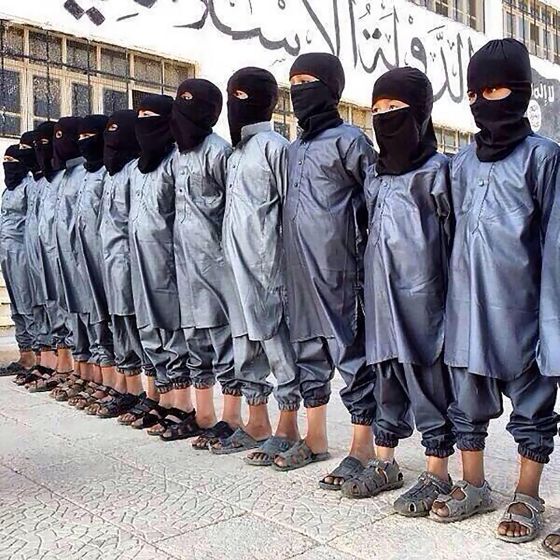
A war against childhood

isis-children

The Wall Street Journal reports: Jomah, a 17-year-old Syrian who joined Islamic State last year, sat in a circle of trainees for a lesson in beheading, a course taught to boys as young as 8.

Teachers brought in three frightened Syrian soldiers, who were jeered and forced to their knees. “It was like learning to chop an onion,” Jomah said. “You grab him by the forehead and then slowly slice across the neck.”

A teacher asked for volunteers and said, “Those who behead the infidels will receive gifts from God,” recalled Jomah, who didn’t want his full name revealed. The youngest boys shot up their hands and several were chosen to participate. Afterward, the teachers ordered the students to pass around the severed heads.

“I’d become desensitized by that time,” said Jomah, who has since defected to Turkey with his family. “The beheading videos they’d shown us helped.”

The enrollment of hundreds of boys in such militant training camps is another tragic facet of Syria’s nearly four-year-long civil war — and its impact could trouble the Middle East for years to come. Parents worry their boys will be forever lost to the indoctrination of Islamic State. [Continue reading…]

A TSG IntelBrief concludes:
• Through systemic indoctrination, intimidation, and extermination, violent extremist groups such as the Islamic State, Boko Haram, and both Afghan and Pakistan Taliban, are targeting children with unprecedented ferocity

• Children are no longer accidental casualties in extremist conflicts but rather they are a primary target

• Extremists are trying to steal the future away from vulnerable regions by stealing the future generation through relentless messaging and violence that separates the youth from their society, government, and culture

• The damage already done by the Syrian civil war, the Islamic State, Boko Haram, and violent extremist groups in in Pakistan pales in comparison to what is yet to come if even a small percentage of their focus on youth pays off.

In the midst of pervasive war-weariness and deeply felt opposition to military intervention following the war in Iraq, social media has not only desensitized children living under ISIS’s rule, serving as a primer on brutality, but it has also desensitized opponents of war.

Images which provoke instinctive revulsion, trigger a desire not only to look away, but also turn away in every way possible, such that both ISIS and those who have become its victims can be cloaked in otherness.

When we see children in masks, it’s easier to see the masks than see the children.

Paradoxically, among the many who readily acknowledge that ISIS came into existence primarily as a result of the war in Iraq and that in this sense, ISIS is an American creation, far fewer are willing to admit that the U.S. has a huge responsibility in now trying to thwart the monster that it unwittingly released.

At the same time, even if we acknowledge that we are part-owners of the problem, no one will be served well by casting America in its traditional self-ascribed role as rescuer.

Now, as has long been the case, the U.S. needs to break out of its bipolar relationship with the rest of the world, neither seeking to dominate, nor retreat.

Facebooktwittermail
