Category Archives: Lands

General el-Sissi is willing to plunge Egypt into chaos

William J. Dobson writes: Gen. Abdel-Fattah el-Sissi certainly knows how to dress the part. On Wednesday, wearing dark sunglasses, full military dress, and a chest full of medals—despite never having seen combat—Egypt’s defense minister looked every bit the junta leader that his critics say he is. “Come out to give me the mandate and order that I confront violence and potential terrorism,” he declared in a nationally broadcast speech, as he called for Egyptians to take to the streets in a show of support for him and the rump government the country’s generals have propped up. “I’ve never asked you for anything. I’m asking you to show the world. If violence is sought, or terrorism is sought, the military and the police are authorized to confront this.” After weeks of violent clashes, Gen. el-Sissi wasn’t interested in tamping down the unrest or demanding a return to calm; he was stirring Tahrir for his own ends.

He sounds like a man looking to start a fight — or at least for the political cover to begin a crackdown on his opponents in the Muslim Brotherhood. Ever since el-Sissi ousted Mohammed Morsi, Egypt’s first democratically elected president, on July 3, the government has increasingly used the “terrorist” label in association with the Muslim Brotherhood. The Egyptian military may desperately need that label to stick—because a threat like terrorism is the perfect legitimizing tool for a government that is being ruled by a military cabal. Having come to power through undemocratic means, the generals know that Egypt’s chaos can make their rule more necessary than ever. [Continue reading…]


Facebooktwittermail

How Gaza and the West Bank became Israel’s weapons testing lab

Jonathan Cook writes: Over the past decade, Israel has surged up the arms trade’s international rankings. Despite having a population smaller than New York City, Israel has emerged as one of the world’s largest exporters of armaments.

Last month, defence analysts Jane’s put Israel in sixth place, ahead of China and Italy, both major weapons producers. Surveys that include Israel’s growing covert trade put it even higher, in fourth place, ahead of Britain and Germany, and beaten only by the United States, Russia and France.

The extent of Israel’s success in this market can be gauged by a simple mathematical calculation. With record sales last year of $7 billion (Dh25.7 billion), Israel earned nearly $1,000 from the arms trade per capita – up to 10 times the per capita income the US derives from its manufacture of weapons.

The Israeli economy’s reliance on arms dealing was highlighted this month when local courts forced officials to reveal data showing that some 6,800 Israelis are actively engaged in the business of arms exports. Separately, Ehud Barak, the defence minister in the last government, has revealed that 150,000 Israeli households – or about one in 10 of the population – depend economically on the weapons industry.

These disclosures aside, Israel has been loath to lift the shroud of secrecy that envelopes much of its arms trade, arguing further revelations would harm “national security and foreign relations”.

But a new documentary lifts the lid on the nature and scope of its arms business.

The Lab, which won a recent award at DocAviv, Israel’s documentary Oscars, is due to premiere in the US early next month. Directed by Yotam Feldman, the film presents the first close-up view of Israel’s arms industry and the dealers who have enriched themselves. The title relates to the film’s central argument that Israel has rapidly come to rely on the continuing captivity of Palestinians, in what are effectively the world’s largest open-air prisons. Massive profits are made from testing innovations on the more than four million Palestinians in Gaza and the West Bank.

Attacks such as Operation Cast Lead of winter 2008-09 or last year’s Operation Pillar of Defence, the film argues, serve as little more than laboratory-style experiments to evaluate and refine the effectiveness of new military approaches, both strategies and weaponry. Gaza, in particular, has become the shop window for Israel’s military industries, allowing them to develop and market systems for long-term surveillance, control and subjugation of an “enemy” population. [Continue reading…]

Facebooktwittermail

Egypt’s military rulers using xenophobia to cement their power

Sarah Carr writes: Former President Mohamed Morsi was stripped of power illegally in a military coup, even if this decision was backed by a large majority of the general public.

It was mostly the privately owned satellite media and newspapers that became the army’s court jester, or at least did so with the most gusto. Logos appeared on screens insistently informing viewers that 30 June was a popular revolution, not a coup. Then the terrorism rhetoric began, and the pro-Morsi protesters were no longer just a bunch of skin-disease ridden, cult supporting lunatics, but also terrorists. Again, this happened almost seamlessly. Television presenters indulged themselves in the vilest xenophobia against Palestinians and Syrians, who they claimed were camped out in pro-Morsi sit-ins and meddling in Egyptian affairs.

Only the weakest of evidence was produced to support these claims, including a video of some men dancing dabke to this Palestinian pro-Morsi song. The aim, of course, was twofold: Firstly, to support the claim that the Brotherhood has links with Hamas and other foreign groups involved in acts of insurgency in Sinai, and secondly, to isolate the Brotherhood even further, turn it into a “them” separate from the rest of the population. The fastest and most foolproof way to do this in Egypt is to establish that a group has links with foreign powers. It works every time.

The media campaign has been disastrous for Syrian refugees, whether already in Egypt or seeking to cross its borders. Syrians who want to come to Egypt to flee the devastation in their country must now gain security authorization before doing so. Syrians already in Egypt are quietly being rounded up at army checkpoints and detained—even individuals registered with the United Nations.

The general public was sold. It ran stumbling and screaming into Sisi’s protective arms and nestled in his bosom. Almost overnight, people mutated into barrel-thumping nationalists celebrating a victory against a foreign enemy, when no battle has yet been won and their enemy is one of them. Hot air—lots of hot air — has been blown into former President Gamal Abdel Nasser’s corpse. Perhaps they are trying to blow his spirit into Sisi. Three years after the heady independent days of 25 January, and Egyptians are once again seeking out the army strongman to hold their hand, and an enemy—invented or real, it does not matter—to define and shape their cause. Like all nationalist movements, this is sentiment partly informed by fear and hate. There is nothing of real ideological substance here, no long-term goal other than either containing the Brotherhood or crushing the Islamist movement. [Continue reading…]

Facebooktwittermail

Egypt army gives Brotherhood 48 hours to join roadmap

Reuters reports: Egypt’s army gave the Muslim Brotherhood until Saturday afternoon to sign up to political reconciliation, a military official said on Thursday, after the army issued a veiled threat to use tougher tactics against the group.

“We will not initiate any move, but will definitely react harshly against any calls for violence or black terrorism from Brotherhood leaders or their supporters. We pledge to protect peaceful protesters regardless of their affiliation,” the official said, saying they had 48-hours to comply.

Facebooktwittermail

Syria’s exodus: a refugee crisis for the world

The Guardian reports: Western countries including the US and Britain may be asked to accept tens of thousands of Syrian refugees because the exodus from the civil war is overwhelming countries in the region, the UN’s refugee chief has warned.

With no end to the war in sight, the flight of nearly 2 million people from Syria over the past two years is showing every sign of becoming a permanent population shift, like the Palestinian crises of 1948 and 1967, with grave implications for countries such as Lebanon and Jordan, UN and other humanitarian aid officials say.

One in six people in Lebanon are now Syrian refugees. The biggest camp in Jordan has become the country’s fourth-largest city. In addition to those who have crossed borders, at least four million Syrians are believed to have been displaced within their own country, meaning that more than a quarter of the population has been uprooted.

In an interview with the Guardian, António Guterres, the United Nations high commissioner for refugees, said the situation was already far more than just a humanitarian crisis. If a resolution to the conflict was not found within months, the UN will look to resettle tens of thousands of Syrian refugees in countries better able to afford to host them, including Britain. Germany has already offered to take 5,000, but other offers have been limited, Guterres said.

Facebooktwittermail

Egypt’s military ruler risks igniting civil war

The New York Times reports: The commander of the armed forces asked Egyptians on Wednesday to hold mass demonstrations that would give him a “mandate” to confront violence and terrorism, appealing to one side of Egypt’s sharply divided populace and raising the specter of broader unrest.

During a speech to recent military graduates, the commander, Gen. Abdul-Fattah el-Sisi, warned of forces taking the country into a “dark tunnel,” a clear reference to Islamist supporters of the deposed president, Mohamed Morsi, and he asked Egyptians to protest on Friday.

“I’m asking you to show the world,” he said. “If violence is sought, or terrorism is sought, the military and the police are authorized to confront this.”

The call for mass mobilization thrust the general into the center of Egypt’s contentious politics, raising questions about his ambitions while contradicting the military’s pledges to defer to civilian leaders after removing Mr. Morsi. His appeal also hinted at a broader crackdown against Islamists, whose leaders have already been detained.

As the Muslim Brotherhood planned competing protests on Friday, Egyptians faced another threat of bloody street clashes in what has become a long and wearying cycle.

In a statement, the Brotherhood said the general’s speech amounted to a call for “civil war.” [Continue reading…]

Facebooktwittermail

McKeon: Egypt’s military ‘doing the right thing’

Al-Monitor reports: The Republican chairman of the House Armed Services Committee, in an exclusive interview with Al-Monitor at his Capitol Hill office, said that he opposes cutting off US military assistance to Egypt and that Egypt’s armed forces are “doing the right thing” to support democracy in Egypt.

In contrast to Sen. John McCain and others who have called for stopping military aid to Egypt because of its armed forces’ role in deposing former President Mohammed Morsi, Rep. Howard “Buck” McKeon, who has been chairman of the committee since January 2011, said that Egypt’s military has been a “stabilizing influence” and its actions were necessary to put Egypt’s democratic transition back on track.

Those who support cutting off military aid to Egypt argue that US foreign assistance provisions require ending assistance in the event of a military coup. [Continue reading…]

Facebooktwittermail

Egypt imposes toughest Gaza restrictions in years

The Associated Press reports: Egypt’s new government has imposed the toughest border restrictions on the Hamas-run Gaza Strip in years, sealing smuggling tunnels, blocking most passenger traffic and causing millions of dollars in economic losses.

Some in Hamas fear the movement is being swept up in the same Egyptian military campaign that earlier this month toppled the country’s democratically elected Islamist president, Mohammed Morsi — like the Gaza rulers part of the region’s Muslim Brotherhood.

Egypt’s military has said the Gaza restrictions are part of its security crackdown in the Sinai and has not suggested it is trying to weaken the Hamas government or bring it down in the process.

Past predications that Gazans fed up with the daily hardships of life under blockade will rise up against Hamas have not materialized.

However, the new Gaza border restrictions are tougher than any enforced by Morsi’s pro-Western predecessor, Hosni Mubarak, a foe of Hamas and the Muslim Brotherhood, according to Gaza residents and Hamas officials. [Continue reading…]

Facebooktwittermail

U.S., in sign of displeasure, halts F-16 delivery to Egypt

The New York Times reports: President Obama, in his first punitive response to the ouster of Mohamed Morsi as president of Egypt, has halted the delivery of four F-16 fighter planes to the Egyptian Air Force.

Mr. Obama, administration officials said, wanted to send Egypt’s military-led government a signal of American displeasure with the chaotic situation there, which has been marked by continued violence, the detention of Mr. Morsi and other leaders of the Muslim Brotherhood, and a transition that has not included the Brotherhood.

Defense Secretary Chuck Hagel relayed the decision to Gen. Abdul-Fattah el-Sisi, the head of Egypt’s military, a senior official said, and did not say when the Pentagon might reschedule the delivery.

“Given the current situation in Egypt, we do not believe it is appropriate to move forward at this time with the delivery of F-16s,” the Pentagon press secretary, George Little, said Wednesday. He did not cite any specific actions by the Egyptian military. [Continue reading…]

Facebooktwittermail

Is the U.S. ramping up a secret war in Somalia?

Colum Lynch reports: The Obama administration earlier this year expanded its secret war in Somalia, stepping up assistance for federal and regional Somali intelligence agencies that are allied against the country’s Islamist insurgency. It’s a move that’s not only violating the terms of an international arms embargo, according to U.N. investigators. The escalation also could be a signal that Washington’s signature victory against al-Qaeda’s most powerful African ally may be in danger of unraveling.

Just last year, Obama’s team was touting Somalia as unqualified success. “Somalia is a good news story for the region, for the international community, but most especially for the people of Somalia itself,” Johnnie Carson, the U.S. assistant secretary of state for African affairs, told reporters last October at the New York Foreign Press Center. Carson praised African forces, principally Uganda and Kenya, for driving the terror group al-Shabab out of the Somalia’s main cities, Mogadishu and Kismayo. “The U.S.,” he boasted, “has been a significant and major contributor to this effort.” Indeed, the United States has emerged as a major force in the region, running training camps for Ugandan peacekeepers destined for battle with Somalia’s militants, and hosting eight Predator drones, eight more F-15E fighter jets, and nearly 2,000 U.S. troops and military civilians at a base in neighboring Djibouti.

But despite the array of forces aligned against it, Al-Shabab is demonstrating renewed vigor. “The military strength of al-Shabaab, with an approximately 5,000-strong force, remains arguably intact in terms of operational readiness, chain of command, discipline and communications ability,” according to a report by the U.N. Monitoring Group for Somalia and Eritrea. “By avoiding direct military confrontation, it has preserved the core of its fighting force and resources.”

“At present, al-Shabaab remains the principal threat to peace and security in Somalia,” the report adds. “The organization has claimed responsibility for hundreds of assassinations and attacks involving improvised explosive devices, ambushes, mortar shelling grenades and hit and run tactics.”

Not coincidentally, perhaps, American involvement in the region is again on the rise, as well. Last year, according to the U.N. group, the United States violated the international arms embargo on Somalia by dispatching American special operations forces in Russian M-17 helicopters to northern Somalia in support of operations by the intelligence service of Puntland, a breakaway Somali province. [Continue reading…]

Facebooktwittermail

Tales of witnesses to Cairo massacre back pro-Morsi version

McClatchy reports: Overlooking the scene where 55 supporters of deposed President Mohammed Morsi died during a standoff with the Egyptian military two weeks ago are two 16-story apartment buildings whose residents are perhaps the only unbiased witnesses to what happened.

With no videos or photos having surfaced of the initial violence, Morsi supporters and the military have offered two very different versions of what set off the confrontation, the deadliest incident since the military toppled Morsi, Egypt’s first democratically elected leader, early this month. At least 100 people have since died in clashes between the military and Morsi partisans, most recently Tuesday, when nine people were killed.

But the July 8 incident outside the Republican Guard headquarters in eastern Cairo remains a touchstone for those who say Morsi was toppled in a military coup and that the military has since taken an approach to Islamists that guarantees years of low-level warfare. Many here fear that Morsi’s incompetent Islamist government has been replaced by an excessively brutal security force reminiscent of the three decades of Hosni Mubarak’s rule. Indeed, it was a call against police brutality that launched the January 2011 uprising that led to Mubarak’s fall.

The military’s version of events says pro-Morsi protesters tried to storm the Republican Guard headquarters, where Morsi partisans think the deposed president is being held, and that security forces turned to live bullets only after they’d fired warning shots, blank rounds and tear gas to no effect.

Protesters say they were simply praying when an unwarranted attack began.

The stories of nine occupants of the apartment buildings whom McClatchy interviewed seem to back the protesters’ version of events, even though many of those residents said they had little sympathy for Morsi and had grown frustrated with the protesters’ constant chants, which had gone on for days. [Continue reading…]

Facebooktwittermail

Short cuts in Cairo

Adam Shatz writes: On 4 July, the day after the army overthrew Mohamed Morsi and suspended the constitution, I got an email from a friend in Cairo. A photograph of the 30 June demonstrations in Tahrir Square was emblazoned with the words: ‘This is not a coup’. He didn’t say what else it might be, but soon enough others did. A second revolution, a ‘people’s coup’, a ‘re-colution’: terms coined to describe how the events felt to them, or perhaps to bridge the discomfiting gap between experience and reality. It’s not the first time a coup in Egypt has been called something else: Nasser and the Free Officers who overthrew King Farouk in 1952 also called their coup a revolution. What’s different today is that the most ferocious critics of coup-talk are people like my friend, veterans of the 2011 uprising against Mubarak.

Their insistence is understandable: having brought down another hated president, they’re proud of what they’ve achieved and resent the suggestion that they’ve been manipulated – especially when it comes from Westerners. The youth movement Tamarrod collected 22 million signatures for a petition urging Morsi to resign, and organised the biggest demonstrations in Egypt’s history. You can argue that Morsi’s removal set an alarming precedent, but not that it was unpopular. You can’t even cast it as an elite secular conspiracy against the pious Islamic masses: General Abdel Fattah al-Sisi, commander of the Supreme Council of the Armed Forces, is a devout Muslim (his wife wears a niqab) and has the support of the Salafi al-Nour party. The Salafis are to the right of the Muslim Brotherhood, but they didn’t appreciate the Brothers’ authoritarian style, and they knew an opportunity when they saw one. Within days of Morsi’s removal they flexed their muscles by blocking Mohamed ElBaradei’s appointment as interim prime minister; ElBaradei, who used to say he would never collaborate with the Scaf, accepted the vice presidency as a consolation prize. For now, an obscure jurist called Adli Mansour is acting president, and the economist Hazem el-Beblawi is prime minister. But why bother to remember the names? The ‘re-colution’ will eat its children, just as the revolution did. [Continue reading…]

Facebooktwittermail

Syria’s Nusra Front tries to show it’s a different kind of al Qaida

McClatchy reports: Two al Qaida-linked rebel groups in Syria appear to be distancing themselves from each other in what may be an effort by the Nusra Front, which the United States has branded as an international terrorist organization, to remain relevant amid signs that major portions of the Syrian population are chafing under harsh rule by conservative religious fighters.

A series of incidents in which residents and fighters in rebel-held areas have protested what they say is a heavy-handed approach to a raft of issues have put Nusra and the other group, the Islamic State of Iraq and the Levant, on the political defensive even as the umbrella group of rebels that the West recognizes, the Free Syrian Army, comes under pressure by the United States to reduce the groups’ influence.

“The jihadists are rightly worried that the U.S. will demand action against jihadists as a vetting bottom line. They talk a lot about the FSA being recruited by the CIA to fight them,” said Joshua Landis, an associate professor at University of Oklahoma who’s an expert on Syria.

When the Obama administration agreed last month to supply weaponry to the Free Syrian Army’s Supreme Military Council, it quickly became clear that ensuring that those weapons didn’t go to Nusra or the Islamic State was a major condition of the aid, which nevertheless has been slow to materialize. Adding to the tensions has been the killing by an Islamic State member of a commander from a pro-Free Syrian Army unit in the mountains along the Syrian coast, allegedly in a dispute over a checkpoint.

In an effort to tamp down the perception that the Free Syrian Army was powerless over these al Qaida-linked groups, a commander in the area said the Free Syrian Army had demanded an arrest. The Islamic State’s response was to order the arrest and trial of the suspected shooter.

That hasn’t yet happened. “There has been no reaction from his group,” said Tasmim al Laathiqiyah, a member of the Khalwah Bin al Azwar Battalion, a rebel unit affiliated with the Free Syrian Army. [Continue reading…]

Facebooktwittermail

Across Syria, violent day of attacks and ambush

The New York Times reports: Violence raged across Syria on Sunday as government forces killed dozens of rebels in an ambush east of Damascus, fighters linked to Al Qaeda battled Kurdish militias and Syria’s military peppered an outdoor market with mortar rounds.

Antigovernment activists also accused government forces of killing 13 members of a family in northwestern Syria.

In the deadliest attack, government forces ambushed a group of rebel fighters in the town of Adra, northeast of Damascus, and left dozens of dead bodies lying in the sand, according to video broadcast on Al Manar, a television station run by Hezbollah, the Lebanese militant group and political party that supports President Bashar al-Assad.

The Syrian Observatory for Human Rights, an anti-Assad group based in Britain that tracks the conflict through a network of contacts on the ground, said on Monday that 65 people had been killed in the countryside around Damascus, including 58 insurgent fighters. The ambush in Adra accounted for 49 rebel deaths.

It was another blow to the rebel movement. The momentum in the civil war has shifted in favor of Mr. Assad, whose forces have rolled back a number of rebel gains near Damascus, the capital, and elsewhere. Infighting among rebels who took up arms to topple Mr. Assad has allowed his forces to solidify their hold on central Syria and gradually expand their reach. [Continue reading…]

Facebooktwittermail

People, power, or propaganda? Unraveling the Egyptian opposition

Max Blumenthal writes: The debate over the legitimacy of Egypt’s new, military-installed government has become a popularity battle, with some of the most vocal supporters of the coup claiming that the June 30 protests against President Mohammed Morsi represented the largest demonstrations in human history, a real-life Cecil B. DeMille production, with crowd sizes ranging anywhere between 14 to 33 million people – over one-third of the entire population of Egypt.

Substituting subjective head counts for vote totals, Morsi’s opponents have also pointed to the 22 million signatures supposedly gathered by the newfangled Tamarod youth movement. To them, the tens of millions in the streets were a clear sign that “the people” had sided unequivocally with the army and its political allies.

The importance of head counts to the military-installed government’s international legitimacy was on display at a July 11 press conference at the US State Department. Pressed by Matt Lee of the Associated Press on whether the Obama administration considered Morsi’s ouster a coup, and if it would respond by canceling aid including a planned shipment of four F-16’s to Egypt, State Department spokesperson Jen Psaki countered by citing Tamarod’s figures, declaring that the US could not reverse the will of the “22 million people who spoke out and had their voices heard.”

Days later, the Pentagon announced that the F-16 sale would proceed as planned. As far as the US was concerned, Egypt had not just witnessed a military coup. Instead, “the people” – or at least 22 million of them – had spoken.

With Egypt’s new army-backed regime relying on jaw dropping, record-shattering crowd estimates and petition drive figures to assert its democratic legitimacy, it is worth investigating the source of the numbers, and asking whether they add up at all. [Continue reading…]

Facebooktwittermail

Egypt’s return to military rule

The Washington Post reports: When the military ousted Egypt’s first democratically elected president, Zeinhom Hassan Ibrahim slaughtered a sheep, hired a DJ and threw a block party for his neighbors.

Ibrahim, a former parliamentarian from longtime ruler Hosni Mubarak’s now-defunct National Democratic Party, had lived through the year of Mohamed Morsi’s rule in blinking disbelief, as if the whole world had turned upside down.

But now, things are finally getting back to normal.

Egypt’s new power dynamic, following the July 3 coup that ousted Morsi, is eerily familiar. Gone are the Islamist rulers from the once-banned Muslim Brotherhood. Back are the faces of the old guard, many closely linked to Mubarak’s reign or to the all-
powerful generals. And for a seemingly broad array of Egyptians, that’s exactly the way they want it.

The overthrow of Morsi has yielded a new appreciation for military rule in a country that so recently shunned it, and a striking return to the way things were before the 2011 revolution against a Mubarak regime that was widely considered irredeemably corrupt and exploitative.

Telltale signs of the old guard are cropping up in Egypt’s new cabinet, where Mubarak-era figures abound and Islamists are absent; in the halls of the nation’s justice system, where prosecutors are investigating the nation’s pre-coup leaders on charges of incitement; and in darkened jail cells, where prisoners are blindfolded, handcuffed and interrogated about their adherence to the Brotherhood.

Gen. Abdel Fatah al-Sissi, the man who delivered news of Morsi’s dismissal on national television, has now assumed the role of deputy prime minister in addition to his earlier titles of defense minister and commander of Egypt’s armed forces. Few observers doubt that he pulls the levers behind a facade of civilian rule. [Continue reading…]

Facebooktwittermail

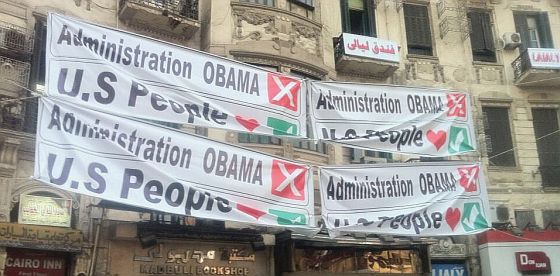
Egyptians hate U.S. government, not American people

Tahrir Square banners, Cairo.

Marc Lynch writes: This week, Hosni Mubarak’s old media boss, Abdel Latif el-Menawy, published an astonishing essay on the website of the Saudi-funded, Emirati-based satellite television station Al Arabiya. Menawy described a wild conspiracy in which the U.S. ambassador to Egypt, Anne Patterson, directed Muslim Brotherhood snipers to murder Egyptian soldiers.

It would be easy to dismiss the ravings of an old Mubarak hand if they were not almost tame compared with the wild rumors and allegations across much of the Egyptian media and public. Even longtime observers of Egyptian rhetoric have been taken aback by the vitriol and sheer lunacy of the current wave of anti-American rhetoric. The streets have been filled with fliers, banners, posters, and graffiti denouncing President Barack Obama for supporting terrorism and featuring Photoshopped images of Obama with a Muslim-y beard or bearing Muslim Brotherhood colors.

A big Tahrir Square banner declaring love for the American people alongside hatred for Obama rings somewhat false given the fierce, simultaneous campaign against CNN and American journalists. The rhetoric spans the political spectrum: veteran leftist George Ishaq (Patterson “is an evil lady”), the Salafi Front (calling for demonstrations at the U.S. Embassy against foreign interference), the reckless secularist TV host Tawfik Okasha (whipping up xenophobic hatred), leaders of the Tamarod campaign (refusing to meet with Deputy Secretary of State William Burns because the United States “supports terrorism”), and Brotherhood leaders (blaming the United States for the military coup).

Would it be strange for Egyptians not to make a sharp distinction between the American press and the U.S. government? All too often CNN, the New York Times and other pillars of the media establishment display such a cozy relationship with government that even if they are not technically arms of state media, they very often act like that.

To treat what are explicitly attacks on the U.S. government as though they represent attacks on the American people seems just as irresponsible as some of the conspiracy theories themselves. Maybe this difficulty in discriminating between the government and the people isn’t so much a problem for the Egyptians as it is for someone who is both trapped inside the Washington bubble and has been an occasional adviser to the White House.

Facebooktwittermail