Mustafa al-Kadhimi writes: An alliance combining Shiite and Sunni currents in Baghdad succeeded last Saturday, June 15, in forming a local government without the participation of the State of Law Coalition. The latter was the largest winning bloc in the local elections held this past April. This step represents a development that will have major implications on the course of the political conflict in Iraq and the general election scheduled for 2014.
Despite the success of Prime Minister Nouri al-Maliki’s State of Law Coalition in obtaining 20 of 58 seats in Baghdad, the Al-Ahrar bloc, led by Muqtada al-Sadr, won 11 seats; the Sunni Mutahidoun block, led by Osama al-Nujaifi, obtained seven seats; the Citizen bloc obtained six seats and around 14 seats were distributed over other blocs and minority quotas. The way the seats were distributed allowed these forces to come together and form a government that excluded the biggest winner in the elections.
At first glance, it seems that this distribution, according to which the local government of Baghdad was formed on Saturday, is wide-ranging, inconsistent and incompatible at key points. It also seems that the State of Law Coalition will overcome its loss by trying to attract small blocs in the Baghdad Council to change the current government, a scenario that may be realized in the coming months. There is, however, another scenario that is more attainable, which involves the new alliance in Baghdad achieving greater harmony and making this experience a prelude to changing the political map in the general elections in 2014.
Not only does Baghdad have the largest population in Iraq (about 8 million), but its local government may have the means to tame the sectarian sensitivities, which are becoming more dangerous in Iraq and the region.
The Sunni Mutahidoun bloc was given the most prominent legislative position in the city — head of the provincial council — while the position of governor was allocated to the Sadrist movement, and Ammar al-Hakim’s party obtained the position of mayor of Baghdad. This represents a new step in understanding the nature of the conflict in Iraq and finding a way to resolve it. [Continue reading…]
Category Archives: Lands
Hamas and Hezbollah’s strained relations
Al-Monitor reports: The conflict in Syria has stressed the relationship between the Palestinian Sunni Hamas movement and the Lebanese Shiite Hezbollah organization, transforming it from one of “intimacy” between allies to a tension-inducing “quarrel” after Hamas took a position against the Syrian government of President Bashar al-Assad and Hezbollah became involved militarily in supporting the regime.
Informed Palestinian sources, who spoke on condition of anonymity, revealed to Al-Monitor that members of Hezbollah had asked Hamas members residing in Beirut’s southern suburbs to leave the area at the end of the battle for Qusair in Syria. The Party of God believed that Palestinians from Hamas had participated in the fighting against it and Syrian regime forces.
One source told Al-Monitor on June 10, “Following this tension, Hamas leaders in Lebanon contacted Hezbollah leaders and an urgent meeting was held between the two sides. Hamas strongly denied that Palestinian fighters affiliated with the movement had participated in the fighting in Syria.” In addition, the source offered, “Following these high-level contacts, which involved Lebanese politicians, the two sides agreed that Hezbollah would back down on its demand that Hamas leave Beirut’s southern suburbs, which is Hezbollah’s stronghold. Most Hamas leaders live in this area, and it is home to the movement’s main office.”
On June 11, the Lebanese daily Al-Akhbar, which is close to Hezbollah, published “It’s Forbidden to Criticize Hamas.” According to the story, “Hezbollah had issued an internal circular forbidding party officials from commenting on or directing any criticism at the Islamic Resistance Movement [Hamas].” [Continue reading…]
Egypt Brotherhood backs Syria jihad, denounces Shi’ites
Reuters reports: Egypt’s ruling Muslim Brotherhood blamed Shi’ites for creating religious strife throughout Islam’s history, as the movement joined a call by Sunni clerics for jihad against the Syrian government and its Shi’ite allies.
In a striking display of the religious enmity sweeping the region since Lebanon’s Iran-backed Hezbollah committed its forces behind Syrian President Bashar al-Assad, a Brotherhood spokesman in Cairo told Reuters on Friday: “Throughout history, Sunnis have never been involved in starting a sectarian war.”
Until recently, Egypt’s new Islamist president, the Brotherhood’s Mohamed Mursi, was promoting rapprochement with Iran, the bastion of Shi’ite political power and in February he hosted the first visit by an Iranian president in over 30 years.
But spokesman Ahmed Aref said Hezbollah had launched a new “sectarian war” last month by joining Tehran’s other key ally Assad in a fight that pits mainly Sunni rebels against a Syrian elite drawn from Assad’s Alawite minority, a Shi’ite offshoot.
For that reason, Aref said, the Brotherhood, which emerged from oppression after the fall of military rule two years ago to run by far the most populous Arab state, had joined a call made on Thursday by leading Sunni clerics for holy war in Syria.
The Iranian people challenge the West
Paul Pillar writes: Hassan Rouhani’s stunning and sweeping victory in the Iranian presidential election is already generating much debate among expert Iran-watchers about how to interpret this outcome. There are different views, for example, on what inference should be drawn regarding the posture of Supreme Leader Khamenei toward the election. Was this outcome one that the leader might have anticipated and is part of a skillful management of contending factions, or does the election result instead indicate that the leader’s control of Iranian politics is less than was often surmised? There also are different views on what role sanctions-induced economic strain may have had on the election. These are genuine questions on which objective and well-informed observers can disagree. Not genuine is the spin from some other fast-off-the-mark commentators who are endeavoring to deny any significance to Rouhani’s victory and to portray the Iranian regime as nothing but the same old recalcitrant adversary—a spin motivated by opposition to reaching agreements with Iran and the favoring of confrontation and even war with it.
Useful implications for policy toward Iran can be drawn without resolving all these analytical questions, even the genuine ones. Sometimes a particular course of action is the best course under any of several different interpretations of exactly what is going on in another nation’s capital. This is one of those instances. In particular, there are clear implications for approaching the next stage of negotiations on, and policy toward, Iran’s nuclear program—which, for better or for worse, is the subject dominating discussion of relations with the Islamic Republic.
One thing that the Iranian election would have changed no matter what the outcome on election day is that we soon will not have Mahmoud Ahmadinejad to kick around any more. The end of his distracting and annoying presence can only be to the good. Perhaps at least a little more serious attention will be devoted in the United States to policy and diplomacy when there is a little less energy allocated to expressing outrage over the outgoing Iranian president’s mistranslated quotes about wiping maps and his other intentionally inflammatory rhetoric. [Continue reading…]
How Rouhani won the Iranian presidential election
Mahmoud Reza Golshanpazhooh writes: Although some analysts are trying to argue that the vote for Mr. Hassan Rouhani was, in fact, a negative vote to the Islamic establishment’s policies, it was, in reality, a vote to moderation and foresight. These two concepts were major components of Mr. Rouhani’s election campaign as well. The high vote garnered by Mr. Rouhani was the result of the collective effect of a number of variables as follows:
– His fair – and at the same time categorical – criticism of certain policies followed by the incumbent administration;
– His finesse in defending his own viewpoints, track records, and policies in televised debates, especially in the second and third debates;
– The full and all-out support provided to Mr. Rouhani by former presidents, Akbar Hashemi Rafsanjani and Mohammad Khatami;
– The smart move by the other reformist candidate, Mohammad Reza Aref, in withdrawing his presidential bid without declaring his official support for Mr. Rouhani. As a result, the clear demarcation between Mr. Aref’s purely reformist attitude and Mr. Rouhani’s moderate views was maintained;
– Increased political understanding on the part of the Iranian people as they were well aware that they could only play a crucial part in determining their own fate through participating in the political process, not by boycotting it;
– The great effort made by Mr. Rouhani and his election campaign to carefully observe the rules of the political game and their clear commitment to pursuing any possible protests to election process through legal channels as specified by the Iranian Constitution. This was very important because it redirected the votes of the mostly traditional sectors of the Iranian society toward him as they were afraid that voting for the reformists would only increase conflicts and tension in the society.
– Another important factor was the clerical nature of Mr. Rouhani, which played an effective role in attracting the votes of a large part of the religious people to him as well as the votes cast by the ordinary people in villages and small towns. There were also many other, less significant factors at work. [Continue reading…]
Gezi Park has become a hotbed of activity as Turks make their stand
Constanze Letsch writes: It is one of the most beautiful successes of the Gezi Park protests: cramped together inside an endangered inner city park, united in their anger at an authoritarian prime minister, protesters of all colours – leftists, nationalists, feminists, anarchists, religious groups, secularists, students, bankers – are engaging in dialogue.
Ahmet Metin, head of the Istanbul branch of the nationalist Association for Kemalist Thought, says he led “some wholesome discussions” with Kurdish protesters, LGBT activists and liberals, for the first time. “We don’t share the same political views, and we don’t agree on everything,” he admits. “But we’re all here to defend democratic rights. It’s a point of departure.”
Few romanticise this unexpected eruption of pluralist civil society. Every now and then, small verbal skirmishes break out: nationalists grumble at flags of the jailed Kurdish PKK leader Abdullah Öcalan, hoisted in one corner of the park. Kurds are uneasy about protesters claiming to be soldiers of modern Turkey’s founder, Mustafa Kemal Atatürk. Posters ask activists not to use sexist or racist language in their slogans. “Before you call anyone ‘a faggot’, remember that faggots have been on the frontline of this struggle all along,” one cardboard sign reminds passersby.
Hamdi, a 29-year-old architect who quit his job in the central Anatolian city of Kayseri to join the Gezi park protests, underlines that no political party has managed to force its label on to the movement. “We all know what we want from this and that’s enough to keep us together. We don’t need pre-packed ideologies.” [Continue reading…]
Turkey expands crackdown on street unrest
The New York Times reports: The Turkish authorities widened their crackdown on the antigovernment protest movement on Sunday, taking aim not just at the demonstrators themselves, but also at the medics who treat their injuries, the business owners who shelter them and the foreign news media flocking here to cover a growing political crisis threatening to paralyze the government of Prıme Minister Recep Tayyip Erdogan.
After an intense night of street clashes that represented the worst violence in nearly three weeks of protests, Mr. Erdogan rallied hundreds of thousands of his supporters on Sunday — many of them traveling on city buses and ferries that the government had mobilized for the event — at an outdoor arena on the shores of the Sea of Marmara. In some of his toughest language yet, he called his opponents terrorists and made clear that any hope of a compromise to end the crisis was gone.
“It is nothing more than the minority’s attempt to dominate the majority,” he said of the protesters. “We will not allow it.”
The escalating tensions have raised the risk of an extended period of civil unrest that could undermine Turkey’s image as a rising global power and a model of Islamic democracy, which Mr. Erdogan has cultivated over a decade in power. [Continue reading…]
Defector Syrian general will be conduit for U.S. military aid to rebels
The Washington Post reports: A mild-mannered Syrian general who taught at a military academy before he defected last year is poised to play a key role in shaping the outcome of Syria’s war now that the United States has said it will provide direct military assistance to the rebels.
Gen. Salim Idriss, 56, heads the Supreme Military Council of the fragmented Free Syrian Army, and the Obama administration has anointed him as the sole conduit of weapons to the rebels, whether supplied by the United States or by allies such as Saudi Arabia and Qatar, which have already been sending arms.
The United States still has not committed to providing any weaponry, Idriss said Sunday in a phone interview from the Turkish capital, Ankara, after two days of talks with U.S. officials over what form the unspecified military assistance announced last week would take.
He urged the United States to move swiftly on the arms deliveries before opposition fighters suffer further setbacks on the battlefield.
“We need help. I can tell you very clearly, very urgently, we need it as soon as possible,” he said in the interview before heading back to his headquarters in the northern Syrian province of Idlib.
Recent advances by forces loyal to President Bashar al-Assad have been facilitated by his allies Iran and Russia, which are providing vast quantities of arms and ammunition to prop up Syrian government forces, Idriss said. Fighters from the Lebanese Shiite Hezbollah movement are bolstering the ranks of Assad’s conventional army, which is weary from more than two years of battling the rebellion. [Continue reading…]
I saw Nasrallah in Qusair
Ali Hashem writes: In the center of the city, I stood in the middle of the main road as a huge, black four-wheel-drive came my way.
I stared at the man sitting beside the driver: The face was familiar, but something was missing. It was clear I was face to face with Hezbollah Secretary-General Sayyed Hassan Nasrallah, without a turban, wearing a military uniform. He smiled and nodded to me, and while I was still in shock, the car was out of sight. There was no convoy, only one car, but as I said before, there were security measures taken in the city and around.
It took me some time to confirm that whom I saw was Nasrallah. When I returned to Beirut, I started my investigations to confirm it, and I did.
While investigating, I came across another piece of information: this visit wasn’t the first for Nasrallah to Qusair during this very crisis. “Sayyed Nasrallah went to Qusair a day before the start of the battle: he met the commanders, visited some injured fighters and gave a speech,” a source close to Hezbollah told me, “He spoke for around half an hour with his main commanders exchanging ideas on the battle and the expectations and how many days it’ll take them to finish it.”
As for the latest visit, the one day after the offensive, our source said that Nasrallah visited the city of Qusair and the towns around it in the country side. He added, “Sayyed Nasrallah wanted to thank the fighters personally, he met them, met the injured, and went around the area.”
Obama mustn’t waste the opportunity he has been handed by the Iranian people
Vali Nasr writes: Rowhani was widely excoriated in Iran for ostensibly betraying the national interest in 2003, when, as the country’s nuclear negotiator, he signed on to a voluntary suspension of uranium enrichment. That concession was meant as a confidence-building measure to build momentum for a broader nuclear deal, but the reformist hope turned into defeat when talks failed amid allegations that Iran had violated protocols laid out by the International Atomic Energy Agency. The supreme leader and his conservative coterie concluded that the suspension had been construed as Iranian weakness and only invited greater international pressure. They blamed Rowhani for having put Iran on its heels. The defeatist image became a stain on the reformists’ reputation and contributed to the conservative juggernaut that swept Mahmoud Ahmadinejad to power in 2005.
Ahmadinejad lost no time reversing the suspension. In a matter of days, the West offered Iran a new diplomatic package that reportedly included trade incentives, the promise of long-term access to nuclear supplies, and assurances of non-aggression. Rowhani’s boss, the reformist President Mohammad Khatami, complained that in doing so the West had rewarded Ahmadinejad’s brazen defiance over the reformists’ gesture of compromise.
Once bitten twice shy, Rowhani is unlikely to yet again risk being branded as soft on the West. He will venture concessions only if he is assured of tangible returns. This time it has to be Rowhani who gets more out of the United States than Ahmadinejad and Jalili did — and they had been offered spare aircraft parts and, in the last round of talks, relief from international sanctions on trade in gold and precious metals. Rowhani will be looking for real sanctions relief and a promise of recognition of Iran’s right to enrichment.
The dilemma for Washington is that, as a reformist, Rowhani is an outsider, weaker than Ahmadinejad when it comes to selling any compromise with the West to Iran’s suspicious conservative establishment. Rowhani’s electoral mandate gives him room to maneuver, but that is not enough to shield him from the backlash that would follow any rebuff at the negotiating table. So he will likely wait for a signal of American willingness to make serious concessions before he risks compromise. [Continue reading…]
How Iran’s Supreme Leader paved the way for Rouhani’s victory
Al-Monitor: Two days before Iranians voted for who would succeed Mahmoud Ahmadinejad as president of the Islamic Republic, Supreme Leader Ayatollah Ali Khamenei offered a rhetorical olive branch to the country’s opposition. He said that even those who “do not support the Islamic system” should come out and vote.
Khamenei’s message was a direct and unprecedented acknowledgement of the reformists and millions of silent secularists who comprise Iran’s “opposition” as stakeholders in the country. It was also a message to them that their votes would count.
This overture should be considered now that Hassan Rouhani — a candidate supported by reformists, and a reformist himself in all but name — has become the seventh president of the Islamic Republic of Iran.
The Supreme Leader’s comments actively contributed to the success of a candidate that is not within the conservative confines of his “principlist” political stable, in the process creating a more inclusive and pluralistic Iran. Contrary to endless punditry about Saeed Jalili being Khamenei’s favored candidate and even the front-runner, it now appears that the Supreme Leader made the calculated decision to acquiesce to the will of the Iranian people. [Continue reading…]
Noam Chomsky interview: Sykes-Picot is failing
Al-Akhbar English: Maha Zaraket: What is the title of your [commencement] speech [at the American University of Beirut]?
Noam Chomsky: I do not remember if it has a title, but it is going to be some comments on legitimacy of borders and states and possibilities of eroding them.
MZ: Do you think the Middle East is going through a rewrite of Sykes-Picot agreement?
NC: I think the Sykes-Picot agreement is falling apart, which is an interesting phenomenon. That is a century. But, the Sykes-Picot agreement was just an imperial imposition that has no legitimacy; there is no reason for any of these borders – except the interests of the imperial powers.It is the same all over the world. it is hard to find a single border that has any justification, including the US-Mexico border and the US-Canada border. You look around the world, just about every conflict that is going on results from the imposition of imperial borders that have nothing to do with the population.
I think as far as Sykes-Picot is concerned, it is beginning to erode. Whatever happens in Syria – it’s hard to imagine – but if anything survives, parts of Syria will be separated. The Kurdish areas are almost autonomous now and they are beginning to link up with the almost-autonomous parts of Northern Iraq Kurdish areas, and may spill over to some extent to southeastern Turkey. What will happen in the rest of the country is hard to say.
MZ: Do you think the new borders will be made by the local population? Or new imperialisms?
NC: I wish that were true, but that is not how the world works. Maybe someday, but not yet, not today.
MZ: What do you think of the Hezbollah intervention in Syria?
NC: They are in a very difficult position. If the rebels win in Syria, they become very exposed. That may mean their demise. There is reason behind it, I am not sure this is the right one, you could argue about it, but it is understandable.
MZ: Are you going to meet Nasrallah this time?
NC: No, I do not know if it is possible. But it is deeply in mind. It is difficult.
MZ: If you meet him again, what would you tell him?
NC: I would like to meet him, but just to find out more about their thinking and their plans. They are not coming to me for advice. You know.
MZ: You called for support of the Turkish protesters. How do you see the uprising in Turkey?
NC: I think the [Taksim demonstrators] are doing a great thing. I think it is extremely important. Of global importance. The initial reaction of the Erdogan regime was pretty similar to Mubarak and Assad: harsh brutal response to a legitimate set of demands. [Continue reading…]
Iran’s new president hails ‘victory of moderation’
Reuters reports: Moderate cleric Hassan Rohani won Iran’s presidential election on Saturday with a resounding defeat of conservative hardliners, calling it a victory of moderation over extremism and pledging a new tone of respect in international affairs.
Though thousands of jubilant Iranians poured onto the streets in celebration of the victory, the outcome will not soon transform Iran’s tense relations with the West, resolve the row over its nuclear program or lessen its support of Syria’s president in the civil war there – matters of national security that remain the domain of Supreme Leader Ayatollah Ali Khamenei.
But the president runs the economy and wields broad influence in decision-making in other spheres. Rohani’s resounding mandate could provide latitude for a diplomatic thaw with the West and more social freedoms at home after eight years of belligerence and repression under President Mahmoud Ahmadinejad, who was legally barred from seeking a third consecutive term.
“This victory is a victory of wisdom, a victory of moderation, a victory of growth and awareness and a victory of commitment over extremism and ill-temper,” Rohani told state television, promising to work for all Iranians, including the hardline so-called “Principlists” whom he defeated at the poll.
“I warmly shake the hands of all moderates, reformists and Principlists,” he said.
The mid-ranking cleric seemed to strike a new tone in the way he talked about Iran’s relations with the rest of the world.
Rohani said there was a new chance “in the international arena” for “those who truly respect democracy and cooperation and free negotiation”.
Celebrating crowds sprang up near Rohani’s headquarters in downtown Tehran and across the city and country as his victory was confirmed.
Barbara Slavin writes: It is too soon to say whether the election results — which gave Rouhani 18.6 million of the 37 million votes cast — will cause a swift change in Iranian policy or negotiating strategy. However, the poor showing for more conservative candidates — particularly current chief nuclear negotiator Saeed Jalili, who came in third — is too strong a signal for Iran’s leader to ignore.
By entering the race, Jalili insured that the nuclear issue — which is normally taboo for public debate in Iran — would be discussed during the brief campaign. In a final televised debate a week before the elections, the other candidates harshly criticized Jalili’s stewardship of talks with the five permanent members of the UN Security Council plus Germany (P5+1).
Former Foreign Minister Ali Akbar Velayati, who might resume that post under Rouhani, was scathing:
“You want to take three steps and you expect the other side to take 100 steps, this means that you don’t want to make progress,” he said. “This is not diplomacy. … We can’t expect everything and give nothing.”
During the campaign, Rouhani repeatedly noted the connection between the lack of agreement on the nuclear front and Iran’s deteriorating economy. It was nice that more centrifuges are spinning, he said, but it would be better if they were gears in Iran’s shuttered factories.
Ali Vaez, Iran analyst for the International Crisis Group, told Al-Monitor in an email “the nuclear issue became — by design or accident — a central theme in the elections. As such, the outcome will inevitably impact the country’s nuclear policy.”
Vaez added, “The electoral defeat of Saeed Jalili and his narrative cannot be inconsequential. Khamenei’s bottom lines — recognition of Iran’s right to domestic enrichment and removal of sanctions — are unlikely to change. But Iran’s approach to nuclear diplomacy will.”
Landslide win for Rowhani in Iran elections
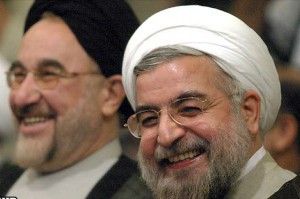
The Washington Post reports: Hassan Rouhani, a moderate Shiite cleric known as one of Iran’s leading foreign policy experts, has won the election to succeed Mahmoud Ahmadinejad as the Islamic Republic’s next president, Interior Minister Mostafa Mohammad-Najjar announced Saturday evening.Hassan Rowhani with former president Mohammad Khatami
With results from all the precinct in, Rouhani had won 50.7 percent of the votes, avoiding a runoff, Mohammad-Najjar said.
Bloomberg reports: Support for Rohani swelled in the final days of the campaign after former presidents Ali Akbar Rafsanjani and Mohammad Khatami joined forces to endorse him.
Addressing a packed Tehran stadium last week, Rohani, who campaigned on the slogan “prudence and hope,” urged his young supporters to overcome political apathy and their frustration over the lack of jobs and vote for him. Rohani waved a giant key at his rallies as a symbol that he will unlock closed doors.
“Though hardliners remain in control of key aspects of Iran’s political system, the centrists and reformists have proven that even when the cards are stacked against them, they can still prevail due to their support among the population,” Trita Parsi, author of “A Single Roll of the Dice: Obama’s Diplomacy with Iran” and president of the National Iranian-American Council in Washington, wrote in an e-mail.
Long lines at polling stations yesterday led to voting being extended several times, to 11 p.m. local time. State-run Press TV estimated voter turnout at about 80 percent.
The departure of Mohammad Reza Aref from the campaign on June 10 meant Rohani had the reformist platform to himself against a field of five conservatives who failed to agree on a unity candidate.
Rohani has spoken in favor of increased freedom for the press and non-governmental organizations. He has also called for the easing of social restrictions, criticizing the government’s “unwarranted interventions” in Iranians’ lives.
Economy ‘Critical’In April, Rohani promised that his government would pursue “dialogue and interaction with the world.” He also said the economy is in a “critical” situation and that sanctions can’t be blamed for the country’s “weaknesses.”
Still, he said sanctions must be tackled for the economy to take a new direction away from a 30 percent inflation rate and unemployment that left a quarter of Iranians age 15 to 29 without jobs in the year ended March 20.
Earlier this week, Farideh Farhi wrote: The decision by the reformist candidate Mohammadreza Aref to withdraw his candidacy — and in effect open the path for the centrist Hassan Rowhani to become the unified candidate of both the centrists and reformists — is an important development in Iranian politics. Its impact will reach beyond this election.
This isn’t only because the centrist and reformist forces, currently led by former presidents Akbar Hashemi Rafsanjani and Mohammad Khatami, respectively, have done what the conservative forces failed to do. After all, the conservatives — or the array of forces known as the “Principlists” in Iran, also began with the idea of coalition-building in mind. The trio – former foreign minister Ali Akbar Velayati, Tehran mayor Mohmmad Baqer Qalibaf, and former Parliament Speaker Gholamreza Haddad Adel — had agreed that only one of them would stand on Election Day. Today, however, only Haddad Adel has dropped out without specifying his preferred candidate.
Beyond Velayati and Qalibaf, other principlist candidates, including nuclear negotiator Saeed Jalili and former IRGC commander Mohsen Rezaie, remain in the race. So now a splintered principlist field faces a candidate that has the backing of significant political and social forces; a candidate who may, just may, become president if the Iranian electorate decides to vote in larger than expected numbers and, of course, there is no ballot box-tampering.
Just this thought, for me, represents an amazing turn of events in Iran’s ongoing election saga. But even if this form of strategizing does not yield success for whatever reason, the process that led to this alliance is an important one; one that may have a lasting impact on Iranian politics. [Continue reading…]
The Syria strategy vacuum
Marc Lynch writes: Many of the advocates of aggressive intervention define the Syrian conflict primarily as a front in the cold war against Iran. From this perspective, Hezbollah’s entry into the fray and the fall of Qusayr are not necessarily a bad thing — Washington now has an opportunity to strike directly at one of Iran’s most valuable assets in the Middle East. The enemy’s queen, to use a chess metaphor, has now moved out from behind its wall of pawns and is open to attack. Fear of a rebel defeat — and of a victory for Hezbollah and Iran — should squeeze more cash and military support out of the Arab Gulf, Europe, and the United States.
If Washington endorses the goal of bleeding Iran and its allies through proxy warfare, a whole range of more interventionist policies logically follow. The model here would presumably be the jihad against the Soviet occupation of Afghanistan — a long-term insurgency coordinated through neighboring countries, fueled by Gulf money, and popularized by Islamist and sectarian propaganda.
“Success” in this strategy would be defined by the damage inflicted on Iran and its allies — and not by reducing the civilian body count, producing a more stable and peaceful Syria, or marginalizing the more extreme jihadists. Ending the war would not be a particular priority, unless it involved Assad’s total military defeat. The increased violence, refugee flows, and regionalization of conflict would likely increase the pressure on neighboring states such as Turkey, Jordan, Lebanon, Israel, and Iraq. It would also likely increase sectarianism, as harping on Sunni-Shiite divisions is a key part of the Arab Gulf’s political effort to mobilize support for the Syrian opposition (and to intimidate local Shiite populations, naturally). And the war zone would continue to be fertile ground for al Qaeda’s jihad, no matter how many arms were sent to its “moderate” rivals in the opposition.
What follows if the conflict were understood instead as a Syrian civil war and humanitarian catastrophe? Resolving these twin crises has long been the focus of international and U.S. diplomatic efforts and is again at the fore of the proposed (but probably stillborn) Geneva II conference, which aims to bring the Syrian regime and opposition together to reach a negotiated deal. Such a settlement could in theory reduce the killing, allow the return of refugees, reduce pressure on Syria’s neighbors, marginalize the jihadists, and assuage the region’s spiraling sectarian hatreds. But it would not mark a defeat of Iran and its allies. [Continue reading…]
CIA preparing to deliver rebels arms through Turkey and Jordan
The Washington Post reports: The CIA is preparing to deliver arms to rebel groups in Syria through clandestine bases in Turkey and Jordan that were expanded over the past year in an effort to establish reliable supply routes into the country for nonlethal material, U.S. officials said.
The bases are expected to begin conveying limited shipments of weapons and ammunition within weeks, officials said, serving as critical nodes for an escalation of U.S. involvement in a civil war that has lately seen a shift in momentum toward the forces of President Bashar al-Assad.
Syria experts cautioned that the opposition to Assad remains a chaotic mix of secular and Islamist elements, highlighting the risk that some American-provided munitions may be diverted from their intended recipients.
But U.S. officials involved in the planning of the new policy of increased military support announced by the Obama administration Thursday said that the CIA has developed a clearer understanding of the composition of rebel forces, which have begun to coalesce in recent months. Within the past year, the CIA also created a new office at its headquarters in Langley to oversee its expanding operational role in Syria. [Continue reading…]
Politico: “Arming the rebels … I don’t think it will really matter a whole lot,” said Shadi Hamid of the Brookings Institution. “That, by itself, is not enough to tip the balance decisively one way or the other. … It’s taken the administration a year and a half to get to the point I think that they should have been at a year and a half ago, so it’s hard for me to imagine them doing a 180.”
“The tendency so far by the administration has been to escalate slowly — and perhaps too slowly,” said Anthony Cordesman of the Center for Strategic and International Studies. “I would be surprised if the administration escalated suddenly to the highest level.”
Cordesman said the White House may have missed the moment when the rebels had enough momentum that modest increases in U.S. military aid might have helped rout the regime.
“A year ago, mortar, light artillery, RPG-type systems, enough ammunition and overcoming the lack of training, that might have made a decisive difference,” said the analyst. Now, “it can only buy time.”
“We have to all admit the rebels are losing now,” Hamid added. “Just providing some more advanced weapons, even if does have an impact, that will be many months before we see tangible results of that. I just think the ground that has to be gained by the rebels at this point is so much that I don’t see how weapons are enough.”
Notably, White House officials did not claim that the new assistance would fundamentally alter the military balance between the regime and the rebels.
First round in Iran’s presidential election
The Los Angeles Times reports: Polls cited in state-run media and reported by Western news agencies suggested for the first time in the closing hours of the campaign that Rowhani would get about 15% of the vote. A survey by the Mehr Center for Opinion Polling projected Tehran Mayor Mohammed Baqer Qalibaf would garner about 18% and chief nuclear negotiator Saeed Jalili about 10%. A survey cited by the Fars News Agency two days earlier said Rowhani would come in third behind Qalibaf and Jalili.
Analysts note that the opportunity to derail the carefully orchestrated election could be as much of a lure for reformists to abandon their intended boycott as is the prospect of a moderate winning or at least making it into the runoff.
“The whole purpose of having Aref drop out and having Rowhani become the favorite son of the reform camp was deliberately and unquestionably intended to get people to come out and vote,” said Gary Sick, a senior research scholar at Columbia University and a former National Security Council member under presidents Ford, Carter and Reagan.
“What has happened in virtually every election is that, when given the least opportunity, the people of Iran vote against the regime,” said Sick, who was chief White House aide for Iran during the revolution and hostage crisis. “It is not at all inconceivable that the reformist camp, if enough people decide to vote, could come through this election in good shape.”
Trita Parsi writes: There are three factors that may create opportunities for resolving tensions with Iran if Mr. Rouhani wins the elections – and the regime is forced to respect that result.
First, it’s not just about Rouhani; it’s about the personnel that would follow him into government and populate key ministries and institutions and reconfigure the political makeup of the regime’s decision-making table. When Mahmoud Ahmadinejad came to power, within months he fired 80 of Iran’s most experienced ambassadors and foreign policy profiles. Many of these were Iran’s most pragmatic and competent foreign policy hands, often key players in Iran’s more conciliatory decisions, such as the collaboration with the United States in Afghanistan and the suspension of enrichment in 2004. They were replaced by inexperienced ideologues hired not for their capabilities but their loyalty to Mr. Ahmadinejad. A reversal of this trend can prove quite valuable.
Second, Mr. Rouhani and his entourage hold a different world view than those close to Mr. Ahmadinejad and the supreme leader. While still suspicious and distrustful of the West, and while still committed to Iran’s bottom line on the nuclear issue, the elite that associates with Mr. Rouhani does not see the world in Manichean black and white. The outside world may be seen as hostile, but common interests can still be found. Collaboration is still possible. Rather than emphasizing ideology and resistance, they pride themselves on being pragmatic and results-oriented (of course, within the context of the political spectrum of the Islamic republic). It is not a surprise that most of the sensitive arrangements Iran have entered into came about during periods that this current dominated Iran’s decision making.
Third is the difference in assessing the risks of peacemaking versus confrontation. The hardliners’ insistence on resistance at any cost combined with their hesitance about compromise, indicates far greater willingness to accept risks for escalation and confrontation than for compromise. A similar problem exists on the American side, where risks for confrontation are easier accepted and assessed to be smaller than the risks one inevitably has to take to strike a deal. This psychological dimension of Tehran’s cost-benefit analysis should not be discounted.
How Erdogan’s language fans the flames
Ali Yenidunya writes: It is now almost two weeks since mass demonstrations arose against his Government, but Prime Minister Recep Tayyip Erdogan shows no sign of relenting in his decision to re-develop Istanbul’s Gezi Park, the catalyst for the protests, or to give way on wider demands, such as holding police accountable for violence that has killed three protesters and injured thousands.
Instead, on Tuesday, Erdogan justified police attacks to clear Istanbul’s Taksim Square and other protest sites: “What were we supposed to do? Kneel in front of these people and ask them remove the banners? How would those illegal rags be removed from public buildings?”
The Prime Minister stigmatised dissent, “Violent actions that took place in many cities of Turkey have camouflaged themselves behind the Gezi Park protests.”
This is dangerous language. It divides the country into two inimical camps, simplifies the crisis, and embedding it in a politics in which “democracy” is defined only through the “ballot box” and every opposing demand is labeled “illegitimate”. [Continue reading…]