Category Archives: Russia

Russia’s arsenal in Syria: What do we know?

Michael Kofman writes: Russia’s campaign in Syria is about saving the Syrian regime by recapturing as much of the territory lost this spring as possible and translating those military gains into a much stronger negotiating hand. These strikes target the Army of Conquest and Free Syrian Army forces surrounding and inside the regime’s territory. A combined Russian, Iranian, and Syrian campaign with support from Hezbollah aims to destroy non-Islamic State rebels. Not since the Soviet war in Afghanistan has Moscow deployed for such an expeditionary operation, in even a limited fashion. Can Russia hope to achieve such ambitious gains with limited means? Does this application of military power truly stand a chance of changing the facts on the ground? The answers to these questions in large part depend on the array of weapons and platforms that Russia has deployed as a part of this campaign and how it is using them. By exploring Russia’s arsenal in, above, and off the shores of Syria, we can also learn a bit about Russia’s military modernization efforts.

Thus far the Russian intervention is serving as the glue for the joint Syrian-Iranian effort, but its impact has been more to shift momentum and reinvigorate the Syrian Army On the ground, the airstrikes are no doubt denting rebel forces, but they are not yet able to punch holes in rebel positions for Syrian forces to exploit. These are fairly humble capabilities compared to that of the U.S. Air Force and Navy, but leaps and bounds ahead of where the Russians were as recently as 2008, when it lost six aircraft in the Russia-Georgia war. Military reforms, a large modernization effort, and a relentless exercise program have restored competence and capability to a percentage of the Russian military. Meanwhile Russian missile technology has not only reached parity, but in some areas leapfrogged that of Western counterparts. Its air force is attempting to emulate in a limited fashion the U.S. performance during the 1991 Gulf War, with mixed results, but nonetheless a dramatic improvement over anything Russia has been able to do in its post-Soviet history. [Continue reading…]

Facebooktwittermail

Russia paves way for Assad regime’s Iranian-backed advance on Aleppo

The Observer reports: After many scares and several false starts, the crucial battle for Syria’s second biggest city has begun.

For more than a year the southern edges of rebel-held Aleppo have been a wasteland. Regime soldiers have been fixed in their positions several kilometres from the battered city limits, while rebels have shored up defences on their side of the ruins.

Now, three weeks into Russia’s intervention in the Syrian war, there is movement on one of the conflict’s most static fronts. And weary opposition forces don’t like what they are seeing.

“The regime advanced six kilometres [on Friday] and they took three villages,” said Zakaria Malafji, a member of the Free Syrian Army inside Aleppo. “The Russians showered us with bombs even in the civilian areas. They want to clear everything so the regime tanks and even the soldiers on foot can advance.”

Pitched against the mix of Islamists and non-ideological rebels in the rubble is the strongest force that Bashar al-Assad has been able to call on at any point during the four-and-a-half-year war. An Iranian military brigade is stationed around 20km south, along with hundreds of Hezbollah fighters, Shia militias from Iraq and the Syrian Army.

A senior US official on Friday said the Pentagon estimated the Iranian strength at 2,000 officers and soldiers – Tehran’s largest contribution to a battle and a signal that it is no longer shy to acknowledge the fact that its troops are actively defending the regime.

Straight from a grinding battle in the mountains near Damascus, Lebanon’s Hezbollah has also travelled to Aleppo en masse. “Every one of the brothers I know has gone there,” said one resident of the Beirut suburb of Dahiyeh, a Hezbollah stronghold. “This is the first time they’ve all disappeared like that. They’re even shortening their vacation times.”

Rebels inside Aleppo say they have the weapons and the stamina to keep their enemies from seizing the eastern half of the city they have controlled since July 2012. They say that large numbers of anti-tank missiles supplied by their allies – Turkey, Saudi Arabia, Qatar and the US – have reached them in recent days and warn that they have had three years to prepare their defences. [Continue reading…]

Facebooktwittermail

Saudi Arabia targets Russia in battle for European oil market

Reuters reports: From global majors such as Shell and Total to more modest Polish energy firms, oil refiners in Europe are cutting their longstanding use of Russian crude in favour of Saudi grades as the world’s top exporters fight for market share.

Russia has for years been muscling in on Asian markets where Saudi Arabia was once the unchallenged dominant supplier. But now Riyadh is retaliating in Moscow’s backyard of Europe with aggressive price discounting.

This has nothing to do with Western sanctions imposed on Russia over Ukraine, which apply to energy industry equipment but not to oil or gas itself. Instead it is a commercial battle for customers as both exporters ramp up their output despite weak world oil prices. [Continue reading…]

Facebooktwittermail

Oil nations feel the strain of  OPEC’s continuing price war

The Telegraph reports: Oil is arguably Saudi Arabia’s best weapon against both Russia and Iran. Although the kingdom’s finances are under severe strain from the collapse in export revenues it can still fall back on its $655bn (£423bn) of foreign assets while Russia and Iran will feel the impact of another year of weak oil prices more acutely.

After a year of carnage in the oil industry, it is now clear that it will take more time for Al-Naimi’s strategy of allowing weaker prices to do the job of totally shutting down higher cost producers.

A 60pc slump in oil prices since last November has caused havoc but the main target of Opec ‘s campaign, shale oil in the US, has so far proved to be remarkably resilient.

Hardest hit have been the high cost producers in areas such as the North Sea where prices below $50 per barrel have placed the entire offshore industry at risk.

Energy consultant Wood Mackenzie now fears that 140 fields in the waters off north-east Scotland, where oil has been pumped since the 1970s, could be closed down over the next five years if oil prices remain so low. [Continue reading…]

Facebooktwittermail

Syrian army launches Aleppo offensive with Iranian support

Reuters reports: Syrian troops backed by Hezbollah and Iranian fighters launched an offensive south of Aleppo province on Friday, expanding the army’s counter-attack against rebels across western Syria with support from Russian air strikes.

The assault means the army is now pressing insurgents on several fronts near Syria’s main cities in the west, control of which would secure President Bashar al-Assad’s hold on power even if the east of the country is still held by Islamic State.

Aleppo, a commercial and industrial hub near the border with Turkey, was Syria’s largest city before its four-year civil war, which grew out of protests against Assad’s rule.

Control of the city, still home to two million people, is divided between the government and rebels.

“This is the promised battle,” a senior military source in Syria said of the offensive backed by hundreds of Hezbollah and Iranian forces which he said had made some gains on the ground.

It was the first time Iranian fighters had taken part on such a scale in the Syrian conflict, he said, although their numbers were modest compared to the army force. “The main core is the Syrian army,” the source said. [Continue reading…]

Facebooktwittermail

‘Hands off Syria’ applies to Russia too

In a newly released statement, leading Syrian activists and others condemn the Russian intervention:

As people and groups from many countries, united by a common commitment to peace, justice and human rights, we condemn the military offensive that began with air strikes launched by Russia in Syria on 30 September 2015 and accelerating subsequently.

While the Russian government has said that these operations were directed against the Islamic State (ISIS), most were on areas with no ISIS presence. The focus of the Russian military offensive appears to have been on opposition communities in the northern Homs region, a continuing center of resistance to the Assad Regime.

The victims of the Russian aggression on 30 September were predominantly civilians, including many children. Humanitarian conditions were dire in the area before Russia launched its offensive because it has long been under siege by the regime for its resistance.

The Assad Regime has wreaked havoc across Syria. The civil war it started by shooting democracy protesters has killed over a quarter-million Syrians, forced half the population from their homes and made millions of refugees. In the course of doing this, it has lost control of half the country. Although peace can never be restored by the regime that destroyed it, it would appear that Russia is now going to directly use its military might to further prop up a regime that would have collapsed years ago without foreign backing. This operation by Russian forces can only deepen the agony of the Syrian people, increase the flow of refugees, and strengthen the hand of extremist forces like ISIS.

To read the complete statement, see the list of signatories, and to lend your support, please visit Pulse Media.

Facebooktwittermail

Worst job in Syria being given to Cubans

Update: The Cuban government denies these reports.

*

University of Miami:

The Institute for Cuban and Cuban-American Studies has received information that General Leopoldo Cintra Frias, Head of the Cuban Armed Forces, visited Syria recently leading a group of Cuban military personnel sent by Cuba in support of Syria’s dictator Assad and Russian involvement in that country.

The Cuban military contingent will be primarily deployed in Syria manning Russian tanks provided to Assad by the Russians.

“An Arab military officer at the Damascus airport reportedly witnessed two Russian planes arrive there with Cuban military personnel on board. When the officer questioned the Cubans, they told him they were there to assist Assad because they are experts at operating Russian tanks, according to Jaime Suchlicki, the institute’s executive director,” reports Fox News.

As well as providing expertise in their assigned task, the Cubans enter the war with two other “advantages”: they don’t speak Arabic and thus won’t be exposed to dispiriting battlefield accounts from their Syrian counterparts, and prior to their arrival in Syria they almost certainly had no access to YouTube (Cuba has very limited broadband internet access) so may not be aware of the high toll American-made anti-tank missiles have taken in recent weeks.

Facebooktwittermail

Iran and Hezbollah losing senior commanders in Syria at a rapid rate

The Daily Beast reports: With the aid of Russian airstrikes, Iranian-backed foreign fighters, and a combination of Syrian dictator Bashar al-Assad’s regular and militia forces are on the march. Yet Iran and its proxies have taken some significant high-ranking casualties since the start of their recruitment and deployment drives to Syria.

These losses all serve to map out the current offensive being launched in the northwest of the country, including Idlib, Hama, and Aleppo. While other significant losses had been suffered in past engagements, deaths of key members were often more sporadic or concentrated on one group during a specific battle. If the goal is to secure an Assad-led coastal Syrian rump-state, it is coming at high cost to Assad’s Iranian ally.

The most well known of Tehran’s casualties was the 67 year old Islamic Revolutionary Guard Corps (IRGC) Brigadier General, Hossein Hamedani. Announced as having been killed on October 9th, Hamedi was reportedly killed in Aleppo. Officially, he was described by the Iranians as a, “high-ranking military advisor” to Assad. But to write Hamedani off as merely an “advisor” would be the equivalent of referring to Napoleon as just, “a French general.” [Continue reading…]

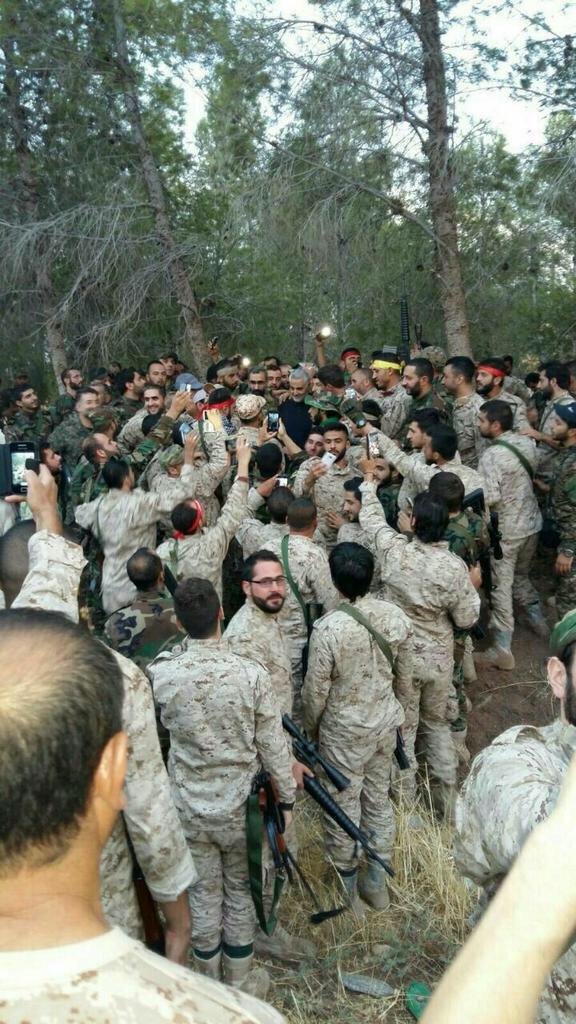
In what appears to have been a morale-boosting effort, General Qassem Soleimani, the commander of Iran’s elite Qods Forces, has made an appearance in a location open to question, where soldiers took the opportunity to take selfies with the man widely viewed as the architect of the current Russian-led campaign.

Facebooktwittermail

Iran sends thousands of troops to Syria to bolster the planned ground offensive in Aleppo

Reuters reports: A delegation of Iranian lawmakers arrived in Damascus on Wednesday in the build-up to a joint operation against insurgents in northwest Syria, and said U.S.-led efforts to fight rebels had failed.

The visit, led by the chairman of the Iranian parliament’s National Security and Foreign Policy Commission, Alaeddin Boroujerdi, came as Iranian troops prepared to bolster a Syrian army offensive that two senior officials told Reuters would target rebels in Aleppo.

The attack, which the officials said would be backed by Russian air strikes, underlined the growing involvement in the civil war of Syrian President Bashar al-Assad’s two main allies, which has alarmed a U.S.-led coalition opposed to the president that is bombing Islamic State militants.

“The international coalition led by America has failed in the fight against terrorism. The cooperation between Syria, Iraq, Iran and Russia has been positive and successful,” Boroujerdi was quoted as saying by Iran’s state broadcaster IRIB as he arrived at Damascus airport.

The delegation was due to meet Assad, said officials.

Iran has sent thousands of troops into Syria in recent days to bolster the planned ground offensive in Aleppo, the two officials told Reuters. [Continue reading…]

Facebooktwittermail

Putin says U.S. fails to cooperate in Syria

The New York Times reports: President Vladimir V. Putin of Russia criticized the United States and others on Tuesday for what he said was their lack of cooperation with the Russian military campaign in Syria, suggesting that they had “mush for brains.”

Mr. Putin was responding to widespread accusations in the West that Russian warplanes were targeting practically every group opposed to the Syrian government except the Islamic State, also known as ISIS or ISIL. He complained that while the Russian government had asked for the coordinates of the groups that should or should not be attacked, the United States had not responded to either request.

“Recently, we have offered the Americans: ‘Give us objects that we shouldn’t target.’ Again, no answer,” he said. “It seems to me that some of our partners have mush for brains.” [Continue reading…]

Facebooktwittermail

Where are the anti-war protesters now?

Haid Haid writes: Russia’s recent military intervention in Syria doesn’t seem to have provoked the same reaction worldwide as the one the US faced against Assad in retaliation to the chemical gas attacks in Syria in August 2013. While the demonstration against the US airstrikes brought together the left and the right in major world cities, Russia’s intervention hasn’t prompted a strong reaction even from those who are considered ‘friends of Syria.’ This is not the first time that the reactions of anti-war coalitions and peace movements differ on the Syrian conflict, based on the actors calling for them. Iranian support to the Assad regime, for instance, with armed militias, weaponry, money, military experts, etc., has also gone unnoticed.

This selective approach by anti-war movements to foreign military interventions raises many questions about what they consider a war to be. Should we consider all military interventions bad? Does the actor’s identity matter more than the action itself? Can we be selective about acting upon our principles? When is it acceptable to favor someone’s interests over the miseries of others? [Continue reading…]

Facebooktwittermail

What are Russia’s grand designs in Central Asia?

By David Lewis, University of Exeter

While international attention has focused on Russian military operations in Ukraine and Syria, Moscow has also been involved in a flurry of diplomatic and security initiatives to address the growing instability in northern Afghanistan.

But its moves to bolster regional security are more than just a response to local security concerns. Russia has a broader strategy that could leave it as the dominant security actor across much of Eurasia.

Even before the shock of the Taliban occupation of Kunduz in late September, Russian officials were concerned about the fragile security situation in northern Afghanistan, including the rise of Islamic State in northern Afghanistan and its potential spread to Central Asia and thence to Russia’s large Muslim community. As if to emphasise the domestic threat, on October 12 Russian police announced that they had uncovered a terrorist plot in Moscow apparently involving a group of Central Asian militants.

Insecurity in Afghanistan may pose a potential security threat for Moscow, but it is being seized upon as a major geopolitical opportunity. Against a backdrop of failed Western policies across much of Russia’s southern flank, Moscow is moving quickly to fill a security vacuum in the region. It is strengthening existing alliances to consolidate its hold over former Soviet republics in Central Asia and reshaping the security dynamics of the region around its own favoured security groupings – the Collective Security Treaty Organisation (CSTO) and the Shanghai Cooperation Organisation (SCO).

The first step has been a series of meeting with Central Asian leaders, all on the front line in case of renewed Afghan insecurity. A meeting between Russian president Vladimir Putin and Emomali Rakhmon, the president of Tajikistan, led to promises of more attack helicopters to bolster the existing Russian military based in the country, which has become the hub of a well-developed defence system against cross-border infiltration.

Continue reading

Facebooktwittermail

Russia’s intervention in Syria may help ISIS advance in Iraq

Hassan Hassan writes: Nearly two weeks after the Russian intervention began in Syria, one could say it has not got off to a good start. Last week, the Syrian regime launched its first ground offensive against the rebels under Russian air support.

The assault, in Hama’s northern countryside, failed spectacularly – rebels affiliated to the Free Syrian Army destroyed at least 18 tanks and held their ground. The anti-government forces had advanced last month towards Al Masasnah, where the battles took place on Monday, and one of the villages that would lead the rebels further into the regime’s heartlands. The offensive was thus an important operation for the government and at the heart of the Russian forces’ role in Syria.

The following day, US officials claimed cruise missiles fired by Russian warships in the Caspian Sea crashed in Iran. And over the weekend, the Syrian army also lost control of “the UN hill” in Quneitra.

But the most significant development happened on Wednesday, when ISIL swept through several rebel-held villages and reached the doorsteps of Aleppo. The advances, made possible by the disruptive targeting of opposition forces committed to fighting ISIL, were the most important gains for the organisation in Aleppo since the rebels expelled it from much of the north in early 2014.

Of course, it is hard to judge the Russian intervention based on last week’s performance. But the developments so far serve as a reality check for early speculation about the scope of the Russian role, such as a ground offensive to expel ISIL from Palmyra. Moscow will be forced to focus its mission on the daunting task of securing the regime’s vital areas. [Continue reading…]

Facebooktwittermail

Russia airstrikes help push Syria rebels closer, for now

The Wall Street Journal reports: Moscow’s intervention in Syria’s multisided civil war has spurred some of the country’s fractious rebels to fight together, offering another shot at a more unified front against the Assad regime and its Russian and Iranian allies.

Since Russian warplanes entered the conflict two weeks ago, three local rebel alliances have emerged across the provinces where President Bashar al-Assad aims to regain ground and consolidate control. Although such alliances have been short-lived in the past, rebels said more were expected in the coming weeks.

Opposition factions including U.S.-backed rebels and Nusra Front, al Qaeda’s affiliate in Syria, have come together to counter a regime offensive across several fronts in the northwest, while others continue to fight Islamic State militants.

On Monday, regime forces briefly retook part of Kafar Nabouda, a rebel-held town in Hama province, which it has been attacking for a week. More than 700 rockets were fired on rebels and Russian planes launched numerous airstrikes, said Abu al-Majid al-Homsi, a commander in Hama with Suqoor al-Ghab, a rebel group that has received training by the Central Intelligence Agency.

But hours later, rebels were able to push them back as a result of tight coordination through a joint command post they established last week, he said.

“Any coalition will benefit the rebels,” said Maj. Yasser Abdolraheem, a commander with Faylaq al-Sham, a moderate group that has fighters in several provinces. “But time and time again problems and differences emerge and they don’t survive.”

Rebel coalitions have formed and disbanded regularly over the 4½-year war, and their ideological and strategic differences remain profound. Rivalries among rebel leaders have also endured, and scores are sometimes settled violently among the rank-and-file.

“You have those kinds of local-unity projects and ad hoc alliances forming all the time, and it’s usually in preparation for when they are going to attack something or for a certain goal or a certain offensive,” said Aron Lund, editor of Syria in Crisis, a website run by the Carnegie Endowment for International Peace, a Washington-based think tank. “Most of these unity experiments tend to either fade away after that goal is achieved or they fade away without that goal being achieved.”

Amid the latest fighting, Islamic State militants also have seized the opportunity to advance against the rebels in some areas. [Continue reading…]

Aymenn al-Tamimi writes: In a joint statement released on 5 October, 41 Syrian rebel factions condemned the “Russian military aggression against the Syrian people,” describing it as a “genuine occupation of the land even if some sides claim that it was done on official request from the Assad regime.” The statement added that the Russian airstrikes in Homs province, which left “approximately 50 martyrs from the civilians,” should be considered Russia’s first war crime in Syria. The statement went on to describe “any forces occupying the land of our beloved homeland” as “legitimate targets,” and repeated the standard mantra of commitment to Syria’s territorial unity, opposing any sort of “partition project,” while concluding with a call on “all armed revolutionary factions” to “unite ranks” and put aside differences.

The language of the statement, especially in referring to Syria as watanina al-habib (Arabic for “our beloved homeland”), excludes groups with transnational jihadist agendas. The signatories include familiar mainstream groups whose vision is confined to the national framework, such as Jaish al-Islam (based primarily in Damascus), Ahrar al-Sham (arguably the single most powerful rebel group in Syria), the Saudi-backed quietist Salafi coalition known as the Authenticity and Development Front and the southern FSA Yarmouk Army. But does this statement actually represent greater unity among these factions? Or will the Russian intervention push rebels toward jihadi factions like Syria’s al-Qaida affiliate Jabhat al-Nusra – as is widely feared?

The answer is that the prospect for real mergers among these signatories is marginal. Whatever impressions of political unity dealings in Turkey and joint online statements might convey, groups on the ground are localized and tend to be divided. The case of Jabhat al-Shamiyya, one of the signatories to the statement, is emblematic of the problem. [Continue reading…]

Facebooktwittermail

Ankara suicide bombings cast long shadow over Turkey’s Syria policy

The National reports: The deadly suicide bombings in Ankara have heightened fears that Turkey’s troubled Syria policy may be experiencing blowback.

The twin attacks – Turkey’s most devastating in recent history – killed at least 97 civilians and wounded 246 more on Saturday during a predominantly Kurdish peace rally in the capital.

ISIL is the prime suspect in the suicide bombings, and investigators are close to identifying one of the perpetrators, prime minister Ahmet Davutoglu told Turkish broadcaster NTV on Monday.

Turkish president Recep Tayyip Erdogan has dangerously supported hardline militant groups – such as the Army of Conquest, a coalition that includes Al Qaeda’s Syria branch Jabhat Al Nusra and the Salafist group Ahrar Al Sham – to topple Syrian president Bashar Al Assad.

His contentious policy in Syria was already under strain before this, with Russia directly intervening in the war and the US forging close ties with Turkey’s other nemesis on the ground – the Kurdish Democratic Union Party (PYD).

The growing tussle of superpowers in the Syrian war is edging Turkey out of the equation, according to analysts. [Continue reading…]

Facebooktwittermail

Turkey warns U.S., Russia against backing Kurdish militia in Syria

Reuters reports: Turkey has warned the United States and Russia it will not tolerate Kurdish territorial gains by Kurdish militia close to its frontiers in north-western Syria, two senior officials said.

“This is clear cut for us and there is no joking about it,” one official said of the possibility of Syrian Kurdish militia crossing the Euphrates to extend control along Turkish borders from Iraq’s Kurdistan region towards the Mediterranean coast.

Turkey fears advances by Kurdish YPG militia, backed by its PYD political wing, on the Syrian side of its 900 km (560-mile) border will fuel separatist ambitions among Kurds in its own southeastern territories. But Washington has supported YPG fighters as an effective force in combating Islamic State.

“The PYD has been getting closer with both the United States and Russia of late. We view the PYD as a terrorist group and we want all countries to consider the consequences of their cooperation,” one of the Turkish officials said.

Turkey suspects Russia, which launched air strikes in Syria two weeks ago, has also been lending support to the YPG and PYD.

“With support from Russia, the PYD is trying to capture land between Jarablus and Azaz, going west of the Euphrates. We will never accept this,” the official said. [Continue reading…]

Facebooktwittermail

Putin’s model of success

Jackson Diehl writes: Western officials who pronounce themselves puzzled about Vladi­mir Putin’s intentions in Syria are missing some big clues. There is a clear model for the campaign Russia is pursuing on behalf of Syrian dictator Bashar al-Assad, a legacy that is Putin’s pride: Chechnya.

The Muslim republic in the North Caucasus and the decade-long war that Putin launched there in September 1999 have mostly been forgotten by the outside world since the dictator installed there by Putin, Ramzan Kadyrov, consolidated control in the late 2000s. But the Kremlin regards it as a “good, unique example in history of [the] combat of terrorism,” as Dmitry Medvedev, Putin’s prime minister, put it. Chechnya, Medvedev said last year, is “one of the business cards of Russia.”

What are the components of this winning formula? First, define all opposition to the prevailing regime as terrorist, indistinguishable from the most extreme jihadists. That enables a fundamental political aim: to eliminate alternatives. In Syria today, moderate and secular opposition forces arguably are getting harder to find. That wasn’t the case in Chechnya in 1999. The country’s nationalist president, Aslan Maskhadov, had won a democratic election, defeating an Islamist opponent by 59 to 23 percent. His predecessor, Dzhokhar Dudayev, was so secularized that he was unaware how many times a day Muslims pray. [Continue reading…]

Facebooktwittermail