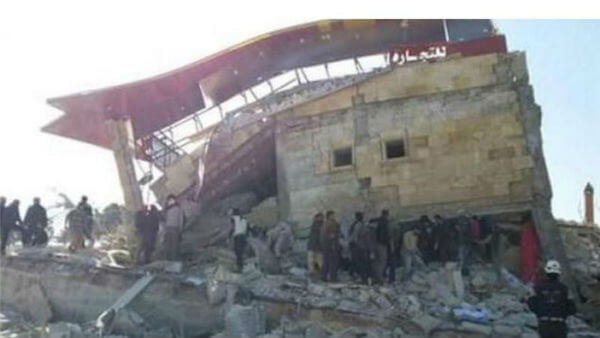
NOW reports: An activist group has accused Russian airstrikes of causing widespread damage in Palmyra amid a regime offensive that has seen the Syrian army and allied militias advance to the entrance of the UNESCO World Heritage Site.
“Russia’s systematic bombing and destruction of the ancient city of Palmyra has continued for twenty consecutive days,” the Palmyra Revolution Coordination alleged in a statement issued Tuesday.
The pro-revolution activist group accused Russia of arbitrarily shelling the ISIS-held city “without differentiation between humans and stones.”
“More than 900 raids targeted the city in the past two weeks, more than half of them [using] [internationally-proscribed] cluster bombs.”
The Palmyra Revolution Coordination group also claimed that Russian raids have destroyed more than half of the town’s neighborhoods, levelling “schools, hospitals and mosques.”
“Russia is destroying our city and our civilization.”
An activist who escaped from the town last week echoed these claims in an interview with the Syria Direct news website, saying that the regime has been using a “scorched earth policy” on the city. [Continue reading…]
Category Archives: Russia
The Baltic elves taking on pro-Russian trolls
Michael Weiss writes from Vilnius, Lithuania: My elf was on time and surprisingly tall.
Mindaugas is an unassuming, thirtysomething advertising agency director by day, and a ferocious cyber-warrior by night. He started a phenomenon, here in Lithuania, of countering Kremlin propaganda and disinformation on the Internet. “We needed to call our group something. What to name it? Well, we were fighting trolls. So I said, ‘Let’s be elves.’”
There were 20 or 30 at first, when the trolls began a targeted campaign of leaving nasty comments about the Lithuanian government and society, usually pegged to a hatred of NATO, the European Union and, of course, the United States. Since then, elves have proliferated into the hundreds. They’re now scattered about neighboring Latvia and Estonia and have even been spotted as far north as Finland. The elves pride themselves on clandestinity and reclusiveness, and so I was quite lucky to catch this Lithuanian Legolas on my last night in Vilnius.
“Most of us were already participating in some online groups,” said this man, who suggests we call him Mindaugas in person. “Fighting the trolls on Facebook and vKontakte, giving examples of Russian lies. That’s how we met.”
Facebook is where the light skirmishes take place; the mortal combat is reserved for the comment sections of Lithuanian news articles, where the trolls loose a constant drizzle of falsehoods and complaints, each comment helping to construct an alternate reality version of life in this Baltic country of 3 million. Rather than a thriving and patriotic post-Soviet success story, which it is, the image the trolls cultivate is that of a demoralized and angry society whose people are ready for regime change, be it through internal democratic mechanisms or through “liberation” by a friendly neighboring army. [Continue reading…]
Syria: An unviable regime facing a divided opposition
Aron Lund writes: While Syria’s Sunni Arab rebels share many goals and allies, and infighting among them remains relatively rare, these factions have never managed to find a center of gravity around which to unify. Forceful international support is often portrayed as the means to change this, but in fact, it has had the opposite effect. The West and its allies have intervened to empower rivals to the jihadi bloc that would otherwise dominate, thus cementing the insurgency’s fragmentation instead of ending it. This dynamic is unlikely to go away. The large Islamist rebel factions that could tip the scales in a non-jihadi direction, such as Ahrar al-Sham, seem unwilling and unable to disentangle themselves from the Nusra Front. This leaves the Sunni Arab insurgency stuck in a position from which it cannot win.
That leaves Bashar al-Assad. While he has so far succeeded in preventing the emergence of a credible competitor and blocking all proposals for a political transition, the president has not yet offered a positive plan for how to reunify and stabilize Syria. At this point, his regime seems at once inevitable and unviable.
Even with strong Russian and Iranian support, Assad’s government seems too weak to reconquer the country by force. The president could theoretically compensate for this weakness by engaging in effective diplomacy or striking deals with his opponents, but he has so far shown neither the inclination nor the ability to do so. Indeed, the resistance to a full-blown Assad restoration would be massive; hatred of Assad and his family is a main motivating cause of the insurgency as well as its international support networks.
Assad might, however, be able to engineer international acquiescence to his continued dominance of a fractured country. If things continue to go the government’s way militarily, as they have since Russia intervened on September 30, and if international resistance to him subsides, Assad could potentially lock down the core regions of what has become known as “useful Syria.” This could include Damascus, Homs, Hama, Tartous, Latakia, and Aleppo, plus parts or all of Deir Ezzor, Daraa, and Raqqa. International economic and military support channeled through the central government could then sustain, and to some extent revive, the state apparatus. In so doing, it would help to reconnect some, though not all, of the peripheral areas to Damascus.
But even in this scenario, the bloodshed would not be over. There would certainly be flare-ups between Assad and other actors. In some areas, notably those now controlled by jihadists, the war would be likely to last for a long, long time. Human rights abuses in government-held territory would of course continue unabated and Syrians would be doomed to kiss the boot of the Assad family for another generation. Even beyond that, political stability would be of only a relative nature. Over time, the government would struggle to re-create a functioning economy, survive internal challenges, and retain basic cohesion. Still, this is probably the direction in which Russian President Vladimir Putin is trying to nudge the Geneva peace process, arguing that it is the only way of avoiding a permanent state collapse. And no other major actor has offered a credible way forward. It is entirely possible that such a victory for Assad, if it can be called that, would only postpone rather than prevent complete state failure. [Continue reading…]
Syria shows that Russia built an effective military. Now how will Putin use it?
The Washington Post reports: As Russia turned the Syrian conflict into an exhibition ground for its newly robust military over the past six months, its neighbors were watching with rapt interest.
This, after all, was a sterling opportunity to assess Russia’s new battlefield capabilities, in the form of ship-based cruise missiles, improved logistics and elite units. And on display, too, were Russia’s weaknesses.
“It is like a game of football,” said Janis Berzins, the managing director at the Center for Security and Strategic Research of the National Defense Academy of Latvia, a NATO member nation that borders Russia. “If you’re playing against Germany, then you go watch Germany play, right? It’s the natural thing to do.”
No one expects Russia and NATO to engage in a conventional war anytime soon. But with limited, consequential interventions in two conflicts, Ukraine and Syria, in the past two years, President Vladimir Putin had shown the Russian military’s growing proficiency as well as his appetite to use force to achieve his greater geopolitical goals. [Continue reading…]
Putin calls Syria operation a success and says it will lead to peace
The New York Times reports: President Vladimir V. Putin of Russia said on Thursday that his country’s more than five-month military operation in Syria had been a success, with the upper hand on the battlefield returned to the Syrian government and with President Bashar al-Assad ready to make the compromises necessary for a peaceful settlement.
As the Russian leader spoke, Kurdish leaders in northern Syria were putting the final touches on a plan that would unite territories controlled by Kurdish forces within an autonomus entity within a federated Syria.
The new entity is to be called the Democratic Federation of Rojava-North Syria, Kurdish leaders said at a news conference later in the day, and its structure and bylaws are to be hashed out by an executive council with 31 members, half of them female.
Anticipating criticism, a spokeswoman for the group, Hediye Yusif, said this was not intended as a first move toward the partition of the country. “We are against the division of Syria,” she said. “Federalism doesn’t mean partition. It’s the opposite; we see it as a positive step towards a democratic Syria for all.”
In Mr. Putin’s first extensive remarks on Syria since he ordered the bulk of Russian forces to return home on Monday night, he said that the Russian military would remain engaged in what he called the fight against terrorism, but added that it could return if needed.
“If necessary, literally within a few hours, Russia can build its contingent in the region to a size proportionate to the situation developing there,” Mr. Putin said.
Russian forces remain engaged in efforts to take back the ancient Syrian city of Palmyra, Mr. Putin said, adding that he expected it to be liberated soon. The city was captured from government forces last May by the Islamic State, which has destroyed temples, triumphal arches and other landmarks. [Continue reading…]
Rise of radical nationalism across Europe plays to Putin’s advantage
Bloomberg reports: A growing pro-Kremlin contingent in Europe, likely emboldened by Russia’s decision to withdraw most of its forces from Syria, is tipping popular sentiment further toward President Vladimir Putin.
The most pressing of the issues vital to Putin is European Union sanctions against Russia, introduced in the wake of Moscow’s intervention in Ukraine in 2014. It’s hard to say whether the EU can preserve unity on the subject for much longer, said Petras Vaitekūnas, the former Lithuanian foreign minister, who advises the Ukrainian Security Council.
“I expect big problems with that, and with our ability to repulse Putin’s onslaught,” he said.
Ten days ago, yet another far-right party supporting Russia gained a foothold in an EU country, this time Slovakia. People’s Party, Our Slovakia won 8% of the vote in national elections, joining a burgeoning club including Hungary’s Jobbik, Greece’s Golden Dawn and Marine Le Pen’s National Front in France.
The far-right parties, which often stem from neo-Nazi groups and sport crypto-fascist insignia, are the most visible layer of the pro-Russia camp in Europe. With Europe engulfed in a migrant crisis sparked by the war in Syria, their anti-immigrant and anti-EU rhetoric is in hot demand across the continent, particularly in the east. Party leaders are frequent guests in Moscow, and many of them are closely linked to Russia’s own reactionary networks. Together, they are nudging the political mainstream toward radical nationalism, which these days often comes hand in hand with pro-Russian sentiment. [Continue reading…]
Putin’s long-term strategy in Syria
Steven Simon writes: Over the past six months, Russian aircrews flew over 10,000 missions, averaging between 60 and 74 sorties per day, a relatively high operational tempo. They did this fairly cheaply, unlike Operation Inherent Resolve, the U.S. military operation against the Islamic State (also known as ISIS), in which attack aircraft need to traverse comparatively long distances from their bases to targets. The Russians have been able to stage strike aircraft literally minutes from their targets. Their cost per sortie has therefore been quite low. According to Jane’s, the estimated daily cost of Russian operations has been in the $4 million range, which is small potatoes in the context of a defense budget of $50 billion. In contrast, the average cost of a single air strike conducted under Inherent Resolve is $2.4 million.
Having dusted off and renovated its old installations at Tartus—and with personnel remaining in place—Russia can redeploy its aircraft on very little notice. Indeed, the Russians will probably do what the United States does in the Persian Gulf, rotating aircraft in and out of bases in Qatar and the United Arab Emirates in a manner that amounts to a permanent presence, but is technically temporary. Their removal back to Russian bases does not therefore represent some kind of closure owing to a presumed difficulty of reestablishing a presence in Syria in the future. It merely represents a tactical pause. [Continue reading…]
AFP reports: The US military said Wednesday it has seen no significant reduction in Russia’s combat power in Syria despite President Putin’s surprise announcement this week of a partial withdrawal of his country’s forces.
Colonel Steve Warren, a US military spokesman in the region, said Russian intentions remain unclear.
“We have not seen a significant reduction, frankly, in their combat power. Particularly the ground combat power remain static, the air combat power has been slightly reduced, but that’s it,” he said. [Continue reading…]
Is Putin trying to pressure Assad to negotiate?
Commenting on an article by Russia analyst Morteza Makki appearing in an Iranian daily, Arash Karami writes: Makki wrote that despite [Foreign Minister] Zarif’s positive statement on the withdrawal, “this quick and surprising decision by Russia shows that Iran and Russia’s partnership in Syria was not a strategic partnership. The Russians make decisions based on their own calculations and interests, and the partnership was not such that Iran and Syria would be able to push forward with their views and positions by leaning on the Russians.”
Makki continued that it is possible Russia’s decision was made to force President Bashar al-Assad’s government to show flexibility in the Geneva negotiations, saying that in their recent statements, the Syrians have been very optimistic and have presented red lines regarding Assad’s departure. Even conservative media outlets have suggested Russian President Vladimir Putin was angered by Syrian officials’ comments ahead of the negotiations in Geneva.
When it comes to Syria, the Iranian media has typically been keen to conform to the statements of officials. To see an article suggest that the official version presented by authorities is hiding key points is rare indeed. Most Iranian media outlets have parroted official positions on the Russian withdrawal, but they, too, have struggled to explain it. Even Iran Newspaper, which operates under the administration’s direction, called the withdrawal “surprising.” [Continue reading…]
Kurds hope to establish a federal region in northern Syria
The New York Times reports: Syrian Kurdish parties are working on a plan to declare a federal region across much of northern Syria, several of their representatives said on Wednesday. They said their aim was to formalize the semiautonomous zone they have established during five years of war and to create a model for decentralized government throughout the country.
If they move ahead with the plan, they will be dipping a toe into the roiling waters of debate over two proposals to redraw the Middle East, each with major implications for Syria and its neighbors.
One is the longstanding aspiration of Kurds across the region to a state of their own or, failing that, greater autonomy in the countries where they are concentrated: Turkey, Iraq, Iran and Syria, all of which view such prospects with varying degrees of horror.
The other is the idea of settling the Syrian civil war by carving up the country, whether into rump states or, more likely, into some kind of federal system. The proposal for a federal system has lately been floated by former Obama administration officials and publicly considered by Secretary of State John Kerry, but rejected not only by the Syrian government but by much of the opposition as well. [Continue reading…]
Middle East Eye reports: Syrian Kurds have declared a “Federation of Northern Syria” that unites three Kurdish majority areas into one entity, an announcement swiftly denounced by the Syrian government, opposistion and regional powers.
According to Kurdish Democratic Union Party (PYD) official Idris Nassan, the plan will involve “areas of democratic self-administration” under the federal banner, encompassing all ethnic and religious groups living in the area.
Two officials at talks involving Kurdish, Arab, and other parties in the town of Rmeilan told the AFP news agency that delegates had agreed a “federal system” unifying the three mainly Kurdish cantons in northern Syria.
According to the pro-Kurdish Firat News Agency (ANF), the “Rojava and Northern Syria Unied Democratic System Document Text” was approved after a vote from 200 delegates, which included Arab, Kurdish, Armenian, Turkmen, Chechen, Syriac and other ethnic groups.
The boundaries of the federalised region have yet to be established, according to a delegate to the talks on Twitter. [Continue reading…]
Russian airstrikes in Syria killed 2,000 civilians in six months

The Guardian reports: Russian airstrikes in Syria have killed about 2,000 civilians in six months of attacks on markets, hospitals, schools and homes, rights groups and observers say, warning that plans for a military drawdown may not mean an end to the deaths.
Moscow has insisted it carried out only surgical strikes on “terrorists”, but victims and fighters say bombers strayed well behind frontlines in areas far from strongholds of Islamic State or al-Qaida fighters.
Jets appear to have intentionally bombed civilian areas, in a campaign to spread fear and clear areas where government ground troops were planning to advance. Coalition airstrikes led by the US have also killed civilians, but have stricter rules of engagement. [Continue reading…]
Interpreting the Russian withdrawal from Syria
Aron Lund writes: The Russian intervention has achieved quite a lot. It has undercut the Syrian opposition, stabilized Assad’s government, and produced a peace process on more favorable terms for Assad than was previously possible. Perhaps Putin was always planning for an intervention of limited duration and kept Assad informed about this. With a truce in place, now is a good time to start scaling it down.
Meanwhile, other forms of support to the Syrian government are likely to continue and, if the peace process collapses, Putin could easily reverse his decision. Remember, the Hmeymim and Tartus bases will remain operational, which leaves Russia with all the infrastructure it needs to resume airstrikes on short notice.
Putin may be bluffing. The Russian government is not above a bit of wartime subterfuge and Putin saying something is not the same as Moscow actually doing it. The Kremlin has very consistently lied about its troop presence in eastern Ukraine and about what insurgent factions are being targeted in Syria. It is possible that the Russian president is simply telling his enemies what they want to hear, in order to mollify critics in the White House and gain time, without any intention of stopping the attacks.
The announcement on Monday was vaguely phrased. At no point did Putin say that he would end military operations in Syria. Parse his words and you will notice that he only commits to “begin withdrawing the main part of our military group,” while leaving some troops to guard the Russian bases, monitor the ceasefire, and engage in “creating conditions for the peace process.”
Putin may be banking on the failure of the peace talks. He knows he will be able to find plenty of excuses to delay, alter, or reverse his decision later. Even if a significant number of aircraft and pilots were to be pulled back to Russia, they can return to Hmeymim in a matter of days. [Continue reading…]
Russia’s exit from Syria highlights Assad’s limitations
Hassan Hassan writes: Five years after the uprising in Syria began, a renewed chance to steer the conflict in a less violent trajectory presents itself. Tensions have mounted between moderate rebels and Jabhat al-Nusra in northern Syria, and residents demonstrated in support of the rebels against the al-Qaeda affiliate; the Free Syrian Army has recently launched an offensive against the Islamic State in southern Syria; and Russia has announced that it will start withdrawing its main forces from the country. In the wake of positive sentiments following a semi-successful cessation of hostilities deal, the United States should capitalize on the current environment to de-escalate the conflict and shift its focus toward extremists. The Russian air campaign that began in September, while substantially improving the government’s ability to launch offensives and repulse attacks, has serious limitations and has not been the overwhelming victory that the regime would like to portray. In this context, the U.S. now has a compelling opportunity to act as counterbalance.
In a speech on July 26, 2015, Syrian President Bashar al-Assad made three uncharacteristic remarks that underscored the toll that four years of armed conflict had had on the Syrian Arab Army (SAA) and foreshadowed the dramatic entry of the Russian military into the theater some two months later. The first confession was that the SAA was suffering from “fatigue,” “demoralization,” and a “shortage in manpower.” Secondly, he spoke of the necessity for the army to cede control of certain areas, even if that territory appears significant to the regime’s support base. “In some cases, we have to abandon certain areas to move forces to an area we want to hold.” Finally, Assad highlighted the central role of foreign Shi’a militias in the war. He thanked Hezbollah and other foreign militias fighting on the side of the regime. He said that Hezbollah had the experience and skills needed to battle opposition fighters, and proclaimed, “A homeland is not for those who live in it or hold its passport, but those who defend it and protect it.” [Continue reading…]
How Iran views the Russian withdrawal from Syria
Arash Karami reports: Iranian officials and analysts are speculating about why Russian President Vladimir Putin suddenly decided to begin withdrawing troops from Syria. Some wonder whether Russia won concessions from the United States and the Syrian opposition, but most seem to think that Russia’s action is a positive sign, or at the least nothing to worry about.
Ali Akbar Velayati, foreign policy adviser to Iranian Supreme Leader Ayatollah Ali Khamenei, spoke to Iranian reporters March 15 after holding a press conference with Syrian Deputy Foreign Minister Faisal Mekdad in Iran. According to the media, Velayati said that during his meeting with Mekdad, they discussed “defending the territorial integrity” of Syria and its April 13 parliamentary elections. When asked if Iranian troops would replace the Russian forces leaving Syria, Velayati said that Russia’s action “will not change the overall cooperation between Iran, Russia, Syria and allied forces such as Hezbollah.”
Velayati noted that Russia still has an air base in Syria and, if necessary, would again up its effort against terrorists. Velayati added that at the moment, the Syrian government has the upper hand given recent gains by its allies, the cease-fires and the Geneva negotiations. In addition to its air base, Russia will also reportedly keep its maritime base in Syria operable, and nearly 1,000 military personnel will remain in the country. [Continue reading…]
Russia’s mafia state
Masha Gessen writes: The term “mafia state” was pioneered by Bálint Magyar, a sociologist in Hungary, Russia’s closest ally in Europe. Magyar and his colleagues have elaborated on the concept in the last decade, as Hungarian leader Viktor Orbán has amassed power, eliminated political and economic rivals, and turned the institutions of his state into instruments of personal power. So important is this concept to Hungarian intellectuals’ understanding of what has happened to their society that an edited collection of twenty sociological articles on the topic sold 15,000 copies there — an almost unheard-of figure for an academic volume anywhere, especially in a country of 9.8 million people. The concept is little-known outside of Hungary, though Magyar believes it describes the regimes in three other post-Communist states: Azerbaijan, Kazakhstan, and Russia. (Magyar’s own book, Post-Communist Mafia State: The Case of Hungary, has just been translated into English.)
Here is what a mafia state is not, according to Magyar, whom I interviewed in Budapest last year. It is not a kleptocracy or “crony capitalism,” because both of these terms suggest voluntary association among participants and appear to imbue all of them with agency. But in Russia, for example, the men who used to be known as the oligarchs have long since forfeited all political power and much personal autonomy in exchange for a share of the spoils. It is not “neoliberal” or “illiberal” because it is neither a development of liberalism nor a deviation from it — it has little to do with liberalism at all. Sure, it has so-called elections as well as courts and laws, but these have become entirely instrumentalized: they serve to help regulate relationships within the clan and to apportion favors, mostly because these were the tools most immediately available when the mafia came to power. It is not an oligarchy, because political power has been monopolized, as has corruption. It is not a dictatorship, because, unlike a dictatorship, the mafia state has some legitimacy — precisely the sham democratic rituals that lead some to call them “hybrid regimes.”
Much of the analysis of post-Soviet regimes focuses on what they lack: fair and open elections, for example, or free media. That, says Magyar, is like trying to describe an elephant by what it is not: “The elephant has no wings — OK. It cannot swim in water — OK. But that doesn’t tell us what an elephant is! ”To understand what a mafia state is, we need to imagine a state run by, and resembling, organized crime. At its center is a family, and at the center of the family is a patriarch. “He doesn’t govern,” says Magyar. “He disposes — of positions, wealth, statuses, persons.” In Putin’s Russia, the “family” includes, among others, long-time secret-police colleagues Igor Sechin and Sergei Ivanov, but also ostensible liberals from Putin’s St. Petersburg days, like prime minister Dmitry Medvedev and former finance minister Aleksei Kudrin. A somewhat more recent addition to the family is defense minister Sergei Shoigu, who had served as emergencies minister under Yeltsin. The patriarch and his family have only two goals: accumulating wealth and concentrating power. Violence and ideology — the pillars of a totalitarian state — become, in the hands of a mafia state, mere instruments. The distinction is particularly meaningful because all the states the model describes are post-Communist. Where the state used to own the entire economy, now it seeks simply to control the most lucrative businesses and skim off the top of the rest—and eliminate those who refuse to pay.
Mafia states murder people, just like the Mafia does—but they murder only the people who are immune to coercion and blackmail: journalists, for example, or defiantly independent actors like the opposition politician Boris Nemtsov, shot dead a year ago in Moscow. “But these murders, and even imprisonments, are on a much smaller scale than in traditional dictatorship because they are not necessary,” says Magyar. Most of the time, coercion will do the job — and mafia states, unlike some others, are pragmatic and do not murder for the sake of it. [Continue reading…]
Russian Syria withdrawal: Vladimir Putin is the consummate political gambler
By Scott Lucas, University of Birmingham
Russian president, Vladimir Putin, is not an easy politician to read. He is willing to say one thing while his diplomats and military do another – as the long-running conflict in Ukraine has demonstrated. His statements are at the pinnacle of a Russian state propaganda machine shrouding any “truth” in layers of often deceptive assertions.
And, as the announcement on March 14 of a “withdrawal of most of [Russia’s] military group” from Syria demonstrated, he can spring a surprise on both his allies and his foes.
So, does this represent mission accomplished for Putin – as he maintained on Monday (“the tasks … are generally fulfilled”), or is this a sign of Russian weakness, with the costs of military intervention compounded by a shaky economy, the challenge of sanctions on Moscow, and a sharp fall in oil revenues?
Or is Putin just being deceptive, with his air force ready to resume bombing and his advisers ready to support pro-Assad ground offensives – especially if political talks to resolve Syria’s five-year conflict fail in Geneva?
What does Russia’s partial withdrawal from Syria signify?
Foreign Policy reports: Joshua Landis, director of the Center for Middle East Studies at the University of Oklahoma, said that until the past week, he had been in touch with officials close to the Assad regime in Damascus who expressed “a constant drumbeat of confidence that they’re going to take back every inch of Syrian soil, and Russia is their partner.” But those communications abruptly fell off earlier this month. “No one was answering the phones in Damascus. That leads me to believe they were thrown for a loop.”
Landis said that Putin’s planned withdrawal from Syria means he’s not going to back Assad “all the way.” But he said the move was also likely aimed at Washington, which has frustrated Moscow by refusing to work with Putin to fight the Islamic State. “This is a shot across America’s bow as well,” Landis said, “with Russia saying, ‘We’ll leave, and you’ll be stuck holding the bag in Syria.’”
The withdrawal announcement, reported by Russian state media, appears to have caught the White House off guard. A senior administration official said Monday that they had seen reports of the Russian move and that “we expect to learn more about this in the coming hours.” A spokesman for the Defense Department declined to comment. [Continue reading…]
BBC News reports: Russia will continue air strikes in Syria despite the withdrawal of most of its forces, a senior official has said.
Deputy Defence Minister Nikolay Pankov said it was too early to speak of defeating terrorism, after a campaign that has bolstered Syria’s government.
Russian defence ministry video showed the first group of aircraft taking off from Hmeimim air base in Syria on Tuesday morning and in flight.
Hours later, Russian TV showed planes arriving in the southern Russian city of Voronezh, where they were greeted on the tarmac by priests and crowds waving balloons.
Su-24 tactical bombers, Su-25 attack fighters, Su-34 strike fighters and helicopters were returning home, the TV said. [Continue reading…]
The Associated Press reports: The head of the defense committee in Russia’s upper house of parliament has estimated that about 1,000 Russian military personnel will remain in Syria at Russia’s two bases.
The head of the parliamentary defense committee, Viktor Ozerov, said Tuesday that he estimated about 1,000 Russian military personnel would remain in Syria at the two bases. That’s according to the Interfax news agency.
Ozerov says Russia would need a minimum of two battalions, a total of 800 troops, to protect the two bases. He says it will continue to conduct air reconnaissance, requiring some of the plane crews to remain, and the military specialists advising the Syrian army also would stay.
The estimate follows President Vladimir Putin’s announcement Monday that some of the Russian aircraft and troops would be withdrawn. Russia has not revealed how many soldiers it has deployed to Syria, where it maintains a naval facility as well as an air base, but U.S. estimates of the number of Russian military personnel varies from 3,000 to 6,000.
Britain’s foreign minister says he is skeptical about Russia’s announced military withdrawal from Syria.
Foreign Secretary Philip Hammond told lawmakers in the House of Commons that Russia had made past pledges to pull its troops out of Ukraine, “which later turned out to be merely routine rotation of forces.”
He says that “because Russia is completely un-transparent about its motives and its plans, we can only speculate.”
Hammond says a genuine de-escalation by Russia “would be welcome,” and urges Moscow to use its influence on President Bashar Assad’s government to seriously engage with the opposition.
Hammond said that “Russia has unique influence to help make these negotiations succeed and we sincerely hope that they will use it.” [Continue reading…]
Laura Rozen spoke to Paul Saunders, a Russia expert at the Center for the National Interest, who said: “It is striking, and many in … and out of the region will take note of the fact that President Putin said that withdrawal is going to take place because the Russian forces have achieved their objective,” Saunders told Al-Monitor March 14. “Because when they went in, it was framed very much in terms of strikes on [IS]. That mission is not really completed.”
“What has actually been accomplished is this rather tentative temporary cessation of hostilities leading to some kind of successful peace process between Assad and the forces of the opposition,” Saunders said.
Putin “is trying to send a message to both sides,” Saunders said. “Certainly for the Assad regime side, it makes very clear to them that they better actually negotiate seriously.”
But the announced partial withdrawal “does not mean Russia is just walking away,” Saunders added. “The pace of the withdrawal … also provides leverage. It can be slowed, it can be accelerated. Moscow has the continuing leverage that it needs.” [Continue reading…]
The New York Times reports: The announcement on Monday surprised people on all sides of the conflict. State Department officials, Syrian antigovernment activists, Mr. Assad’s supporters and Syrian opposition negotiators all reacted with disbelief, not sure whether to lament, celebrate or laugh.
In Idlib Province, held by a combination of insurgents that range from the Nusra Front to American-backed rebels, people fired guns in the air.
“People are distributing sweets and calling ‘God is great’ from the mosques,” said a fighter who gave his name as Ahmed. “There’s optimism, but we don’t know what’s hidden.”
Farther south, in Homs, an antigovernment activist, Firas — who, like Ahmed, asked that only his first name be used for safety reasons — was worried. “The Russians were sponsoring the cease-fire,” he said. “Now the regime will bomb again and the Russians will leave us for the Iranians, a disaster.”
Even in Geneva, the opposition spokesman, Salem al-Muslet, reflected that ambivalence, resenting Russia’s support for Mr. Assad but seeing Mr. Putin as the only figure who could force Mr. Assad to negotiate in earnest.
“Nobody knows what is in Putin’s mind, but the point is, he has no right to be in our country in the first place,” he said at first. “Just go.” Later, he added, “If it’s true, this is a good sign and a good start to a political solution.” [Continue reading…]
Putin’s profitable intervention in Syria
Michael Weiss writes: The Syria war was as much a mediated weapons and hardware expo as it was a client rescue mission.
In October, Russian warships debuted the new Kalibr cruise missile, firing it across 900 miles of sea and land, across Iranian and Iraqi airspace (some of the missiles crash-landed in Iran, according to the Pentagon). But the display became a marquee event for Kremlin-run television, here acting as a multimedia brochure for Rosoboronexport, the Russian state arms dealer, which last year sold $15 billion in weapons to foreign purchasers.
The 45 or so fixed-wing aircraft deployed to Bassel al-Assad International Airport in Latakia, now a permanent Russian garrison and airbase on the Mediterranean, ranged from souped-up Soviet models to state-of-the-art killing machines. The Russian Air Force’s most modern ground attack jet, the Su-34, was showcased as a source of enormous national pride, with the state-owned outlet Sputnik reveling pornographically in the warplane’s ability to hunt “terrorists.” (The Su-34 was also documented cluster bombing populated areas, such as Hraytan, Aleppo.) Just before the New Year, Sergei Smirnov, the director of the Chkalov aviation factory, gave an interview with Vedomosti in which he said that Algeria, which has sought the purchase of the Su-32 export variant from Russia for the last eight years, recently made an official application to purchase the bombers from Rosoboronexport. Other potential buyers, according to “military expert” Igor Korotchenko, again hyping the Su-34 in Sputnik, are Vietnam, Iraq, Kazakhstan, Turkmenistan, Uzbekistan, Uganda, Nigeria, and Ethiopia.
Another sophisticated toy is the T-90 battle tank, examples of which have been spotted all over the Syrian battle space, at first guarding the Latakia airbase and now being driven by the Syrian army and Iranian-built Shia militias, such as Iraq’s Asaib Ahl al-Haq, or League of the Righteous, which in 2007 killed five U.S. soldiers in Karbala. In late December, Algeria announced that it planned to buy its third tranche of T-90s. Iran now also wants them. [Continue reading…]
Refugee crisis: Russian withdrawal from Syria won’t let Europe off the hook
By Geoff Gilbert, University of Essex
The first Russian aircraft have already begun to leave Syria following Vladimir Putin’s troop withdrawal announcement. The ceasefire appears to be holding and parties are committed to fresh peace talks in Geneva. But will this development mean anything for the flow of refugees out of the war-torn country? It would be premature to make any assumptions about an early easing of the crisis, given the sheer number of people fleeing the conflict.
When the revolt against the Assad regime started five years ago, it seemed it was another phase in the Arab Spring that was sweeping the region. Little did anyone realise that it would lead to the largest cross-border displacement of a single population in decades.
This at a time when displacement around the globe generally was escalating. The United Nations High Commissioner for Refugees’ resources are stretched – only 2-3% of its budget comes from UN central funds – and it cannot put other crises on the “back burner” while it deals with the Syrian displacement.
The conflict in Syria has challenged Europe in terms of its internal freedom of movement, its core values and, most fundamentally, its adherence to international human rights standards.
The European focus distorts the reality of that crisis. According to the Internal Displacement Monitoring Centre (iMDC), as of December 2015 there were 6.6m internally displaced persons (IDPs) compared to about 4.2m refugees. International organisations and local humanitarian actors were still operating in-country trying to provide relief and protection.
Even when the focus is on those who have crossed an international border, the Euro-centrism of some parts of the media is called into question by the sheer numbers in neighbouring countries. Statistics from UNHCR show instantly how it is neighbouring states that continue to offer protection while Europe persists in closing its doors in some vain hope the problem will somehow resolve itself.