Category Archives: Syria

‘Welcome to Stalingrad. Welcome to Kobane’: Inside the Syrian town under siege by ISIS

Vice News: “Welcome to Stalingrad. Welcome to Kobane,” said a Kurdish militant, starting his car. A mad dash across the closed Turkish border had just brought us into the majority Kurdish Syrian town, then nearing its 100th day of fighting off a brutal siege by the Islamic State. The jihadists have blitzed it since mid-September from the south, west, and east after taking over all the nearby towns, sending wave after wave of fighters for more than three months.

The Kurdish militia defending the city, the People’s Protection Units (YPG), have made progress in pushing back the Islamic State back in recent weeks, but it was still necessary for the YPG fighter driving to keep the headlights off so as not to draw attention to the vehicle. All across the city, hardened YPG fighters are still on guard, defending against new Islamic State attacks daily and pushing forward, block by block and house by house.

When VICE News arrived in late December, the YPG had effectively pushed the Islamic State outside the city center. One YPG commander said they controlled 75 percent of the city, but that appeared an over-estimation, and a sizeable portion is changing hands regularly. Fierce street battles have mostly given way to mortar and rocket attacks, as well as constant sniper fights.

Facebooktwittermail

Experts cast doubt on Spiegel claim of Syrian nuclear facility

Christian Science Monitor: German news magazine Der Spiegel alleges that the government of Syrian President Bashar al-Assad is operating a secret nuclear facility close to the Lebanese border.

Der Spiegel claimed on Saturday, citing the opinion of unnamed “western intelligence agencies,” that the Assad regime continues, with Iranian assistance, to seek a nuclear weapon more than seven years after Israel destroyed a covert Syrian nuclear reactor in the north-east of the country.

Nuclear weapons experts have voiced doubts about the claim. Iranian Foreign Minister Mohammed Zarif dismissed the report as “ridiculous.”

The new alleged nuclear facility is located in a narrow valley, nine miles west of the town of Qusayr and only a few hundred yards north of the border with Lebanon, according to Der Spiegel.

Facebooktwittermail

Evidence points to continued existence of Syrian nuclear program

Der Spiegel reports: According to intelligence agency analysis, construction of the facility began back in 2009. The work, their findings suggest, was disguised from the very beginning, with excavated sand being disposed of at various sites, apparently to make it more difficult for observers from above to tell how deeply they were digging. Furthermore, the entrances to the facility were guarded by the military, which turned out to be a necessary precaution. In the spring of 2013, the region around Qusayr saw heavy fighting. But the area surrounding the project in the mines was held, despite heavy losses suffered by elite Hezbollah units stationed there.

The most recent satellite images show six structures: a guard house and five sheds, three of which conceal entrances to the facility below. The site also has special access to the power grid, connected to the nearby city of Blosah. A particularly suspicious detail is the deep well which connects the facility with Zaita Lake, four kilometers away. Such a connection is unnecessary for a conventional weapons cache, but it is essential for a nuclear facility.

But the clearest proof that it is a nuclear facility comes from radio traffic recently intercepted by a network of spies. A voice identified as belonging to a high-ranking Hezbollah functionary can be heard referring to the “atomic factory” and mentions Qusayr. The Hezbollah man is clearly familiar with the site. And he frequently provides telephone updates to a particularly important man: Ibrahim Othman, the head of the Syrian Atomic Energy Commission.

The Hezbollah functionary mostly uses a codename for the facility: “Zamzam,” a word that almost all Muslims know. According to tradition, Zamzam is the well God created in the desert for Abraham’s wife and their son Ishmael. The well can be found in Mecca and is one of the sites visited by pilgrims making the Hajj. Those who don’t revere Zamzam are not considered to be true Muslims.

Work performed at the site by members of Iran’s Revolutionary Guard is also mentioned in the intercepted conversations. The Revolutionary Guard is a paramilitary organization under the direct control of Iran’s Supreme Leader Ali Khamenei. It controls a large part of the Iranian economy and also plays a significant role in Iran’s own nuclear activities. Not all of its missions abroad are cleared with the government of moderate President Hassan Rohani. The Revolutionary Guard is a state within a state.

Experts are also convinced that North Korea is involved in Zamzam as well. Already during the construction of the Kibar facility, Ibrahim Othman worked closely together with Chou Ji Bu, an engineer who built the nuclear reactor Yongbyon in North Korea.

Chou was long thought to have disappeared. Some thought that he had fallen victim to a purge back home. Now, though, Western intelligence experts believe that he went underground in Damascus. According to the theory, Othman never lost contact with his shady acquaintance. And experts believe that the new nuclear facility could never have been built without North Korean know-how. The workmanship exhibited by the fuel rods likewise hints at North Korean involvement.

What approach will now be taken to Zamzam? How will the West, Assad and Syria’s neighbors react to the revelations?

The discovery of the presumed nuclear facility will not likely be welcomed by any of the political actors. It is an embarrassment for everybody. [Continue reading…]

Facebooktwittermail

ISIS leader in Kobane apparently dished out cocaine to his fighters

With candor you’re unlikely to find from a traditional news outlet, Joakim Medin reports from Kobane: Streets and strategic buildings have been taken over by slow street fighting, which culminated in the important December 22 recapturing of Kobane’s Cultural Center. A few hours earlier, the happy fighters of this YPG unit had managed to make their own successful early morning attack against a house on the southern front, where an IS leader named Emir Abu Zahra was known to reside. They told me that in the firefight he was shot and killed.

“They also found a few things of his, which they took with them,” Dayan told me.

A slightly older fighter who speaks German came back into the room where we drank tea and perused the findings. Among them was a very thick, professional Dell laptop — one of those rugged, military-style Latitude XFRs, which has a ballistic armor protection system and is sold in stores for a few thousand dollars. They are meant to be used in demanding environments by oil workers, the police, and the army. It’s an expensive piece of equipment, but something you can probably easily pick up after having robbed the central bank of Mosul.

There’s also a traditional looking Middle Eastern dagger among the possessions they said they took from the now dead IS leader. Surprisingly, it’s not an authentic one, but a tacky copy with an Egyptian sphinx emblazoned on the case, and a horned goat head on the shaft. There are no blood traces on the blade.

And finally, sitting in front of me, is a large, transparent plastic bag filled with white powder. The YPG fighters told me they are not sure what this could be. So I dipped my index finger into it, and sure enough, it’s a big bag of cocaine. I must admit, I am familiar with the taste of the drug.

“Cocaine? What is that?” they ask.

The other guys have no knowledge of this drug, or how people use it. It’s nothing they have heard of or encountered before. But Dayan suggests that the powder is something Abu Zahra was distributing in smaller portions to his fighters.

There have been persistent rumors and accusations of drug use in the ranks of Islamic State fighters. Leaders in the group have been said to drug their militants to give them greater courage as they go into battle. This has led to both successful, but also reckless and ineffective suicide attacks by fighters who can easily be shot down. Certain IS militants have been described as “drug-crazed,” and Kurds report having found mysterious pills, capsules, and syringes on living and dead IS fighters. [Continue reading…]

Facebooktwittermail

Europe’s fear of Syria’s ‘ghost ships’

James Denselow writes: The story of the Ezadeen, the ship set on autopilot and set towards Europe with 450 fleeing Syrian refugees on board, could be a turning point in the European response to the crisis in Syria. With a conflict that has killed some 200,000 people burning brightly on its doorstep Europe’s prime focus to date has been on ensuring that it stays away from the flames. The emergence of “ghost ships”, the latest gruesome tactic to come out of a conflict that has also put the “barrel bomb” into the popular lexicon, may force a much needed revaluation on the strategy of Europe’s response.

The discovery of the Ezadeen is simply the latest in an increasing number of horror stories emerging from the Mediterranean Sea. The boat, aptly a former livestock carrier, was found in rough seas some 40 nautical miles off the Italian coast – the second vessel in four days to be found sailing abandoned by its crew.

The ghost ships represent both a new tactic – using large cargo ships to move people in winter across longer crossing – and a new trend – that of the refugees coming from Syria. Last year some 230,000 people arrived illegally across the Mediterranean into the EU with Italy receiving the lion’s share of 160,000 whilst 3,500 people died trying to make the crossing. The UNHCR explained that in 2014 for the first time, people mainly from Syria “have become a major component in this tragic flow, accounting for almost 50 per cent of the total”. [Continue reading…]

Facebooktwittermail

The rise and fall of one of the Syrian opposition’s most powerful commanders

The Washington Post reports: In Syria’s chaotic and increasingly radicalized revolution, one man stood out for having resolutely moderate views, a large following and, it was widely whispered, the support of the United States and its allies.

Jamal Maarouf, a former day laborer who until recently was one of northern Syria’s most powerful commanders, had been held up by the Syrian opposition as a model rebel leader who shunned extremism and was among the first to take up arms against the Islamic State.

He had also, however, established a reputation as a warlord, whose fighters exacted tribute at checkpoints and spent more time engaged in the lucrative smuggling businesses he operated than waging war.

When the al-Qaeda-affiliated Jabhat al-Nusra group forced him to flee his headquarters in the picturesque Jabal Zawiya mountains of northern Idlib province in November, Maarouf found himself with few friends. About half of his men remained behind, preferring to accommodate the invaders than fight for their leader. Moderate allied groups declined to respond to his pleas for help. So did the U.S.-led coalition, which failed to answer e-mails sent by the Syrian opposition requesting airstrikes against his attackers. [Continue reading…]

Facebooktwittermail

Foreigners fighting with Kurds against ISIS in Syria: who and why?

Reuters reports: While illegally crossing the Iraqi-Syrian border, Canadian Peter Douglas was adamant that his incursion was for humanitarian reasons – to help the people of Syria.

Douglas is one of a growing band of foreigners to dodge authorities and join the fight against Islamic State militants who have killed thousands and taken vast parts of Iraq and Syria, declaring a caliphate in territory under their control.

Many of these fighters argue they are there for humanitarian reasons but they say their decision to take up arms to fight for the Syrian people will not be viewed as such by some.

“I want to fight the Islamic State, although it might be the last thing I do,” said Douglas, 66, from Vancouver, as he prepared to board a boat crossing a remote stretch of the Tigris River .

“I know I have 10 years to live before I will start develop dementia or have a stroke so I wanted to do something good,” he added, although he acknowledged that taking up arms was new on the list of jobs and occupations he has previously pursued.

So far an estimated few dozen Westerners have joined Kurdish fighters battling Islamic State in northern Syria, including Americans, Canadians, Germans, and Britons. [Continue reading…]

Facebooktwittermail

Wars and instability prompt biggest migrant wave since World War Two

The Guardian reports: The two “ghost ships” discovered sailing towards the Italian coast last week with hundreds of migrants – but no crew – on board are just the latest symptom of what experts consider to be the world’s largest wave of mass-migration since the end of the second world war.

Wars in Syria, Libya and Iraq, severe repression in Eritrea, and spiralling instability across much of the Arab world have all contributed to the displacement of around 16.7 million refugees worldwide.

A further 33.3 million people are “internally displaced” within their own war-torn countries, forcing many of those originally from the Middle East to cross the lesser evil of the Mediterranean in increasingly dangerous ways, all in the distant hope of a better life in Europe.

“These numbers are unprecedented,” said Leonard Doyle, spokesman for the International Organisation for Migration. “In terms of refugees and migrants, nothing has been seen like this since world war two, and even then [the flow of migration] was in the opposite direction.”

European politicians believe they can discourage migrants from crossing the Mediterranean simply by reducing rescue operations. But refugees say that the scale of unrest in the Middle East, including in the countries in which they initially sought sanctuary, leaves them with no option but to take their chances at sea. [Continue reading…]

Facebooktwittermail

Syria deaths hit new high in 2014, observer group says

The New York Times reports: More than 76,000 people died in Syria’s civil war in 2014, including more than 3,500 children, a monitoring group reported on Thursday. The figures would make last year the deadliest in Syria since the conflict began in March 2011.

The figures from the monitoring group, the Syrian Observatory for Human Rights, put the total number of dead in the conflict as of Wednesday at 206,603.

The group, based in Britain, uses a network of contacts inside Syria to tally casualties, and its figures cannot be independently corroborated. The United Nations, which once regularly documented the numbers of dead and wounded in Syria, discontinued the practice some time ago. [Continue reading…]

Facebooktwittermail

The brothers who ambushed ISIS

Mohammed A. Salih reports: It was a sunny day in late November when Ahmed Ismael, 22, went with a group of seven other fighters to ambush militants from the self-proclaimed Islamic State, or ISIS, on the eastern flank of this besieged town.

Then the plan went terribly wrong. The would-be ambushers were themselves ambushed. Two car bombs exploded and a group of jihadists blocked their way from behind, cutting off their exit route. During the intense firefight that followed, four Kurdish fighters died, including three of Ahmed’s cousins.

“They had heavy weapons but we only had AK-47s,” says Ahmed, his voice still shaky as he recounts the details. “It was my first real fight. We stayed there for four hours. We ran out of ammunition. I was next to my cousins when they died.”

As the fight raged on, Ahmed and the three women fighters who were part of the mission, sent out calls for help. Finally, a squad of reinforcements arrived and they were able to retreat.

Since then, there have been many other skirmishes, so many that war has come to seem a ways of life for Ahmed and his older brother Nusin. But neither had ever thought before that they were destined to become fighters. They had led a quiet life in this otherwise rural and peripheral town in northern Syria that, until a few months ago, few people had ever heard of outside the region. They were carpenters making chairs, beds and other rudimentary pieces of furniture for the locals.

But when the jihadists from ISIS launched a large-scale assault on Kobani in September, the two brothers had to make a choice. “We wondered what to do,” says 24-year-old Nushin. “We sent our family to Turkey,” he says, “But this is our town. The two of us did not want to leave. Where could we go? We decided to stay here and defend our home.” [Continue reading…]

Facebooktwittermail

Vanguard of Syria’s uprising, now on the run from ISIS, weighs a bleak future

The New York Times reports: The cigarette smoke in the hotel room grew as thick as the cottony fog outside in this Turkish border town, as Syrian men, night after night, told their war stories. Their memories veered from exhilaration to black humor to terror, but mostly they told of what they had lost: Friends. A fiancée. An arm. A country. None were out of their mid-20s.

Three were insurgents, or had been. One had helped capture an army tank; another had hidden in tall grass as tank fire killed his raiding party. They told of abandoning one insurgent group after another, finding commanders too violent, too corrupt, too disorganized, too pious, not pious enough.

Three others, civilian antigovernment activists who broadcast war news on social media, were on the run from Islamic State extremists. For them, the fog was a comfort, shrouding their movements as they drove to the hotel. They had trekked for days from the remote Syrian provincial capital of Deir al-Zour, holding their breath at Islamic State checkpoints, hoping to find safety here in southern Turkey.

But they still felt hunted, sure that the group had eyes and ears everywhere, among bearded strangers in Syrian-run cafes or in hotels welcoming foreign fighters. They did not tell friends where they were staying, and they did not know when or whether they could go home.

Not long ago, these men would have felt secure here. Early in the Syrian conflict Antakya, long a sleepy provincial town, became the high-octane hub of an insurgency that thought it was winning. Back then, young fighters and activists, including some of those recently huddling in the hotel room, filled cafes to brainstorm, dreaming of new power and new freedoms.

But some of those flocking to Antakya would later become their enemies. The city was becoming a way station for foreign jihadists, who spent lavishly, even spurring a market for Taliban-style dress. They ultimately transformed Syria’s battlefield, many of them coalescing into the radical Islamic State group, which routed or co-opted other insurgents and shifted the West’s focus from ousting President Bashar al-Assad to countering the extremist group’s momentum. Now, the group has turned violently against any Assad opponents who fail to flock to its banner — like the young men in the hotel room.

Those men are part of what is looming as a lost generation of young Syrians. They are marooned in southern Turkey, unsure how to envision their future, and their hopes are deflating as rapidly as Antakya’s wartime boom. [Continue reading…]

Facebooktwittermail

More civilians killed in Syria since 2011 than British civilians killed in World War Two

London during The Blitz, December 1940.

NFZSyria reports: For the entire conflict, the Violations Documentation Center in Syria has recorded 78,867 civilians killed to date, greater than the recorded number of British civilians killed in the Second World War.

The VDC is unable to record all violent deaths. By comparing their numbers to the UN’s most recent minimum count, it appears the true figure of civilians violently killed in Syria since March 2011 may well be over 137,000. All violent deaths, civilian and military, are now well over 200,000.

The UN’s minimum count of 191,369 violent deaths to the end of April 2014 was greater than Iraq Body Count’s number for total violent deaths in Iraq in the ten years from 2003 to 2013: 174,000 including combatants. [Continue reading…]

Facebooktwittermail

Syria year-end predictions and analysis by Joshua Landis

Joshua Landis writes: Syria will become increasingly fragmented in 2015. The Somalia-ization of the country is inevitable so long as the international community degrades all centers of power in Syria and the opposition fails to unite.

Who owns what?

The four strongest authorities in Syria are the Assad government, ISIS, Nusra, and the Kurds. They rule close to 95% of Syrian territory. The Assad government rules 45% of the land and perhaps 65% of the population, give or take. ISIS rules 35%, but controls less than 3 million people. Kurds may control about 8% or 9% of Syria and Nusra another 5%. This leaves the hundreds of additional militias controlling the remaining 5%, but in some areas “No FSA faction can operate without Nusra’s approval.” Jihadis prevailed in 2014.


Thanks to @deSyracuse for his maps. Click on it to go to his site and use interactive features

All authorities will become weaker, with the possible exception of the Kurds. The United States is at war with all important Arab factions. It is actively bombing ISIS and Nusra, while sanctioning Assad. Although Washington has been funding a “train and equip” project to the tune of half a billion dollars, it appears to have neither urgency nor teeth. Coalition forces are divided on objectives. This means that all centers of authority in Syria are being degraded while none are being built up. It means no one can win. The Assad regime, ISIS, and Nusra are all likely to see their power diminish over the coming year. The FSA militias have become practically irrelevant and must take orders from the radicals. The educated and worldly activists who played such a vital role in launching the revolution have been pushed aside and are today without influence. One can interpret this either as: a) Liberals and democrats in Syria were such a small elite that they were quickly swept aside by the tide of sectarians, fascists, and Islamists; or B) Assad intentionally destroyed the liberals and moderates so that he would face only extremists, leaving the world to face an either-or choice: Assad or al-Qaida. The reality is probably a measure of both.

The Assad government strengthened its control over major cities, while losing control over rural areas. It gained ground in the Damascus suburbs, Kalamoun, Homs and Aleppo, but it lost territory in others, such as Idlib, the Golan, Deraa and the Jazira. This strategy reveals Assad’s urban bias. He believes he can regain the support of the urban middle classes who fear the radicalized and poorer country-folk. The Baath originally relied on rural support against the cities. But as it went bankrupt and turned away from subsidies and socialism toward neo-liberal policies mixed with a heavy dose of corruption, it turned its back on the urban poor and struggling countryside. Today the regime is trying to turn the rich against the poor in an effort to convince them that the revolution was a pipe-dream and that they must fight “terrorism.” Collapsing oil revenues in Iran and Russia mean that Assad will have to suffer with less money in 2015. But so too will the rebels because they are as reliant on oil money as the regime. All incomes will take a nosedive. Ninety percent of Syrians live below the poverty line, according to the UN. But poverty can get worse. [Continue reading…]

Facebooktwittermail

Syria Kurds control 70 percent of besieged Kobane: monitor

Reuters reports: Kurdish forces have regained control of around 70 percent of the Syrian town of Kobani near the Turkish border after pushing back Islamic State fighters that have spent months besieging it, a group monitoring the war said on Wednesday.

Backed by U.S-led air strikes, Kurdish forces made significant advances overnight on Tuesday after violent clashes with Islamic State in the south of the town, the British-based Syrian Observatory for Human Rights said.

Facebooktwittermail

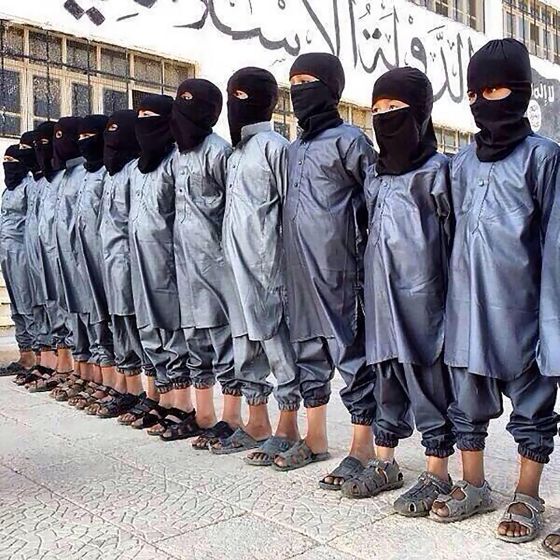
A war against childhood

isis-children

The Wall Street Journal reports: Jomah, a 17-year-old Syrian who joined Islamic State last year, sat in a circle of trainees for a lesson in beheading, a course taught to boys as young as 8.

Teachers brought in three frightened Syrian soldiers, who were jeered and forced to their knees. “It was like learning to chop an onion,” Jomah said. “You grab him by the forehead and then slowly slice across the neck.”

A teacher asked for volunteers and said, “Those who behead the infidels will receive gifts from God,” recalled Jomah, who didn’t want his full name revealed. The youngest boys shot up their hands and several were chosen to participate. Afterward, the teachers ordered the students to pass around the severed heads.

“I’d become desensitized by that time,” said Jomah, who has since defected to Turkey with his family. “The beheading videos they’d shown us helped.”

The enrollment of hundreds of boys in such militant training camps is another tragic facet of Syria’s nearly four-year-long civil war — and its impact could trouble the Middle East for years to come. Parents worry their boys will be forever lost to the indoctrination of Islamic State. [Continue reading…]

A TSG IntelBrief concludes:
• Through systemic indoctrination, intimidation, and extermination, violent extremist groups such as the Islamic State, Boko Haram, and both Afghan and Pakistan Taliban, are targeting children with unprecedented ferocity

• Children are no longer accidental casualties in extremist conflicts but rather they are a primary target

• Extremists are trying to steal the future away from vulnerable regions by stealing the future generation through relentless messaging and violence that separates the youth from their society, government, and culture

• The damage already done by the Syrian civil war, the Islamic State, Boko Haram, and violent extremist groups in in Pakistan pales in comparison to what is yet to come if even a small percentage of their focus on youth pays off.

In the midst of pervasive war-weariness and deeply felt opposition to military intervention following the war in Iraq, social media has not only desensitized children living under ISIS’s rule, serving as a primer on brutality, but it has also desensitized opponents of war.

Images which provoke instinctive revulsion, trigger a desire not only to look away, but also turn away in every way possible, such that both ISIS and those who have become its victims can be cloaked in otherness.

When we see children in masks, it’s easier to see the masks than see the children.

Paradoxically, among the many who readily acknowledge that ISIS came into existence primarily as a result of the war in Iraq and that in this sense, ISIS is an American creation, far fewer are willing to admit that the U.S. has a huge responsibility in now trying to thwart the monster that it unwittingly released.

At the same time, even if we acknowledge that we are part-owners of the problem, no one will be served well by casting America in its traditional self-ascribed role as rescuer.

Now, as has long been the case, the U.S. needs to break out of its bipolar relationship with the rest of the world, neither seeking to dominate, nor retreat.

Facebooktwittermail

The Southern Front is gaining ground in the birthplace of Syria’s revolution

Dafna H. Rand and Nicholas Heras write: Syria’s civil war is heading toward a point of no return. Advances by the Islamic State (IS) in eastern and northern Syria and the resurgence of other jihadi organizations in northwestern Syria are pushing the remnants of the so-called “moderate” armed opposition squarely into the Syrian regime’s line of fire. Any hope that a secular, nationalist movement can govern post-Assad Syria is rapidly waning.

In the south of the country, however, an important force could represent an alternative to both the brutality of the regime and the jihadis. A coalition of secular and nationalist rebels known as the Southern Front (SF) has been able to hold territory for many months in the governorate of Daraa, 90 miles south of Damascus. Its model of rule deserves greater scrutiny: The coalition, which binds together roughly 50 armed groups, has generated a singular example of civil-military governance in Syria — creating a “third way” of local governance that threatens Bashar al-Assad’s depiction of the Syrian opposition movement as extremists and terrorists.

Since 2013, the SF coalition has relied on a combination of strategies to hold ground in Daraa. It has co-opted and forged tactical alliances with the al Qaeda-affiliated Nusra Front; it has coordinated with the local militias and the tribes in the areas; and it is holding the military and ideological line against IS, al-Nusra Front, and other militant Salafist organizations, while fighting off the advances of the Assad regime and its auxiliary forces. [Continue reading…]

Facebooktwittermail

Desperate for soldiers, Assad’s government imposes harsh recruitment measures

The Washington Post reports: The Syrian regime has intensified efforts to reverse substantial manpower losses to its military with large-scale mobilizations of reservists as well as sweeping arrest campaigns and new regulations to stop desertions and draft-dodging.

The measures have been imposed in recent months because of soaring casualties among forces loyal to President Bashar al-Assad, as well as apparent increases in desertions and evasions of compulsory military service, analysts say. Some speculate that the moves also could be part of stepped-up military efforts to win more ground from rebels in anticipation of possible peace talks, which Russia has attempted to restart to end nearly four years of conflict.

But the regime’s measures have added to already simmering anger among its support base over battlefield deaths during the conflict. The anger may be triggering a backlash that in turn could undermine Assad’s war aims, Syrians and analysts say. [Continue reading…]

Facebooktwittermail
