Category Archives: Syria

What does Obama regard as an acceptable body count in Syria?

If Bashar al-Assad ever thought that Barack Obama believed in such a thing as a “red line” — a line that must not be crossed — he probably also had a hunch that as the President of Syria he had more power to define such a line than would an American president who invariably prizes pragmatism above principle.

The following article appeared in Foreign Policy just two days before today’s reports of hundreds of deaths in Damascus from chemical weapons attacks. An American intelligence official is quoted, saying: “As long as they keep body count at a certain level, we won’t do anything.”

Has Assad once again demonstrated that the only definite attribute Obama’s red line possesses is that it is permanently open to redefinition?

Noah Shachtman and Colum Lynch write: All of the major players in Syria — and all of their major backers — now agree that chemical weapons have been used during the civil war there. But the mysteries surrounding a string of alleged nerve gas assaults over the spring have, in some ways, only grown thicker. The motivations and tactics behind the unconventional strikes continue to puzzle U.S. intelligence analysts. And the arrival in Damascus of United Nations weapons inspectors holds little promise of solving the riddles.

Independent tests of environmental samples by both Russian and American spy services indicate that the deadly nerve agent sarin was used during a March 19 battle in Khan al-Assal, for example. Beyond that basic fact, there’s little agreement. The Russians blame the Syrian rebels for launching that unconventional strike on the Aleppo suburb, while the Americans say it was a case of chemical friendly fire.

U.S. intelligence officials tell Foreign Policy that they’re continuing to investigate claims of new chemical weapon attacks in Syria, including an alleged strike earlier this month in the town of Adra that left men foaming at the mouth and dogs twitching in the street. They’re continuing to see supplies shuffled around some of Syria’s biggest chemical weapons arsenals, such as the notorious Khan Abu Shamat depot.

But the number of reports of unconventional attacks has dropped sharply since early June, these same officials say. That’s right around the time when forces loyal to dictator Bashar al-Assad took over the strategic town of Qusair and gained the upper hand in Syria’s horrific civil war. The decline provides to American spy services another indication that it was Assad’s forces who launched the chemical attacks; there’s little need to gas people when you’re winning.

There was a time when such determinations appeared to hold geopolitical significance. The Obama administration repeatedly called the use of chemical weapons a “red line.” But that line has now been crossed repeatedly, with little consequence. And that’s led U.S. intelligence officials to confront another question: How massive would the chemical strike have to be in order to prompt America and its allies to intervene in Syria in a major way?

“As long as they keep body count at a certain level, we won’t do anything,” an American intelligence official admits. [Continue reading…]


Facebooktwittermail

Syria: Reports of hundreds killed in government chemical weapons attack

Haroon Siddique, at The Guardian, reports: My colleague Ian Sample, has been speaking to chemical weapons experts who say the videos appear to show signs of poisoning but doubt whether there will be an opportunity to independently verify what happened and also questioned the timing of the alleged attacks.

One chemical weapons inspector who is not in Syria told the Guardian:

I very much doubt the team will be given access to the site. The whole inspection has been delayed for weeks and months already over the formalities of visiting each site.

That could change if the pressure becomes so huge for the Syrian government that they have to let them in, but if an attack has happened as appears that would be a PR catastrophe. With an incident of this size, the team will try to talk to the Syrians. If the government thinks this hasn’t happened, the inspectors can say they should want proof, so why not give them access.

Unconfirmed videos of the aftermath of the attack show dead children and adults, and others with a range of symptoms, including constricted pupils, difficulty breathing, foaming at the mouth, and shaking or fits. These are consistent with a sarin attack, but are not enough to confirm that a nerve agent was responsible.

Ralph Trapp, an expert on chemical and biological weapons, said:

It is possible a gas was involved, but the images I’ve seen were not clear enough to see other symptoms beyond difficulty in breathing and suffocation. It certainly looks like some sort of poisoning.

Many symptoms can be caused by other substances, and chemical weapons inspectors will need to rule these out. Missiles can strike chemical stores, realising poisonous gases like chlorine, which is used to sterilise water. Shells that carry sarin can also carry fuel-air explosives, which can cause people to suffocate. The munition produces a huge cloud of fuel that is ignited to produce a blast and suck huge amounts of oxygen out of the air.

Though the videos are almost impossible to verify, Trapp said the footage shows what a chemical weapons attack on a civilian area would look like.

This is one of the first videos I’ve seen from Syria where the numbers start to make sense. If you have a gas attack you would expect large numbers of people, children and adults, to be affected, particularly if it’s in a built up area.

Scott Lucas reports: Only hours after the mass killing of civilians in airstrikes by the Assad regime — possibly using chemical weapons — news has broken that the US military has ruled out American intervention, even of a limited nature, in Syria.

In a letter sent on Monday to Congressman Eliot Engel, the Chairman of the Joint Chiefs of Staff, General Martin Dempsey, said the American military is capable of taking out the Syrian air force and shifting the balance of the civil war.

However, Dempsey argued that the approach would plunge the US into another war in the Arab world and offer no strategy for peace, given the fragmented opposition to the Assad regime:

Syria today is not about choosing between two sides but rather about choosing one among many sides. It is my belief that the side we choose must be ready to promote their interests and ours when the balance shifts in their favor. Today, they are not.

Dempsey, who was recently in Israel for discussions, said Syria’s war was “tragic and complex”:

It is a deeply rooted, long-term conflict among multiple factions, and violent struggles for power will continue after Assad’s rule ends. We should evaluate the effectiveness of limited military options in this context.

Dempsey said that US should concentrate on increased humanitarian assistance to bolster a “moderate” opposition as “the best framework for an effective US strategy toward Syria”.

Facebooktwittermail

If Syria remains one nation, it will be a nation of orphans and widows

Robin Yassin-Kassab describes his recent trip into liberated Syria: At first the strangest sensation was the normality of the surroundings. A hot and breezy afternoon ran past the windows – stubbled wheat fields, rocky outcrops, smooth-topped tells. But the villages seemed much poorer here, some of their roads gnarled up by tanks. In one hamlet, the Jabhat al-Nusra logo was printed on the walls. Our secular hosts explained that the Islamist group, designated a terrorist organisation by the UK and US, had liberated this stretch of land.

We diverted to avoid al-Fu’aa, a Shia village still held by the regime, and drove on towards Taftanaz, where the scale of the damage wrought by shelling and aerial bombardment became terribly apparent. We passed streets of crumpled buildings, long banks of debris, shopfront shutters buckled by the vacuum bombs that suck in and ignite the air to create fireballs.

White paint on the walls warned: “Watch out – Taftanaz airfield ahead!” The airfield was liberated in January after two months of siege. The resistance lost many men here – the burnt and cratered fields around offer no cover whatsoever. Now ruined tanks and lopsided helicopters rest inside the perimeter, and Free Army militia sit guard at the entrance.

Next we drove into Saraqeb, a city of significant size, again notable for its war damage, and victim of a chemical attack in April. We stopped in the busy centre so one of us could vomit into roadside rubbish, while the others (one an uncovered woman) entered a cafe to eat haytalya, a local speciality. Jabhat al-Nusra runs a sharia court here. Its black flag flies atop the famous TV mast. Nevertheless, nobody looked twice at our friend’s unveiled hair. Saraqeb felt not like the Taliban’s Afghanistan but like Syria minus the regime: socially conservative but largely tolerant of difference.

The media image of the liberated areas suggests the regime has been replaced by heavy-handed militias. At least in Idlib province (Aleppo has suffered much more from thuggery, corruption and Islamist fanaticism, a fact much lamented by the activists and fighters I spoke to), it is not like that at all. No checkpoint stopped us. The men with guns were locals and were considered protectors, not oppressors.

Many men have fought. They fight for a while, then take time off to visit their families in the camps or to harvest the fields (those that haven’t been burned). Most have no political aim other than defending themselves by ending the regime. Some are Islamists, usually moderate and democratic.

One such is Abu Abdullah who, before his leg injury, fought with the rebel group Liwa al-Islam in Douma in the Damascus suburbs. He shocked me with his statement: “We aren’t fighting for freedom, but for Islam.” But the follow-up was more reassuring. “Europe,” he said, “is implementing Islam without being aware of it. It educates its people, it respects their rights, there’s one law for all.”

He doesn’t fight for “freedom” because to him the word means people doing anything they like, regardless of the rights of others. His vision of an Islamic state is one compatible with democracy; it wouldn’t enforce dress codes or ideological allegiances because (he quotes the Quran) “there is no compulsion in religion”.

As for the foreign fighters, Abu Abdullah, like everybody I spoke to, views them with disdain. Syria has enough men, he told me. Syria needs weapons, not men. Foreigners only cause problems. They increase the sectarian element, as Assad and Iran want. They ruin the revolution’s reputation. In any case, most of them aren’t fighting but resting, waiting for “the next stage”. [Continue reading…]

Facebooktwittermail

Kurdish militias clash with al Qaeda-linked rebel faction in northeastern Syria

The Associated Press reports: Kurdish militias battled al-Qaida-linked rebel groups in northeastern Syria on Tuesday in the latest round of heavy fighting that has helped fuel a mass exodus of civilians from the region into neighboring Iraq, activists said.

Clashes between Kurdish fighters and Islamic extremist rebel groups have sharply escalated in Syria’s northern provinces in recent months. The violence, which has left hundreds dead, holds the potential to explode into a full-blown side conflict within Syria’s broader civil war.

Tuesday’s fighting, which pitted Kurdish militiamen against rebels from the Islamic State of Iraq and the Levant, was focused in three villages near the town of Ras al-Ayn in the predominantly Kurdish Hassakeh province, according to the Britain-based Syrian Observatory for Human Rights monitoring group. There was no immediate word on casualties.

Facebooktwittermail

U.N. says thousands of Syrians fleeing to Iraq

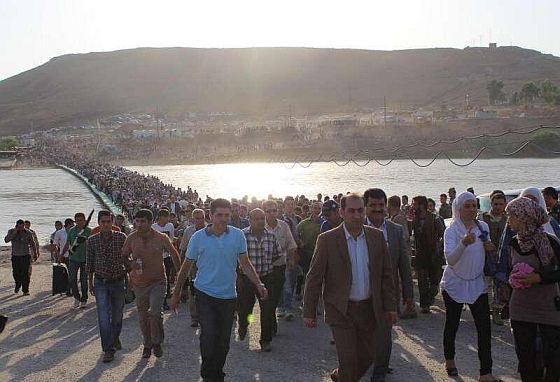
UNHCR photo shows mass exodus of Syria refugees fleeing to Iraq.

The Associated Press reports: In a mass exodus, around 30,000 Syrians have fled their homeland’s bloody civil war and crossed over into neighboring Iraq’s northern self-ruled Kurdish region over the past five days, the U.N. refugee agency said Monday.

The massive influx of people, many of whom are Syrian Kurds seeking refuge from escalating violence in northeastern Syria, has put severe strain on the resources of aid agencies as well as Iraqi Kurdistan’s regional government.

“Syrian refugees are still pouring into Iraq’s northern Kurdish region in huge numbers and most of them are women and children. The reason behind this sudden flow is still not clear,” said Youssef Mahmoud, a spokesman for the U.N. refugee agency in Iraq’s Kurdish region.

“Today, some 3,000 Syrian refugees crossed the borders and that has brought the number to around 30,000 refugees since Thursday,” he said, adding that the latest wave has brought the number of Syrian refugees in the Kurdish region to around 195,000. [Continue reading…]

Facebooktwittermail

The Brotherhood starts anew in Syria

Raphaël Lefèvre writes: While the Egyptian Brotherhood makes global headlines and Tunisia’s Ennahda Party struggles to remain in power, very little is publicly known about the state of Syria’s Muslim Brotherhood. In recent weeks, much has been made of the decrease in the group’s influence over the Syrian National Coalition (SNC). In contrast, not a lot has been said on the Brotherhood’s actual influence inside Syria and its strategy for the revolution. How exactly does the movement plan on dealing with recent trends in the conflict, such as the rise of Islamic extremism in opposition ranks?

A series of interviews conducted with prominent Syrian Brotherhood members and other members of the opposition in Istanbul and Beirut reveal that the group is adapting to an increasingly fragmented Syria made up of competing centers of power. But even if it seems to be gaining some traction on the ground through humanitarian assistance, political activism and armed opposition, the Syrian Brotherhood is still facing enormous external and internal challenges.

“We’ll have to deal with two major problems in the coming months and years,” one member of the Syrian Brotherhood leadership remarked bluntly. “The first is to continue to rebuild our structure and, perhaps most importantly, our image [which has been] tainted by 30 years of absence.”

In Syria, membership in the Muslim Brotherhood has been punishable by death since a law was passed to that effect in July 1980. In February 1982, a large-scale regime massacre in the city of Hama led most remaining members to flee to neighboring countries, where they are today estimated to number around 7,000–10,000. “The second problem,” argued the Brotherhood leader, “will be to deal with our own internal challenges.” The thirty-year exile of Brotherhood members has indeed stirred up tension within the group along regional and generational lines. An election to select the next leader is due next year, and it could be a turning point in the group’s future.

It was this simmering tension that led the Brotherhood leadership to agree, early on in the uprisings, on a “decentralization” policy: every regional sub-group forming the core of the Brotherhood would have to decide on the best strategy to return to Syria, rebuild a local following, and contribute to the revolutionary effort. [Continue reading…]

Facebooktwittermail

Defiant Hezbollah leader pledges to continue fight in Syria

Reuters reports: Hezbollah leader Sayyed Hassan Nasrallah accused radical Sunni Islamists on Friday of being behind a car bomb that killed 24 people in Beirut and vowed that the attack would redouble his group’s commitment to its military campaign in Syria.

In a fiery speech to supporters, one day after the deadliest bombing in the capital since Lebanon’s civil war ended two decades ago, Nasrallah raised the stakes by pledging to join the battle in Syria himself if needed.

Thursday’s blast in the Shi’ite militant Hezbollah’s south Beirut stronghold followed months of sectarian tension and violence in Lebanon fuelled in part by Hezbollah’s intervention against Sunni Muslim rebels in Syria’s civil war.

“It is most likely that a takfiri group was responsible for yesterday’s explosion,” Nasrallah said, referring to radical Sunni Muslim factions linked to al Qaeda, many of whom are fighting with Syrian rebels against President Bashar al-Assad.

“If you think by killing our women and children … and destroying our neighborhoods, we would retreat from the position we took (in Syria) you are wrong,” he said in a combative speech broadcast by videolink from a secret location to his supporters.

Facebooktwittermail

Not anymore: A story of Syria’s revolution

Business Insider: One key thing has been lost amidst reports of foreign fighters and al-Qaeda-affiliated rebels fighting in the Syrian civil war: the revolution began with an Arab Spring “Day of Rage” on March 15, 2011, when a group of 200 mostly young protesters gathered in the Syrian capital of Damascus to demand democratic reforms and the ouster of President Bashar al-Assad.

American Matthew Van Dyke, a self-described “freedom fighter” who gives a new definition to the term “combat journalist,” has not forgotten that fact.

The 34-year-old documentary filmmaker, who arrived in Aleppo in October after helping Libyan rebels topple ruler Muammar Qaddafi, has produced a mini-documentary titled “Not Anymore: A Story Of Revolution.”

The 14-minute short — which will be screened at film festivals this summer — details Syria’s struggle for freedom as experienced by a 32-year-old rebel fighter and a 24-year-old female journalist in Aleppo, Syria’s biggest city.

Facebooktwittermail

Majid Rafizadeh interviewed on Syria

PolicyMic: Sarah Browne (SB): What does the fall of the Muslim Brotherhood of Egypt mean to Syria and why is Asaad in celebration?

Majid Rafizadeh (MR): From Assad’s perspective, he is fighting radical Islamic and fundamentalist groups associated with the Muslim brotherhood and Al-Qaeda. Assad’s regime claims that it struggles to defeat these Islamist groups which want to take over the country and the region. In addition, Assad and his people repeatedly point out that political Islam and the Islamists can not govern a country efficiently. As a result, the fall of the Muslim Brotherhood was viewed as strong evidence and proof for Assad’s claims. In other words, from Assad’s perspective, the fall of Morsi and his party buttressed his long-held opinion that political Islam is a failure.

Furthermore, we should not forget that Assad’s regime has been at odds with the Muslim Brotherhood since 1970, when Hafez Al-Assad, father of Bashar Al-Assad, came to power. The 1982 massacre in Hama which was committed by the Assad regime obliterated the Muslim Brotherhood operation in Syria. However, they came back since the uprising erupted. Secondly, the Muslim brotherhood in Egypt has been siding with Gulf states (including Saudi Arabia and Qatar) to support the rebels. Morsi harshly criticized the Alawite sect of Assad. The Muslim Brotherhood backs the rebels and anti-Assad groups. Therefore, the fall of the Muslim Brotherhood and Morsi was also viewed as another victory for Assad’s regime.

SB: Does it seem likely that Syrian terror groups could obtain chemical weapons and if so, how will that affect the rest of the world?

MR: At this point, it is difficult to argue that the rebels or other Islamist groups who are fighting Assad will have access to chemical weapon anytime soon. The regime has been moving around the chemical weapons and they have been obscuring their places. In addition, the rebels and Islamists groups do not possess the technological capabilities of creating chemical weapons at this point. However, if chemical weapons fall in the hands of anti-Assad groups, including the rebels, Free Syrian Army, and Al Qaeda-linked groups such as Jubhat Alnusra, we might see immediate international intervention to neutralize the chemical weapons, or the region will face a larger conflagration.

SB: What will become of Syrian refugees?

MR: The refugees situation is tragic and the scope and the servity of the crisis is unprecedented since the Rwandan genocide. Even António Guterres, the head of the United Nations refugee agency, who expressed growing alarm, told the Security Council that the pace at which the Syrians’ are fleeing their country is the worst since the Rwandan genocide in 1994. The United Nations has estimated that there are approximaetly 2.5 million Syrian refugees registered and there could be as many as three million refugees by the end of the year. In addition, around one fourth of the population has been internally dispalced. More than five million of Syria’s 23 million citizens have been forced from their homes. Aid groups estimate that there are 1.6 million school-age children among the refugees from Syria’s civil war. Sixty percent of the camp’s population is under 17, and they are in need of basic education and food. One in three Syrians are in “desperate” need for basic needs such water, food, blanket and shetlter. I think as the war continues, the situtaion of the Syrian refugees will deteriorate and the United Nations will find it harder and harder to address the basic needs of millions of refugees. This can have tremendous negative consequences on the physical and psychological health of not only millions of children but the global health, as well as on the the education, of millions of children and security of the region. [Continue reading…]

Facebooktwittermail

Al Qaida groups lead Syrian rebels’ seizure of air base in sign they continue to dominate anti-Assad forces

McClatchy reports: Syrian rebels spearheaded by al Qaida in Iraq and its local allies took control Tuesday of a crucial military airport in northern Syria, opening a vital supply line between the rebel-held north and Turkey.

The end of the siege that had clamped down the airport since last October began Monday, when two non-Syrian nationals drove an armored personnel carrier, loaded with explosives, into a position manned by defenders of the regime of President Bashar Assad. The explosion devastated the Assad troops and allowed rebels to overrun the Mannagh Air Base in Idlib province.

Those rebels included multiple units affiliated with the Syrian Military Council, an umbrella group with U.S. backing. That poses an uncomfortable pairing of a group supported by U.S. resources with Islamist organizations Washington has labeled as terrorist.

The Syrian Opposition Coalition, the political component of the SMC, announced that the airbase had been “liberated’ by a mixture of nine rebel groups. They included the al Qaida-affiliated Islamic State of Iraq and Greater Syria, or ISIS, and its Syrian sister organization, the Nusra Front.

Taking the airbase was critical because the facility had been used by Assad’s forces to target rebel supply lines and positions with artillery and air strikes. [Continue reading…]

Facebooktwittermail

Syrian rebels make new push on Assad’s Alawite heartland

The Washington Post reports: Syrian rebels launched a major new offensive against forces loyal to President Bashar al-Assad in the country’s northwestern Alawite heartland Sunday, claiming to have overrun a string of villages in the mountains overlooking the coastal port of Latakia.

At least 30 rebel fighters and government loyalists were killed in the fighting, in which the rebels used tanks and heavy artillery to advance to within 12 miles of the Assad family’s mountain home town of Qurdaha in the province of Latakia, according to activists and human rights groups.

The claims could not be independently verified, but videos posted by rebel groups on YouTube showed tanks firing on mountain villages and rebel groups raising their flags over captured government positions in villages belonging to members of Assad’s minority Alawite sect. The Latakia Coordination Committee said scores of Alawites had fled from the countryside into the city.

The push in Latakia comes as the rebels show signs that they are starting to recover from a string of recent setbacks that had triggered concerns among their regional allies that Assad’s regime may be poised to crush the 21 / 2-year-old revolt. Rebel commanders and opposition leaders say the concerns appear to have spurred fresh supplies of weapons to the rebels in recent weeks, though it is unclear who is supplying them. [Continue reading…]

Facebooktwittermail

Syria’s Assad says he certain to defeat rebels

Reuters reports: Syrian President Bashar al-Assad said on Thursday he was confident of victory against rebels and made a symbolic visit to a town once overrun by insurgents and now mostly retaken by his army.

But Assad’s forces took a blow in the central city of Homs, where at least 40 people were killed in a huge explosion that hit a weapons cache and in mortar attacks on mainly Alawite districts – the same minority sect as Assad – and guarded by pro-Assad militia, opposition activists said.

Loyalists retaliated by bombarding the north-western district of al-Waer, killing 22 people, mostly civilians. Tens of thousands of Sunni Muslim refugees had taken refuge at al-Waer, fleeing bombardment by Assad’s forces on rebellious Sunni neighbourhoods in the centre of Homs, they said.

Assad’s visit to the battered town of Daraya, southwest of Damascus, and a defiant speech illustrate the confidence of a president who is taking the upper hand in a conflict two years after many Syrians believed he was about to be toppled.

Facebooktwittermail

Syria’s exodus: a refugee crisis for the world

The Guardian reports: Western countries including the US and Britain may be asked to accept tens of thousands of Syrian refugees because the exodus from the civil war is overwhelming countries in the region, the UN’s refugee chief has warned.

With no end to the war in sight, the flight of nearly 2 million people from Syria over the past two years is showing every sign of becoming a permanent population shift, like the Palestinian crises of 1948 and 1967, with grave implications for countries such as Lebanon and Jordan, UN and other humanitarian aid officials say.

One in six people in Lebanon are now Syrian refugees. The biggest camp in Jordan has become the country’s fourth-largest city. In addition to those who have crossed borders, at least four million Syrians are believed to have been displaced within their own country, meaning that more than a quarter of the population has been uprooted.

In an interview with the Guardian, António Guterres, the United Nations high commissioner for refugees, said the situation was already far more than just a humanitarian crisis. If a resolution to the conflict was not found within months, the UN will look to resettle tens of thousands of Syrian refugees in countries better able to afford to host them, including Britain. Germany has already offered to take 5,000, but other offers have been limited, Guterres said.

Facebooktwittermail

Syria’s Nusra Front tries to show it’s a different kind of al Qaida

McClatchy reports: Two al Qaida-linked rebel groups in Syria appear to be distancing themselves from each other in what may be an effort by the Nusra Front, which the United States has branded as an international terrorist organization, to remain relevant amid signs that major portions of the Syrian population are chafing under harsh rule by conservative religious fighters.

A series of incidents in which residents and fighters in rebel-held areas have protested what they say is a heavy-handed approach to a raft of issues have put Nusra and the other group, the Islamic State of Iraq and the Levant, on the political defensive even as the umbrella group of rebels that the West recognizes, the Free Syrian Army, comes under pressure by the United States to reduce the groups’ influence.

“The jihadists are rightly worried that the U.S. will demand action against jihadists as a vetting bottom line. They talk a lot about the FSA being recruited by the CIA to fight them,” said Joshua Landis, an associate professor at University of Oklahoma who’s an expert on Syria.

When the Obama administration agreed last month to supply weaponry to the Free Syrian Army’s Supreme Military Council, it quickly became clear that ensuring that those weapons didn’t go to Nusra or the Islamic State was a major condition of the aid, which nevertheless has been slow to materialize. Adding to the tensions has been the killing by an Islamic State member of a commander from a pro-Free Syrian Army unit in the mountains along the Syrian coast, allegedly in a dispute over a checkpoint.

In an effort to tamp down the perception that the Free Syrian Army was powerless over these al Qaida-linked groups, a commander in the area said the Free Syrian Army had demanded an arrest. The Islamic State’s response was to order the arrest and trial of the suspected shooter.

That hasn’t yet happened. “There has been no reaction from his group,” said Tasmim al Laathiqiyah, a member of the Khalwah Bin al Azwar Battalion, a rebel unit affiliated with the Free Syrian Army. [Continue reading…]

Facebooktwittermail

Across Syria, violent day of attacks and ambush

The New York Times reports: Violence raged across Syria on Sunday as government forces killed dozens of rebels in an ambush east of Damascus, fighters linked to Al Qaeda battled Kurdish militias and Syria’s military peppered an outdoor market with mortar rounds.

Antigovernment activists also accused government forces of killing 13 members of a family in northwestern Syria.

In the deadliest attack, government forces ambushed a group of rebel fighters in the town of Adra, northeast of Damascus, and left dozens of dead bodies lying in the sand, according to video broadcast on Al Manar, a television station run by Hezbollah, the Lebanese militant group and political party that supports President Bashar al-Assad.

The Syrian Observatory for Human Rights, an anti-Assad group based in Britain that tracks the conflict through a network of contacts on the ground, said on Monday that 65 people had been killed in the countryside around Damascus, including 58 insurgent fighters. The ambush in Adra accounted for 49 rebel deaths.

It was another blow to the rebel movement. The momentum in the civil war has shifted in favor of Mr. Assad, whose forces have rolled back a number of rebel gains near Damascus, the capital, and elsewhere. Infighting among rebels who took up arms to topple Mr. Assad has allowed his forces to solidify their hold on central Syria and gradually expand their reach. [Continue reading…]

Facebooktwittermail

Momentum shifts in Syria, bolstering Assad’s position

The New York Times reports: Not long ago, rebels on the outskirts of Damascus were peppering the city with mortar rounds, government soldiers were defecting in droves and reports circulated of new territory pried from the grip of President Bashar al-Assad.

As his losses grew, Mr. Assad unleashed fighter jets and SCUD missiles, intensifying fears that mounting desperation would push him to lash out with chemical weapons.

That momentum has now been reversed.

In recent weeks, rebel groups have been killing one another with increasing ferocity, losing ground on the battlefield and alienating the very citizens they say they want to liberate. At the same time, the United States and other Western powers that have called for Mr. Assad to step down have shown new reluctance to provide the rebels with badly needed weapons.

Although few expect that Mr. Assad can reassert his authority over the whole of Syria, even some of his staunchest enemies acknowledge that his position is stronger than it has been in months. His resilience suggests that he has carved out what amounts to a rump state in central Syria that is firmly backed by Russia, Iran and Hezbollah and that Mr. Assad and his supporters will probably continue to chip away at the splintered rebel movement. [Continue reading…]

Facebooktwittermail

Syria crisis worst since Rwanda, U.N. says

Al Jazeera reports: Six thousand people are fleeing Syria every day as the conflict intensifies and merges with violence in neighbouring Iraq, United Nations officials have said.

The warnings were given on Tuesday at a rare public briefing of the UN’s Security Council in New York

The High Commissioner for Refugees, Antonio Guterres, told the meeting that the organisation had “not seen a refugee outflow escalate at such a frightening rate since the Rwandan genocide almost 20 years ago”.

Ivan Simonovic, the Assistant Secretary-General for Human Rights, told the meeting that at least 92,901 people were killed in Syria – among them more than 6,500 children – between March 2011 and the end of April 2013.

“The extremely high rate of killings nowadays – approximately 5,000 a month – demonstrates the drastic deterioration of the conflict,” Simonovic told the council meeting.

Facebooktwittermail