The New York Times reports: Little by little, the central Syrian city of Homs is losing its infrastructure and its landmarks. The national hospital lies in ruins. Rebel-held neighborhoods stretch for blocks without an intact building. Many government offices are closed. The silver-domed mosque of Khalid bin al-Waleed — named for an early Islamic warrior particularly revered by Sunnis — stands pockmarked and perforated.
Abandoned cars rust beneath piles of rubble and downed wires.
Homs was an early bellwether of what Syria would become. One of the first cities to rise up in rebellion, it was home to mass demonstrations. As protests turned to armed revolt, the city began to split, largely along sectarian lines, with much of the Sunni majority supporting the uprising and members of President Bashar al-Assad’s Alawite sect joining pro-government militias. Now, after more than a year of siege, bombardment and clashes, which have intensified recently as the government has renewed its assault on rebel strongholds, Homs may well be the site of the most concentrated destruction in the country.
“For two years, the regime couldn’t retake Homs,” said a man who identified himself as Abu Nizar, 55, a resident of the Ensha’at district. “Now they want to retake it, but after changing its demographic and sectarian fabric.”
For many months, Homs has been a city divided. Several central areas have been gradually flattened as they have changed hands, with the army briefly retaking control, only to lose it again. Government-held areas continued to function, with shops and restaurants open, preserving a rhythm of daily life. But recently, the government sought to break what amounted to a stalemate. The army began raining rockets and shells onto rebel areas in and around the old city center as pro-government fighters vowed to retake control and open a route to the north.
On a recent visit, the city seethed with fear and antagonism. “This time we will clean Homs completely and will not leave any germs behind us,” said a pro-government fighter who called himself Abu Haidar. “Homs should be cleaned forever from all traitors.” [Continue reading…]
Category Archives: Syria
U.S. claims Israel airstrike targeted missiles Russia sold to Syria
The New York Times reports: Israel carried out an air attack in Syria this month that targeted advanced antiship cruise missiles sold to the Syria government by Russia, American officials said Saturday.
The officials, who declined to be identified because they were discussing intelligence reports, said the attack occurred July 5 near Latakia, Syria’s principal port city. The target was a type of missile called the Yakhont, they said.
Mark Regev, a spokesman for the Israeli prime minister, declined to comment on the strike, as did George Little, the Pentagon spokesman.
The Russian-made weapon has been a particular worry for the Pentagon because it expanded Syria’s ability to threaten Western ships that could be used to transport supplies to the Syrian opposition, enforce a shipping embargo or support a possible no-flight zone.
The missile also represented a threat to Israel’s naval forces and raised concerns that it might be provided to Hezbollah, the Lebanese militia that has joined the war on the side of the Syrian government. [Continue reading…]
Why the press is failing in Syria
Francesca Borri writes: He finally wrote to me. After more than a year of freelancing for him, during which I contracted typhoid fever and was shot in the knee, my editor watched the news, thought I was among the Italian journalists who’d been kidnapped, and sent me an email that said: “Should you get a connection, could you tweet your detention?”
That same day, I returned in the evening to a rebel base where I was staying in the middle of the hell that is Aleppo, and amid the dust and the hunger and the fear, I hoped to find a friend, a kind word, a hug. Instead, I found only another email from Clara, who’s spending her holidays at my home in Italy. She’s already sent me eight “Urgent!” messages. Today she’s looking for my spa badge, so she can enter for free. The rest of the messages in my inbox were like this one: “Brilliant piece today; brilliant like your book on Iraq.” Unfortunately, my book wasn’t on Iraq, but on Kosovo.
People have this romantic image of the freelancer as a journalist who’s exchanged the certainty of a regular salary for the freedom to cover the stories she is most fascinated by. But we aren’t free at all; it’s just the opposite. The truth is that the only job opportunity I have today is staying in Syria, where nobody else wants to stay. And it’s not even Aleppo, to be precise; it’s the frontline. Because the editors back in Italy only ask us for the blood, the bang-bang. I write about the Islamists and their network of social services, the roots of their power—a piece that is definitely more complex to build than a frontline piece. I strive to explain, not just to move, to touch, and I am answered with: “What’s this? Six thousand words and nobody died?” [Continue reading…]
A month after U.S. pledged more help, Syrian rebels in worse shape
McClatchy reports: A month after the Obama administration pledged stepped-up support for Syria’s armed opposition, the government of President Bashar Assad’s position has improved, with U.S. assistance to the rebels apparently stalled and deadly rifts opening among the forces battling to topple the Assad regime.
Government forces appear close to forcing rebels from the key city of Homs after a 10-day offensive, while an al Qaida-linked rebel group on Thursday assassinated a top commander from the more moderate, Western-backed Supreme Military Council, signaling what one British newspaper dubbed a “civil war within a civil war.”
And that’s only some of the recent setbacks for the Syrian opposition’s two-track struggle toward improved fighting capabilities and greater political legitimacy.
In the United States, political and logistical snags are preventing the distribution of promised military aid, while in Turkey, the exiled civilian Syrian Opposition Coalition remains mired in organizational turmoil.
The coalition’s prime minister, Ghassan Hitto, a naturalized American citizen, resigned his post, days after the group elected a new chairman, Ahmed Assi al Jarba. Hitto and Jarba represent different factions in the organization, one backed by Qatar, the other by Saudi Arabia, with Jarba’s election representing a Saudi victory.
Jarba’s ascendency is also a defeat for the Syrian Muslim Brotherhood, which has dominated the exile opposition for years.
The biggest reversals, however, came inside Syria, where areas once solidly under rebel control have begun to slip away. That has cut into the opposition’s ability to provide aid to hungry, besieged communities – a key part of a strategy to prove it could govern Syria, should Assad fall. [Continue reading…]
New split in Syrian opposition
Reuters reports: Syrian rebels said on Friday the assassination of one of their top commanders by al Qaeda-linked militants was tantamount to a declaration of war, opening a new front for the Western-backed fighters struggling against President Bashar al-Assad’s forces.
Rivalries have been growing between the Free Syrian Army (FSA) and the Islamists, whose smaller but more effective forces control most of the rebel-held parts of northern Syria more than two years after pro-democracy protests became an uprising.
“We will not let them get away with it because they want to target us,” a senior FSA commander said on condition of anonymity after members of the Islamic State of Iraq and Levant killed Kamal Hamami on Thursday.
“We are going to wipe the floor with them,” he said.
Hamami, also known by his nom de guerre, Abu Bassir al-Ladkani, is one of the top 30 figures on the FSA’s Supreme Military Command. His killing highlights how the West’s vision of a future, democratic Syria is unraveling.
The Syrian war is about politics, not theology
Robin Yassin-Kassab writes: As in Iraq, Palestine-Israel, or Northern Ireland, the conflict in Syria is not about theology but about group fears and resentments. Ultimately, it’s about power. Communal tensions are the result not of ancient enmities but of contemporary political machinations. And nothing is fixed in time. Syria’s supposedly ‘Sunni rebellion’ (which contains activists and fighters of all sects) becomes more or less Islamist in response to rapidly-changing political realities. A few months ago, for example, Islamist black flags dominated demonstrations in Raqqa, in the east of the country; now Raqqa’s demonstrations are as likely to protest Jabhat an-Nusra, the extremist militia which nominally controls the city, as the regime. This isn’t an Islamist rebellion but a popular revolution. As in Egypt, if the Islamists oppress the people or fail to deliver, they too will be revolted against.
Yet much of the rightist, leftist and liberal media choose to understand the revolution in the terms of 19th Century orientalism, as if Syrians are fated by culture or race to follow ancient, unchanging patterns. Simon Jenkins, in the Guardian of May 28th, illustrates the approach perfectly.
First he expresses the weird, counter-factual belief that Britain destroyed “secular politics” in Libya (where Islamists lost a democratic election, somewhat unexpectedly, after Qaddafi’s tyranny had given ‘secularism’ such a bad name). Then he fits Syria neatly into the Sunni-Shia box, and tells us, “these disputes are intractable… For Sunni to accept Shia and vice versa is for each to deny the faith.” His sweeping generalisation fails to account for the fact that a third of Iraqi marriages before 2003 were mixed-sect, or that non-Sunnis and secularists are fighting al-Assad, or that al-Assad’s Alawi sect was traditionally considered heretical by Shia as well as Sunni authorities.
Or take the case of Patrick Cockburn, a journalist who rightly questioned Bush-era propaganda that the War on Terror was a war for Western freedom, but who takes at face value (in the London Review of Books, June 6th) Hassan Nasrallah’s ‘conviction’ that the Syrian war is an existential one for Shia survival. The ‘existential’ excuse is at least the third justification for Hizbullah’s invasion of Syria: first it was because Syria’s was a “resistant” regime; then to defend “Lebanese citizens living in Syria”. Now comes fear of Salafist extremists, who Nasrallah pretends represent the majority of revolutionary forces. Yet Nasrallah cooperated with Jabhat an-Nusra’s Iraqi base during the American occupation. He’s worked with them before and could so again, if politics would allow him. Obviously, an easier way to solve the Salafist threat would be to support the Syrian people against their tyrant and thereby win back their devotion (because Syrian Sunnis loved Hizbullah when it was fighting an Israeli occupation). [Continue reading…]
Syrian regime loyalists view events in Egypt as a victory for Assad
Al-Akhbar reports: Syrian officials had turned off their phones. After Bashar al-Assad’s interview on Egypt with the Syrian state-run daily Al-Thawra, they refused to comment on the situation. Assad had declared the end of political Islam, expressing confidence in the Egyptian people’s consciousness that led to the overthrow of the Muslim Brotherhood.
Two other official statements appeared, one from Syrian Information Minister Omran al-Zobi and the other from Qadri Jamil, the deputy prime minister for economic affairs. Zobi said this was the beginning of the end for Islamist regimes, comparing the collapse of the Brotherhood model in Egypt to Syria’s steadfastness.
An “official source” within the Syrian foreign ministry issued a statement congratulating the Egyptian people, expressing “respect for the popular national protest movement.” Deputy Foreign Minister Faisal Mekdad refused to give a statement to journalists during his meeting with an Algerian delegation at the Syrian foreign ministry.
Syrians agreed that Egyptian President Mohamed Mursi’s ouster is a testament to the Egyptian people’s ability to determine their own political destiny. Although there were no rallies in solidarity with Egyptians, as happened previously, Syrian regime loyalists viewed events in Egypt as a victory for Assad since Mursi, who had interfered in Syrian affairs, was booted even though he came to power through elections. [Continue reading…]
Egypt’s shadow hangs over Syrian opposition
Reuters reports: Syria’s opposition hit deadlock on Friday in talks to elect a new leader, as the toppling of Egypt’s Muslim Brotherhood dealt a blow to its most influential faction.
The stalemate is preventing the main players in the Syrian National Coalition from reaching a deal acceptable to their Saudi and Qatari backers, who want to strengthen the opposition to counter an onslaught by President Bashar al-Assad’s forces in Syria’s civil war.
Sources in the Arab- and Western-backed coalition said the fate of an agreement hinges on the Syrian Muslim Brotherhood, the only organized group in the opposition, which holds a balance of votes between a Saudi-backed and a Qatari-backed candidate.
But the group is reeling from this week’s political blow its mother branch in Egypt, where the armed forces intervened to topple Islamist President Mohamed Mursi after mass street protests.
“The atmosphere is subdued. The Brotherhood in Egypt, and by extension in Syria and elsewhere, took a blow, but even their opponents feel that the Middle East lost a historic opportunity to convince Islamists to embrace democracy,” a coalition official said in Istanbul, where the opposition is meeting. [Continue reading…]
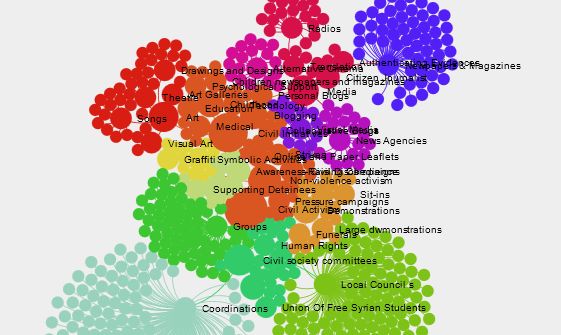
A map of non-violent activism in Syria
Kristyan Benedict writes: Non violent resistance in Syria? Don’t make me laugh. Those trying to topple Assad are all cannibals and head choppers….or so the likes of the academic “Angry Arab”, Asad Abu Khalil would, it would seem at times, try to convince you.
The reality is Syrians in their tens of thousands continue to resist the Assad regimes brutality (and sometimes resist certain armed opposition groups) through non-violent methods of staggering diversity and creativity. The extremely grim and brutal reality which regime apologists and quite often the mainstream media present is but one, extremely narrow perspective of what is going on in Syria. It is far from the whole truth.
A Syrian activist friend of mine, Omar al Assil, has recently produced a beautiful, interactive map of non-violent resistance in Syria. It was created with his colleagues in the Syrian Non Violence Movement including their members inside Syria.
I mention Abu Khalil as he was the first to respond to the map when the social commentator, Sultan Sooud Al-Qassemi posted it on his Facebook wall on June 21. Abu Khalil responded smugly: “Very convincing. Is there a special color for beheadings?”.
Pulse Media’s Muhammad Idrees Ahmad responded eloquently in the same thread to Abu Khalil’s customary inelegance: “He wants you to make blanket generalisations; to make no distinction between the Syrian majority who oppose the regime peacefully, the minority who defend themselves with arms, or the few who commit unpardonable crimes. They must all be judged by the standard of the lowest among them. Find the most criminal action, and extrapolate it onto the whole opposition.”
That extrapolation is a common reaction by many who only want to amplify the negatives of those opposed to the Assad regime. [Continue reading…]
Foreign media portrayals of the conflict in Syria are dangerously inaccurate
Patrick Cockburn writes: It is difficult to prove the truth or falsehood of any generalisation about Syria. But, going by my experience this month travelling in central Syria between Damascus, Homs and the Mediterranean coast, it is possible to show how far media reports differ markedly what is really happening. Only by understanding and dealing with the actual balance of forces on the ground can any progress be made towards a cessation of violence.
On Tuesday I travelled to Tal Kalakh, a town of 55,000 people just north of the border with Lebanon, which was once an opposition bastion. Three days previously, government troops had taken over the town and 39 Free Syrian Army (FSA) leaders had laid down their weapons. Talking to Syrian army commanders, an FSA defector and local people, it was evident there was no straight switch from war to peace. It was rather that there had been a series of truces and ceasefires arranged by leading citizens of Tal Kalakh over the previous year.
But at the very time I was in the town, Al Jazeera Arabic was reporting fighting there between the Syrian army and the opposition. Smoke was supposedly rising from Tal Kalakh as the rebels fought to defend their stronghold. Fortunately, this appears to have been fantasy and, during the several hours I was in the town, there was no shooting, no sign that fighting had taken place and no smoke.
Of course, all sides in a war pretend that no position is lost without a heroic defence against overwhelming numbers of the enemy. But obscured in the media’s accounts of what happened in Tal Kalakh was an important point: the opposition in Syria is fluid in its allegiances. The US, Britain and the so-called 11-member “Friends of Syria”, who met in Doha last weekend, are to arm non-Islamic fundamentalist rebels, but there is no great chasm between them and those not linked to al-Qa’ida. One fighter with the al-Qa’ida-affiliated al-Nusra Front was reported to have defected to a more moderate group because he could not do without cigarettes. The fundamentalists pay more and, given the total impoverishment of so many Syrian families, the rebels will always be able to win more recruits. “Money counts for more than ideology,” a diplomat in Damascus told me. [Continue reading…]
Syrian army launches offensive in Homs
The Washington Post reports: Syrian fighter jets and heavy-artillery units pounded rebel-held areas of the central city of Homs on Saturday, in what activists described as the fiercest push to take full control of the city in more than a year.
The bombardment of districts including al-Qusoor, Khalidiya, Jouret al-Shiya and the ancient Old City began about 9 a.m. and continued for three hours before the army deployed ground troops, activists said.
The government has been pressing a campaign against pockets of resistance in central Syria since taking control earlier this month of the town of Qusair, which lies between Homs and the Lebanese border. Once known as the capital of the revolution for its early role in the uprising against President Bashar al-Assad, Homs is divided between government-controlled and rebel-held areas, which have been under siege for the past year.
“It’s the worst day since the beginning of the siege,” said Abu Rami, a spokesman for the opposition Syrian Revolution General Commission and a resident of al-Qusoor who uses a pseudonym. “Civilians can’t leave. We are trapped.” [Continue reading…]
Taking outsize role in Syria, Qatar funnels arms to rebels
The New York Times reports: As an intermittent supply of arms to the Syrian opposition gathered momentum last year, the Obama administration repeatedly implored its Arab allies to keep one type of powerful weapon out of the rebels’ hands: heat-seeking shoulder-fired missiles.
The missiles, American officials warned, could one day be used by terrorist groups, some of them affiliated with Al Qaeda, to shoot down civilian aircraft.
But one country ignored this admonition: Qatar, the tiny, oil- and gas-rich emirate that has made itself the indispensable nation to rebel forces battling calcified Arab governments and that has been shipping arms to the Syrian rebels fighting the government of President Bashar al-Assad since 2011.
Since the beginning of the year, according to four American and Middle Eastern officials with knowledge of intelligence reports on the weapons, Qatar has used a shadowy arms network to move at least two shipments of shoulder-fired missiles, one of them a batch of Chinese-made FN-6s, to Syrian rebels who have used them against Mr. Assad’s air force. Deployment of the missiles comes at a time when American officials expect that President Obama’s decision to begin a limited effort to arm the Syrian rebels might be interpreted by Qatar, along with other Arab countries supporting the rebels, as a green light to drastically expand arms shipments.
Qatar’s aggressive effort to bolster the embattled Syrian opposition is the latest brash move by a country that has been using its wealth to elbow its way to the forefront of Middle Eastern statecraft, confounding both its allies in the region and in the West. The strategy is expected to continue even though Qatar’s longtime leader, Sheik Hamad bin Khalifa al-Thani, stepped down last week, allowing his 33-year-old son to succeed him. [Continue reading…]
Syria’s oilfields create surreal battle lines amid chaos and tribal loyalties
Ghaith Abdul-Ahad writes: A northern wind had been blowing since early morning, lifting a veil of dust that had blocked the sun and turned the sky the colour of ash. Abu Zayed was sitting on the porch of his unfinished concrete home, watching the storm build. He loved sandstorms. They reminded him of Dubai, where he had lived before the war. He admired the people there for turning a desert into a paradise. They had vision, he told his followers.
Six months ago, he left the Gulf emirate to join the Syrian revolution, attending opposition conferences in Istanbul and Cairo, jostling for position on behalf of his father, the leading sheikh of a powerful tribe in eastern Syria.
But Abu Zayed soon became disgusted with the bickering among the rebel leadership. “There is an opposition council in every hotel lobby in Istanbul,” he said. “You can’t distinguish them from the regime.”
Instead, like other disaffected tribal leaders, Abu Zayed returned home to his ancestral land and put his energy into building up his clan, taking control of his energy-rich ancestral lands.
Most of the oil and gas fields in eastern Syria lie idle or pump meagre quantities that are refined using primitive techniques to generate a pittance, but Abu Zayed’s land has a huge gas plant. It stands less than a mile from his home.
His father had chosen him out his 40 brothers to look after the plant because he was seen as a man of vision. The war had given him a chance to realise his dream: to build an oil-fuelled emirate.
The hard edges of Syria’s frontlines – dogmatic, revolutionary, Islamist or pure murderously sectarian – almost melt away outside the oilfields. New lines emerge pitting tribesmen against battalions, Islamists against everyone else, and creating sometimes surreal lines of engagement, where rebels help maintain government oil supplies in return for their villages being spared from bombardment and being allowed to siphon oil for themselves.
“There is chaos now,” Abu Zayed said. “The Free Syrian Army is chasing loot, and they don’t care about civilians. The military councils are stealing the aid and then selling it. There are dozens of battalions here, we don’t even know who is manning a checkpoint at the end of the street. Some people are saying the days of Bashar [al-Assad] were better, that the opposition has betrayed the people.
“But we can organise this situation,” he said. “Look at this gas plant, it’s under our control. Things are organised here and we can do the same for other oil and gas fields.
“Most of the people who control the oilfields around here are making about 5m Syrian pounds [£32,000] a day. They exploit a field for a few weeks, but because of the chaos, another powerful cousin or battalion soon arrives to fight for it and take control of it.
“I tell these people to lease me the field for S£10m a month. I collect all the fields under my control, bring in companies to exploit them properly and organise truck convoys to sell the gas to Turkey. Then we’ll buy Patriot [missile] batteries and drones to protect the fields against the regime.”
His ambition did not stop there. “Once you have economic power you can convene a council for the tribes here inside the country, and organise all the military units in one military council,” he said.
Using the old definition of tribal land from the French colonial era, before the Syrian republic and its socialist laws that smashed feudal property, each tribe is now claiming ownership of the fields that lie in its wajeh (tribal territory). As the Syrian regime has crumbled, society in the desert east has fallen back on the tribes. “Even [al-Qaida affiliate] Jabhat al-Nusra can’t do anything against us,” said Abu Zayed. “They try to get fields but they can’t. Not Nusra, not even the Americans could take these fields from us with all the weapons we have now.” [Continue reading…]
U.S. begins shipping arms for Syrian rebels
The Wall Street Journal reports: The Central Intelligence Agency has begun moving weapons to Jordan from a network of secret warehouses and plans to start arming small groups of vetted Syrian rebels within a month, expanding U.S. support of moderate forces battling President Bashar al-Assad, according to diplomats and U.S. officials briefed on the plans.
The shipments, related training and a parallel push to mobilize arms deliveries from European and Arab allies are being timed to allow a concerted push by the rebels starting by early August, the diplomats and officials said, revealing details of a new covert plan authorized by President Barack Obama and disclosed earlier this month.
The CIA is expected to spend up to three weeks bringing light arms and possibly antitank missiles to Jordan. The agency plans to spend roughly two weeks more vetting an initial group of fighters and making sure they know how to use the weapons that they are given, clearing the way for the first U.S.-armed rebels to enter the fight, diplomats briefed on the CIA’s plans said.
Talks are under way with other countries, including France, about pre-positioning European-procured weapons in Jordan. Saudi Arabia is expected to provide shoulder-fired antiaircraft missiles, known as Manpads, to a small number of handpicked fighters, as few as 20 at first, officials and diplomats said. The U.S. would monitor this effort, too, to try to reduce the risk that the Manpads could fall into the hands of Islamists.
Up to a few hundred of the fighters will enter Syria under the program each month, starting in August, according to diplomats briefed on CIA plans. [Continue reading…]
Obama’s ‘Alice in Wonderland’ Syria strategy
Micah Zenko writes: President Obama’s decision to intervene more directly in Syria’s civil war by providing limited lethal aid to certain members of the Syrian opposition is a significant foreign policy commitment. It is also a very confused one.
Forget for a moment that the case for Syria’s chemical weapons use was based on unverifiable evidence, or that the administration had reportedly decided to arm Syrian rebels before it even had that evidence. Forget that the president himself reportedly does not think arming the rebels will achieve much, that only 11 percent or 20 percent of the American people endorse his decision, that analysts dismiss it as “too little, too late,” and that even Capitol Hill supporters believe the move is insufficient. As Senate Foreign Relations Committee Chairman Robert Menendez stated: “You can’t just simply send them a pea shooter against a blunderbuss.”
What was most troubling about this latest shift in U.S. policy was the absence of a speech or briefing by the president, or a cabinet official, to clearly articulate why America is deepening its involvement in this Middle East conflict, what U.S. interests are at stake in the civil war, and what strategic objective the United States hopes to achieve. When asked directly about his decision to provide lethal assistance, Obama stated: “I cannot and will not comment on specifics around our programs related to the Syrian opposition.”
The cornerstone of holding public officials accountable by evaluating their policy choices is to first understand what those policies are, but since the June 13 announcement, Obama administration officials have offered the following reasons: [Continue reading…]
New wave of foreigners in Syrian fight
The Washington Post reports: He was young and bright, with an education from Egypt’s premier school of Islamic studies and lucrative job offers in the Gulf.
But Bilal Farag chose a different path, friends say, one that led him to die on a distant Syrian battlefield while fighting Shiite Muslims he regarded as infidels.
“Everybody has their own goal in life,” said a close friend, Hosam Ali. “Bilal’s was to be a martyr.”
Waves of Egyptians are now preparing to follow, fired by the virulently sectarian rhetoric of Sunni preachers and encouraged by the newly permissive policies of Egypt’s Islamist government. In recent days, this city’s ancient mosques have crackled with calls for jihad, as hard-line Sunni Muslim leaders command the faithful to respond to recent escalations in Syria by the Shiite forces of Iran and Hezbollah.
The Sunni backlash has echoed far beyond Egypt, penetrating every corner of the region, where divisions between the rival Muslim sects are hardening fast. At the Grand Mosque in Mecca, Islam’s holiest site, the top cleric broke down in tears on pan-Arab television last week as he pleaded with his fellow Muslims to help the Syrian rebels “by all means.”
Foreign militants have long played a critical role in the Syrian uprising, but the prospect of a fresh flow of radicalized fighters bent on waging sectarian war threatens to complicate the Obama administration’s recently announced strategy to arm the rebellion’s moderate factions. [Continue reading…]
U.S. has secretly provided arms training to Syria rebels since 2012
The Los Angeles Times reports: CIA operatives and U.S. special operations troops have been secretly training Syrian rebels with anti-tank and antiaircraft weapons since late last year, months before President Obama approved plans to begin directly arming them, according to U.S. officials and rebel commanders.
The covert U.S. training at bases in Jordan and Turkey, along with Obama’s decision this month to supply arms and ammunition to the rebels, has raised hope among the beleaguered Syrian opposition that Washington ultimately will provide heavier weapons as well. So far, the rebels say they lack the weapons they need to regain the offensive in the country’s bitter civil war.
The tightly constrained U.S. effort reflects Obama’s continuing doubts about being drawn into a conflict that has already killed more than 100,000 people and his administration’s fear that Islamic militants now leading the war against President Bashar Assad could gain control of advanced U.S. weaponry.
Meanwhile, the New York Times reports: During his more than four decades in power, Col. Muammar el-Qaddafi of Libya was North Africa’s outrageously self-styled arms benefactor, a donor of weapons to guerrillas and terrorists around the world fighting governments he did not like.
Even after his death, the colonel’s gunrunning vision lives on, although in ways he probably would have loathed.
Many of the same people who chased the colonel to his grave are busy shuttling his former arms stockpiles to rebels in Syria. The flow is an important source of weapons for the uprising and a case of bloody turnabout, as the inheritors of one strongman’s arsenal use them in the fight against another.
Evidence gathered in Syria, along with flight-control data and interviews with militia members, smugglers, rebels, analysts and officials in several countries, offers a profile of a complex and active multinational effort, financed largely by Qatar, to transport arms from Libya to Syria’s opposition fighters. Libya’s own former fighters, who sympathize with Syria’s rebels, have been eager collaborators.
“It is just the enthusiasm of the Libyan people helping the Syrians,” said Fawzi Bukatef, the former leader of an alliance of Libyan brigades who was recently named ambassador to Uganda, in an interview in Tripoli.
As the United States and its Western allies move toward providing lethal aid to Syrian rebels, these secretive transfers give insight into an unregistered arms pipeline that is difficult to monitor or control. And while the system appears to succeed in moving arms across multiple borders and to select rebel groups, once inside Syria the flow branches out. Extremist fighters, some of them aligned with Al Qaeda, have the money to buy the newly arrived stock, and many rebels are willing to sell. [Continue reading…]
Rouhani win could bring dividends in Syria
Barbara Slavin writes: Since the surprise election of Hassan Rouhani as Iran’s next president, most expert commentary has focused on the potential to improve US-Iran relations and resolve the long-running dispute over Iran’s nuclear program. However, the replacement of the abrasive Mahmoud Ahmadinejad by a veteran negotiator nicknamed the ‘diplomat sheikh’ could also provide an opportunity to ease growing sectarian tension in the region and to tamp down the civil war in Syria.
During the sixteen years (1989-2005) Rouhani served as secretary of Iran’s Supreme National Security Council, Iran’s relations with Saudi Arabia improved from the low points of the 1979 revolution and the 1980-88 Iran-Iraq war. At his first news conference as president-elect on Monday, June 17, Rouhani noted that he had signed a security agreement with the Saudis in 1998 and suggested that repairing the breach with the House of Saud would be a major priority for his administration.
Iran intends to have “friendly and close relations” with neighboring states, especially Saudi Arabia, Rouhani said. In regard to Saudi Arabia–a principal backer of opposition forces battling the Iran-supported Assad regime–Rouhani added, “We are not only neighbors but brothers.”
In the past, both Saudi Arabia and the United States have rejected Iranian participation in Syria peace talks but that attitude may shift with Rouhani in the presidency. Saudi King Abdullah was quick to congratulate Rouhani on his victory.
France, which had vehemently opposed Iran’s presence at a proposed Geneva conference, also appears to have softened its view. “My position is that if he [Rouhani] can be useful, yes, he would be welcome” at the conference, French President Francois Hollande said Tuesday at the G-8 summit in Northern Ireland, Agence France Press reported.
Russia–Bashar al-Assad’s other principal backer–has insisted that Iran attend any new talks. President Barack Obama’s administration, after first opposing this, has waffled, noting that the invitations will come from the United Nations (UN), as though the United States had no say in the matter. [Continue reading…]