Category Archives: Syria

Gaining a clearer view of the Syrian civil war

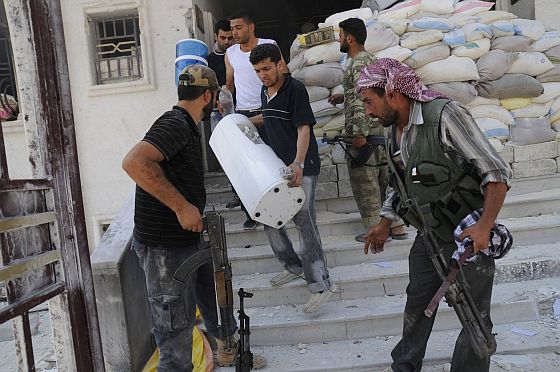
In an effort to correct some of the caricatures of the fighters in Syria, Christoph Reuter reports: These men with beards and Kalashnikovs, constantly shouting “Allahu akbar,” do fit with a certain framework, but that framework doesn’t exist anymore. Nor does the image of the ultra-warrior apply to all who adorn themselves with the al-Qaida logo. A group of jihad tourists kidnapped a British and a Dutch photographer in late July, and the British photographer, John Cantlie, later said their camp seemed “like an adventure course for disenchanted 20-year-olds.”

In the village of Atmeh, directly on the border with Turkey, we too met radicals with warlike garb, headbands and al-Qaida flags, their black garments and new SUV spotless. “They drive back and forth here all day,” said one perplexed FSA member. “They seem to like it.” And in Antakya, the sleepy provincial capital in Turkey where journalists, aid organizations and Syrian refugees meet, the jihad tourists can be found every evening on the patios of the nicer hotels, enjoying a Coca Cola and a water pipe.

That doesn’t stop Syria’s state-run media from spreading the story that the majority of those fighting on the rebels’ side are foreign al-Qaida terrorists. Ironically, that story finds willing ears in the West, including with Islam alarmists who think they detect al-Qaida behind every bearded man they see, and with left-wing conspiracy theorists who see the US as synonymous with interventionist imperialism.

The true danger, the one we sense growing with each trip we make to Syria, is the increasing brutality and barbarism on both sides. The question is no longer simply how this conflict will end, but also at what price. In any case, the fall of the house of Assad is inevitable.

Tens of thousands of people have died. They are civilians, soldiers and rebels. Gangs massacre their way through suburbs and villages. Half a million people have fled abroad, and far more are desperately on the move within their own country, afraid to stay where they are, but fearing death around every next corner.

A year ago, Homs, Aleppo, Rastan, Talbiseh, Douma, Zabadani, Deir el-Zour, Idlib and hundreds of other cities and villages did not yet look like small Mediterranean Stalingrads. The irresistible pull of revenge increases with each wave of killing, for both the Alawites and the Sunnis.

“If someone has lost a son, it’s still possible to stop him,” said a pharmacist in the village of Martin. “If he’s lost two, it’s very difficult. With three, it’s impossible. I’ve read about what Mahatma Gandhi achieved in India and I admire it. But what would have become of him here? In a week he would have been lying dead in a field.”


Facebooktwittermail

Syria’s citizen journalists

Mohammed Sergie reports: Omar, a former marketing student at a private university in Damascus, is living a life he never could have imagined. He’s originally from Idlib, one of Syria’s smaller cities in the heart of the northwest olive groves. Now he’s living in the line of fire as a media activist, documenting violence and escorting foreign journalists and human rights workers through Syrian terrain.

The role of media activist has bloomed in Syria. For scores of young revolutionaries, the most effective way to serve in the uprising is to essentially become an itinerant cameraman, capturing scenes in battle and uploading them to a global audience. Many become fixers for foreign news outlets as a source of income. Omar, for one, didn’t ask for money. He was just glad to have a professional journalist, especially one with Syrian roots, join him for the ride.

In Idlib province, where Omar does most of his work, the Assad regime has kept control of the major city, but lost the surrounding terrain. Its army, security forces and irregular militia members, or shabiha, have pulled back to the provincial capital. The city itself has swollen in number from 200,000 to 750,000, as rebels fighting for control of the towns and villages in Idlib have sent their families to relative safety. They can’t openly express themselves there, but they are free from the regime shelling and air strikes that pound the rebel held areas.

Omar, who goes by the nom de guerre Abu Al Huda, has memorized the topography of Idlib province, charting its farm roads and villages during the revolution. A lively tour guide, he points out the landmark battles for military bases in the countryside and highlights the aftermath of MiG strikes and barrel bombs.

“You are riding in a martyr’s car,” he said, explaining that the hole in the driver’s seat was made by the bullet that killed his 27-year-old brother Mouayad Al Ghafeer in June. [Continue reading…]

Facebooktwittermail

Peace envoy warns of escalating toll as 400 Syrians die in one day

The Washington Post reports: The Syrian civil war could claim 100,000 more lives over the next year if the government and the rebels fighting it do not negotiate a settlement, the international peace mediator warned Sunday.

“What is happening in Syria is bad, very, very bad,” said Lakhdar Brahimi, who is charged by the United Nations and the Arab League with seeking a peaceful end to 21 months of hostilities that have killed 44,000 Syrians. Speaking at the Arab League headquarters in Cairo, Brahimi added: “It is also escalating. If we have 50,000 killed in almost two years and the war stays another year, we will not have 25,000 more, we will have 100,000 more killed.”

Brahimi issued his chilling prediction after one of the deadliest 24-hour periods in the conflict, which began in March 2011. Opposition groups that monitor the death toll said as many as 400 people — more than double the typical daily death toll — were killed Saturday. About half of them were civilians slain in an alleged mass killing carried out by government troops at a petrochemical university in central Syria, opposition groups reported. [Continue reading…]

Facebooktwittermail

‘The people of Aleppo needed someone to drag them into the revolution’

Ghaith Abdul-Ahad reports: The man stands among the blackened, shell-shattered buildings, and reaches up to encompass them in a broad sweep of his wiry arms. “This,” he proclaims, “is the state of Abu Ali Sulaibi.”

The ruined corner of downtown Aleppo does not, of course, constitute a state and nor does it belong to the man claiming it in his name. But as the Syrian civil war has stagnated and Aleppo has fractured into “liberated” neighbourhoods run by different militias, Abu Ali and commanders like him have become the rulers of a series of mini-fiefdoms. These two blocks of the rebel frontline in Saif al-Dawla are his.

Walking through the once prosperous streets, Abu Ali recalls the life he lived here, pointing out the places where he played as a child, went to school and fell in love. He now lives in a small apartment in the heart of the zone with his wife, Um Ali, three daughters, a son, and a cat named Sanjoob, or Squirrel.

Fifty metres from Abu Ali’s sector, across the Saif al-Dawla Boulevard, a similar array of shattered buildings is occupied by government troops. They are close enough that during lulls in the shooting they can continue the conflict by shouting abuse.

Half of the building where his parents used to live has been sheared off by a rocket attack, spilling furniture and a chandelier into the street. The remaining structure serves as Abu Ali’s command centre, where some of his fighters sleep. He stands in the middle of a small living room surrounded by fighters resting under thick blankets on the floor.

“I can’t believe that this is my mother’s living room,” he says. Then, to the men: “Wake up, you beasts!”

As no one stirs, he pulls a pistol from his belt and fires into the ceiling, bringing down a chunk of plaster. The men jump from their mats, grabbing their guns. “That was Abu Ali’s wake-up call,” he says.

Outside, Abu Ali sits on a broken plastic chair set amid the rubble. His fighters, bleary-eyed, sit around him, making Turkish coffee and smoking. There is no food. The men live on one meal a day and many have not eaten since lunch the day before.

A trickle of civilians who braved the sniper fire to reach Abu Ali’s headquarters now come forward, as they do each morning, to ask favours of the chief. Some are trying to salvage their food or furniture, others come to ask permission to scavenge or squat in the empty apartments.

On this morning, six civilians stand sheepishly in front of him: a man in his 50s and his teenage son; a lanky man in a coat that is too big for him; a young engineer in rimless glasses and a bald man with his sister, who wears a black hijab. The civilians stay at a distance out of respect or fearing his unchecked anger.

“What do you want?”

“We want to collect some of our stuff, Abu Ali,” the older man says.

“Not today. Come back on Saturday.”

“But you told us to come on Wednesday.”

“I changed my mind. You should know that this is the state of Abu Ali Sulaibi.” He roars out his catchphrase as much for the benefit of his men as the civilians.

“You are all informers,” he tells the scared civilians. “I know you cross back to government side and report on us.”

“We are not,” says the bald man. “Our hearts are with you.”

“When you say that, I know you are an informer.” Turning to one of his men he says, half-joking: “Wasn’t he the one who was chasing us when we were out demonstrating?” The bald man’s face turns pale.

Abu Ali keeps the civilians waiting for two hours. Then, like a true autocrat, he quickly changes his mind and summons two of his men to take them where they want to go. [Continue reading…]

Facebooktwittermail

FSA Aleppo commander: “Even the people are fed up with us. We were liberators, but now they denounce us”

Ghaith Abdul-Ahad reports: It wasn’t the government that killed the Syrian rebel commander Abu Jameel. It was the fight for his loot. The motive for his murder lay in a great warehouse in Aleppo which his unit had captured a week before. The building had been full of rolled steel, which was seized by the fighters as spoils of war.

But squabbling developed over who would take the greater share of the loot and a feud developed between commanders. Threats and counter-threats ensued over the following days.

Abu Jameel survived one assassination attempt when his car was fired on. A few days later his enemies attacked again, and this time they were successful. His bullet-riddled body was found, handcuffed, in an alley in the town of al-Bab.

Captain Hussam, of the Aleppo military council, said: “If he had died fighting I would say it was fine, he was a rebel and a mujahid and this is what he had set out to do. But to be killed because of a feud over loot is a disaster for the revolution.

“It is extremely sad. There is not one government institution or warehouse left standing in Aleppo. Everything has been looted. Everything is gone.”

Captured government vehicles and weapons have been crucial to the rebels since the start of the conflict, but according to Hussam and other commanders, and fighters interviewed by the Guardian over a fortnight in northern Syria, a new phase has been reached in the war. Looting has become a way of life. [Continue reading…]

Facebooktwittermail

Battle for Aleppo shows both sides’ weaknesses

C.J. Chivers reports: The sniper walked through the rubble near this city’s front lines. He was searching for another spot from where he might catch a Syrian soldier in his rifle scope’s cross hairs.

Speaking in French-accented English, he said he was not Syrian, but a roaming jihadist who had journeyed here to help the Sunni uprising against President Bashar al-Assad’s secular, Alawite rule.

“I am a Muslim,” he said. “When you see on TV many of your brothers and sisters being killed you have to go help them. This is an obligation in Islam.”

The presence of this foreign antigovernment fighter, who claimed to be from Paris and gave his name as Abu Abdullah, pointed to recurring questions of the battle for Syria’s largest city: How much longer will the fighting last, and what will its effects be?

Now in its sixth month, the battle for Aleppo has become the contest for Syria in a microcosm, exposing the weakness of both sides, while highlighting anew the perils and costs of the country’s bitter civil war.

It has underlined the rebels’ difficulties in organizing a coherent campaign; their paucity of infantry weapons heavier than machine guns; and some of their fighters’ participation in the same human rights abuses for which they condemn the government, including the summary killing of prisoners.

It has also left rebels vulnerable to allegations of corruption, including the theft of much needed food and other aid.

Simultaneously, the fighting has exposed the government’s seemingly fatal miscalculations. For all of its statements to the contrary, and no matter its effort to mass soldiers and firepower here, Mr. Assad’s government has mustered neither the popular support nor the military might to stop the rebels’ slow momentum, much less to defeat them. [Continue reading…]

Facebooktwittermail

Alawite cleric: Assad duped us into sectarian war

Asharq Al-Awsat reports: Speaking to Asharq Al-Awsat on the condition of anonymity, an opposition Alawite religious cleric who recently fled to the Turkish town of Antakya revealed that “the Alawite community is living in a state of great fear, after we have become aware that the collapse of the al-Assad regime is imminent, which will place us at the mercy of fierce reprisals from the Sunni majority.”

He added “many Alawite families have already fled their homes in Damascus and returned to their villages in the Lattakia countryside.”

The cleric also revealed that he, along with a number of other Alawite activists, have worked hard to convince many Alawite youth not to join Syria’s military reserves or heed military summons, calling on the Alawite community “not be become embroiled in killing their Syrian brothers.”

He added “the regime has embroiled us in a sectarian war against the Sunnis, and if the Alawites had participated in the revolution since the beginning the regime would have been toppled, whilst the Alawite community would have no reason to fear. However after all this bloodshed, it is very difficult.”

The cleric, speaking to Asharq Al-Awsat on the condition of anonymity for fear of reprisals from the al-Assad regime, also called on the Sunni community “to extend their hand to the remaining Alawite community following the ouster of the regime so that we can make peace and build a free, just and democratic Syria.”

Facebooktwittermail

As fighting rages in Aleppo, Syrians face hunger, disease and little hope of aid

The Washington Post reports: In Aleppo, Syria — Darkness comes early to the streets of this ancient city, once a symbol of Syria’s richly storied past and now at the heart of the deepening nightmare that the country’s revolution has become.

By 5 p.m., people are scurrying home, down streets potholed by artillery, past piles of rubble and mountains of garbage that hasn’t been collected in months, to spend the evenings huddled in the cold without heat, light or, increasingly, food.

“We just lie under blankets because it is so cold. We have no work, no money and no life,” said Omar Abu Mohammed, 55, one of the few remaining residents of his badly bombed neighborhood, as he prepared to head indoors for the night.

“It is time to go now because soon there will be snipers,” he added, as a shell boomed softly in the distance.

Shells are exploding somewhere in Aleppo most of the time, but after five months of fighting, people have become inured to the ever-present threat. Rain and cloudy skies have deterred warplanes, providing some relief from the airstrikes that can wipe out whole apartment buildings, along with their inhabitants, in an instant.

But the onset of this second winter since Syrians rose up against their government 22 months ago is bringing new calamity to a people already ground down by violence and war. Hunger, cold and disease are emerging as equally profound challenges in the desperate daily struggle that life has become for millions, not only in Aleppo but across Syria, where the quest for greater freedoms sparked by the Arab Spring has gone badly, horribly wrong. [Continue reading…]

Facebooktwittermail

Syria: interview with a Jabhat al-Nusra official

Abu Adnan, a 35-year-old religious scholar and Shari’a law official in Jabhat al-Nusra’s leadership in the Aleppo area, gave an interview with Rania Abouzeid for Time magazine.

The interview took place in a town in northern Syria, in the countryside outside Aleppo. I was not blindfolded nor subjected to a physical security check. I was picked up at a northern Syria border post, driven for about 15 minutes inside the country before the vehicle stopped in front of a black pickup truck waiting in the middle of an otherwise empty stretch of road. There were three men in the vehicle, including Abu Adnan, who silently approached the car I was in, and sat in the backseat. He did not introduce himself until I asked who he was later.

We drove to a small cold concrete room with a tiny window that barely let in any light from an already overcast sky. We sat among boxes of long-life milk and bags of blankets and winter clothes waiting to be distributed. Our host, the driver, tried to start a portable gas heater, but there was no gas.

“America has called us terrorists because it says that some of our tactics bear the fingerprints of al-Qaeda in Iraq, like our explosives and the car bombs,” Abu Adnan said, his breath condensing as he spoke. “We are not like al-Qaeda in Iraq, we are not of them.”

Jabhat al-Nusra does count Syrian veterans of the Iraq war among its numbers, men who bring expertise — especially the manufacture of improvised explosive devices (IEDs) — to the front in Syria. Still, Jabhat al-Nusra is not the only rebel outfit to use IEDs and other groups — some so-called moderates operating under the loose umbrella of the Free Syrian Army (FSA) have also allegedly used suicide bombers who were either willing or unwilling (i.e prisoners). Like Jabhat al-Nusra, a number of other Islamist groups also want to install an Islamic state in Syria, while even secular rebel units increasingly speak in ugly sectarian terms that demonize minorities, particularly members of Assad’s Alawite sect. Yet only Jabhat al-Nusra’s tactics were designated as “terrorist” by a U.S. administration that admits it is still trying to understand the various armed elements in the Syrian conflict, fueling all manner of theories about why Jabhat al-Nusra was slapped with the description. Also why time the announcement just as rebels as a whole seem to have gained a renewed momentum? The key, it seems, is the alleged links to al-Qaeda in Iraq.

Facebooktwittermail

Syrian military police chief al-Shalal defects

BBC News reports: The commander of Syria’s military police has defected from President Bashar-al Assad’s government and reportedly fled to Turkey.

Lt Gen Abulaziz al-Shalal is one of the highest-ranking officials to join the uprising against the Syrian regime.

The army had failed to protect Syrians and turned into “gangs of murder”, the general said in a video statement.

Facebooktwittermail

No easy route if Assad opts to go, or to stay, in Syria

The New York Times reports: President Bashar al-Assad of Syria sits in his mountaintop palace as the tide of war licks at the cliffs below.

Explosions bloom over the Damascus suburbs. His country is plunging deeper into chaos. The United Nations’ top envoy for the Syrian crisis, Lakhdar Brahimi, met with Mr. Assad in the palace on Monday in an urgent effort to resolve the nearly two-year-old conflict.

How Mr. Assad might respond to Mr. Brahimi’s entreaty depends on his psychology, shaped by a strong sense of mission inherited from his iron-fisted father and predecessor, Hafez al-Assad; his closest advisers, whom supporters describe as a hard-line politburo of his father’s gray-haired security men; and Mr. Assad’s assessment, known only to himself, about what awaits him if he stays — victory, or death at the hands of his people.

From his hilltop, Mr. Assad can gaze toward several possible futures.

East of the palace lies the airport and a possible dash to exile, a route that some say Mr. Assad’s mother and wife may have already taken. But the way is blocked, not just by bands of rebels, but by a belief that supporters say Mr. Assad shares with his advisers that fleeing would betray both his country and his father’s legacy.

He can stay in Damascus and cling to — even die for — his father’s aspirations, to impose a secular Syrian order and act as a pan-Arab leader on a regional and global stage.

Or he can head north to the coastal mountain heartland of his minority Alawite sect, ceding the rest of the country to the uprising led by the Sunni Muslim majority. That would mean a dramatic comedown: reverting to the smaller stature of his grandfather, a tribal leader of a marginalized minority concerned mainly with its own survival.

Mr. Brahimi was closemouthed about the details of his meeting, but has warned in recent weeks that without a political solution, Syria faces the collapse of the state and years of civil war that could dwarf the destruction already caused by the conflict that has taken more than 40,000 lives.

A Damascus-based diplomat said Monday that Mr. Assad, despite official denials, is “totally aware” that he must leave and was “looking for a way out,” though the timetable is unclear.

“More importantly,” said the diplomat, who is currently outside of Syria but whose responsibilities include the country, “powerful people in the upper circle of the ruling elite in Damascus are feeling that an exit must be found.”

Yet others close to Mr. Assad and his circle say any retreat would clash with his deep-seated sense of himself, and with the wishes of increasingly empowered security officials, whom one friend of the president’s has come to see as “hotheads.” [Continue reading…]

Facebooktwittermail

Syrian Christian refugees have little to celebrate

Al-Monitor reports: A funeral mass many not sound like a festive occasion, but it is one of the initiatives by charities and churches to alleviate the suffering of Syria’s Christian refugees in Lebanon this Christmas. “Many people had to flee before being able to bury their dead,” says Issam John Darwish, archbishop of the Melkite Catholic diocese of Zahle. The funeral will commemorate more than 300 people.

The diocese is also distributing heating fuel and food packages to the 400 families that have registered with Zahle’s more than 130 local churches. Christian charities such as Caritas are distributing clothes to Syrian refugees to mark the holidays, and World Vision has organized Christmas plays through which refugees are encouraged to find the holiday spirit.

But many refugees say they have little to celebrate. “I don’t feel like there are any holidays,” says 24-year-old Talej Hallak. She fled the bombs falling on Qusayr, just across the Syrian border in March. It’s the first time she is experiencing Christmas outside her country and without her relatives. Her father died “during the war,” as she refers to the 22-month-old conflict, images of which flicker on the TV screen behind her. And there will be no gifts for 5-year-old Ibrahim or 2½-year old Pamela either; the family is scraping by on what her husband, Khoder, makes as a painter. [Continue reading…]

Facebooktwittermail

Russian military presence in Syria poses challenge to U.S.-led intervention

The Guardian reports: Russian military advisers are manning some of Syria’s more sophisticated air defences – something that would complicate any future US-led intervention, the Guardian has learned.

The advisers have been deployed with new surface-to-air systems and upgrades of old systems, which Moscow has supplied to the Assad regime since the Syrian revolution broke out 21 months ago.

The depth and complexity of Syria’s anti-aircraft defences mean that any direct western campaign, in support of a no-fly zone or in the form of punitive air strikes against the leadership, would be costly, protracted and risky. The possibility of Russian military casualties in such a campaign could have unpredictable geopolitical consequences.

Meanwhile, near-daily atrocities have kept western governments under pressure to act. A Syrian government air strike on a town near the central city of Hama on Sunday killed dozens of civilians queueing for bread, according to human rights activists.

Amateur footage from Halfaya showed mangled human remains strewn along a street where people had been blown off scooters and out of cars. One video showed a boy with his feet blown off. Piles of corpses could be seen beneath rubble outside a two-storey building the cameraman described as a bakery. It was unclear how many bodies were in the smoking ruins.

Human Rights Watch has previously accused the regime of targeting bakeries. The group warned the Assad regime that such targeted bombing of civilians represented war crimes. However, in the face of a Russian veto at the UN security council, the international criminal court has not had a mandate to investigate the atrocities committed by either side. The UN has put the death toll at more than 40,000 as the war continues to escalate. [Continue reading…]

Facebooktwittermail

Syria: Support for the revolution doesn’t equal support for the revolutionaries

Adnan A. Zulfiqar writes: Sectarian conflict might dominate coverage of Syria today, but internal Sunni dynamics will define its tomorrow. Tensions between Alawis and Sunnis won’t be settled over night, but the demographics in Syria do not suggest a prolonged conflict similar to Iraq or Lebanon.

Unlike those countries, Syria is overwhelmingly Sunni (~75%) and Bashar al-Assad’s fate rests on their support. Over the last two years, the strategic alliance between Assad and the Sunni elite has eroded significantly. Assad’s former Syrian-Sunni allies are now some of his opponent’s most important financial contributors. Russia seemingly hedging its bets on Syria’s future, and the United States attempting to raise its profile on the issue bothindicate that post-Assad preparations are being made.

After almost two years since the rebellion began, over 44,000 have been killed, according to the Syrian Observatory for Human Rights. According to press accounts and my personal observations during a recent trip to the Syrian/Turkey border as part of Truman Project’s Democracy and Human Rights Initiative, the rebels control much of Syria’s north, including most of the border with Turkey, significant portions of Aleppo, and are steadily making a push for Damascus, the final prize. Even Assad’s deputies have cynically taken to the airwaves to advocate for a political resolution, an unlikely proposition at this stage.

An impending power vacuum is inevitable so focus must shift to the competitors aiming to fill that space. The common consensus is that the opposition’s political and military factions are poised to battle for authority. In reality, this competition highlights a more fundamental confrontation: traditionalist Sunnism versus its more puritanical Salafi strain. The Syrian coalition understands this with their perspicacious selection of Mu’az al-Khatib to lead the opposition: the former head imam at Umayyad Masjid, the country’s most important religious site and the fourth holiest site in Islam. Al-Khatib, a Sunni traditionalist, can counter the growing appeal of Salafism. Rebel militias are dominated by an ideological spectrum of Salafi fighters, but are united by both the cause and their interpretive approach to Islam’s foundational texts. Despite Salafism never having mass appeal in Syrian society, there is potential for that to change. [Continue reading…]

Facebooktwittermail