Category Archives: Syria

Syria’s Kurds: A struggle within a struggle

As Syria’s conflict has expanded, the population in majority-Kurd areas has remained relatively insulated. Keeping a lower profile, it has been spared the brunt of regime attacks; over time, security forces withdrew to concentrate elsewhere. Kurdish groups stepped in to replace them: to stake out zones of influence, protect their respective areas, provide essential services and ensure an improved status for the community in a post-Assad Syria. Big gains could be reaped, yet cannot be taken for granted. Kurdish aspirations remain at the mercy of internal feuds, hostility with Arabs (evidenced by recent clashes) and regional rivalries over the Kurdish question. For Syria’s Kurds, long-suppressed and denied basic rights, prudence dictates overcoming internal divisions, clarifying their demands and – even at the cost of hard compromises – agreement with any successor Syrian power structure to define and enshrine their rights. And it is time for their non-Kurdish counterparts to devise a credible strategy to reassure all Syrians that the new-order vision of the state, minority rights, justice and accountability is both tolerant and inclusive.

See the International Crisis Group’s latest report, Syria’s Kurds: A Struggle Within a Struggle.

Facebooktwittermail

Tribalism and the Syrian crisis

Tareq al-Abd writes: Prominent tribal figures have become omnipresent in Syrian opposition meetings, at a time when the regime is also hosting meeting after meeting for these same leaders. All of this is transpiring amid fears that societal unity will once again become fragmented, opening the door to tribal clashes in the worst possible scenario that could face Syria.

Tribal influence has returned to the forefront of the country’s political scene. Although their presence on the ground fluctuates between weak in some areas to effective in others, the impression is that Syrian society still longs for the old days of tribal friction and polarization, despite the fact that cohesion between some of them has played a positive role in avoiding disputes. As a result, there is a new drive to monitor the country’s tribal communities, their influence and relationship with the regime, be they for or against the current government.

The Syrian tribes are spread throughout all the regions of the country, from the extreme northeast in the plains of al-Jazira and the Euphrates river valley, all the way to the Badiya desert, Homs, Hama and the Damascus countryside, as well as the southern regions of Hauran and Jabal al-Druze. All these tribes are interconnected and have relationships with neighboring countries, especially Iraq and Jordan, with some tribes even claiming ties in Saudi Arabia. Furthermore, many inhabitants of Mount Lebanon still retain a strong connection to their places of origin in southern Syria and maintain good relations with their relatives there, while others have Turkish ancestry, such as the Abazaid clan in Daraa. [Continue reading…]

Facebooktwittermail

Syrian rebels accuse jihadist groups of trying to hijack revolution

Martin Chulov reports: Over the past six weeks a once co-operative arrangement between Aleppo’s regular Free Syrian Army units and al-Nusra has become one of barely disguised distrust.

A week of interviews with rebel groups in north Syria has revealed a schism developing between the jihadists and residents, which some rebel leaders predict will eventually spark a confrontation between the jihadists and the conservative communities that agreed to host them.

Some already talk of an Iraq-style “awakening” – a time in late-2006 as when communities in the Sunni heartland cities of Fallujah and Ramadi turned on al-Qaida groups in their midst that had tried to impose sharia law and enforce their will through the gun barrel.

“We’ll fight them on day two after Assad falls,” a commander said. “Until then we will no longer work with them.”

In recent weeks Liwa al-Tawhid and other militias who form part of the Free Syrian Army have started their own operations, without inviting al-Nusra along.

A raid on an infantry school north of Aleppo was one such occasion; so are attacks against Batallion 80 on the outskirts of the city’s international airport and a military base to the east, known as Querres.

“They are not happy with us,” the rebel leader said. “But they had been hoarding all their weapons anyway.”

Another significant issue for rebel leaders is what to do with state assets that have fallen into the hands of the opposition.

“They see stealing things that used to belong to the government, like copper factories, or any factory, as no problem,” said the rebel commander. “They are selling it to the Turks and using the money for themselves. This is wrong. This is money for the people.”

On Monday al-Nusra units went to a state-owned water factory on the Euphrates river. They invited regular rebel units to go with them as they picked through parts inside the factory for selling to whoever wanted them.

One unit did join the jihadists. Others refused.

“These are Syrian assets for Syrian people,” said a rebel commander who did not want to be named. “They see this as an open pasture for them to do as they please. Our job is to protect the state for life after Assad, not to destroy it.”

Money is flowing to al-Nusra. Members acknowledge that they receive cash from benefactors in the Sunni Arab world. But their coffers are also being filled with a garage sale of state assets, largely conducted by al-Nusra leaders.

A rebel unit pulled up on a main road in eastern Aleppo just up the road from the al-Nusra base. Pigeons circled over the city’s ancient citadel, which soared from a hilltop in the near distance.

Another rebel approached, this time to complain that young girls in his village had been pledged as brides to anyone who joined al-Nusra. “This is part of the employment benefits,” he said.

For now, community leaders seem to be able to say no to al-Nusra suitors who come calling, but fear these rights might be whittled away if the group consolidates its influence. [Continue reading…]

Facebooktwittermail

Syria: Is it too late?

Frederic C. Hof writes: Syria is dying. Bashar al-Assad has made it clear that the price of his removal is the death of the nation. A growing extremist minority in the armed opposition has made it clear that a Syria of citizenship and civil society is, in its view, an abomination to be killed. And those in the middle long begging for Western security assistance are increasingly bemoaning that it is already too late. Between the cold, cynical sectarianism of Assad and the white-hot sectarian hatred of those extremists among his opponents Syria already is all but gone, a body politic as numbingly cold and colorless as the harsh wintry hell bringing misery and hopelessness to untold numbers of displaced Syrians.

It might in fact be too late to save Syria from the diabolical ministrations of Assad and his enabling Salafist enemies. Indeed, the single-minded, self-centered destructiveness of foes who once cooperated in the killing of Iraqis and who now collaborate in the murder of Syria may be sufficiently powerful to block any effort at national salvation regardless of its source. By facilitating Assad’s poison pill sectarian strategy Iran, Hezbollah, and Russia have facilitated the implantation of al-Qaeda (in the form of the Nusra Front) in Syria. By funneling arms and money to those calling for death to Alawites and the establishment of a Syrian emirate, donors in certain Gulf countries, Turkey, and elsewhere have advanced Assad’s survival strategy with a toxic blend of tactical skill and strategic stupidity. As in “Murder on the Orient Express,” many hands have plunged the knife into a victim perhaps too far gone to be saved.

Yet even if one accepted, analytically, the “it’s too late to save Syria” thesis, and the argument that saving Syria was never something the United States and its allies could do, can this be the basis of prudent policy? If Syria, as now appears likely, becomes a death star of failed statehood, will the effects of its ravaged carcass on the surrounding neighborhood be so benign as to present no challenges to US statecraft far more perilous than those presented by Syria now? Will the great sucking sounds of Lebanon, Jordan, Turkey and perhaps Iraq being pulled into the black hole of what was once Syria become the next normal; chapter two in the “it’s too late” saga? Will Americans at that point look back with regret at our reluctance to try to shape and influence when we may at least have had a chance to do so? [Continue reading…]

Facebooktwittermail

Assad tests Obama’s ‘red line’ on the use of chemical weapons

Foreign Policy‘s blog, The Cable, reports: A secret State Department cable has concluded that the Syrian military likely used chemical weapons against its own people in a deadly attack last month, The Cable has learned.

United States diplomats in Turkey conducted a previously undisclosed, intensive investigation into claims that Syrian President Bashar al-Assad used chemical weapons, and made what an Obama administration official who reviewed the cable called a “compelling case” that Assad’s military forces had used a deadly form of poison gas.

The cable, signed by the U.S. consul general in Istanbul, Scott Frederic Kilner, and sent to State Department headquarters in Washington last week, outlined the results of the consulate’s investigation into reports from inside Syria that chemical weapons had been used in the city of Homs on Dec. 23.

The consul general’s report followed a series of interviews with activists, doctors, and defectors, in what the administration official said was one of the most comprehensive efforts the U.S. government has made to investigate claims by internal Syrian sources. The investigation included a meeting between the consulate staff and Mustafa al-Sheikh, a high-level defector who once was a major general in Assad’s army and key official in the Syrian military’s WMD program.

An Obama administration official who reviewed the document, which was classified at the “secret” level, detailed its contents to The Cable. “We can’t definitely say 100 percent, but Syrian contacts made a compelling case that Agent 15 was used in Homs on Dec. 23,” the official said.

The use of chemical weapons by the Assad regime would cross the “red line” President Barack Obama first established in an Aug. 20 statement. “We have been very clear to the Assad regime, but also to other players on the ground, that a red line for us is we start seeing a whole bunch of chemical weapons moving around or being utilized. That would change my calculus. That would change my equation,” Obama said.

James S Ketchum MD and Frederick R Sidell MD describe the effects of BZ*. In the 1960s, Ketchum, a psychiatrist, was the U.S. Army’s leading expert and investigator in the use of chemical weapons. Although BZ was weaponized, it was later determined it could have no value in the battlefield and the U.S. stockpile was destroyed. A Soviet version was developed and also one in Iraq, known as Agent 15.

When delirium is present in its full-blown state, the individual seems to be in a “waking dream,” often staring and muttering, sometimes shouting, as simple items in the environment are variably perceived as elaborate structures, animals, or people. These hallucinations may arise from some trivial aspect of the surroundings, such as a strip of molding, a pillow, or an irregular spot on the floor. A total lack of insight generally surrounds these misperceptions.

Another striking characteristic of delirium is its fluctuation from moment to moment, with occasional lucid intervals and appropriate responses. An individual might answer “Shakespeare” when asked who wrote Hamlet, but when asked the same question 5 minutes later, might get down on the floor and attempt to remove an imaginary manhole cover, or become absorbed in a miniature World Series game being played out before his eyes.

“Phantom” behaviors, such as plucking or picking at the air or at garments, is characteristic (whence the old term “woolgathering”). This “carphologia,” as it was known in the 19th century, can be comical at times. When two individuals are both delirious they may play off of each other’s imaginings. A subject was once observed to mumble, “Gotta cigarette?” and when his companion held out an invisible pack, he followed with, “S’okay, don’t wanna take your last one.”

Recovery from drug-induced delirium is gradual, with a duration presumably determined by the pharmacokinetic persistence of the causative agent. The more spectacular and florid hallucinations are gradually replaced by more modest distortions in perception. (Instead of large animals, mice and insects are described by the subject.) Awareness gradually returns and with it comes the subject’s partial insight that his mental faculties are not what they should be. Ironically, paranoid tendencies often emerge at this stage, as the individual senses that something is amiss but cannot carry out the reality testing required to rule out malevolent manipulation of the environment by others. A period of restorative sleep generally precedes the return to normal cognitive function.

The Cable spoke to two doctors who treated victims in Homs on December 23:

Both doctors said that the chemical weapon used in the attack may not have been Agent 15, but they are sure it was a chemical weapon, not a form of tear gas. The doctors attributed five deaths and approximately 100 instances of severe respiratory, nervous system, and gastrointestinal ailments to the poison gas.

If the Assad regime wanted to test President Obama’s resolve in laying down a “red line” on the use of chemical weapons, then an obvious way to pose such a challenge would be to employ a weapon whose effects might mostly be non-lethal. This would then leave Washington with the dilemma it now seems to face. Should it now make good on its earlier commitment that unspecified consequences would follow the use of chemical weapons, or does it fudge its “red line” and thus invite a more extreme test?

So far, each test of Obama’s boundaries has indicated that they are quite elastic.

*It’s important to note that descriptions of the effects of BZ as provide through research in which carefully measured amounts of the drug were administered, cannot reliably indicate the effects of the drug released in a battle where levels of exposure will vary widely. However, one symptom the doctors in Homs described observing in the victims — “They all had miosis — pinpoint pupils” — does not correspond with the effects of an anticholinergic such as BZ, which causes pupil dilation.

Facebooktwittermail

Forming a Syrian opposition government: the time is now

Frederic C. Hof writes: The Syrian Opposition Council (SOC) formed in November 2012 faces no shortage of dire challenges as it tries to organize itself and give desperately needed political leadership to a heterogeneous hodgepodge of armed and unarmed opponents of the dying yet lethally venomous regime of Bashar al-Assad. How to uphold the primacy of citizenship in an increasingly sectarian struggle? How to maintain credibility with those who are fighting and dying? How to reach out to minorities and other fence sitters inside Syria? How to prepare for the practicalities of transition and governance? How to shape and influence international support for Syria’s revolution rather than being shaped and influenced by outsiders? How to eclipse internal rivalries and policy differences with selflessness and a unifying sense of mission encompassing a broadly acceptable vision of what the new Syria will be and how it will function?

In a just world, Syrians emerging from an induced political coma of some 50 years would not be faced with such daunting tasks. Starting with the 1958-1961 Egyptian-run United Arab Republic, Syrians have become accustomed to the heavy hand of intelligence services on political discourse. Over the years, frank political discussions even within families became guarded and circumscribed, a condition not significantly altered by the “Damascus Spring” experiment over a decade ago. Now it is all out there for discussion and decision. Syrians who, not long ago, could only choose among silence, torture, and departure are now being asked to practice teamwork, transparency, and compromise. There is nothing fair or just about this situation.

Yet fair or not, ready or not, Syria requires a government. For more than 40 years the Syrian Arab Republic Government (SARG) was the transmission belt for the desires of a narrow, family-based clique. That government is now neutered—the geographical scope of its assigned writ having shrunken dramatically over the past 21 months. Yet a functioning bureaucracy will be central to any transition plan due to the need for continuity of government. Ministries, departments, and agencies—including the security services—employ people and provide services, albeit often ineffectively and corruptly. The preservation of these organs, as imperfect as they are, can facilitate the rapid dispersal of international assistance post-Assad and reassure millions of Syrians who fear the chaos of revolutionary rule. Reform will come in time. It is important to distinguish government and its associated bureaucracy from the ruling clique, which has become a militia, willing and even eager to risk destroying Syria to try to save itself.

As I have written previously the old expression, you can’t beat something with nothing, applies in spades to Syria. No one—not even Bashar al-Assad himself—doubts the corruption, incompetence, and brutality of what remains of the old system. Yet millions of Syrians grudgingly adhere to “the Doctor.” They do so partly because they fear his jailers and torturers, but largely because they know not what comes next. This is the obstacle that a provisional government formed by the SOC can address and overcome. [Continue reading…]

Facebooktwittermail

Assad offers only more of the same — mukhabarat brutality

Hassan Hassan writes: The world still blinks every time that Bashar Al Assad speaks, as if it has not learnt anything from 21 months of violence.

In his speech yesterday – his ninth since the uprising began – the dictator offered a plan that would include a lengthy, complicated process of gradual change and “truth and reconciliation”. That would, in theory, lead to a new coalition government and a new constitution.

The speech was preceded by an aggressive two-week diplomatic campaign by the regime’s allies and the UN envoy Lakhdar Brahimi. That renewed push for diplomacy followed 140 countries’ recognition of the National Coalition as the sole representative of the Syrian people, Nato Patriot missiles and military personnel that were dispatched to Turkey’s border, and pledges of increased support for the opposition.

The diplomatic overture by the regime is part of a Russian-backed plan that would keep Al Assad in power until presidential elections in the summer of 2014. And the diplomacy appears to have succeeded in slowing down aid to the rebels, with reports that arms supplies are drying up. But the speech yesterday should remind the world that this dictator has no place in a future Syria and that support for the rebels is the only way forward.

Russia probably pressured on Al Assad to announce a plan of reconciliation. But the speech sounded more vindictive, dismissive and exclusivist than even his previous bombast. For example, he said the plan was directed at only segments of the opposition, and that “those who reject the offer, I say to them: why would you reject an offer that was not meant for you in the first place?” In other points, he emphasised vengeance rather than reconciliation. He also blamed the rebels for the destruction of infrastructure and for cutting off electricity and communications.

“Syria accepts advice but never accepts orders,” he said. “All of what you heard in the past in terms of plans and initiatives were soap bubbles, just like the [Arab] Spring.” [Continue reading…]

Facebooktwittermail

‘Russian ships gathering off Syria to deter West’

Jerusalem Post: Russia has concentrated five landing ships in the eastern Mediterranean in a show of force meant to deter Western nations from intervening militarily in Syria, The Sunday Times quoted a Russian diplomat as saying.

According to the report, the ships are carrying military vehicles and hundreds of Russian marines, and are being accompanied by combat vessels.

While officially Russia has claimed the ships have been deployed to partake in an exercise to “improve the management, maintenance and testing of the interaction of naval forces,” the Times quoted the diplomat as saying the marines were meant to deter the West from deploying ground forces in the uprising against Syrian President Bashar Assad.

“Russia should be prepared for any developments, as it believes the situation in Syria might reach its peak before Easter,” the Times quoted the diplomatic source as saying.

Facebooktwittermail

No one knows what will happen after the Assad regime falls

Christoph Reuter reports: Night falls quickly in Syria, as the overloaded pickup trucks carrying stray refugee families emerge through the mist. The headlight beams from our car fall over destroyed houses on our drive through olive groves and abandoned towns. Campfires can occasionally be seen in the distance.

We’ve driven along this road once before, in April 2012, which these days seems like an eternity ago. At the time, there was still electricity here, and people still lived in Taftanas, Sarmin, Kurin and other villages in Idlib Province, in northern Syria. But now, in December 2012, entire villages are empty and pockmarked with bullet holes, their residents having fled from airstrikes, hunger and frigid temperatures.

After a while, we reach a village where residents did not openly demonstrate against Syrian dictator Bashar Assad in the past. As a result, they still have electricity today. A man opens a door, shivering as he looks out at the damp, cold landscape. “Thank God for this weather!” he says wryly. It’s been raining for days, and everything seems immersed in fog and mud. But the fog is also a deterrent against aircraft and helicopters, sparing the area the usual bombardment for a few days and providing a moment of calm in the midst of the apocalypse.

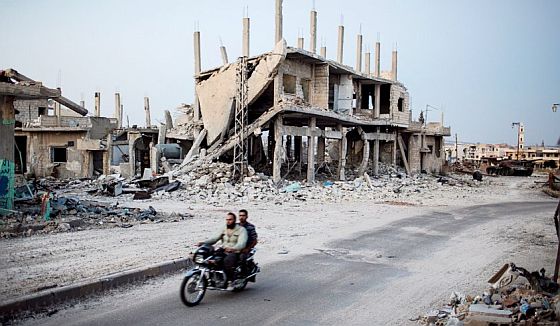
Today, Syria is a devastated country. The cities have turned into battlefields, and in the places from which the Assad regime’s troops and militias were forced to withdraw, its air force is now incinerating the infrastructure.

Nevertheless, after months of static conflict between unequally matched forces, during which provinces were neither lost by the regime nor gained by the rebels, the balance has suddenly shifted. Military camps, airports and cities are falling to the rebels, while demoralized and hungry Syrian army units are simply giving up. The rebels are already on the eastern outskirts of Damascus, the capital. The army is defending its last bastions in the north and east, like islands in a sea, only able to receive supplies from the air. Even the Russian government, Assad’s most important ally next to Iran, is gradually abandoning the dictator. Before Christmas, Russian President Vladimir Putin said he wasn’t concerned with the fate of the Assad regime.

“We are tired,” says one of the rebels who have gathered in the village on this evening. The group includes a man charged with distributing bread, a few fighters and the owner of the only satellite telephone in the village. Everyone here has lost friends and relatives, in a country that is sinking all around them.

“The others, the soldiers, are also tired. But at least we know what we’re fighting for,” the rebel says. Even though they are sometimes worried about the future, about the days after victory when revenge will be taken, another adds: “Who can blame someone whose family was killed?”

But where would that leave a revolution that was intended to bring down the dictator, but not plunge the country into a civil war? The Assad regime will fall, but no one knows what will happen after that. [Continue reading…]

Facebooktwittermail

A Syrian way out of the civil war

David Ignatius writes: To help oust Syrian President Bashar al-Assad, an opposition group has drafted a plan for a transitional justice system that would impose harsh penalties against die-hard members of his inner circle but provide amnesty for most of his Alawite supporters.

The goal is to provide a legal framework that reassures Alawites this isn’t a fight to the death and that they will have a place in a post-Assad Syria. The plan would also encourage the rule of law in areas that have been liberated from Assad’s control, stemming the growing trend toward warlordism and revenge killings.

To me, this legal transition plan is the best idea advanced so far by the Syrian rebels because it addresses not just the brutality of the Assad regime but the real danger that Syria will descend into a chaotic failed state as the war continues and hatreds deepen. The U.S. and British governments support the ideas of accountability and reconciliation in general but haven’t endorsed any specific formula for Syria.

The plan was prepared by the Syrian Support Group, which backs moderate elements within the Free Syrian Army, with help from international lawyers. The proposal has been communicated to leaders of the National Coalition of Syrian Revolutionary and Opposition Forces, the umbrella organization for anti-Assad rebels. Advocates hope that the international community will also endorse the plan at the next Friends of Syria meeting in Italy.

The idea is similar to the “truth and reconciliation” process that helped resolve bitter conflicts in South Africa, Rwanda and Northern Ireland. “It sends a strong positive signal to the people of Syria that victory for the rebels is inevitable” and that the new government “will deliver justice, compensate victims and be compassionate towards all,” explains a legal memo prepared by McCue & Partners, a London firm that is advising the Syrian Support Group.

The transition process would begin with the identification of 100 regime insiders whose defection could accelerate Assad’s fall. Some of these Assad supporters might be offered partial amnesty if they agreed to cooperate. The sooner they defected, the more leverage they might have under a future government. As part of the political transition, a compensation fund would be created to aid victims of the war. [Continue reading…]

Facebooktwittermail

Assad could hang on till 2014

The Guardian: Bashar al-Assad is likely to stay in power until 2014, according to Syrian watcher Joshua Landis, director of the Centre for Middle East Studies at the University of Oklahoma.

Many pundits predict that the Assad regime is nearing collapse and it is difficult to find any who think Assad will survive the year as president. But Landis, author of the widely read blog Syria Comment, bucks the trend.

Asked to clarify remarks he made on Twitter earlier today about Assad’s prospects, Landis replied: “Who is going to defeat him?”

He told the Guardian that rebels remained divided, underfunded and poorly equipped. He said:

Ethnic and sectarian divisions make victory difficult. Poverty hurts the regime, but also it hurts rebels, who are scavenging and beginning to cannibalise each other.

The Syrian army, by contrast, remains cohesive, fully armed and with a clear command-and-control structure, Landis pointed out. It has also changed tactics to focus on protecting Damascus and the survival of the regime, Landis claimed.

It has learned it cannot control everything and has fallen back. The south and Damascus is much more difficult terrain for rebels than the north and Aleppo.

Aleppo has been harder to defend because of its proximity to Turkey, which offers rebels protection and short lines of retreat. “In the south [neighbouring countries] Lebanon, Israel, Iraq and Jordan are all hostile to rebels and do not allow them refuge, comfort and resupply,” Landis said.

Landis also pointed out that the international community remains divided over how to tackle the crisis. The US is concerned about supporting al-Qaida-linked groups such as Jabhat al-Nusra, which is leading the fight against the Syrian government in many areas and which the US has proscribed as a terrorist organisation.

“The US has few interests in Syria and every incentive to stay out,” Landis said.

And the main regional opponents of the Assad government – Turkey, Qatar and Saudi Arabia – lack a co-ordinated approach and have not always worked in concert.

Facebooktwittermail

Nasrallah warns against Syria partition

Middle East Online: War-torn Syria is threatened with “schemes of division and partition”, the head of Lebanon’s Hezbollah movement, Hassan Nasrallah, said in a televised speech on Thursday.

“We fundamentally and ideologically reject any form of partition or division of any Arab or Islamic country and call for them to preserve their unity,” said Nasrallah, whose Shiite militant group is a longstanding ally of the Damascus government of President Bashar al-Assad.

“From Yemen to Iraq to Syria, the region is threatened more than ever by partition, even in Egypt and Libya and Saudi Arabia.

“We in Lebanon and in the region are living through one of the most important and dangerous phases, an atmosphere of strife.”

Nasrallah said that Western and Arab governments which have recognised the armed opposition were responsible for the flood of Syrian refugees into Lebanon, who now number more than 125,000, according to the United Nations.

“The people who bear responsibility for the continuation of their displacement are the same ones responsible for the bloodshed that is inhibiting Syrians from reaching a political dialogue or settlement,” he said.

“If a military solution continues, there will be a long war,” he warned, calling on the Lebanese government to take a stand.

Facebooktwittermail

60,000 killed in Syrian war, says U.N.

The Guardian reports: At least 60,000 people have died in Syria’s conflict, the UN human rights commissioner has said, citing an “exhaustive” study which has sharply increased the number of those believed killed.

Before the latest UN-commissioned survey it had been estimated that up to 45,000 people had perished during the conflict; the up-to-date calculation increases the death toll by a third.

The revised estimate came as it was reported that dozens had been killed on Wednesday after a government war plane bombed people queuing at a petrol station in a suburb of Damascus.

According to the UN report, almost three-quarters of those listed as killed on both sides of the conflict were men. Estimating casualties is a notoriously difficult process in the midst of an ongoing war, but in this case the UN says it has established the name, place and date of death of each of those it says it has counted.

The real death toll is likely to be greater because reports containing incomplete information were excluded and a significant number of killings may not have been documented at all.

“There are many names not on the list for people who were quietly shot in the woods,” said Rupert Colville, a spokesman for the human rights commissioner, Navi Pillay.

Facebooktwittermail

Syria’s chaos isn’t of America’s making

Aaron David Miller writes: Who lost Syria? Comments of some U.S. senators, analysts and journalists, including the editorial board of this newspaper, suggest there is no doubt: Bashar al-Assad and his thugocracy are primarily responsible for the killings, but the tragedy of Syria is also a direct result of a terrible failure of leadership on the part of the international community, and of the United States in particular.

Syria, it is charged, is Barack Obama’s Rwanda.

Don’t believe it.

The idea that Syria was anyone’s to win or lose, or that the United States could significantly shape the outcome there, is typical of the arrogant paternalism and flawed analysis that have gotten this country into heaps of trouble in the Middle East over the years.

One of the virtues of the Arab ­Spring/Winter is that Arab people came to own their politics — for better or worse. This sense of ownership was often painful to watch — democracy isn’t always liberal — but it brought authority and legitimacy to the political turbulence roiling that region since late 2010. That made change real and home-grown. The United States and Israel were not central to the myths, tropes and narratives of these historic changes, nor should they be.

Some have argued for intervention by attempting to draw a parallel to Libya: We helped the rebels bring down Moammar Gaddafi, this thinking goes. Why not do the same in Syria?

Three interconnected realities provide the answer. First, there was an international consensus for action in Libya, specifically through the United Nations and NATO. Second, Libya was low-hanging fruit from a military perspective: It had a weak regime, no effective air defenses, no weapons of mass destruction and no allies. The Libyan rebels also held discrete territory, from which it was easy to organize.

Syria is fundamentally different. It combines the worst aspects of three volatile elements: civil war, sectarian violence and manipulation by external powers. The argument that the United States created this mess makes sense only if there really were good options to intercede earlier that might have averted this fate.

Yet that was never the case. Yes, we could have done more on the humanitarian side and perhaps taken a more active role far earlier in helping to organize a political opposition, even covertly.

But since this conflict began in early 2011, all of the military options for intervention have been heavily skewed toward risk rather than reward. Given the Assad regime’s firepower, its allies (Russia and China blocking actions in the U.N. Security Council; Iran supplying money and weapons), Assad’s determination to do whatever it took to survive and his success in keeping much of his Alawite military, security and intelligence forces intact, none of the suggested military options was consequential enough to bring down the regime or to give the rebels a victory.

To stop the regime’s assault, let alone to topple it, would have required direct military pressure, most likely a massive air and missile campaign and probably an intervention force. Those, quite rightly, were never under serious consideration. Half-measures such as arming the rebels and instituting a “no-fly” zone carried risks but no identifiable rewards. It was never clear how a limited military response would shape events. U.S. planners could not be certain that a military response wouldn’t have pushed Russia and Iran to up the ante with more weapons. And with Washington seeking Moscow’s support to keep pressure on Iran’s nuclear program, a major escalation over Syria wouldn’t have helped. [Continue reading…]

Facebooktwittermail

Why Russia won’t help on Syria

Samuel Charap writes: With all the high-level diplomatic visits to Moscow and accompanying news headlines, a casual observer might easily conclude that Russia holds the key to resolving the Syrian crisis. But as the latest round of failed talks this weekend — this time between Russia’s foreign minister, Sergey Lavrov, and Lakhdar Brahimi, the United Nations and Arab League envoy on Syria — conclusively demonstrate, Russia will not be part of the solution on Syria.

Senior Russian officials have made that clear for months, but some members of the international community, perhaps until recently, just didn’t believe them.

This confusion could stem from the frequent reporting on the ties that bound Russia to President Bashar al-Assad’s Syria — military, religious, intelligence-sharing and so on. These factors certainly play some role in Moscow’s approach. But they do not explain why the Kremlin has issued three U.N. Security Council vetoes, bent over backward to water down the Geneva Communiqué calling for a peaceful transition of authority, and fastidiously avoided joining the call for Assad to step down. Moscow did not take these steps because of its interests in Syria or because it backs Assad — indeed, as early as the summer of 2011, Russia’s president at the time, Dmitri Medvedev, warned that barring immediate reforms, “a sad fate awaits him.”

Rather, the tragedy in Syria has brought to the surface a fundamental divergence between Russia’s approach to international intervention and that of much of the rest of the international community, particularly the United States and the European Union. Moscow does not believe the U.N. Security Council should be in the business of endorsing the removal of a sitting government. [Continue reading…]

Facebooktwittermail