The Jerusalem Post reports: Syrian rebels have achieved “relative control” over the border area with Israel, a senior military source told The Jerusalem Post this week.
The development appears to mark yet another milestone in the gradual collapse of the Assad regime.
The rebel control of the border area has been in place since around mid-November, according to IDF evaluations.
As a result, the IDF is facing unknown armed groups, some of which are identified with the global jihad, sitting just across the Syrian border.
As a people, Americans are inclined towards fundamentalism and fundamentalism is not at its core about religion — it’s about belief buttressed by a disdain for reason.
The national dogma of the last decade or so has been an unquestioned belief in the righteousness and importance of fighting terrorism. In as much as this belief could be given a veneer of rationality, it is essentially this: America is good and terrorism is evil. Good must prove that it is stronger than evil.
Are most Americans worried about Jabhat al-Nusra? No. They’ve never heard of it. But if told that it is an al Qaeda affiliate, then most — whether Republicans or Democrats — will be duly concerned. Why? Because if it’s an al Qaeda affiliate then we all know what it wants to do: destroy America.
Is there any evidence that Jabhat al-Nusra, currently leading the fight against the Assad regime, will soon or ever turns its attention to destroying America? Not that I’ve seen. Even so, the State Department thought it would be a good idea to designate the group as a terrorist organization.
The Syrian National Coalition, which the United States now regards as the legitimate representative body for the Syrian people, thinks otherwise.
But didn’t some members of the Nusra Front demonstrate their anti-American tendencies by fighting against American troops in Iraq? Not exactly. Fighting against an American occupation is not the same as fighting against America. Moreover, the fight in Syria is yet another demonstration of how fluid America’s alliances often are. It’s not long ago that the demon at the center of this fight — Bashar al-Assad — was himself an American ally of sorts, valued in particular because of his willingness to interrogate and torture prisoners on the CIA’s behalf.
McClatchy reports: Right after the United States formalized its backing of a new Syrian opposition group Wednesday, the mutual unease underpinning the partnership surfaced as the group’s leader openly criticized the United States for declaring the rebel movement’s Nusra Front a terrorist group linked to al Qaida in Iraq.
Sheik Moaz al Khatib, head of the Syrian National Coalition of Revolutionary and Opposition Forces, asked the Obama administration to rethink its labeling of the Nusra Front, stressing that the militant faction was integral to the fight against the regime of President Bashar Assad.
“The logic under which we consider one of the parts that fights against the Assad regime as a terrorist organization is a logic one must reconsider,” Khatib told reporters in Marrakesh, Morocco, after more than 100 nations agreed to recognize his group as the “legitimate representative” of the Syrian people.
Khatib’s tacit endorsement of Nusra was echoed by many rebel commanders inside Syria and signals a thorny road ahead as U.S. officials attempt to disentangle nationalist or relatively moderate rebel factions from the Islamist extremists who have become perhaps the leading military force in the nearly two-year fight to topple Assad.
“We love our country. We can differ with parties that adopt political ideas and visions different from ours. But we ensure that the goal of all rebels is the fall of the regime,” added Khatib, a Muslim cleric who’s complained in the past that blueprints for a post-Assad transition were too secular.
U.S. officials did not react to Khatib’s statements, but Deputy Secretary of State William Burns said in Morocco that Khatib had been invited to visit Washington soon. [Continue reading…]
The Guardian reports: Russia has acknowledged for the first time that the regime of Syrian president Bashar al-Assad is losing control of the country.
“One must look the facts in the face: the tendency is that the regime and government of Syria is losing more and more control and more and more territory,” Mikhail Bogdanov, Russia’s deputy foreign minister, said on Thursday, Russian news agencies reported. “Unfortunately, the victory of the Syrian opposition cannot be ruled out.”
“Today we are dealing with issues of preparing an evacuation – we have a mobilisation plan, we are figuring out where our citizens are,” he said. An estimated 5,300 Russian citizens live in Syria.
Bogdanov’s statement was the first time a Russian official has publicly considered the possibility of an opposition victory in the conflict, which is estimated to have killed more than 40,000 people. Russia has stood by Assad, providing his regime with weapons and repeatedly blocking UN actions despite an international outcry.
Ian Pannell reports from Aleppo: Adnan Abu Hassan works over a small wood fire, spreading patties of dough over the back of a hot pan that rests on the charcoals until they become crisp flatbreads.
Adnan is not a baker; he is a painter but these are desperate times in Aleppo’s sprawling al-Sukkari neighbourhood.
“There’s no work at the moment,” he says. “Life is very hard. I earn 100 Syrian pounds a day and I have to feed four children and pay the rent.”
That is less than $1.50 or about 90 pence a day. In an economy ravaged by war, the value of the Syrian pound has fallen almost as rapidly as prices for basic goods have risen.
Inflation is rampant and unemployment is endemic. What Adnan earns from bread is simply not enough to survive and like most of his neighbours, he struggles to get by on handouts, donations and loans.
Restless crowds
The battle for Aleppo appears to have eased over the last few weeks but the suffering of those who live in this ancient city has not. Aleppo is facing a winter of misery and of dearth.
When the sun sets at 4:30, the streets are empty. The electricity supply was cut off days ago, in some areas weeks ago, and darkness seems to consume the city. [Continue reading…]
Tony Karon writes: As western and Arab governments prepare to meet in Marrakech today under the “Friends of Syria” rubric, the US is scrambling to adapt its Syria policy to an increasingly complex reality that is changing rapidly, largely beyond western influence.
Last week’s flurry of conflicting reports suggesting President Bashar Al Assad might be preparing to use chemical weapons may have been more a sign of agitation in Washington than of suicidal thoughts in Damascus. The regime has long been aware that using chemical weapons would prompt western powers to unleash air strikes. Israeli analysts have suggested that the greatest danger was not the use of chemical weapons, but that advancing rebels might seize them. Any activity around weapons depots may have been a result of munitions being moved for safekeeping.
Still, it seemed as if someone in Washington was trying to get the urgent attention of policymakers by sounding doomsday alarms. Rebel forces certainly made astonishing gains during the past month – they’ve overrun key outlying regime military bases; downed regime aircraft with shoulder-fired missiles; moved closer to cutting off the Assad garrison in Aleppo and launched a sustained operation in the suburbs of Damascus.
The regime’s strategists may be acknowledging that it can no longer rule all of Syria, and must instead contract its domain, fighting to hold on to key routes and cities, but accepting that recapturing the swathes of territory in the north, east and south held by rebels is beyond the manpower of the regime’s reliable (predominantly Alawite) security forces.
If so, the regime’s security core may see its best hopes for survival in the “Lebanonisation” of Syria – a scenario, already under way, in which the central state effectively collapses, and power is carved up among local and regional sectarian militias defending their own turf in a long-term war of all against all. The regime has already ceded territory along the Turkish border to Kurdish militias that have no intention of bending the knee to Damascus, regardless of who rules there. [Continue reading…]
Amal Hanano (a pseudonym for a Syrian-American writer):Cities, like dreams, are made of desires and fears, even if the thread of their discourse is secret, their rules are absurd, their perspectives deceitful, and everything conceals something else.
In Italo Calvino’s novel, Invisible Cities, a world traveler named Marco Polo describes the cities of a vast but crumbling empire to its ruler, Kublai Khan. Over time, the intricate descriptions of the cities begin to overlap until the khan slowly realizes that his appointed traveler has been describing the same city, an imagined city, over and over, in fragments — each vignette exposing another perspective, unveiling yet another city, where death mirrors life and cities are named after Italian women. Each city is suspended between reality and imagination, structured on a set of absurd rules, reminding the reader that a city can only be absorbed through short glances, each glance anchored to an object, a story, or a memory.
I’ve been reading and rereading Invisible Cities for over a decade. Before the Syrian revolution, Calvino’s poetics were safely rooted in the realm of fiction. When I recently picked it up to look for a quote, I began to read it once more — this time sneaking a few pages at a time between my daily intake of endless streams of gruesome images emerging from our all-too-real Syrian cities. For the first time, Calvino’s words detached from fantasy; Syria’s cities became embedded within the lines of the Invisible Cities. I listened, along with Kublai Khan, to Marco Polo’s narrations and tried to understand how cities become invisible.
Watching death has become a pastime of the revolution. There is much to learn from it. Death is sudden; it is shorter than a short YouTube clip. Death is a man wrapped in his shroud, bloodied gauze strips tied around his head, cotton stuffed in his nostrils, and the bluish-gray tinge of his skin. Death is the camera panning over mass graves where children’s bodies are arranged in long, perfect lines, then covered with rust-colored dirt. The death of Syrians accumulated so fast it seems impossible to comprehend over 40,000 lives lost in less than two years.
But the death of a city is different. It is slow — each neighborhood’s death is documented bomb by bomb, shell by shell, stone by fallen stone. Witnessing the deaths of your cities is unbearable. Unlike the news of dead people — which arrives too late, always after the fact — the death of a city seems as if it can be halted, that the city can be saved from the clutches of destruction. But it is an illusion: The once-vibrant cities cannot be saved, so you watch, helpless, as they become ruins.
Ruins are sold to us as romantic and poetic. As tourists wandering ancient sites, cameras dangling from our necks and guidebooks in hand, we seek beauty in the swirling dust over the remains of a dead civilization. We imagine what is was like then, before empires decayed and living objects became historical artifacts. But that kind of romanticism is only afforded with the distance of time and geography. In war, ruins-in-the-making are not beautiful, not vessels of meaningful lessons, not a fanciful setting for philosophical contemplations on the follies of men. When you witness it live, when it is real, and when it happens to your city, it becomes another story altogether. [Continue reading…]
Aaron Y. Zelin writes: The backlash within Syria to the U.S. decision to designate the Syrian-based jihadist group Jabhat al-Nusra as a terrorist organization has been swift. Opposition to the designation, which was officially announced on Dec. 11, extends well beyond groups ideologically sympathetic to Jabhat al-Nusra’s radical goals. After more than 40,000 deaths, the starvation and torture of many, and the sadistic tactics of the Assad regime, Syrians now want the fall of the regime more than ever — even if that means temporarily embracing groups with suspect long-term goals.
The Barack Obama administration’s designation of Jabhat al-Nusra asserts that the group is an extension of al Qaeda in Iraq (AQI) — merely one of the terrorist organization’s aliases. Whether this is the case or whether the administration is issuing the designation as part of a political effort to convince the opposition to shun Jabhat al-Nusra, the move will likely fail to marginalize the group at this juncture. Following the fall of the regime, however, it could help sideline the most destructive influences trying to gain a foothold in post-Assad Syria.
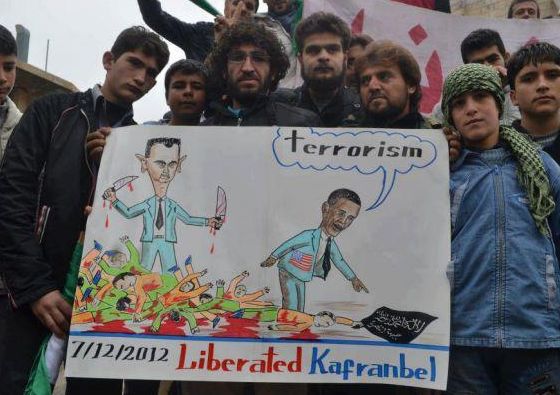
The reaction among anti-Assad Syrians was perhaps best captured by an image that appeared on Facebook shortly after news of the planned designation broke last week. In the picture, residents of the northwestern town of Kafr Anbel hold up a poster showing Obama pointing accusingly toward a flag associated with Jabhat al-Nusra, saying “Terrorism.” Behind the U.S. president, however, is Syrian President Bashar al-Assad standing triumphant on a pile of murdered Syrian civilians.
The image reflects the reality that the Syrian opposition simply does not view Jabhat al-Nusra as the primary threat to the country — that designation still belongs to Assad’s murderous army. Nor is it lost on Syrians that the Obama administration has provided scant military assistance in their efforts to topple the regime — but is now singling out a rebel group that has become perhaps their revolution’s most effective fighting force. This is a view that seems to extend well beyond Jabhat al-Nusra’s ideological milieu: None of the individuals in the Kafr Anbel picture, for example, look like Islamists or Salafis. [Continue reading…]
Lindsey Hilsum writes: They’re happy, but they’re not happy. Pleased that President Obama announced last night that the US recognises the new Syrian opposition coalition as the “legitimate representative of the Syrian people.” Unhappy that one of the fiercest fighting forces on the ground, Jabhat al-Nusra, has been designated by the USA as a terrorist group.
Here in Marrakech, where the international Friends of Syria group is meeting, the Syrian National Coalition, which formed last month, is trying to re-present itself as a government in waiting, and a civilian authority which guides the newly formed High Military Command of rebel fighters.
To them it is President Bashar al-Assad’s forces that are the terrorists, not the jihadi groups fighting alongside the Free Syrian Army to overthrow him.
“There is nothing wrong with fighting in the name of Islam,” said the coalition leader, Ahmed Moaz al-Khatib, a moderate imam, in his speech to assembled ministers and diplomats. He requested the Americans to reconsider their decision.
“We will work with everybody on the ground who has an agenda which includes ending the suffering of the Syrian people,” said Yaser Tabbara, a coalition spokesman. “If al-Nusra is on the same page, they will be dealt with using dialogue and containment.”
In other words, you Americans can call them terrorists if you like but they’re more useful to us than you are. The Americans are not giving the Syrian opposition weapons, while al-Nusra are fighting on the same side.
The New York Times reports: President Obama said Tuesday that the United States would formally recognize a coalition of Syrian opposition groups as that country’s legitimate representative, intensifying the pressure on President Bashar al-Assad to give up his bloody struggle to stay in power.
Mr. Obama’s announcement, in an interview with Barbara Walters of ABC News on the eve of a meeting in Morocco of the Syrian opposition leaders and their supporters, was widely expected. But it marks a new phase of American engagement in a bitter, nearly two-year-long conflict that has claimed at least 40,000 lives, threatened to destabilize the region, and defied all outside attempts to end it.
The announcement puts Washington’s political imprimatur on a once-disparate band of opposition groups, which have coalesced, under pressure from the United States and its allies, to develop what American officials say is a credible transitional plan to govern Syria if Mr. Assad is forced out.
Moreover, it draws an even sharper line between those elements of the opposition that the United States champions and those it rejects. The Obama administration coupled its recognition with the designation hours earlier of a militant Syrian rebel group, Al Nusra Front, as a foreign terrorist organization, affiliated with Al Qaeda.
Human Rights Watch: The Syrian military has used air-delivered incendiary bombs in at least four locations across Syria since mid-November2012, Human Rights Watch said today. The conclusion is based on interviews with four witnesses and multiple videos analyzed by Human Rights Watch.
The Syrian military should cease its use of incendiary weapons immediately, Human Rights Watch said. A total of 106 nations have prohibited the use of air-delivered incendiary weapons, which cause serious burns, in populated areas, but Syria has not banned the weapons.
“We’re disturbed that Syria has apparently begun using incendiary munitions, as these weapons cause especially cruel civilian suffering and extensive property destruction when used in populated areas,” said Steve Goose, Arms division director at Human Rights Watch. “Syria should stop using incendiary weapons in acknowledgment of the devastating harm this weapon causes.”
Incendiary weapons can contain any number of flammable substances, including napalm, thermite, or white phosphorus and are designed to set fire to objects or to cause burn injuries. They are not chemical weapons, which kill and incapacitate by the toxic properties of the chemicals released.
AFP reports: The European Union, winners of this year’s Nobel Peace Prize, said at the Oslo award ceremony Monday that Syria was “a stain” on the world’s conscience.
“Let me say it from here today,” said European Commission president Jose Manuel Barroso. “The current situation in Syria is a stain on the world’s conscience and the international community has a moral duty to address it.”
Barroso said that on international human rights day, the thoughts of the 27-nation bloc were with those “all over the world who put their lives at risk to defend the values that we cherish.”
At talks in Brussels on Monday, EU foreign ministers were discussing the situation in Syria, where heavy fighting was continuing in a 21-month conflict against the regime of President Bashar al-Assad.
How much influence does Washington have over the war in Syria? Somewhere between little and none.
How is that evident?
Look at the efforts to marginalize Jabhat al-Nusra, the militant group commonly described as an affiliate of al Qaeda in Iraq.
The State Department is considering designating the group as a terrorist organization and this has brought a swift response from Syria: 83 battalions of rebel fighters have issued a statement expressing solidarity with Al Nusra (h/t Joshua Landis) and told the Americans to mind their own business.
Washington still seems to be populated by puppet masters who imagine they can choreograph a process through which “moderates” are peeled away from “extremists”. What seems to have escaped the attention of these puppeteers is that their puppets do not actually have strings attached. They operate with their own free will.
As the United States pushes the Syrian opposition to organize a viable alternative government, it plans to blacklist the Nusra Front as a terrorist organization, making it illegal for Americans to have financial dealings with the group and most likely prompting similar sanctions from Europe. The hope is to remove one of the biggest obstacles to increasing Western support for the rebellion: the fear that money and arms could flow to a jihadi group that could further destabilize Syria and harm Western interests.
When rebel commanders met Friday in Turkey to form a unified command structure at the behest of the United States and its allies, jihadi groups were not invited.
The Nusra Front’s ally, Al Qaeda in Iraq, is the Sunni insurgent group that killed numerous American troops in Iraq and sowed widespread sectarian strife with suicide bombings against Shiites and other religious and ideological opponents. The Iraqi group played an active role in founding the Nusra Front and provides it with money, expertise and fighters, said Maj. Faisal al-Issawi, an Iraqi security official who tracks jihadi activities in Iraq’s Anbar Province.
But blacklisting the Nusra Front could backfire. It would pit the United States against some of the best fighters in the insurgency that it aims to support. While some Syrian rebels fear the group’s growing power, others work closely with it and admire it — or, at least, its military achievements — and are loath to end their cooperation.
Leaders of the Free Syrian Army, the loose-knit rebel umbrella group that the United States seeks to bolster, expressed exasperation that the United States, which has refused to provide weapons throughout the conflict that has killed more than 40,000 people, is now opposing a group they see as a vital ally.
The Nusra Front “defends civilians in Syria, whereas America didn’t do anything,” said Mosaab Abu Qatada, a rebel spokesman. “They stand by and watch; they look at the blood and the crimes and brag. Then they say that Nusra Front are terrorists.”
He added, “America just wants a pretext to intervene in Syrian affairs after the revolution.”
The United States has been reluctant to supply weapons to rebels that could end up in the hands of anti-Western jihadis, as did weapons that Qatar supplied to Libyan rebels with American approval. Critics of the Obama administration’s Syria policy counter that its failure to support the rebels helped create the opening that Islamic militants have seized in Syria.
The Nusra Front’s appeals to Syrian fighters seem to be working.
At a recent meeting in Damascus, Abu Hussein al-Afghani, a veteran of insurgencies in Afghanistan, Iraq and Libya, addressed frustrated young rebels. They lacked money, weapons and training, so they listened attentively.
He told them he was a leader of Al Qaeda in Iraq, now working with a Qaeda branch in Syria, and by joining him, they could make their mark. One fighter recalled his resonant question: “Who is hearing your voice today?”
On Friday, demonstrators in several Syrian cities raised banners with slogans like, “No to American intervention, for we are all Jebhat al-Nusra,” referring to the group’s full name, Ansar al-Jebhat al-Nusra li-Ahl al-Sham, or Supporters of the Front for Victory of the People of Syria. One rebel battalion, the Ahrar, or Free Men, asked on its Facebook page why the United States did not blacklist Mr. Assad’s “terrorist” militias.
Another jihadist faction, the Sahaba Army in the Levant, even congratulated the group on the “great honor” of being deemed terrorists by the United States.
Perhaps it’s inaccurate to say that the U.S. has little influence. Better to say, it does indeed exert great influence whose outcome is predictably the opposite of the one intended. In this ‘art’ of reshaping the Middle East, the Obama administration seems no less skilled than the Bush administration.
Reuters reports: Syrian rebel groups have chosen Brigadier Selim Idris, a former officer in President Bashar al-Assad’s army, to head their new Islamist-dominated military command, opposition sources said on Saturday.
Idris, whose home province of Homs has been at the forefront of the Sunni Muslim-led uprising, was elected by 30 military and civilian members of the joint military command after talks attended by Western and Arab security officials in the Turkish city of Antalia.
“Saleh is not ideological, but he has been appointed top aides who are close to Salafist rebels,” one of the sources who has been following the meeting said.
The joint command named Islamist commanders Abdelbasset Tawil from the northern province of Idlib and Abdelqader Saleh from the adjacent province of Aleppo to serve as Idris’s deputies, the source said.
The unified command includes many with ties to the Muslim Brotherhood and to Salafists, who follow a puritanical interpretation of Islam. It excludes the most senior officers who had defected from Assad’s military.
Its composition, estimated to be two-thirds from the Muslim Brotherhood and its allies, reflects the growing strength of Islamist fighters on the ground and resembles that of the civilian opposition leadership coalition created under Western and Arab auspices in Qatar last month.
Absent from the group is Colonel Riad al-Asaad, founder of the Syrian Free Army and Brigadier Mustafa al-Sheikh, a senior officer known for his opposition to the Muslim Brotherhood.
As for the broad Western concern about the danger Western-supplied arms falling into the hands of Al Nusra fighters, the issue is rapidly becoming a moot point. As more and more Syrian military bases are taken over by rebels including Al Nusra, it is the Syrian government’s own arsenal that is becoming instrumental in its downfall. The video below shows the major Regime 111 base west of Aleppo, shortly after it was captured by Al Nusra yesterday. EA WorldView says: “large amounts of equipment, including anti-aircraft weapons, tanks, and artillery pieces, were stored on the base, and with this base captured the insurgents will now be able to focus this weaponry, and their previously captured equipment, on the remaining Assad bases inside and around Aleppo.”
One of the warnings most frequently issued by critics of NATO intervention in Libya was the danger this would pose by setting a precedent: if the West intervenes on behalf of Gaddafi’s opponents, then all across the Arab world, those who rise up to challenge their authoritarian rulers will expect similar outside support. This fear then fed widespread skepticism about the magnitude of the imminent threat to the population in Benghazi. Was an atrocity really about to take place or was this prediction merely being used as a pretext for intervention?
Subsequent events across the region have demonstrated that even if there were some pro-interventionists who imagined that Libya set a precedent, it has instead served if anything as a model not to be followed. Moreover, as warnings about the peril of chemical weapons in Syria are issued, the Obama administration seems to have drawn another lesson from Benghazi: an atrocity can only serve as a justification for military action after it has taken place.
So, those who are alarmed that the specter of WMD is being raised now in order to justify direct military involvement by the U.S. in Syria can take comfort in this thought: the deaths of tens of thousands of Syrians over the last two years has not been enough to draw America into another war. The only thing that would precipitate such involvement would be the deaths of thousands more and even then, these would have to occur over a period of days rather than months.
The lesson from Libya is that the U.S. will not intervene to prevent genocide; it will only intervene after genocide has already occurred. Indeed, the administration’s red line is merely that if Assad uses chemical weapons, there will be “consequences” — no one has actually spelled out what those consequences might be, so even in such an event we should not assume that military action will follow.
In a guest post at Joshua Landis’ Syria Comment, Aron Lund writes: On the WMD discussion in your last post, which I think was spot on: My guess is that what’s happening is that some intelligence agencies are really picking up signals of WMD motion on the ground, but that the dramatic “mixing sarin and putting it into bombs” info is pure propaganda. It seems designed to spook the public, make a case for intervention, and, to some extent, force the hand of the Obama administration.
In the unlikely event that Assad has really started activating his WMD capacity, it could be for a military purpose or as a political signal. There are basically three things he would be interested in: 1) to threaten any would-be intervention force, e.g. Turkey, 2) to remind everyone that he could carry out a lethal last strike on Israel if the regime falls, 3) possibly, to shift chemical material over to allies in Lebanon, to create a kind of second-strike capability if the regime is attacked and unable to respond.
None of these things involve gassing populated areas in Syria with air-dropped bombs. It could perhaps be done, but it would be hugely counter-productive, not least in terms of an international response, and it’s obviously dangerous on a complex close-quarters battlefield such as Syria’s. It is certainly possible that the regime could have an internal meltdown and start making irrational choices, but so far its decision-makers seem to be acting rationally and in their own best interest. Given that, they’re not going to be poison-gassing Aleppo anytime soon. [Continue reading…]
Reporting for the Daily Star, Marlin Dick describes a phone conversation, claimed to be between two Syrian military officers — a conversation that was recorded presumably without the awareness of either party and then posted on YouTube. Dick acknowledges that the authenticity of the recording cannot be verified, but he presents several reasons for concluding that it is not a fake. As for why it was recorded and then ended up on YouTube, he writes:
“The likeliest explanation is that the conversation was recorded, possibly as a part of the regime’s surveillance of its officers, and then seized when Base 46 near Maaret al-Numan was taken by the rebels, several weeks after the Eid.
“Regime positions at Saraqeb were overrun right after the purported conversation took place.
“A Syrian Alawite familiar with military culture described the men’s dialect as impeccable and their conversation as natural.”
The phone conversation described is around 11 minutes long. An army operator makes a brief appearance at the beginning, to put the call through to a Lt. Mohammad.
The two officers then engage in a back-and-forth conversation whose staccato pace signals that they know each other well. Their accents indicate they are Alawites, although that sect is not mentioned, and neither are the civilian casualties, or any political aspects of the war.
The caller passes on holiday greetings for the Eid al-Adha, indicating that the conversation took place at the end of October. He immediately senses that the officer, possibly a relative, is either upset or in pain.
“What’s the matter, you’re not doing well?” the caller asks, generating the weary response: “It was the worst day of my life.”
At first the two avoid discussing the details of battles and other military operations; they complain about the lack of opportunities to make telephone calls using either land lines or cellphones due to poor network coverage.
They move to the news that a friend or acquaintance has been killed in battle; the word “martyred” is used, which is common in Arab armies.
They debate when exactly, and from whom, they heard the news. The two men spend time discussing several such cases of friends lost, and the caller notes sadly how their graduating class is becoming depleted. He goes on to mention how he has now lost two commanding officers, and laughs nervously.
They talk about where mutual acquaintances are posted, and what they know of conditions in these places. In answer to a question, the caller says he is stationed in Maaret al-Numan, probably meaning in or near the largely rebel-held town, while the other man is in Saraqeb, a town in Idlib 30 kilometers to the north.
The caller describes the constant rebel attacks on army checkpoints in the Idlib area and the many regime troops who have been killed.
In response to a question about his duties in Maaret al-Numan, the caller says he commands a unit responsible for guarding a nearby depot in Wadi Daif, the airbase that has been under siege by rebels since October.
“What’s in the depot?” the officer in Saraqeb asks.
“There’s fuel – 5,000 liters of gasoline. Enough to blow Maaret al-Numan and Kafranbel to smithereens,” he says.
“So blow it up, and get out of there,” the officer responds.
The caller is amused by the idea and quickly dismisses it. This doesn’t prevent his friend from repeating the suggestion over the next few minutes, in a tone that manages to be both playful, and serious.
They both complain about the lack of support from other units, the inability to use many roads – “you just get blown up if you do” – and the isolation.
Throughout the rest of the conversation they make several brief references to the state of the war and the regime’s prospects for victory.
The caller talks about being a “strike force” in the area while the second man, who is markedly demoralized, rejects the idea, based on the steady, bloody attrition.
“No … no … we’re not a strike force,” he insists, before asking: “What’s the point of being out here?”
The caller tries repeatedly to boost his friend’s morale but at one point blurts out: “There’s no solution.”
When the caller asks about defections, the demoralized officer’s response is: “No, there haven’t been any defections … there’s just … disgust.”
Neither man presumes to predict how or when the war will end.
The New York Times reports: When President Obama first warned Syria’s leader, President Bashar al-Assad, that even making moves toward using chemical weapons would cross a “red line” that might force the United States to drop its reluctance to intervene in the country’s civil war, Mr. Obama took an expansive view of where he drew that boundary.
“We cannot have a situation where chemical or biological weapons are falling into the hands of the wrong people,” he said at an Aug. 20 news conference. He added: “A red line for us is we start seeing a whole bunch of chemical weapons moving around or being utilized. That would change my calculus.”
But in the past week, amid intelligence reports that some precursor chemicals have been mixed for possible use as weapons, Mr. Obama’s “red line” appears to have shifted. His warning against “moving” weapons has disappeared from his public pronouncements, as well as those of Secretary of State Hillary Rodham Clinton. The new warning is that if Mr. Assad makes use of those weapons, presumably against his own people or his neighbors, he will face unspecified consequences.
It is a veiled threat that Defense Secretary Leon E. Panetta repeated Thursday: “The president of the United States has made very clear that there will be consequences, there will be consequences if the Assad regime makes a terrible mistake by using these chemical weapons on their own people.”
The White House says the president has not changed his position at all — it is all in the definition of the word “moving.”
Tommy Vietor, the spokesman for the National Security Council, said Thursday that “ ‘moving around’ means proliferation,” as in allowing extremist groups like Hezbollah, which has training camps near the weapons sites, to obtain the material.
Whenever the White House needs to make a statement utterly lacking in credibility, they always call on Tommy Vietor — that seems to be his specialty. What has moved around is the administration’s stance and the clarification comes from Panetta.
Obama’s statement in August implied that the U.S. would act to prevent Assad from using chemical weapons. The U.S. position now is that Assad will suffer serious consequences if he uses them — a tacit acknowledgment that the U.S. is not actually capable of preventing these weapons being used.
This website or its third-party tools use cookies, which are necessary to its functioning. By closing this banner, you agree to the use of cookies.