The Associated Press reports: International envoy Kofi Annan said Tuesday that Iran must be “part of the solution” to the bloody crisis in its close ally Syria, and that the Tehran has offered its support to end the conflict.
Annan was in Iran in a bid to salvage his faltering peace plan for the 16-month-old crisis in Syria, which activists say has killed more than 17,000 people. The trip to Tehran comes a day after Annan agreed with Syrian President Bashar Assad on a new framework to stop the violence.
“My presence here proves that I believe Iran can play a positive role and should therefore be a part of the solution in the Syrian crisis,” Annan told reporters in Tehran after meeting with Iranian Foreign Minister Ali Akbar Salehi.
He said that he has “received encouragement and cooperation” from the Iranian government, he said but did not specify what support Tehran has offered.
Category Archives: Syria
Why Russia supports Assad
Ruslan Pukhov writes: Many Russians believe that the collapse of the Assad government would be tantamount to the loss of Russia’s last client and ally in the Middle East and the final elimination of traces of former Soviet prowess there — illusory as those traces may be. They believe that Western intervention in Syria (which Russia cannot counter militarily) would be an intentional profanation of one of the few remaining symbols of Russia’s status as a great world power.
Such attitudes are further buttressed by widespread pessimism about the eventual outcome of the Arab Spring, and the Syrian revolution in particular. Most Russian observers believe that Arab revolutions have completely destabilized the region and cleared the road to power for the Islamists. In Moscow, secular authoritarian governments are seen as the sole realistic alternative to Islamic dominance.
The continuing struggles in Arab countries are seen as a battle by those who wear neckties against those who do not wear them. Russians have long suffered from terrorism and extremism at the hands of Islamists in the northern Caucasus, and they are therefore firmly on the side of those who wear neckties.
To people in Moscow, Mr. Assad appears not so much as “a bad dictator” but as a secular leader struggling with an uprising of Islamist barbarians. The active support from Saudi Arabia, Qatar and Turkey’s Islamist government for rebels in Syria only heightens suspicions in Russia about the Islamist nature of the current opposition in Syria and rebels throughout the Middle East.
Finally, Russians are angry about the West’s propensity for unilateral interventionism — not to mention the blatantly broad interpretation of the resolutions adopted by the United Nations Security Council and the direct violations of those resolutions in Libya.
According to this view, the West, led by America, demonstrated its cynicism, perfidy and a typical policy of double standards. That’s why all the Western moralizing and calls for intervention in Syria are perceived by the Russian public as yet another manifestation of cynical hypocrisy of the worst kind.
There is no doubt that preserving his own power is also on Mr. Putin’s mind as his authoritarian government begins to wobble in the face of growing protests that enjoy political approval and support from the West. He cannot but sympathize with Mr. Assad as a fellow autocratic ruler struggling with outside interference in domestic affairs.
But ideological solidarity is a secondary factor at best. Mr. Putin is capitalizing on traditional Russian suspicions of the West, and his support for Mr. Assad is based on the firm conviction that an Islamist-led revolution in Syria, especially one that receives support through the intervention of Western and Arab states, will seriously harm Russia’s long-term interests.
Why there will be no foreign military intervention in Syria
John Hubbel Weiss writes: Despite its rhetoric condemning the Syrian regime, there is … reason to doubt that Washington really wants Assad to fall. Assad’s regime is “the devil we know,” and one with demonstrated weaknesses: Witness its expulsion from Lebanon and its defeats by Israel. At the same time, it has a professional and mostly loyal army and an identifiable and mostly loyal power base in one-fifth of the population: the Alawite and Christian minorities.
The Free Syrian Army and other adversaries of Assad are far less professional and unified, with a possibly far more volatile power base, the country’s Sunni Muslim majority.
Nor does the American and UN response to the Sudanese government’s atrocities give Syrians cause to hope for a rescue. Senators Lieberman and McCain have called for giving military support to the Syrian rebels. Despite the fact that in Darfur alone the Sudanese government under Omar al-Bashir has caused the death of nearly a 100 times more civilians and created 80 times more refugees than Assad has done in Syria, the United States has never seen fit to arm Darfur rebels.
Elie Wiesel has called for Assad to be charged with crimes against humanity. Although such a charge would serve as a gesture of moral concern and solidarity with the Syrian people, it would probably not deter the Syrian president from continuing his attacks. After all, an International Criminal Court indictment for genocide has not caused any change in the intensity of Sudanese president Mr. Bashir’s 22-year-long string of atrocities against the people of Darfur, the Nuba Mountains, Abyei, the South, and elsewhere in Sudan.
It is more than likely, therefore, that an assessment of American and international policy toward intervention in the Libyan and Sudanese cases will do little to shake the Syrian government’s confidence that it can continue down a path of the most ruthless repression.
The Syrian people themselves, with an enduring courage that has prompted a growing but still small number of high Syrian officers to abandon the regime, are the only ones who will convince Assad it is time to choose a less murderous path.
Syria, jihad and the boys from Tunisia’s Ben Guerdane
The National reports: Khared Zawi is finishing his restaurant lunch and watching television, transfixed as the newsreader’s voice reports atrocious violence in Syria over amateur video of explosions and corpses.
“It’s not acceptable,” says the young Tunisian from behind his wispy beard. “No human on this planet will accept it, and no Arab.”
In crushing a nationwide uprising, Bashar Al Assad has insulted Islam by destroying mosques while followers of the Syrian president’s Alawite branch of Shia Islam have killed Sunni Muslims, Khared says. “I’m supporting the guys fighting Bashar.”
During the 16 months in which peaceful pro-democracy protests became a bloody and increasingly sectarian conflict between government forces and rebels, Syria has become a focal point of outrage across the Arab world, and a trickle of young men embracing militant Sunni Islam have gone to fight there.
As many as 12 of them may be from this dusty Tunisian border town. Their families woke up one day to find a son or brother mysteriously vanished. Some of the missing loved ones disclosed their destination with a single telephone call to say they were in Turkey and heading for Syria. In at least one case, a terse phone call from a stranger said the young man was dead.
Bashar al Assad’s war on terrorism
Most estimates agree that more than 15,000 Syrians have been killed since the uprising began. Whatever the make-up of the armed opposition, everyone agrees that the only forces in Syria with tanks and heavy artillery belong to the Syrian army. Damage to buildings in many cities caused by shelling by these forces has been widely seen. Yet, President Bashar al-Assad now claims that the majority of the casualties in the conflict are government supporters who have been killed by “terrorists.”
Here’s my question for anyone who anyone who casts a critical eye on the global war on terrorism: why would you not be even more skeptical about Syria’s war on terrorism?
Robert Mackey has posted an interview of Assad conducted in English by Jürgen Todenhöfer, a former member of the German Parliament who is an outspoken critic of Western foreign policy in the Muslim world.
Mr. Todenhöfer also interviewed Mr. Assad during a previous reporting trip to Syria, late last year. After that visit, the German author wrote in a report for Frankfurter Allgemeine Zeitung: “Paradoxically, it is Bashar al-Assad who could most likely achieve a peaceful transition toward democracy, because he still has the power and still holds the authority among the majority of the population.”
In that same article, Mr. Todenhöfer also criticized foreign media reports on Syria and the armed rebels. “According to my personal experiences in Damascus, Dara’a, Homs and Hama,” he wrote, “at least half of the reports on Syria are simply false – almost like before the Iraq war.” He added that the “guerrilla commandos, whose methods differ little from those of the state’s security services,” have “robbed the revolution of its innocence and also harmed the peaceful demonstrators who have the historical merit of having initiated the process of democratization.”
Mr. Assad’s comments in the new interview included the accusation that Syrian rebels — whom he described as “an amalgam of Al Qaeda” and drug-smuggling criminals — were responsible for the recent massacre in Houla. He also claimed that the “armed gangs” who carried out the killings had worn government uniforms to frame forces loyal to him.
Meanwhile, The Guardian reports: Kofi Annan has declared his third round of talks with Bashar al-Assad as “constructive” and suggested his stillborn plan to stop the violence in Syria may yet be revived.
The UN special envoy to Syria said on Monday that a fresh approach to end the conflict would be put to the Syrian opposition, but offered no further details.
The centrepiece of the former UN chief’s plan announced in April was a ceasefire by both sides that never took hold. Instead, the violence in Syria has escalated, with daily death tolls over the past two months approaching those seen during the bloodiest days of Iraq’s civil war six years ago.
Before Monday’s summit, the Syrian president described Annan’s plan as good. After the two-hour meeting, Assad’s aides couched the the talks as “constructive and good”.
Iran warns of regional ‘catastrophe’ if no political solution is found to Syria crisis
The Associated Press reports: An Iranian official has warned of a “catastrophe” in the Middle East if no political solution is found to the 16-month crisis in Syria.
Deputy Foreign Minister Hossein Amir Abdollahian also says Syria has a strong army and is able to defend itself from attack alone without Iran’s help.
Iran is Syria’s closest ally and has stood by President Bashar Assad’s regime through the uprising against his rule.
Abdollahian spoke at a press conference in Amman, Jordan, Sunday.
His comments follow an acknowledgement by special envoy Kofi Annan that the international community’s efforts to find a political solution to the escalating violence in Syria have failed.
Reuters reports: Syria’s navy fired live missiles from ships and helicopters over the weekend, state media said on Sunday, in an exercise aiming at showcasing its ability to “defend Syria’s shores against any possible aggression”.
Syrian television aired video of a variety of missiles being fired from launchers on land and from ships and showed the Syrian Defence Minister Dawud Abdallah Rahijia in attendance.
“Naval Forces conducted an operational live fire exercise on Saturday, using missiles launched from the sea and coast, helicopters and missile boats, simulating a scenario of repelling a sudden attack from the sea,” Syrian news agency SANA said, adding manoeuvres would continue for several days.
Opposition figures have been calling for a no-fly zone and NATO strikes against Syrian forces, similar to those carried out in Libya last year which enabled rebel ground forces to end the rule of Muammar Gaddafi.
But while President Bashar al-Assad has faced sanctions and international condemnation over his crackdown on dissent which has left thousands dead, major Western and Arab powers have shied away from the idea of direct military action.
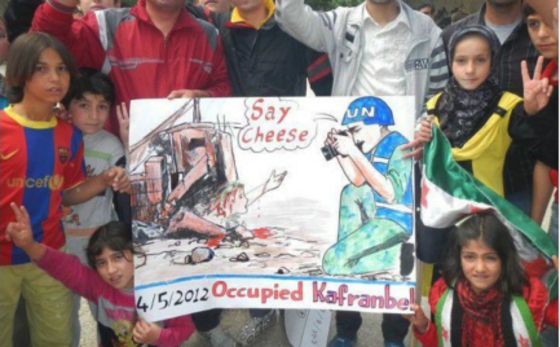
The banners from Kafranbel, a town in northwestern Syria

Foreign Policy: A town in northwestern Syria has become the creative center of the revolt against President Bashar al-Assad. Since the beginning of the uprising, the residents of Kafr Anbel have drawn signs that skewer the Assad regime and express outrage that the world has not done more to stop the killing in Syria.
The signs come in two basic varieties. Some are cartoons, often drawing their inspiration from Western movies or TV shows, which lampoon the Syrian government and its allies, notably Russian President Vladimir Putin. Others are straightforward, text-only banners that call for NATO intervention in Syria or arming the rebel Free Syrian Army (FSA). Many of the signs are written in English.
Raed Fares, an activist in Kafr Anbel, explained to FP that the town’s residents chose to draw in English, rather than Arabic, explicitly to reach an international audience. “It’s very important to send our message to all the world,” he said. “And English is the public language.”
Syria fighting widespread, spills into Lebanon
Reuters reports: Syria’s conflict spilled further into Lebanon on Saturday when mortar fire from government forces crashed into villages in the north, killing two women and a man after rebels crossed the border for refuge, residents said.
In contrast with Turkey, which openly harbors rebels fighting to topple Syrian President Bashar al-Assad, Lebanon was not expected to respond militarily and has played down the effect of regular clashes along the frontier.
But rebels have used north Lebanon as a base and Assad’s forces have at times bombed villages and even crossed the border in pursuit of militants, threatening to inflame tensions in Lebanon given a long history of Syrian domination there.
Residents of Lebanon’s Wadi Khaled region said several mortar bombs hit farm buildings five to 20 km (3 to 12 miles) from the border at around 2 a.m. At midday villagers reported more explosions and said they heard gunfire close to the border.
In the village of al-Mahatta, a house was destroyed, killing a 16-year-old girl and wounding a two-year old and a four-year old, family members told Reuters. A 25-year-old woman and a man were killed in nearby villages, residents said.
The Lebanese army issued a brief statement about the incident. There was no immediate response from the prime minister or the foreign ministry, both of whom have expressed fears that Lebanon could be dragged into the conflict.
Video: Palestinians from Syria flee to Jordan
Syria: How important is the Tlass defection?
Joshua Landis answers this question: Absolutely important – The Tlass family has been at the heart of the regime from the beginning. They are the keystone of the Sunni-Alawi alliance that has cemented the regime for 4 decades.
Abdul Halim Khaddam and the Tlass family were the two leading Sunni families in the state from the beginning, when Hafiz al-Assad, the architect of the regime, built the structures that have endured since. Bashar preserved the blueprint drawn up by his father.
Vice President Khaddam defected in 2005. His departure sent a shudder through the regime, but this time is different. The Tlas defection sends the sign that the regime is done for. No longer is this uprising merely about angry young men in the countryside. It has reached to the very top. The elite Sunnis are looking for the exit door – but it will be hard to replicate this defection. Manaf got the golden parachute into Paris. His family is all out – his father, brother, wife and children. He planned this carefully. He has the power and the means.
Other generals have no bodyguards, no visas, no money…. It will be a long and painful process for most to defect.
What is more the Alawite officers have their backs to the wall.
The regime will not just collapse. This is not “The Tipping Point” but it is very significant for morale. It sends a message: the game is up.
A statement by General Manaf Tlass: As issued by international press and media, I have just left Syria.
With the will to remain faithful to my military principles and loving feelings towards Syria, I have always tried to fulfill my duty with rightness, in order to preserve unity for Syria and its people.
I did not joined the armed forces to see this army harm its own people, without giving systematically a chance to political solutions.
Thus, because I was in complete opposition with the unjustified violence and crimes committed by Assad’s regime in the past months, I was progressively dismissed from my place of duty in the armed forces.
Today, I call for all my comrades in armed forces, whatever their rank in the hierarchy, who are dragged into this fight against their Syrian fellows and against their own ideals, to end supporting this regime.
I recognize the legitimacy of the fight of the opposition members to the regime, particularly the ones on the ground. In this respect, let me be grateful to those who made it possible for me to leave the Syrian territory where my own person and family were threatened.
In the coming days, I will make a statement on my motives and the possibilities that the future offers me.
Long life to Syria!
General Manaf Tlas
WikiLeaks: PR firm tried to buff Syria’s image after crackdown
The Los Angeles Times reports: A New York-based public relations firm tried to help the Syrian government “brand” its reforms last year as media reported its crackdown on protesters, according to an email released Friday by WikiLeaks.
The firm, Brown Lloyd James, had earlier helped arrange a rosy profile of Syrian first lady Asma Assad in Vogue magazine that praised her as “the freshest and most magnetic of first ladies.” It had been paid $5,000 a month for that work, according to a Foreign Agents Registration Act document.
Months later, in a memo last May to one of her aides, the firm advised Syria that it needed to buff up its image abroad as decidedly unflattering stories of mass arrests and alleged killings spread in the press.
“Mass arrests of activists, protesters and in some cases males older than 15 have skyrocketed, with thousands held in detention centers where human rights activists say they have been subjected to physical and mental abuse,” the Los Angeles Times reported eight days before the firm sent its memo. A later article said dissidents claimed a mass grave filled with slain protesters had been found in the south.
The public relations firm said Syria suffered from “an imbalance in its communications approach” that had failed to reassure the Syrian people and outsiders that it was genuinely pursuing reform.
“Syria seems to be communicating with two hands. One is offering reform and the other, rule of law. Rule of law is a fist. Reform is an open hand. Right now the fist appears to the outside world, and probably to many Syrians, as though it is ten times bigger than the outstretched palm,” the firm wrote in its email, which WikiLeaks dated to May 19, 2011. “They must be brought into better balance.”
Brown Lloyd James added that the Obama administration had not demanded regime change and clearly wanted the leadership in Syria to survive, saying “criticism has been relatively muted.” It warned, however, that the U.S. tone had grown harsher in recent weeks and could be nearing a tipping point.
Manaf Tlas: Syrian regime ‘taking country to Hell’
BBC News reports: Sources close to Brigadier General Manaf Tlas, who met him days before he deserted, told the BBC he was very angry about what was happening in Syria and accused the regime of “taking the country to Hell”.
“If I were him, I would have done an [former Turkish leader and political reformer Kamal] Ataturk or resigned the second month the uprising began,” the sources quoted him saying of Bashar al-Assad, before he left for Turkey.
A commander in the elite Republican Guard, Gen Tlas is the highest ranking official – and the first from President Assad’s inner circle – to desert since the uprising began in March 2011.
Gen Tlas had been under partial house arrest since May 2011 because he opposed the regime’s response to the uprising.
He was the first government official to meet the opposition, back in March 2011, seeking to open a dialogue and find a political solution to the crisis.
He was also involved in reconciliation efforts in rural Damascus – mainly in Douma and Daraya and Tal – as well as in Homs and his home town Rastan.
Brig Gen Tlas met residents of several towns and helped obtain the release of many of their prisoners, even taking families from Douma to meet President Assad, who promised them a peaceful solution.
But Rastan was the turning-point for Manaf Tlas.
In May 2011, power and mobile networks were cut off in Rastan in preparation for an attack on the city by the official forces. Manaf Tlas ordered the services to be restored and promised the protesters they had the right to demonstrate peacefully.
Celebrating this, protesters chanted his name, which was enough to anger Maher al-Assad, Bashar’s brother and head of the Republican Guard, who ordered Manaf Tlas to stay at home.
Gen Tlas continued going to his base but no longer with any power to issue orders.
Hours after his desertion was announced, his house was ransacked by a mob, under the watch of the army, eyewitnesses said.
The BBC has spoken to members of Gen Tlas’ family, but they refused to comment.
His wife, Thala Khair, and other family members, are in Paris.
Many people within the opposition see Manaf Tlas as someone who has not been involved in bloodshed and believe he could play an important role in a transitional phase in rebuilding the military establishment.
Members of the Free Syrian Army (FSA) who defected from the military, are said to hold hopes for Gen Tlas as a reputed army figure.
Leading Syrian general has ‘defected and is on his way to Paris’
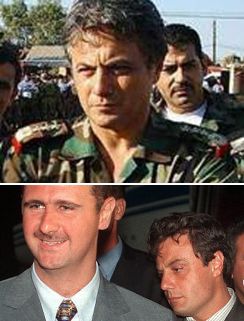
The New York Times reports: Opponents of President Bashar al-Assad of Syria met with their international sponsors here on Friday to intensify pressure for his removal, buoyed by word that Brig. Gen. Manaf Tlass, a commander in the elite Republican Guard, close friend of the president and a member of the Damascus aristocracy, had defected and fled the country.Brig. Gen. Manaf Tlass
French Foreign Minister Laurent Fabius told the meeting that a “senior official” and commander of the Republican Guard had “defected and is on his way to Paris.” Ministry officials confirmed that Mr. Fabius was referring to General Tlass but did not say whether the Syrian general would join the talks.
[…]
Much attention at the meeting on Friday seemed certain to be devoted to General Tlass’s intentions.Within the Damascus leadership, “Manaf is one of the regime’s main figures,” said Bashar al-Heraki, a member of the Syrian National Council, the umbrella political group in exile. “It is a negative sign for this regime,” Mr. Heraki said. “It has started to lose control.”
As one of the government’s most prominent Sunni Muslims, the elder General Tlass helped to disguise the fact that Hafez al-Assad relied on an inner circle composed mostly of his own minority Alawite sect.
The elder General Tlass was also said to have played a key role in the anointment of Bashar al-Assad as his father’s heir after his firstborn son, Basil, died at the wheel of his Mercedes in 1994.
At the official memorial service for Basil, the elder General Tlass was quoted as saying that he could see the light of Basil’s eyes shining from Bashar’s. Bashar soon became the heir apparent, ending his medical career and enrolling for military training, where the elder General Tlass promoted him and where his elevation into the officer corps coincided with that of Manaf’s.
In the second generation of the elite, families with two sons often divided their roles, with one going into business and the other joining the armed forces. It was true of Bashar’s first cousins, the Makhloufs, and it was true for the Tlass family.
Firas Tlass became a business tycoon, while Manaf — a charismatic figure — was promoted to a one-star general in the Republican Guards, one of the core units used in attempts to crush the current uprising. Maher al-Assad, the president’s younger brother, heads the praetorian force where Manaf served.
The president and Manaf were sometimes seen eating out together in Damascus.
“He’s a close friend to Bashar,” Mr. Heraki said. “So it is not only a strong strike against the regime, but the strongest message yet to Bashar that he is no longer safe, and a message to other officers thinking about defecting.”
Other opposition figures were less charitable, suggesting that General Tlass fled only to try to save the family’s substantial fortune as the government collapses.
The Tlass family came from Rastan, a predominantly Sunni Muslim city near Homs that has been under assault as a center for defecting officers. As the siege intensified, the Tlass family gradually left the country. Mustafa Tlass was said to have left for Paris in March, citing the need to seek medical treatment, while Firas was believed to be pursuing his business interests from the United Arab Emirates. He has kept a low profile, declining interview requests.
Manaf was believed to have at least one son enrolled at the American University of Beirut, where his wife also lived, and the reported defection came after the school year had ended.
For one top Syrian defector, a path less traveled
The Wall Street Journal reports: On his final day at Syria’s oil ministry in Damascus, Abdo Husameddin tried to avoid raising suspicions: He stayed to sign off on some paperwork, he said, chatted with the oil minister and left at 5 p.m.
That March evening, the deputy oil minister started a three-day covert journey to Turkey, hosted at safehouses across the country and guarded by fighters opposed to President Bashar al-Assad. A year into the country’s uprising, he became the highest-ranking official to defect from the Syrian government.
In the weeks that followed, all of Mr. Husameddin’s assets and bank accounts in Syria were frozen, he said in an interview with The Wall Street Journal. Months later, Turkish security agents still sometimes escort him around his new host country, warning him that even abroad, he faces a threat from Syrian intelligence agencies, he said.
Syria’s conflict has left up to 15,000 people dead, and has in recent months devolved into what some international diplomats have characterized as a civil war. Soldiers have defected at an increasing pace, including a Syrian air force pilot who flew his jet to Jordan last week. The government typically doesn’t comment on defections but called the air-force pilot who defected to Jordan a “traitor.”
On Thursday, Syrian media said a brigadier general from a family with close ties to President Assad had fled to Turkey in what would be the conflict’s highest-level military defection.
But far fewer of the regime’s high civilian officials have abandoned the regime. That fact has complicated efforts by the Syrian opposition to persuade world powers that it has legitimate leaders in line should President Assad fall. By contrast, in Libya’s recent conflict, a procession of high-profile ministry and diplomatic defectors provided the foundation of the opposition to Moammar Gadhafi and later of Libya’s transitional government.
President Assad’s top security, ministry and military officials have proven fiercely loyal, and many come from the president’s Alawite minority. But the 1.2 million civil servants in Syria’s state institutions are, like broader society, polarized between pro- and anti-regime Syrians, according to Mr. Husameddin and current and former Syrian officials who corroborated much of his account of the dynamics at the country’s state offices.
Mr. Husameddin attributes the lack of high-level defections largely to stepped-up security measures, a characterization echoed by other, lower-level state employees who have turned against the Assad regime. Safe passage out of the country is becoming increasingly tricky, Mr. Husameddin said, and there are few incentives to risk uprooting families and livelihoods to join a fragmented opposition.
Many state employees in Syria have turned against the regime but are staying in their jobs, he added, saying they are “defecting silently.”
“When the regime falls, we need these people,” he said. “We don’t want the state to collapse. In fact, they will be beneficial in the next phase.”
Regime officials say the lack of high-profile civilian defections reflects the loyalty of government workers and their determination to defeat what they see as a terrorist insurgency. The government hasn’t commented on Mr. Husameddin’s defection. The oil ministry didn’t return requests to comment.
Regional powers have even raised the prospect of offering tens of millions of dollars to woo potential defectors from government, said two people familiar with such offers. “A lot of money is being paid to ply people away,” said one of these people. “But there’s also the thinking that some people should be kept in place for the day after.” [Continue reading…]

Syrian regime’s top Sunni defects — General Manaf Mustafa Tlass flees to Turkey
Joshua Landis writes: General Manaf Tlass, one of Syria’s top Sunni military figures from the inner-circle of Bashar al-Assad, has defected.
For 16 months the opposition has been complaining that elite Sunnis have not defected. That complaint can now, officially, be put to rest if the stories of Manaf’s flight prove to be true. In March it was rumored that he had led with his father and brother, but those stories were false.
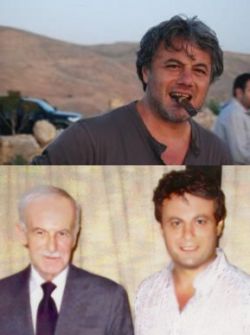
Manaf Tlass, the son of ex-Defense Minister (1972 – 12 May 2004), Mustafa Tlass, has fled the country. Mustafa Tlass was instrumental in smoothing the way for Bashar to assume power after the death of his father.Manaf Tlass with cigar and with Hafez al-Assad
When Hafez al-Assad died in June 2000, his son Bashar was immediately promoted in military rank by Defense Minister Mustafa Tlass. He was also made secretary-general of the Baath Party whereas Manaf became a member of the Party’s Central Committee and an officer in the Republican Guard.
On Tuesday, all of Syria was buzzing that Manaf had defected but there was no confirmation. His Honda had supposedly turned up in the Rukn ad-Din neighborhood of Damascus, but he was no where to be found. Rumors of his possible defection were wide-spread on Twitter.
أكد مصدر أمني رفيع المستوى “لسيرياستيبس” فرار العميد مناف مصطفى طلاس إلى تركيا..
“A highly placed source in intelligence has confirmed that General Manaf Mustafa Tlass has fled to Turkey.”Manaf Tlass’s father and brother, Firas who is a leading businessman, are believed to be out of the country. The father had gone to Paris on the pretext of getting medical attention. Firas is said to be in Dubai. It is not clear where the women and children of his family are.
Manaf Tlass was a close confidant of Bashar from his earliest days and part of his inner circle or “shille”, which included people, such as his cousins Rami and Hafiz Makhlouf, Mudar al-Assad (son of Rifaat), Nader Qala’i (ex-CEO of Syriatel and business partner to Rami) Yazan Aslan (son of Ali Aslan, Chief of Staff)
Manaf is as handsome as a movie star and carried a lot of authority. He was a true military guy and had spent his entire life in the military, unlike Bashar. People close to him say that when he walked into a room, all eyes turned to him. Not only did women find him attractive, but men did as well. He carried himself with an air of self-confidence and authority. He is smart, dashing and cunning.
The word is that Manaf had been told to solve the Harasta and Duma problems (the growing uprising on the outskirts of Damascus). He did a good job by negotiating with the opposition leaders in both suburbs, agreeing that both government forces and opposition would pull back. The Alawi leadership said “no, that is not how we are going to do this.” They pushed him aside and came down like a ton of bricks on the opposition in both neighborhoods, in an effort to assert state authority and crush the uprising through military means.
Manaf supported a policy of negotiation, flexibility and compromise. He was overruled by the military leadership and has since looked for a way out. [Continue reading…]
Meanwhile, today Wikileaks released 25 emails from Syria (more to come).
Turkish firefighters battle blazes ‘deliberately started’ on Syria border
The Associated Press reports: Turkish firefighters are battling blazes along the border with Syria in areas where thousands of Syrians have crossed to flee the fighting in their country.
Mehmet Harbi, a forestry official, claimed the fires were “deliberately started” at four different points on the Syrian side of the border and spread to Turkey because of strong winds. Turkey’s state-run TRT television said Syrian forces were believed to have started the fires to deny shelter to rebels along the border area. Harbi and TRT provided no evidence to substantiate their claims.
More than 35,000 Syrians are living in refugee camps on the Turkish side of the border that were opened to care for the many people fleeing Syria’s unrest. Sporadic clashes between Syrian forces and activists also have occurred on the Syrian side of the border.
Turkey finds bodies of pilots shot down by Syria
The Wall Street Journal reports: Turkey on Wednesday found the bodies of two pilots shot down by Syria last month during a contested flight that pushed the neighbors’ relations to a new low almost a year after Ankara threw its weight behind the opposition to oust President Bashar al-Assad from power.
The military General Staff in Ankara said on Wednesday that it was working to remove the bodies of Captain Gokhan Ertan and Lieutenant Hasan Hüseyin Aksoy from the Mediterranean. Turkey didn’t identify the location of the dead pilots or provide any additional details. The armed forces weren’t immediately able to provide comment.
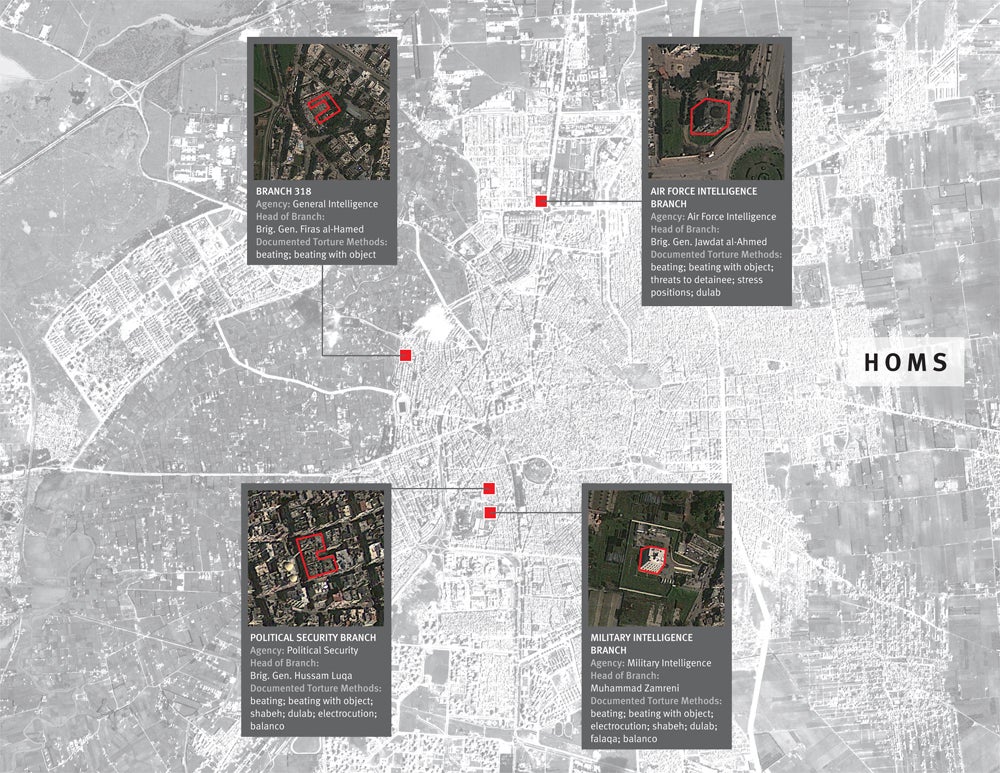
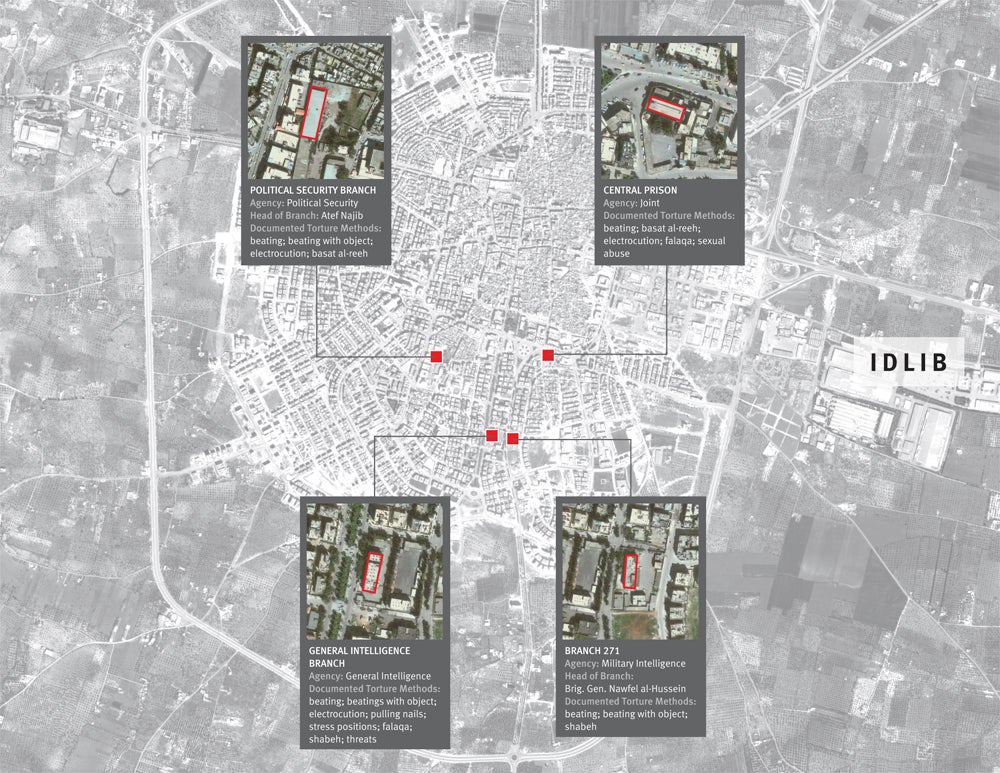
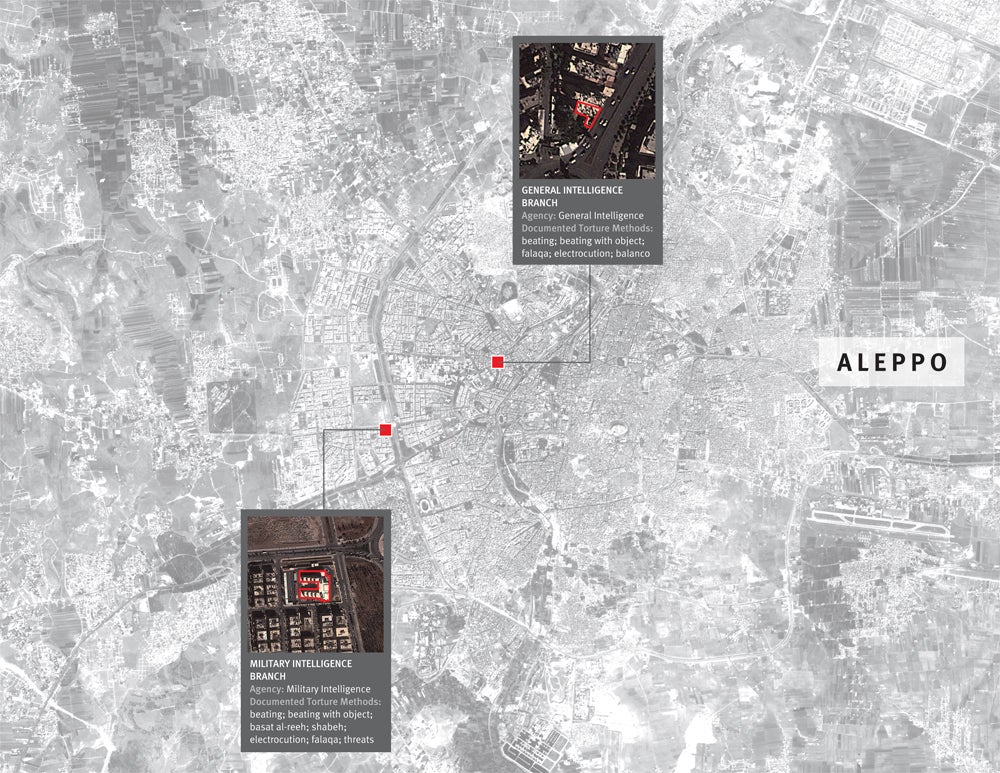
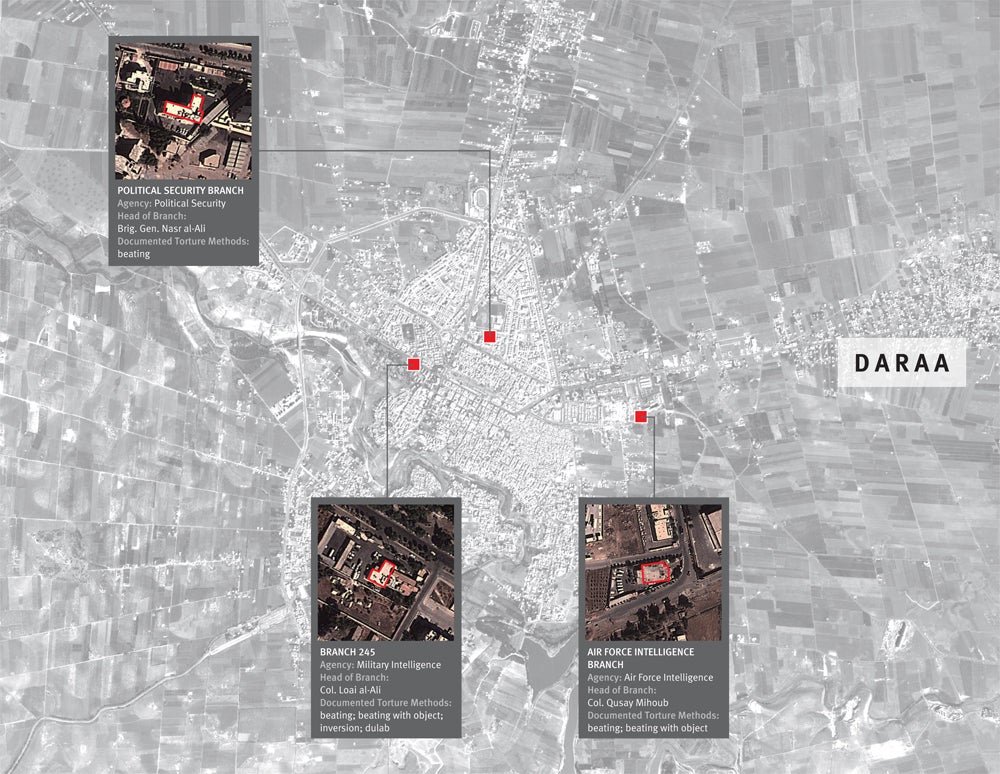
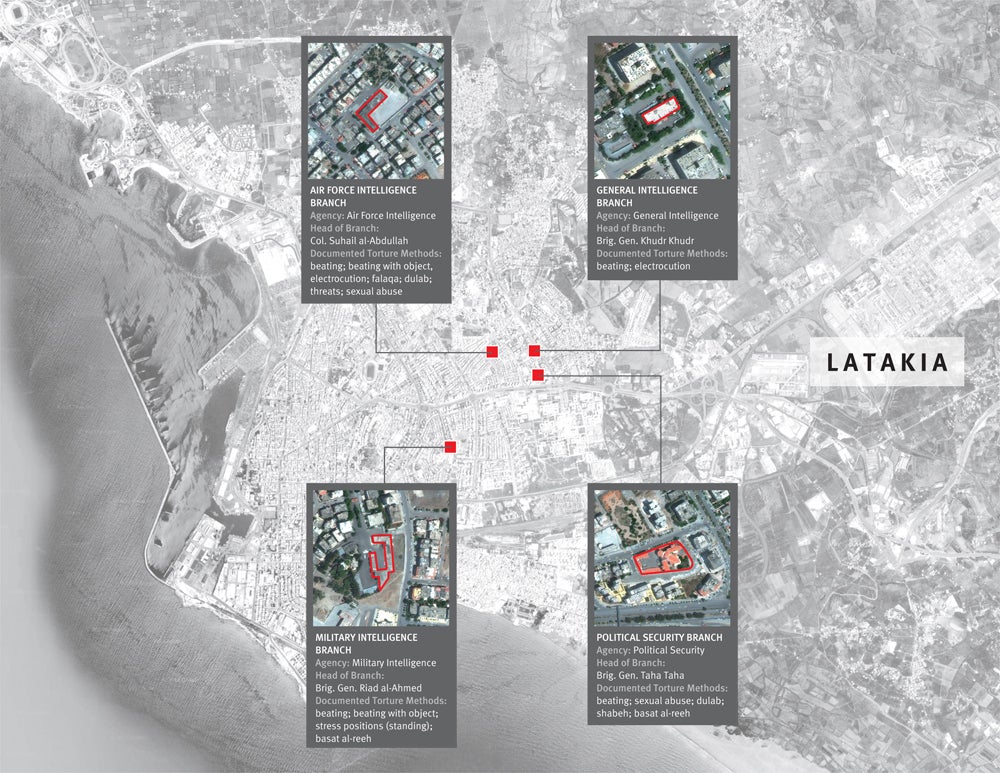
Syria: Torture centers revealed by Human Rights Watch
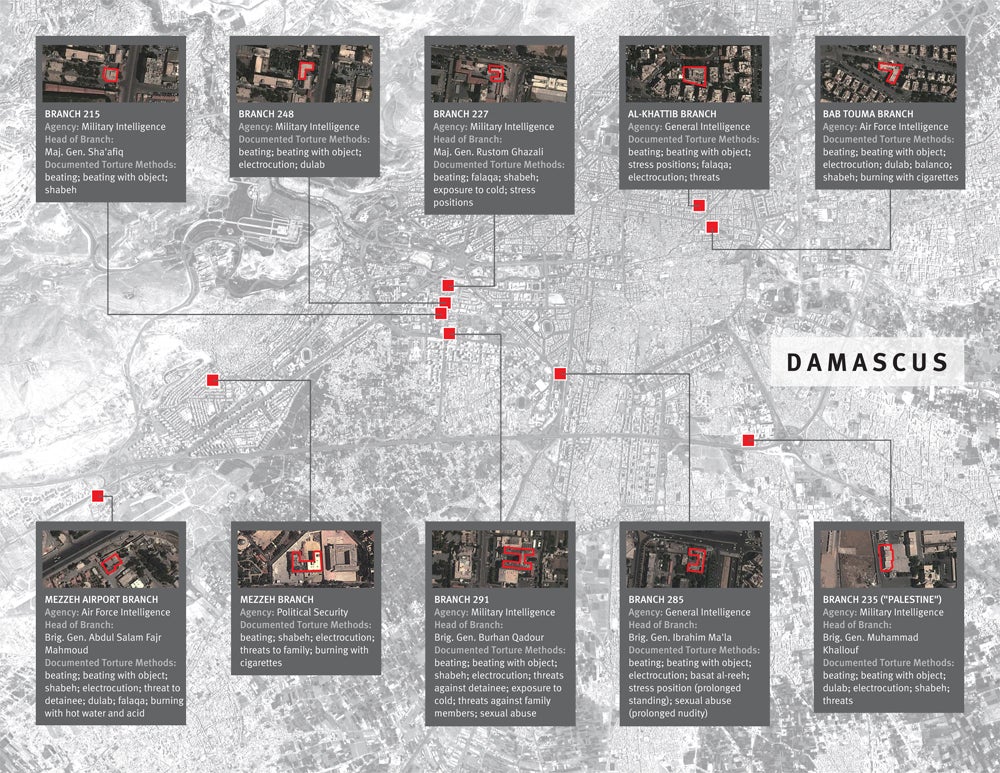
Human Rights Watch: Former detainees and defectors have identified the locations, agencies responsible, torture methods used, and, in many cases, the commanders in charge of 27 detention facilities run by Syrian intelligence agencies, Human Rights Watch said in a multimedia report released today. The systematic patterns of ill-treatment and torture that Human Rights Watch documented clearly point to a state policy of torture and ill-treatment and therefore constitute a crime against humanity.
The 81-page report, “Torture Archipelago: Arbitrary Arrests, Torture and Enforced Disappearances in Syria’s Underground Prisons since March 2011” is based on more than 200 interviews conducted by Human Rights Watch since the beginning of anti-government demonstrations in Syria in March 2011. The report includes maps locating the detention facilities, video accounts from former detainees, and sketches of torture techniques described by numerous people who witnessed or experienced torture in these facilities.
“The intelligence agencies are running an archipelago of torture centers scattered across the country,” said Ole Solvang, emergencies researcher at Human Rights Watch. “By publishing their locations, describing the torture methods, and identifying those in charge we are putting those responsible on notice that they will have to answer for these horrific crimes.”
Click to view in-depth, satellite images of the torture centers in the following cities: Damascus, Homs, Idlib, Aleppo, Daraa, and Latakia.