Category Archives: Syria

How Denmark turned ugly

refugees1

Hugh Eakin writes: In country after country across Europe, the Syrian refugee crisis has put intense pressure on the political establishment. In Poland, voters have brought to power a right-wing party whose leader, Jarosław Kaczyński, warns that migrants are bringing “dangerous diseases” and “various types of parasites” to Europe. In France’s regional elections in December, some Socialist candidates withdrew at the last minute to support the conservatives and prevent the far-right National Front from winning. Even Germany, which took in more than a million asylum-seekers in 2015, has been forced to pull back in the face of a growing revolt from Chancellor Angela Merkel’s own party and the recent New Year’s attacks on women in Cologne, allegedly by groups of men of North African origin.

And then there is Denmark. A small, wealthy Scandinavian democracy of 5.6 million people, it is according to most measures one of the most open and egalitarian countries in the world. It has the highest income equality and one of the lowest poverty rates of any Western nation. Known for its nearly carbon-neutral cities, its free health care and university education for all, its bus drivers who are paid like accountants, its robust defense of gay rights and social freedoms, and its vigorous culture of social and political debate, the country has long been envied as a social-democratic success, a place where the state has an improbably durable record of doing good. Danish leaders also have a history of protecting religious minorities: the country was unique in Nazi-occupied Europe in prosecuting anti-Semitism and rescuing almost its entire Jewish population.

When it comes to refugees, however, Denmark has long led the continent in its shift to the right—and in its growing domestic consensus that large-scale Muslim immigration is incompatible with European social democracy. To the visitor, the country’s resistance to immigrants from Africa and the Middle East can seem implacable. In last June’s Danish national election—months before the Syrian refugee crisis hit Europe—the debate centered around whether the incumbent, center-left Social Democrats or their challengers, the center-right Liberal Party, were tougher on asylum-seekers. The main victor was the Danish People’s Party, a populist, openly anti-immigration party, which drew 21 percent of the vote, its best performance ever. Its founder, Pia Kjærsgaard, for years known for suggesting that Muslims “are at a lower stage of civilization,” is now speaker of the Danish parliament. With the backing of the Danish People’s Party, the center-right Liberals formed a minority government that has taken one of the hardest lines on refugees of any European nation. [Continue reading…]


Facebooktwittermail

Inside Obama administration differing views on support for Syrian Kurds

Josh Rogin and Eli Lake write: Syrian Kurds are now attacking U.S.-supported rebels, but U.S. officials disagree about whether the Kurds have switched sides — and about whether the U.S. should continue increasing its arms support for them, as opposed to focusing support on Sunni Arab rebels.

Kurdish fighters have taken advantage of the Russian-backed Syrian regime offensives in the north of the country, seizing territory from U.S.-backed rebels who are on the defensive. But factions within the Obama administration disagree about whether the Kurds are simply being opportunistic, or have coordinated their attacks with Russia, Iran and the Syrian regime.

Some administration officials told us that U.S. intelligence has documented meetings between the Kurds’ armed group and officials in the Iranian Revolutionary Guards Quds Force, which has fought alongside the Assad regime against the opposition since 2011. This faction also says the Kurdish group, the YPG, is closely working with the PKK, a Kurdish terrorist organization at war with Turkey. [Continue reading…]

Facebooktwittermail

UN finds ‘deliberate’ destruction of hospitals in Syria

msf-hospital

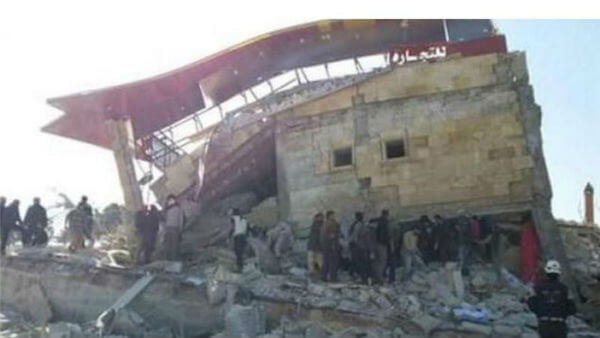
The New York Times reports: First, the government soldiers made sure no food could get into rebel-held towns. Then, government planes bombed what health centers remained in those towns, making sure that those who got sick from hunger had no medical care to save them.

That is the harrowing picture painted by the latest report of the United Nations Commission of Inquiry on the war in Syria. The report, released Monday, chronicles a series of attacks on health care centers by government forces and the Islamic State, and it says the “deliberate destruction of health care infrastructure” was responsible for driving up deaths and permanent disabilities.

To follow the commission’s work in Syria — it has written 11 reports since August 2011 — is to witness how blatantly the laws of war have been broken, with no prospects of accountability.

The commission flatly asserts in the latest report that “war crimes are rampant” by government forces and their armed rivals, and for the first time it sharply points to the very countries that are bargaining over a peace deal for fueling the violence. [Continue reading…]

Facebooktwittermail

Syrian rebels see flaws in U.S.-Russian truce plan

Reuters reports: The United States and Russia announced plans for a “cessation of hostilities” in Syria that would take effect on Saturday but exclude groups such as Islamic State and al Qaeda’s Nusra Front, a loophole Syrian rebels immediately highlighted as a problem.

Monday’s agreement, described by a U.N. spokesman as “a first step towards a more durable ceasefire,” is the fruit of intensive diplomacy between Washington and Moscow, which back opposing sides in the 5-year-old civil war that has killed more than 250,000 people.

Presidents Barack Obama and Vladimir Putin discussed the accord by phone, and the Kremlin leader said it could “radically transform the crisis situation in Syria.” The White House said it could help advance talks on bringing about political change in Syria.

To succeed, the deal will require both countries to persuade their allies on the ground to comply. Fighting and air strikes continued on Monday, according to a British-based monitoring group.

The plan allows the Syrian army and allied forces, as well as Syrian opposition fighters, to respond with “proportionate use of force” in self-defense. It leaves a significant loophole by allowing further attacks, including air strikes, against Islamic State, Nusra and other militant groups.

Bashar al-Zoubi, head of the political office of the Yarmouk Army, part of the rebel Free Syrian Army, said that would provide cover for Syrian President Bashar al-Assad and his Russian allies to keep attacking opposition-held territory where rebel and militant factions are tightly packed.

“Russia and the regime will target the areas of the revolutionaries on the pretext of the Nusra Front’s presence, and you know how mixed those areas are, and if this happens, the truce will collapse,” he said. [Continue reading…]

Facebooktwittermail

Azaz: The border town that is ground zero in Syria’s civil war

Martin Chulov reports: For nearly five years of war, the Syrian border town of Azaz had been little more than a staging point. Opposition fighters used it to receive supplies from the main crossing three miles north, and casualties of the brutal conflict were sent the other way to hospitals inside Turkey.

Nothing changed when Islamic State made Azaz one of its main hubs for six months from mid-2013. The supplies kept coming and the wounded continued to leave, even as the struggle for the north slowly changed hue from homegrown insurrection to a conflict fuelled by many international agendas. The gateway remained just that – until a fortnight ago, when the Kurds of northern Syria moved towards it.

Since then, Azaz has been transformed into ground zero of the war for the north of Syria. Its fate has implications far beyond, with Turkey, especially, now more heavily invested – and exposed – to the region’s shifting dynamics than at any point since its leaders swung behind the Syrian opposition in the summer of 2011.

What becomes of Syria could well be determined in the border areas around Azaz, where a Game of Thrones-like cast of players is vying for supremacy over lands that stretch south to the ancient city of Aleppo, and north beyond the Turkish frontier, over which Ankara now has less control than at any point since the modern state of Turkey was formed. [Continue reading…]

Facebooktwittermail

‘Provisional’ Syria ceasefire plan called into question as bombs kill 120

The Guardian reports: A “provisional agreement” on a ceasefire in Syria has been reached between the US and Russia, the US secretary of state, John Kerry, said on Sunday, but serious doubts remain on whether it will come into force as the country reeled from a series of deadly car bombs in Syria’s two biggest cities that left more than 120 dead.

In Homs, twin car bombs killed at least 57 people and wounded 100 on Sunday, and explosions hit parts of the capital, Damascus, killing a further 62 and wounding 180, according to the UK-based Syrian Observatory for Human Rights. The attacks on both cities were claimed by Islamic State.

Kerry said he had reached an agreement following phone talks with his Russian counterpart, Sergei Lavrov, amid signs that Russia is putting some pressure on the Syrian president, Bashar al-Assad, to comply. There are serious doubts over the strength of the deal, which would need the agreement of Vladimir Putin and Barack Obama, who are expected to speak by phone later this week.

A previous UN-brokered ceasefire, agreed between the interested parties in Munich a fortnight ago, failed to come into force on Friday as expected, with Russia continuing its bombing campaign and the Syrian army moving to encircle Syria’s second city of Homs. [Continue reading…]

Facebooktwittermail

Concerns in Saudi Arabia over signs of more military involvement in Syria

The Washington Post reports: Saudi Arabia is flexing its muscles as pro-government forces in Syria’s civil war make sweeping advances, but concerns have mounted about its expanding military involvement in the conflict.

Syrian President Bashar al-Assad’s military, backed by Iranian-led militiamen and Russian airstrikes, has pressed a major offensive in the northern city of Aleppo, even as talks to broker a ceasefire have made some progress.. The move threatens rebel groups that have received cash and weapons from Saudi Arabia, a Sunni powerhouse and U.S. ally that opposes Assad because of his alliance with Shiite rival Iran.

Saudi officials have responded by dispatching warplanes to Turkey, another opponent of the Syrian leader. They have said they could commit ground forces to Syria that would technically fight the Islamic State militant group but could also seemingly challenge pro-Assad forces.

Saudi leaders also have announced large-scale military exercises involving 20 mostly Arab and African nations.

“Bashar al-Assad will leave – have no doubt about it,” Saudi Foreign Minister Adel al-Jubeir recently told CNN. “He will either leave by a political process or he will be removed by force.” [Continue reading…]

Facebooktwittermail

Syria and the world: Reactionarism is back and progressing

Yassin Al-Haj Saleh writes: There is something deeply atavistic about the course that the Syrian conflict has taken. Its latest developments, in particular, take us back to a time prior to the formation of the contemporary Syrian entity at the end of the First World War – indeed back to the nineteenth century or earlier. And behind this atavistic drama, some episodes of which are reviewed in this article, there appears to be an antiquating dynamic, so to speak, accompanied by justifications for the repeated resurrections of the what I shall call here “the antiquated.”

The manifestations, dynamisms and justifications of this antiquating process are facets of an increasing reactionarism, the scope of which is now expanding far beyond Syria into the rest of the world. [Continue reading…]

Facebooktwittermail

The significance of Aleppo

Syria Deeply spoke with Frederic Hof, a former ambassador and resident senior fellow at the Atlantic Council’s Rafik Hariri Center for the Middle East, Dmitri Trenin, director of the Carnegie Moscow Center, and Hassan Hassan, a Syria expert with the Tahrir Institute for Middle East Policy, about the strategic importance of Aleppo, the likelihood of a “cessation of hostilities” by the end of the week, and the difference in endgames between Damascus and Moscow.

Syria Deeply: Would a siege on Aleppo be a game changer for Russia and the Assad regime?

Frederic Hof: A siege of Aleppo would add about 250,000 people to the 1 million Syrians already besieged, the overwhelming majority by the Assad regime. As over 20 reports by Ban Ki-moon testify, the regime systematically denies access by U.N. humanitarian aid convoys to these areas. So a besieged Aleppo would change an already abysmal game to something even worse. There is no evidence of Moscow seeking an exit from Syria, graceful or otherwise. The nature of the Russian military campaign suggests that President Vladimir Putin wishes to neutralize all alternatives to Assad and ISIS in the hope that Washington will embrace Assad and thus implicitly renounce “regime change.” It is not unthinkable that he could succeed. [Continue reading…]

Facebooktwittermail

Sudden retreats don’t mean that ISIS is defeated

Hassan Hassan writes: On Friday, Hasaka became the second Syrian province to be fully liberated from ISIL in two years, after Idlib around this time in 2014. According to local reports, the group’s withdrawal from its last stronghold in Hasaka was “swift and surprising”. This sudden defeat, which follows similar ones in recent months, raises questions about the group’s current capabilities.

ISIL’s loss of Shaddadi, its last outpost in Hasaka, is significant and symbolic. This was the town from where, in 2014, the group planned much of its effort to take or secure its control of Syrian territory. Jabhat Al Nusra, Al Qaeda’s affiliate in Syria, crumbled there after most of its fighters switched sides when Abu Bakr Al Baghdadi announced the formation of ISIL. The city was the planning centre for ISIL, and there were rumours that Mr Al Baghdadi had visited it a few times.

The defeat is also operationally remarkable. The group has now lost control over oilfields – about 200 small oil wells and major oilfields such as Jibisa and Kabibah – and critical areas that could potentially weaken its defences in Deir Ezzor, Raqqa and even Mosul. [Continue reading…]

Facebooktwittermail

Russia guilty of Syria war crimes, says Amnesty

msf-hospital

Sky News reports: Amnesty International has told Sky News that Russia is guilty of some the most “egregious” war crimes it has seen in decades.

The human rights organisation claims Moscow’s warplanes have been deliberately targeting civilians and rescue workers in Syria over the last week.

Tirana Hassan, director of Amnesty’s crisis response programme, said the attacks are ongoing – with strikes documented on schools, hospitals and civilian homes.

She claimed the bombing of civilian targets by Russian and Syrian forces was in itself a war crime, but warned there have been consistent reports of second bombardments which injure and kill humanitarian workers and civilians attempting to evacuate the wounded and the dead. [Continue reading…]

Facebooktwittermail

Russia steps up Syria cyber assault

Financial Times reports: Russia is mounting a far-reaching cyber espionage campaign against Syrian opposition groups and NGOs, as Moscow seeks to influence the flow of information on the country’s humanitarian crisis and obscure the full extent of its military operations there.

Targets include some of the most important human rights organisations and aid groups operating in the country, such as the Syrian Observatory of Human Rights, which reports on military incidents and is frequently cited in western media outlets, the Financial Times has learnt. The operation shares many of the hallmarks of Moscow’s sustained hacking campaign against the Ukrainian government in 2013 and 2014. [Continue reading…]

Facebooktwittermail

America is now fighting a proxy war with itself in Syria

kobane

Mike Giglio reports: American proxies are now at war with each other in Syria.

Officials with Syrian rebel battalions that receive covert backing from one arm of the U.S. government told BuzzFeed News that they recently began fighting rival rebels supported by another arm of the U.S. government.
The infighting between American proxies is the latest setback for the Obama administration’s Syria policy and lays bare its contradictions as violence in the country gets worse.

The confusion is playing out on the battlefield — with the U.S. effectively engaged in a proxy war with itself. “It’s very strange, and I cannot understand it,” said Ahmed Othman, the commander of the U.S.-backed rebel battalion Furqa al-Sultan Murad, who said he had come under attack from U.S.-backed Kurdish militants in Aleppo this week.

Furqa al-Sultan Murad receives weapons from the U.S. and its allies as part of a covert program, overseen by the CIA, that aids rebel groups struggling to overthrow the government of Syrian president Bashar al-Assad, according to rebel officials and analysts tracking the conflict.

The Kurdish militants, on the other hand, receive weapons and support from the Pentagon as part of U.S. efforts to fight ISIS. Known as the People’s Protection Units, or YPG, they are the centerpiece of the Obama administration’s strategy against the extremists in Syria and coordinate regularly with U.S. airstrikes. [Continue reading…]

Facebooktwittermail

In Syria ‘the Americans are like a policeman that passes by the scene of a crime and closes his eyes’

The Telegraph reports: If anywhere can show the consequences of American foreign policy under President Barack Obama, it may be the small town of Marea, north of Aleppo.

In the course of the last five years, it has seen Assad regime tanks roll through from the south, firing shells through its houses.

It has been repeatedly attacked from the east by Islamic State of Iraq and the Levant (Isil). On occasion it has been bombed from the air by the regime and shelled from the ground by Isil on the same day.

Now its rebel defenders are fighting Isil, the regime, Russian bombers, and a new enemy, the Syrian Kurdish militia the YPG, all at once.

America is calling for a ceasefire. But it is not clear whether even if one were declared, it would stop any of those enemies from attacking Marea. [Continue reading…]

Facebooktwittermail

In Libya, Obama chose to lead from behind; in Syria it’s now feed from behind

The New York Times reports: Most of the Russian and American aircraft traversing Syria have been warplanes firing missiles and dropping bombs. But under an international agreement to aid Syrians trapped in the fighting, Russian planes will soon be dropping food in an operation partly financed by the United States.

The United Nations World Food Program will start its first airdrops in Syria in coming days, relief officials said Thursday. The main focus is Deir al-Zour, an eastern Syrian city where more than 200,000 inhabitants are ringed by forces of the Islamic State, which has made land access impossible.

Under the emergency aid agreement, truck convoys began supplying food and medicine to five besieged towns in other parts of Syria on Wednesday. Staffan de Mistura, the United Nations special envoy for the Syrian conflict who helped to negotiate the final arrangements, had hinted that airdrops were an option for areas that are unreachable by land.

The World Food Program will use aircraft provided by a Russian contractor for the drops, which are conducted by parachute from high altitudes, said Bettina Luescher, a spokeswoman for the agency. [Continue reading…]

If the U.S. administration wanted to salvage a few crumbs of credibility among the Syrians who it has otherwise deserted, it could have seized this opportunity in public diplomacy — just as the Russians have.

It’s all very well to say that getting aid to those in need is more important than taking credit, but somehow, I doubt very much that U.S. decision-making at this juncture has been guided by humility. Moreover, Russia’s interest in taking the lead is surely guided by its own desire to do exactly what the Assad regime has in its long-running manipulation of UN aid distribution: support it’s military strategy by steering aid towards its own supporters.

Obama might persist in his passive approach to Syria because he sees himself as the choreographer of America’s departure from the Middle East, but walking away is much easier said than done.

Syria has become a global crisis precisely because so many governments and populations outside the conflict thought it could be ignored or viewed calmly from a comfortable distance.

Meanwhile, many of those who in the past argued most vehemently against Western intervention have since become cheerleaders of Russia’s intervention — erstwhile anti-militarists who turn out to be secret admirers of Vladamir Putin’s muscularity.

Facebooktwittermail

Russia warns Assad not to snub Syria ceasefire plan

Reuters reports: President Bashar al-Assad was out of step with the views of his main ally, Russia, when he said he planned to fight on until he re-established control over all of Syria, Russia’s envoy to the United Nations was quoted as saying on Thursday.

In the first public sign of cracks in the alliance between Moscow and Damascus, the envoy, Vitaly Churkin, said Russia had helped Assad turn the tide of the war so it was now incumbent on him to follow Russia’s line and commit to peace talks.

Churkin said Russia was working towards a peaceful settlement for Syria, and that attempting to take back control over the whole country would be a futile exercise which would allow the conflict to drag on indefinitely.

Asked in an interview with Kommersant newspaper about Assad’s comments that he would keep fighting until all rebels were defeated, Churkin said: “Russia has invested very seriously in this crisis, politically, diplomatically, and now also in the military sense.

“Therefore we of course would like that Bashar al Assad should take account of that.”

“I heard President Assad’s remarks on television… Of course they do not chime with the diplomatic efforts that Russia is undertaking…. The discussions are about a ceasefire, a cessation of hostilities in the foreseeable future. Work is underway on this.” [Continue reading…]

Facebooktwittermail

Saudi foreign minister: ‘I don’t think World War III is going to happen in Syria’

Der Spiegel reports:
SPIEGEL: Is Saudi Arabia in favor of supplying anti-aircraft missiles to the rebels?

Al-Jubeir: Yes. We believe that introducing surface-to-air missiles in Syria is going to change the balance of power on the ground. It will allow the moderate opposition to be able to neutralize the helicopters and aircraft that are dropping chemicals and have been carpet-bombing them, just like surface-to-air missiles in Afghanistan were able to change the balance of power there. This has to be studied very carefully, however, because you don’t want such weapons to fall into the wrong hands.

SPIEGEL: Into the hands of Islamic State.

Al-Jubeir: This is a decision that the international coalition will have to make. This is not Saudi Arabia’s decision.

SPIEGEL: The Russian intervention has had a big impact on the situation in Syria. How would you describe Saudi Arabia’s relationship with Russia at this point?

Al-Jubeir: Other than our disagreement over Syria, I would say our relationship with Russia is very good and we are seeking to broaden and deepen it. Twenty million Russians are Muslims. Like Russia, we have an interest in fighting radicalism and extremism. We both have an interest in stable energy markets. Even the disagreement over Syria is more of a tactical one than a strategic one. We both want a unified Syria that is stable in which all Syrians enjoy equal rights. [Continue reading…]

Facebooktwittermail

Médecins Sans Frontières: Attacks on civilians and hospitals in Syria have become routine

Dr Joanne Liu, International President of Médecins Sans Frontières, writes: Today in Syria, the abnormal is now normal. The unacceptable is accepted.

Relentless, brutal, and targeted attacks on civilians are the dominant feature of this war. In addition to the countless numbers of dead, hundreds of thousands of people are fleeing for their lives. Many of them trapped, and denied the fundamental right to flight.

Deliberate attacks against civilian infrastructure, including hospitals struggling to provide lifesaving assistance, are routine.

Healthcare in Syria is in the crosshair of bombs and missiles. It has collapsed.

Let me be clear: attacks on civilians and hospitals must stop. The normalization of such attacks is intolerable. [Continue reading…]


[Click infographic to enlarge]

Facebooktwittermail