Category Archives: Turkey

Erdogan: The strong man now at his weakest

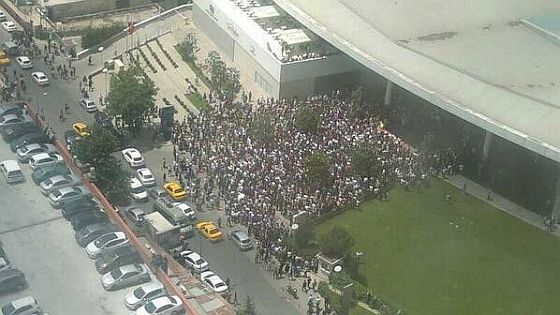
Steven Cook writes: “Re-cep Tay-yip Er-do-gan! Re-cep Tay-yip Er-do-gan!” chanted supporters of the Turkish prime minister, as a friend and I made our way through the absolutely mammoth crowd that descended on the Kazlicesme area of Istanbul last Sunday to hear their leader speak. As with Erdogan’s rally in the capital, Ankara, the day before, the people who turned out here, many of whom were decked out in scarves, T-shirts, and masks supporting the prime minister, vastly outnumbered the Gezi Park protesters who have captured global headlines. Young, old, well-to-do, decidedly modest, religious, and secular all declared their devotion to the Justice and Development Party (AKP) and Erdogan. When the prime minister surveyed the 295,000 souls who had come to express their devotion and thundered, “Taksim Square is not Turkey!” it was a vindication of his vision, his economic policies, and the strength of his leadership. Yet the irony was that at Kazlicesme, Erdogan’s demonstration of strength revealed his profound weakness and political vulnerability.

Anyone with even a passing interest in Turkey knows something about the Erdogan mystique. He’s the tough guy from the Kasimpasa neighborhood — literally and figuratively down a steep slope from Taksim Square — who has remade Turkey over the last decade. For the media personalities parachuted into a maelstrom of tear gas, water cannons, and pepper spray, Turkey under Erdogan is best described as an economic and political success story, a “model” of a “Muslim democracy and prosperity” for the Arab world. But Erdogan’s reservoir of support is based on a much more tangible set of factors. The fact that he presides over the 17th-largest economy in the world — it was the 16th in the 1990s — is less important than the fact that more people are participating in it than ever before. There are still fabulously wealthy and terribly poor people in Turkey, but the overall gap between the two has narrowed. That is no small accomplishment. In other high-growth countries like Brazil, China, and Russia, for example, that gap has grown.

Consistent with the kind of grassroots work that the AKP’s precursor, the Welfare Party, perfected in the 1980s and 1990s, Erdogan — the guy who used to sell the Turkish version of the bagel, called simit, from a cart on the street — has focused much of his time in office on improving the lives of ordinary Turks. In places where transportation was thin, health care was basic, and government services were non-existent, the prime minister has paved roads, built airports, established “Erdogan-care,” and forced local governments to be responsive to their constituents. As a result, Kasimpasa is not so rough-and-tumble anymore and the people there love him for it. [Continue reading…]


Facebooktwittermail

Erdoğan is fighting the last war

Joost Lagendijk writes: Erdoğan’s rise to power is inextricably connected with changes in Turkey’s society and economy in the 1980s and 1990s that challenged the old power structures and created new spaces for conservative businessmen, media and politicians. The self-made man from Kasımpaşa is the most successful among a new generation of pious Muslims who went into politics, especially after he realized that, in order to reach his goals, he had to moderate his policies and rhetoric. Still, since he became Istanbul mayor in the 1990s, his battle has been with the old elite and their representatives in politics and society, knowing that he could count on the support of the downtrodden and marginalized plus the growing middle classes and new business elites who shared his social conservatism and economic liberalism. His sympathies have always been with like-minded companies that rose with him and not with the old and established ones like the Koç family.

That struggle has made him the most successful politician since Atatürk and brought Turkey a lot of gains that are often overlooked these days. The country has become more prosperous since the AKP came to power, nobody even considers calling the army to intervene and we have never been closer to a solution for the Kurdish problem. But, apparently, at the back of Erdoğan’s mind there was always the fear that, one day, the old elites will try to strike back at him and his party because, deep down, they can’t stand being ruled by a so-called Black Turk that does not respect their views or lifestyles.

Listening to Erdoğan, I think it is obvious that he is convinced the people who went out on the streets to protest him are being manipulated by the same old forces he has been fighting his whole political life. In his perception of reality, they want to undermine and eventually destroy the new Turkey he has been building. As is every Turkish citizen, he is also prone to believe that his old foes in Turkey are being assisted by their traditional allies abroad and in the international media.

What we end up with is a mix of worn-out conspiracy theories and a political vision based on the fights of the past.

It is tragic to see the man who contributed considerably to Turkey’s journey towards a mature democracy is now stumbling somewhere halfway through because he is unable to understand that, as a result of his own policies, Turkey has changed. [Continue reading…]

Facebooktwittermail

Gezi Park has become a hotbed of activity as Turks make their stand

Constanze Letsch writes: It is one of the most beautiful successes of the Gezi Park protests: cramped together inside an endangered inner city park, united in their anger at an authoritarian prime minister, protesters of all colours – leftists, nationalists, feminists, anarchists, religious groups, secularists, students, bankers – are engaging in dialogue.

Ahmet Metin, head of the Istanbul branch of the nationalist Association for Kemalist Thought, says he led “some wholesome discussions” with Kurdish protesters, LGBT activists and liberals, for the first time. “We don’t share the same political views, and we don’t agree on everything,” he admits. “But we’re all here to defend democratic rights. It’s a point of departure.”

Few romanticise this unexpected eruption of pluralist civil society. Every now and then, small verbal skirmishes break out: nationalists grumble at flags of the jailed Kurdish PKK leader Abdullah Öcalan, hoisted in one corner of the park. Kurds are uneasy about protesters claiming to be soldiers of modern Turkey’s founder, Mustafa Kemal Atatürk. Posters ask activists not to use sexist or racist language in their slogans. “Before you call anyone ‘a faggot’, remember that faggots have been on the frontline of this struggle all along,” one cardboard sign reminds passersby.

Hamdi, a 29-year-old architect who quit his job in the central Anatolian city of Kayseri to join the Gezi park protests, underlines that no political party has managed to force its label on to the movement. “We all know what we want from this and that’s enough to keep us together. We don’t need pre-packed ideologies.” [Continue reading…]

Facebooktwittermail

Turkey expands crackdown on street unrest

The New York Times reports: The Turkish authorities widened their crackdown on the antigovernment protest movement on Sunday, taking aim not just at the demonstrators themselves, but also at the medics who treat their injuries, the business owners who shelter them and the foreign news media flocking here to cover a growing political crisis threatening to paralyze the government of Prıme Minister Recep Tayyip Erdogan.

After an intense night of street clashes that represented the worst violence in nearly three weeks of protests, Mr. Erdogan rallied hundreds of thousands of his supporters on Sunday — many of them traveling on city buses and ferries that the government had mobilized for the event — at an outdoor arena on the shores of the Sea of Marmara. In some of his toughest language yet, he called his opponents terrorists and made clear that any hope of a compromise to end the crisis was gone.

“It is nothing more than the minority’s attempt to dominate the majority,” he said of the protesters. “We will not allow it.”

The escalating tensions have raised the risk of an extended period of civil unrest that could undermine Turkey’s image as a rising global power and a model of Islamic democracy, which Mr. Erdogan has cultivated over a decade in power. [Continue reading…]

Facebooktwittermail

How Erdogan’s language fans the flames

Ali Yenidunya writes: It is now almost two weeks since mass demonstrations arose against his Government, but Prime Minister Recep Tayyip Erdogan shows no sign of relenting in his decision to re-develop Istanbul’s Gezi Park, the catalyst for the protests, or to give way on wider demands, such as holding police accountable for violence that has killed three protesters and injured thousands.

Instead, on Tuesday, Erdogan justified police attacks to clear Istanbul’s Taksim Square and other protest sites: “What were we supposed to do? Kneel in front of these people and ask them remove the banners? How would those illegal rags be removed from public buildings?”

The Prime Minister stigmatised dissent, “Violent actions that took place in many cities of Turkey have camouflaged themselves behind the Gezi Park protests.”

This is dangerous language. It divides the country into two inimical camps, simplifies the crisis, and embedding it in a politics in which “democracy” is defined only through the “ballot box” and every opposing demand is labeled “illegitimate”. [Continue reading…]

Facebooktwittermail

The war in Syria and Turkey’s protests

Sophia Jones writes: The names of the dead are taped to Sycamore trees in Istanbul’s Gezi Park: Fatma Erboz, age 3. Ahmet Uyar, 45.

These trees — threatened by government redevelopment plans that have in turn inspired mass protests around Turkey — have been transformed into memorials for the more than 50 people who died in twin car bombings last month in Reyhanli, a Turkish town on the border of Syria.

On Tuesday morning, police attempted to drive protestors out of the park with water cannons and tear gas — perhaps signaling an end to the popular and mostly peaceful demonstrations that have spread across Turkey over the past two weeks. But the issues that have fueled the turmoil — from complaints over the Islamist government’s conservative social policies to demands for greater democracy — are not likely to dissipate so quickly. And that is particularly true of one issue that has inflamed many protesters’ anger at Turkish Prime Minister Recep Tayyip Erdogan: The government’s stance on the war ravaging Syria, which has now claimed over 80,000 lives.

The war in Syria is polarizing Turkey. According to a recent study by MetroPOLL Strategic and Social Research Center, based in Ankara, only 28 percent of the Turkish public supports the prime minister’s policies on Syria. Since the start of the conflict, the government has strongly condemned Syrian President Bashar al-Assad. From early on, Erdogan has vocally supported the Free Syrian Army (FSA), the rebel group battling the regime, and has urged the United States to supply them with weapons and to establish a no-fly zone.

Turkey is crucial for the rebels. It offers refuge for their families as well as a safe zone where they can plan and launch attacks over the border. Turkish businesses supply the rebels with everything from medicine to uniforms to cigarettes. But many Turks have long worried that this would make them subject to retaliation by the Syrian government — a fear that, for many, was confirmed by the attacks in Reyhanli. The leader of Turkey’s main opposition has repeatedly confronted Erdogan over his pro-rebel policies, accusing the prime minister of supporting Syrian “terrorists.” [Continue reading…]

Facebooktwittermail

I can never trust the Turkish police and government again

Can Oz writes: I am scared. With every speech that prime minister Recep Tayyip Erdoğan gives, I feel the hatred and disgust against me and young people of my generation increase. All we are after is a bit of freedom, a bit of space to live and a few trees. It reminds me of a line from Jimi Hendrix’s If 6 Was 9: “I’m the one that has to die when it’s time for me to die, so let me live my life the way I want to.”

Today I was in Taksim Square again, a few hours after the police cleared the area with water cannon, tear gas and rubber bullets, and protesters hurled fireworks and fire bombs. Some say the protesters’ firebomb attack was staged, and while I don’t have certain proof that this was the case, it wouldn’t surprise me: over the past few days I have witnessed so many lies from the police and government that I don’t think I can ever trust them again. I have spent days with the protesters – withstanding another gas attack, cheering, singing chants and sharing food in the park – and I haven’t encountered any signs of weapons or violence on their behalf. These people made me feel like I’m living a dream.

The purpose of my visit to Taksim Square was to listen to the press conference the Taksim Solidarity movement had prepared; and I was confident that I could trust the chief of police and Istanbul mayor’s assurance that the park would not be attacked. Then, right before the press conference was about to start, gas rained down over our heads once again. It was a moment of crushing disappointment. Coughing, wiping tears out of my eyes, practically blind, I realised that our government would never understand the meaning of the passive resistance that Martin Luther King Jr and Mahatma Gandhi were famous for. That’s when I ran out of the park.

I am the owner of the biggest literary publishing house in the country. In the past few days I have received hate mail and death threats, just because I was publicly part of this passive resistance movement. [Continue reading…]

Facebooktwittermail

Not the deep state but the streets pushing Erdoğan to change

Lale Kemal writes: A majority of Turks are now conscious of the fact that the mass protests that took place in this country in the past were masterminded by deep state elements so that they could hold on to their power at the expense of the elected governments.

Between 1960 and 2007, Turks witnessed bloody clashes that took place among leftist and rightist university students and massive demonstrations protesting against the governments in the periods prior to the three military coups as well as the three memorandums issued by the Turkish military that twice resulted in the fall of the government. The 29-year-old Kurdish uprising is a product of the bloody 1980 military coup, with the junta dealing a serious blow to democratic rights, which also deeply affected Kurds when they were banned from speaking their mother tongue even among themselves.

The current nationwide anti-government protests, however, are largely a product of people who are genuine in their demands in broader terms.

A peaceful, small-scale sit-in protest that started nine days ago in İstanbul’s Taksim Square against the demolition of the Gezi public park quickly turned into anti-government protests, reflecting people’s discontent. It escalated into some of the worst scenes of public disorder and police violence coupled with violence triggered by extreme groups seen in Turkey in recent years.

Today’s demonstrations are different from the previous deep-state organized ones since, among other things, they have brought together people from every segment of society. We understand this from the slogans being chanted by the demonstrators as well as the solidarity being displayed by the protesting crowds reflecting different ideologies that vary from moderate secularists and environmentalists to conservatives as well as gays and lesbians.

The driving force that united the protesters appears to be their anger against Prime Minister Recep Tayyip Erdoğan’s increased authoritarian behavior, treating the people as his subjects with arrogance and overconfidence. [Continue reading…]

Facebooktwittermail

Turkey finds that trouble knows no bounds

Hugh Pope writes: As instability undermines the Arab states established in the post-First World War map of the Middle East, a now vigorous Turkey, heir of the Ottoman Empire that was the main loser from that 20th century order, is taking a new look at the region.

‘Those borders are all false’, sniffed one of Turkey’s former top diplomats over dinner in February. Recep Tayyip Erdogan, the Turkish Prime Minister, says that Syria’s growing troubles since 2011 now amount to ‘an internal affair’ for Turkey, while in private officials talk breezily of Syria as ‘our former province’.

In the capital Ankara, a senior security official agreed that tumult in Syria over the past two years had vaporized much of the Cold War frontier of barbed wire and watch-towers. ‘The borders have become meaningless,’ he said.

In short, a major change is under way after decades in which Turkish policy was predicated on making the best of what it found in the Middle East.

This is not just a reaction to the catastrophic collapse of Syria into a failed state. In northern Iraq, Turkey is now moving firmly to cement a privileged energy, trade and security relationship with the Kurdistan Regional Government. ‘We warned the United States for 10 years, “you’re going to break up Iraq”. For this whole time we paid the price [of trying to hold Iraq together]’, the senior security official said. ‘Finally we saw the situation now that America is leaving, and said, “well, let’s turn this to our advantage”.’

Nobody in power in Ankara is talking of new annexations. But Turkey’s more opportunistic approach is rooted in the centuries during which it controlled most countries of what is the Sunni Muslim Arab world today, and a lingering grievance about how that empire was dismantled after the First World War ended in 1918.

Foreign Minister Ahmet Davutoglu often says that uprisings in the Arab world can be seen as ‘closing a century of parenthesis’ – shorthand for rebuilding links between former Ottoman lands, even though he denies the policy is ‘neo-Ottoman’. [Continue reading…]

Facebooktwittermail

Erdogan has been warned

Sule Kulu writes: “History shows that if nations cannot manage to win all together, they are destined to lose all together,” declared Turkey’s prime minister, Recep Tayyip Erdogan, on the first anniversary of his 2007 re-election. “We defend freedom, justice, democracy and welfare for everybody.”

Back then, he promised that his Justice and Development Party, known by its Turkish initials, A.K.P., would embrace all sections of society regardless of political affiliation. He even thanked those who didn’t vote for him.

Five years later, Mr. Erdogan is facing growing criticism for disrespecting people’s lifestyles and interfering in their personal choices. His government has drafted and passed bills without public consultation. A law on restricting alcohol sales was passed on May 24 in Parliament via a last-minute amendment.

And then, two weeks later, again without public consultation, he began the demolition of a popular park as part of a controversial urban renewal plan for Taksim Square. The small-scale sit-in opposing the demolition morphed into mass nationwide public demonstrations after the police used excessive force against protesters.

How could a skilled politician as smart and experienced as Mr. Erdogan, who has been able to overcome a number of political crises in the past, including a threatened military coup in 2007, fail to see the bigger political picture?

In the past few days, Mr. Erdogan has claimed that those rallying against him were mobilized by the country’s opposition parties, especially the ultrasecular and ultranationalist bloc led by the Republican People’s Party (C.H.P.). He said the issue was not the park but a concerted political campaign against him by those who opposed his policies on partisan grounds. This was understandable given that his opponents have ignored the A.K.P.’s landmark achievements for the sake of partisanship in the past.

However, a quick look was enough to confirm that the opposition that took over Taksim last weekend was different. It was a largely nonpartisan movement made up of liberals, conservatives, independents and even likely A.K.P. voters. Their cause was later overshadowed by some violent groups, who dealt a serious blow to the public image of the protests through vandalism, looting and attacking women wearing head scarves. Yet the initial sit-in group, as well as those participating in the broader protests that followed, represented a broad cross section of society. [Continue reading…]

Facebooktwittermail

Protests in Turkey are ‘tremendous democratic advance’

Ziya Meral writes: Often, it is fair to say that most of what we read on Turkey in the international media tells us more about those who write it than guide us towards a healthy analysis of developments in the country. The same goes for vast majority of the commentary on the protests we saw in Istanbul and across the country over the last week.

While protests in each of the cities have a different context and local factors, without a doubt initial protests on and around Gezi Park have triggered a larger social eruption. Therefore, understanding the Gezi Park protests would be important as a reflection on trends that unite these protests.

So far, the most credible data that emerged on protestors in Istanbul’s Taksim Square has been a poll among 3,000 protestors in the Taksim area by Bilgi University. The findings signal important insights.

Bilgi’s survey has found that 39 per cent of protestors are 19 to 25 years old and 24 per cent are 26 to 30 years old. Some 53 per cent have never joined a protest before, while 70 per cent do not feel close to any opposition party. Only 7 per cent say they joined the protests due to mobilisation by a political group. As to the reasons for the protest – some 92 per cent blame the prime minister’s attitude, 91 per cent say police brutality, 84 per cent the media’s silence on the events, and 56 per cent say the cutting of the trees. [Continue reading…]

Facebooktwittermail

What’s Happening In Turkey?

The Guardian reports: A crowd-funding campaign has raised over $55,000 in under 24 hours to help pay for a full-page ad in the New York Times calling for democratic action and new dialogue on Turkey.

The Indiegogo campaign – “Full Page Ad for Turkish Democracy in Action: OccupyGezi for the World” – called on contributors to raise a stated goal of $53,800, and asks people to “wake up”.

The text of the full-page New York Times ad:

Millions of Turkish citizens have been outraged by the violent reaction of their government to a peaceful protest aimed at saving Istanbul’s Gezi Park.

Outraged, yet not surprised.

Over the course of Prime Minister Erdogan’s 10-year term, we have witnessed a steady erosion of our rights and freedoms. Arrests of numerous journalists, artists, and even elected officials; restrictions on freedom of speech, women’s rights, and even alcohol sales have all demonstrated that the ruling party is not serious about democracy. Time and again, the prime minister has mocked and trivialised his nation’s concerns while Turkey’s own media has remained shamefully silent.

The people protesting bravely throughout Turkey are the proud inheritors of Atatürk’s legacy. We are not looters or extremists. We are students, teachers, workers, mothers, fathers. We represent various ethnicities and creeds, religions and ideologies. We stand united now because of our concern for Turkey’s future.

We demand an end to police brutality.

We demand a free and unbiased media.

We demand an open dialogue, not the dictate of an autocrat.

We hope that you will join the conversation and stand with us in solidarity.

http://en.wikipedia.org/wiki/2013_protests_in_Turkey

#GeziPark #OccupyGezi #DirenGeziParki (En. Resist Gezi Park)

This statement is crowdfunded by concerned individuals from around the world.

Facebooktwittermail

Turkish police arrest suspected Iranian agent in Ankara protests

Today’s Zaman reports: Turkish police have arrested, among others, an Iranian national named Shayan Shamloo in connection with violent demonstrations in the Turkish capital that followed what was initially a peaceful environmental protest at Gezi Park in İstanbul.

According to a source in the government who wanted to remain anonymous because of the pending investigation into violent events held in a couple of locations in Ankara, the Iranian national was suspected to have played a provocateur role.

The same source also told Today’s Zaman that authorities suspect Mr. Shamloo has connections with the Iranian intelligence. Police have reportedly arrested some 15 foreign nationals across the country in connection with events and most of them have turned out to be Iranian nationals.

Facebooktwittermail

A turning point in Turkey’s history?

Emre Caliskan and Simon A. Waldman write: The protests come as Turkey’s Prime Minister Recep Tayyip Erdogan is seeking to change the Turkish constitution to give more powers to the president, an office Erdogan is believed to be eyeing when his term as prime minister soon expires. Many Turks believe that this will give him further powers. Already there are deep concerns over sweeping laws and policies passed by Erdogan which threaten to alter the nature of Turkey’s identity to one that favors Islam over secularism without transparency or due process.

Last week, with little public debate, Turkey’s parliament passed legislation to restrict the sale of alcohol. “We don’t want a generation wandering around in a merry state day and night,” declared Erdogan. This is despite the fact that Turkey enjoys one of the lowest levels of alcohol consumption and drink-related problems in the Organization for Economic Cooperation and Development (OECD).

Also last week at a groundbreaking ceremony for a third Bosporus bridge in Istanbul, it was announced that the bridge would be named after Selim the Grim, a conquering Ottoman sultan known for his aversion to alcohol and his massacres of Alevis, a constituency that represents roughly 15% of Turkey’s population. This controversial decision was again made without public consultation.

Meanwhile, the independent media, a pillar of any healthy democracy, has been consistently targeted by Erdogan and his Justice and Development Party (AKP). According to the Reporters Without Borders’ 2013 World Press Freedom Index, Turkey is “the world’s biggest prison for journalists,” where approximately 70 journalists are still behind bars. Turkey was ranked 154th for open press out of 179 countries, a worse ranking than Iraq, Afghanistan and Russia.

This has not gone unnoticed by the public. The almost total media blackout of the first day of protests shocked many Turkish demonstrators who took to Twitter and Facebook to transmit news. But even social media has not escaped the wrath of Erdogan. “There is a now menace which is called Twitter,” the prime minister remarked, “Social media is the worst menace to society.”

Another source of public concern is the peace talks between Ankara and the Kurdistan Workers Party (PKK). Considered a terrorist group by Ankara, the PKK has waged a battle against Turkey since 1984 in its demand for Kurdish rights and autonomy. However, there was little public knowledge or debate about the negotiations. When a team of “elders” was finally selected to discuss the issue with the public, its members were drawn almost exclusively from supporters of Erdogan’s party. Many Turks and Kurds doubt the sincerity of the peace process; there are more than 8,000 Kurdish politicians, journalists and activists behind bars, mostly for non-violent offenses. [Continue reading…]

Facebooktwittermail

Viewing the Gezi Park protest the right way

Ziya Meral writes: Much has been and will be written about why and how a small and peaceful protest in Taksim Square’s Gezi Park evolved into a large social eruption. Relatively little has been said about what this might mean politically, socially, economically and diplomatically in the near future.

No matter from which political angle one looks at the events we have seen in Turkey over the past days, it is clear that one of the biggest problems in Turkey is our weak democratic culture. We have problems in handling different opinions, lifestyles, beliefs and political views and expressing ourselves, compromising, negotiating and reconciling.

Soon, there will be healthy calls for accountability and justice over how the police and authorities and, in some cases, protesters have conducted themselves and how the government handled this process. All of these are necessary, but if we want to see a lasting impact of what we have experienced last week and if we want to learn lessons from it as a nation beyond our usual polarization of “us” versus “them,” we must find ways to conceptualize Gezi Park’s memory from now on.

One way of not only memorializing but also seeking to develop Turkey’s democratic culture would be to declare Gezi Park as a Speakers’ Corner in the style of Hyde Park in London. This would not only make sure that protesters’ voices are not lost amid all the party politics and finger pointing that will follow, but also it would give us an inclusive platform to learn to communicate, listen and disagree. Thus, it would be a memorial site with a dynamic and future-looking aspect, which not only seeks to establish an account of what happened but universalizes what we learn or should learn from it. [Continue reading…]

Facebooktwittermail

Nationwide strike call in Turkey likely to inflame anti-Erdogan protests

McClatchy reports: Police clashed with anti-government protesters in major cities around Turkey for a fourth day Monday as one of the country’s biggest public service unions threatened a nationwide strike Tuesday to show its discontent with Prime Minister Recep Tayyip Erdogan’s government.

In Ankara, police in helicopters, firing tear gas and plastic bullets, pursued groups of demonstrators throughout the city, Turkish television reported; on the ground, they discharged tear gas at one group of about 1,000 demonstrators. But more young people flocked to the city center.

In the western port city of Izmir, protesters threw fire bombs at the offices of Erdogan’s Justice and Development Party overnight, setting the building ablaze, Turkish television reported.

In Istanbul, where the protests began over the government’s plans to build a shopping center in one of the few parks in the city center, a Turkish doctors association announced the first fatality of the clashes – a young leftist who was killed when a car struck him during a protest on a major highway.

The Obama administration Monday took the unusual step of delivering a public dressing down of the Turkish government, a vital ally, for excess use of force.

Secretary of State John Kerry called for “a full investigation” of reports of excessive force and “full restraint from police.” He urged both the government and the protesters “to avoid any provocations and violence.”

The White House said those protesting were peaceful, law-abiding citizens, exercising their right to free expression – a very different take on the nature of the protests from that offered by Erdogan.

The combative leader, boasting that he’s won three elections and has the support of half the country, showed no intention of defusing the tensions, which erupted after police used heavy-handed tactics against a peaceful protest in Istanbul’s Gezi Park that began last week after workers began chopping down trees. After calling the protesters “looters” and “extremists” over the weekend, he charged on Monday that they were walking “arm in arm with terrorists,” Reuters reported. [Continue reading…]

Facebooktwittermail

A breakout role for Twitter? Extensive use of social media in the absence of traditional media by Turks in Turkish in Taksim Square protests

A protest outside Turkey's NTV against their lack of coverage of the #occupygezi protests.

Pablo Barberá and Megan Metzger write: Over the past several years the role of social media in promoting, organizing, and responding to protest and revolution has been a hot topic of conversation. From Occupy Wall Street to the Arab Spring Revolutions, social media has been at the center of many of the largest, most popular demonstrations of political involvement. The protests taking place in Turkey add to this growing trend, and are already beginning to add new layers to our understanding of how social media can contribute to public participation.

Protests have been ongoing since early this week in Istanbul’s Taksim Square. Organized in response to government plans to tear down the green space in the center of the square and replace it with a shopping center, the protests have morphed into a more visceral expression of the general discontent with the government’s policies over the last several years In response, the police fired massive amounts of tear gas and pepper spray into the crowd and set fire to tents set up for protesters to sleep in, leaving several people injured. Protesters have begun wearing homemade gas masks while continuing to protest on the street. As of 2 AM Turkish time on Saturday, the protests are still in progress and some protestors have reportedly breached the barrier and entered the park.

The social media response to and the role of social media in the protests has been phenomenal. Since 4pm local time yesterday, at least 2 million tweets mentioning hashtags related to the protest, such as #direngeziparkı (950,000 tweets), #occupygezi (170,000 tweets) or #geziparki (50,000 tweets) have been sent. As we show in the plot below, the activity on Twitter was constant throughout the day (Friday, May 31). Even after midnight local time last night more than 3,000 tweets about the protest were published every minute. [Continue reading…]

Facebooktwittermail