Dan De Luce writes: If Russian tanks and troops rolled into the Baltics tomorrow, outgunned and outnumbered NATO forces would be overrun in under three days. That’s the sobering conclusion of war games carried out by a think tank with American military officers and civilian officials.
“The games’ findings are unambiguous: As currently postured, NATO cannot successfully defend the territory of its most exposed members,” said a report by the RAND Corp., which led the war gaming research.
In numerous tabletop war games played over several months between 2014-2015, Russian forces were knocking on the doors of the Estonian capital of Tallinn or the Latvian capital of Riga within 36 to 60 hours. U.S. and Baltic troops — and American airpower — proved unable to halt the advance of mechanized Russian units and suffered heavy casualties, the report said.
The study argues that NATO has been caught napping by a resurgent and unpredictable Russia, which has begun to boost defense spending after having seized the Crimean peninsula in Ukraine and intervened in support of pro-Moscow separatists in eastern Ukraine. In the event of a potential Russian incursion in the Baltics, the United States and its allies lack sufficient troop numbers, or tanks and armored vehicles, to slow the advance of Russian armor, said the report by RAND’s David Shlapak and Michael Johnson. [Continue reading…]
Pierre Vaux reports: Russia’s dirty war in Ukraine is far from frozen, and despite the deteriorating situation, the West appears keen to turn a blind eye.
While the fighting in southeast Ukraine has rumbled on incessantly throughout the winter, inducing conflict fatigue and a drop in media coverage, the last weeks have seen a marked spike in the number of attacks.
Ukrainian officials are reporting up to 71 attacks a day, with most of the fighting concentrated around the separatist-held cities of Donetsk and Gorlovka, as well as the countryside east of the Azov port city of Mariupol.
Both sides accuse each other of daily using heavy mortars, which were supposed to have been withdrawn in accordance over a year ago in accordance with the first Minsk agreement. [Continue reading…]
Syria Direct reports: Thousands of civilians displaced by a major ongoing regime offensive in the northern Aleppo countryside are seeking refuge in Afrin, a pocket of Kurdish-held territory in the province’s northwest perceived as “comparatively more secure and stable,” an Afrin activist told Syria Direct Thursday.
Nestled in the northwest corner of Aleppo province, Afrin is the westernmost of the four cantons making up Rojava, a swathe of Kurdish territories in northern Syria held and primarily administrated the Democratic Union Party (PYD).
“Displaced people started to pour in around a week ago,” Sheikhmous al-Afrini, a Kurdish aid activist in Afrin told Syria Direct on Thursday.
In images posted by local news page Efrin Anha on social media on Wednesday, displaced north Aleppo residents sit surrounded by rugs, mattresses and plastic bags holding the possessions they were able to bring with them.
Russia has reportedly launched hundreds of air raids using cluster munitions and vacuum missiles in recent days in the north Aleppo countryside to support regime forces operating on the ground, pro-opposition Shaam News Network reported. The bombings are “like rain,” Smart News correspondent Muhammad Najm a-Din told Syria Direct on Wednesday. [Continue reading…]
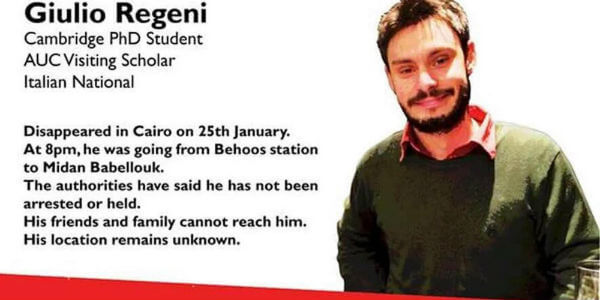
The Guardian reports: Italian authorities are demanding a full investigation into the death of an Italian student whose body was found in Cairo bearing signs that he had been tortured.
The body of Giulio Regeni, a 28-year-old who was pursuing a PhD at Cambridge, was found in a ditch in the suburbs outside Cairo on Wednesday night, days after the Italian government announced it was growing increasingly concerned about his disappearance.
The Egyptian prosecutor leading the investigation team on the case said Regeni’s body had been found with stab wounds, cigarette burns, cuts to the ears and signs of beatings and a “slow death”. Reports in the local media said he was found naked from the waist down. The body was found on Wednesday, and it is believed that he may have been killed days earlier. [Continue reading…]
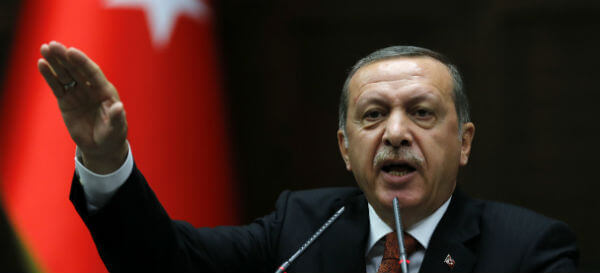
Behlul Ozkan writes: Last month, more than 1,200 Turkish and foreign academics signed a petition calling attention to the continuing humanitarian crisis in many Kurdish-majority towns in southeastern Turkey, which are the site of fighting between the Turkish Army and the Kurdistan Workers’ Party, or P.K.K. The petition decried the Army’s shelling of urban areas and the imposition of weekslong, 24-hour curfews, which have left many civilians unable to bury their dead or even obtain food. President Recep Tayyip Erdogan publicly denounced the signers as “so-called intellectuals” and “traitors.” Within days, antiterror police had detained and harassed dozens of the signatories.
Mr. Erdogan’s actions shouldn’t have been surprising. The president has a history of jailing journalists and cracking down on media companies critical of his policies. And yet this time the response from his supporters was exceptionally chilling: A pro-Erdogan organized crime boss proclaimed, “We will take a shower in your blood,” while the office doors of some of the academics were ominously marked with red crosses.
Prime Minister Ahmet Davutoglu, who as a former academic might have been expected to come to his colleagues’ defense, announced that he “did not regard the petition as falling under the rubric of free speech.” He then set out on a trip to several European countries in order to encourage foreign investment in Turkey’s foundering economy. In Britain and Germany, Mr. Davutoglu received a warm welcome from Prime Minister David Cameron and Chancellor Angela Merkel. The European Union’s response to the latest crackdown on dissent in Turkey amounted to little more than a statement calling the persecution of the academics “extremely worrying.”
Many prominent Western academics and non-governmental organizations have been vocal in censuring the persecution suffered by their Turkish counterparts. The European Union’s lack of action on Turkey’s crackdown on academic freedom and human rights would therefore be inexplicable but for one crucial detail: As the European Union faces its largest refugee crisis since World War II, the 2.5 million Syrians currently in Turkey are a huge bargaining chip for Ankara. Europe’s leaders are well aware of this. [Continue reading…]
President Obama said: This is a moment when, as Americans, we have to truly listen to each other and learn from each other. And I believe it has to begin with a common understanding of some basic facts. And I express these facts, although they’d be obvious to many of the people in this place, because, unfortunately, it’s not facts that are communicated on a regular basis through our media.
So let’s start with this fact: For more than a thousand years, people have been drawn to Islam’s message of peace. And the very word itself, Islam, comes from salam — peace. The standard greeting is as-salamu alaykum — peace be upon you. And like so many faiths, Islam is rooted in a commitment to compassion and mercy and justice and charity. Whoever wants to enter paradise, the Prophet Muhammad taught, “let him treat people the way he would love to be treated.” (Applause.) For Christians like myself, I’m assuming that sounds familiar. (Laughter.)
The world’s 1.6 billion Muslims are as diverse as humanity itself. They are Arabs and Africans. They’re from Latin America to Southeast Asia; Brazilians, Nigerians, Bangladeshis, Indonesians. They are white and brown and black. There’s a large African American Muslim community. That diversity is represented here today. A 14-year-old boy in Texas who’s Muslim spoke for many when he wrote to me and said, “We just want to live in peace.”
Here’s another fact: Islam has always been part of America. Starting in colonial times, many of the slaves brought here from Africa were Muslim. And even in their bondage, some kept their faith alive. A few even won their freedom and became known to many Americans. And when enshrining the freedom of religion in our Constitution and our Bill of Rights, our Founders meant what they said when they said it applied to all religions.
Back then, Muslims were often called Mahometans. And Thomas Jefferson explained that the Virginia Statute for Religious Freedom he wrote was designed to protect all faiths — and I’m quoting Thomas Jefferson now — “the Jew and the Gentile, the Christian and the Mahometan.” (Applause.)
Jefferson and John Adams had their own copies of the Koran. Benjamin Franklin wrote that “even if the Mufti of Constantinople were to send a missionary to preach to us, he would find a pulpit at his service.” (Applause.) So this is not a new thing. [Continue reading…]
The New York Times reports: For Mr. Obama, the remarks were also an admission of how little progress has been made since the speech in Cairo [in 2009], where he called for “a sustained effort to listen to each other, to learn from each other, to respect one another, and to seek common ground.” In his speech on Wednesday, he suggested that his hopes for a reconciliation had been dashed, but he called on all Americans to stick by the country’s founding ideals.
Muslims in the audience hailed the address.
“I think it was one of the best speeches he’s ever given,” said Representative André Carson, an Indiana Democrat. Representative Keith Ellison, a Minnesota Democrat, said the speech “hit me in the heart” and was a vital antidote to growing intolerance.
“I have a 19-year-old daughter who is a Muslim and wants to contribute to her nation, and it bugs me that someone who says he wants to be president would want to exclude her,” Mr. Ellison said.
But Morton Klein, president of the Zionist Organization of America, one of the country’s oldest and largest pro-Israel organizations, denounced Mr. Obama for visiting a mosque whose leaders, Mr. Klein said, have among other issues criticized Israeli military actions. “Going to such a mosque only encourages radical Muslims to harm Americans,” Mr. Klein said. [Continue reading…]
TSG IntelBrief: On February 2, Syrian government forces, backed by Russian air support, continued a major push to cut rebel supply lines north of Aleppo. On top of recent successes against the rebels elsewhere, it appears that President Assad is determined to maintain military momentum even while peace talks stutter along in Geneva. In fact, given the opposition demand for a ceasefire against civilians—as called for by Security Council resolution 2254 (2015) adopted in mid-December—Assad’s actions appear calculated to bring the peace talks to a halt.
This is understandable for Assad, but unfortunate for Syria. Opposition groups have come a long way towards agreeing to a common position since the last attempt to hold talks in early 2014, and their representatives are far more likely to be able to implement an agreement now. The previous talks suffered from a disconnect between the political opposition around the table and the fighters on the ground, as well as from disagreements surrounding objectives. Efforts by Qatar, Turkey and Saudi Arabia—aided by the United States—have brought the majority of rebel groups together as the High Negotiations Committee (HNC). And although the alliance is fragile—and the extent to which it also represents Ahrar al-Sham, a key element of the opposition, remains unclear—the HNC has more credibility than any opposition alliance that has emerged previously.
The so-called Islamic State and al-Qaeda affiliate Jabhat al-Nusra (JaN) are expressly excluded from the HNC, as they are from the peace talks. Ahrar al-Sham, though a deeply conservative Islamist group that was originally seen as a sister organization to JaN, has steadily distanced itself from the global aspirations of al-Qaeda towards a strictly nationalist platform with no stated ambition beyond Syria. This has created divisions among its supporters and led to the assassinations of its leaders, but the group has nonetheless survived as a major force. JaN has tried repeatedly to merge with Ahrar al-Sham before it drifts too far away, but recent talks collapsed when JaN agreed to change its name, but not to abandon its affiliation to al-Qaeda. Tensions between the two groups have risen as a result and have led to armed clashes. JaN now faces an impending split as pressure builds to relax its hard line. [Continue reading…]
Reuters reports: Britain said on Tuesday Russia could be trying to carve out an Alawite mini-state in Syria for its ally President Bashar al-Assad by bombing his opponents instead of fighting Islamic State militants.
Russia and Britain have been trading barbs after British Foreign Secretary Philip Hammond told Reuters he believed President Vladimir Putin was worsening the Syrian civil war by bombing opponents of Islamic State.
Hammond dismissed Russian criticism that he was spreading “dangerous disinformation”, saying there was a limit to how long Russia could pose as a promoter of the peace process while bombing Assad’s opponents, who the West hopes can shape Syria once the president is gone.
“Is Russia really committed to a peace process or is it using the peace process as a fig leaf to try to deliver some kind of military victory for Assad that creates an Alawite mini state in the northwest of Syria?” Hammond told reporters in Rome.
The comments indicate growing frustration in Western capitals about Putin’s intervention, alongside Iran, in Syria but also give a frank insight into the Western assessment of the Kremlin’s potential objectives for Syria. [Continue reading…]
Judy Dempsey writes: Russia’s propaganda machine—which went full blast against members of the Ukrainian government during the Ukraine crisis, labeling them fascists and anti-Semites—is in full swing again. This time, the target is Germany, once considered Russia’s closest ally in Europe.
Ever since Chancellor Angela Merkel declared her intention to allow refugees from Syria to enter Germany, the Russian media have been reporting every twist and turn of the opposition that is building up in her conservative bloc and among sections of the German public to her open-door refugee policy.
But in recent days, the Russian state media, joined by none other than Sergey Lavrov, the Russian foreign minister, have taken a different turn. They are tapping into Germany’s community of 1.2 million ethnic Russians to criticize Merkel’s policies and boost those who are unequivocally against Germany taking in refugees. The community is known for its conservative if not xenophobic views, as witnessed during demonstrations by Germany’s anti-Islam Pegida movement, in which ethnic Russians participate.
Now, Russia may be using Germany’s Russian-speaking community to create further opposition to Merkel, similar to the way it tries to instrumentalize the ethnic Russian communities in the Baltic states. Merkel is an easy target, certainly for many Russians living in Germany and for Russians back home. To the surprise and annoyance of the Kremlin, Merkel has managed to keep the EU united over maintaining sanctions on Russia after it annexed Crimea in March 2014 and subsequently invaded eastern Ukraine. [Continue reading…]
The Associated Press reports: The Russian military has beefed up its air group in Syria with state-of-the art fighter jets amid tensions with Turkey.
Russian Defense Ministry spokesman Igor Konashenkov said Monday that Su-35 fighters have been deployed to Hemeimeem air base in Syria. Konashenkov on Monday didn’t say how many Su-35s had been sent to Syria, but Russian media reports said there were four of them and state television showed them parked in Hemeimeem.
Russian warplanes so far have flown about 6,000 missions since Moscow launched its air campaign four months ago. [Continue reading…]
Semih Idiz writes: Tensions between Russia and Turkey continue to escalate following the downing in November of a Russian Su-24 fighter jet that strayed into Turkish airspace.
Questions are being raised now whether the two countries are heading for a military confrontation. A leading Turkish military expert told Al-Monitor that such a Russian move could spell disaster for Turkey.
Turkey accused Russia of violating its airspace again last week and summoned Russia’s ambassador in Ankara to lodge a formal protest. President Recep Tayyip Erdogan and Prime Minister Ahmet Davutoglu also warned Moscow that it was playing with fire and would have to face the consequences. [Continue reading…]
Adam Taylor writes: There may be no more globally divisive question over the past few years than whether the Islamic State is representative of the world’s global Muslim population or not. Speaking in Rome on Tuesday, U.S. Secretary of State John F. Kerry waded into this controversial debate yet again – and took a remarkably strong position for a Western leader.
“Daesh is in fact nothing more than a mixture of killers, of kidnappers, of criminals, of thugs, of adventurers, of smugglers and thieves,” Kerry said. “And they are also above all apostates, people who have hijacked a great religion and lie about its real meaning and lie about its purpose and deceive people in order to fight for their purposes.”
The use of the word “apostates” – a term to describe someone who renounces or abandons their religion – has raised eyebrows among observers. The description has been commonly used by extremist groups: The Islamic State has justified its attacks on Muslims with rhetoric that suggests these Muslims were apostates, which they view as a crime punishable by death.
On Twitter, Nasser Weddady, a popular online activist who grew up in Syria, mocked Kerry for his comment. Wedaddy and others also jokingly suggested that Kerry was a “takfiri,” a word used to describe a Sunni Muslim who accuses others of apostasy. [Continue reading…]
The Daily Beast reports: In the war against the self-proclaimed Islamic State, there are two ways to count the number of U.S. boots on the ground. There’s the one that officials admit to. Then there’s the ground truth.
Officially, there are now 3,650 U.S. troops in Iraq, there primarily to help train the Iraqi national army.
But in reality, there are already about 4,450 U.S. troops in Iraq, plus another nearly 7,000 contractors supporting the American government’s operations. That includes almost 1,100 U.S. citizens working as military contractors, according to the latest Defense Department statistics. [Continue reading…]
Paul Wood and Richard Hall report: Al Gharra is a mud-brick village built on hard, flat Syrian desert and populated by the descendants of Bedouin. It is a desolate place. Everything is dun colored: the bare, single-story houses and the stony desert they stand on. There is not much farming — it is too dry — just a few patches of cotton and tobacco.
Before the war, villagers got a little money from the government to look after the national park on Mount Abdul-Aziz, a barren rock that rises 3,000 feet behind the village and stretches miles into the distance. Mount Abdul-Aziz is named after a lieutenant of the 12th-Century Muslim warrior Saladin, who built a fort to dominate the plain below. There is a military base there today too, which changes hands according to the fortunes of Syria’s civil war. In 2011, the regime of Bashar al-Assad held the base; next it was the rebels of the Free Syrian Army; then the so-called “Islamic State” (IS); and finally the Kurds, who advanced and took the mountain last May under the cover of American warplanes.
Abdul-Aziz al Hassan is from al Gharra, his first name the same as the mountain’s. He left the village while the Islamic State was in charge, but it is because of a bomb from an American plane that he cannot go back. What happened to his family is the story of just one bomb of the 35,000 dropped so far during 10,000 missions flown in the US-led air war against the Islamic State. [Continue reading…]
The Washington Post reports: The top U.S. general in Iraq on Monday addressed recent political rhetoric in the presidential campaign that the United States should “carpet-bomb” the Islamic State, saying that the Pentagon is bound by the laws of armed conflict and does nt indiscriminately bomb civilian areas.
“We’re the United States of America, and we have a set of guiding principles and those affect the way we as professional soldiers, airmen, sailors, Marines, conduct ourselves on the battlefield,” MacFarland said. “So indiscriminate bombing, where we don’t care if we’re killing innocents or combatants, is just inconsistent with our values. And it’s what the Russians have been accused of doing in parts of northwest Syria. Right now we have the moral high ground, and I think that’s where we need to stay.”
The comments came in response to a question from CNN’s Barbara Starr during a Pentagon news conference. The general was asked why the military isn’t engaged in “so-called carpet-bombing,” a phrase that has been used often by presidential candidate Sen. Ted Cruz (R.-Tex.). [Continue reading…]
The New York Times reports: President Obama plans to substantially increase the deployment of heavy weapons, armored vehicles and other equipment to NATO countries in Central and Eastern Europe, a move that administration officials said was aimed at deterring Russia from further aggression in the region.
The White House plans to pay for the additional weapons and equipment with a budget request of more than $3.4 billion for military spending in Europe in 2017, several officials said Monday, more than quadrupling the current budget of $789 million. The weapons and equipment will be used by American and NATO forces, ensuring that the alliance can maintain a full armored combat brigade in the region at all times.
Though Russia’s military activity has quieted in eastern Ukraine in recent months, Moscow continues to maintain a presence there, working with pro-Russian local forces. Administration officials said the additional NATO forces were calculated to send a signal to President Vladimir V. Putin that the West remained deeply suspicious of his motives in the region.
“This is not a response to something that happened last Tuesday,” a senior administration official said. “This is a longer-term response to a changed security environment in Europe. This reflects a new situation, where Russia has become a more difficult actor.” [Continue reading…]
The Washington Post reports: As Iraqi security forces choke off Islamic State fighters in the militant-held city of Fallujah, civilians inside say they are trapped and struggling to survive.
The military siege, which has tightened in the past two months, is preventing food and medical supplies from reaching the city 40 miles west of Baghdad, while the Islamic State won’t let families leave.
The United Nations says it is “deeply worried” about the deteriorating humanitarian situation and unverified reports of deaths from a lack of food and basic medicine.
Between 30,000 and 60,000 people are estimated to remain in the city, which has been under Islamic State control for more than two years. Their worsening plight comes amid an international outcry over starvation in the besieged Syrian town of Madaya — a disaster residents and officials from Fallujah say they fear could also unfold there if civilians aren’t evacuated. [Continue reading…]
This website or its third-party tools use cookies, which are necessary to its functioning. By closing this banner, you agree to the use of cookies.