Obama’s plan to punish Assad is likely to do more harm than good

Elizabeth O’Bagy writes: With the U.S. poised to attack Syria, debate is raging over what that attack should look like, and what, if anything, the U.S. is capable of accomplishing. Those questions can’t be answered without taking a very close look at the situation in Syria from ground level.

Since few journalists are reporting from inside the country, our understanding of the civil war is not only inadequate, but often dangerously inaccurate. Anyone who reads the paper or watches the news has been led to believe that a once peaceful, pro-democracy opposition has transformed over the past two years into a mob of violent extremists dominated by al Qaeda; that the forces of President Bashar Assad not only have the upper hand on the battlefield, but may be the only thing holding the country together; and that nowhere do U.S. interests align in Syria—not with the regime and not with the rebels. The word from many American politicians is that the best U.S. policy is to stay out. As Sarah Palin put it: “Let Allah sort it out.”

In the past year, I have made numerous trips to Syria, traveling throughout the northern provinces of Latakia, Idlib and Aleppo. I have spent hundreds of hours with Syrian opposition groups ranging from Free Syrian Army affiliates to the Ahrar al-Sham Brigade.

The conventional wisdom holds that the extremist elements are completely mixed in with the more moderate rebel groups. This isn’t the case. Moderates and extremists wield control over distinct territory. Although these areas are often close to one another, checkpoints demarcate control. On my last trip into Syria earlier this month, we traveled freely through parts of Aleppo controlled by the Free Syrian Army, following roads that kept us at safe distance from the checkpoints marked by the flag of the Islamic State of Iraq. Please see the nearby map for more detail.

Contrary to many media accounts, the war in Syria is not being waged entirely, or even predominantly, by dangerous Islamists and al Qaeda die-hards. The jihadists pouring into Syria from countries like Iraq and Lebanon are not flocking to the front lines. Instead they are concentrating their efforts on consolidating control in the northern, rebel-held areas of the country.

Groups like Jabhat al Nusra, an al Qaeda affiliate, are all too happy to take credit for successes on the battlefield, and are quick to lay claim to opposition victories on social media. This has often led to the impression that these are spearheading the fight against the Syrian government. They are not.

These groups care less about defeating Assad than they do about establishing and holding their Islamic emirate in the north of the country. Many Jabhat al Nusra fighters left in the middle of ongoing rebel operations in Homs, Hama and Idlib to head for Raqqa province once the provincial capital fell in March 2013. During the battle for Qusayr in late May, Jabhat al Nusra units were noticeably absent. In early June, rebel reinforcements rallied to take the town of Talbiseh, north of Homs city, while Jabhat al Nusra fighters preferred to stay in the liberated areas to fill the vacuum that the Free Syrian Army affiliates had left behind.

Moderate opposition forces—a collection of groups known as the Free Syrian Army—continue to lead the fight against the Syrian regime. While traveling with some of these Free Syrian Army battalions, I’ve watched them defend Alawi and Christian villages from government forces and extremist groups. They’ve demonstrated a willingness to submit to civilian authority, working closely with local administrative councils. And they have struggled to ensure that their fight against Assad will pave the way for a flourishing civil society. One local council I visited in a part of Aleppo controlled by the Free Syrian Army was holding weekly forums in which citizens were able to speak freely, and have their concerns addressed directly by local authorities.

Moderate opposition groups make up the majority of actual fighting forces, and they have recently been empowered by the influx of arms and money from Saudi Arabia and other allied countries, such as Jordan and France. This is especially true in the south, where weapons provided by the Saudis have made a significant difference on the battlefield, and have helped fuel a number of recent rebel advances in Damascus.

Thanks to geographic separation from extremist strongholds and reliable support networks in the south, even outdated arms sent by the Saudis, like Croatian rocket-launchers and recoilless rifles, have allowed moderate rebel groups to make significant inroads into areas that had previously been easily defended by the regime, and to withstand the pressure of government forces in the capital. In recent months, the opposition has achieved major victories in Aleppo, Idlib, Deraa and Damascus—nearly reaching the heart of the capital—despite the regime’s consolidation in Homs province.

At this stage in the conflict, barring a major bombing campaign by the U.S., sophisticated weaponry, including anti-tank and anti-aircraft weapon systems, may be the opposition’s best chance at sustaining its fight against Assad. This is something only foreign governments, not jihadists, can offer. Right now, Saudi sources that are providing the rebels critical support tell me that they haven’t sent more effective weaponry because the U.S. has explicitly asked them not to.

There is no denying that groups like Jabhat al Nusra and the Islamic State of Iraq and al-Sham have gained a foothold in the north of Syria, and that they have come to dominate local authorities there, including by imposing Shariah law. Such developments are more the result of al Qaeda affiliates having better resources than an indicator of local support. Where they have won over the local population, they have done so through the distribution of humanitarian aid.

Yet Syrians have pushed back against the hard-line measures imposed on them by some of these extremists groups. While I was last in northern Syria in early August, I witnessed nearly daily protests by thousands of citizens against the Islamic State of Iraq and al-Sham in areas of Aleppo.

Where does this leave the U.S. as the White House contemplates a possible strike? The Obama administration has emphasized that regime change is not its goal. But a punitive measure undertaken just to send a message would likely produce more harm than good. If the Syrian government is not significantly degraded, a U.S. strike could very well bolster Assad’s position and highlight American weakness, paving the way for continued atrocities. [Continue reading…]


Facebooktwittermail

China joins Russia in opposing military strikes on Syria

The Guardian reports: The Chinese intervention came as G20 leaders gathered in St Petersburg on Thursday for a summit likely to be dominated by Syria. The Russian president, Vladimir Putin, is now expected to allow the issue on the agenda for dinner, reflecting the reality that the fate of the world economy is inextricably intertwined with the risk of a Middle East conflagration.

The Chinese deputy finance minister, Zhu Guangyao, told a pre-G20 briefing: “Military action would have a negative impact on the global economy, especially on oil prices – it will cause a hike in the oil price.”

The UN special envoy on Syria, Lakhdar Brahimi, is also rushing to the summit to update G20 leaders on the state of stalled peace talks.

It also emerged that the pope has written to Putin, reportedly saying military action would be a futile pursuit.

In a sign of tensions ahead of the summit, Putin called the US secretary of state a liar for claiming al-Qaida did not have a significant presence in Syria. He also warned that US bombing of Syria could lead to highly dangerous attacks on Syrian nuclear reactors.

EU leaders have expressed their concern at the pace of the drive to war. The president of the European commission, José Manuel Barroso, said consensus in the international community was needed on Syria and argued efforts should be focused on a political solution.

Herman Van Rompuy, the president of the European council, said: “No military solution to the Syrian conflict.”

Italy’s prime minister, Enrico Letta, also claimed the summit was the “last opportunity” for negotiated and political solutions to Syria’s civil war.

Letta urged Putin to “avoid” a final break with Washington over Syria, adding that concern over Syria had hit “maximum” levels.

In contrast, the French foreign minister said: “The position of France is to punish and negotiate.”

“We are convinced that if there is no punishment for Mr Assad, there will be no negotiation,” Laurent Fabius told France 2 television before travelling to the summit. “Punishment will allow negotiation, but obviously it will be difficult.” [Continue reading…]

Facebooktwittermail

Defecting Assad ally reaches Istanbul

Reuters reports: Bashar al-Assad’s former defense minister has reached Istanbul after a defection that betrays cracks in the president’s support among his own Alawite sect, opposition and diplomatic sources said on Thursday.

Dismissing a cursory Syrian state television denial of the first Reuters report that General Ali Habib had been spirited across the Turkish frontier this week, opposition figures said Habib was likely to keep a low profile after evading house arrest and reaching Turkey with the aid of Western agents.

One prominent opposition figure also spoke of speculation that Habib, who is in his 70s and apparently broke with Assad after a crackdown on protesters in 2011, might be lined up by U.S. and Russian officials for a role in transitional arrangements to negotiate an end to the civil war.

“My information, based on a trusted Western source, is that he is in Istanbul,” veteran dissident Kamal al-Labwani, now based in Paris, told Reuters on Thursday. “Habib exited with Western intelligence involvement, so do not expect public statements by security operatives on his whereabouts.”

Facebooktwittermail

Rockets in Syrian attack carried large payload of gas, experts say

The New York Times reports: A new study of images apparently from the Syrian attack last month concludes that the rockets delivering toxic sarin gas to neighborhoods around Damascus held up to 50 times more nerve agent than previously estimated, a conclusion that could solve the mystery of why there were so many more victims than in previous chemical attacks.

The study, by leading weapons experts, also strongly suggests that the mass of toxic material could have come only from a large stockpile. American, British and French officials have charged that only the Syrian government and not the rebels was in position to make such large quantities of deadly toxins.

Secretary of State John Kerry told Congress, in hearings on Tuesday and Wednesday, that the United States believes the Syrian military was responsible for the attack, and in classified briefings officials have pointed to Unit 450, which controls Syrian chemical weapons.

The new study was conducted by Richard M. Lloyd, an expert in warhead design, and Theodore A. Postol, a physicist at the Massachusetts Institute of Technology. They based their investigation on scores of online videos and photographs posted since the Aug. 21 attack sent thousands of sick and dying Syrians to hospitals in the Damascus suburbs.

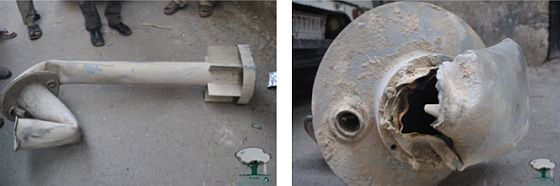
In interviews and reports, the two weapons specialists said their analysis of rocket parts and wreckage posted online suggested that the warheads carried toxic payloads of about 50 liters (13 gallons), not the one or two liters (up to half a gallon) of nerve agent that some weapons experts had previously estimated.

“It’s a clever design,” Dr. Postol said of the munitions in an interview. “It’s clever not only in how it was implemented but in the effectiveness of its dispersal. It accounts for the large number of causalities.”

Shortly after the attack, some analysts said they doubted if the identified rockets could have carried enough nerve agent to have caused the mass casualties. Mr. Lloyd and Dr. Postol say their analysis explains how the misidentification of a central rocket part resulted in the excessively small payload estimates.

In an interview, Mr. Lloyd said the manufacture of the rockets, if not the deadly nerve agent, appeared to be within the capabilities of both the Syrian government and the rebels.

But Stephen Johnson, a former British Army chemical warfare expert who is now a forensic expert at Cranfield University, at Shrivenham, said if the estimate of a 50-liter payload was correct, only the Syrian government could have achieved such a large volume of production.

“That’s a fairly substantial amount to produce yourself and beyond the opposition in its wildest dreams,” he said. Suggestions that the Syrian rebels seized or secretly obtained such amounts, Mr. Johnson added, lacked credibility. “It’s more supportive of the argument that it was the government,” he said. [Continue reading…]

Facebooktwittermail

Syrian chemical weapons: how lab tests uncover evidence of sarin gas

The Guardian reports: The latest tests from Porton Down will strengthen the consensus that the nerve agent sarin was used in the deadly attack in eastern Damascus in August.

Scientists at the lab found signs of sarin in soil taken from the site of the attack, and also on clothing from a person caught up in the atrocity that the US says killed more than 1,400 people.

The UK government will not say what signatures of sarin the scientists have found, but the details are important. The specific chemicals that tests reveal are often the only solid proof that a nerve agent has been used, and what kind of chemical was unleashed.

Tests on soil and clothing will rarely pick up sarin itself, because the agent breaks down swiftly when it meets water, which could be moisture in the air or sweat from the victim. More likely they will detect traces of sarin’s breakdown products, but these must be interpreted with care.

Beyond finding intact sarin, the most convincing smoking gun for the nerve agent is a compound called isopropyl methylphosphonic acid (IMPA). This is the chemical that sarin degrades into first of all and it can come from nothing else. Among chemical weapons experts, a positive test for IMPA is generally regarded as proof of sarin.

But tests can struggle to pick up IMPA in samples much older than a week or so, because it too breaks down into other substances. One is a related compound, called methylphosphonic acid (MPA), but this is not solid proof for sarin: other agents also degrade into MPA, such as VX, soman and cylcosarin. [Continue reading…]

Facebooktwittermail

Russia cites but doesn’t release report claiming Syrian rebels used sarin in Aleppo in March

McClatchy runs the headline: “Russia says it’s compiled 100-page report blaming Syrian rebels for a chemical weapons attack”. Generally speaking, I think McClatchy does a commendable job in refusing to parrot whatever might be the official line coming out of Washington. In this case, however, I think they let their readers down by using a misleading headline.

A lot of people glean their news from reading nothing more than headlines and in this case will likely have missed the indefinite article — a chemical attack — and assumed the Russian report refers to the chemical attack in Damascus on August 21.

Evidence that opposition forces had used sarin in Aleppo would be significant, so given that Russia’s foreign ministry asserts that it produced a detailed 100-page “scientific and technical document”, why have they not made the report public and why are they publicizing its existence weeks after they delivered it to the UN? And given that Russia remains a loyal ally of the Assad regime, how are we to trust the objectivity of a report based on evidence collected by Russian technicians which was then examined in Russian laboratories?

McClatchy reports: Russia says it has compiled a 100-page report detailing what it says is evidence that Syrian rebels, not forces loyal to President Bashar Assad, were behind a deadly sarin gas attack in an Aleppo suburb earlier this year.

In a statement posted on the Russian Foreign Ministry’s website late Wednesday. Russia said the report had been delivered to the United Nations in July and includes detailed scientific analysis of samples that Russian technicians collected at the site of the alleged attack, Khan al Asal.

Russia said its investigation of the March 19 incident was conducted under strict protocols established by the Organization for the Prohibition of Chemical Weapons, the international agency that governs adherence to treaties prohibiting the use of chemical weapons. It said samples that Russian technicians had collected had been sent to OPCW-certified laboratories in Russia.

The report itself was not released. But the statement drew a pointed comparison between what it said was the scientific detail of the report and the far shorter intelligence summaries that the United States, Britain and France have released to justify their assertion that the Syrian government launched chemical weapons against Damascus suburbs on Aug. 21. The longest of those summaries, by the French, ran nine pages. Each relies primarily on circumstantial evidence to make its case, and they disagree with one another on some details, including the number of people who died in the attack.

The Russian statement warned the United States and its allies not to conduct a military strike against Syria until the United Nations had completed a similarly detailed scientific study into the Aug. 21 attack. It warned that what it called the current “hysteria” about a possible military strike in the West was similar to the false claims and poor intelligence that preceded the United States invasion of Iraq. [Continue reading…]

Facebooktwittermail

Egypt’s interior minister survives bomb attack

The Associated Press reports: Egypt’s interior minister escaped an assassination attempt Thursday when a suspected car bomb struck his convoy in a Cairo neighborhood, in the first attack on a senior government official since the country’s Islamist president was toppled in a coup two months ago.

The assassination attempt against Mohammed Ibrahim, who is in charge of the police force, fueled concerns over a possible wave of violence in retaliation for the July 3 ouster of Mohammed Morsi and the ensuing crackdown on Islamists.

The blast wounded at least 22 police and civilian bystanders and heavily damaged three vehicles in Ibrahim’s convoy — though he survived unhurt. Security officials said initial investigations showed it came from a parked car loaded with explosives in the trunk. They spoke on condition of anonymity because the probe was not yet complete.

The attack echoed the sort of insurgency-style methods that Islamic militants have increasingly used in Egypt’s tumultuous Sinai Peninsula. Last month, militants there attempted a suicide car bombing but were killed by police before carrying it out.

Facebooktwittermail

Obama rewrites history — disowns ‘red line’ on use of chemical weapons in Syria

August 20, 2012:

Chuck Todd: Mr. President, could you update us on your latest thinking of where you think things are in Syria, and in particular, whether you envision using U.S. military, if simply for nothing else, the safe keeping of the chemical weapons, and if you’re confident that the chemical weapons are safe?

President Obama: I have, at this point, not ordered military engagement in the situation. But the point that you made about chemical and biological weapons is critical. That’s an issue that doesn’t just concern Syria; it concerns our close allies in the region, including Israel. It concerns us. We cannot have a situation where chemical or biological weapons are falling into the hands of the wrong people.

We have been very clear to the Assad regime, but also to other players on the ground, that a red line for us is we start seeing a whole bunch of chemical weapons moving around or being utilized. That would change my calculus. That would change my equation.

September 4, 2013:

Yahoo News: Recasting his role in setting a “red line” on Syria, President Barack Obama insisted on Wednesday that Congress and the world will lose credibility if Bashar Assad’s alleged chemical weapons massacre goes unpunished.

“My credibility’s not on the line. The international community’s credibility is on the line, and America and Congress’ credibility is on the line,” Obama said during a visit to Stockholm, Sweden.

“I do have to ask people, well, if, in fact, you’re outraged by the slaughter of innocent people, what are you doing about it?” Obama asked. “The moral thing to do is not to stand by and do nothing.”

The president rejected any notion that he needs to use military force against Syria in order to preserve his personal standing in the world after calling a chemical weapons attack a “red line” in an Aug. 20, 2012, press conference.

“I didn’t set a red line. The world set a red line,” he insisted.

So is Obama now not merely U.S. president but also president of the world? When he says “my calculus” this doesn’t merely reflect his own thinking — it represents the will of humanity?

The people who fear world government are mostly nutcases, but when Obama talks like this he fuels their paranoia.

You — Barack Obama, the guy sitting in the White House — it was you who set that red line. You weren’t giving a legal interpretation of the Chemical Weapons Convention to which Syria isn’t even a signatory.

Moreover, it’s worth noting, as the Washington Post points out, Syria’s possession of chemical weapons stockpiles “results from a never-acknowledged gentleman’s agreement in the Middle East that as long as Israel had nuclear weapons, Syria’s pursuit of chemical weapons would not attract much public acknowledgement or criticism.”

Obama now says: “The moral thing to do is not to stand by and do nothing.” True. And given that, how does he account for the fact that for the last two years, as 100,000 Syrians have been killed, he has essentially stood by and done nothing?

As always though, this isn’t a choice between nothing and something, the “something” now seemingly reduced to a Goldilocks military strike — one that is not too hot, nor too cool.

In several directions there are diplomatic doors inching open — in Iran and Russia. Instead of pursuing those, Obama appears to insist on a course of action that might end becoming worse than nothing and there’s nothing moral about that.

Facebooktwittermail

When the United States looked the other way on chemical weapons

Glenn Kessler reports: One of the administration’s main arguments for attacking Syria is because the government crossed an important line by using chemical weapons against its own people.

Rep. Nancy Pelosi, a strong supporter of military strikes, echoed that argument on Tuesday. She noted that as far back as 1925, nearly 40 nations had joined together to ban the first use of chemical weapons when the Geneva Protocol was signed. (Her mention of 170 countries appears to refer to the 1993 Chemical Weapons Convention, which seeks to prohibit the production of chemical weapons and mandates their destruction; Syria has refused to sign the treaty, though 189 other countries have signed it.)

Such treaties generally do not have mechanisms for enforcement. As far as we know, no nation has ever attacked another to punish it for the use of chemical weapons, so Obama’s request is unprecedented.

Indeed, Syria’s chemical weapons stockpile results from a never-acknowledged gentleman’s agreement in the Middle East that as long as Israel had nuclear weapons, Syria’s pursuit of chemical weapons would not attract much public acknowledgement or criticism. (The Fact Checker, when serving as The Washington Post’s diplomatic correspondent, learned of this secret arrangement from Middle Eastern and Western diplomats, but it was never officially confirmed.) These are the sorts of trade-offs that happen often in diplomacy. After all, Israel’s nuclear stockpile has never been officially acknowledged, and Syria in the 1980s and 1990s was often supportive of U.S. interests in the region, even nearly reaching a peace deal with Israel.

But there is an even more striking instance of the United States ignoring use of the chemical weapons that killed tens of thousands of people — during the grinding Iraq-Iran war in the 1980s. As documented in 2002 by Washington Post reporter Michael Dobbs, the Reagan administration knew full well it was selling materials to Iraq that was being used for the manufacture of chemical weapons, and that Iraq was using such weapons, but U.S. officials were more concerned about whether Iran would win rather than how Iraq might eke out a victory. Dobbs noted that Iraq’s chemical weapons’ use was “hardly a secret, with the Iraqi military issuing this warning in February 1984: ”The invaders should know that for every harmful insect, there is an insecticide capable of annihilating it . . . and Iraq possesses this annihilation insecticide.” [Continue reading…]

Just in case anyone doubts that Bashar al-Assad has genocidal intentions much like those of Saddam Hussein, in an interview this week he made it clear that the only way he thinks he can deal with his opponents is “to annihilate them.”

Syrian President Bashar al-Assad has said there is no longer hope for a political solution to the conflict in Syria and that the only way to deal with the rebels challenging his leadership “is to annihilate them.”

In an interview with Le Figaro, a French newspaper, Assad claimed that rebel forces had been almost entirely infiltrated by al-Qaeda.

“We are fighting terrorists,” he said. “80-90% of those we are fighting belong to al-Qaeda. They are not interested in reform or in politics. The only way to deal with them is to annihilate them.”

Facebooktwittermail

Israel lobby strongly supports attack on Syria

Haaretz reports: The American Jewish establishment jumped off the fence on Tuesday and came out in full support of Congressional approval of President Barack Obama’s plans to launch a military strike against Syria’s chemical weapon capacity.

And Israeli Ambassador Michael Oren took the unusual step of expressing support for elements of President Obama’s statements on Syria, including his assertion that the Assad regime must be held accountable and that there should be “international consequences” for his use of chemical weapons.

The sudden unified burst of support for Obama’s request for Congressional authorization for a strike against Syria follows almost two weeks in which Jewish organizations have maintained a low profile on the August 21 chemical attack near Damascus and the American response to it.

Jewish leaders told Haaretz that the public support expressed in the past two days by leading Republican figures such as Representatives John Boehner and Eric Cantor, as well as the qualified backing shown by Senator John McCain, allayed concerns that the Jewish groups would be accused of taking sides in a political feud between the two parties. “The dynamics changed overnight,” one source said.

The Conference of Presidents of Major Jewish Organizations said in a statement that “failing to take action would damage the credibility of the U.S. and negatively impact the effort to prevent Iran from achieving a nuclear weapons capacity.”

The American Jewish Committee sent a letter to all members of Congress expressing support for Obama’s request for “limited military action” against Syria and warning that “acquiescence in the face of the crimes evidently committed by the Assad regime would doubtless have wide-ranging consequences for U.S. interests and influence in the Middle East and around the world.”

The pro-Israel lobby AIPAC urged Congress to “grant the president the authority to protect America’s security interests.” The lobby’s statement said that “barbarism on a mass scale must not be given a free pass.” And sources said that AIPAC would henceforth lobby Congress to support the use of force against Bashar Assad.

The Anti-Defamation League went a step further, lauding Obama’s “demonstration of U.S. leadership” and calling on Congress to “swiftly add its voice to hold Assad accountable for the wanton slaughter of his own citizens.”

ADL National Director Abe Foxman told Haaretz that from a “moral perspective” there was “nothing to debate” because of “our own people’s experience with gas.” In addition, he said, the threat to America’s national security interests in the Middle East, in which Israel has such a high stake, “go above and beyond any political consideration.”

Malcolm Hoenlein, Executive Vice President of the Conference of Presidents, said yesterday that the statement reflects the “general consensus” of the American Jewish organizations. He said that some organizations expressed concerns about taking sides in a political battle, but that briefings by the Administration helped to forge the Conference’s statement, which reflects the “middle ground” of various Jewish opinions.

The sources said that their support also stemmed from conversations with Israeli leaders who expressed concern about the negative ramifications of a Congressional veto on Obama’s proposals both for Israel and for America’ standing in the Middle East.

Facebooktwittermail

The evidence on munitions linked to the August 21 chemical attacks

Eliot Higgins has become one of the most widely respected analysts studying weapons used in Syria. At Brown Moses Blog he writes:

Since the August 21st alleged chemical attack in Damascus, I’ve been working to gather as much evidence as possible relating to the attack, and sharing it on this blog. This post acts to summarise the evidence I’ve gathered so far, as well as examining some of the claims made about the attack. This is all up for healthy debate in the comments below, and it should be kept in mind that “evidence” does not equal “proof” when debating this information.

What munitions were used in the attack?

One thing to understand about the munitions used in chemical attacks is they are designed to disperse an agent, and as chemical agents are generally heat sensitive, huge explosions are the not the ideal mechanism to do that. In many cases a smaller dispersal charge is used, and this means you can expect to find significant remains of the munitions used after a chemical attack.

M14 140mm Artillery Rocket

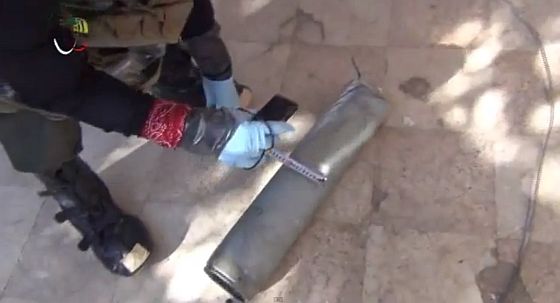
Since the attacks the remains of only two munitions have been recorded by activists in Damascus. The first, a M14 140mm artillery rocket fired from the BM-14 multiple rocket launcher (and variants), was filmed in Medmah al-Sham in Damascus, and footage recorded by the activists shows the UN inspectors taking measurements and samples from the munition. The remains shown in the video are barely damaged, with only the warhead and connector missing. This may be significant, as one potential warhead carries 2.2kg of sarin, but it should be clear there’s also a smoke warhead for this munition. As with both munitions linked to the alleged chemical attack, it seems only the UN report will clarify whether or not these were likely to be carrying any sort of chemical agent. Only one example of this artillery rocket was recorded and put online, it’s unknown if there’s further examples at the attack sites. More details on the M14 140mm and my identification of it can be found here.

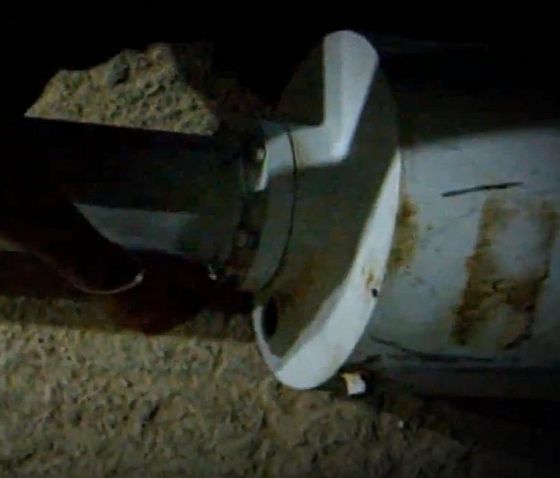
The second munition linked to the alleged chemical attack is pictured above. What’s extremely interesting about this munition is it appears to be something that’s unique to the conflict. I’ve spoken to a number of arms and chemical weapons specialists, and they do not recognise this as any specific type of munition. For the purposes of this blog post, and to save me having to write out “the unidentified munition linked to alleged chemical attacks” repeatedly, I will refer to this as the UMLACA (Unidentified Munition Linked to Alleged Chemical Attacks). [Continue reading…]

The canister shown in the image above, appears to be of similar dimension to the head of the missile shown in the video at the top of this post. Its construction quality does not suggest that this was fabricated in some jihadist’s workshop. Moreover, the launcher shown in the video appears to be an Iranian Falaq-2 model, according to N.R. Jenzen-Jones.

For those who are still in the false flag brigade and who insist that the attack must have been launched by an opposition element — sure, that’s possible.

It’s possible that rebels were able to steal or capture an Iranian launcher. It’s possible that they were also able to obtain missiles already armed with their chemical components from one of the regime’s stockpiles. It’s possible that having gathered together the weapons and the delivery system. It’s possible that each of these came with detailed instructions on how to use them. And it’s possible that these novices in the use of such weapons were quick studies and successfully fired them.

All of that is possible. But is it likely? And given the more obvious explanation — that these chemical weapons were being used by the forces that had been trained and then authorized to use them — why lean in favor of the remote possibility?

I suspect the reason is this — and it has nothing to do with the evidence. If you start with two convictions — that military intervention in Syria is a bad idea, and that the U.S. is hellbent on intervening — then you will be vigilant, watching for anything that could be used as a pretext for intervention. If such a pretext emerges, then the first line of resistance in preventing its use as a justification for intervention will be to say: it didn’t happen. The second line of resistance is to concede it happened but to assert that the Assad regime was not responsible.

The cause is just — attempting to oppose what appears to be an unjust war-making agenda — but its pursuit gets quickly divorced from any desire to be objective. The focus is on that which must be resisted, even if that means abandoning any real interest in what actually happened.

Facebooktwittermail

Putin says could turn against Assad — if case proved

Reuters reports: President Vladimir Putin offered a glimpse of international compromise over Syria on Wednesday, declining to entirely rule out Russian backing for military action as he prepared to host a summit of world leaders.

As the United States and allies prepare to bypass any Russian U.N. veto and attack Damascus, there is little chance of Putin’s support. But his words may herald new efforts to overcome great power rivalries that have let Syria descend into bloody chaos.

At the same time, Moscow said it had sent a warship it calls a “carrier killer” to the eastern Mediterranean, where a U.S. fleet is waiting for Congress to approve orders from President Barack Obama to launch punitive strikes against Syrian President Bashar al-Assad following his forces’ alleged use of poison gas.

Putin’s remarks on the eve of a G20 summit in St. Petersburg stressed Russia did not share Obama’s conviction that Assad has resorted to chemical warfare – he noted suggestions the August 21 gassing was instead the work of al Qaeda-linked rebels.

And only proof, plus backing in the U.N. Security Council that depends on Moscow, would justify using force, he added. Nonetheless, in saying he did “not rule out” his support, Putin gave a shot of warmth to relations with the West that the Syrian conflict has helped chill to levels recalling the Cold War.

Russian support for military strikes on Syria could actually be the best way of preventing them happening. The possibility of losing Russia’s protection will probably alarm Assad even more than the threat of attacks. If the Obama administration was to turn its attention to a political strategy instead of obsessing over target lists, it would see an important opening in Putin’s comments and grab hold of it.

Facebooktwittermail

German intelligence supports view that the Assad regime launched chemical attacks

Der Spiegel reports: Germany has said in no uncertain terms that it will not participate in a strike on Syria without the backing of the United Nations Security Council. But the country’s foreign intelligence agency, the Bundesnachrichtendienst (BND), agrees with the US position which holds Syrian President Bashar Assad responsible for the poison gas attacks near Damascus on Aug. 21. In a secret briefing to select lawmakers on Monday, BND head Gerhard Schindler said that while there is still no incontestable proof, analysis of the evidence at hand has led his intelligence service to believe that Assad’s regime is to blame.

In the briefing, Schindler said that only the Assad regime is in possession of binary chemical weapons such as sarin. The BND believes that regime experts would be the only ones capable of manufacturing such weapons and deploying them with small missiles. The BND believes that such weapons had been used several times prior to the attack on Aug. 21, which is believed to have killed more than 1,400 people. Schindler said in the earlier attacks, however, the poison gas mixture was diluted, explaining the much lower death tolls in those assaults.

During his 30-minute presentation, Schindler offered up scenarios to explain why the Assad regime resorted to chemical weapons use, including, he said, the possibility that Assad sees himself involved in a crucial battle for Damascus. The city is besieged by rebel groups, with particular pressure coming from the east. Schindler believes it is possible that the regime ordered the use of poison gas as a way of intimidating the rebels. It could also be the case that errors were made in mixing the gas and it was much more potent than anticipated, he said. [Continue reading…]

Facebooktwittermail

Now the Israel lobby has told Congress how to vote, why should Obama care about public opposition to military strikes?

Oh, how about for this reason: That grandiose title, “leader of the free world,” is supposed to signal that America is a democracy and its democratically elected representatives are supposed to take into consideration the views of the people they represent. So, public opinion should matter on the question about authorizing military strikes on Syria. But that’s now all irrelevant because the Israel lobby has spoken and members of Congress no longer need to think too much about which way to cast their votes.

Pew Research: President Obama faces an uphill battle in making the case for U.S. military action in Syria. By a 48% to 29% margin, more Americans oppose than support conducting military airstrikes against Syria in response to reports that the Syrian government used chemical weapons.

The new national survey by the Pew Research Center, conducted Aug. 29-Sept. 1 among 1,000 adults, finds that Obama has significant ground to make up in his own party. Just 29% of Democrats favor conducting airstrikes against Syria while 48% are opposed. Opinion among independents is similar (29% favor, 50% oppose). Republicans are more divided, with 35% favoring airstrikes and 40% opposed.

The public has long been skeptical of U.S. involvement in Syria, but an April survey found more support than opposition to the idea of a U.S.-led military response if the use of chemical weapons was confirmed. The new survey finds both broad concern over the possible consequences of military action in Syria and little optimism it will be effective. [Continue reading…]

Facebooktwittermail

U.S. considers stepping up its effort to make the war in Syria drag on for as long as possible

The Wall Street Journal reports: The Obama administration is considering putting the Pentagon in charge of arming and training moderate rebel forces in Syria, a move that could help expand the effort significantly beyond the limited scope of the current Central Intelligence Agency program, U.S. officials said.

These internal discussions come as Congress begins a debate over a resolution to authorize limited strikes against Syria in response to the alleged use of chemical weapons last month.

The move would substantially revamp one of the administration’s most secretive and controversial undertakings in the 2½-year-old civil war. President Barack Obama authorized the CIA program in June after Hezbollah’s large-scale entry into the conflict on Syrian President Bashar al-Assad’s side and a U.S. determination that Syrian forces had used chemical arms in small amounts in earlier clashes.

The idea of giving the Pentagon a greater role in the effort has gained traction in recent weeks among some in Congress and in the administration who say the CIA’s arming and training program is too small and slow-moving.

Administration officials have privately told lawmakers they don’t want to tip the balance against the Assad regime for fear Islamist groups in the opposition with links to al Qaeda could seize large swaths of the country and Mr. Assad’s weapons. At the same time, the White House says it wants to build up moderate elements in the hope they will one day play a leadership role in a post-Assad Syria. [Continue reading…]

Facebooktwittermail

Previous U.S. ‘limited’ military strikes all backfired

Reuters reports: President Barack Obama’s national security team is trying to make the case to sceptical U.S. lawmakers for a limited strike against the Syrian government over its alleged use of chemical weapons on August 21.

Following are details of missile strikes and other limited military action taken by the United States over the past 30 years and what transpired afterwards:

* Lebanon 1983 – In September 1983, U.S. battleships anchored in the Mediterranean Sea off Lebanon shelled Syrian, Palestinian and Druze forces in the Shouf Mountains outside Beirut in support of the Lebanese army, during the complex civil war that began in 1975.

It was one of several actions that created a perception that the United States was taking sides in the war. A month later, Shi’ite Muslim suicide bombers blew up the U.S. Marine and French barracks in Beirut, killing 241 Marines and 58 French paratroopers. President Ronald Reagan pulled U.S. forces out of Lebanon in February 1984. Lebanon’s civil war raged on until 1990.

* Libya 1986 – U.S. bomber aircraft struck sites in the Libyan cities of Tripoli and Benghazi, 10 days after the deadly bombing of West Berlin’s LaBelle nightclub frequented by American soldiers, which Washington blamed on Libya. Libyan leader Muammar Gaddafi’s adopted daughter was alleged to have been killed, and his sons were reported injured.

Libya was not linked to another major terrorist attack until the 1988 bombing of Pan Am Flight 103 over Lockerbie, Scotland, which killed 259 passengers and crew and 11 people on the ground. Libyan Abdel Basset al-Megrahi, who denied involvement in downing the jet, was convicted of the bombing in a court in the Netherlands 2001. Gaddafi ruled Libya until his ouster in August 2011. [Continue reading…]

Facebooktwittermail

Egypt bans Al Jazeera and other satellite channels

Mada Masr reports: An Administrative Court ordered on Tuesday to stop the broadcasting of a number of satellite channels including Al-Jazeera, local media reported.

Other channels banned from broadcasting include Al-Quds, Al-Yarmouk and Ahrar 25 January channels, the state-run Egynews portal reported.

The court also ordered the closure of their offices.

The cases were raised by Mahmoud Farghali, head of the Social Justice Party against the ministers of investment and information, as well as the heads of the channels. The case claimed that the accused have no licenses to broadcast while they have also been broadcasting false information that are conducive to destabilizing Egypt and causing divisions.

According to Al-Masry Al-Youm, a privately owned daily, permits are issued to channels by the ministers of investment, communication and information technology and information. In a joint statement issued last Thursday, these ministers said that Al-Jazeera has no legal document that justifies its work in Egypt. [Continue reading…]

Facebooktwittermail

NSA surveillance in Latin America

The Economist: When David Miranda, the Brazilian partner of Glenn Greenwald, an American journalist, was stopped and questioned by the police for nine hours in Heathrow airport last month, tempers in his home country flared. The law invoked by his detainers does not require them to give grounds for their actions. But then it is only supposed to be used against suspected terrorists, which Mr Miranda clearly is not. What he did do was carry materials relating to Mr Greenwald’s reporting on documents passed to him by Edward Snowden, a former contractor for America’s National Security Agency (NSA) and now a fugative whistleblower.

Mr Miranda was set free to continue his journey to Rio de Janeiro, where he and Mr Greenwald live, but only after his laptop and hard drive were confiscated. The incident angered Brazil’s government, already incensed by the revelations, co-written by Mr Greenwald and published on July 7th by O Globo, a Brazilian newspaper, that the NSA had allegedly been monitoring Brazilian citizens’ telecoms and internet activity for a decade.

On September 1st the row escalated further. TV Globo, the paper’s sister television network, aired a programme presenting documents provided by Mr Greenwald that suggest the NSA had spied not only on ordinary Latin American citizens but on Enrique Peña Nieto and Dilma Rousseff (pictured), the presidents of Mexico and Brazil, respectively. Among them was an NSA slide dated June 2012 displaying passages of what were said to be text messages sent by Mr Peña, who was still a presidential candidate at the time, in which he mentioned planned ministerial appointments. Though no content purporting to come from Ms Rousseff was shown, the programme detailed how the NSA filtered electronic communications and tracked e-mail, telephone calls and text messages sent between people close to her. [Continue reading…]

Facebooktwittermail