The Guardian reports: Egypt’s interim government was accused of attempting to return the country to the Mubarak era on Monday, after the country’s interior ministry announced the resurrection of several controversial police units that were nominally shut down following the country’s 2011 uprising and the interim prime minister was given the power to place the country in a state of emergency.
Egypt’s state security investigations service, Mabahith Amn ad-Dawla, a wing of the police force under President Mubarak, and a symbol of police oppression, was supposedly closed in March 2011 – along with several units within it that investigated Islamist groups and opposition activists. The new national security service (NSS) was established in its place.
But following Saturday’s massacre of at least 83 Islamists, interior minister Mohamed Ibrahim announced the reinstatement of the units, and referred to the NSS by its old name. He added that experienced police officers sidelined in the aftermath of the 2011 revolution would be brought back into the fold.
Police brutality also went unchecked under Morsi, who regularly failed to condemn police abuses committed during his presidency. But Ibrahim’s move suggests he is using the ousting of Morsi – and a corresponding upsurge in support for Egypt’s police – as a smokescreen for the re-introduction of pre-2011 practices. [Continue reading…]
Egypt’s new dictator

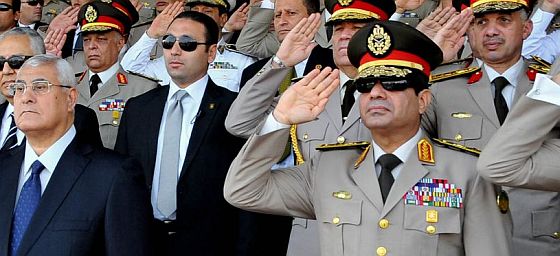
Gen. Abdel-Fattah el-Sissi
The Associated Press reports: In dark sunglasses and a uniform studded with medals, Egypt’s top general is everywhere, looking down from posters and banners proclaiming him “lion of the nation.” Adoring songs vow “We are behind you.”
Barely a month after he removed the elected president, Gen. Abdel-Fattah el-Sissi is riding a wave of adulation, drawing comparisons between him and modern Egypt’s first charismatic strongman, former President Gamal Abdel-Nasser. State media and pro-military TV channels and newspapers have done everything they can to fuel the fervor.
But some warn that the personality cult could pave the way to new authoritarianism after a coup that the army and its supporters insist was aimed at promoting democracy.
“I worry about el-Sissi and the possible arrogance of the victor. And I fear him if he decides that the army is stronger than any future president that he will control like a puppet,” wrote Mohammed Fathy, a columnist in the newspaper Al-Watan. “The admiration for him has gone beyond normal levels and is now more like deifying him.”
The hype has swelled to the point that some are convinced el-Sissi will take off his uniform and run for president in elections due to take place early next year. A military spokesman denied el-Sissi has any intention to do so. That has done nothing to end the speculation by those for and against the idea.
“Bottom line, el-Sissi will be president because he has no choice but to be. People have already started treating him as such and because he is de facto ruler,” Fathy wrote in a column on Monday, adding that media are depicting the general as “Nasser 2013.”
The raving over el-Sissi is rooted in the satisfaction many Egyptians took from his July 3 coup removing President Mohammed Morsi. It came after four days of massive protests by millions nationwide demanding the president step down, accusing him of failing to manage the country and handing power over to his Islamist allies. [Continue reading…]
EU foreign policy chief meets Morsi under detention
The Washington Post reports: The European Union’s Catherine Ashton has met with deposed Egyptian president Mohamed Morsi. The Monday night meeting marked the first visit that Morsi has had from an outside official since he was ousted from power in a July 3 coup.
The visit signaled for the first time that Egypt’s military, which is holding Morsi, may be willing to work with him towards a political solution to the country’s ongoing crisis, which has seen waves of violence between security forces and Morsi’s supporters since his ouster.
Last week, prosecutors announced that Morsi was being investigated for allegations of espionage and murder; charges that his supporters in the Muslim Brotherhood have dismissed as politically motivated, but which could carry the death penalty.
Ashton would not go into detail about her two-hour conversation with Morsi on Monday night, but she said Tuesday that the deposed president had access to newspapers and television, and was in good condition.
“He’s well, and we had a friendly and open and very frank discussion,” Ashton said at a brief press conference on Tuesday. She did not say where Morsi, who has been held incommunicado for four weeks, was being held. [Continue reading…]
Video: Wadah Khanfar on the assault on democracy in Egypt
As an Anglican ex-bishop, I can tell you: Iran’s new president could be our best hope for peace
Michael Nazir-Ali writes: The installation of Hassan Rouhani as President of Iran next month heralds a new chapter for the country. It is clear that he was elected not only because it was felt — both at the highest levels and by the people — that he was best placed to negotiate with the West on Iran’s nuclear programme but also because he was the candidate most likely to appeal to reform-hungry Iranians.
Rouhani is a protégé of the former president Muhammed Khatami, with whom I have had the chance to work. When he was President, I spent a whole day with him meeting political, civil society and religious leaders. Visiting him in Iran, I was always struck by his learning and his humility. Khatami knew about the puritan origins of the United States and the ways that tension between religious beliefs and liberty was resolved. He never tired of pointing out similarities between the difficulties of the Iranian experience and the founding of America. In opposition to the then fashionable ‘clash of civilisations’ thesis, he launched his own ‘dialogue of civilisations’ programme.
Khatami’s presidency failed because the West, especially the US, did not respond adequately to his overtures, but also because he ran into opposition from hard-liners. His failure showed where real power resided — with the ‘Ulama’, the legal authority made up of the Guardianship of the Revolution, and with the Supreme Leader, Ayatollah Ali Khamenei.
The popular portrayal of Iran as a nation either driven by Islamic revolutionary fervour or by the periodic welling up of liberal political dissent does not do justice to the complexity of this society. There is constant interplay between the ancient civilisation of Iran and Islam in its political form. Iranians understand their identity as continuous with the pre-Islamic as well as the Islamic periods. Their attitude to art, for instance, particularly pictorial and even religious art, is quite different from the rest of the Islamic world’s.
Ayatollah Khomeini, the architect of the revolution, developed the notion of Wilayet-i-Faqui: the custodianship of the nation by Islamic Islamic jurists. Although there are some precedents for this in the constitutional history of Iran, such a comprehensive claim to the supremacy of Sharia and its interpreters strikes many as novel and there have been various challenges to it. [Continue reading…]
Letter to President Obama from Edward Snowden’s father, Lon Snowden
Re: Civil Disobedience, Edward J. Snowden, and the Constitution
Dear Mr. President:
You are acutely aware that the history of liberty is a history of civil disobedience to unjust laws or practices. As Edmund Burke sermonized, “All that is necessary for the triumph of evil is that good men do nothing.”
Civil disobedience is not the first, but the last option. Henry David Thoreau wrote with profound restraint in Civil Disobedience: “If the injustice is part of the necessary friction of the machine of government, let it go, let it go: perchance it will wear smooth certainly the machine will wear out. If the injustice has a spring, or a pulley, or a rope, or a crank, exclusively for itself, then perhaps you may consider whether the remedy will not be worse than the evil; but if it is of such a nature that it requires you to be the agent of injustice to another, then, I say, break the law. Let your life be a counter-friction to stop the machine.”
Thoreau’s moral philosophy found expression during the Nuremburg trials in which “following orders” was rejected as a defense. Indeed, military law requires disobedience to clearly illegal orders.
A dark chapter in America’s World War II history would not have been written if the then United States Attorney General had resigned rather than participate in racist concentration camps imprisoning 120,000 Japanese American citizens and resident aliens.
Civil disobedience to the Fugitive Slave Act and Jim Crow laws provoked the end of slavery and the modern civil rights revolution.
We submit that Edward J. Snowden’s disclosures of dragnet surveillance of Americans under § 215 of the Patriot Act, § 702 of the Foreign Intelligence Surveillance Act Amendments, or otherwise were sanctioned by Thoreau’s time-honored moral philosophy and justifications for civil disobedience. Since 2005, Mr. Snowden had been employed by the intelligence community. He found himself complicit in secret, indiscriminate spying on millions of innocent citizens contrary to the spirit if not the letter of the First and Fourth Amendments and the transparency indispensable to self-government. Members of Congress entrusted with oversight remained silent or Delphic. Mr. Snowden confronted a choice between civic duty and passivity. He may have recalled the injunction of Martin Luther King, Jr.: “He who passively accepts evil is as much involved in it as he who helps to perpetrate it.” Mr. Snowden chose duty. Your administration vindictively responded with a criminal complaint alleging violations of the Espionage Act.
From the commencement of your administration, your secrecy of the National Security Agency’s Orwellian surveillance programs had frustrated a national conversation over their legality, necessity, or morality. That secrecy (combined with congressional nonfeasance) provoked Edward’s disclosures, which sparked a national conversation which you have belatedly and cynically embraced. Legislation has been introduced in both the House of Representatives and Senate to curtail or terminate the NSA’s programs, and the American people are being educated to the public policy choices at hand. A commanding majority now voice concerns over the dragnet surveillance of Americans that Edward exposed and you concealed. It seems mystifying to us that you are prosecuting Edward for accomplishing what you have said urgently needed to be done!
The right to be left alone from government snooping–the most cherished right among civilized people — is the cornerstone of liberty. Supreme Court Justice Robert Jackson served as Chief Prosecutor at Nuremburg. He came to learn of the dynamics of the Third Reich that crushed a free society, and which have lessons for the United States today.
Writing in Brinegar v. United States, Justice Jackson elaborated:
The Fourth Amendment states: “The right of the people to be secure in their persons, houses, papers, and effects, against unreasonable searches and seizures, shall not be violated, and no Warrants shall issue, but upon probable cause, supported by Oath or affirmation, and particularly describing the place to be searched, and the persons or things to be seized.”
These, I protest, are not mere second-class rights but belong in the catalog of indispensable freedoms. Among deprivations of rights, none is so effective in cowing a population, crushing the spirit of the individual and putting terror in every heart. Uncontrolled search and seizure is one of the first and most effective weapons in the arsenal of every arbitrary government. And one need only briefly to have dwelt and worked among a people possessed of many admirable qualities but deprived of these rights to know that the human personality deteriorates and dignity and self-reliance disappear where homes, persons and possessions are subject at any hour to unheralded search and seizure by the police.
We thus find your administration’s zeal to punish Mr. Snowden’s discharge of civic duty to protect democratic processes and to safeguard liberty to be unconscionable and indefensible.
We are also appalled at your administration’s scorn for due process, the rule of law, fairness, and the presumption of innocence as regards Edward.
On June 27, 2013, Mr. Fein wrote a letter to the Attorney General stating that Edward’s father was substantially convinced that he would return to the United States to confront the charges that have been lodged against him if three cornerstones of due process were guaranteed. The letter was not an ultimatum, but an invitation to discuss fair trial imperatives. The Attorney General has sneered at the overture with studied silence.
We thus suspect your administration wishes to avoid a trial because of constitutional doubts about application of the Espionage Act in these circumstances, and obligations to disclose to the public potentially embarrassing classified information under the Classified Information Procedures Act.
Your decision to force down a civilian airliner carrying Bolivian President Eva Morales in hopes of kidnapping Edward also does not inspire confidence that you are committed to providing him a fair trial. Neither does your refusal to remind the American people and prominent Democrats and Republicans in the House and Senate like House Speaker John Boehner, Congresswoman Nancy Pelosi, Congresswoman Michele Bachmann, and Senator Dianne Feinstein that Edward enjoys a presumption of innocence. He should not be convicted before trial. Yet Speaker Boehner has denounced Edward as a “traitor.” Ms. Pelosi has pontificated that Edward “did violate the law in terms of releasing those documents.” Ms. Bachmann has pronounced that, “This was not the act of a patriot; this was an act of a traitor.” And Ms. Feinstein has decreed that Edward was guilty of “treason,” which is defined in Article III of the Constitution as “levying war” against the United States, “or in adhering to their enemies, giving them aid and comfort.”
You have let those quadruple affronts to due process pass unrebuked, while you have disparaged Edward as a “hacker” to cast aspersion on his motivations and talents. Have you forgotten the Supreme Court’s gospel in Berger v. United States that the interests of the government “in a criminal prosecution is not that it shall win a case, but that justice shall be done?”
We also find reprehensible your administration’s Espionage Act prosecution of Edward for disclosures indistinguishable from those which routinely find their way into the public domain via your high level appointees for partisan political advantage. Classified details of your predator drone protocols, for instance, were shared with the New York Times with impunity to bolster your national security credentials. Justice Jackson observed in Railway Express Agency, Inc. v. New York: “The framers of the Constitution knew, and we should not forget today, that there is no more effective practical guaranty against arbitrary and unreasonable government than to require that the principles of law which officials would impose upon a minority must be imposed generally.”
In light of the circumstances amplified above, we urge you to order the Attorney General to move to dismiss the outstanding criminal complaint against Edward, and to support legislation to remedy the NSA surveillance abuses he revealed. Such presidential directives would mark your finest constitutional and moral hour.
Sincerely,
Bruce Fein
Counsel for Lon Snowden
Lon Snowden
source: http://msnbcmedia.msn.com/i/msnbc/sections/tvnews/dateline%20nbc/obama.pdf

Truth is not something to be determined by the state
In 1977, I was an undergraduate at Lancaster University in England coming towards the end of my first year studying politics. My perspective on America at that time had been shaped by events of the preceding decade: Vietnam; the assassinations of Martin Luther King Jr and Bobby Kennedy; Watergate and Nixon; the CIA’s illegal operations; and this amorphous but far-reaching entity called American Power.
Still, as much as America seemed to dominate the world, in my own experience — like that of most other non-Americans across the West — that domination came mostly in the relatively benign and sometimes enriching form of American culture — from Lucille Ball to Mission Impossible, and from Jack Kerouac to Miles Davis.
And then something unusual happened.
On April 6 the university was in recess for the Easter vacation but suddenly Lancaster and one student in particular became the focus of national news when Britain’s secret police raided the campus.
Steve Wright was a graduate student in the politics department engaged in research on “Social Control and Death Technologies.” Wright’s supervisor was Dr. Paul Smoker, one of the founding fathers of modern peace research, who was then Lancaster’s Director of the Programme of Peace and Conflict Research.
That Britain had a secret branch of the police force dedicated to tackling political subversion was not common knowledge, even though the Special Branch (also known as Specialist Operations 15 or SO15) had actually been created in 1883 to combat Irish nationalists.
As the force grew through the 20th century, the scope of what it deemed potential threats to public order and national security expanded to include the Campaign for Nuclear Disarmament, groups in the animal rights movement and later anti-globalisation demonstrators.
In 1977, there were indications that Britain’s intelligence services had also come to regard investigative journalism as a national security threat.
What would later emerge was that Wright’s arrest was part of an operation designed to protect not only Britain’s state secrets but also to protect American interests and specifically those of the National Security Agency.
At the time of the arrest, Sir Charles Carter, the Vice Chancellor (chief administrator) of the University issued a public statement in defense of academic freedom and the right for research to be undertaken without the interference of the security service. Carter noted:
Truth is not something to be determined by the state.
It would be more than a decade before the NSA’s operations in Britain were first reported in the press. This came in spite of the British government’s best efforts to suppress publication of Duncan Campbell’s investigation of Project P415, otherwise known as ECHELON — a system of global surveillance that the NSA had been building and operating before Edward Snowden was even born.
In a 2005 article for the journal Surveillance & Society, Wright (who is now Associate Director of the Praxis Centre, Leeds Metropolitan University) told the story behind the uncovering of ECHELON and an investigation in which all the key researchers got promptly arrested.
Decades after those events, this story is of particular relevance now, as the NSA presents its global mass surveillance operations as having been necessitated by 9/11. As Campbell reported in 1988, the NSA and its partners’ surveillance systems “rely on near total interception of international commercial and satellite communications”.
Not only does the NSA eavesdrop on everyone — it has been doing so for far longer than most Americans realize.
Steve Wright gave me permission to republish his 8,200 article which I have divided into four parts which I will post over the next four days, beginning with: The ECHELON trail — Part One: An illegal vision.
The ECHELON trail — Part One: An illegal vision
By Steve Wright1, Surveillance & Society, 2005
Abstract
This article tells the story behind the uncovering of the US operated global telecommunications interceptions system now known as ECHELON. It begins with the use of fieldwork techniques in the early 1970’s exploring the configuration of Britain’s Post Office towers – these were ostensibly the microwave links through which Britain’s long distance telephone calls were made. This modelling process revealed a system within the system of microwave towers linked to the American base of Menwith Hill in the North York Moors. All the key researchers were then promptly arrested, a raid by Special Branch on the author’s university at Lancaster ensued and later a show trail for the other main researchers, most notably Duncan Campbell. Eventually in 1988, Duncan wrote up the ECHELON story, which for its time was an incredible piece of detective work using materials lifted from waste bins by the women activists campaigning around the Menwith Hill Base. Little notice was taken until 1997 when an obscure book by Nicky Hager, Secret Power explained the role and function of ECHELON in more depth. The author represented these findings in a policy report to the European Parliament on the technology of political control that led to a process of political debate and disagreement of the ethics of such a system which continues even today.
Introduction
Studies of surveillance are challenging, and often demand a sustained research commitment. It is no coincidence that many of the key British researchers active in this field in the early 1970’s remain so today. I am currently still working on issues of what are essentially tools of social and political control – both professionally as an Associate Reader at Leeds Metropolitan University in the Praxis Centre, ethically as a lecturer in the School of Applied Global Ethics and politically as chair of the Board of Trustees of Privacy International.
This article describes how I became engrossed in studying ‘technologies of political control’, and tracked the members of the security industrial complex, responsible for proliferating it to some of the world’s most unsavoury regimes. More specifically, it relates how a lowly postgraduate researcher stumbled across the entrails of a global telecommunications interception system; precipitated the first Special Branch police raid on a British University; provoked the first ever parliamentary debate on the British secret police; and accidentally detonated a worldwide political and ethical debate on the existence of a futuristic global electronic spying network, now known as ‘ECHELON’. In relating my personal experience of researching the ECHELON trail, I hope to illustrate how many of the challenges facing surveillance scholars during critical periods of their work can be faced and eventually overcome without the researcher becoming part of the food chain of the process they are watching.
ECHELON is a (now out-of-date) code name given to the US National Security Agency’s worldwide facility for the mass interception of electronic telecommunications including, phone, fax and email using key words and context. It works on the basis that other telecommunication links can be used to siphon off messages travelling by satellite, microwave relay link or fibre optic cable, if they intercept such streams at a key node, and can work at a prodigious rate of more that 2 million intercepts per hour. Essentially, the system can work because for some of its journey, telecommunications traffic is travelling as an electronic stream that can be intercepted if the appropriate infrastructure is in place. However, the current wisdom is that ECHELON does not exist in the way it was originally construed but is a now thought to be a collection of subsets of interception capabilities using a range of code names of which we remain ignorant. Nevertheless, for the sake of simplicity, it makes sense to continue to use the generic label ‘ECHELON’ whilst recognizing that new surveillance algorithms have evolved since the early researchers built their crude paradigms.
My interest in surveillance studies began over three decades ago when no such field existed. I was a student at Manchester University on an unusual course, entitled ‘Liberal Studies in Science’. The course attempted to bridge the communication gap between science and the humanities, and create ‘literate scientists’ (in the wake of C.P Snow’s famous critique of the ‘two cultures’). The training given by the course certainly paid off in the years which followed, since it enabled its students to look at specific technical problems with perspectives from many different disciplines.
I became fascinated by the process of technology assessment: the attempt to examine unforeseen impacts of technological innovation. For example, the course examined nuclear arms races, and the parallels with arms races emerging in counter-insurgency conflicts, which were then in the news, fired my imagination. The course’s coverage of the Vietnam War highlighted a new generation of military systems which had potential domestic uses such as helicopter-mounted flight stabilized CCTV night vision cameras, already beginning to find a market in policing the U.S. home front.
At the same time on the UK home front, the British Society for Social Responsibility in Science (BSSRS) was just beginning to examine the deployment of new weapons and technologies in the burgeoning ‘troubles’ in Northern Ireland: a province that was about to become the most surveilled zone in Europe. BSSRS conceptualized this new equipment as a ‘technology of political control’. According to BSSRS, this technology encompassed new crowd control technologies designed to appear safe (rather than be safe), new torture technologies designed to induce psychological breakdown; and new surveillance and telecommunication systems that provided a powerful nervous system for ‘the strong state’. Continue reading
How America’s top tech companies created the surveillance state
Michael Hirsh reports: With Edward Snowden on the run in Russia and reportedly threatening to unveil the entire “blueprint” for National Security Agency surveillance, there’s probably as much terror in Silicon Valley as in Washington about what he might expose. The reaction so far from private industry about the part it has played in helping the government spy on Americans has ranged from outraged denial to total silence. Facebook’s Mark Zuckerberg, he of the teen-nerd hoodie, said he’d never even heard of the kind of data-mining that the NSA leaker described—then fell quiet. Google cofounder Larry Page declared almost exactly the same thing; then he shut up, too. Especially for the libertarian geniuses of Silicon Valley, who take pride in their distance (both physically and philosophically) from Washington, the image-curdling idea that they might be secretly in bed with government spooks induced an even greater reluctance to talk, perhaps, than the Foreign Intelligence Surveillance Act, which conveniently forbids executives from revealing government requests for information.
But the sounds of silence from the tech and telecom sectors are drowning out a larger truth, one that some of Snowden’s documents might well supply in much greater detail. For nearly 20 years, many of these companies—indeed most of America’s biggest corporate sectors, from energy to finance to telecom to computers—have been doing the intelligence community’s bidding, as America’s spy and homeland-security agencies have bored their way into the nation’s privately run digital and electronic infrastructure. Sometimes this has happened after initial resistance, and occasionally under penalty of law, but more often with willing and even eager cooperation. Indeed, the private tech sector effectively built the NSA’s surveillance system, and got rich doing it.
Books have been written about President Eisenhower’s famous farewell warning in 1961 about the “military-industrial complex,” and what he described as its “unwarranted influence.” But an even greater leviathan today, one that the public knows little about, is the “intelligence-industrial complex.”
The saga of the private sector’s involvement in the NSA’s scheme for permanent mass surveillance is long, complex, and sometimes contentious. Often, in ways that appeared to apply indirect pressure on industry, the NSA has demanded, and received, approval authority—veto power, basically—over telecom mergers and the lifting of export controls on software. The tech industry, in more than a decade of working-group meetings, has hashed out an understanding with the intelligence community over greater NSA access to their systems, including the nation’s major servers (although it is not yet clear to what degree the agency had direct access). “I never saw [the NSA] come and say, ‘We’ll do this if you do that,’ ” says Rebecca Gould, the former vice president for public policy at Dell. “But the National Security Agency always reached out to companies, bringing them in. There are working groups going on as we speak.” [Continue reading…]
Momentum builds against NSA surveillance
The New York Times reports: The movement to crack down on government surveillance started with an odd couple from Michigan, Representatives Justin Amash, a young libertarian Republican known even to his friends as “chief wing nut,” and John Conyers Jr., an elder of the liberal left in his 25th House term.
But what began on the political fringes only a week ago has built a momentum that even critics say may be unstoppable, drawing support from Republican and Democratic leaders, attracting moderates in both parties and pulling in some of the most respected voices on national security in the House.
The rapidly shifting politics were reflected clearly in the House on Wednesday, when a plan to defund the National Security Agency’s telephone data collection program fell just seven votes short of passage. Now, after initially signaling that they were comfortable with the scope of the N.S.A.’s collection of Americans’ phone and Internet activities, but not their content, revealed last month by Edward J. Snowden, lawmakers are showing an increasing willingness to use legislation to curb those actions.
Representatives Jim Sensenbrenner, Republican of Wisconsin, and Zoe Lofgren, Democrat of California, have begun work on legislation in the House Judiciary Committee to significantly rein in N.S.A. telephone surveillance. Mr. Sensenbrenner said on Friday that he would have a bill ready when Congress returned from its August recess that would restrict phone surveillance to only those named as targets of a federal terrorism investigation, make significant changes to the secret court that oversees such programs and give businesses like Microsoft and Google permission to reveal their dealings before that court.
“There is a growing sense that things have really gone a-kilter here,” Ms. Lofgren said. [Continue reading…]
New York Times calls for FISA court reform
An editorial in the New York Times says: There are so many deeply troubling things about the Foreign Intelligence Surveillance Court that it is difficult to know where to begin, but a good place might be the method by which the court’s judges are chosen.
All 11 of the current members were assigned to the court by Chief Justice John Roberts Jr. In the nearly eight years he has been making his selections, Chief Justice Roberts has leaned about as far right as it is possible to go. Ten of those 11 members were appointed to the bench by Republican presidents; the two previous chief justices put Republican-appointed judges on the court 66 percent of the time, as reported by Charlie Savage in The Times.
The FISA court considers government requests for warrants to collect phone and Internet data, among other things, on an enormous scale. The judges hear only the government’s argument. There is no adversary present to represent interests of those whose privacy would be violated — which could well involve millions of Americans. The court’s rulings, some of which include novel interpretations of constitutional law, remain secret.
If the surveillance court is to be considered part of the American justice system, it needs to start looking more like an actual court. For starters, there is no good reason the chief justice should have sole authority to appoint the court’s judges. Already, critics of the current system have floated numerous alternative ways for selecting FISA court judges.
One idea worth considering, offered by Senator Richard Blumenthal, Democrat of Connecticut, is for each of the chief judges of the federal appeals courts to select one judge for the surveillance court.
This approach could minimize the risk of politicizing the process. A further step might be to require the chief judges’ choices to be submitted for approval to a board consisting of members of Congress with experience in intelligence matters and experts with experience in protecting civil liberties.
The professional qualifications of the judges appointed by Chief Justice Roberts are not in question. But given the extent to which the FISA court’s rulings have infiltrated our lives, it is appropriate for the public to have a voice in who sits on it.
The authority of our judiciary derives from its independence and its accountability. At the very least, the power to select the judges who are making secret law should not rest in the hands of one man.
With NSA revelations, Sen. Ron Wyden’s vague warnings about privacy finally become clear
The Washington Post reports: It was one of the strangest personal crusades on Capitol Hill: For years, Sen. Ron Wyden said he was worried that intelligence agencies were violating Americans’ privacy.
But he couldn’t say how. That was a secret.
Wyden’s outrage, he said, stemmed from top-secret information he had learned as a member of the Senate Intelligence Committee. But Wyden (D-Ore.) was bound by secrecy rules, unable to reveal what he knew.
Everything but his unhappiness had to be classified. So Wyden stuck to speeches that were dire but vague. And often ignored.
“I want to deliver a warning this afternoon: When the American people find out how their government has secretly interpreted the Patriot Act, they will be stunned and they will be angry,” Wyden said on the Senate floor in May 2011.
Two years later, they found out.
The revelations from former National Security Agency contractor Edward Snowden — detailing vast domestic surveillance programs that vacuumed up data on phone calls, e-mails and other electronic communications — have filled in the details of Wyden’s concerns.
So he was right. But that is not the same as winning.
To change the law and restrict domestic spying, the low-key Wyden still must overcome opposition from the White House and the leaders of both parties in Congress. [Continue reading…]
After the police massacre of pro-Morsi supporters, survivors say: ‘We either have freedom or we die.’
The Guardian reports: The sand-filled forecourt outside the Zeinhom morgue, Cairo’s main mortuary, was a carousel of coffins. From the left-hand door, out came families carrying dead relatives to their funerals, stray dogs sniffing at their heels. Through the door on the right, in went still more bodies for their autopsies. By the end of Sunday, officials had assessed 82 corpses, as the death toll from Saturday’s police massacre of pro-Morsi supporters kept rising.
So too did the mourners’ feelings of isolation. “If this was animals being killed, people would care,” said one of those outside the morgue, lawyer Islam Taher, alluding to the indifference of mainstream Egyptian opinion to the death of Morsi supporters. “But because it’s us, they don’t.”
On Friday 28 June, Taher had pitched camp with his childhood friend Mohamed Fahmy, a 28-year-old unemployed commerce graduate from a small village in eastern Egypt, at the Rabaa Adawiya sit-in in east Cairo, near where Saturday’s massacre took place. On Sunday, exactly a month later, both arrived together at the the Zeinhom morgue – but this time Fahmy was dead in a battered brown coffin, shot through his right temple by a police marksman, after a night-time pro-Morsi march on Saturday morning turned into a massacre.
“Suddenly, he had a bullet through the front of his head, and a hole out the other side,” said Taher, holding out a picture taken on his phone of a brain-dead Fahmy breathing his last hours earlier. “He didn’t have any weapons. He just had his bare chest.”
State officials said Saturday’s deaths took place after pro-Morsi protesters fired first – and even claimed that police only used teargas to disperse them. But protesters told of a state-initiated bloodbath and a subsequent cover-up. “We asked them to record his death as a murder by police,” said Ashraf Mamdouh, loading the body of his brother-in-law, Hegazy Zakaria, into a van that would take him to his funeral in a village outside Cairo. “But they forced us to accuse anonymous sources.”
Inside the morgue, the scene had been one of mayhem. “We didn’t have enough places in the fridges to fit all the bodies,” said Dr Hazem Hossam, an official at Zeinhom.
“We had to do autopsies on the floor. At some points we had to ask families to help us with the process. It was chaos.”
Five miles away at Rabaa al-Adawiya – the ground-zero of pro-Morsi support over the last month, the Islamist equivalent of Tahrir Square – protesters said the attack had strengthened their resolve. [Continue reading…]
In Egypt’s Sinai, insurgency taking root
The Washington Post reports: More than three weeks after the military coup that ousted this nation’s first democratically elected — and Islamist — president from power, the roots of a violent insurgency are burrowing fast into the sands of Egypt’s Sinai Peninsula.
The rapid thud of machine-gun fire and the explosions of rocket-propelled grenades have begun to shatter the silence of the desert days and nights here with startling regularity, as militants assault the military and police forces stationed across this volatile territory that borders Israel and the Gaza Strip.
The emerging Sinai crisis gives Egypt’s military a pretext to crack down on Islamist opponents across the country, including in Cairo, where at least 72 people were killed over the weekend when security forces opened fire on demonstrators rallying in support of ousted president Mohamed Morsi.
Egypt’s interim government issued a decree Sunday that granted the military the power to detain civilians, state media reported. Analysts and rights activists said the decree suggested that a state of emergency, a tool that the regime of now-deposed autocrat Hosni Mubarak had used for decades to silence opponents, might soon follow.
But in the Sinai, where the reaction to Morsi’s ouster turned deadly within days of the coup, such state-sponsored violence and repression is likely to only feed the conviction of militants, who see themselves as waging a war against a despotic and irreligious military regime. [Continue reading…]
Natural gas is not clean energy
Anthony R. Ingraffea writes: Many concerned about climate change, including President Obama, have embraced hydraulic fracturing for natural gas. In his recent climate speech, the president went so far as to lump gas with renewables as “clean energy.”
As a longtime oil and gas engineer who helped develop shale fracking techniques for the Energy Department, I can assure you that this gas is not “clean.” Because of leaks of methane, the main component of natural gas, the gas extracted from shale deposits is not a “bridge” to a renewable energy future — it’s a gangplank to more warming and away from clean energy investments.
Methane is a far more powerful greenhouse gas than carbon dioxide, though it doesn’t last nearly as long in the atmosphere. Still, over a 20-year period, one pound of it traps as much heat as at least 72 pounds of carbon dioxide. Its potency declines, but even after a century, it is at least 25 times as powerful as carbon dioxide. When burned, natural gas emits half the carbon dioxide of coal, but methane leakage eviscerates this advantage because of its heat-trapping power.
And methane is leaking, though there is significant uncertainty over the rate. But recent measurements by the National Oceanic and Atmospheric Administration at gas and oil fields in California, Colorado and Utah found leakage rates of 2.3 percent to 17 percent of annual production, in the range my colleagues at Cornell and I predicted some years ago. This is the gas that is released into the atmosphere unburned as part of the hydraulic fracturing process, and also from pipelines, compressors and processing units. Those findings raise questions about what is happening elsewhere. The Environmental Protection Agency has issued new rules to reduce these emissions, but the rules don’t take effect until 2015, and apply only to new wells. [Continue reading…]
How Obama is undermining democracy around the world
Matt Lee reports: For decades, foreign armies that received U.S. assistance were on notice that toppling their freely elected civilian leaders would mean an aid suspension.
After Egypt, that seems no more, despite a law requiring just that if Washington determined a coup had taken place.
The Obama administration made a technically legal move to decide not to decide if the Egyptian military’s ouster of the country’s first democratically elected president was a “coup.”
That’s now created a wide opening to skirt legislation intended to support the rule of law, good governance and human rights around the world — principles long deemed inviolable American values.
Previous U.S. administrations have endured criticism for appearing to pay them only lip service. But this new and unprecedented finding sends a confusing message that probably will resonate beyond Egypt to other fragile — and perhaps not so fragile — democracies where soldiers are unhappy with ballot box results or the policies of their elected commanders in chief.
“The law does not require us to make a formal determination … as to whether a coup took place, and it is not in our national interest to make such a determination,” State Department spokeswoman Jen Psaki said Friday. She spoke in the administration’s only on-camera news briefing a day after members of Congress were informed privately that the U.S. laws was no longer necessarily applicable.
That interpretation of the 1961 Foreign Assistance Act might come as a surprise to juntas and militaries in Mali, Madagascar, Honduras and Pakistan. All of them, and others, have coped with U.S. aid suspensions over the past decade or so because of coups. In each case, there was a presumption that the United States would make a coup determination based on the law, and it did. [Continue reading…]
Many of 74 pro-Morsi protesters shot in Cairo were targeted killings
Human Rights Watch: Many of the at least 74 pro-Morsy protesters killed in clashes with Egypt’s riot police and plain clothed men who stood alongside were shot in the head or chest. They were killed on July 27 over a period of several hours during clashes on a road near the Muslim Brotherhood’s sit-in at Rabaa al-Adawiya in eastern Cairo.
Human Rights Watch interviewed seven witnesses to the violence and reviewed extensive video footage of the events. Medical staff interviewed by Human Rights Watch judged some of the deaths to be targeted killings because the position of the shots would likely result in death.
The New York Times reports: In the attack on Saturday, civilians joined riot police officers in firing live ammunition at the protesters as they marched toward a bridge over the Nile. By early morning, the numbers of wounded people had overwhelmed doctors at a nearby field hospital.
One doctor sat by himself, crying as he whispered verses from the Koran. Nearby, medics tried to revive a man on a gurney. When they failed, he was quickly lifted away to make room for the many others.
McClatchy reports: A brief visit to a field hospital – one of three treating casualties – showed the brutality of what had taken place. A McClatchy reporter counted 27 dead laid out on the hospital’s floor, and as she left, three more bodies arrived, adding to a frantic and horrific scene. At least three of the dead had been shot in the head, and the gaping wounds left the victims’ brains exposed.
Over and over, hospital workers would move a body to the ground and search the pockets for an identification card. When they found one, they wrote the deceased’s name on an arm. They then tied the body’s hands and toes together, to prevent arms and legs from flopping around as the corpse was moved. Often the workers had put a white wrap around the head to cover the gunshot wounds. Piles of national identification cards and personal belongings, like bloodied shirts and pants, were piled up nearby.
The only movement was that of doctors who seemed to jump around the corpses, reaching for bandages and the plaster needed to prepare shrouds, where the deceased’s name would be written again. One man who’d been assigned to clean blood from the floor shuffled through the scene, armed with a mop and a bucket that appeared to hold more blood than water. Over and over he went over the same spot near one head, as the blood kept pouring out.
Doctors said the injuries could only have come from professional marksmen. Ebtesan Zain, a gynecologist, said she came to help her fellow doctors only to discover she was not needed – everyone she encountered was dead.
“Those injuries had to be done by snipers. It couldn’t be anything else,” Zain said. “They were shooting directly in the head between the eyes and in the chest.”
Reuters reports: Thousands of supporters of Egypt’s Muslim Brotherhood stood their ground in Cairo on Sunday, saying they would not leave the streets despite “massacres” by security forces who shot dozens of them dead.
Ex-CIA officer reveals lies and distortions behind Milan kidnapping
A former CIA officer involved in the 2003 kidnapping of a Muslim cleric, Osama Mustapha Hassan Nasr, in Milan, spoke to McClatchy: Confirming for the first time that she worked undercover for the CIA in Milan when the operation took place, Sabrina De Sousa provided new details about the “extraordinary rendition” that led to the only criminal prosecution stemming from the secret Bush administration rendition and detention program launched after the Sept. 11, 2001, attacks.
The cleric, Osama Mustapha Hassan Nasr, was snatched from a Milan street by a team of CIA operatives and flown to Egypt, where he was held for the better part of four years without charges and allegedly tortured. An Egyptian court in 2007 ruled that his imprisonment was “unfounded” and ordered him released.
Among the allegations made by De Sousa in a series of interviews with McClatchy:
– The former CIA station chief in Rome, Jeffrey Castelli, whom she called the mastermind of the operation, exaggerated Nasr’s terrorist threat to win approval for the rendition and misled his superiors that Italian military intelligence had agreed to the operation.
– Senior CIA officials, including then-CIA Director George Tenet, approved the operation even though Nasr wasn’t wanted in Egypt and wasn’t on the U.S. list of top al Qaida terrorists.
– Condoleezza Rice, then the White House national security adviser, also had concerns about the case, especially what Italy would do if the CIA were caught, but she eventually agreed to it and recommended that Bush approve the abduction. [Continue reading…]