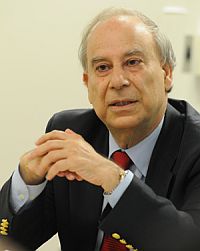
The new and the ordinary in the Middle East

Rami G. Khouri writes: Every once in a while the Middle East region experiences a series of major and simultaneous developments in several different arenas, indicating that something important is taking place. We are passing through just such a moment this week, with quite dramatic developments in Lebanon, Syria, Iraq, Palestine-Israel, Iran, Turkey, Egypt, Tunisia, Libya and several Arabian Peninsula states, without any sign of what is truly historic and new and what is a passing phenomenon.

Conspiracy theorists will be disappointed to learn that nobody is in charge, as they had long imagined, or is pulling strings to achieve predetermined objectives, like the break-up of large Arab countries into a series of ethnic principalities, or the control of Arab countries by Islamist groups beholden to Saudi Arabia, Qatar and the United States. Local dynamics primarily drive each set of major changes across the region, with cross-border linkages following as a corollary in most cases.

Iraq is pursuing its own post-war domestic conflicts and stresses and trying to figure out the balance among its Arab and Kurdish components, its Iraqi and Iranian interests, and the frail communalism among Iraqi Arab Shiites and Sunnis. The United States is pushing hard to revive a Palestinian-Israeli peace negotiation by focusing on three tactics that have repeatedly failed and probably will fail again: tripartite meetings with Jordan; talks between Shimon Peres and Mahmoud Abbas, who would not recognize a credible peace process if they found it in their soup; and, a proposed $4 billion development initiative for occupied Palestinian territories that focuses on economic development rather than liberation as the antidote to the depressed condition in Arab Palestine. [Continue reading…]

Facebooktwittermail

Which of Syria’s neighbors has most to lose in the fight?

GlobalPost: Much like downtown Beirut, the skyline in this city’s southern reaches, where the militant group Hezbollah is strong, is dotted with new apartment blocks built atop the ruins of past wars.

But with the conflict in Syria grinding next door, less than 40 miles to the east, south Beirut could again be at the epicenter of another armed conflict in Lebanon. The Western-backed leader of the Free Syrian Army, Gen. Selim Idriss, this week issued a deadline for Hezbollah to leave Syria or face attacks on its home turf.

In a televised speech Sunday, Hezbollah leader Sayyed Hassan Nasrallah said the group would fight alongside the Syrian regime, one of its primary backers, “until the end.” Hours later, two rockets crashed into the outskirts of the group’s traditional powerbase in south Beirut, injuring several people.

Hezbollah — a powerful Lebanese Shia militant and political group — has thrown its weight behind Syrian President Bashar al-Assad, putting an already fragile Lebanon in the crosshairs of a spiraling regional conflict.

Hezbollah fighters are suffering losses in battles inside Syria, sectarian rhetoric is on the rise in Lebanon, and Israel has said it is willing to carry-out more strikes on Syrian soil to keep advanced weapons from reaching Hezbollah.

In a taped interview on Hezbollah’s television station Al-Manar, Assad said on Thursday that Russia had delivered the first shipment of the sophisticated S-300 surface-to-air missile system. Israel has previously said it would again strike targets in Syria if the regime acquires them.

“We are worried that the war in Syria is coming to Lebanon,” said Ibrahim, a resident of the Hezbollah stronghold, Dahiyeh, in Beirut’s sprawling southern reaches. Many of the young men that fill Hezbollah’s ranks come from this area.

“But more than that,” Ibrahim, a staunch Hezbollah supporter, said, “the young people around here are angry and want to fight.” [Continue reading…]

Facebooktwittermail

Israel and Syria, an unstable relationship

At Open Democracy, Paul Rogers writes: Israel’s long search for impregnable security in the region has in its own view been aided by the stability of neighbouring autocracie. Egypt under Hosni Mubarak, Jordan under King Hussein and now King Abdullah, Saudi Arabia under the House of Saud, and even Syria under Hafez and now Bashar Assad – all recognised the power of Israel and were all too aware of Israel’s ultimate nuclear capability.

Israel was the regional superpower, even if that could never be acknowledged.

True, uncertainty in Lebanon (and to a degree over Gaza) remained an exception to the pattern, with Syria’s support for Hizbollah a continuing irritation and Israel’s failures against that movement in the conflict of 2006 a source of real concern. At the same time, the Assad regime’s acceptance of the status quo over the strategically vital Golan heights was a reassurance, and overall – southern Lebanon and Gaza excepted – Israel’s immediate position was secure.

In the two years since the Arab awakening, such certainty has eroded: notably with Egypt (and particularly Sinai) but now much more with Syria. There is an acute concern with the United Nations peacekeepers on the Golan heights, especially as Austria’s government has warned that it might withdraw its significant contingent. Austrian units make up barely a third of the total UN force, but their commitment has been substantial and a pullout could encourage others to follow suit in a way that leads to the collapse of the operation. [Continue reading…]

Facebooktwittermail

How patent protection is threatening lives

Council on Foreign Relations: Dr. Margaret Chan, director-general of the World Health Organization, closed the annual World Health Assembly this week [May 27] sounding alarm about a new SARS-like virus circulating primarily in Saudi Arabia.

“My greatest concern right now is the novel coronavirus,” Chan warned the representatives of two hundred nations gathered in Geneva. “We do not know where the virus hides in nature. We do not know how people are getting infected. Until we answer these questions, we are empty-handed when it comes to prevention.”

But impeding an effective response is a dispute over rights to develop a treatment for the virus. The case brings to the fore a growing debate over International Health Regulations, interpretations of patent rights, and the free exchange of scientific samples and information. Meanwhile, the epidemic has already caused forty-nine cases in seven countries, killing twenty-seven of them.

At the center of the dispute is a Dutch laboratory that claims all rights to the genetic sequence of the Middle East Respiratory Syndrome coronavirus [MERS-CoV]. Saudi Arabia’s deputy health minister, Ziad Memish, told the WHO meeting that “someone”–a reference to Egyptian virologist Ali Zaki–mailed a sample of the new SARS-like virus out of his country without government consent in June 2012, giving it to Dutch virologist Ron Fouchier of Erasmus Medical Center in Rotterdam.

“The virus was sent out of the country and it was patented, contracts were signed with vaccine companies and anti-viral drug companies, and that’s why they have a MTA [Material Transfer Agreement] to be signed by anybody who can utilize that virus, and that should not happen,” Memish said.

Though Memish referred to a “patent,” the Dutch team has not patented the viral genetic sequence but has placed it under an MTA, which requires sample recipients to contractually agree not to develop products or share the sample without the permission of Erasmus and the Fouchier laboratory. Memish said that the Dutch MTA was preventing Saudi Arabia from stopping the MERS-CoV outbreak, which appears to have started eleven months ago in the Eastern part of his country. The Dutch team denies the MTA is slowing work on the outbreak, saying it has given virus samples to any lab that has requested it.

Courts in North America and Europe have ruled that it is possible to patent life forms or their genetic sequences, spurring the practice of claiming patent control on newly identified microoganisms. Such patents give owner rights over royalties on all products derived from the genetic sequence, including vaccines, diagnostics, and genetically targeted treatments. But they have spawned controversy outside of wealthy countries, since they are perceived as guaranteeing profits for Western pharmaceuticals at the expense of country-of-origin use and access. [Continue reading…]

Facebooktwittermail

A new theory of everything

New Scientist: Physicists have a problem, and they will be the first to admit it. The two mathematical frameworks that govern modern physics, quantum mechanics and general relativity, just don’t play nicely together despite decades of attempts at unification. Eric Weinstein, a consultant at a New York City hedge fund with a background in mathematics and physics, says the solution is to find beauty before seeking truth.

Weinstein hit the headlines last week after mathematician Marcus du Sautoy at the University of Oxford invited him to give a lecture detailing his new theory of the universe, dubbed Geometric Unity. Du Sautoy also provided an overview of Weinstein’s theory on the website of The Guardian newspaper to “promote, perhaps, a new way of doing science”.

For a number of reasons, few physicists attended Weinstein’s initial lecture, and with no published equations to review, the highly public airing of his theory has generated heated controversy. Today, Weinstein attempted to rectify the situation by repeating his lecture at Oxford. This time a number of physicists were in the lecture hall. Most remain doubtful.

Most physicists working on unification are trying to create a quantum version of general relativity, informed by the list of particles in the standard model of physics. Weinstein believes we should instead start with the basic geometric tools of general relativity and work at extending the equations in mathematically natural ways, without worrying whether they fit with the observable universe. Once you have such equations in hand, you can try to match them up with reality. [Continue reading…]

Facebooktwittermail

Obama’s drone war is destroying tribal society

Akbar Ahmed writes: When people in Washington talk about shrinking the drone program, as President Obama promised to do last week, they are mostly concerned with placating Pakistan, where members of the newly elected government have vowed to end violations of the country’s sovereignty. But the drone war is alive and well in the remote corners of Pakistan where the strikes have caused the greatest and most lasting damage.

Drone strikes like Wednesday’s, in Waziristan, are destroying already weak tribal structures and throwing communities into disarray throughout Pakistan’s tribal belt along the border with Afghanistan. The chaos and rage they produce endangers the Pakistani government and fuels anti-Americanism. And the damage isn’t limited to Pakistan. Similar destruction is occurring in other traditional tribal societies like Afghanistan, Somalia and Yemen. The tribes on the periphery of these nations have long struggled for more autonomy from the central government, first under colonial rule and later against the modern state. The global war on terror has intensified that conflict.

These tribal societies are organized into clans defined by common descent; they maintain stability through similar structures of authority; and they have defined codes of honor revolving around hospitality to guests and revenge against enemies.

In recent decades, these societies have undergone huge disruptions as the traditional leadership has come under attack by violent groups like the Taliban, Al Qaeda in the Arabian Peninsula and Somalia’s Al Shabab, not to mention full-scale military invasions. America has deployed drones into these power vacuums, causing ferocious backlashes against central governments while destroying any positive image of the United States that may have once existed.

American precision-guided missiles launched into Pakistan’s Pashtun tribal areas aim to eliminate what are called, with marvelous imprecision, the “bad guys.” Several decades ago I, too, faced the problem of catching a notorious “bad guy” in Waziristan.

It was 1979. Safar Khan, a Pashtun outlaw, had over the years terrorized the region with raids and kidnappings. He was always one step ahead of the law, disappearing into the undemarcated international border between Afghanistan and Pakistan, the very area where Osama bin Laden would later find shelter.

I was then the political agent of South Waziristan, a government administrator in charge of the area. When Mr. Khan kidnapped a Pakistani soldier, the commanding general threatened to launch military operations. I told him to hold off his troops, and took direct responsibility for Mr. Khan’s capture.

I mobilized tribal elders and religious leaders to persuade Mr. Khan to surrender, promising him a fair trial by jirga, a council of elders, according to tribal custom. Working through the Pashtun code of honor, Mr. Khan eventually surrendered unconditionally and the writ of the state was restored. [Continue reading…]

Facebooktwittermail

David Petraeus moves to Wall Street

Gawker: David Petraeus’ road to redemption has reached its gilded destination. As we first reported in April, the disgraced former CIA director will join Kohlberg Kravis Roberts, the private equity giant best known for “large debt-fueled corporate takeovers.”

How exactly does experience designing failed counter-insurgencies translate to an expertise in high finance? “As the world changes and we expand how and where we invest, we are always looking to sharpen the ‘KKR edge,’” cofounder and co-CEO Henry Kravis said of his new hire.

Petraeus will sharpen edges as chairman of the newly-formed KKR Global Institute, where his team will include Ken Mehlman, the former Bush campaign manager and onetime chairman of the Republican National Committee, who has been with KKR since 2008.

George Anders writes: Petraeus’s new job calls for him to get into the “thought leadership” business. As my colleague Halah Touryalai reports, his global institute is expected to address “macro-economic issues like the role of central banks in the world since the crisis, changes in public policy, and other areas where KKR has interests.”

In essence, KKR wants Petraeus, a former four-star general with a uniquely intellectual bent, to help establish the private-equity firm as a citadel of big-picture insights. That would be a welcome change for Kravis and Roberts, who doubtless have grown tired of endless allusions to “Barbarians at the Gate,” an archly titled account of KKR’s 1988 takeover battle for RJR Nabisco.

Blackstone has always had a bit of geopolitical cachet, thanks to founding partner Pete Peterson’s days as Commerce Secretary and his ongoing interest in fiscal policy and Social Security. Carlyle at one time had former President George H.W. Bush as an adviser, helping to buttress that firm’s image as deeply connected to the political realm. Now it’s KKR’s turn to try.

Such has become the nature of power in government: that “service to the nation” turns out to merely be a stepping stone to the advancement of self interest. Whatever Petraeus’ precise value to KKR turns out to be, he will be establishing himself within what has become a transnational system of governance in which representation is limited to the interests of shareholders and power can freely be exercised without democratic irritations like the need for accountability and transparency.

Right-wing nuts who arm themselves in fear of the creation of World Government don’t seem to have noticed that it’s already here — even if it’s more amorphous and less centrally organized than conspiracy theorists might imagine.

Facebooktwittermail

How secrecy structures power

Rosa Brooks writes: [C]lassified information is the currency of the realm inside the national security sausage-making machine. Increasingly, it’s the only way to be special.

You don’t have a security clearance? You’re no one. You have a secret-level clearance? I’m sorry, a top-secret clearance is required for you to be part of this meeting. You have a top-secret clearance? Regrettably, this document is part of a compartmented special-access program and you’re not read-in. In fact, it’s part of a waived, unattributed special access program that only I and four other people know about! Sorry ‘bout that.

As the national security bureaucracy has expanded and more and more classified documents are produced, more and more people need security clearances in order to do their jobs. But as more and more people receive security clearances, the iron law of supply and demand kicks in, and the value of clearances goes down.

According to a 2010 Washington Post series on “Top Secret America,” an estimated 854,000 people hold top-secret clearances. That’s not a very exclusive club: Any secret held by 854,000 people isn’t much of a secret. Throw in the people with lower-level clearances and we get up to more than 4 million, or nearly 2 percent of the adult population of the United States. Who let those guys into the club?

As a result, we keep finding new ways to distinguish between levels and types of access, and more and more documents are (often reflexively) given a high classification, even when there’s really no secret to keep. The U.S. government’s Information Security Oversight Office reported that 92 million decisions to classify information were made in 2011, representing a 20 percent increase in classification decisions from 2010 and a 40 percent increase from 2009.

And as I said, this problem isn’t new. An excellent 2011 report by the Brennan Center for Justice offers some choice glimpses into history. By 1956, only a decade and a half after an executive order signed by FDR launched the modern classification system, a DOD panel was already warning that “overclassification has reached serious proportions.” In 1970, a Defense Science Board task force reported that “the volume of scientific and technical information that is classified could profitably be decreased by perhaps as much as 90 percent.” In 1985, yet another DOD committee concluded sadly that “too much information appears to be classified.” In 1994, a joint CIA-DOD commission found that “the classification system… has grown out of control.” [Continue reading…]

Facebooktwittermail

Rogue Monsanto GM wheat threatens U.S. food supply

Mother Jones: One of the four major US crops — corn, soybeans, hay (alfalfa), and wheat — is not like the other.

For one, wheat is mainly consumed directly by people, while the others are mostly used as animal feed. Its status as people food — the stuff of bread, the staff of life — probably explains why wheat is different from the other three in another way: It’s also the only one that genetically modified Monsanto hasn’t turned into a cash cow. The company has made massive profits churning out corn, soy, and (most recently) alfalfa seeds genetically altered to withstand doses of its own herbicide, Roundup. But the company has never commercialized a GM wheat variety — and stopped trying back in 2004, largely because of consumer pushback against directly consuming a GM crop. And thank goodness, too, because Roundup Ready technology is now failing, giving rise to a plague of herbicide resistant weeds and a gusher of toxic herbicides.

Wheat’s non-GMO status is why the Internet went berserk when the US Department of Agriculture revealed Wednesday that Roundup Ready wheat had sprouted up on a farm in Oregon. According to the USDA, a farmer discovered the plants growing in a place they shouldn’t have been and tried unsuccessfully to kill them with Roundup. Oops. USDA testing confirmed that the rogue wheat was the same experimental Roundup Ready variety that Monsanto had last been approved to test in Oregon in 2001.

The revelation had immediate trade implications. About half the overall US wheat crop gets exported — and Oregon’s wheat farmers export 90 percent of their output. Many countries accept US-grown GM corn and soy for animal feed. But as the USDA noted, no country on Earth has approved the sale of GM wheat. And if Roundup Ready wheat is growing on one farm, our trading partners might legitimately ask, what guarantee is there that it’s not growing on others? Already, Japan has responded by suspending imports of US wheat, Bloomberg reports. [Continue reading…]

Facebooktwittermail

Stalin — not the Bomb — made Japan surrender, ending WW2

Ward Wilson points out that while the nuclear attacks on Hiroshima and Nagasaki are typically viewed as extraordinary in the level of destruction they caused, during the U.S. air campaign at that time there was less reason than we imagine to draw a sharp distinction between conventional and nuclear bombing.

In the summer of 1945, the U.S. Army Air Force carried out one of the most intense campaigns of city destruction in the history of the world. Sixty-eight cities in Japan were attacked and all of them were either partially or completely destroyed. An estimated 1.7 million people were made homeless, 300,000 were killed, and 750,000 were wounded. Sixty-six of these raids were carried out with conventional bombs, two with atomic bombs. The destruction caused by conventional attacks was huge. Night after night, all summer long, cities would go up in smoke. In the midst of this cascade of destruction, it would not be surprising if this or that individual attack failed to make much of an impression — even if it was carried out with a remarkable new type of weapon.

Japan’s decision to surrender probably had much less to do with the effect of nuclear weapons, than with Stalin’s decision to invade.

The Japanese were in a relatively difficult strategic situation. They were nearing the end of a war they were losing. Conditions were bad. The Army, however, was still strong and well-supplied. Nearly 4 million men were under arms and 1.2 million of those were guarding Japan’s home islands.

Even the most hardline leaders in Japan’s government knew that the war could not go on. The question was not whether to continue, but how to bring the war to a close under the best terms possible. The Allies (the United States, Great Britain, and others — the Soviet Union, remember, was still neutral) were demanding “unconditional surrender.” Japan’s leaders hoped that they might be able to figure out a way to avoid war crimes trials, keep their form of government, and keep some of the territories they’d conquered: Korea, Vietnam, Burma, parts of Malaysia and Indonesia, a large portion of eastern China, and numerous islands in the Pacific.

They had two plans for getting better surrender terms; they had, in other words, two strategic options. The first was diplomatic. Japan had signed a five-year neutrality pact with the Soviets in April of 1941, which would expire in 1946. A group consisting mostly of civilian leaders and led by Foreign Minister Togo Shigenori hoped that Stalin might be convinced to mediate a settlement between the United States and its allies on the one hand, and Japan on the other. Even though this plan was a long shot, it reflected sound strategic thinking. After all, it would be in the Soviet Union’s interest to make sure that the terms of the settlement were not too favorable to the United States: any increase in U.S. influence and power in Asia would mean a decrease in Russian power and influence.

The second plan was military, and most of its proponents, led by the Army Minister Anami Korechika, were military men. They hoped to use Imperial Army ground troops to inflict high casualties on U.S. forces when they invaded. If they succeeded, they felt, they might be able to get the United States to offer better terms. This strategy was also a long shot. The United States seemed deeply committed to unconditional surrender. But since there was, in fact, concern in U.S. military circles that the casualties in an invasion would be prohibitive, the Japanese high command’s strategy was not entirely off the mark.

One way to gauge whether it was the bombing of Hiroshima or the invasion and declaration of war by the Soviet Union that caused Japan’s surrender is to compare the way in which these two events affected the strategic situation. After Hiroshima was bombed on August 8, both options were still alive. It would still have been possible to ask Stalin to mediate (and Takagi’s diary entries from August 8 show that at least some of Japan’s leaders were still thinking about the effort to get Stalin involved). It would also still have been possible to try to fight one last decisive battle and inflict heavy casualties. The destruction of Hiroshima had done nothing to reduce the preparedness of the troops dug in on the beaches of Japan’s home islands. There was now one fewer city behind them, but they were still dug in, they still had ammunition, and their military strength had not been diminished in any important way. Bombing Hiroshima did not foreclose either of Japan’s strategic options.

The impact of the Soviet declaration of war and invasion of Manchuria and Sakhalin Island was quite different, however. Once the Soviet Union had declared war, Stalin could no longer act as a mediator — he was now a belligerent. So the diplomatic option was wiped out by the Soviet move. The effect on the military situation was equally dramatic. Most of Japan’s best troops had been shifted to the southern part of the home islands. Japan’s military had correctly guessed that the likely first target of an American invasion would be the southernmost island of Kyushu. The once proud Kwangtung army in Manchuria, for example, was a shell of its former self because its best units had been shifted away to defend Japan itself. When the Russians invaded Manchuria, they sliced through what had once been an elite army and many Russian units only stopped when they ran out of gas. The Soviet 16th Army — 100,000 strong — launched an invasion of the southern half of Sakhalin Island. Their orders were to mop up Japanese resistance there, and then — within 10 to 14 days — be prepared to invade Hokkaido, the northernmost of Japan’s home islands. The Japanese force tasked with defending Hokkaido, the 5th Area Army, was under strength at two divisions and two brigades, and was in fortified positions on the east side of the island. The Soviet plan of attack called for an invasion of Hokkaido from the west.

It didn’t take a military genius to see that, while it might be possible to fight a decisive battle against one great power invading from one direction, it would not be possible to fight off two great powers attacking from two different directions. The Soviet invasion invalidated the military’s decisive battle strategy, just as it invalidated the diplomatic strategy. At a single stroke, all of Japan’s options evaporated. The Soviet invasion was strategically decisive — it foreclosed both of Japan’s options — while the bombing of Hiroshima (which foreclosed neither) was not.

Facebooktwittermail

Damage control: Holder may rein in prosecutors in leak investigations

The New York Times reports: Attorney General Eric H. Holder Jr., under fire over investigative tactics in leak cases, has opened internal discussions over tightening rules on when prosecutors may seek phone logs and other information that could identify reporters’ sources as he began a series of a meetings on Thursday with leaders of news media organizations.

According to an adviser familiar with the deliberations, Mr. Holder has discussed expanding a requirement for high-level review of proposed subpoenas for reporters’ phone records so that it would include e-mails. He is also examining whether to tighten a standard for when officials may seek such records without giving prior notice to the news organization.

President Obama has given Mr. Holder until July 12 to make his proposals, and Mr. Holder wants to complete an overhaul of department regulations on leak investigations before his tenure is over, said the adviser, who spoke on condition of anonymity because the deliberations are preliminary. Mr. Holder has given no indication that he intends to step down any time soon, however. [Continue reading…]

Facebooktwittermail

Assad warns Israel

The New York Times reports: President Bashar al-Assad of Syria displayed a new level of defiance on Thursday, warning Israel that he could permit attacks on the Golan Heights and suggesting that he had secured plenty of weapons from Russia — possibly including an advanced missile system — as his opponents faltered politically and Hezbollah fighters infused force into his military campaign to crush the Syrian insurgency.

Mr. Assad spoke in an interview broadcast on Al-Manar television, which is owned by his ally Hezbollah, the powerful Lebanese Shiite militant group, further punctuating his message of growing confidence that he could prevail over an insurgency that is now more than two years old and has claimed more than 80,000 lives.

Asked about Russian weapons deliveries, Mr. Assad said: “Russia is committed with Syria in implementing these contracts. What we agreed upon with Russia will be implemented, and part of it has been implemented over the recent period, and we are continuing to implement it.”

He was vague on whether Russia’s deliveries had included a sophisticated S-300 air missile system — of particular concern to Israel because it could compromise its ability to strike Syria from the air and because those missiles can hit deep inside Israeli territory. The Israelis have said they would not abide a Syrian deployment of S-300s, suggesting they would use force to destroy them. [Continue reading…]

Facebooktwittermail

Council on American-Islamic relations demands investigation of Todashev shooting

Orlando Weekly: On Wednesday, the Council on American-Islamic Relations requested a private investigation of last week’s deadly shooting of an Orlando man by an FBI agent who was questioning his connection to Boston Marathon bombing suspect Tamarlan Tsarnaev.

CAIR-Tampa executive director Hassan Shibly announced that, through anonymous “intermediary” sources, he learned that Ibragim Todashev was unarmed when he was shot by the agent.

“We confirmed today with our sources that he was unarmed,” Shibly said. “He was shot seven times, and once in the head.”

After the news conference, Khusen Taramov – a friend of Todashev’s – showed photos of Todashev’s body. The photos were taken at an Orlando funeral home after the Orange-Osceola County Medical Examiner released the body to Todashev’s family.

Facebooktwittermail

America’s Syria policy appears to have hit a dead end

Hannah Allam reports: With Russia pledging missiles to Syrian President Bashar Assad, the civilian opposition unable to agree on much of anything, and regime loyalists pushing rebels out of strategic areas, the United States finds itself with no clear policy path to its oft-stated goal of Assad’s ouster.

Unclear from the beginning, U.S. policy on Syria has grown only more contradictory and ad hoc since the popular uprising that the Obama administration was quick to support transformed into a brutal civil war with a death toll now beyond 70,000. Both tracks of the State Department’s latest “dual-track” approach have led to dead ends, with neither a strong political opposition nor a trusted, viable rebel force ready to take charge in the increasingly unlikely event that the Assad regime should collapse.

Wednesday dealt fresh setbacks to U.S. and international plans to build the political and military capabilities of the anti-Assad movement. Weeklong opposition talks in Istanbul ended without meeting the goals of expanding membership of the Islamist-dominated group or naming an interim government – failures that could cost leaders crucial international support. Also Wednesday, Hezbollah-backed regime forces claimed victory in the vicious battle for control of Qusayr, a strategically important town near the Lebanese border.

Analysts who’ve closely monitored the conflict for the past two years blame a series of miscalculations and half-measures for the lack of a strong U.S. position on Syria. While the White House and its supporters in the foreign policy community defend the current approach as “cautious,” other analysts see it as frozen and out of touch with events on the ground. [Continue reading…]

Facebooktwittermail

Iraq violence claims more lives

Al Jazeera reports: Fresh attacks in Iraq, including car bombs in Baghdad, have killed at least 19 people, including police officers, amid a surge of violence that has left 160 dead in a week and increased fears of all-out sectarian conflict.

On Thursday morning, a car bomb in northeast Baghdad killed four people and wounded a dozen more, while another vehicle packed with explosives went off in the centre of the capital, leaving two dead and 10 wounded, officials said.

Al Jazeera’s Jane Arraf, reporting from Baghdad, said that at least eight policemen were killed in the northern city of Mosul after unknown gunmen opened fire on local officers.

“There has not been a claim of responsibility for the attack. But in the past an al-Qaeda front group has claimed responsility for attacks on Shia areas and security forces, which they see as illegitimate,” she said.

Two border policemen were also ambushed along the main Iraq-Jordan highway and shot dead.

The latest violence came a day after multiple bomb blasts struck two neighbourhoods in the Iraqi capital, killing at least 28 people, including several members of a wedding party.

Facebooktwittermail

Extremists point to Western foreign policy to explain their acts. Why do we ignore them?

Mehdi Hasan writes: Did you know that the alleged ringleader in the 11 September 2001 attacks had originally planned to land one of the hijacked US airliners and give a speech to the assembled press corps? Can you guess what he wanted to rant about, live on Fox News? Seventy-two virgins in heaven? Nope. The need for sharia law? Guess again. According to the report of the official 9/11 commission, Khalid Sheikh Mohammed had intended to “deliver a speech excoriating US support for Israel… and repressive governments in the Arab world”.

In the vexed discussion about extremism and radicalisation, foreign policy is the issue that dare not speak its name. Our leaders zealously police the parameters of the debate, pre-emptively warning off those who might dare connect the dots between wars abroad and terror at home. It would be “wrong”, said the Mayor of London, Boris Johnson, on the morning after the attack in Woolwich, “to try to draw any link between this murder and British foreign policy”.

Really? The problem for Johnson is that the “link” was made by none other than one of the suspects in the barbaric killing of Drummer Lee Rigby, Michael Adebolajo. Straight after the murder. On camera. “The only reason we killed this man… is because Muslims are dying daily,” he said. “This British soldier is an eye for an eye, a tooth for a tooth.” Are we expected to ignore such statements? Or notice only the references to “Muslims”?

To highlight this is to invite inevitable and hysterical criticism; I will be accused of apologising for acts of terror, or condoning them. So permit me to issue a pre-buttal: there is no moral justification for the deliberate killing of non-combatants. Nothing – no cause, no war, no grievance – justifies the murder of innocents. Yet establishment figures continue to denounce those of us who cite the radicalising role of foreign policy as (to quote the former US state department spokesman James Rubin) “excuse-makers” for al-Qaeda. To explain is not to excuse. The inconvenient truth for Rubin, Johnson et al is that Muslim extremists usually cite political, not theological, justifications for their horrendous crimes. [Continue reading…]

Facebooktwittermail

Holder faces new round of criticism after leak inquiries

The New York Times reports: Attorney General Eric H. Holder Jr., a lightning rod of Republican attacks during President Obama’s first term, is now contending with a new round of criticism over the Justice Department’s campaign against leaks to the news media.

This time it is the news media and even some Democrats who are upset with Mr. Holder, who in recent days has taken steps seemingly aimed at assuaging them. He endorsed the enactment of a “media shield” law and invited leaders of news organizations to meet with him Thursday to discuss tightening rules on warrants and subpoenas for reporters’ records as part of leak investigations.

Even as Mr. Holder has sought to regain his footing, Republicans have resumed their criticism, accusing him of misleading Congress in testimony over whether the Justice Department has considered prosecuting journalists under the Espionage Act for publishing government secrets.

In a letter Wednesday, the House Judiciary Committee chairman, Representative Robert W. Goodlatte of Virginia, and a Republican colleague, Representative Jim Sensenbrenner of Wisconsin, expressed “great concern” about Mr. Holder’s testimony before the committee this month, saying it “appeared to be at odds” with court documents that have come to light involving a warrant for e-mails of James Rosen, a Fox News reporter.

The prospect of a new round of perjury accusations from Congress has underscored that the furor over the leak investigations might pose a new threat to Mr. Holder, who surprised many Democrats by choosing to stay on after Mr. Obama’s re-election. For now, Democrats on the House Judiciary Committee are standing by Mr. Holder, even though the ranking member, Representative John Conyers Jr. of Michigan, pronounced himself “deeply troubled” by some of the investigative tactics used in recent leak cases. [Continue reading…]

BuzzFeed: Leading civil liberties groups criticized comments made by the Democratic Party’s communications director that media groups refusing to attend an off-the-record meeting with Attorney General Eric Holder are giving up their “right [to] gripe” about the Department of Justice’s pursuit of journalists’ records under Holder’s leadership.

“I think that what the Department of Justice is doing in soliciting comments … is in principle a good thing, but the suggestion that news organizations somehow give up their right to object by not accepting the invitation is a problem,” said Gabe Rottman, legislative counsel and policy advisor at the American Civil Liberties Union’s Washington legislative office.

After New York Times executive editor Jill Abramson announced the paper would not be attending a meeting with Holder to discuss the DOJ policies for dealing with reporters in leak investigations, Democratic Party communications director Brad Woodhouse tweeted:


Abramson had said in a statement, “We will not be attending the session at DOJ. It isn’t appropriate for us to attend an off the record meeting with the attorney general.” The Associated Press also will not be attending if the meeting remains off the record.

Michael Calderone is keeping track of who will be attending or not attending Holder’s meeting.

Jonathan Turley writes: Recently, Attorney General Eric Holder appeared before the House Judiciary Committee to answer questions about the administration’s sweeping surveillance of journalists with the Associated Press. In the greatest attack on the free press in decades, the Justice Department seized phone records for reporters and editors in at least three AP offices as well as its office in the House of Representatives. Holder, however, proceeded to claim absolute and blissful ignorance of the investigation, even failing to recall when or how he recused himself.

Yet, this was only the latest attack on the news media under Holder’s leadership. Despite his record, he expressed surprise at the hearing that the head of the Republican National Committee had called for his resignation. After all, Holder pointed out, he did nothing. That is, of course, precisely the point. Unlike the head of the RNC, I am neither a Republican nor conservative, and I believe Holder should be fired.

Holder’s refusal to accept responsibility for the AP investigation was something of a change for the political insider. His value to President Obama has been his absolute loyalty. Holder is what we call a “sin eater” inside the Beltway — high-ranking associates who shield presidents from responsibility for their actions. Richard Nixon had H.R. Haldeman and John Ehrlichman. Ronald Reagan had Oliver North and Robert “Bud” McFarlane. George W. Bush had the ultimate sin eater: Dick Cheney, who seemed to have an insatiable appetite for sins to eat. [Continue reading…]

Facebooktwittermail