Bill McKibben writes: Earlier this month, the trustees of the city graveyard in Santa Monica, California (final resting place of actor Glenn Ford and tennis star May Sutton) announced they were selling their million dollars worth of stock in fossil fuel companies. As far as I know they were the first cemetery board to do so, but they join a gathering wave of universities, churches and synagogues, city governments and pension funds.
In the last few months, fossil fuel divestment has turned into one of the fastest-growing protest campaigns in recent American history – and it’s already reached all the way to Australia, where portions of the Uniting Church have announced they’ll sell their fossil fuel stock as well.
It’s happening because it’s one of the few ways for concerned people and institutions to take a stand on climate change, and confront the enormous power of the fossil fuel industry. But it’s also happening because once you run the numbers, there’s no way to escape the conclusion that this industry is now an outlaw industry. Not outlaw against the laws of the state – they generally have a large hand in writing those – but outlaw against the laws of physics. [Continue reading…]
Video: Al-Nakba (episodes 1-4)
Reading Iranian minds
Paul Pillar writes: Many who offer opinions on policy toward Iran, and particularly on how to handle negotiations over its nuclear program, implicitly claim an unusual ability to read the minds of Iranian decision-makers. Assertions are made with apparent confidence about what the Iranians want, fear or believe, even without any particular evidence in support. Several possible explanations can account for the misplaced confidence.
One is that we are seeing common psychological mechanisms in action. A well-established human tendency is, for example, to interpret cooperative behavior on another person’s part as a response to one’s own behavior, while ascribing uncooperative conduct to innate orneriness on the part of the other person. Thus there is a failure to understand how firmness in Iran’s negotiating position is a response to firmness on the Western side, and there is an accompanying tendency to interpret a lack of Iranian concessions as indicating an Iranian desire to stall and drag out negotiations.
Another explanation is that a particular frame of mind is imputed to the Iranians because it implies a U.S. policy that is politically popular for other reasons. Loading ever more onerous sanctions on Iran is a popular political sport, especially on Capitol Hill, to show toughness or love for Israel. The politicians who play that sport therefore favor a view of the Iranian mindset according to which the Iranians are simply not hurting enough and need to hurt some more, after which they will cry uncle. [Continue reading…]
Iran’s sexual revolution
Afshin Shahi writes: When someone mentions Iran, what images leap into your mind? Ayatollahs, religious fanaticism, veiled women? How about sexual revolution? That’s right. Over the last 30 years, as the mainstream Western media has been preoccupied with the radical policies of the Islamic Republic, the country has undergone a fundamental social and cultural transformation.
While not necessarily positive or negative, Iran’s sexual revolution is certainly unprecedented. Social attitudes have changed so much in the last few decades that many members of the Iranian diaspora are shellshocked when they visit the country: “These days Tehran makes London look like a conservative city,” a British-Iranian acquaintance recently told me upon returning from Tehran. When it comes to sexual mores, Iran is indeed moving in the direction of Britain and the United States — and fast.
Good data on Iranian sexual habits are, not surprisingly, tough to come by. But a considerable amount can be gleaned from the official statistics compiled by the Islamic Republic. Declining birth rates, for example, signal a wider acceptance of contraceptives and other forms of family planning — as well as a deterioration of the traditional role of the family. Over the last two decades, the country has experienced the fastest drop in fertility ever recorded in human history. Iran’s annual population growth rate, meanwhile, has plunged to 1.2 percent in 2012 from 3.9 percent in 1986 — this despite the fact that more than half of Iranians are under age 35.
At the same time, the average marriage age for men has gone up from 20 to 28 years old in the last three decades, and Iranian women are now marrying at between 24 and 30 — five years later than a decade ago. Some 40 percent of adults who are of marriageable age are currently single, according to official statistics. The rate of divorce, meanwhile, has also skyrocketed, tripling from 50,000 registered divorces in the year 2000 to 150,000 in 2010. Currently, there is one divorce for every seven marriages nationwide, but in larger cities the rate gets significantly higher. In Tehran, for example, the ratio is one divorce to every 3.76 marriages — almost comparable to Britain, where 42 percent of marriages end in divorce. And there is no indication that the trend is slowing down. Over the last six months the divorce rate has increased, while the marriage rate has significantly dropped. [Continue reading…]
Video: Afghanistan drawdown
Officials: Man who knew Boston bombing suspect was unarmed when shot
The Washington Post reports: A Chechen man who was fatally shot by an FBI agent last week during an interview about one of the Boston bombing suspects was unarmed, law enforcement officials said Wednesday.
An air of mystery has surrounded the FBI shooting of Ibragim Todashev, 27, since it occurred in Todashev’s apartment early on the morning of May 22. The FBI said in a news release that day that Todashev, a former Boston resident who knew bombing suspect Tamerlan Tsarnaev, was killed during an interview with several law enforcement officers.
The FBI has provided few other details, saying that the matter is being investigated by an FBI review team that may not finish its probe for several months.
“The FBI takes very seriously any shooting incidents involving our agents and as such we have an effective, time-tested process for addressing them internally,” FBI spokesman Paul Bresson said in a statement Wednesday. “The review process is thorough and objective and conducted as expeditiously as possible under the circumstances.”
Music: Jeff Beck — ‘Cause We’ve Ended As Lovers’
The war in Syria and the threat to the Middle East
Patrick Cockburn writes: The Syrian civil war is spreading. This, not well-publicised advances or withdrawals on the battlefield, is the most important new development. Political leaders in the region see the dangers more intensely than the rest of the world. ‘Neither the opposition nor the regime can finish the other off,’ Nouri al-Maliki, the Iraqi prime minister, said earlier this year. ‘If the opposition is victorious, there will be a civil war in Lebanon, divisions in Jordan, and a sectarian war in Iraq.’ Of these countries, the most vulnerable is Lebanon, given the division between Sunni and Shia, a weak state, porous borders and proximity to heavily populated areas of Syria. A country of four million people has already taken in half a million Syrian refugees, most of them Sunnis.
In Iraq, the Syrian civil war has reignited a sectarian conflict that never entirely ended. The destabilising of his country that Maliki predicted in the event of an opposition victory has already begun. The overthrow of Saddam brought to power a Shia-Kurdish government that displaced Sunni rule dating back to the foundation of the Iraqi state in 1921. It is this recently established status quo that is now under threat. The revolt of the Sunni majority in Syria is making the Sunni minority in Iraq feel that the regional balance is swinging in their favour. They started to demonstrate in December, modelling their protests on the Arab Spring. They wanted reform rather than revolution, but to the Shia majority the demonstrations appeared to be part of a frighteningly powerful Sunni counter-offensive across the Middle East. The Baghdad government equivocated until 23 April, when a military force backed by tanks crushed a sit-in protest in the main square of Hawijah, a Sunni town south-west of Kirkuk, killing at least 50 people including eight children. Since then local Sunni leaders who had previously backed the Iraqi army against the Kurds have been demanding that it leave their provinces. Iraq may be disintegrating.
The feeling that the future of whole states is in doubt is growing across the Middle East – for the first time since Britain and France carved up the remains of the Ottoman Empire after the First World War. ‘It is the end of Sykes-Picot,’ I was told repeatedly in Iraq; the reference was to the agreement of 1916 which divided up the spoils between Britain and France and was the basis for later treaties. Some are jubilant at the collapse of the old order, notably the thirty million Kurds who were left without a state of their own after the Ottoman collapse and are now spread across Iraq, Turkey, Iran and Syria. They feel their moment has come: they are close to independence in Iraq and are striking a deal with the Turkish government for political rights and civil equality. In March, the Kurdish guerrillas of the PKK declared an end to their thirty-year war with the Turkish government and started withdrawing into the mountains of northern Iraq. The 2.5 million Kurds in northern Syria, 10 per cent of the population, have assumed control of their towns and villages and are likely to demand a high degree of autonomy from any postwar Syrian government.
What will the new order in the Middle East look like? This should be Turkey’s great moment in the region: it has a powerful military, a prospering economy and a well-established government. It is allied to Saudi Arabia and Qatar in supporting the Syrian opposition and is on good terms with the US. But these are dangerous waters to fish in. Three years ago, Ankara was able to deal peaceably with Syria, Iraq and Iran, but now it has poisonous relations with all three. Engagement in Syria on the side of the rebels isn’t popular at home and the government is clearly surprised that the conflict hasn’t yet ended. There are signs that the violence is spilling over Turkey’s 510-mile frontier with Syria, across which insurgent groups advance and retreat at will. On 11 May, two bombs in a Turkish border town killed 49 people, almost all Turkish. An angry crowd of Turks marched down the main street chanting ‘kill the Syrians’ as they assaulted Syrian shopkeepers. Arab politicians wonder whether the Turks know what they are getting into and how they will handle it. ‘The Turks are big on rhetoric but often disappointing when it comes to operational ability,’ one Arab leader says. ‘The Iranians are just the opposite.’ The recent deal between the government and Turkey’s Kurds could easily unravel. A long war in Syria could open up divisions in Turkey just as it is doing elsewhere.
When the US invaded Iraq in 2003, it changed the overall balance of power and destabilised every country in the region. The same thing is happening again, except that the impact of the Syrian war is likely to be less easily contained. [Continue reading…]
Video: Stalemate in Aleppo
(This video appeared at GlobalPost last month, but it’s still worth watching.)
Daniel Klaidman’s loyal service to the Obama administration
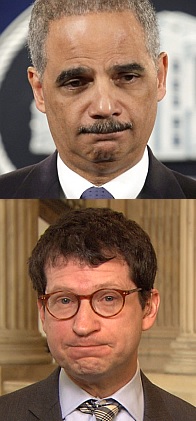
Alex Pareene writes: Eric Holder feels bad. The attorney general of the United States has been criticized quite a bit since basically the day he was announced as Obama’s pick for the job, but lately that criticism has come from liberals, who are upset with the Justice Department for excessive snooping on journalists. Holder, according to Daniel Klaidman in the Daily Beast, now feels really personally sorry about the whole treating reporters like criminals thing, because he still thinks of himself as a good liberal.
Holder signed off on the search warrant issued for Fox News reporter James Rosen. The warrant justified seizing Rosen’s records by claiming that his handling of his source, a State Department contractor, may have constituted a violation of the Espionage Act. The AG apparently did not feel bad about this until he read in a newspaper that he had done so:
But for Attorney General Eric Holder, the gravity of the situation didn’t fully sink in until Monday morning when he read the Post’s front-page story, sitting at his kitchen table. Quoting from the affidavit, the story detailed how agents had tracked Rosen’s movements in and out of the State Department, perused his private emails, and traced the timing of his calls to the State Department security adviser suspected of leaking to him. Then the story, quoting the stark, clinical language of the affidavit, described Rosen as “at the very least … an aider, abettor and/or co-conspirator” in the crime. Holder knew that Justice would be besieged by the twin leak probes; but, according to aides, he was also beginning to feel a creeping sense of personal remorse.
Holder’s supposed “remorse” is risible. He didn’t realize how far he’d gone until he read about what he’d done in the Washington Post? Whoops! I accidentally criminalized news-gathering. (At least someone still reads the paper in print.) It is a bad sign of bubble-inhabiting when an administration doesn’t understand the ramifications of its actions until it reads about itself in the press.
I once compared Daniel Klaidman to a crow feeding off a rotting carcase but suggested that that might be unfair to crows. Even so, sycophantic behavior, as much as it expresses itself through an apparent desire to please others (Klaidman’s description of Holder’s angst must surely have pleased the attorney general), tends to be driven by the shameless pursuit of self interest.
At a time when plenty of journalists in Washington must be feeling like betrayed lovers, there are others whose desire to stay in bed with their sources is so strong they are apparently willing to forgive anything.
However contrite officials like Holder might act, and however outraged the press might present itself, each side can be in little doubt that their incestuous relations will continue.
How Obama’s speech provided little clarity on drone strikes
Micah Zenko writes: There were a series of pre- and post-speech leaks to influential national security reporters which suggested that Obama would limit drone targets. Two hours before the speech there was also an embargoed conference call with three anonymous administration officials (you can probably guess who they were), which provided some clarity. President Obama also reportedly met with foreign policy columnists after his speech, including Thomas Friedman, David Ignatius, Fred Hiatt, and Gerald Seib.
These sources told us three things:
First, the new classified presidential policy guidance contains a “preference that the United States military have the lead for the use of force…beyond Afghanistan where we are fighting against al-Qaida and its associated forces,” according to one official. “The White House plan is for the Defense Department to assume control over all drone operations in less than two years,” wrote Mark Mazzetti. In contrast, Greg Miller determined that “Obama’s New Drone Policy Leaves Room for CIA Role.” On Tuesday, White House correspondent Peter Baker contended that ending CIA drone strikes in Pakistan is not assured, but will be reviewed bi-annually “to determine if it was ready to be moved to military control.”
Second, in responding to a question about military versus CIA operations, another anonymous official said that “the targeting parameters for all lethal actions are uniform,” which I interpreted to mean that they apply no matter who is the lead executive authority. In January 2012, Director of National Intelligence James Clapper stated that the same legal principles regarding “direct actions” apply to “all components of the government involved in counterterrorism, be it military or nonmilitary.”
Third, the new guidelines indicate that targets must present a “continuing, imminent threat to Americans,” according to a U.S. official. The New York Times and the Financial Times both wrote that this indicated an end to the controversial practice of “signature strikes” against anonymous military age males whose guilt is determined, in part, by the patterns of their observable behavior. But, on Tuesday, Baker wrote: “For now, officials said, ‘signature strikes’ targeting groups of unidentified armed men presumed to be extremists will continue in the Pakistani tribal areas.” Meanwhile, Declan Walsh revealed that this year “the United States cut back on so-called signature strikes against clusters of militant suspects.” So, who knows?
The problem is that, in his speech, President Obama did not directly address any of those issues, nor are they discussed in the declassified summary of the presidential policy guidance. He also did not speak to the longstanding concern of what procedures are in place to mitigate harm to civilians, stating instead: “Before any strike is taken, there must be near-certainty that no civilians will be killed or injured — the highest standard we can set.” This is merely an assertion, and it raises further questions about how the Obama administration defines “near-certainty” and what lower standard they were following previously. [Continue reading…]
Why it won’t be the end of the world if Iran gets the bomb
Alireza Nader writes: It’s as clear as day that the Islamic Republic pursues goals in the Middle East that put it on a collision course with the United States. Iran is opposed to Israel as a Jewish state, for instance, and competes for regional influence with the conservative Gulf Arab monarchies. But that doesn’t mean it is irrational: On the contrary, its top leadership, including Supreme Leader Ayatollah Ali Khamenei, is deliberative and calculating. President Mahmoud Ahmadinejad’s antics and often wild rhetoric shouldn’t obscure the fact that the Islamic Republic is interested in its own survival above all else. When contemplating the prospect of a nuclear-armed Iran, we should all be grateful that notions of martyrdom and apocalyptic beliefs don’t have a significant pull on Iranian decision-making.
Iran’s possible pursuit of nuclear weapons capability is motivated by deterrence, not some messianic effort to bring about the end times. The Islamic Republic has a relatively weak conventional military that is no match for U.S. and most Western forces — most of its regular naval and ground forces operate equipment from the 1960s and 1970s. It has tried to make up for this through a doctrine of asymmetry: It has supported terrorist and insurgent groups across the Middle East and created a “guerrilla” navy, which — at best — might be able to swarm U.S. ships and interrupt shipping in the Persian Gulf. This is all meant to prevent U.S.-driven regime change.
Nukes could provide the ultimate deterrent for an insecure regime. And Iran has a lot to be insecure about: It is a Shia and Persian-majority theocracy surrounded by hostile Sunni Arabs, which has recently watched the United States overrun unfriendly regimes in Afghanistan and Iraq with relative ease. The regime perceives both conflicts as having damaged U.S. credibility and power — but knows this is no guarantee it can protect itself in a future conflict against the vastly superior American military without a nuclear bomb.
As dangerous as it is, Iran’s possible pursuit of nuclear weapons makes logical sense. And it isn’t an effort that is unique to the Islamic Republic: Any Iranian political system, whether imperial, theocratic, or democratic, would at least consider a nuclear weapons capability. Although a nuclear-armed Iran would be a dangerous development, a closer look demonstrates that it could well be a containable challenge for the United States and its allies. [Continue reading…]
Britain’s wars fuel terror. Denying it only feeds Islamophobia
Seumas Milne writes: Eight years on, nothing has been learned. In the week since a British soldier was horrifically stabbed to death by London jihadists on the streets of Woolwich, it’s July 2005 all over again. David Cameron immediately rushed to set up a task force and vowed to ban “hate clerics”. Now the home secretary wants to outlaw “nonviolent extremist” organisations, censor broadcasters and websites and revive plans to put the whole country’s phone and web records under surveillance.
“Kneejerk” barely does it justice. As for the impact on Muslims, the backlash has if anything been worse than in 2005, when 52 Londoners were killed by suicide bombers. As the police and a BBC reporter described the alleged killers as of “Muslim appearance” (in other words, non-white), Islamophobic attacks spiked across the country. In the first five days 10 mosques were attacked, culminating in a triple petrol bombing in Grimsby.
As politicians and the media congratulated themselves that Britain was “calmly carrying on as usual”, it won’t have felt like that to the Muslim woman who had her veil ripped off and was knocked unconscious in Bolton. Nor, presumably, to the family of 75-year-old Mohammed Saleem, stabbed to death in Birmingham in what had all the hallmarks of an Islamophobic attack last month – or, for that matter, the nearly two-thirds of the population who think there will be a “clash of civilisations” between white Britons and Muslims, up 9% since the Woolwich atrocity. [Continue reading…]
After London attack, Britain grapples with anti-Muslim rage
GlobalPost reports: The London Islamic Cultural Society sits on a quiet street in Wood Green, a multiethnic, working-class neighborhood in north London.
Next door is the Greek Cypriot Women’s Organisation and across the street is the Gospel Centre, an evangelical Christian church with a billboard depicting a smiling Jesus in an England soccer jersey and the caption “No one saves better.”
But on Tuesday, only the mosque bore a warning to its members on the door.
“Security Alert: This Mosque will open 10 minutes before each prayer and close 15 minutes after each Prayers,” reads a sign posted next to a prayer time reminder and a flier for an upcoming fundraising carnival.
Mosques and Muslim community centers around the UK have been on alert since the May 22 murder of an off-duty soldier by two men with alleged ties to Islamic extremism.
Suspects Michael Adebolajo, 28, and Michael Adebowale, 22, were shot by police and injured after confronting officers after the killing. Adebowale was released from the hospital Tuesday and immediately taken into police custody in south London.
Amid the emotional public response to the brutal public killing of Drummer Lee Rigby, 25, a violent minority has chosen to direct its anger at members of Britain’s Muslim community. [Continue reading…]
Environmentalism and beauty
Rebecca Giggs writes: It is peak sakura — the short, spring season of cherry-tree flowering that so besots Japan. In Ueno Park in Tokyo, falling blossoms settle over the sleeping salarymen, recumbent on tarpaulins with traffic masks yanked down around their necks. Curtains of petals draw open and closed in the wind around huddled teenagers. The flowers land on bitumen and bare soil, sometimes drifting into the open food containers of gathered observers. A distracted child places a piece of yellow eel, festooned with sakura, into her mouth.
For all their abundance, these branches are more likely to produce the candied maraschino cherries used to trim cocktails than the grocer’s fruit with which we are familiar. Japan’s urban cherries are ornamental, neutered cousins of orchard varieties. Planted to mark out places or events of note, some of the trees are thought to be more than 1,000 years old. Despite their lack of edible fruit, for two to three weeks in late March or early April, the city’s cherries become the most important trees in Japan. The nation’s climatic range triggers a staggered cherry flowering — a ‘blossom front’ that is monitored by the Japanese tourism agency as it sweeps up from Fukuoka, through Tokyo and north towards Sapporo. The cherries, and late, slow-moving plum flowers, jostle as they race around the Japanese Alps (cold snaps advantage the plum buds). When the sprays of blossom finally break open through the capital, their momentum is as forceful as floodwaters returning. The cherries’ high, white foam pours through avenues that lead to shrines, into graveyards, over public lands, and then to the brink of rivers and lakes where great canopies of petals spread above koi fish the size of corncobs.
During sakura, families and other groups, from workplaces or social clubs, assemble to celebrate a tradition known as hanami: flower-viewing picnics. These picnics first flourished in the Heian period, and are featured in the 11th-century courtly novel The Tale of Genji. When the hanami are in full swing, it can seem as if Ueno Park — one of Tokyo’s most popular locations for the celebration — has become the staging ground for a hundred small re‑enactments of scenes from A Midsummer Night’s Dream. Young women in short crinolines, chalk tights and dark Rococo-era dresses dart between the trees like insistent fairies. Some carry lace umbrellas (‘Goth Lolita Wear’ occupies a whole floor in a nearby department store). Junior wage-earners, sent to stake a patch for their superiors, set to dreaming in intimately vulnerable postures; their arms and legs flung out to indicate an intention to occupy more space. Paired shoes in a row belong to no one nearby. Nihonshu (saké) turns cheeks ruddy and friends garrulous.
As the sun sets, the mood of enchantment reveals other themes: metamorphosis and attraction. Flash cameras twig at the edge of perception all through the night. The shots later come to colonise social media — sakura, stark and fibrous against the black sky. The flowers are extended electronically, long after they have withered, dropped, and ceased to be.
Gazing into the throats of flowers is surely one of the most trite, and universal, acts of environmental appreciation. From hand-picked posies displayed on a mantelpiece to the questing of the German Romantics for the impossible blue flower — a symbol of inspiration for the 18th-century poet Novalis — flowers induce an apparently effortless contemplation of aesthetic beauty in nature. Yet, for all the stock wonder of cherries crowned in blossom, contemporary Western environmentalism has an uneasy relationship with notions of the beautiful.
Political environmentalism has learnt to take a functional view of nature, turning a blind eye to cultural values such as beauty and to aesthetic practices such as hanami. In striving to establish an impartial, globally consistent means of gauging nature’s value, local forms of environmental imagination have been relegated to the work of poets. Nature is viewed as systemic and quantifiable, neither mysterious not resplendent. In an overburdened world, this is how we have come to debate the comparative significance of habitats and organisms: as ecosystem services.
Perhaps, for environmental thought to be accepted in the political mainstream, it was always necessary to discard the drippy spiritualism of a former age and embrace the numbers game. Yet, something important has been lost in the exchange. Sidelining the environmental imagination — particularly its manifold local variations in different cultures — has narrowed the green movement. Better science, accountancy and leadership might well be essential to confronting the realities of our current environmental crises, but without developing a way to talk about the unreal aspects of our environmental relationships and our imagined attachments to natural phenomena, progress will only ever be tenuous. Ancient as it is, the Japanese tradition of sakura offers germane insight into this very contemporary problem. [Continue reading…]
(There’s no sense reading about cherry blossom without being able to see it — and if not in real life, then at least on a video. For some reason, it’s near impossible to find a nicely made video that doesn’t have a saccharine soundtrack.)

Music: Jeff Beck — ‘Where Were You’
By intervening in Syria, Hezbollah makes dramatic gamble
The New York Times reports: Fighting a pre-emptive war against foreign jihadists is not the usual mission for Hezbollah, the Lebanese militant group best known for confronting Israel. So when its leader, Hassan Nasrallah, explained why he was sending fighters into Syria, he took care to remind his followers that they were not “living in Djibouti” but on the border of a country whose two-year uprising Hezbollah sees as a threat to its existence.
With its plunge into the Syrian civil war, Hezbollah is taking its followers in an unaccustomed direction, in a gamble that could help rescue it from that threat, bringing it new power and confidence, or end in a defeat with wide repercussions. Hezbollah is betting its prestige and security on the effort to crush a Syrian rebellion that is detested by Hezbollah’s Shiite Muslim base, but popular with the group’s Lebanese rivals and with much of the Sunni majority in the wider Arab world.
Hezbollah’s biggest stake in the conflict is the same as that of its ally, Syria’s President Bashar al-Assad: survival. The group relies on Syria to provide a conduit for arms from its main patron, Iran. Preserving that flow is a matter of life or death for Hezbollah, as its leaders have made clear.
Hezbollah’s involvement in Syria, which it long played down, has gradually come out into the open as the casualties mount. In the past month, as the group began helping the Syrian Army sweep villages surrounding the strategic town of Qusayr in an effort to connect Damascus with government strongholds on the coast, 141 fighters have been killed, according to the Syrian Observatory for Human Rights, a Britain-based group that tracks the violence through contacts in Syria. Of those, it said, 79 have died in the past 10 days, a number in accord with counts by researchers tracking Hezbollah Web sites.
To justify the unexpected new sacrifices it is asking from its followers, Hezbollah has framed the risky intervention in Syria as crucial to safeguarding its avowed core missions: challenging Israel, empowering its Shiite community and protecting Lebanon. But if it fails, by Hezbollah’s own assessment the fallout could jeopardize all three of those missions. That would leave the group weakened, with bridges burned at home and abroad, amid growing fears of a regional war between Sunnis and Shiites. [Continue reading…]
AFP reports: Iran has opened two lines of credit totalling $4 billion to Damascus and expects to open up a third to counter the effects of an international embargo, Syria’s central bank said on Monday.
“Iran continues to support Syria, by opening one line of credit worth a billion dollars to finance the import of different items and another line of credit worth three billion dollars to finance the purchase of petrol and associated products,” central bank governor Adib Mayale said, quoted in the government daily Tishreen.
He said Iran was considering an additional loan totalling another $3 billion to bolster the struggling Syrian economy, which is dealing with the economic impact of a war and international sanctions.
In January, Syrian state news agency SANA said Iran and Syria had signed a deal that would see Tehran extend a billion-dollar line of credit to Damascus.
Syria fighting rages, more chemical attacks reported
Reuters reports: Heavy fighting raged around the strategic Syrian border town of Qusair and the capital Damascus on Monday and further reports surfaced of chemical weapons attacks by President Bashar al-Assad’s forces on rebel areas.
Intensified government offensives are widely seen as a bid to strengthen Assad’s position before a peace conference proposed by the United States and Russia for next month.
In Brussels, British Foreign Secretary William Hague, who was pushing his European Union colleagues to allow member states to arm the rebels, said the expiry of existing EU sanctions this week meant countries could now choose to send weapons to opposition fighters if they wanted to.
While Britain and France say such a move could strengthen the rebels ahead of the peace talks, other countries oppose sending arms and EU diplomats said there was an agreement not to send weapons for now.
The Telegraph reports: The Syrian government has been unleashing a barrage of chemical weapons against its own people, according to two French journalists who spent two months undercover in the country.
Embedded with anti-government forces on the outskirts of Syria’s capital Damascus, Jean-Philippe Remy and photographer Laurent van der Stockt from Le Monde witnessed a series of attacks.
“No odour, no smoke, not even a whistle to indicate the release of a toxic gas,” wrote Mr Remy, from the front line in the suburb of Jobar.
“And then the symptoms appear. The men cough violently. Their eyes burn, their pupils shrink, their vision blurs. Soon they experience difficulty breathing, sometimes in the extreme; they begin to vomit or lose consciousness. The fighters worst affected need to be evacuated before they suffocate.”
Mr van der Stockt was beside the rebel fighters when they were targetted by the gas, leaving him suffering from blurred vision and respiratory difficulties for four days.