The agricultural fulcrum: better food, better climate

Diana Donlon writes: This past year treated us to a climate change preview in spades: crazy heat waves, prolonged drought, and epic storms like Sandy. To help us stabilize the climate, before we reach the point of no return, we must tap the immense potential of our food system.

Since becoming an agrarian society, we’ve known that growing food successfully depends on climate stability. Not enough water, crops wither and die. Too much, they rot. Beyond this, we know that crops have specific climatic requirements. Wheat, for instance, grows best in a dry, mild climate. Stone fruits like cherries need a minimum number of “chill hours” in order to blossom and later fruit. Intense heat disrupts pollination and can even shut down photosynthesis. These are basic parameters. If we continue to disregard them, food will become more scarce over time and we will go hungry. Indeed, as the National Climate Assessment, the government’s 1,146-page report released earlier this week states: “The rising incidence of weather extremes will have increasingly negative impacts on crop and livestock productivity because critical thresholds are already being exceeded.”

Agriculture, positioned as it is at the intersection of food and climate, presents a unique fulcrum. Pushed in the direction of industrial agriculture, it contributes egregiously to our climate problem: As activist Bill McKibben has noted, industrial agriculture — predominant in the U.S. — “essentially insures that your food is marinated in crude oil before you eat it.” This is because at every step, from the production of fertilizers and pesticides to the harvesting, processing, packaging, and transporting of materials, the industrial food system depends on climate-changing fossil fuels. Indeed, in a new report on climate change and food systems, the agriculture research organization CGIAR concluded that our global food system is responsible for nearly a third of all greenhouse gas emissions.

But we can tip the scale in the other direction toward sustainable agriculture, working in concert with natural systems instead of depleting them. This side of the scale presents an elegant, under-recognized opportunity to stabilize the climate. Not only do agro-ecological, organic and other sustainable farming methods emit significantly less greenhouse gas (GHG) overall, they can also sequester or store excess carbon. Given our long list of existing environmental worries — erosion, polluted watersheds, dead zones in the Gulf of Mexico — strengthening our top soil is a lot smarter than loading it up with nitrogen and washing it down the Mississippi. [Continue reading…]

Facebooktwittermail

Will Kerry remember climate change when he decides Keystone’s fate?

Bloomberg reports: As a senator, John Kerry fought for sweeping climate change legislation, called human-induced warming among the top challenges facing the U.S., and pushed for an international accord to cut carbon dioxide emissions.

That track record has emboldened critics of TransCanada Corp’s Keystone XL pipeline who want him to scuttle the remaining $5.3 billion portion of the project if he’s confirmed as secretary of State. Appearing yesterday at a hearing on his nomination before the Senate committee he chairs, Kerry was non- committal on the Canada-U.S. pipeline, though called himself a “passionate advocate” for action on climate change.

“He’s made climate leadership a signature issue in his Senate career,” said Erich Pica, president of Friends of the Earth, an environmental group, in a phone interview yesterday. “At the State Department, Kerry has the ability to ensure the analysis that is done gives the president the full flavor of the global warming impacts from the pipeline.”

A rejection of the Keystone XL project would exacerbate a bottleneck of shipments from Alberta’s oil sands that has made Canadian heavy oil among the cheapest in the world. The shortage of pipeline capacity and rising output has widened the gap between heavy Canadian crude and a U.S. benchmark to $36 as of yesterday.

The decision ultimately rests with President Barack Obama, who in his inaugural address this week pledged to act on climate change. Kerry’s influence may come as the State Department updates an environmental assessment originally criticized by green groups as inadequately weighing how the pipeline, which would carry bitumen from tar sands in Canada, may affect climate change.

“There is a statutory process with regards to the review and that is currently ongoing,” Kerry told the Senate Foreign Relations Committee yesterday. “It will not be long before that comes across my desk, and I will make the appropriate judgments about it.”

Investors appear to be betting on Keystone approval, sending TransCanada shares to a record high this week. TransCanada, the country’s second-largest pipeline operator, has climbed 3.9 percent since Kerry was nominated Dec. 21 and has advanced 4.1 percent this year. [Continue reading…]

Facebooktwittermail

Obama puts fox in charge of hen house at SEC

Matt Taibbi writes: I was shocked when I heard that Mary Jo White, a former U.S. Attorney and a partner for the white-shoe Wall Street defense firm Debevoise and Plimpton, had been named the new head of the SEC.

I thought to myself: Couldn’t they have found someone who wasn’t a key figure in one of the most notorious scandals to hit the SEC in the past two decades? And couldn’t they have found someone who isn’t a perfect symbol of the revolving-door culture under which regulators go soft on suspected Wall Street criminals, knowing they have million-dollar jobs waiting for them at hotshot defense firms as long as they play nice with the banks while still in office?

I’ll leave it to others to chronicle the other highlights and lowlights of Mary Jo White’s career, and focus only on the one incident I know very well: her role in the squelching of then-SEC investigator Gary Aguirre’s investigation into an insider trading incident involving future Morgan Stanley CEO John Mack. While representing Morgan Stanley at Debevoise and Plimpton, White played a key role in this inexcusable episode.

As I explained a few years ago in my story, “Why Isn’t Wall Street in Jail?”: The attorney Aguirre joined the SEC in 2004, and two days into his job was asked to look into reports of suspicious trading activity involving a hedge fund called Pequot Capital, and specifically its megastar trader, Art Samberg. Samberg had made suspiciously prescient trades ahead of the acquisition of a firm called Heller Financial by General Electric, pocketing about $18 million in a period of weeks by buying up Heller shares before the merger, among other things.

“It was as if Art Samberg woke up one morning and a voice from the heavens told him to start buying Heller,” Aguirre recalled. “And he wasn’t just buying shares – there were some days when he was trying to buy three times as many shares as were being traded that day.”

Aguirre did some digging and found that Samberg had been in contact with his old friend John Mack before making those trades. Mack had just stepped down as president of Morgan Stanley and had just flown to Switzerland, where he’d interviewed for a top job at Credit Suisse First Boston, the company that happened to be the investment banker for . . . Heller Financial.

Now, Mack had been on Samberg’s case to cut him in on a deal involving a spinoff of Lucent. “Mack is busting my chops” to let him in on the Lucent deal, Samberg told a co-worker.

So when Mack returned from Switzerland, he called Samberg. Samberg, having done no other research on Heller Financial, suddenly decided to buy every Heller share in sight. Then he cut Mack into the Lucent deal, a favor that was worth $10 million to Mack.

Aguirre thought there was clear reason to investigate the matter further and pressed the SEC for permission to interview Mack. Not arrest the man, mind you, or hand him over to the CIA for rendition to Egypt, but merely to interview the guy. He was denied, his boss telling him that Mack had “powerful political connections” (Mack was a fundraising Ranger for President Bush).

But that wasn’t all. Morgan Stanley, which by then was thinking of bringing Mack back as CEO, started trying to backdoor Aguirre and scuttle his investigation by going over his head. Who was doing that exactly? Mary Jo White. [Continue reading…]

Facebooktwittermail

How academia betrayed and continues to betray Aaron Swartz

Michael Eisen writes: As news spread last week that digital rights activist Aaron Swartz had killed himself ahead of a federal trial on charges that he illegally downloaded a large database of scholarly articles with the intent to freely disseminate its contents, thousands of academics began posting free copies of their work online, coalescing around the Twitter hashtag #pdftribute.

This was a touching tribute: a collective effort to complete the task Swartz had tried – and many people felt died trying – to accomplish himself. But it is a tragic irony that the only reason Swartz had to break the law to fulfill his quest to liberate human knowledge was that the same academic community that rose up to support his cause after he died had routinely betrayed it while he was alive.

The most obvious culprit was MIT, whose computer system Swartz used for his downloads. Their decision to make sharing journal articles a criminal matter is inexcusable. But their real betrayal was allowing these articles to fall into private hands in the first place.

Although most academic research is funded by the public, universities all but force their scholars to publish their results in journals that take ownership of the work and place it behind expensive pay walls.

Centuries ago, when printing and mailing paper journals was the most efficient way to disseminate new knowledge, a symbiotic relationship developed between scholars, who had ideas they wanted to share, and publishers, who had printing presses and the means to convey printed works to a wide audience. Transferring copyright to publishers, which protected their ability to recover costs and profit from their investment, was a reasonable price for authors to pay to further their disseminating mission.

But with the birth of the internet, scholars no longer needed publishers to distribute their work. As NYU’s Clay Shirky has noted, publishing went from being an industry to being a button.

Had the leaders of major research universities reacted to this technological transformation with any kind vision, Swartz’s dream of universal free access to the scholarly literature would now be a reality. But they did not. Rather than seize this opportunity to greatly facilitate research and education, both within and outside the academy, they chose instead to reify the status quo. [Continue reading…]

Facebooktwittermail

Egyptian protests over football sentences turn deadly

The Guardian reports: At least 22 people have been killed in the Egyptian city of Port Said amid violent protests that followed a court’s sentencing of 21 people to death on charges related to clashes between rival football fans last year.

Those killed on Saturday morning included two policemen shot dead at a prison in the north-eastern city where demonstrators had gathered to protest against the death sentences of the 21 men held inside. There are reports that more than 200 people have been injured.

The Egyptian army has deployed armoured personnel carriers and military police on the streets of the city.

The death sentences, which were announced live on television, relate to clashes in Port Said on 1 Febraury 2012 after Cairo’s Al Ahly beat the local team, Al Masry. Supporters of Al Masry attacked Al Ahly fans, causing a stampede for the exits. The police did not intervene in the violence except to switch off the stadium lights, and in the confusion the Cairo fans were crushed as crowds pushed against a locked gate which gave way under the pressure. Seventy-four people were killed.

Fans in Cairo cheered the verdict as those in Port Said protested, blocking streets and attacking police.

Facebooktwittermail

Egypt: The revolution will not be celebrated

The Egypt editors at Jadaliyya write: The common, seemingly benign question “where were you during the revolution” leaves most partisans of the January 25 Revolution with a strong sense of unease. While it is obvious that the question, whenever it comes up, is almost always posed in reference to the 2011 eighteen days of national protests that led to the end of Hosni Mubarak’s thirty-year rule, this innocent query fails to do justice to the belief that the revolution and the eighteen-day uprising are not one and the same. The phrasing of the question, moreover, proceeds on an assumption that the revolution ended with Mubarak’s departure, and that what followed was “politics as usual.” This assumption happens to coincide with a narrative that successive wielders of power have tried to sell to the Egyptian people over the past two years, namely one that purports that the revolution succeeded (and therefore “ended”) with Mubarak’s departure, and that dissenters need to vacate public squares and factories, and begin deferring to their “elders” among the politicians, the legislators, and the constitution writers. “Where were you during the revolution,” in other words, is a question that evokes our own fears about the counter-revolution and its efforts to build a popular consciousness that reduces the January 25 Revolution to an event of the past—one that warrants commemoration and celebration—and not a living phenomenon and an ongoing struggle that has ways to go. These concerns are heightened at a time when it has become acceptable in international media to call revolutionaries “anti-Morsi protesters” or “the secular opposition,” embracing the distortive view that the struggle for revolutionary change in Egypt has taken a backseat to ideological spats and partisan politics.

This is to say that partisans of the revolution in Egypt confront more than just a battle against the wielders of power as they continue to resist calls for transformative change, demands for social and economic rights, and efforts to create a meaningful social depth for the January 25 Revolution. They also face a serious battle against the hegemonic narrative that the days of revolution in Egypt are over, and that the country has re-entered into a state of normalcy in which contentious political action is no longer deemed socially or legally acceptable. [Continue reading…]

Facebooktwittermail

Egypt: The rule of the Brotherhood

Commenting on Mohamed Morsi’s rise to power, Yasmine El Rashidi writes: Many theories still circulate, trying to explain how he did it. The Brotherhood, it is said, propped up the Nasserist candidate Hamdeen Sabahy to bring Morsi’s Islamist rival Aboul Fotouh down. The US government quietly decided to support the Brotherhood. The Mubarak strongman Ahmed Shafik actually won but the Brotherhood threatened mayhem and so results were fudged.

Whatever the case, Morsi’s win seemed less about his popularity and the efficiency of the Muslim Brotherhood as a campaigning machine, and more about the opposition, particularly the splintered vote of the liberal and secular and leftist factions, whose choices of candidates offered little variation in their rhetoric and plans. Up until the final moment at polling stations back in June, many people I spoke to said they were undecided. Taken together, however, the opposition candidates received a sizable chunk of the vote.

Morsi won by three percent — 51.7 percent to Shafik’s 48.3 — while just over half the eligible electorate of 51 million took part. His supporters these days justify his actions as taken “on behalf of the people”; but the nation was not overwhelmingly behind him and his proclaimed ideals.

Was the nation divided between those in favor of the old regime and those in favor of the Islamists? Or was it the case that millions of young Egyptians who had taken to the streets to oppose Mubarak were voting “no” to Mubarak’s Shafik, rather than “yes” to Morsi? As the prominent newspaper editor Hassanein Heikal has said at dinner parties and on TV: “It was not that people knew what they wanted and were voting for it. They simply knew what they didn’t want, and they were voting against it.” Many of my own friends — who identify themselves as liberal, secular, “revolutionary”—voted against the possibility of a return to the life we had known. [Continue reading…]

Facebooktwittermail

Brothers and officers — a history of pacts

Wael Eskandar writes: The politics of the past two years have generated widespread interest in the historical relationship between the Muslim Brotherhood (MB) and Egypt’s wielders of power, especially at a time when observers are eager to understand the prospects for accommodation (or adversity) between the MB and traditional bureaucratic powers inside the Egyptian state, such as the military establishment.

For instance, the circumstances surrounding the election of President Mohamed Morsi in June 2012 have raised numerous questions about the MB’s relationship with Egypt’s military rulers. During the lead-up to the announcement of the election results, it seemed that the Supreme Council of the Armed Forces (SCAF) was bargaining with the Brotherhood over the future of the country. While official results were due on 20 June, their announcement was postponed to 24 June with little transparency on why the official vote count was being withheld and what was happening behind the scenes.

MB statements at the time suggested that the SCAF was holding the results hostage until the group accepts the continuation of military leaders’ reserved powers as per the constitutional annex that SCAF had issued on 17 June 2012 shortly before the end of voting. Before it was annulled last August by President Morsi, the annex to the Constitutional Declaration set limitations on presidential authority and granted the SCAF legislative powers in light of the dissolution of parliament in mid-June. In its official response that same month, the MB vowed to fight for presidential powers and called on its supporters to occupy Tahrir Square in protest of SCAF’s constitutional annex. Eventually, official results were released declaring Morsi’s victory. The MB’s nominee ended up swearing the oath to the Supreme Constitutional Court, thus implicitly recognizing the dissolution of parliament and the SCAF-sponsored constitutional framework that the Brotherhood supposedly rejected. Morsi became Egypt’s first elected president after the January 25 Revolution, yet one question remains lurking in the background: at what price? [Continue reading…]

Facebooktwittermail

Egypt’s unfinished revolution

Charles Holmes writes: The ideological vision of Gamal Abdel Nasser, who led the 1952 revolution that overthrew Egypt’s monarchy, has defined the last six decades of Egyptian politics: Arab nationalism, vehement anti-colonialism, the nationalization of the country’s economy, and the preeminence of the military are the foundation on which modern Egypt is built. While Nasserism was arguably successful in helping Egypt emerge from its political past, it has long been in slow decline — and is now on the verge of collapse.

The crumbling of the Mubarak regime two years ago momentarily wrenched Egypt’s population out of a decades-old slumber. But today, many vestiges of Nasser’s Egypt — key structures of state, society, and the economy — linger on. They are the creaking, dysfunctional machinery of a protectionist system still striving to shut out the forces of modernity and globalization in order to preserve the vested interests of an elite few.

Egypt’s insidious state security establishment is a prime example of the country’s unfinished revolution. The Jan. 25 protests proved to be the watershed moment when — for all its networks of informants, secret police officers, and legions of thugs — it had no answer to modern technology, digital media, and mobile communications. While describing the uprising as a “Facebook Revolution” remains misleading, protesters understood how their technological advantages enabled them to outmaneuver a clumsy and brutal security apparatus. Two years on, however, the Interior Ministry remains unreformed, the scars of years of brutalization of Egyptian society are yet to be healed, and civilian law enforcement faces an undetermined future.

Depressingly then, though no less predictably, the Muslim Brotherhood has quickly revealed itself as representing a continuation of this broken system. [Continue reading…]

The Associated Press reports: Violence erupted across Egypt on Friday as tens of thousands took to the streets to deliver an angry backlash against President Mohammed Morsi and his Muslim Brotherhood, demanding regime change on the second anniversary of the revolution that toppled Hosni Mubarak. At least seven people were killed.

Two years to the day after protesters first rose up against the autocratic ex-president, the new phase of Egypt’s upheaval was on display: the struggle between ruling Islamists and their opponents, played out against the backdrop of a worsening economy.

Rallies turned to clashes in multiple cities around Egypt, with police firing tear gas and protesters throwing stones. At least six people, including a 14-year-old boy, were killed in Suez, where protesters set ablaze a building that once housed the city’s local government. Another person died in clashes in Ismailia, another Suez Canal city east of Cairo.

At least 480 people were injured nationwide, the Health Ministry said, including five with gunshot wounds in Suez, raising the possibility of a higher death toll.

Facebooktwittermail

How Bush, Rumsfeld and Algerian intelligence helped foster the Islamist uprising in Mali

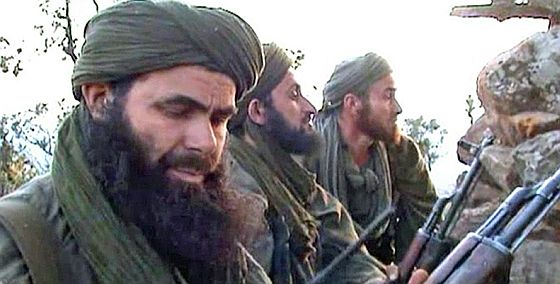
Abdelhamid Abou Zeid, an Algerian national and senior commander of al-Qaeda in the Islamic Maghreb (AQIM).

In an analysis appearing in the New Internationalist last month, Jeremy Keenan, professor of social anthropology at London University’s School of Oriental and African Studies, explained how the current conflict in Mali is rooted in “a largely covert and highly duplicitous alliance” forged between Algerian President Abdelaziz Bouteflika and President George W Bush in the summer of 2001.

[T]he Bush administration and the regime in Algiers both needed a ‘little more terrorism’ in the region. The Algerians wanted more terrorism to legitimize their need for more high-tech and up-to-date weaponry. The Bush administration, meanwhile, saw the development of such terrorism as providing the justification for launching a new Saharan front in the Global War On Terror. Such a ‘second front’ would legitimize America’s increased militarization of Africa so as better to secure the continent’s natural resources, notably oil. This, in turn, was soon to lead to the creation in 2008 of a new US combat command for Africa – AFRICOM.

The first US-Algerian ‘false flag’ terrorist operation in the Sahara-Sahel was undertaken in 2003 when a group led by an ‘infiltrated’ DRS [the Algerian intelligence service] agent, Amari Saifi (aka Abderrazak Lamari and ‘El Para’), took 32 European tourists hostage in the Algerian Sahara. The Bush administration immediately branded El Para as ‘Osama bin Laden’s man in the Sahara’.

In 2002, a … plan was presented to US Defense Secretary Donald Rumsfeld by his Defense Science Board. Excerpts from its ‘Summer Study on Special Operations and Joint Forces in Support of Countering Terrorism’ were revealed on 16 August 2002, with Pamela Hess, William Arkin and David Isenberg, amongst others, publishing further details and analysis of the plan. The plan recommended the creation of a ‘Proactive, Preemptive Operations Group’ (P20G as it became known), a covert organization that would carry out secret missions to ‘stimulate reactions’ among terrorist groups by provoking them into undertaking violent acts that would expose them to ‘counter-attack’ by US forces.

My new book on the Global War On Terror in the Sahara (The Dying Sahara, Pluto 2013) will present strong evidence that the El Para operation was the first ‘test run’ of Rumsfeld’s decision, made in 2002, to operationalize the P20G plan. In his recent investigation of false flag operations, Nafeez Ahmed states that the US investigative journalist Seymour Hersh was told by a Pentagon advisor that the Algerian [El Para] operation was a pilot for the new Pentagon covert P20G programme.
[…]
Since the El Para operation, Algeria’s DRS, with the complicity of the US and the knowledge of other Western intelligence agencies, has used Al Qaeda in the Islamic Maghreb, through the almost complete infiltration of its leadership, to create a terrorist scenario. Much of the terrorist landscape that Algeria and its Western allies have painted in the Sahara-Sahel region is completely false.

The Dying Sahara analyzes every supposed ‘terrorism’ incident in the region over this last, terrible decade. It shows that a few are genuine, but that the vast majority were fabricated or orchestrated by the DRS. Some incidents, such as the widely reported Al Qaeda in the Islamic Maghreb attack on Algeria’s Djanet airport in 2007, simply didn’t happen…

In order to justify or increase what I have called their ‘terrorism rents’ from Washington, the governments of Mali, Niger and Algeria have been responsible on at least five occasions since 2004 for provoking Tuareg into taking up arms, as in 2004 (Niger), 2005 (Tamanrasset, Algeria), 2006 (Mali), 2007-09 (Niger and Mali)…

Around the time of the El Para operation, the Pentagon produced a series of maps of Africa, depicting most of the Sahara-Sahel region as a ‘Terror Zone’ or ‘Terror Corridor’. That has now become a self-fulfilled prophecy. In addition, the region has also become one of the world’s main drug conduits. In the last few years, cocaine trafficking from South America through Azawad to Europe, under the protection of the region’s political and military élites, notably Mali’s former president and security forces and Algeria’s DRS, has burgeoned. The UN Office of Drugs Control recently estimated that 60 per cent of Europe’s cocaine passed through the region. It put its value, at Paris street prices, at some $11 billion, with an estimated $2 billion remaining in the region.

While it will be clear from all this that Mali’s latest Tuareg rebellion had a complex background, the rebellion that began in January 2012 was different from all previous Tuareg rebellions in that there was a very real likelihood that it would succeed, at least in taking control of the whole of northern Mali. The creation of the rebel MNLA in October 2011 was therefore not only a potentially serious threat to Algeria, but one which appears to have taken the Algerian regime by surprise. Algeria has always been a little fearful of the Tuareg, both domestically and in the neighbouring Sahel countries. The distinct possibility of a militarily successful Tuareg nationalist movement in northern Mali, which Algeria has always regarded as its own backyard, could not be countenanced.

The Algerian intelligence agency’s strategy to remove this threat was to use its control of Al Qaeda in the Islamic Maghreb to weaken and then destroy the credibility and political effectiveness of the MNLA. This is precisely what we have seen happening in northern Mali over the last nine months.

In an interview last week, Scott Horton asked Keenan to further substantiate his claim that Al Qaeda in the Islamic Maghreb has been supported by the Algerian government.

In this segment of the interview, Keenan describes a large camp deep in the Algerian Sahara in which AQIM fighters were trained while the camp was being supplied by the Algerian army and intelligence service.

The existence of this camp has been known by Western intelligence services for two or three years since at least two of these men were arrested in Europe. Keenan has been able to interview these AQIM members and then cross-check the information they provided with information he has gathered from independent sources.

Since 2008, much of that camp has been moved down into northern Mali, forming the base of the Islamist forces that have now taken over the area.

Facebooktwittermail

Mali’s cocaine-fueled jihad

McClatchy reports: On Jan. 14, Diakaridia Doumbia locked his door, climbed to the second floor and peered down from his mud-brick home at a swarm of cocaine-drugged Islamist rebels who’d captured the town of Diabaly earlier that day.

The towering retired soldier, now graying, placed a call to a friend in the Malian military.

“They are outside my house. They look like they are packing their cars to keep driving,” he reported. Soon after, French jets swooped down and struck, obliterating several of the cars and incinerating their inhabitants.

Later, Doumbia received a call. This time, the man on the other line wasn’t Malian.

“It was the French commander. He called often, and we talked. I told him where the rebels were and what they were doing,” said Doumbia, who served in the Malian military from 1974 until 2007.

The French beat back the sudden Islamist advance south into Diabaly with heavy air power, but it turns out they had some help: Doumbia and a spontaneous network of residents who responded to the capture of their farming community by risking their lives to channel intelligence out of the town.

“Everyone was calling,” said the mayor, Oumar Diakite, who was out of town when Diabaly was attacked and then was summoned by the governor. Diakite compiled the reports in real time – working next to detailed computer grids of the area that had been saved from U.S. development projects in the area’s complex canal system – and reported the coordinates to the military, which relayed them to the French command.

The townspeople’s response will pose a serious problem for the rebels if it’s replicated elsewhere. Fighting an insurgency against a more powerful force is hard, but it’s even harder without local complicity.

Part of the town’s disgust stemmed from the intruders’ behavior, and one trait in particular: Many of the outsiders, some of whom belonged to the regional al Qaida group and quickly banned cigarettes in the town, apparently were druggies.

Doumbia and one other Diabaly resident reported watching the rebels regularly taking cocaine. A third resident reported seeing emptied, white-coated bags lying around and said everyone knew what was inside them.

“We saw them sniffing it, smoking it. Some were injecting it,” Doumbia said.

A bag of white powder was flung outside the gate of a friend’s house after one bombing raid, the contents equal to half a kilogram of sugar. Doumbia sent a child to fetch it and confirm its contents, he said, but it was already gone.

Experts say the Sahara desert in West Africa, with its loose borders and weak governments, is rapidly becoming one of the prime cocaine-trafficking routes in the world. Its lucrative windfall is thought to help finance the Islamist rebels, and a legion of fighters dependent on the drug might make finally squelching the insurgency even more difficult. [Continue reading…]

Facebooktwittermail

U.N. urges Syria’s neighbours to keep open borders to refugee exodus

Reuters reports: The United Nations on Friday urged Syria’s neighbours to keep open their borders to civilians fleeing the intensifying conflict and said that the refugee exodus into Jordan was “absolutely dramatic”.

More than 30,000 Syrians have arrived in Jordan’s main Zaatri camp this year, including 4,400 on Thursday and another 2,000 overnight, it said. Most were fleeing fighting in the southern area of Deraa, food and fuel shortages and high prices.

Turkey has said that camps are filling up as soon as they are built and officials in Jordan said this week it would keep its borders open but wanted other countries to help it boost its ability to cope with the influx.

“It is just absolutely dramatic the inflow of people that continues into Jordan,” Melissa Fleming, chief spokeswoman of the U.N. High Commissioner for Refugees (UNHCR), told a news briefing in Geneva.

Jordan now hosts more than 206,000 Syrians who have registered as refugees or await processing, while the government says that more than 300,000 Syrians are actually in the country.

A further 30,000 Syrians could be preparing to head to Jordan, according to the UNHCR’s latest assessment.

Across the region, 678,540 Syrian refugees had registered or were being processed as of Tuesday, according to UNHCR figures for Jordan, Turkey, Lebanon, Iraq and North Africa.

Facebooktwittermail

Why the Israeli elections were a victory for the Right

Max Blumenthal writes: The story of the Israeli elections is not, as was expected, the dominance of Prime Minister Benjamin Netanyahu and his right-wing Likud-Beiteinu coalition with former foreign minister Avigdor Lieberman. Instead, it is the unlikely triumph of Yair Lapid, a media celebrity who managed to secure nineteen seats in the next Knesset, making his newly formed Yesh Atid, or There Is a Future, the second-largest party in Israel. In the coming days, Lapid will play a pivotal role in the formation of the next governing coalition, and he is certain to receive a ministerial role in any future administration.

The results were a stinging rebuke to Netanyahu, who had expected over forty seats and wound up with only thirty-one. But what do they mean for the status quo of the Israeli occupation and the slow-motion dispossession of the Palestinians? Lapid has been cast in mainstream US media accounts as a “centrist,” a label that carries moderate connotations. According to the Washington Post, his success could “signal more flexibility in peace negotiations with the Palestinians.” But Lapid is, in fact, a politically vague media celebrity presiding over a party comprising random figures he personally selected — “as much a mystery as the future the party claims to be fighting for,” as the Times of Israel described him. As a potential coalition partner, the vapid broadcast personality seems like a perfect tool for Netanyahu; he is far more refined than Lieberman, who has consistently verged on bellicose incitement, but has no clear ideological core.

What’s more, Lapid has offered scant evidence that he views the Palestinian issue any differently than Netanyahu does. When he unveiled his foreign policy platform last year, Lapid chose to do so at a university inside the illegal mega-settlement of Ariel. Israel “must at last get rid of the Palestinians and put a fence between us,” he declared, explaining that he chose to launch his campaign at the settlement because “there is no map on which Ariel isn’t a part of the state of Israel.” Like Netanyahu, he says he strongly opposes the division of Jerusalem, an implicit rejection of the international consensus for a Palestinian state with East Jerusalem as its capital. (The Labor Party, which won fifteen seats and is generally labeled center-left, also supports annexing the major settlement blocs.)

In a 2007 column for the Israeli daily Yediot Aharonoth, Lapid insisted that ending the occupation would mean certain death for himself and fellow Israeli Jews. He wrote, “It may be true that the humane thing is to remove the roadblocks and checkpoints, to stop the occupation immediately, to enable the Palestinians freedom of movement in the territories, to tear down the bloody inhumane wall, to promise them the basic rights ensured to every individual. It’s just that I will end up paying for this with my life.… Call me a weakling; call me thickheaded — I don’t want to die.” [Continue reading…]

Facebooktwittermail

Fighting against the jihadist occupation of northern Mali

Karima Bennoune writes: Before the recent French intervention in Mali began, 412,000 people had already left their homes in the country’s north, fleeing torture, summary executions, recruitment of child soldiers and sexual violence against women at the hands of fundamentalist militants. Late last year, in Algeria and southern Mali, I interviewed dozens of Malians from the north, including many who had recently fled. Their testimonies confirmed the horrors that radical Islamists, self-proclaimed warriors of God, have inflicted on their communities.

First, the fundamentalists banned music in a country with one of the richest musical traditions in the world. Last July, they stoned an unmarried couple for adultery. The woman, a mother of two, had been buried up to her waist in a hole before a group of men pelted her to death with rocks. And in October the Islamist occupiers began compiling lists of unmarried mothers.

Even holy places are not safe. These self-styled “defenders of the faith” demolished the tombs of local Sufi saints in the fabled city of Timbuktu. The armed groups also reportedly destroyed many churches in the north, where displaced members of the small Christian minority told me they had previously felt entirely accepted. Such Qaeda-style tactics, and the religious extremism that demands them, are completely alien to the mainstream of Malian Islam, which is known for its tradition of tolerance.

That openness is exactly what the jihadists seek to crush. “The fact that we are building a new country on the base of Shariah is just something the people living here will have to accept,” the Islamist police commissioner in the town of Gao said last August. Until military action began this month, local citizens were on their own in resisting the imposition of Shariah — and they fought back valiantly. A radio journalist was severely beaten by Islamist gunmen after speaking on the radio against amputations. Women marched through the streets of Timbuktu against Islamist diktats on veiling until gunfire ended their protest.

The acting principal of a coed high school in Gao told me his school had been occupied by militants from the Movement for Unity and Jihad in West Africa. They announced that they had come to protect the premises. Instead, they quickly stole its computers, refrigerators and chairs. “We consider ourselves under occupation,” the principal told me. “We consider ourselves martyrs.” He has risked his life to keep his school open, to continue to educate boys and girls together, though he must put them on opposite sides of the classroom now. “My presence creates hope for my students. I cannot kill this hope,” he told me. [Continue reading…]

Those who see foreign intervention as a universal evil are fond of the expression: this can’t end well. Yet this ideological opposition to intervention — a stance which presupposes that intervention necessarily leads to a negative outcome — also presupposes that there is something inherently benign about non-intervention.

Beneath the reasonable expectation that outsiders are frequently in danger of making a problem worse because they have failed to understand its complexity — a failure all too common in American efforts to shape the world in its own image — there is just as often the attitude: I am not my brother’s keeper. It’s not my problem, nor my responsibility.

The crucial issue, however, is not to intervene or not intervene; it is: who is calling for the intervention? Has there been a plea for help from people in need, or is help being imposed by those who presuppose they know what is good for others?

And this question points to the hubris that lurks so often in the seemingly humble guise of non-intervention. It declares that even when pleas for help are loud and clear, they should politely be ignored because they are coming from people who don’t really understand what is in their own interests.

To Malians, Syrians, and Libyans, the underlying message from anti-interventionists is essentially the same: we feel your anguish but we really can’t help. We’re clumsy. Our governments are led by fake humanitarians who really only want to plunder your resources. And besides, our economies are ailing and we need to focus on our our own nation-building. Maybe the UN and the NGOs can help you out, but we have to take care of ourselves and so do you.

In my pointed criticism of anti-interventionism, I’m not arguing against negotiation. Political conflicts demand political solutions. But those who assume that right now French troops in Mali can only do harm are perhaps more naive than the flag-waving Malians who greeted the troops’ arrival.

Facebooktwittermail

Mali’s Ansar Dine rebel group splits amid blistering French air strikes, growing African force

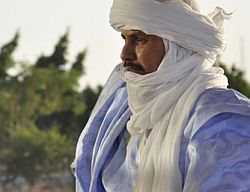
Alghabass Ag Intalla

The Associated Press reports: Mali’s rebel movement showed new signs of discord on Thursday in the wake of punishing French air strikes, with one wing of the Ansar Dine group now pledging to negotiate an end to the country’s crisis and possibly even fight against its former comrades-in-arms.

France’s air and land campaign that began two weeks ago to save Mali’s embattled interim government has shaken up the military landscape and put the international spotlight on the former French colony. Mali’s government was on a new political defensive, urging its soldiers to respect human rights after new allegations that they had carried out summary executions in zones of battle against the radical Islamists.

Three al-Qaida-linked extremist groups have controlled Mali’s vast northeast for months, capitalizing on chaos that followed a coup d’etat in Mali’s capital, Bamako, in March. But in a new sign of splintering, former Ansar Dine leader Alghabass Ag Intalla told the Associated Press on Thursday that he and his men were breaking off from Ansar Dine “so that we can be in control of our own fate.”

“We are neither AQIM or MUJAO,” he said of the other groups, al-Qaida in the Islamic Maghreb and the Movement for the Unity and Jihad in West Africa, known by its French-language acronym. “We are a group of people from the north of Mali who have a set of grievances that date back at least 50 years.”

The comments suggested that at least some of Islamist fighters are searching for an exit in the wake of the French airstrikes. French radio RFI reported earlier Thursday that Intalla’s new group will be called the Islamic Movement for the Azawad, a Tuareg term for northern Mali, and his men are willing to fight their former comrades-in-arms in Ansar Dine.

“We are not terrorists. We are ready to negotiate,” Intalla told the AP. [Continue reading…]

Facebooktwittermail

The effort to quarantine the Syrian problem is prolonging the war

Robin Yassin-Kassab writes: In response to non-violent protests calling for reform, the Baathist regime in Damascus has brought Syria bloodshed, chaos, and created the conditions in which jihadism thrives. The now partially armed revolution is doing its best to roll back the bloodshed and to eliminate the regime that perpetrates it.

Yet Foreign Policy’s Marc Lynch, one of the more perceptive analysts of the Middle East, argues that after more than 60,000 lives have been lost, “the last year should be a lesson to those who called for arming the rebels.” In a previous article, Lynch noted, “Syrian armed groups are now awash with weapons.”

Anyone laboring under the delusion that pro-revolution foreign powers have flooded Syria with hi-tech weaponry should scroll through the blog of New York Times correspondent C.J. Chivers or peruse the web pages displaying improvised catapult bombs and PlayStation-controlled armored cars. These are hardly the tools of a fighting force that has been armed to the teeth.

While it’s true that some armed groups — particularly the al Qaeda-linked Jabhat al-Nusra — have sometimes found themselves in possession of plenty of weaponry, the resistance remains overwhelmingly dependent on the weapons it can buy, steal, or seize from captured checkpoints and bases.

Simply put, the assumptions of those who called for arming the rebels have not been tested because the rebels have not been armed — except in irrelevant, sporadic and, in Lynch’s words, “poorly coordinated” ways. For instance, an ammunition shortage slowed the original rebel advance in Aleppo to a destructive halt.

Yes, the Saudis and Qataris distributed some light weapons — each according to their own interests, which only compounded the disorganization of rebel forces. The United States has held them back from providing heavy weapons, which could have made a difference against tanks and aircraft. In any case, the Arab Gulf states are also manipulating the Syrian conflict for their own ends: The Saudi tactic seems to be to slowly bleed Iran in Syria in the manner of the Iran-Iraq war rather than to push for a rapid revolutionary victory. [Continue reading…]

Facebooktwittermail