



Americans focus on work and making money, more than anything else. They don’t have time to spend hours drinking tea and socializing. And they know very little about the outside world.
These are the ‘stereotypes’ that Malians project on Americans.
Or, to put it another way, Malians understand Americans surprisingly well even if most Americans don’t know the first thing about Malians or their country.
This glimpse of Malians is provided by Demba Boundy, an independent journalist and English teacher in Bamako, during a conversation with Robert Wright.
Some viewers might treat Boundy’s assessment of the likely success of France’s intervention in Mali with skepticism, but I doubt very much that there will be many visitors to this site who can claim to be more knowledgeable about this West African state or the surrounding region.
(On one point, the size of the Tuareg population, when Boundy says they only amount to 2% of the population, I think this might be misleading — at least based on what I can glean from Wikipedia. The whole Malian population of 14.5 million is very unevenly divided between the north and south with only 10% of the population in the north. The estimated size of the Tuareg population is 450,000 — though this must fluctuate since they are nomadic. That would mean that in northern Mali, about 30% of the population is Tuareg.)
Aluf Benn says Yair Lapid’s success in yesterday’s election sprang from his ability to define the Israeli mainstream and become its voice. What the 2011 middle-class revolt demonstrated, in Lapid’s analysis was that “Israelis couldn’t care less about the Palestinian issue and the settlements. Instead they crave economic security and better education.”
The key question in the wake of Tuesday’s result, Benn writes, is:
can you really live in Tel Aviv and feel like it’s Berlin, with no occupation and settlements barely 20 minutes away? Can Israel isolate itself behind wire and concrete and fix its education and welfare, as if the Palestinians don’t exist? It sounds good in a campaign, but disconnected from real life. And therefore Lapid’s test will be in his ability to pull Netanyahu towards a moderate foreign policy, and not to accept empty pledges of constitutional and social reform in return for sustaining Likud.
Coalition talks are the endgame of Israeli elections, and the political rookie Lapid now awaits a tough poker game with the master of survival, Netanyahu.
Michael J. Koplow writes: When Netanyahu decided to call early elections, he did it because the political timing seemed favorable for him rather than because he was forced to. Despite his term being marked by no significant policy accomplishments or remarkable stances, Netanyahu has achieved a nearly unprecedented degree of governmental stability.
In contrast, the next Netanyahu government, which will almost certainly be the result of today’s election, is not only going to be less stable on a daily basis than the previous one, but will also be likely to fall well before Netanyahu’s term is up and before he is ready to call another round of elections. The new Israeli government is going to be facing enormous cross-cutting pressures from within its own ranks and from outside the country, and no matter how hard he tries to construct a stable coalition, there will be nothing Netanyahu can do to mitigate this problem. Rather, the coalition choices that Netanyahu makes are going to determine which set of pressures will ultimately bring him down. In essence, Netanyahu will be picking his poison rather than coming up with a cure.
Patrick Martin reports: Prime Minister Benjamin Netanyahu earned the right in Tuesday’s Israeli election to be asked to try to form the country’s next government, but whether he will succeed or not is up to a neophyte politician named Yair Lapid, whose party’s second-place finish has stunned the country.
Riding a wave of protest over such issues as the cost of housing and the privilege given Israel’s ultra-Orthodox Haredim to avoid the military draft, Mr. Lapid, a popular former broadcast journalist, made these two concerns the centrepiece of his campaign.
Another first-time politician, Naftali Bennett, argued for much the same things, but Mr. Bennett, leader of a national religious party known as the Jewish Home, also championed the expansion of Israeli settlements in the West Bank and the abandonment of the idea of a Palestinian state – a position too extreme, perhaps, for many Israelis.
Whatever this election was about, it wasn’t about making peace with the Palestinians, nor about Israel’s relations with Arab states in the region. It was about what Israelis wanted in their daily lives.
The outcome of Tuesday’s vote, however, leaves Mr. Netanyahu with one of two choices, both with broader, regional implications. Either he tries to govern with a paper-thin majority of right wing and ultra-Orthodox parties (in which case he will have to adopt an even more confrontational approach to Palestinian statehood as demanded by Mr. Bennett), or he will reach out to the centrist Mr. Lapid to form a broader coalition.
Based on the phone call he made to Mr. Lapid late Tuesday night, he appears to have chosen the latter approach.
What remains to be seen now is whether the Prime Minister will jettison the ultra-Orthodox and their privileges from his coalition – or leave Mr. Bennett and his pro-settlement views out of a new government. The choice may be made for him by Mr. Lapid.
In either scenario, as long as Mr. Netanyahu is Prime Minister, Israel’s policy toward Iran won’t change.
For Mr. Netanyahu, the man who was assumed to be the once and future prime minister, the results are a stunning setback.
An editorial in Haaretz said: Israelis awaken this morning to a day of uncertainty. The voting is over, but the election is not. The soldiers’ votes, disqualified votes, the electoral threshold − all of these will still move the numbers this way or that. But to learn some lessons, no waiting is necessary.
Israel on Tuesday expressed no confidence in Prime Minister Benjamin Netanyahu. After four years at the country’s helm, together with his natural partner, MK Avigdor Lieberman, Netanyahu lost about a quarter of his strength despite − or perhaps because of − the merger with Lieberman. Netanyahu, Israelis said on Tuesday, has failed. He has failed in the political sphere, the foreign policy sphere and the socioeconomic sphere.
His failure is a failure of leadership, which will continue to cast a pall over us if he survives in power. Netanyahu plunged from Likud and Yisrael Beiteinu’s 42 MKs to about 30 because the Israeli public felt that his government had not understood the deeper significance of the protests of the summer of 2011.
Reuters reports: Palestinians reacted warily to the outcome of the poll, voicing doubts it would produce a government more willing to compromise for peace, even if it included centrist parties.
An editorial in the Ramallah-based Al-Quds daily said such parties would provide a “cosmetic decoration” for a Netanyahu-led government that would mislead world public opinion without halting a drive to expand Jewish settlement on occupied land.
Jeffrey Goldberg writes: A Netanyahu-Bennett-Lapid coalition would be far more likely to take bold action against another of Israel’s threats, the rise of the ultra-Orthodox, than to take on the peace process. Thousands of ultra-Orthodox Haredi men don’t serve in the army and are on the public dole so that they can pursue full-time religious studies. And Haredi political parties are becoming more radical (ayatollah-like, in some ways), demanding sex segregation on public buses and generally trying to erase the line dividing synagogue from state. Lapid’s popularity is derived in large part from his stalwart stance against the privileges accrued by the ultra-Orthodox.
Lev Grinberg says: this election revolved around whiteness.
That was precisely the criticism leveled at the leadership of the Rothschild Boulevard protesters in the summer of 2011: its whiteness, its dominance, its failure to represent the periphery and its desire to preserve the power of the middle class — that is, the secular Ashkenazim.
Watch The Untouchables on PBS. See more from FRONTLINE.
David Bromwich writes: Zero Dark Thirty is a spy thriller about the tracking and killing of Osama Bin Laden. Good police work did it, the film says, and it aims to show what (in the extraordinary circumstances) good police work amounts to. Action movies have been the director Kathryn Bigelow’s métier, and Zero Dark Thirty is tense and well-paced. It has the kind of proficiency one associates with, say, The Hunt for Red October. It does not mean to compete with a film like The Battle of Algiers. There is no question here of taking up a complex historical subject and exploring it with a semblance of human depth. Rather, the movie accepts the ready prejudices and fears of its American audience, and builds up pressure for two hours to prepare the thrill and relief at the raid on Bin Laden’s compound in Abbottabad. The first two hours skip forward selectively to cover the trajectory of ten years. The final twenty-five minutes of action are portrayed almost in real time.
Until Americans stop indulging our elected officials in their appetite for secrecy, we will not know exactly what orders the Navy Seals carried into Abbottabad. Pretty clearly, it was a kill mission and not “Capture or Kill.” Zero Dark Thirty makes killing the personal preference of its heroine, Maya, a CIA agent who begins the hunt in September 2001 and whose relentless pursuit is clinched by success. When she talks to the Navy Seals team, she says she wants them to “kill him for me.” The “me” element in the international hunt, and its reflexive connection to revenge, is emphasized more than once. This overtly simplifies an area of moral doubt which the film in other ways simplifies covertly. Maya’s stamina, force, and drive somehow place her beyond challenge. By the end, her superiors at CIA are intimidated, and we feel they ought to be. Maya has no friends, and no life outside the hunt, but her determination is itself a sort of passion. It is, in fact, the only passion that is represented in the film.
How was Bin Laden found? Zero Dark Thirty tells us that it was done by the torture of detainees; by the collection and deduction of evidence from dossiers, videos, recorded phone calls and intercepted emails; and by tailing couriers. All of these methods the movie dispassionately records, and it affirms the efficacy of all. The narrative lacks the patience and tightness to illustrate many convincing particulars of the detective work. That it leaves us in the dark, however, is also part of the point. We Americans, the film is saying, must put ourselves in the hands of the experts who have mastered the darkness. [Continue reading…]
Afghanistan is on the verge of momentous change as U.S. and NATO troops prepare to withdraw in 2014. Will this be the dawn of lasting stability or will the country slip back into war? What kind of commitment will be required to address the huge problems facing the country? “The Hard Places” is a new feature-length documentary that will examine these questions about the future by first looking back and chronicling the extraordinary journey of Dr. Tom Little, a man who chose to forsake a life of comfort and security in order to make a lasting difference.
American optician Dr. Tom Little arrived in Afghanistan just before the country entered a relentless series of conflicts that has lasted to the present day – from Soviet occupation, to civil war, to Taliban rule and the U.S. invasion following 9/11. Despite almost constant danger he, his wife and children decided to stay and live among the people they served. Little’s dream was to create a sustainable eye program that would train native Afghans to become eye doctors and to establish eye clinics throughout the country to treat the thousands of people suffering from vision problems in that unforgiving environment. Little believed it was his calling to help those who had no options, who were caught up in violent circumstances, but yet whom he also saw as fellow human beings in need of a healing touch. Today, in large part because of his perseverance and dedication, his organization, IAM, provides nearly 90% of all eye-care in the war torn nation.
In July of 2010, Tom and a team of fellow aid workers backpacked 120 miles into the remote province of Nuristan at the invitation of village elders to serve a population of nearly 50,000 people with no access to medical care. On August 5th, 2010, as he and his team were only a day trip away from solid roads returning to Kabul, they were ambushed and murdered in the wilderness. In 2011, in recognition of his life’s work and sacrifice, President Obama posthumously awarded Tom Little the Presidential Medal of Freedom, the highest honor bestowed upon any U.S. citizen.
We need a film that examines the real cost of lasting change and shines a light on those who take on the challenge. In recent days we have seen an increased incidence of aid workers being targeted by militants whose goal is to make bridge building between East and West impossible. The goal of “The Hard Places” is to reveal the lasting impact of Dr. Little’s work and use his story as a lens to investigate the challenges, dangers and successes of international aid work and highlight the continuing need for medical training, sustainable development and medical access for the Afghan people.
Please consider supporting this project by making a donation at Kickstarter — and to appreciate Lukas and Salome Augustin’s talent as filmmakers, watch Afghanistan – Touch Down in Flight:
The Telegraph reports: Taliban commanders have branded Prince Harry a naïve “coward” for his comments comparing the decade-long conflict in Afghanistan with computer games.
Two senior figures told The Daily Telegraph that the unguarded description was an insult to the men who had fought and died alongside Captain Wales.
They were angered by the way Prince Harry described his role as co-pilot of an Apache helicopter, in charge of its weapons systems, firing Hellfire air-to-surface missiles, rockets and a 30-millimetre gun.
“It’s a joy for me because I’m one of those people who loves playing PlayStation and Xbox, so with my thumbs I like to think I’m probably quite useful,” he said in an interview timed to coincide with his departure after a 20-week tour.
The unguarded comments could prove a headache for President Hamid Karzai, who has staked his reputation on working closely with Nato-led forces and wants the US to station troops in Afghanistan beyond the end of 2014.
It also hands insurgents a propaganda opportunity as they continue to try to turn the local population against foreign fighters in a war that is becoming as much about PR salvoes as it is about rockets and bullets.
As Syria’s conflict has expanded, the population in majority-Kurd areas has remained relatively insulated. Keeping a lower profile, it has been spared the brunt of regime attacks; over time, security forces withdrew to concentrate elsewhere. Kurdish groups stepped in to replace them: to stake out zones of influence, protect their respective areas, provide essential services and ensure an improved status for the community in a post-Assad Syria. Big gains could be reaped, yet cannot be taken for granted. Kurdish aspirations remain at the mercy of internal feuds, hostility with Arabs (evidenced by recent clashes) and regional rivalries over the Kurdish question. For Syria’s Kurds, long-suppressed and denied basic rights, prudence dictates overcoming internal divisions, clarifying their demands and – even at the cost of hard compromises – agreement with any successor Syrian power structure to define and enshrine their rights. And it is time for their non-Kurdish counterparts to devise a credible strategy to reassure all Syrians that the new-order vision of the state, minority rights, justice and accountability is both tolerant and inclusive.
See the International Crisis Group’s latest report, Syria’s Kurds: A Struggle Within a Struggle.
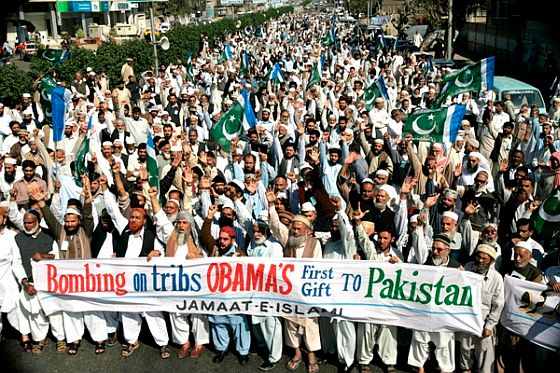
Under President Obama's command, there have been over 300 drone strikes on Pakistan.
The Washington Post reports: The Obama administration is nearing completion of a detailed counterterrorism manual that is designed to establish clear rules for targeted-killing operations but leaves open a major exemption for the CIA’s campaign of drone strikes in Pakistan, U.S. officials said.
The carve-out would allow the CIA to continue pounding al-Qaeda and Taliban targets for a year or more before the agency is forced to comply with more stringent rules spelled out in a classified document that officials have described as a counterterrorism “playbook.”
The document, which is expected to be submitted to President Obama for final approval within weeks, marks the culmination of a year-long effort by the White House to codify its counterterrorism policies and create a guide for lethal operations through Obama’s second term.
A senior U.S. official involved in drafting the document said that a few issues remain unresolved but described them as minor. The senior U.S. official said the playbook “will be done shortly.”
The adoption of a formal guide to targeted killing marks a significant — and to some uncomfortable — milestone: the institutionalization of a practice that would have seemed anathema to many before the Sept. 11 , 2001, terrorist attacks.
Among the subjects covered in the playbook are the process for adding names to kill lists, the legal principles that govern when U.S. citizens can be targeted overseas and the sequence of approvals required when the CIA or U.S. military conducts drone strikes outside war zones.
U.S. officials said the effort to draft the playbook was nearly derailed late last year by disagreements among the State Department, the CIA and the Pentagon on the criteria for lethal strikes and other issues. Granting the CIA a temporary exemption for its Pakistan operations was described as a compromise that allowed officials to move forward with other parts of the playbook.
The decision to allow the CIA strikes to continue was driven in part by concern that the window for weakening al-Qaeda and the Taliban in Pakistan is beginning to close, with plans to pull most U.S. troops out of neighboring Afghanistan over the next two years. CIA drones are flown out of bases in Afghanistan.
“There’s a sense that you put the pedal to the metal now, especially given the impending” withdrawal, said a former U.S. official involved in discussions of the playbook. [Continue reading…]
The Bureau of Investigative Journalism has produced a detailed infographic on “Obama’s 300 Strikes on Pakistan” Continue reading

At Bridges from Bamako, Bruce Whitehouse identifies each of the musicians in the video above and where they come from, and provides his own translation of the lyrics. He goes on to write:
On the surface, this looks like an anti-war song. The lyrics repeat the notion that Malians constitute one family, sharing the same blood, the same mother and father. Kinship is the strongest idiom governing social relations in Mali, and rhetorical appeals to kinship have great power to end conflict.
Yet this song also carries a message of defiance. Even as some artists decry war (as Kouyaté points out, Malians really aren’t used to it), others exhort their audience to set aside their differences and mobilize in defense of the fatherland (faso). Tiken Jah and Master Soumy are not alone in urging Malians to get ready for war. Ethnomusicologist Ryan Skinner of Ohio State University tells me the verse by griot singer Babani Koné begins with
a dramatic “sow wèlè,” or “calling of the horses.” This staple form of the griot verbal art… connotes the gathering of forces in preparation for conflict, for war. [Koné] calls on the horses (“sow“) and their “great warrior princes” (“sukèlèmansadenw“) to converge. This suggests that the Malians she calls on (literally) may not like war, but they are not unprepared for it.
A bit later, Oumou Sangaré sings “N’an m’an cɛ siri Maliba bɛ bɔ an bɔlɔ dɛ,” which I translate above as “If we don’t get ready, Maliba will slip away from us.” The verb k’i cɛ siri literally means to tie one’s waist – like girding one’s loins to prepare for a fight. When they sing about standing together, I suspect the message is directed more at Bamako’s still-divided political class than at their rebellious northern compatriots. These Malians want the world to know that while they hate war, they’re now facing an enemy that does not share their disposition to dialogue and compromise. They will do what’s necessary to defend their country.
The multiethnic, multilingual display of artistry in “Mali-ko” is an inspiring reminder of another thing I’ve come to love about Malian society: its long history of peaceful conflict resolution and inter-group harmony. Yet the absence of the country’s best-known Tuareg musicians from this project is conspicuous. The project’s lone participant of Tuareg ethnicity is Ahmed Ag Kaedi, leader of the group Amanar. I can’t avoid wondering if he was only pressed into service after Mali’s more famous Tuareg artists (Tinariwen, Tartit, Takamba Super Onze) either espoused the separatist cause or had to flee Mali fearing for their safety. Many Tuareg viewing this video are probably wondering the same thing.
Nonetheless, the most important message from the artists behind “Mali-ko” is that the Malian people are ready and willing to stand up to the threat before them. The Malian armed forces, still reeling from a string of battlefield defeats, badly need to hear this message. Mali is a place where words can conjure victory even in the darkest hour.
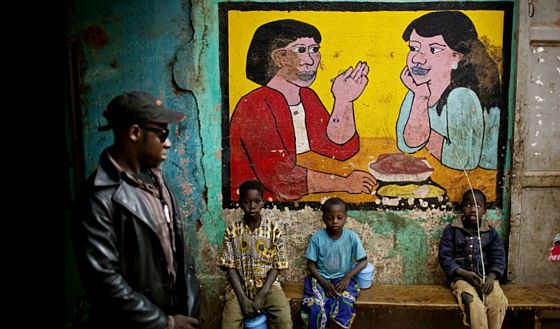
“Residents of the town of Niono, near the frontline, spend time outside a local restaurant,” says the caption to a photo appearing in the Washington Post on Sunday.
It wasn’t what the artist intended, but there turned out to be something prescient about depicting light-skinned people eating chicken in this dusty impoverished town in the Ségou Region of Mali.
Channel 4’s Lindsey Hilsum tweets:
The sole hotel in #niono #Mali served50+ journalists chicken for 3 days. Now we’ve all left. And all the chickens in town have bn eaten.
— Lindsey Hilsum (@lindseyhilsum) January 22, 2013
War correspondents always like to say they are near or at the frontline. The action gets confused with the story — even when reporters are perfectly aware that the audience back home (wherever that might be) is essentially none the wiser to be told that Islamist fighters have either advanced into or fled from Diabaly or whatever else the news of the day might be.
Telling the story of what’s happening in Mali doesn’t force the press to swarm around the charred remains left after each skirmish, yet war reporting is driven by imagery more than anything — images that convey the effects of violence but often little more.
If journalists didn’t insist on moving as a pack and took longer developing more informative stories, they might not end up depriving the locals of food that can hardly be spared.


The Guardian reports: The US space agency Nasa warned last week that the Amazon rainforest may be showing the first signs of large-scale degradation due to climate change.
A team of scientists led by the agency found that an area twice the size of California continues to suffer from a mega-drought that began eight years ago.
The new study shows the severe dry spell in 2005 caused far wider damage than previously estimated and its impact persisted longer than expected until an even harsher drought in 2010.
With little time for the trees to recover between what the authors describe as a “double whammy”, 70m hectares of forest have been severely affected, the analysis of 10 years of satellite microwave radar data revealed.
The data showed a widespread change in the canopy due to the dieback of branches, especially among the older, larger trees that are most vulnerable because they provide the shelter for other vegetation.
“We had expected the forest canopy to bounce back after a year with a new flush of leaf growth, but the damage appeared to persist right up to the subsequent drought in 2010,” said study co-author Yadvinder Malhi of Oxford University.
The Amazon is experiencing a drought rate that is unprecedented in a century, said the agency.

The Philadelphia Inquirer reports: In testimony before a Senate subcommittee, Ken Cook spoke passionately about 10 Americans who were found to have more than 200 synthetic chemicals in their blood.
The list included flame retardants, lead, stain removers, and pesticides the federal government had banned three decades ago.
“Their chemical exposures did not come from the air they breathed, the water they drank, or the food they ate,” said Cook, president of the Environmental Working Group, a national advocacy group.
How did he know?
The 10 Americans were newborns. “Babies are coming into this world pre-polluted with toxic chemicals,” he said.
More than 80,000 chemicals are in use today, and most have not been independently tested for safety, regulatory officials say.
Yet we come in contact with many every day – most notably, the bisphenol A in can linings and hard plastics, the flame retardants in couches, the nonstick coatings on cookware, the phthalates in personal care products, and the nonylphenols in detergents, shampoos, and paints.
These five groups of chemicals were selected by Sonya Lunder, senior scientist with the Environmental Working Group, as ones that people should be aware of and try to avoid.
They were among the first picked in the U.S. Environmental Protection Agency’s recent effort to assess health risks for 83 of the most worrisome industrial chemicals.
Lunder’s basis was that they are chemicals Americans come in contact with daily. You don’t have to live near a leaking Superfund site to be exposed. They are in many consumer products, albeit often unlabeled.
Studies by the Centers for Disease Control and Prevention and others have shown that they are detectable in the blood or urine of many of us.
Plus, much data exist showing their harm. “We have an incredible body of evidence for all these chemicals,” she said. “In all cases, we have studies linking human exposure to human health effects.”
Lunder and others see these five as symbolic of the government’s failure to protect us from potential – or actual – toxins.
“A lot of people presume that because you’re buying something on the store shelf … someone has vetted that product to make sure it is safe,” said Sarah Janssen, senior scientist with the Natural Resources Defense Council, another advocacy group. “Unfortunately, that’s not true.” [Continue reading…]
“Aaron’s unique quality was that he was marvelously and vigorously different. There is a scarcity of that. Perhaps we can all be a little more different too.” Edward Tufte, January 19, 2013.