



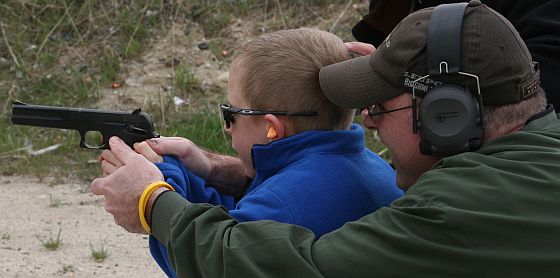
The New York Times reports: Threatened by long-term declining participation in shooting sports, the firearms industry has poured millions of dollars into a broad campaign to ensure its future by getting guns into the hands of more, and younger, children.
The industry’s strategies include giving firearms, ammunition and cash to youth groups; weakening state restrictions on hunting by young children; marketing an affordable military-style rifle for “junior shooters” and sponsoring semiautomatic-handgun competitions for youths; and developing a target-shooting video game that promotes brand-name weapons, with links to the Web sites of their makers.
The pages of Junior Shooters, an industry-supported magazine that seeks to get children involved in the recreational use of firearms, once featured a smiling 15-year-old girl clutching a semiautomatic rifle. At the end of an accompanying article that extolled target shooting with a Bushmaster AR-15 — an advertisement elsewhere in the magazine directed readers to a coupon for buying one — the author encouraged youngsters to share the article with a parent.
“Who knows?” it said. “Maybe you’ll find a Bushmaster AR-15 under your tree some frosty Christmas morning!” [Continue reading…]


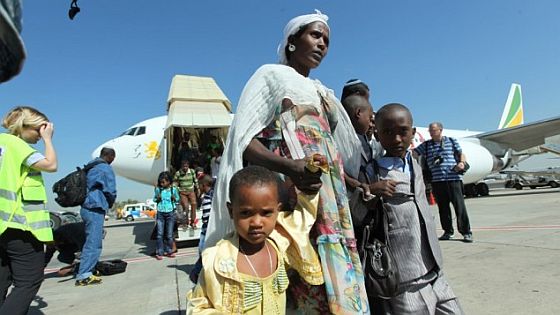
Ethiopian immigrants arriving in Israel, October 2012.
Haaretz reports: A government official has for the first time acknowledged the practice of injecting women of Ethiopian origin with the long-acting contraceptive Depo-Provera.
Health Ministry Director General Prof. Ron Gamzu has instructed the four health maintenance organizations to stop the practice as a matter of course.
The ministry and other state agencies had previously denied knowledge or responsibility for the practice, which was first reported five years ago.
Gamzu’s letter instructs all gynecologists in the HMOs “not to renew prescriptions for Depo-Provera for women of Ethiopian origin if for any reason there is concern that they might not understand the ramifications of the treatment.”
He also instructed physicians to avail themselves of translators if need be.
Gamzu’s letter came in response to a letter from Sharona Eliahu-Chai of the Association of Civil Rights in Israel, representing several women’s rights and Ethiopian immigrants’ groups. The letter demanded the injections cease immediately and that an investigation be launched into the practice.
On December 9, the Times of Israel reported: Ethiopian women who moved to Israel eight years ago claimed Israeli officials coerced them to receive injections of Depo-Provera, a long-acting birth control drug, as a prerequisite to immigration.
Speaking to reporters on an episode of Israel Educational Television’s investigative show “Vacuum” that aired on Saturday, several immigrants described the intense pressure placed on them to keep their families small. The women claimed Israeli representatives from the Joint Distribution Committee (JDC) and the Health Ministry told them that raising large families is especially difficult, that it is for hard people with many children to find work and support their families, and that many landlords would not be willing to rent apartments to large families.
Gal Gabbai, the show’s anchor, reported that in the past decade, approximately 50,000 Ethiopian Jews have immigrated to Israel. During that period, the birth rate among this community, which has traditionally favored very large families, has plummeted by nearly 50 percent.
Several women interviewed by Gabbai said that they were told at the transit camps in Ethiopia that they had to receive the shots if they wanted to immigrate to Israel and continue receiving medical treatment from the JDC. Furthermore, many of the women claimed they were never told that the shots were to prevent pregnancy. Rather, they were under the impression that the shots were vaccinations.
Some women reportedly refused to tell their husbands about the shots, fearing the men would be furious.
The report said many women continued to receive Depo-Provera after arriving in Israel, despite suffering such side effects as severe headaches and abdominal pains.
One woman who suffered from osteoporosis said she has been receiving shots for four years without ever being warned that Depo-Provera was dangerous to women in her condition.
A hidden camera in a local health clinic recorded a Ethiopian woman being told by a nurse that this shot is given “primarily to Ethiopian women because they forget, they don’t understand, and it’s hard to explain to them, so it’s best that they receive a shot once every three months… basically they don’t understand anything.”
Israeli authorities denied all of the allegations.
“In with the New Year, out with the Africans,” a video report by David Sheen showed one of the most recent and bluntest expressions of racism in Israel, as residents of South Tel Aviv demanded that the government round up, jail and deport all non-Jewish African asylum-seekers.
Apologists for the Jewish state might have responded in one or two ways: to argue that the demonstrators are marginal (even though the included a member of the Knesset), or that even if their actions are ill-conceived, these Israelis are driven by the desire to protect Israel’s Jewish identity.
What the government policy designed to limit the size of Israel’s Ethiopian population makes indisputable is that racism is institutionally based in the workings of the state.

The euphemisms will come fast and furious. Our soldiers will be greeted as “heroes” who, as in Iraq, left with their “heads held high,” and if in 2014 or 2015 or even 2019, the last of them, as also in Iraq, slip away in the dark of night after lying to their Afghan “allies” about their plans, few here will notice.
This will be the nature of the great Afghan drawdown. The words “retreat,” “loss,” “defeat,” “disaster,” and their siblings and cousins won’t be allowed on the premises. But make no mistake, the country that, only years ago, liked to call itself the globe’s “sole superpower” or even “hyperpower,” whose leaders dreamed of a Pax Americana across the Greater Middle East, if not the rest of the globe is… not to put too fine a point on it, packing its bags, throwing in the towel, quietly admitting — in actions, if not in words — to mission unaccomplished, and heading if not exactly home, at least boot by boot off the Eurasian landmass.
Washington has, in a word, had enough. Too much, in fact. It’s lost its appetite for invasions and occupations of Eurasia, though special operations raids, drone wars, and cyberwars still look deceptively cheap and easy as a means to control… well, whatever. As a result, the Afghan drawdown of 2013-2014, that implicit acknowledgement of yet another lost war, should set the curtain falling on the American Century as we’ve known it. It should be recognized as a landmark, the moment in history when the sun truly began to set on a great empire. Here in the United States, though, one thing is just about guaranteed: not many are going to be paying the slightest attention.
No one even thinks to ask the question: In the mighty battle lost, who exactly beat us? Where exactly is the triumphant enemy? Perhaps we should be relieved that the question is not being raised, because it’s a hard one to answer. Could it really have been the scattered jihadis of al-Qaeda and its wannabes? Or the various modestly armed Sunni and Shiite minority insurgencies in Iraq, or their Pashtun equivalents in Afghanistan with their suicide bombers and low-tech roadside bombs? Or was it something more basic, something having to do with a planet no longer amenable to imperial expeditions? Did the local and global body politic simply and mysteriously spit us out as the distasteful thing we had become? Or is it even possible, as Pogo once suggested, that in those distant, unwelcoming lands, we met the enemy and he was us? Did we in some bizarre fashion fight ourselves and lose? After all, last year, more American servicemen died from suicide than on the battlefield in Afghanistan; and a startling number of Americans were killed in “green on blue” or “insider” attacks by Afghan “allies” rather than by that fragmented movement we still call the Taliban.
Whoever or whatever was responsible, our Afghan disaster was remarkably foreseeable. In fact, anyone who, from 2006 on, read Ann Jones’s Afghan reports at TomDispatch wouldn’t have had a doubt about the outcome of the war. Her first piece, after all, was prophetically entitled “Why It’s Not Working in Afghanistan.” (“The answer is a threefold failure: no peace, no democracy, and no reconstruction.”) From Western private-contractors-cum-looters making a figurative killing off the “reconstruction” of the country to an Afghan army that was largely a figment of the American imagination to up-armored U.S. soldiers on well-guarded bases whose high-tech equipment and comforts of home blinded them to the nature of the enemy, hers has long been a tale of impending failure. Now, that war seems headed for its predictable end, not for the Afghans who, as Jones indicates in her latest sweeping report from Kabul, may face terrible years ahead, but for the U.S. After more than 11 years, the war that is often labeled the longest in American history is slowly winding down and that’s no small thing.
So leave the mystery of who beat us to the historians, but mark the moment. It’s historic. Tom Engelhardt
Counting down to 2014 in Afghanistan
Three lousy options: pick one
By Ann JonesKabul, Afghanistan — Compromise, conflict, or collapse: ask an Afghan what to expect in 2014 and you’re likely to get a scenario that falls under one of those three headings. 2014, of course, is the year of the double whammy in Afghanistan: the next presidential election coupled with the departure of most American and other foreign forces. Many Afghans fear a turn for the worse, while others are no less afraid that everything will stay the same. Some even think things will get better when the occupying forces leave. Most predict a more conservative climate, but everyone is quick to say that it’s anybody’s guess.
Only one thing is certain in 2014: it will be a year of American military defeat. For more than a decade, U.S. forces have fought many types of wars in Afghanistan, from a low-footprint invasion, to multiple surges, to a flirtation with Vietnam-style counterinsurgency, to a ramped-up, gloves-off air war. And yet, despite all the experiments in styles of war-making, the American military and its coalition partners have ended up in the same place: stalemate, which in a battle with guerrillas means defeat. For years, a modest-sized, generally unpopular, ragtag set of insurgents has fought the planet’s most heavily armed, technologically advanced military to a standstill, leaving the country shaken and its citizens anxiously imagining the outcome of unpalatable scenarios.

Al Jazeera reports: Egyptian President Mohamed Morsi has declared a 30-day state of emergency and a night-time curfew in three cities along the Suez Canal that have seen deadly clashes in recent days.
In a televised address late on Sunday, Morsi said the emergency measures in Port Said, Ismailia and Suez would take effect on Monday from 9:00pm local time (19:00 GMT) to 6:00am (04:00 GMT), warning that more action would be taken to stem the latest eruption of violence across much of the country.
“I have said I am against any emergency measures but I have said that if I must stop bloodshed and protect the people then I will act,” Morsi said.
He also called for dialogue with top politicians starting on Monday to resolve the situation.
Deadly clashes across the country between protesters and police have killed at least 48 people since Friday, when Egyptians commemorated the two-year anniversary of the revolution that toppled former President Hosni Mubarak.
Reuters reports: Residents of Mali’s northern town of Gao, captured from sharia-observing Islamist rebels by French and Malian troops, danced in the streets to drums and music on Sunday as the French-led offensive also drove the rebels from Timbuktu.
The weekend gains made at Gao and Timbuktu by the French and Malian troops capped a two-week whirlwind intervention by France in its former Sahel colony, which has driven al Qaeda-allied militant fighters northwards into the desert and mountains.
In Gao, the largest town in the north where the Islamist insurgents had banned music and smoking, cut off the hands of thieves and ordered women to wear veils, thousands cheered the liberating troops with shouts of “Mali, Mali, France, France”.
French special forces backed by Rafale fighter jets and Tiger helicopters had helped capture the town early on Saturday.
Among the celebrating Gao crowds, many smoked cigarettes, women went unveiled and some men wore shorts to flout the severe sharia Islamic law the rebels had imposed for months. Youths on motorcycles flew the flags of Mali, France and Niger, whose troops also helped secure the ancient town on the Niger River.
“Now we can breathe freely,” said Hawa Toure, 25, wearing a colorful traditional African robe banned under sharia for being too revealing. “We are as free as the wind today. We thank all of our friends around the world who helped us,” she said.
French and Malian troops also arrived at the weekend at the fabled Saharan trading town of Timbuktu, more than 300 km (190 miles) to the west of Gao, and were working to restore government control over the UNESCO World Heritage Site.
A Malian military source said the French and Malian troops had met no resistance up to the gates of Timbuktu and controlled the airport. They were working on flushing out any Islamist rebel fighters still hiding in the city, a labyrinth of ancient mosques and monuments and mud-brick homes between alleys.
Al Jazeera reports: Since France launched its military intervention in Mali two weeks ago, the combined Malian and French forces have managed to quickly retake much of the country.
They have done so almost exclusively beyond the eyes of the media, an exceptional feat in the age of Twitter and livestreaming. Where journalists have been allowed to “embed” with French troops, they have been kept well away from operations and are restricted to marginal stories about logistics.
“In times of conflict, it is up to journalists and the media, and not the military, to determine the risks that they are willing to take to gather information,” the international media organisation Reporters Without Borders said in a statement denouncing the “media blackout” imposed by French and Malian military.
French officials have organised no press conferences in Bamako. Their press contingent in Bamako consists of a one-man band, whose main function is to refer media queries to Paris.
The Malian army has likewise restricted media access, barring journalists and human rights organisations from areas safely in its hands such as Konna and Sevare for some days. The lack of freedom of movement has also drawn criticism from aid groups, who say people are being blocked from fleeing the conflict.
On top of the roadblocks, communications have been cut wherever operations are underway, making it impossible to independently verify what is taking place.
Destin Gnimadi, a journalist at the daily Malian newspaper Le Prétoire, told Al Jazeera that the Malian defence ministry rarely gives press conferences or shares any information with the national media.
Jean-Paul Marthoz adds: The French army is often called la Grande Muette, or “the Great Silent.” The war in Mali confirms the French military’s well-deserved reputation of being secretive about front-line actions. “Locking the information is more in the culture of the French army than of the U.S. army,” says Maurice Botbol, director of La Lettre du Continent. In the first two weeks of military operations against Islamist militant groups in Mali, the French army has released only a blurry video of an air attack at an undisclosed location.
International journalists who have flown to Mali are kept far from the front lines. No journalist has been embedded with the Special Forces that have carried out the first assaults. Most reporters who receive the authorization to accompany the troops are limited to coverage of marginal stories, such as military preparations on the Bamako airport or the “progress of the troops to the North,” very far from the battlefields.
The roads to the North are blocked by a succession of checkpoints manned by the Malian army. “They are very nervous,” says Gérard Grizbec, a reporter with the public service TV channel France 2. “They have received stern orders from the French forces: ‘Don’t let yourself being overtaken by journalists.’ They usually ask us where we’re going, check our passport, and request an accreditation of the Malian Communications Ministry.”
And then they often turn the media away.
“All the reporters that travel to the North come back frustrated and furious to Bamako,” complains Jean-Paul Mari, special envoy for the newsweekly Le Nouvel Observateur. “This is a war without images and without facts.” On January 22, the French channel i>Télé devoted a whole report to the difficulty of reporting. “We try to outwit the Malian army,” says its editor-in- chief, Lucas Menget. “It is like a cat-and-mouse game.” And up to now, it is a losing game for the press.

That might sound like a mangled version of the aphorism: you are what you eat — something surely worth remembering when industrially-produced toxins are now so pervasive they can be found in unborn babies.
What I am alluding to, however, is actually a question of self-identity as illuminated not by the external sources of our food but by our advancing understanding of the human microbiome.
The human body is made up of 10 trillion cells, while our gut hosts 100 trillion bacteria — microscopic organisms performing a vast array of functions far beyond their widely understood role in digestion. They don’t just break down food but also regulate the immune system, produce vitamins and hormones and even appear to affect the way our brain works. When our gut flora thrive, we thrive.
For that reason, one of the most promising recent advances in medicine has been in the use of fecal transplants — the transfer of gut flora from a healthy donor to someone with intestinal disease.
If that’s something you’d rather not visualize, it gets even worse. The most effective way of performing such a transplant is via a nasogastric tube. That’s right: down the nose and through the stomach to the top end of the small intestine.
Treatment of Clostridium difficile, an intestinal disease that kills 14,000 Americans annually, has had over a 90% success rate for patients given a fecal transplant, a procedure whose use was first documented in 1958.
The use of this treatment would likely already be far more commonplace and diverse in its application were it not for two reasons: Firstly, as a treatment that involves no drugs and makes less effective drug treatments redundant, the use of fecal transplants does not serve the interests of the pharmaceutical industry. Secondly, and perhaps just as importantly, the very idea of such a treatment is something that many people will find repulsive. It represents a kind of invasion and defilement of who and what we take ourselves to be. It involves an exchange of bodily fluids that transgresses most people’s notion of what might be desirable, amounting to the filthiest kind of intimacy one could imagine.
If, however, we set aside the taboos that condition our perceptions of the human body and think about this in a more abstract way, gut flora — whether they be native or transplanted — invite us to think about not just what contributes to good health but also what shapes who or what we are.
In as much as we are inclined to view the world as a complex of systems, we tend to view most systems as hierarchies. At the top sits the executive — God, president, CEO, general, brain — and below reside a multitude of individually expendable subordinates — person, citizen, worker, soldier, cell.
Identity becomes glued to the executive yet dissolves in the amorphous mass over which he (it is almost invariably he) rules.
Picture, for instance, the way in which a company like Apple, with over 70,000 employees, became synonymous with Steve Jobs. Or, the way American power is supposedly embodied in the individual of the president — so-called leader of the free world.
In the hierarchical conception of such systems, power extends from the top, downwards and outwards. In reality, power flows the opposite way. It flows up from the bottom, most of the time without question yet always with the possibility of suspension. The workers could walk out; the citizens could rebel. At such moments, the real structure of power becomes manifest.
So, consider again ones body and think of it as New York. It sounds like a fanciful song we might sing in our head where we can be number one, yet the actual city is not its landmarks — standing or fallen — or its skyline, or its shows, or words sung by Frank Sinatra. It is millions of people — a pulsating mass of organisms, moving through vessels underground, walking, driving, riding, endlessly scattering and aggregating in a process that cannot be reduced to any of its parts — a process which constitutes the life of a city, or if you will, the percolation of the gut flora of New York. A few New Yorkers might harbor the conceit that they keep the city running, but however they might aggrandize themselves, none turns out to be indispensable.
Still, as we each tell ourselves who we are, we locate meaning in a larger sphere. For instance, in our noblest moments we rise above our fears and show we have guts — but that expression, it turns out, is much more telling than we could have imagined.
What we take to be our own courage (or lack of it) may actually say less about the narrative construct we call character and more about our physical gut and the activity of trillions of bacteria such as Lactobacillus rhamnosus.
Mice fed a broth rich in this particular microorganism become more adventurous and show fewer signs of stress. The bacteria don’t just give them a healthier gut but also a healthier brain, an indication that who we are is intimately shaped by what lives inside our body. Such findings also suggest that the enteric nervous system, our “second brain,” may have as much influence over our behavior as does the stuff up top.
Given that the human microbiome is at this point a vast yet mostly uncharted territory, the fact that this is territory in which medicine — through the use of antibiotics — has engaged in open warfare for much of the last century, is all the more reason to think about our nature. In a rampage to kill our enemies we have also been destroying our selves.

The Observer reports: For many years Mokhtar Belmokhtar was little more than a footnote in the intelligence reports analysing the increasingly muscular presence of Islamist groups in Saharan Africa.
The man whose al-Qaida-inspired Signed in Blood Battalion led the attack on the In Amenas gas plant in Algeria, in which at least 38 people were killed, was considered a relatively unimportant figure in the political ecosystem of the vast region. But Belmokhtar, who fought for the mujahideen in Afghanistan and the Islamist GIA in the Algerian civil war before becoming a commander in the Mali-based al-Qaida in the Islamic Maghreb (AQIM), was ambitious.
In 2003 he masterminded the kidnapping of 32 European tourists whom he successfully ransomed. The money gave him the seed capital he needed to develop a sophisticated trading business throughout Saharan Africa, along the ancient 2,000-mile salt route used by the Tuareg tribesmen to transport goods from the continent’s west coast through to Timbuktu in Mali, then on to Niger before arriving in the Algerian south, gateway to the Mediterranean.
But while the Tuareg made their money in trading salt, gold and silk, Belmokhtar, who secured close links with the tribesmen through marriages to the daughters of several of their most prominent families, made a fortune through a different commodity: smuggled cigarettes. Such was the volume of his trade that he earned himself the sobriquet “Mr Marlboro”.
“He was not an important figure in AQIM, he was quite different from al-Qaida and Bin Laden,” said Morten Bøås, a senior research fellow at Oslo University and editor of African Guerrillas: Raging Against the Machine. “He is generally known as one of the more pragmatic figures, more interested in filling his own pockets than fighting jihad.”
The key role cigarettes play in facilitating terrorism has been inexplicably ignored. But it has become of urgent interest to western intelligence agencies as they seek to check al-Qaida’s diverse factions operating across the Saharan region. [Continue reading…]
Ian Birrell writes: At dinner last month after a concert by the Congolese rapper Baloji, I found myself sitting next to his drummer, Saidou Ilboudo. As we chatted over the chicken, he told me the remarkable story of how as a teenager growing up in Burkina Faso he had been recruited one day by Thomas Sankara, the country’s president, to play in a state band.
Sankara is an almost-forgotten figure these days in the west, but in the mid-80s he was one of the most charismatic leaders of his age, a revolutionary known as “Africa’s Che Guevara” who pushed public health, promoted feminism and faced down the global financial institutions causing such damage to the continent.
This was an amazing break for a boy just out of school. For a few years, he enjoyed the privileges and security that went with being part of the president’s circle, while playing in a band that had a dual purpose: to entertain young people while proselytising political messages. Then, in 1987, Sankara was murdered in a French-backed coup and life became trickier.
The idea of publicly funded pop groups might sound strange, but many leading figures of African music served time in such institutions. Given the continent’s oral tradition, there is a proud history of praise singers, and musicians were for centuries vital voices, used and abused by politicians and tribal leaders who understood their power. Think only of Franco, whose liquid guitar-playing made Congolese rumba the heartbeat of Africa while promoting the messages of Mobutu Sese Seko, his thieving president.
After the end of colonialism, musicians were used to fuse countries carved out of often disparate communities. Nowhere was this truer than Mali, a nation on the faultline between the African and Arab worlds in which music is more threaded into the fabric of cultural, social and political life than perhaps any other place on Earth. [Continue reading…]
Gordon Adams writes: [A]fter decades of leaving Africa pretty much alone or engaging through health and economic assistance, the United States is now seriously involved, but driven by the mantra American “security.” Mixing these messages (development, health, and security) is proving difficult for the African countries. They have begun to wonder why the United States has suddenly developed an interest in their continent. Uneasy African governments resisted the notion that Africom should actually be based on the continent as the United States wanted, so the headquarters remains in Stuttgart, Germany.
Well, they might have reason to be concerned. A growing “security” focus for U.S. engagement in Africa changes things. So does the growing lead the Pentagon and the Special Operations forces are taking in that engagement. When security takes the lead, too often, governance and development step aside. And, while the security focus is ostensibly intended to strengthen African capacities to provide national and regional stability, they have the consequence, intended or not, of dragging the United States into Africa’s internal politics, at a potential cost to our long-term interests.
In Mali, for example, the appearance of al Qaeda in the Islamic Maghreb (AQIM) has led some in the U.S. military to warn that the Maghreb (that is, the Northwestern rim of the continent) is becoming a terrorist haven and to suggest that the U.S. cannot prevent this reality with a light, indirect military footprint. Captain Amadou Haya Sanogo, who overthrew the elected Malian government in 2012, was trained under IMET. In Algeria, the United States has partnered with an authoritarian regime in the pursuit of counterterrorism operations.
This increasing focus on security coincides with a broader trend over the past decade towards giving the Pentagon greater direct authority for security assistance programs overall. Where the State Department was once in the lead, DOD is now directly responsible, funded through its own budget, for a growing share of U.S. security assistance, accentuating the pronounced bias in those programs toward DOD’s needs, requirements, and missions.
The largest DOD programs have trained and equipped the Iraqi and Afghan militaries, at a cost well over $50 billion. They provide considerable budgetary support to the militaries of Jordan and Pakistan. By the time the United States left Iraq, the Pentagon was directly responsible for more than half of total U.S. funding for security assistance worldwide.
African programs are now part of this pattern. Especially in Africa, DOD has put the label of “Building Partner Capacity” on its activities. That the programs surely do. But especially in Africa, these activities support a particular kind of capacity — counterinsurgency and counterterrorism operations. These competencies are unhinged, in large part, from broader U.S. foreign policy objectives in Africa, and provide a sneaky way of pulling the United States into security relationships that may not serve our long-run goals for African state building or development.
The major problem is context. Focusing on our security interests in Africa risks ignoring the need for stronger, more capable, more responsive civilian governance and economic development. While DOD likes to argue that security comes first, before governance and development, the risk of militarizing our engagement in Africa is that it will end the development of fledgling accountable governance in Africa (and elsewhere) and increase hostility toward the United States.
Much as Iraq and Afghanistan reproduced the sad lessons of Vietnam, our slide into Africa risks becoming a sequel to a film we have already seen. Two decades of repression and “disappearances” in Latin America followed from a U.S. security and covert assistance program in the 1960s that focused on our fascination with and fear of insurgents and communists — at the cost of democracy and warm and fuzzy feelings about America. Cloaked in the mantra of “Building Partner Capacity,” here we go again, this time in Africa. [Continue reading…]
The Washington Post reports: The United States is significantly expanding its assistance to a French assault on Islamist militants in Mali by offering aerial refueling and planes to transport soldiers from other African nations, the Pentagon announced Saturday night.
The gesture comes amid a debate within the Obama administration about how deeply it should engage in the French effort to prevent Islamists from wresting control of the West African nation. French requests for more robust support from Washington raised a legal dilemma because U.S. law forbids foreign assistance funds to leaders that came to power through a coup. Mali’s military leaders, including some trained by U.S. troops, seized power last year by force.
“The French requested this support, and we believe it was important to move ahead,” a senior defense official said Saturday night, speaking on the condition of anonymity to discuss policy deliberations. “The U.S. has the most advanced refueling technology in the world, and we wanted to provide this support.”
The United States has concluded that the expanded assistance is legally sound because of France’s notification to the United Nations Security Council that its mission in Mali is being offered at the request of the African country’s government, which is fighting “terrorist elements,” Pentagon spokesman Lt. Col. James Gregory said in a statement.
“Under these circumstances, the U.S. can lawfully provide support to France’s efforts in the armed conflict in Mali,” Gregory said. Gregory said the coup bars “foreign assistance funds,” not military support. [Continue reading…]
At Open Democracy, Ammar Abdulhamid writes: The transformation of the Syrian Revolution from a nonviolent and inclusive pro-democracy protest movement into a civil war, pitting majority-Sunni and majority-Alawite militias against each other in deadly daily clashes throughout the country, has been a slow and complex process driven in equal measure by domestic as well as external factors. But while much analysis has addressed the role of external factors, there are certain aspects of the domestic dynamics that remain unexamined, in particular the evolving ethos driving Sunni and Alawite fighters.
Indeed, the very nature of the ruling Assad regime that the protesters challenged contributed to the increasing sectarian character of the conflict. The Alawite community, from which the Assads hail, is a minority sect that mixes Shiite doctrine with indigenous tribal beliefs and Christian rituals, representing 10-12% of Syria’s population. The sect has long been considered heretical by the majority Sunni community, and was actively marginalized and persecuted by the Ottomans who never included the Alawites in the famous millet system that regulated the lives of all confessional minorities under their rule. Indeed, for centuries Alawites lived a very sheltered existence in the coastal mountains of northern Lebanon, Syria and southern Turkey (Hatay Province). Their access to state services, including education, was quite limited, rendering the overwhelming majority illiterate. Moreover, in time, Alawite doctrine became secretive and reserved only for male initiates, creating an additional layer of separation between Alawites and their neighbors and adding to the mutual distrust.
In that “splendid isolation,” at least, in the psychological sense, an Alawite culture that is inimical to change and deeply suspicious of otherness evolved. [Continue reading…]
Jeffrey Lewis writes: Since the government of Syria’s Bashar al-Assad began to totter, the nonproliferation community has been waiting to see if he will unleash what is believed to be a large stockpile of chemical weapons, including VX, sarin, and mustard gas. The possibility that Assad might use chemical weapons is widely regarded as a possible trigger for U.S. intervention. In December, President Obama warned Assad of “consequences” in the event Syria used its chemical weapons. A few days earlier, Hillary Clinton warned that the United States was “certainly planning to take action” in the event of “credible evidence that the Assad regime has resorted to using chemical weapons against their own people.”
So, what makes for “credible evidence”? Enter Josh Rogin, reporter at Foreign Policy, who published a pair of stories detailing a State Department cable regarding possible chemical weapons use by Syrian forces in Homs. An administration official described the cable as having “made a compelling case that Agent 15 was used in Homs on Dec. 23.”
The implication, obviously, is that the “compelling case” is the “credible evidence” that should prompt Washington to rethink its policy limiting itself to “non-lethal” aid to Syrian opposition forces and take action. A reconsideration might be in order, though not for the reason you think.
For starters, somehow, no one has bothered to mention that Agent 15 doesn’t exist.
Yep. Agent 15 is one of the bogus bits of intelligence that helped make the case for invading Iraq. Like many good fish stories, this one has a kernel of truth. A single document found by U.N. inspectors (at the infamous Chicken Farm, if you must know) mentioned something called “Agent 15.” UNSCOM and others believed Agent 15 was a glycollate, related to laboratory experiments that Iraq admitted to with chemically similar incapacitants usually referred to as BZ or “buzz.” But Iraq never produced BZ, Agent 15, or similar incapacitants.
“Agent 15” entered our collective lexicon in 1998, however, when the British announced they had “received intelligence, believed to be reliable, which indicated that, at the time of the Gulf War, Iraq may have possessed large quantities of a chemical warfare mental incapacitant agent known as “Agent 15.” George Robertson, then defense secretary, described it as “one more filthy uncivilised weapon of war in [Saddam’s] armoury.” He warned that Agent 15 could result in: “dilated pupils, flushed faces, dry mouth, tachycardia, increase in skin and body temperature, weakness, dizziness, disorientation, visual hallucinations, confusions, loss of time sense, loss of co-ordination and stupor.” In other words, it turns you into the stars of Absolutely Fabulous. (I’ve placed a copy of the MOD report on my blog, ArmsControlWonk.com.)
Robertson refused to divulge further details, claiming that the Ministry of Defense had yet to evaluate the report. In fact, he’d done quite enough. The always restrained British press went — and I am going to use the technical term here — apeshit. (My favorite headline: “Iraqi ‘zombie gas’ arsenal revealed.”)
The claim didn’t stand up to scrutiny, even before the war. [Continue reading…]
The Observer reports: Local people describe it as a distant growl, an ever-present rumble, just to the north. A reminder that war is now at their doorstep.
It has been this way for two months in Latakia. The port city had managed to ride out Syria’s civil war, seemingly content in the knowledge that whatever was happening in Hama to the south-east, or Idlib a little further north, an army stood between its gates and its foes. Not any more.
The spectre of war is now a reality here in the staunch core of the regime heartland, as much as it is in the rebellious and ravaged Sunni cities to the east. The shells that crunch most hours into the nearby countryside have not yet arrived. But the fear that pervades the communities on the fringes of Latakia is now spreading around the city known throughout the country as the government’s stronghold, and possibly its last redoubt.
“We are afraid, very, very afraid,” said Loubna, a final-year university student and resident of the city. “For so long the regime has been saying we will be safe here. That nothing will happen to us. Nothing can happen to us. But people are leaving, people are dying. Death is so near.” [Continue reading…]
McClatchy reports: To mark the two-year anniversary of an uprising that led to their ascension, members of Egypt’s Muslim Brotherhood came to the town of Faiyum on Friday with a simple message: The government may not be providing services for you, but the powerful social organization supporting it still can.
They fanned out in this historic, impoverished town and picked up 2-week-old trash thrown between apartment buildings. Brotherhood doctors carried boxes of medicine into makeshift clinics to distribute to the ill. Merchants opened subsidized food, gas and clothing markets.
One hundred miles north down the Nile River and a world away, thousands gathered at Tahrir Square, a now international symbol of its literal name, liberation. The opposition, unable to coalesce around a political platform that can unseat the Brotherhood, was back protesting in the streets, battling police tear gas with rocks, stagnation with chants.
But regular protests in Tahrir have done more to alienate voters than to topple Egyptian President Mohammed Morsi. And the Brotherhood’s social campaign no longer buys the votes it once did. There is a patina of disillusionment over millions of Egyptians like Faiyum resident Safa Ramadan, 43, who is too hungry to embrace the luster of revolutionary change, too humiliated to appreciate another handout.
Ramadan’s husband does not make enough money to keep up with rising prices brought by near constant instability. So she pulled her 12-year-old son out of school and made him get a job as a garbage man, or perhaps more aptly, garbage boy. Friday, she stood over baskets of fruit and vegetables, swarmed by flies, and fretted over whether she could afford the extra 10 cents a kilo of tomatoes will cost her this week.
“The prices never go down. They always go up by a lot. What am I supposed to do? Should I pay for school or pay for food?” she asked, draped in a dark headscarf and gown. “Morsi has not done anything for us.” [Continue reading…]
NASA’s analysis of Earth’s surface temperature found that 2012 ranked as the ninth-warmest year since 1880. NASA scientists at the Goddard Institute for Space Studies (GISS) compare the average global temperature each year to the average from 1951 to 1980. This 30-year period provides a baseline from which to measure the warming Earth has experienced due to increasing atmospheric levels of heat-trapping greenhouse gases. While 2012 was the ninth-warmest year on record, all 10 of the warmest years in the GISS analysis have occurred since 1998, continuing a trend of temperatures well above the mid-20th century average. The record dates back to 1880 because that is when there were enough meteorological stations around the world to provide global temperature data.
