‘I’m a United States Senator. I’m not an Israeli senator’

How many American senators have the courage and integrity required to say this? At least one, but not many others. That one was the senator being quoted: Chuck Hagel.

Americans who put Israel first don’t like the ring of Hagel’s words, both because it suggests he might lack sufficient loyalty to Israel and also because that kind of statement shines a light on their own lack of loyalty to the U.S..

Still, aside from those who place their primary allegiance to the Jewish state, it’s hard for others to find much fault in Hagel’s position as described by Aaron David Miller in The Much Too Promised Land (2008):

[P]olitical pressures have taken a serious toll by conditioning a key branch of the American government to be reflexively pro-Israel at a time when serious questions need to be asked and debated about Middle East policy. Congress has little stomach to serve as a forum for this dialogue and debate, let alone to play a role in seriously pressing an administration to pursue Arab-Israeli diplomacy. Some members in both the Senate and the House are willing to be critical of Israel or of AIPAC or to take positions that appear sensitive to Arab or Palestinian concerns, but certainly not many.

One who is willing is Chuck Hagel, the two-term Republican senator from Nebraska. Of all my conversations, the one with Hagel stands apart for its honesty and clarity. If I wanted to be in a safe business, he began, “I’d sell shoes.” Hagel’s logic chain is pretty compelling. America is Israel’s best friend, but it also has key interests in the Arab and Muslim world that, particularly since 9/11, it must try to protect. Being too one-sided when it comes to the Arab-Israeli isn’t good either for Israel or for America. And far too often Congress shrinks from making this clear.

“This is an institution that does not inherently bring out a great deal of courage,” Hagel continues. Most of the time members play it safe and adopt an “I’ll support Israel” attitude. AIPAC comes knocking with a pro-Israel letter, and “then you’ll get eighty or ninety senators on it. I don’t think I’ve ever signed one of those letters. When someone would accuse him of not being pro-Israel because he didn’t sign the letter, Hagel told me he responds: “I didn’t sign the letter because it was a stupid letter.”

Few legislators talk this way on the Hill. Hagel is a strong supporter of Israel and a believer in shared values. “The Jewish lobby intimidates a lot of people up here,” but as he put it, “I’m a United States senator. I’m not an Israeli senator.”


Facebooktwittermail

Chuck Hagel said idea of going to war with Iran is ‘Alice in Wonderland’

Former Republican senator, Chuck Hagel, is expected to be nominated as the next U.S. Secretary of Defense — though skeptics may want to test his willingness to become Secretary of Attack, as in: “Can you confirm that you will support military action against Iran when it becomes clear that that is necessary?” asks Senator X (any Republican will do) during Hagel’s confirmation hearings.

Max Fisher reports that Hagel’s statements thus far have left room for doubt — he apparently has never been heard singing John McCain’s old tune, “bomb, bomb, Iran.”

Mondoweiss: Hagel is a realist who has repeatedly bucked the neoconservatives (and as Eli Lake and Steve Walt say below, the Israel lobby is gearing up to try and do to him what it did to Chas Freeman 4 years ago). The Emergency Committee for Israel (ECI), for instance, is already gearing up to battle Obama over Hagel.

Yesterday, ECI’s Noah Pollak tweeted out one reason (among many) for why he’s so averse to Hagel: he is chairman of the Atlantic Council, a mainstream think tank. The Atlantic Council has posted a piece by a member of the council titled “Israel’s Apartheid Policy.”

Here are some more reasons for why the neoconservatives are coming out swinging against Hagel:

In November 2010, Hagel led a forum on the Iran issue at the Atlantic Council, which he chairs. His comments make clear that he would never go to war with Iran, and the idea that all options must be on the table is one that he specifically rejects.

He says that only in an Alice in Wonderland world would we go to war with Iran. [Continue reading…]

Facebooktwittermail

Syrian opposition says no longer needs foreign forces

Reuters reports: The Syrian people no longer need the intervention of international forces as rebels push towards the heart of the capital of Damascus to topple President Bashar al-Assad, the new leader of Syria’s opposition told Reuters.

Mouaz al-Khatib, the scion of a Damascene Muslim religious dynasty, said the opposition would consider proposals from Assad to surrender power and leave the country, but would not give any assurances until it saw a firm proposal.

Flanked by bodyguards, al-Khatib was speaking to Reuters on Wednesday night after a meeting of Western and Arab nations with the Syrian opposition in the Moroccan city of Marrakech.

“The horrific conditions which the Syrian people endured prompted them to call on the international community for military intervention at various times”, al-Khatib said.

“Now the Syrian people have nothing to lose. They handled their problems by themselves. They no longer need international forces to protect them. The international community has been in a slumber, silent and late (to react) as it saw the Syrian people bleeding and their children killed for the past 20 months,” the eloquent, soft-spoken opposition leader said.

On Assad, he said: “I only hope that he knows that he has no role in Syria or in the lives of the Syrian people. The best thing is that he steps down and stops drinking the blood of the Syrian people.”

Al-Khatib blamed world and regional powers for the rise of radical Islam in Syria, which has long prided itself on being a tolerant mosaic of ethnic groups. He said the world’s failure to stop Assad’s forces from killing peaceful protesters at the beginning of Syria’s revolt in March 2011 was the root cause.

“The international community is partly responsible for the emergence of some disturbing phenomena because of its negligence towards peoples and nations,” said al-Khatib, who was elected as president of the Syrian National Coalition for Opposition and Revolutionary Forces last month.

“When a whole people endure killing for 20 months, then groups emerge with radical or extremist views.”

Facebooktwittermail

Syrian rebels in control of border area with Israel

The Jerusalem Post reports: Syrian rebels have achieved “relative control” over the border area with Israel, a senior military source told The Jerusalem Post this week.

The development appears to mark yet another milestone in the gradual collapse of the Assad regime.

The rebel control of the border area has been in place since around mid-November, according to IDF evaluations.

As a result, the IDF is facing unknown armed groups, some of which are identified with the global jihad, sitting just across the Syrian border.

Facebooktwittermail

Hamas holds rare West Bank rally

AFP reports: Thousands of Palestinians attended a rare Hamas rally in the northern West Bank city of Nablus on Thursday, celebrating the group’s “victory” over Israel in Gaza.

The rally is the first time that the West Bank’s ruling Palestinian Authority (PA) — which is dominated by the Fatah faction, Hamas’s bitter rival — has allowed such a gathering since 2007.

It comes as the two movements, which dominate the Palestinian political scene, take tentative steps towards restarting a fraught reconciliation process, which has stalled in the past year.

An AFP correspondent said at least 5,000 people took part in the celebration, which also marked 25 years since the establishment of the Islamist group which rules the Gaza Strip.

Despite an overcast sky, the mood was exuberant, with enthusiastic youths waving the green flag of Hamas as a procession left the city’s Al-Nasser mosque.

“Our message is that Hamas is here, on the ground and in the heart of our people,” Hamas MP Hosni al-Burini told AFP.

Facebooktwittermail

Rwanda’s genocide and the bloody legacy of Anglo-American guilt

Chris McGreal writes: The United States is allowing one tragic foreign policy failure to compound another.

Eighteen years ago, President Bill Clinton watched passively as the Hutu extremist regime in Rwanda oversaw the murder of hundreds of thousands of Tutsis. His administration refused even to utter the word genocide for fear it would oblige the US to intervene.

Clinton wasn’t alone. One of the leaders of the Tutsi rebels fighting the genocidal regime told me at the time that during his attempts to persuade the UK government to intervene at the UN, he concluded that British officials regarded the Tutsi victims as little more than ants. The French spent their time trying to get the UN to authorise action that would have propped up the Hutu extremist leadership because they feared the alternative would diminish Paris’s influence in central Africa.

The aftermath was a searing experience for Clinton, his Africa gurus and national security advisers – one of whom is now the US ambassador to the UN, Susan Rice, who may well replace Hillary Clinton as secretary of state – that has continued to shape American policy toward Rwanda. When the fighting ended, the true cost of western inaction was laid bare at the mass graves. [Continue reading…]

Facebooktwittermail

Google boss: I’m very proud of our tax avoidance scheme

The Independent reports: The head of the internet giant Google has defiantly defended his company’s tax avoidance strategy claiming he was “proud” of the steps it had taken to cut its tax bill which were just “capitalism”.

In an interview in New York Eric Schmidt, Google’s Chairman, confirmed the company had no intention of paying more to the UK exchequer. Documents filed last month show that Google generated around £2.5 billion in UK sales last year but paid just £6m in corporation tax.

The Californian based search giant has also been revealed to have sheltered nearly $10bn of its revenues in Bermuda allowing it to avoid some $2bn in worldwide income taxes in 2011.

But Mr Schmidt said such schemes were legitimate and the company paid taxes “in the legally prescribed ways”.

“I am very proud of the structure that we set up. We did it based on the incentives that the governments offered us to operate,” he said.

The Silicon Valley boss went on to suggest that Google would not turn down the opportunity to draw on the big savings allowed under the law in the countries it operates in: “It’s called capitalism. We are proudly capitalistic. I’m not confused about this.”

Facebooktwittermail

Finding wealth in poverty

Landfill Harmonic is an upcoming feature-length documentary about a remarkable musical orchestra in Paraguay, where young musicians play instruments made from trash. For more information about the film, please visit facebook.com/landfillharmonicmovie.

I was sent this video by a reader and shortly after that, by coincidence, saw it posted on the website of my local curbside recycling service. It’s clearly going viral.

Looking at the filmmakers’ Facebook page, it’s also clear that lots of viewers feel this documentary has an inspiring message. I too feel the inspiration, but I’m not so clear about the message.

Across the planet, there are millions of people who survive by sifting through garbage in search of objects of value. In America, this scavenging operates at arguably the most primitive level — less often by scouring landfills than by plucking food from trash cans and household items from dumpsters as people with no homes do what they can to survive. But wherever this activity happens, the same equation is at play: in the objects that one group of people see as worthless, another group of people find value.

From a purely materialistic perspective a story about people making violins from trash looks like extraordinary resourcefulness in a world of extreme inequality, but consider where this resourcefulness comes from — it isn’t simply an expression of a hunger that drives some people to make something out of nothing.

The eyes and hands that turn tin cans and other found objects into a musical instrument are guided by minds that don’t see trash — they see discarded materials waiting to be turned to a new purpose. Or, to put it another way, while poverty can feed desperation, it can also fuel an inventive imagination. And such an imagination sees the possibilities in what is present as clearly as the limitations imposed by what is absent.

(If to my eye there is a somewhat depressing element in this story, it is that the creativity that gave birth to these instruments then gets channeled into a somewhat less creative endeavor: the imitation of the music bequeathed by European colonists rather than an exploration of indigenous idioms. Too often, those who struggle to rise out of poverty, do so by trying to model themselves on their own oppressors.)

I see on Facebook some well-meaning inquiries from individuals wanting to know how they might donate unwanted instruments — couldn’t a shortage of instruments in one country be resolved by diminishing the glut from elsewhere?

All across America there must be thousands of violins and trumpets stuffed in the back of closets, discarded and forgotten, waiting to be placed into appreciative hands. But why were they abandoned in the first place?

We live in a land of excesses — too much stuff and too many sources of instant gratification. Learning to play music is hard and painful and demands patience and discipline. Why struggle to play music when it is so much easier to listen to it?

We have reduced culture to a commodity. Its creators possess what most of us regard as a rare attribute, talent, and thanks to the mass production of devises like iPods we can passively consume the creativity of others.

Whether talent is less rare than we imagined we may never discover because we are content to rely on the talent of others rather than delve within and explore our own.

Maybe the message from the children in Cateura says less about how much they have made from so little and more about what we have lost through having so much.

Facebooktwittermail

Why we haven’t had a revolution

Michael Lind writes: More than half a decade has passed since the recession that triggered the financial panic and the Great Recession, but the condition of the world continues to be summed up by what I’ve called ‘turboparalysis’ — a prolonged condition of furious motion without movement in any particular direction, a situation in which the engine roars and the wheels spin but the vehicle refuses to move.

The greatest economic crisis since the Great Depression might have been expected to produce revolutions in politics and the world of ideas alike. Outside of the Arab world, however, revolutions are hard to find. Mass unemployment and austerity policies have caused riots in Greece and Spain, but most developed nations are remarkably sedate. Scandal and sputtering economic growth appear unlikely to prevent another peaceful transition of power within the Communist party of China. And in the US, the re-election of President Obama and the strengthening of his Democratic party in the US Senate reflect long-term demographic changes in an increasingly non-white and secular American electorate, not the endorsement of a bold agenda for the future by the Democrats. They don’t have one.

In the realm of ideas, turboparalysis is even more striking. On both sides of the Atlantic, political and economic debate proceed as though the bursting of the global bubble economy did not discredit any school of thought. Right, left and centre, the players are the same and so are their familiar moves. Public debate is dominated by the same three groups — market fundamentalists, centrist neoliberals, and mildly reformist social democrats — who have been debating one another since the 1980s. Someone who went to sleep like Rip Van Winkle in the 1980s when Reagan and Thatcher were in power and awoke today would find nothing new in the way of economic theories or political doctrines.

By now one might have expected the emergence of innovative and taboo-breaking schools of thought seeking to account for and respond to the global crisis. But to date there is no insurgent political and intellectual left, nor a new right, for that matter. In the US, the militant Tea Party right, many of whose candidates went down to defeat in this year’s elections, represents the last gasp of the Goldwater-Reagan coalition, not something fresh. The American centre-left under Obama is intellectually exhausted and politically feeble, reduced to rebranding as ‘progressive’ policies like the individual mandate system (‘Obamacare’) and tax cuts for the middle class which originated on the moderate right a generation ago. In Britain, the manifestos of various ‘colour revolutions’ — Blue Labour, Red Tory and so on — have the feel of PR brochures promoting rival cliques of ambitious apparatchiks rather than the epochal thinking the times require.

Why has a global calamity produced so little political change and, at the same time, so little rethinking? Part of the answer, I think, has to do with the collapse of the two-way transmission belt that linked the public to the political elite. Institutions such as mass political parties, trade unions, and local civic associations, which once connected elected leaders to constituents, have withered away in more individualistic and anonymous societies. One result is a perpetual crisis of legitimacy on the part of political elites, who owe their electoral successes increasingly to rich donors and skilful advertising consultants. New political movements are hard to found. At the same time, anachronistic movements can continue to raise funds or entertain audiences, even if, like America’s conservative movement, they lose election after election.

But there is a deeper, structural reason for the persistence of turboparalysis. And that has to do with the power and wealth that incumbent elites accumulated during the decades of the global bubble economy. [Continue reading…]

Facebooktwittermail

Syrian opposition doesn’t subscribe to American anti-terrorist fundamentalism

As a people, Americans are inclined towards fundamentalism and fundamentalism is not at its core about religion — it’s about belief buttressed by a disdain for reason.

The national dogma of the last decade or so has been an unquestioned belief in the righteousness and importance of fighting terrorism. In as much as this belief could be given a veneer of rationality, it is essentially this: America is good and terrorism is evil. Good must prove that it is stronger than evil.

Are most Americans worried about Jabhat al-Nusra? No. They’ve never heard of it. But if told that it is an al Qaeda affiliate, then most — whether Republicans or Democrats — will be duly concerned. Why? Because if it’s an al Qaeda affiliate then we all know what it wants to do: destroy America.

Is there any evidence that Jabhat al-Nusra, currently leading the fight against the Assad regime, will soon or ever turns its attention to destroying America? Not that I’ve seen. Even so, the State Department thought it would be a good idea to designate the group as a terrorist organization.

The Syrian National Coalition, which the United States now regards as the legitimate representative body for the Syrian people, thinks otherwise.

But didn’t some members of the Nusra Front demonstrate their anti-American tendencies by fighting against American troops in Iraq? Not exactly. Fighting against an American occupation is not the same as fighting against America. Moreover, the fight in Syria is yet another demonstration of how fluid America’s alliances often are. It’s not long ago that the demon at the center of this fight — Bashar al-Assad — was himself an American ally of sorts, valued in particular because of his willingness to interrogate and torture prisoners on the CIA’s behalf.

McClatchy reports: Right after the United States formalized its backing of a new Syrian opposition group Wednesday, the mutual unease underpinning the partnership surfaced as the group’s leader openly criticized the United States for declaring the rebel movement’s Nusra Front a terrorist group linked to al Qaida in Iraq.

Sheik Moaz al Khatib, head of the Syrian National Coalition of Revolutionary and Opposition Forces, asked the Obama administration to rethink its labeling of the Nusra Front, stressing that the militant faction was integral to the fight against the regime of President Bashar Assad.

“The logic under which we consider one of the parts that fights against the Assad regime as a terrorist organization is a logic one must reconsider,” Khatib told reporters in Marrakesh, Morocco, after more than 100 nations agreed to recognize his group as the “legitimate representative” of the Syrian people.

Khatib’s tacit endorsement of Nusra was echoed by many rebel commanders inside Syria and signals a thorny road ahead as U.S. officials attempt to disentangle nationalist or relatively moderate rebel factions from the Islamist extremists who have become perhaps the leading military force in the nearly two-year fight to topple Assad.

“We love our country. We can differ with parties that adopt political ideas and visions different from ours. But we ensure that the goal of all rebels is the fall of the regime,” added Khatib, a Muslim cleric who’s complained in the past that blueprints for a post-Assad transition were too secular.

U.S. officials did not react to Khatib’s statements, but Deputy Secretary of State William Burns said in Morocco that Khatib had been invited to visit Washington soon. [Continue reading…]

Facebooktwittermail

Russia admits Assad may be ousted by Syrian opposition

The Guardian reports: Russia has acknowledged for the first time that the regime of Syrian president Bashar al-Assad is losing control of the country.

“One must look the facts in the face: the tendency is that the regime and government of Syria is losing more and more control and more and more territory,” Mikhail Bogdanov, Russia’s deputy foreign minister, said on Thursday, Russian news agencies reported. “Unfortunately, the victory of the Syrian opposition cannot be ruled out.”

“Today we are dealing with issues of preparing an evacuation – we have a mobilisation plan, we are figuring out where our citizens are,” he said. An estimated 5,300 Russian citizens live in Syria.

Bogdanov’s statement was the first time a Russian official has publicly considered the possibility of an opposition victory in the conflict, which is estimated to have killed more than 40,000 people. Russia has stood by Assad, providing his regime with weapons and repeatedly blocking UN actions despite an international outcry.

Facebooktwittermail

Britain’s Israel lobby and Israel’s U.S.-assisted suicide

Peter Oborne writes: It is impossible to understand the modern Conservative Party without a grasp of the scale and profundity of its links to the state of Israel. The connection dates back at least as far the historic meeting between the great Zionist leader Chaim Weizmann and the Conservative prime minister A J Balfour in 1905, during which Weizmann convinced Balfour of the case for a Jewish national state.

The warmth forged 107 years ago is today sustained by the Conservative Friends of Israel (CFI). Some 80 per cent of all Tory MPs are members, including most Cabinet ministers. No other lobbying organisation – and certainly not one that acts in the interests of a foreign country – carries as much weight at Westminster. Every year, it takes a significant number of parliamentarians to Israel. Meanwhile, its sponsors play an important role in financing both the Tories nationally, and MPs at the local level.

There is no doubt that the CFI has exercised a powerful influence over policy. The Conservative politician and historian Robert Rhodes James, writing in the Jerusalem Post in 1995, called it “the largest organisation in Western Europe dedicated to the cause of the people of Israel”. Its power has not waned since. On Tuesday, it hosted approximately 100 Tory MPs, including six Cabinet ministers, and a further 40 peers, at a lunch in central London. The speaker was David Cameron, who pronounced himself a “passionate friend” of Israel, making clear (as he has done in the past) that nothing could break that friendship.

This speech can be seen as part of a pattern. The CFI can call almost at will upon the Prime Minister, Chancellor of the Exchequer or Foreign Secretary. The Palestinians enjoy no such access. They would be lucky to get a single Conservative MP in the audience for their events, and perhaps some moribund peer to make an address. There is no such organisation as the Conservative Friends of Palestinians. [Continue reading…]

Facebooktwittermail

Climate change is established — there is no scientific debate

James Lawrence Powell writes: Polls show that many members of the public believe that scientists substantially disagree about human-caused global warming. The gold standard of science is the peer-reviewed literature. If there is disagreement among scientists, based not on opinion but on hard evidence, it will be found in the peer-reviewed literature.

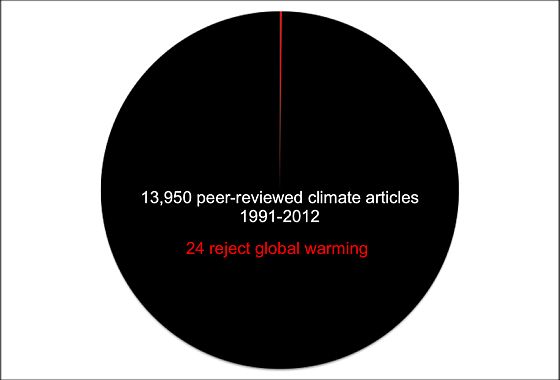
I searched the Web of Science for peer-reviewed scientific articles published between 1 January 1991 and 9 November 2012 that have the keyword phrases “global warming” or “global climate change.” The search produced 13,950 articles. See methodology.

I read whatever combination of titles, abstracts, and entire articles was necessary to identify articles that “reject” human-caused global warming. To be classified as rejecting, an article had to clearly and explicitly state that the theory of global warming is false or, as happened in a few cases, that some other process better explains the observed warming. Articles that merely claimed to have found some discrepancy, some minor flaw, some reason for doubt, I did not classify as rejecting global warming. Articles about methods, paleoclimatology, mitigation, adaptation, and effects at least implicitly accept human-caused global warming and were usually obvious from the title alone. John Cook and Dana Nuccitelli also reviewed and assigned some of these articles; John provided invaluable technical expertise.

This work follows that of Oreskes (Science, 2005) who searched for articles published between 1993 and 2003 with the keyword phrase “global climate change.” She found 928, read the abstracts of each and classified them. None rejected human-caused global warming. Using her criteria and time-span, I get the same result. Deniers attacked Oreskes and her findings, but they have held up.

Some articles on global warming may use other keywords, for example, “climate change” without the “global” prefix. But there is no reason to think that the proportion rejecting global warming would be any higher.

By my definition, 24 of the 13,950 articles, 0.17% or 1 in 581, clearly reject global warming or endorse a cause other than CO2 emissions for observed warming. [Continue reading…]

Facebooktwittermail

European court ruling confirms U.S. has operated as a rogue state, disregarding international law

Amnesty International: A ruling today by the European Court of Human Rights on the CIA’s detention and rendition of German national Khaled El-Masri has been hailed as a historic moment.

The European Court has held unanimously that Macedonia was responsible for the German national’s unlawful detention, enforced disappearance, torture and other ill-treatment, and for his transfer out of Macedonia to locations where he suffered further serious violations of his human rights. It also said that Macedonia did not satisfy its obligation to carry out an effective investigation.

On 31 December 2003, the Macedonian authorities arrested El-Masri, who is of Lebanese descent, after he entered Macedonia from Serbia. They held him incommunicado, subjecting him to enforced disappearance, repeated interrogations and to ill-treatment until 23 January 2004, when they handed him over to CIA agents.

As part of a covert, US-led rendition and secret detention programme, the CIA transferred El-Masri to a secret detention facility in Afghanistan. There he was held unlawfully in secret and denied access to a lawyer. His enforced disappearance continued for over four months, during which he was subjected to torture and other ill-treatment. Finally, on 28 May 2004, El-Masri was put on a plane and flown to Albania where he was released

Amnesty International and the International Committee of Jurists (ICJ) said today’s ruling was significant because for the first time it holds a European state accountable for its involvement in the secret US-led programme.

Amnesty International’s expert on counter-terrorism and human rights, Julia Hall, said:

“This judgment confirms the role Macedonia played in the CIA rendition and secret detention programmes, and is an important step towards accountability for European complicity in rendition and torture.

“Macedonia is not alone. Many other European governments colluded with the USA to abduct, transfer, ‘disappear’ and torture people in the course of rendition operations. This judgment represents progress, but much more needs to be done to ensure accountability across Europe.”

The International Committee of Jurists Secretary General Wilder Tayler said:

“This ruling is historic. It recognises that the CIA rendition and secret detention system involved torture and enforced disappearances. It emphasises that both the victims and the public have the right to know the truth about these serious violations. It affirms without doubt that Europe cannot be an area of impunity but it must be a place of redress and accountability where international human rights law obligations are not bypassed but fulfilled.

“Other European governments – such as Poland, Lithuania, and Romania, against which cases are also pending with the Court – should note today’s European Court judgment and take measures to ensure that the truth is told, thorough, effective, independent and impartial investigations are carried out and those responsible are held accountable.”

Amnesty and the ICJ also stressed that the court’s ruling serves to highlight the absence of accountability in the USA, with the court noting that a claim filed against the CIA by El-Masri was dismissed by the US courts after the US government invoked “state secrets privilege”.

Facebooktwittermail