



Ian Pannell reports from Aleppo: Adnan Abu Hassan works over a small wood fire, spreading patties of dough over the back of a hot pan that rests on the charcoals until they become crisp flatbreads.
Adnan is not a baker; he is a painter but these are desperate times in Aleppo’s sprawling al-Sukkari neighbourhood.
“There’s no work at the moment,” he says. “Life is very hard. I earn 100 Syrian pounds a day and I have to feed four children and pay the rent.”
That is less than $1.50 or about 90 pence a day. In an economy ravaged by war, the value of the Syrian pound has fallen almost as rapidly as prices for basic goods have risen.
Inflation is rampant and unemployment is endemic. What Adnan earns from bread is simply not enough to survive and like most of his neighbours, he struggles to get by on handouts, donations and loans.
Restless crowdsThe battle for Aleppo appears to have eased over the last few weeks but the suffering of those who live in this ancient city has not. Aleppo is facing a winter of misery and of dearth.
When the sun sets at 4:30, the streets are empty. The electricity supply was cut off days ago, in some areas weeks ago, and darkness seems to consume the city. [Continue reading…]
Tony Karon writes: As western and Arab governments prepare to meet in Marrakech today under the “Friends of Syria” rubric, the US is scrambling to adapt its Syria policy to an increasingly complex reality that is changing rapidly, largely beyond western influence.
Last week’s flurry of conflicting reports suggesting President Bashar Al Assad might be preparing to use chemical weapons may have been more a sign of agitation in Washington than of suicidal thoughts in Damascus. The regime has long been aware that using chemical weapons would prompt western powers to unleash air strikes. Israeli analysts have suggested that the greatest danger was not the use of chemical weapons, but that advancing rebels might seize them. Any activity around weapons depots may have been a result of munitions being moved for safekeeping.
Still, it seemed as if someone in Washington was trying to get the urgent attention of policymakers by sounding doomsday alarms. Rebel forces certainly made astonishing gains during the past month – they’ve overrun key outlying regime military bases; downed regime aircraft with shoulder-fired missiles; moved closer to cutting off the Assad garrison in Aleppo and launched a sustained operation in the suburbs of Damascus.
The regime’s strategists may be acknowledging that it can no longer rule all of Syria, and must instead contract its domain, fighting to hold on to key routes and cities, but accepting that recapturing the swathes of territory in the north, east and south held by rebels is beyond the manpower of the regime’s reliable (predominantly Alawite) security forces.
If so, the regime’s security core may see its best hopes for survival in the “Lebanonisation” of Syria – a scenario, already under way, in which the central state effectively collapses, and power is carved up among local and regional sectarian militias defending their own turf in a long-term war of all against all. The regime has already ceded territory along the Turkish border to Kurdish militias that have no intention of bending the knee to Damascus, regardless of who rules there. [Continue reading…]
Food & Environment Reporting Network: Earlier this year, Michele Bamberger, an Ithaca veterinarian, and Robert Oswald, a professor of molecular medicine at Cornell’s College of Veterinary Medicine, published the first (and so far, only) peer-reviewed report to suggest a link between fracking and illness in food animals. The authors compiled case studies of twenty-four farmers in six shale-gas states whose livestock experienced neurological, reproductive and acute gastrointestinal problems. Exposed either accidentally or incidentally to fracking chemicals in the water or air, scores of animals have died. The death toll is insignificant when measured against the nation’s livestock population (some 97 million beef cattle go to market each year), but environmental advocates believe these animals constitute an early warning.
“They’re making their way into the food system, and it’s very worrisome to us,” Bamberger says. “They live in areas that have tested positive for air, water and soil contamination. Some of these chemicals could appear in milk and meat products made from these animals.”
In Louisiana, seventeen cows died after an hour’s exposure to spilled fracking fluid. (Most likely cause of death: respiratory failure.) In northern central Pennsylvania, 140 cattle were exposed to fracking wastewater when an impoundment was breached. Approximately seventy cows died; the remainder produced eleven calves, of which only three survived. In western Pennsylvania, an overflowing waste pit sent fracking chemicals into a pond and a pasture where pregnant cows grazed: half their calves were born dead. The following year’s production was sexually skewed, with ten females and two males, instead of the usual fifty-fifty or sixty-forty split.
In addition to the cases documented by Bamberger, hair testing of sick cattle that grazed around well pads in New Mexico found petroleum residues in fifty-four of fifty-six animals. In North Dakota, wind-borne fly ash, which is used to solidify the waste from drilling holes and contains heavy metals, settled over a farm: one cow, which either inhaled or ingested the caustic dust, died, and a stock pond was contaminated with arsenic at double the accepted level for drinking water.
Cattle that die on the farm don’t make it into the nation’s food system. (Though they’re often rendered to make animal feed for chickens and pigs—yet another cause for concern.) But herd mates that appear healthy, despite being exposed to the same compounds, do: farmers aren’t required to prove their livestock are free of fracking contaminants before middlemen purchase them. Bamberger and Oswald consider these animals sentinels for human health. “They’re outdoors all day long, so they’re constantly exposed to air, soil and groundwater, with no break to go to work or the supermarket,” Bamberger says. “And they have more frequent reproductive cycles, so we can see toxic effects much sooner than with humans.”
Fracking a single well requires up to 7 million gallons of water, plus an additional 400,000 gallons of additives, including lubricants, biocides, scale and rust inhibitors, solvents, foaming and defoaming agents, emulsifiers and de-emulsifiers, stabilizers and breakers. About 70 percent of the liquid that goes down a borehole eventually comes up—now further tainted with such deep-earth compounds as sodium, chloride, bromide, arsenic, barium, uranium, radium and radon. (These substances occur naturally, but many of them can cause illness if ingested or inhaled over time.) This super-salty “produced” water, or brine, can be stored on-site for reuse. Depending on state regulations, it can also be held in plastic-lined pits until it evaporates, is injected back into the earth, or gets hauled to municipal wastewater treatment plants, which aren’t designed to neutralize or sequester fracking chemicals (in other words, they’re discharged with effluent into nearby streams). [Continue reading…]
Amal Hanano (a pseudonym for a Syrian-American writer): Cities, like dreams, are made of desires and fears, even if the thread of their discourse is secret, their rules are absurd, their perspectives deceitful, and everything conceals something else.
In Italo Calvino’s novel, Invisible Cities, a world traveler named Marco Polo describes the cities of a vast but crumbling empire to its ruler, Kublai Khan. Over time, the intricate descriptions of the cities begin to overlap until the khan slowly realizes that his appointed traveler has been describing the same city, an imagined city, over and over, in fragments — each vignette exposing another perspective, unveiling yet another city, where death mirrors life and cities are named after Italian women. Each city is suspended between reality and imagination, structured on a set of absurd rules, reminding the reader that a city can only be absorbed through short glances, each glance anchored to an object, a story, or a memory.
I’ve been reading and rereading Invisible Cities for over a decade. Before the Syrian revolution, Calvino’s poetics were safely rooted in the realm of fiction. When I recently picked it up to look for a quote, I began to read it once more — this time sneaking a few pages at a time between my daily intake of endless streams of gruesome images emerging from our all-too-real Syrian cities. For the first time, Calvino’s words detached from fantasy; Syria’s cities became embedded within the lines of the Invisible Cities. I listened, along with Kublai Khan, to Marco Polo’s narrations and tried to understand how cities become invisible.
Watching death has become a pastime of the revolution. There is much to learn from it. Death is sudden; it is shorter than a short YouTube clip. Death is a man wrapped in his shroud, bloodied gauze strips tied around his head, cotton stuffed in his nostrils, and the bluish-gray tinge of his skin. Death is the camera panning over mass graves where children’s bodies are arranged in long, perfect lines, then covered with rust-colored dirt. The death of Syrians accumulated so fast it seems impossible to comprehend over 40,000 lives lost in less than two years.
But the death of a city is different. It is slow — each neighborhood’s death is documented bomb by bomb, shell by shell, stone by fallen stone. Witnessing the deaths of your cities is unbearable. Unlike the news of dead people — which arrives too late, always after the fact — the death of a city seems as if it can be halted, that the city can be saved from the clutches of destruction. But it is an illusion: The once-vibrant cities cannot be saved, so you watch, helpless, as they become ruins.
Ruins are sold to us as romantic and poetic. As tourists wandering ancient sites, cameras dangling from our necks and guidebooks in hand, we seek beauty in the swirling dust over the remains of a dead civilization. We imagine what is was like then, before empires decayed and living objects became historical artifacts. But that kind of romanticism is only afforded with the distance of time and geography. In war, ruins-in-the-making are not beautiful, not vessels of meaningful lessons, not a fanciful setting for philosophical contemplations on the follies of men. When you witness it live, when it is real, and when it happens to your city, it becomes another story altogether. [Continue reading…]
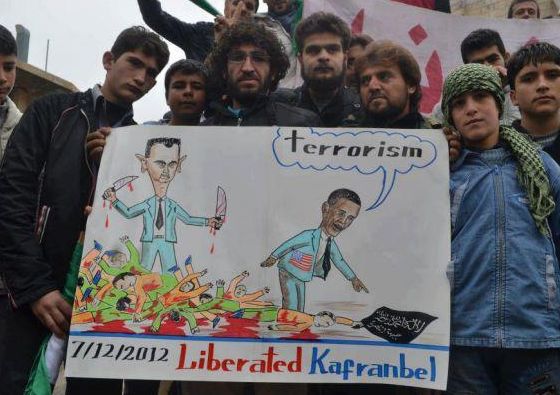
Aaron Y. Zelin writes: The backlash within Syria to the U.S. decision to designate the Syrian-based jihadist group Jabhat al-Nusra as a terrorist organization has been swift. Opposition to the designation, which was officially announced on Dec. 11, extends well beyond groups ideologically sympathetic to Jabhat al-Nusra’s radical goals. After more than 40,000 deaths, the starvation and torture of many, and the sadistic tactics of the Assad regime, Syrians now want the fall of the regime more than ever — even if that means temporarily embracing groups with suspect long-term goals.
The Barack Obama administration’s designation of Jabhat al-Nusra asserts that the group is an extension of al Qaeda in Iraq (AQI) — merely one of the terrorist organization’s aliases. Whether this is the case or whether the administration is issuing the designation as part of a political effort to convince the opposition to shun Jabhat al-Nusra, the move will likely fail to marginalize the group at this juncture. Following the fall of the regime, however, it could help sideline the most destructive influences trying to gain a foothold in post-Assad Syria.
The reaction among anti-Assad Syrians was perhaps best captured by an image that appeared on Facebook shortly after news of the planned designation broke last week. In the picture, residents of the northwestern town of Kafr Anbel hold up a poster showing Obama pointing accusingly toward a flag associated with Jabhat al-Nusra, saying “Terrorism.” Behind the U.S. president, however, is Syrian President Bashar al-Assad standing triumphant on a pile of murdered Syrian civilians.
The image reflects the reality that the Syrian opposition simply does not view Jabhat al-Nusra as the primary threat to the country — that designation still belongs to Assad’s murderous army. Nor is it lost on Syrians that the Obama administration has provided scant military assistance in their efforts to topple the regime — but is now singling out a rebel group that has become perhaps their revolution’s most effective fighting force. This is a view that seems to extend well beyond Jabhat al-Nusra’s ideological milieu: None of the individuals in the Kafr Anbel picture, for example, look like Islamists or Salafis. [Continue reading…]

Lindsey Hilsum writes: They’re happy, but they’re not happy. Pleased that President Obama announced last night that the US recognises the new Syrian opposition coalition as the “legitimate representative of the Syrian people.” Unhappy that one of the fiercest fighting forces on the ground, Jabhat al-Nusra, has been designated by the USA as a terrorist group.
Here in Marrakech, where the international Friends of Syria group is meeting, the Syrian National Coalition, which formed last month, is trying to re-present itself as a government in waiting, and a civilian authority which guides the newly formed High Military Command of rebel fighters.
To them it is President Bashar al-Assad’s forces that are the terrorists, not the jihadi groups fighting alongside the Free Syrian Army to overthrow him.
“There is nothing wrong with fighting in the name of Islam,” said the coalition leader, Ahmed Moaz al-Khatib, a moderate imam, in his speech to assembled ministers and diplomats. He requested the Americans to reconsider their decision.
“We will work with everybody on the ground who has an agenda which includes ending the suffering of the Syrian people,” said Yaser Tabbara, a coalition spokesman. “If al-Nusra is on the same page, they will be dealt with using dialogue and containment.”
In other words, you Americans can call them terrorists if you like but they’re more useful to us than you are. The Americans are not giving the Syrian opposition weapons, while al-Nusra are fighting on the same side.
The New York Times reports: President Obama said Tuesday that the United States would formally recognize a coalition of Syrian opposition groups as that country’s legitimate representative, intensifying the pressure on President Bashar al-Assad to give up his bloody struggle to stay in power.
Mr. Obama’s announcement, in an interview with Barbara Walters of ABC News on the eve of a meeting in Morocco of the Syrian opposition leaders and their supporters, was widely expected. But it marks a new phase of American engagement in a bitter, nearly two-year-long conflict that has claimed at least 40,000 lives, threatened to destabilize the region, and defied all outside attempts to end it.
The announcement puts Washington’s political imprimatur on a once-disparate band of opposition groups, which have coalesced, under pressure from the United States and its allies, to develop what American officials say is a credible transitional plan to govern Syria if Mr. Assad is forced out.
Moreover, it draws an even sharper line between those elements of the opposition that the United States champions and those it rejects. The Obama administration coupled its recognition with the designation hours earlier of a militant Syrian rebel group, Al Nusra Front, as a foreign terrorist organization, affiliated with Al Qaeda.
Human Rights Watch: The Syrian military has used air-delivered incendiary bombs in at least four locations across Syria since mid-November2012, Human Rights Watch said today. The conclusion is based on interviews with four witnesses and multiple videos analyzed by Human Rights Watch.
The Syrian military should cease its use of incendiary weapons immediately, Human Rights Watch said. A total of 106 nations have prohibited the use of air-delivered incendiary weapons, which cause serious burns, in populated areas, but Syria has not banned the weapons.
“We’re disturbed that Syria has apparently begun using incendiary munitions, as these weapons cause especially cruel civilian suffering and extensive property destruction when used in populated areas,” said Steve Goose, Arms division director at Human Rights Watch. “Syria should stop using incendiary weapons in acknowledgment of the devastating harm this weapon causes.”
Incendiary weapons can contain any number of flammable substances, including napalm, thermite, or white phosphorus and are designed to set fire to objects or to cause burn injuries. They are not chemical weapons, which kill and incapacitate by the toxic properties of the chemicals released.
AFP reports: The European Union, winners of this year’s Nobel Peace Prize, said at the Oslo award ceremony Monday that Syria was “a stain” on the world’s conscience.
“Let me say it from here today,” said European Commission president Jose Manuel Barroso. “The current situation in Syria is a stain on the world’s conscience and the international community has a moral duty to address it.”
Barroso said that on international human rights day, the thoughts of the 27-nation bloc were with those “all over the world who put their lives at risk to defend the values that we cherish.”
At talks in Brussels on Monday, EU foreign ministers were discussing the situation in Syria, where heavy fighting was continuing in a 21-month conflict against the regime of President Bashar al-Assad.
Jackson Lears reviews Inside the Centre: The Life of J. Robert Oppenheimer by Ray Monk: Reasonable men can dream monstrous dreams. It is the lesson of the 20th century: a lesson articulated from various perspectives since Adorno and Horkheimer wrote Dialectic of Enlightenment amid the wreckage of World War Two. Defenders of the Enlightenment can cogently argue (and many have) that Nazi science was a grotesque caricature, that the Holocaust was a betrayal of the Enlightenment rather than a fulfilment of its fatal dialectic. But it is harder to make that case with respect to the development of nuclear weapons. Indeed the subject seems designed to lay bare the contradictions at the core of Enlightenment culture by revealing them at work in the subculture of professional physicists bent to the needs of government power. Few social laboratories could more clearly reveal the tensions between chauvinist impulses and humanist aspirations, or between careerist plotting and disinterested service, or – perhaps most important – between the Enlightenment ideal of intellectual openness and the demands for secrecy made by the national security state.
The history of nuclear weapons began in an atmosphere of creative ferment and international trade in ideas. This was the world of Knaben3physik (‘boy physics’) in the 1920s and 1930s, when young men who had not been shaving for more than a few years were excitedly reading one another’s papers and poring over the results of experiments in Cambridge, Göttingen, Copenhagen and (eventually) Berkeley. This was how Niels Bohr, Werner Heisenberg and others created the foundations of quantum physics. Yet within less than a decade this moment had passed. Olympian conversations were drowned out by fascist chants. Jewish physicists, led by Einstein, fled to America; Heisenberg stayed in Germany; Bohr stayed out of sight in occupied Denmark. The concentration of research effort shifted westwards across the Atlantic. But it was research with a new, pragmatic mission: to build an atomic bomb before Hitler did. Theories conceived in open exchange were harnessed to secret purposes, and illuminating ideas were pressed into the service of mass death. No wonder some of the atomic scientists felt remorse, or at least ambivalence, about their achievement; no wonder some began to glimpse the darker dimensions of Enlightenment when the blinding flash of the first atomic explosion revealed their labours had not been in vain.
J. Robert Oppenheimer, the physicist in charge of the Manhattan Project and hence ‘father of the atomic bomb’, was never openly remorseful. But he was nothing if not ambivalent, as Ray Monk makes clear in his superb biography. When the fireball burst Oppenheimer remembered the words from Vishnu in the Bhagavad Gita: ‘I am become death, destroyer of worlds.’ It was his own idiosyncratic translation, and it became his most famous remark. The next day, though, his mood was anything but sombre as he jumped out of a jeep at Los Alamos base camp. His friend and fellow physicist Isidor Rabi said: ‘I’ll never forget the way he stepped out of the car … his walk was like High Noon … this kind of strut. He had done it.’ His colleague Enrico Fermi ‘seemed shrunken and aged, made of old parchment’ by comparison. Yet his euphoria passed, and he sank into second thoughts, despondent about the calamitous consequences awaiting the Japanese. He walked the corridors mournfully, muttering: ‘I just keep thinking about all those poor little people.’ Racial condescension aside, he meant what he said, and during the days following the test his secretary said he looked as though he were thinking: ‘Oh God, what have we done!’ [Continue reading…]
Issandr El Amrani writes: Egypt is in the grip of its worst political crisis since President Hosni Mubarak was deposed two years ago, and shifts in the three-way balance of power between Islamists, secularists and the military make the outcome more difficult to predict. The on-going crisis has dramatically increased the likelihood of protracted political and social instability. Violent street clashes between supporters and opponents of the six-month-old administration of President Muhammad Morsi have claimed eight lives and left hundreds wounded. The sacking of a number of offices of the Muslim Brotherhood, allegations of organized attacks against opposition protesters, as well as the uncompromising and increasingly belligerent rhetoric from both sides suggests the worst is yet to come. Absent a muscular effort by political leaders to contain the crisis, Egypt could be heading into a new season of political violence.
Some of the political leaders on both sides who initially staked out maximalist positions have begun to show more caution, but may lack the political authority or the political will to calm the rising anger of their supporters. In the meantime, the military is sending ambiguous messages and appears to want to remain above the fray, even as each side attempts to drag it back in — and in doing so is willing to give it concessions almost all factions opposed only a year ago.
The crisis is driven by a deeper conflict over the identity and nature of the post-Mubarak Egyptian state, and more immediately over the distribution of power within it, but its immediate focus has been the process by which a new constitution will be adopted. The target of much of the outrage of the past two weeks has been President Morsi’s assumption, in his November 22 decree, of absolute executive power until such time as a new constitution has been enacted. It was compounded by his decision to rush the approval of a draft constitution, in a marathon December 1 session by an Islamist-dominated Constituent Assembly. On December 8, Morsi rescinded elements of his decree that had awarded him unfettered executive power and allowed him to ignore judicial decisions, and explained that in the event that the “no” vote prevails in the December 15 referendum on the draft constitution, a new Constituent Assembly would be chosen in direct elections. But the new announcement failed to repair the deep distrust created by Morsi’s actions. And the president refused to heed the opposition’s demand for a postponement of the referendum, which is scheduled for Saturday —leaving little opportunity to contain the immediate phase of the crisis. [Continue reading…]
The New York Times reports: Islamist supporters of President Mohamed Morsi captured, detained and beat dozens of his political opponents last week, holding them for hours with their hands bound on the pavement outside the presidential palace while pressuring them to confess that they had accepted money to use violence in protests against him.
“It was torment for us,” said Yehia Negm, 42, a former diplomat with a badly bruised face and rope marks on his wrists. He said he was among a group of about 50, including four minors, who were held on the pavement overnight. In front of cameras, “they accused me of being a traitor, or conspiring against the country, of being paid to carry weapons and set fires,” he said in an interview. “I thought I would die.”
The abuses, during a night of street fighting between Islamists and their opponents, have become clear through an accumulation of video and victim testimonies that are now hurting the credibility of Mr. Morsi and his allies as they push forward to this weekend’s referendum on an Islamist-backed draft constitution.
To critics of Islamists, the episode on Wednesday recalled the tactics of the ousted president, Hosni Mubarak, who often saw a conspiracy of “hidden hands” behind his domestic opposition and deployed plainclothes thugs acting outside the law to punish those who challenged him. The difference is that the current enforcers are driven by the self-righteousness of their religious ideology, rather than money.
It is impossible to know how much Mr. Morsi, a leader of the Muslim Brotherhood’s political arm, knew about the Islamists’ vigilante justice. But human rights advocates say the detentions raised troubling questions about statements made by the president during his nationally televised address on Thursday. In it, Mr. Morsi appears to have cited confessions obtained by his Islamist supporters, the advocates said, when he promised that confessions under interrogation would show that protesters outside his palace acknowledged ties to his political opposition and had taken money to commit violence.
Khaled el-Qazzaz, a spokesman for Mr. Morsi, said Monday that he had ordered an investigation into the reported abuses and asked the prosecutor to bring charges against any involved. He said that Mr. Morsi was referring only to confessions obtained by the police, not by his supporters.
But human rights lawyers involved in the cases of the roughly 130 people who ended up in police custody Wednesday night, all or most of them delivered by the Islamists, say the police obtained no confessions. “His statement was completely bogus,” said Karim Medhat Ennarah, a researcher on policing at Egyptian Initiative on Personal Rights, whose lawyers were on hand about an hour after the speech when prosecutors released all the detainees without charges. “There were no confessions; they were all just simply beaten up,” he said. “There was no case at all, and they were released the next day.”
Officials of the Muslim Brotherhood said the group opposed such vigilante justice and did not organize the detentions. And in at least one case one victim said a senior figure of the group rescued her from captivity. But the officials also acknowledged that some of their senior leadership was on the scene at the time. They said some of their members took part in the detentions, along with more hard-line Islamists. [Continue reading…]
Al Monitor: Al-Masry Al-Youm spent three hours in total in the torture chambers established by the Muslim Brotherhood at the gates of the Ittihadiya Palace in the suburb of Heliopolis. The central torture chamber, which is located in front of the gate facing the Omar Ibn Abdel Aziz Mosque on al-Merghany Street, is secured with a cordon and iron barriers, where the Central Security Forces (CSF) prevent the access of any persons without the authorization of the Brotherhood.
We entered the chamber with a great difficulty, after a fellow journalist from the Misr 25 TV channel facilitated. The channel is owned by the Brotherhood. There are brigades and police officers in military uniforms, as well as others in civilian clothes from al-Nozha police station, who oversee the beatings, whippings and torture. Fifteen others from the group, distinguished by their strong bodies, are supervised by three bearded and well-dressed men who decide who will be in the chamber and who may leave, even if the person is a member of the Brotherhood.
The torture process starts once a demonstrator who opposes President Mohammed Morsi is arrested in the clashes or is suspected after the clashes end, and the CSF separate Morsi’s supporters from his opponents. Then, the group members trade off punching, kicking and beating him with a stick on the face and all over his body. They tear off his clothes and take him to the nearest secondary torture chamber, from which CSF personnel, members of the Interior Ministry and the State Security Investigations Services (SSIS) are absent.
It is hard to determine how many locations there are, given that the torture chambers are established as near as possible to where a person is arrested. Before the interrogation process starts, they search him, seize his funds, cellphones or ID, all the while punching and slapping his face in order to get him to confess to being a thug and working for money. [Continue reading…]
The Associated Press reports: Masked gunmen attacked opposition protesters camped out at Cairo’s Tahrir Square early on Tuesday, firing birdshot at them and wounding nine people, security officials said.
The attack stoked tensions just hours ahead of rival mass rallies in the Egyptian capital by supporters and opponents of the country’s Islamist president over a disputed draft constitution. The charter has vastly polarized the nation and triggered some of the worst violence since Mohammed Morsi took office in June as Egypt’s first freely elected president.
It was unclear who was behind the pre-dawn attack on the protesters who have been staging a sit-in at Tahrir for nearly three weeks, said the officials, speaking on condition of anonymity because they were not authorized to talk to the media.
Issandr el-Amrani and Anthony Dworkin speaking at the European Council on Foreign Relations in London today, introduced by Daniel Levy.
