Colin Dayan writes: Talking about Gaza is like talking about God. We face the ineffable. We cannot talk about what we see. Or if we do, we are accused of lacking common sense, failing to take a realistic approach to an unmanageable problem.
What is that problem? Palestinians are the problem. Like so many others in our world today, Palestinians are labeled as “terrorists” by the powerful, so that lethal force is the rule and extreme violence — or exemplary disregard — may be directed indiscriminately against civilians and non-civilians alike. The problem is not a simple one. If we pretend it is, then we risk validating those who hold Israel to an unfair standard, or worse, who question its right to exist. And in protesting Israeli government policy, expressing horror at its brutal excesses, we risk being condemned as “anti-Semitic” or worse, as “self-hating Jews.”
The tired debates about the history of Zionism and the threat of the Palestinian national movement—or, put more bluntly, about the end of Israel and what Jonathan S. Tobin calls “a war with Palestinian Islamists that has no end in sight” — ignore what is specific about more than four decades of Israeli domination in the Occupied Territories. Especially masked in these debates are the unique and various forms of violence used to control the West Bank and Gaza Strip since the eruption of the second Palestinian intifada in September 2000. In the name of “security,” Israel has implemented something like a permanent state of emergency. Brute force coexists with, to a sometimes-calamitous degree, a systematic practice of discrimination, surveillance, and disappearance. Behind the barriers — and they are everywhere — live the confined, sealed off from the zone of inclusion, the Israeli state. [Continue reading…]
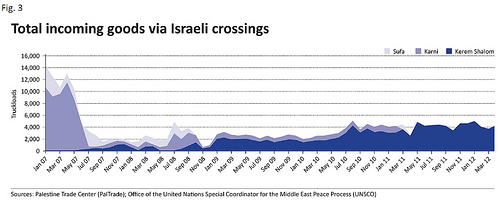
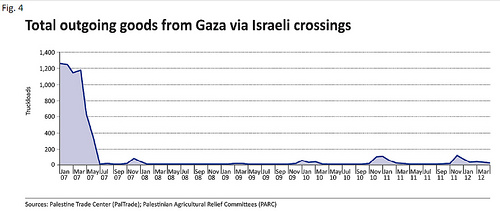
And, the blockade on exports is almost complete, with some minor exceptions, and is devastating to the Gaza economy. Real per capita income among Palestinians in the Gaza Strip is less today than in the early 1990s!
These Israeli policies are a form of collective punishment imposed by an Occupying power on a noncombatant occupied population. Israel also imposes restrictions on Palestinian travel outside the Strip (even, sometimes, unconscionable delays for patients seeking specialist medical care– delays that lead to their deaths). Collective punishment, obstacles to free movement as part of an Apartheid regime, and occasional Israeli attacks that show blatant disregard for civilian life are not only illegal in international law but constitute a set of systematic war crimes that rise to the level of crimes against humanity as defined by the Rome Statutes.
While it is unfortunate that small homemade rockets are sometimes fired by small militant groups from Gaza into Israel, it is impossible to expect social peace from a people being economically strangled. [Continue reading…]
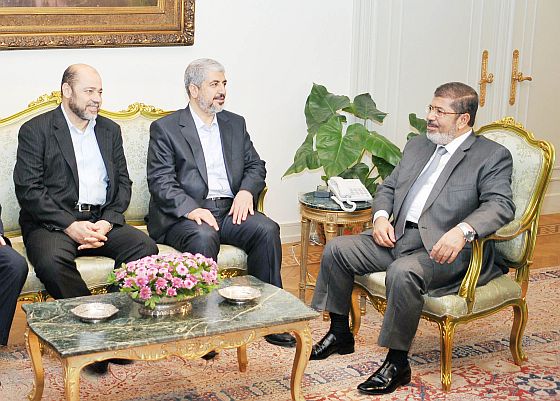
In July, Khaled Meshaal, the leader of Hamas, met Egypt's newly elected President Mohamed Morsy and hailed Morsy's election as the start of a "new era" for Egypt and the Palestinians.
Tony Karon writes: When a civilian bus was bombed in Tel Aviv on Wednesday, many feared the incident would derail negotiations for a truce in the latest conflict between Israel and Hamas. That proved not to be the case. The other anxiety was that an Egypt where the Muslim Brotherhood is in power would somehow jinx the prospects for peace. That fear proved to be groundless too. Indeed, the government of President Mohamed Morsy took the lead role in brokering the Gaza truce announced in Cairo Wednesday night, and will reportedly act as its guarantor. “It was unknown how Egypt would react,” Likud party legislator Yohanan Plesner told Britain’s Telegraph. “When the moment of truth came, the Egyptian leadership moved responsibly and clearly said they were trying to restore stability.” Not only that, says analyst Michael Wahid Hanna at the Century Foundation, “Egypt’s government has put its own international credibility on the line by effectively undertaking to ensure that Hamas observes the terms of its ceasefire — that’s a subtle but profoundly important change.”
Egypt’s Gaza role reflects the emerging contours of a Middle East profoundly changed by the Arab Spring, yet forced to confront decades-old challenges. The essential partnership in tamping down the Gaza violence, notes former U.S. Ambassador to Israel Martin Indyk, is the one “between the United States and Egypt — one using its influence with Israel, the other with Hamas — to put together a ceasefire package as the foundation for a wider resolution of the conflict.” Although Secretary of State Hillary Clinton may have played an important part in finessing the deal, Morsy and the Egyptians provide a service Washington cannot in dealing with Gaza. The U.S. is officially sworn to avoid engagement with Hamas — a movement it defines as a terrorist organization. And while Washington has a preferred Palestinian interlocutor–President Mahmoud Abbas who is based in the West Bank–Abbas has no influence over events in Gaza, where his rivals in Hamas hold sway. And so, the Obama Administration turned to Egypt, urging it to use the Muslim Brotherhood’s political ties with Hamas and the Egyptian intelligence service’s long-established relationship with its Israeli counterparts to broker a truce.
Unlike former President Hosni Mubarak who deemed Hamas an enemy, the Muslim Brotherhood government sees the movement as its own political progeny, and is therefore not shackled by a need to prevent Hamas making political gains from a truce. On the contrary, while Egypt seeks a cease-fire that ends Palestinian rocket fire from Gaza and Israeli air strikes on the territory, Cairo’s mediation also offers Hamas a pathway out of the blockade that has choked off Gaza’s economy for the past five years. Even Israeli leaders have praised the response from Cairo, notwithstanding Egypt’s unprecedented public acts of solidarity with Hamas.
Morsy had made clear, when he addressed the U.N. General Assembly in September, that his government would both abide by the 1978 Camp David peace treaty with Israel but also challenge the status quo in the Palestinian territories. “I say it loudly to those wondering about our position vis-a-vis the international agreements and conventions that we have previously adhered to: we are committed to what we have signed on,” Morsy said at the time. “We also support the inalienable rights of the Palestinian people and are determined to pursue all efforts side by side with them until they regain their rights.” [Continue reading…]
A ceasefire between Israel and the Palestinians in Gaza was due to go into effect at 2pm Eastern, 9pm local time. With a de facto end to the siege — the Rafah border will now stay open — Hamas can reasonably declare victory.
Following is the verbatim English text of the ceasefire agreement between Israel and the Palestinians in Gaza that was reached on Wednesday with Egyptian mediation. The text was distributed by the Egyptian presidency.
Agreement of Understanding For a Ceasefire in the Gaza Strip
1: (no title given for this section)
A. Israel should stop all hostilities in the Gaza Strip land, sea and air including incursions and targeting of individuals.
B. All Palestinian factions shall stop all hostilities from the Gaza Strip against Israel including rocket attacks and all attacks along the border.
C. Opening the crossings and facilitating the movements of people and transfer of goods and refraining from restricting residents’ free movements and targeting residents in border areas and procedures of implementation shall be dealt with after 24 hours from the start of the ceasefire.
D. Other matters as may be requested shall be addressed.
2: Implementation mechanisms:
A. Setting up the zero hour for the ceasefire understanding to enter into effect.
B. Egypt shall receive assurances from each party that the party commits to what was agreed upon.
C. Each party shall commit itself not to perform any acts that would breach this understanding. In case of any observations Egypt as the sponsor of this understanding shall be informed to follow up.
The Guardian reports: The agreed truce was mediated by Egyptian president Mohamed Morsi and his spy chief Mohamed Shehata after days of talks and frantic shuttle diplomacy involving regional leaders, UN secretary general Ban Ki-moon and Clinton.
Clinton had been engaged in talks with Netanyahu in Jerusalem and Palestinian Authority president Mahmoud Abbas in Ramallah before flying to Cairo to meet Morsi.
President Obama also intervened during a tour of Asia to call both Israel and Morsi to encourage them to find a solution.
After the announcement Obama called the Israeli PM to commend him for agreeing to the Egyptian proposal, and to promise to seek funding for a joint missile defence programme.
The agreement appeared to consist of nothing more than a simple truce and failed to address other security issues, let alone the longer-term question of reviving a long-moribund peace process.
However, an Israeli government source said that following the ceasefire agreement, an “ongoing dialogue will start within 24 hours covering underlying issues of concern to both parties”.
They include the further relaxation of border restrictions and targeted assassinations.
On borders, he said: “These restrictions were imposed in the framework of hostilities.” In the absence of hostilities, they may no longer be necessary.
Targeted assassinations, he added, were “an irrelevant question”. “If they are not attacking us, we don’t need to shoot them.”
Two other issues to be discussed in further talks were the re-arming of militant groups and the Israeli-imposed buffer zone inside the Gaza border. “The buffer zone was only introduced in the framework of hostilities,” the source said.
Peter Beaumont reports from Cairo: As frantic diplomatic efforts continued to secure a ceasefire in Gaza between Israel and Hamas, which saw the US secretary of state, Hilary Clinton, arrive in Cairo on Wednesday vowing to work to find an end to the latest conflict, details of the stumbling blocks in the negotiations began to emerge.
On Tuesday evening, despite the continuing violence, an imminent ceasefire appeared certain to many close to the negotiations.
One diplomat who attended an event in Cairo with a number of prominent Islamist politicians was assured a truce “was in the bag” and went to sleep expecting to wake to news of a ceasefire.
But what happened in the period between when Egypt’s president, Mohamed Morsi, and a senior Hamas spokesman indicated a truce would be in force by Tuesday night is instructive of the profound problems that lie ahead in attempting to secure a meaningful long-term ceasefire.
According to those familiar with the negotiations being mediated on the Egyptian side by Morsi and General Mohamed Shehata, head of Egypt’s General Intelligence Directorate, talks had originally focused on a two- to three-stage ceasefire.
The first stage was to have been what is known as a “temporary lull” or tahdiya in Arabic followed by a hudna – a truce or calming period which it had been hoped would set the scene for a longer-term agreement on issues relating both to the blockade of Gaza and assassinations of Hamas figures on one side and Israeli security demands regarding rocket fire on the other.
During Tuesday afternoon and evening that process began unravelling as both sides came under internal pressure to achieve what has proved so difficult before: to come to a comprehensive settlement in one go. [Continue reading…]
For several years, Israeli leaders and the public at large have nurtured the illusion that the state’s national security policies, the construction of the so-called “security fence” (better known as the Apartheid Wall) and other counter-terrorism mechanisms have made Israel safe. In reality, the Wall could not possibly have achieved that purpose — it has never been completed — moreover its actual purpose has always been somewhat transparently political as it carves into Palestinian territory.
The obvious fact is that the lull in violence since 2006 inside Israel has had as much to do would the choices of would-be attackers as it has had with the effectiveness of Israel’s efforts to thwart attacks. Indeed, the more extreme the Jewish state becomes, the more vulnerable it will be to violent reactions generated inside its own population. An ethnocracy in which 25% of the population are treated as second-class citizens inevitably ends up sacrificing freedom in the name of security.
As for today’s bus bombing, one of the most obvious conclusions to draw is that attacks on Gaza cannot continue without provoking a backlash from the West Bank. Israel’s leaders are foolish to imagine that they can politically profit by dragging out the process of reaching a ceasefire agreement.
The Economist‘s Middle East blog: In Cities across the West Bank, Palestinian youth inspired by the fighting in Gaza have been skirmishing with Israeli forces as a new spirit of activism takes hold. Clouds of tear-gas hang over the night-time streets of Bethlehem and Qalandia, the main terminal blocking the West Bank’s access to East Jerusalem, as Israeli soldiers seek to disperse demonstrators. Increasingly, the army resorts to lethal force to repel Palestinians hurling Molotov cocktails so numerous they are reaching intifada levels. Casualties are rising as the army deploys reservists, often ill-trained in crowd control to replace soldiers transferred from the West Bank to the Gaza front. Two Palestinians have been killed following clashes in Hebron, a southern West Bank city and the stronghold of the clan of Ahmad Jabari, the head of Hamas’s military wing, whose assassination on November 14th led to the Israeli offensive, and Nabi Saleh, a village near Ramallah.
With Palestinians in the West Bank rallying in support of Gaza, West Bank politicians talk of an approaching intifada to match those that began in 1987 and in 2000. Israeli observers speak of mounting concern that their country’s assault on Gaza could precipitate a new wave of West Bank unrest. In an attempt to contain it, Israel’s security forces have detained dozens, including in East Jerusalem, where Palestinians have also rallied in support of Hamas. The streets of the old city and the adjoining neighbourhood of Silwan echoed with gunfire in the evening of November 16th as police sought to disperse protesters distributing sweets in celebration of a rocket that landed on the outskirts of Jerusalem. Hamas possesses only a minute fraction of Israel’s fire power, but its rocket attacks on Israel’s cities, including its commercial capital, Tel Aviv, are winning it renewed support amongst Palestinians, gleeful that in however small a measure, their armed militias are redressing the balance of fear.
“No longer are we just helpless refugees,” says Mahmoud, a shopkeeper on Saladin Street, the main shopping district of Israeli-occupied East Jerusalem. “After years of going nowhere, we are starting to look as if we have an army of our own.” Elsewhere on the street, moneychangers put out bowls of sweets for their customers. My normally dour falafel-fryer shook my hand in delight. “Now it is not only Palestinians who are afraid,” he said. [Continue reading…]
Reuters reports: Hamas leader Khaled Meshaal looked like a man at home in Cairo this week as he used the Egyptian capital to declare terms for a ceasefire with Israel, his confidence reflecting the historic changes shaping an Arab world more supportive of his cause.
In Cairo for talks on the Gaza crisis, the bearded Hamas leader in exile has been warmly received in a country where officials viewed his movement with suspicion bordering on outright hostility when Hosni Mubarak was in power.
In stark contrast to those days, a smiling Meshaal was photographed on Monday meeting President Mohamed Mursi, the head of a new Egyptian administration shaped by the Muslim Brotherhood, Hamas’ spiritual mentor. Mursi, unlike Mubarak, is taking a personal interest in truce talks Egypt is overseeing.
Behind the scenes, Hamas leaders are finding a very different attitude from the Egyptian mediators. In Mubarak’s days, the Palestinians often complained that Egyptian intelligence chief Omar Suleiman, who died earlier this year, would try to impose Israel’s terms on them.
“The Egyptian brothers in the intelligence service have always helped in truce matters, this time they are being more helpful because President Mursi is in charge,” said a source close to Hamas. “The former regime used to pressure us more than they did Israel,” the source said.
The changes buoying Hamas have started to become clear in the tone from other Arab states too – a delegation of eight Arab ministers arrived in Gaza on Tuesday in the latest visit to express solidarity with the Palestinians.
The shift marks a challenge to the policies of Western governments including the United States. They shun Hamas as a terrorist group, dealing instead with the Palestinian Authority, from which Hamas seized control of Gaza in 2007.
It also shows that public opinion is starting to have an impact on the foreign policies of Arab states long run by autocrats who have paid scant attention to the views of populations broadly supportive of the Palestinians.
Ending terrorism is much easier than most people realize. All it requires is a change in language and from that can follow a change in perceptions. That doesn’t mean adopting some kind of Obama-speak euphemism like “violent extremism” but rather an objective and descriptive term that has explanatory power.
“Terrorism” connotes random acts of violence conducted by evil, nihilistic people. As such, the problem of terrorism is reduced to the need for its eradication. But trying to eradicate terrorism is like trying to eradicate a disease without identifying the virus that causes it.
If instead of talking about “terrorism,” we talk about “political violence,” the term immediately demands consideration of the political motives which lie behind such acts of violence.
If Western governments and Israel continue to insist on referring to Hamas as a terrorist organization, they do a disservice to their own citizens and hold up a conceptual barrier that obstructs political changes — changes that would not be as difficult to effect as most people imagine.
Ed Husain writes: When I visit Jerusalem and the West Bank, I frequently ask young Arabs about their views on Hamas. In almost every discussion, Christians and Muslims alike refuse to label Hamas as a “terrorist” organization. When I raise criticism of Hamas and its targeting of innocent civilians, my comments never register. The responses are some variation of “Israel has taken over our lands and killed thousands of Arab civilians over the years. Hamas is only resisting occupation and fighting for our rights.”
I hear similar sentiments in Egypt, Saudi Arabia and even non-Arab Pakistan. Al-Jazeera Arabic gives prominence to the popular Egyptian Muslim Brotherhood cleric Yusuf al-Qaradawi, who has repeatedly called suicide bombings against Israelis not terrorism, but “martyrdom.” He argues that since Israelis all serve in the military, they are not civilians. Even children, he despicably argues, are not innocent. They would grow up to serve in the military. Qaradawi is not alone.
I can name tens of Muslim clerics, important formulators of public opinion in a region dominated by religion, that will readily condemn acts of terrorism against the West, but will fall silent when it comes to condemning Hamas or Islamic Jihad. Put simply, support for violent resistance against Israel among Arab and Muslim-majority countries — including allies of the United States such as Qatar, Saudi Arabia, Egypt, Turkey, Tunisia — remains popular.
Hamas benefits from that support. From radical Iran to moderate Tunisia, Hamas’ Prime Minister Ismail Haniyyeh was welcomed by vast cheering crowds during visits this year.
In a new Middle East, where popular opinion matters more than ever before, to demand that people condemn Hamas is a political nonstarter. It won’t happen. Israel’s talk of Hamas terrorism has failed to convince the Muslim and Arab masses. And worse, the label of “terror” loses its importance when entire populations, essentially, see nothing wrong with Hamas’s violent activities.
In short, Israel’s strategy has failed to win Muslim hearts and minds. In the long term, it cannot continue to rely on military superiority and Western support in the face of popular hostility. Israel is a nation in the Middle East, and it needs to find a home and place among its increasingly democratic neighbors. The old ideas of “we do not talk to terrorists” are not only strategically futile, but also untrue.
In order to secure the release of kidnapped Israeli soldier Gilad Shalit, Israelis (in both official and unofficial capacities) negotiated with Hamas. In spite of the Netanyahu government’s bluster about refusing to deal with Hamas now, securing a cease-fire involves doing exactly that with the help of Egypt’s new Islamist government.
In the past, Israel refused to talk with the PLO and Yasser Arafat, and in 1988, despite Israel’s intransigence, the United States opened a dialogue with the PLO and thereby helped steer the organization to its nonviolent politics today. Similar examples abound in recent history from South Africa, where Margaret Thatcher once called the African National Congress and Nelson Mandela terrorists, to Northern Ireland’s Sinn Fein.
In short, when the political calculations shift, the actions of terrorists are altered. Lest we forget, George Washington was labeled a terrorist by the British. But that label carried little weight amid his support base in America.
Ynet reports: Hamas’ Deputy Politburo chief Mousa Abu Marzook posted a message on his Facebook page condemning the execution of six people accused of being Israel collaborators.
He demanded that those behind the act be tried. “The way these collaborators were killed and the images after their death are totally unacceptable and those responsible must be indicted. These events must never repeat themselves,” he wrote.
Abu Marzook further added, “We endorse punishments to spies and especially to those who took part in the death of our commander and undermine our resistance but they should only be punished by law.”
Palestinian gunmen shot dead six alleged collaborators in the Gaza Strip who “were caught red-handed,” according to a security source quoted by Hamas’ Aqsa radio on Tuesday.
Seumas Milne writes: The way western politicians and media have pontificated about Israel’s onslaught on Gaza, you’d think it was facing an unprovoked attack from a well-armed foreign power. Israel had every “right to defend itself”, Barack Obama declared. “No country on earth would tolerate missiles raining down on its citizens from outside its borders.”
He was echoed by Britain’s foreign secretary, William Hague, who declared that the Palestinian Islamists of Hamas bore “principal responsibility” for Israel’s bombardment of the open-air prison that is the Gaza Strip. Meanwhile, most western media have echoed Israel’s claim that its assault is in retaliation for Hamas rocket attacks; the BBC speaks wearisomely of a conflict of “ancient hatreds”.
In fact, an examination of the sequence of events over the last month shows that Israel played the decisive role in the military escalation: from its attack on a Khartoum arms factory reportedly supplying arms to Hamas and the killing of 15 Palestinian fighters in late October, to the shooting of a mentally disabled Palestinian in early November, the killing of a 13 year-old in an Israeli incursion and, crucially, the assassination of the Hamas commander Ahmed Jabari last Wednesday during negotiations over a temporary truce.
Israel’s prime minister, Binyamin Netanyahu, had plenty of motivation to unleash a new round of bloodletting. There was the imminence of Israeli elections (military attacks on the Palestinians are par for the course before Israeli polls); the need to test Egypt’s new Muslim Brotherhood president, Mohamed Morsi, and pressure Hamas to bring other Palestinian guerrilla groups to heel; and the chance to destroy missile caches before any confrontation with Iran, and test Israel’s new Iron Dome anti-missile system.
So after six days of sustained assault by the world’s fourth largest military power on one of its most wretched and overcrowded territories, at least 130 Palestinians had been killed, an estimated half of them civilians, along with five Israelis. The goal, Israel’s interior minister, Eli Yeshai, insisted, had been to “send Gaza back to the middle ages”.
True, the bloodshed hasn’t so far been on the scale of Operation Cast Lead in 2008-9, which left 1,400 Palestinians dead in three weeks. But the issue isn’t just who started and escalated it, or even the grinding “disproportionality” of yet another Israeli military battering (even before last month’s flareups, 314 Palestinians had been killed since 2009, as against 20 Israelis).
It’s that to portray Israel as some kind of victim with every right to “defend itself” from attack from “outside its borders” is a grotesque inversion of reality. Israel has after all been in illegal occupation of both the West Bank and Gaza, where most of the population are the families of refugees who were driven out of what is now Israel in 1948, for the past 45 years.
People like to repeat this claim that Israel has the “fourth largest military power” in the world. I have no idea what if any metric that description is based on. In terms of military spending, Israel ranks #17. In terms of number of troops it ranks #30. But in terms of the Global Militarization Index, it ranks #1.
For the purposes of political rhetoric, maybe “most militarized nation on earth” should replace “fourth largest military power” — at least it has a factual basis.
The Gaza Parkour Team show off their moves during training on October 26. (Music: “Speaking in Tongues” by Hilltop Hoods.)
A few days ago as they continued their training in Khan Younis at the southern end of the Gaza Strip, Israeli bombs started to fall.
“We did this video to convey message to the world that we, despite all what is happening in the Gaza Strip killing and bombing and destruction of facilities there is hope in life.”
Whatever fears Israelis may have had about the president’s re-election have all been duly pacified. Indeed, his popularity in the Jewish state has probably never been higher.
Obama’s response to Operation Pillar of Defense has been impeccable, from an Israeli point of view: sympathetic, supportive and understanding. The right-wing Zionist Organization of America tried to salvage some remains from Obama’s alleged anti-Israel animus by complaining that he hadn’t “personally” condemned Hamas, but even that grievance lasted only 24 hours after Obama stated his position on-camera during the first leg of his tour of Asia.
If there’s been any “daylight” between Israel and the U.S., it has been only a small sliver. Obama has upheld Israel’s right to self-defense and has refrained from any outright criticism of the assault on Gaza, even after an entire 12 member Palestinian family was wiped out as a result of an erroneous air force attack. He has remained steadfast in his support for almost a week, surprising many of his right-wing critics and dismaying some of his supporters on the left.
True, Obama has been urging Prime Minister Benjamin Netanyahu to refrain from a ground assault, but most Israelis, including Netanyahu himself, share Obama’s apprehension that such a development would inflict much heavy casualties on both sides, inflame the volatile Arab world and possibly expand the conflict to other arenas. In this regard, Obama was simply preaching to the converted.
More importantly, Obama is also the beneficiary of Israel’s starry-eyed love affair with its Iron Dome anti-missile system, which has enjoyed spectacular success in protecting Israeli citizens from Hamas missiles. The ingenious Israeli development, which could potentially change the ground rules of modern warfare, was bankrolled by the Obama Administration to the tune of $274 million, with over $600 million pledged for the next three years.
Obama has expressed his commitment to Israel’s security with such insistence it appears to be a priority of no less importance than his duty to uphold the U.S. Constitution. Likewise, the idea that Israel’s security serves American interests is viewed within Washington’s establishment as an axiomatic truth and a pillar of global peace. Like many religious beliefs it is held unquestioned in the absence of any supporting evidence. In the six decades of its existence, Israel’s security has grown inexorably yet from its inception this has remained a state in near-perpetual war.
For decades, the ideas put forward by Ze’ev Jabotinsky in his 1923 essay “The Iron Wall” have shaped the way that many Israelis have approached their relationship with the Palestinians. Jabotinsky, the ideological forefather of Benjamin Netanyahu’s governing Likud party, believed that it was naïve to think that the native Arabs would ever accept what he identified as “Zionist colonization.” Thus, he concluded, the only way that the Zionist project could succeed was through the use of force—“an iron wall which the native population cannot break through.”
What has transpired in Gaza over the past several days, and what has transpired in Palestine over the last century, has proven Jabotinsky and his modern day protégés both right and wrong. They are right to believe that the native Palestinian Arabs will not give up their right to the land or to full equality; they are not simply going to go away. But they are wrong to believe that this challenge can be solved by force.
Over the course of a twenty-three-day campaign four years ago, Israel embarked on operation “Cast Lead” to end projectile fire from Gaza. Then, fourteen hundred Palestinians were killed and thousands more were wounded, most of them civilians. Gaza was devastated, and Hamas was temporarily weakened, as its leadership was aggressively targeted for assassination. (Thirteen Israelis died, too.) Yet the resistance was not broken; this time, projectiles reached Tel Aviv.
What is most disturbing is the way that the Israeli leadership has taken to seeing this not as a failure, but as a lifestyle. In Israel, they talk of “mowing the lawn” in Gaza, a callous idiom used to refer to the periodic bombardment of a besieged territory in the hopes of reducing the capacity of militant groups every few years. Each time they “mow,” however, they sow seeds of hatred for the next generation. How successful, morally or militarily, is a war whose repetition is planned?
If success is measured by the ability to prevent future wars, then Israel’s wars have clearly all been failures.
But where is the evidence that Israel has ever believed it could exist in peace? On the contrary, if wars might have once seemed to be a regrettable necessity for a nation that sees itself existing in a sea of enmity, war-making has indeed become part of the Israeli lifestyle. And thanks to America’s commitment to Israel’s security, this lifestyle is one which involves ever diminishing risks.
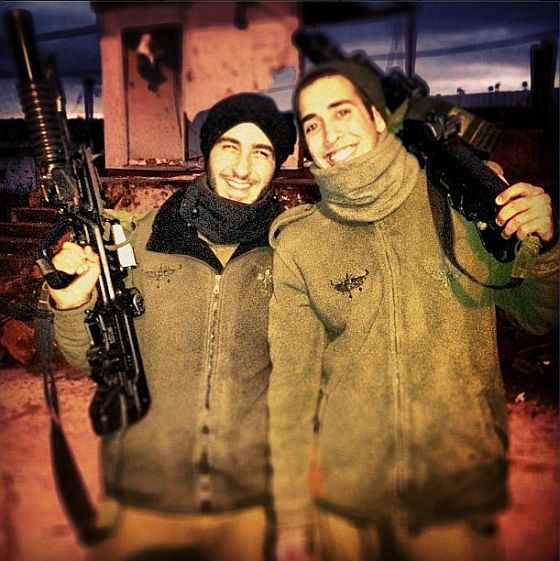
As the Instagram pictures circulating among young Israeli soldiers attest, the prospect of heading to Gaza provokes more glee than fear — and with good reason. During Operation Cast Lead in which 1,400 Palestinians lost their lives, after 20,000 Israeli soldiers entered Gaza just six were killed by enemy fire.
'We're coming for you gaza!'
For the world’s most militarized nation, the strength and invulnerability that has derived in large part from the unfettered supply of U.S. aid and U.S. commitment to ensuring Israel’s Qualitative Military Edge has provided the physical buttress to a religious conviction: that Israel is protected by God.
Ariel Siegelman, the Israeli-American soldier who features in the video above, writes:
After the Second Lebanon War, we learned some very valuable lessons. We learned that we had been living in an imaginary world and that the most dangerous type of war is the one that you call peace. We learned that we are not in fact in a ‘peace process’ at all. We are at war.
Today the question is still asked, ‘But how do we WIN?’ And that is another question coming directly from a Western mindset. There is no such thing as winning in this new kind of war. The war is ongoing, with periods of more violence and periods of less violence, during which the enemy regroups and plans his next attack. When we feel the enemy is getting strong, we must be prepared to make preemptive strikes, hard and fast at key targets, with viciousness, as the enemy would do to us. Only then can we acquire, not peace, but sustained periods of relative calm.
The lesson from Operation Cast Lead has been that Israel has no need to destroy Hamas or even prevent rocket fire from Gaza. All it needs is sustained American support — support which Obama duly provided without hesitation upon the launch of Operation Pillar of Cloud — and once every few years a new generation of Israelis can go through a rite of passage in which they are anointed as the newest members of the state’s warrior caste. Such rites of passage will remain popular among the participants and the Israeli public at large so long as Israel’s military continues to improve its ability to inflict pain without sustaining pain. Thus, while Israelis overwhelmingly support the current assault on Gaza only a minority favor sending troops in on the ground.
What American commitment to Israel’s security has done is not to protect a vulnerable state in a dangerous neighborhood, but rather to empower a sense of divinely ordained invulnerability: the sense that Israel can strike its enemies with impunity.
The successful testing of its defensive shields, rather than merely ensuring that Israelis can live without fear of attack, will inevitably lower the threshold for Israel’s own acts of aggression. The safer Israel becomes, the greater the threat it poses to everyone else.
Wasseem El Sarraj writes: The bombing started on al-Hijriyah (the first day of the Muslim New Year); I was off of work because of the associated national holidays and was looking forward to a four-day long weekend. I have since spent those four days trapped in my home, in Remal, Gaza, an affluent neighborhood inside Gaza City. I am fortunate to not be living in the border areas nor in one of the densely populated—and Hamas-affiliated—camps. None of this means I feel safe.
From the moment the bombing started I cursed the newly built shopping mall that towers over our house. Not only did it break all of Gaza’s lax zoning laws, but its owner was known to be a Hamas sympathizer: each day I have been afraid that it could be one of Israel’s bombing targets. Israel’s target list will be inspected and debated in the aftermath of this operation; at present it seems to be a mixture of rocket-launching sites, pre-identified militants, weapons caches, and then there are the “symbolic” targets. Each of which carries a different strategic calculation for Israel, but from where we sit, the symbolic targeting of government buildings is as baffling as the decision to fight homemade rockets with bombs dropped from F-16s. And all of these risk civilian casualties, the “collateral damage” that rolls much too easily off too many tongues.
In the early morning hours on Saturday, Jawazat, a large police compound just a few minutes away from my house, and next to my favorite pizzeria, was destroyed. A deceptive lull in violence followed, creating hours of silence and waiting during which we dared not venture out. I sat at home with my family, speculating about the possibility of a ceasefire agreement: our fears and our hopes revealed themselves as we began to think that our leaders might be close to reaching an agreement that would bring an end to this horror. Then, in an instant, four heart-stopping explosions, one after the other, shook our once untouchable house. As the deafening explosions subsided I tried to regain some composure; you want to be stoic when the children catch your gaze. But then I realized that it’s me who is the child; I am the one who is the war amateur. My half-brother, who is seven, and my step-brother, who is twelve, are the veterans in surviving wars, for in 2008 they survived Operation Cast Lead, Israel’s bombardment and invasion, whilst I was absent and secure in London. We were only on day three of Operation Pillar of Defense by this Saturday; my young siblings had already undergone all of this for twenty-eight days, thirty-one if you include this operation. [Continue reading…]
Robert Wright writes: President Obama and Bibi Netanyahu are on the same page when it comes to the justification for Israel’s bombardment of Gaza. Netanyahu: “No country in the world would agree to a situation in which its population lives under a constant missile threat.” Obama: “There’s no country on earth that would tolerate missiles raining down on its citizens from outside its borders.”
It’s true that if, say, Canada were lobbing missiles into the US, the US wouldn’t tolerate it. But here’s another thing the US wouldn’t tolerate: If Canada imposed a crippling economic blockade, denying America the import of essential goods and hugely restricting American exports. That would be taken as an act of war, and America would if necessary respond with force–by, perhaps, lobbing missiles into Canada.
This is the situation Gaza has faced for years: a crippling economic blockade imposed by Israel. Under international pressure, Israel has relaxed the import restrictions, but even so such basic things as cement, gravel, and steel are prohibited from entering Gaza. The rationale is that these items are “dual use” and could be put to military ends. But this logic doesn’t explain the most devastating part of the blockade–the severe restrictions on Gaza’s exports.
Gazans can’t export anything to anyone by sea or air, and there are extensive constraints on what they can export by land. They can’t even sell things to their fellow Palestinians in the West Bank. [Continue reading…]
Nathan Brown writes: Hamas has always boasted of its pragmatism. It continues to claim to be a “wasati” movement — the term means “centrist” and is used by Islamists who want to communicate their responsiveness to the interests of the public rather than their devotion to the strictest version of religious teachings. And it is clear that in the first few years after winning elections in Gaza in 2006, some Hamas leaders, confronted with intense regional pressure and a fiscal crisis, and the knowledge that they would have to face the Palestinian voters again in 2010, took initial steps in a more moderate direction.
Unfortunately, the elections they were anticipating were never held (and the primary culprits in that regard were President Mahmud Abbas who threatened constantly to use an utterly imaginary authority to dissolve the parliament and Western actors who supported him in those threats). When a Palestinian civil war erupted in June 2007, the governments in the West Bank and Gaza became more explicitly autocratic, to the detriment of Palestinians in both territories. Hardly anyone harbors expectations any longer of free elections: On those rare occasions when Hamas and the leaders of the West Bank have had half-hearted conversations about reuniting, elections haven’t been a meaningful part of the negotiations.
Any hopes since then that Hamas would moderate have been squandered. The changing regional environment after the Arab upheavals of 2011 seemed to offer brief hope that Hamas would reposition itself away from the “resistance” camp in the region and toward the camp of Islamist movements in North Africa that were dedicated to making political Islam the basis of a practicable governing system. That would have required taking reconciliation with Israel a bit more seriously, interpreting “resistance” a bit more flexibly to encompass popular mobilization more than armed action, and presenting a friendlier diplomatic face to the rest of the world. But the effort, led by Khalid Mish’al, was derailed by Hamas leaders who didn’t want to risk their hold on the government in Gaza.
There is a possible path forward out of this dreary political landscape. The most promising way to force Hamas to become more moderate is to force it to be more responsive to its own public. (As a leading Muslim Brotherhood parliamentarian in neighboring Egypt told me when I asked him whether Hamas would ever accept a two-state solution: “They will have to. Their people will make them.”) And the most promising way to ensure such responsiveness is to speed up the reconciliation between the governments in the West Bank and Gaza, so that those governments can agree to hold elections rather than jealously hold on to their own fiefdoms in a fit of paranoia. But that, in turn, will require that Israel and the international community show a greater willingness to countenance Palestinian reconciliation.