Gregory D. Johnsen writes: With the resignation of David H. Petraeus, President Obama now has a chance to appoint a new C.I.A. director. Unfortunately, one of the leading candidates for the job is John O. Brennan, who is largely responsible for America’s current flawed counterterrorism strategy, which relies too heavily on drone strikes that frequently kill civilians and provide Al Qaeda with countless new recruits. Rather than keeping us safe, this strategy is putting the United States at greater risk.
For all of the Obama administration’s foreign policy successes — from ending the war in Iraq to killing Osama bin Laden — the most enduring policy legacy of the past four years may well turn out to be an approach to counterterrorism that American officials call the “Yemen model,” a mixture of drone strikes and Special Forces raids targeting Al Qaeda leaders.
Mr. Brennan is the president’s chief counterterrorism adviser and the architect of this model. In a recent speech, he claimed that there was “little evidence that these actions are generating widespread anti-American sentiment or recruits for A.Q.A.P.,” referring to Al Qaeda in the Arabian Peninsula.
Mr. Brennan’s assertion was either shockingly naïve or deliberately misleading. Testimonies from Qaeda fighters and interviews I and local journalists have conducted across Yemen attest to the centrality of civilian casualties in explaining Al Qaeda’s rapid growth there. The United States is killing women, children and members of key tribes. “Each time they kill a tribesman, they create more fighters for Al Qaeda,” one Yemeni explained to me over tea in Sana, the capital, last month. Another told CNN, after a failed strike, “I would not be surprised if a hundred tribesmen joined Al Qaeda as a result of the latest drone mistake.”
Rather than promote the author of a failing strategy, we need a C.I.A. director who will halt the agency’s creeping militarization and restore it to what it does best: collecting human intelligence. It is an intelligence agency, not a lightweight version of Joint Special Operations Command. And until America wins the intelligence war, missiles will continue to hit the wrong targets, kill too many civilians and drive young men into the waiting arms of our enemies. [Continue reading…]
Israel must negotiate with political Islam

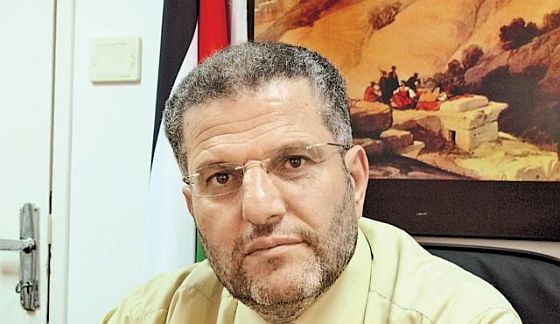
Dr Mahmoud Ramhi
Amira Hass spoke to Dr. Mahmoud Ramhi, a Hamas member of the Palestinian Legislative Council and one of the most prominent Hamas representatives in the West Bank.
Ramhi, an anesthesiologist, was released four months ago from administrative detention after being in custody for two years. He has been arrested and tried several times for belonging to Hamas, and has been in Israeli jails for a total of eight years.
“When Israel assassinated Ahmed Jabari [the Hamas military chief killed Wednesday], it knew that he was involved in negotiations with the Egyptians over a tahadiyeh [lull],” said Ramhi. “Of course it was a loss for Hamas, but ultimately, it was a slap in the face to Egypt.”
Ramhi said Israeli leaders are shortsighted.
“I find that the Israeli leadership behaves foolishly,” he said. “It sees only as far as its election. It looks at the future of the election, but doesn’t look at the future of Israel? Israel has lost all its allies in the region.”
For instance, Israel “lost Turkey as a strategic ally with its own hands, in an attack on a civilian ship,” said Ramhi, referring to the 2010 Israeli naval raid of the Mavi Marmara. “Now it’s losing Egypt. And not because [Egyptian President Mohammed] Morsi, of the Muslim Brotherhood, is in power. In Jordan the protesters are already calling, not for a decrease in gas prices, but for the downfall of the king. Israel has lost its ties with the [Palestinian] Authority, and is now losing its deterrent power, with 4 million Israelis in the line of fire. One can rightly ask how they are to blame, but by the same token we must ask how the 1.5 million Palestinians in Gaza are to blame.”
Ramhi said Israel must recognize that the recent changes in the Arab world are benefiting the Muslim Brotherhood, of which Hamas is part.
“The United States,” said Ramhi, “is smarter than Israel. It is acting in line with its interests. It started moving a bit closer to the Muslim Brotherhood, not just on the Egyptian track, but also [closer] to us, here.”
The U.S. has given a green light to Palestinian Prime Minister Salam Fayyad to bring Hamas members into the Palestinian government in the West Bank, as long as the establishment of a unity government is delayed. This means that Hamas in the West Bank is recognized as a political Islamic movement, said Ramhi. He said the proposal is still being discussed, although Hamas officials have already said, at the meeing some three weeks ago, that they want at least a year in which Hamas supporters get their political rights back: detainees are released, Hamas members fired from their jobs for political reasons get their positions back, and political activity is allowed.
Israel must begin a dialogue with political Islam if it wants to survive, said Ramhi.
“If Israel wants to continue to exist in the region, it must open a channel of political dialogue with political Islam in the area, including Hamas,” he said. “The Israelis need a leadership that knows how to negotiate with others. That can deal with others, not with arrogance or a feeling of supremacy.”
If the world will not defend the Palestinians against Israel, we have the right to defend ourselves
Mousa Abu Marzook, Deputy Chairman of the Hamas Political Bureau, writes: The latest Israeli aggression on the Gaza Strip has prompted several European countries and the US to reaffirm their position of unwavering support for the aggressor. William Hague, Britain’s foreign secretary, Cathy Ashton, the EU high representative for foreign affairs, and Barack Obama, have all claimed that Hamas’s rockets were responsible for the crisis and that it is the right of Israel to defend its citizens. Had they checked the facts, they would have realised Israel started the attacks. The escalation started when an Israeli military incursion into Gaza on 8 November killed a Palestinian child. That was followed by other Israeli incursions and attacks, provoking a response by Palestinian factions.Mousa Abu Marzook
Despite that, there were serious efforts to calm the situation and reach a truce. But clearly Israel had another agenda. By targeting Ahmed al-Jabari, leader of the al-Qassam Brigade, it sabotaged Egyptian efforts to conclude a truce between all Palestinian factions and the Israelis. This was confirmed by Egypt’s president on Saturday.
With the approach of the Israeli elections, the Israeli prime minister, Binyamin Netanyahu, wanted to trade with the blood of the Palestinians, especially after his alliance with the ultra-extremist Avigdor Lieberman failed to boost his popularity in the polls as he’d expected. This is not the first time the Israelis have launched a war for electoral gain. Shimon Peres did it to Lebanon in 1996 and the Olmert-Livni-Barak alliance did it to Gaza in 2008. What is important here is the immoral and short-sighted stance of the European and US governments; they have misconstrued the facts and displayed complete partiality in favour of the aggressor.
The western position has given political cover to the Israeli aggression and encouraged its leadership to continue their attacks. Thus, in the eyes of our people and those of the entire region, western countries are complicit. European governments, in contrast to their peoples whose majority support Palestinian rights, have demonstrated their double standards and hypocrisy again.
The human rights that Europe claims to defend all over the world are denied to the Palestinian people. European governments have done nothing while 1.7 million Gazans have been subjected for the past five years to an Israeli blockade – denying them food, water, medicine and even determining how many calories they should be allowed each day.
The right of people to resist occupation and confront aggression is guaranteed to all peoples; but if Palestinians seek to exercise this right it immediately becomes terrorism and for this they must be persecuted. [Continue reading…]
Hamas wants a fair deal — not just an end to this assault but an end to the siege of Gaza
The New York Times reports on ceasefire negotiations being brokered by the Egyptian government in Cairo. Israeli forces are poised to invade the Gaza Strip, yet in this report it is Hamas that is characterized as assuming an “aggressive stance” because it has the apparent audacity to be making some security demands — as though the only reasonable demand Hamas could make would be for Israel to suspend its current assault.
Hamas, badly outgunned on the battlefield, appeared to be trying in the talks to exploit its increased political clout with its ideological allies in Egypt’s new Islamist-led government. The group’s leaders, rejecting Israel’s call for an immediate end to the rocket attacks, have instead laid down sweeping demands that would put Hamas in a stronger position than when the conflict began: an end to Israel’s five-year-old embargo of the Gaza Strip, a pledge by Israel not to attack again and multinational guarantees that Israel would abide by its commitments.
Prime Minister Benjamin Netanyahu of Israel stuck to his demand that all rocket fire cease before the Israeli air campaign lets up, and Israeli tanks and troops remained lined up outside Gaza on Sunday. Tens of thousands of reserve troops had been called up. “The army is prepared to significantly expand the operation,” Mr. Netanyahu said at the start of a cabinet meeting.
Reda Fahmy, a member of Egypt’s upper house of Parliament and of the nation’s dominant Islamist party, who is following the talks, said Hamas’s position was just as unequivocal. “Hamas has one clear and specific demand: for the siege to be completely lifted from Gaza” he said. “It’s not reasonable that every now and then Israel decides to level Gaza to the ground, and then we decide to sit down and talk about it after it is done. On the Israeli part, they want to stop the missiles from one side. How is that?”
He added: “If they stop the aircraft from shooting, Hamas will then stop its missiles. But violence couldn’t be stopped from one side.”
Hamas’s aggressive stance in the cease-fire talks is the first test of the group’s belief that the Arab Spring and the rise in Islamist influence around the region have strengthened its political hand, both against Israel and against Hamas’s Palestinian rivals, who now control the West Bank with Western backing.
It also puts intense new pressure on President Mohamed Morsi of Egypt, a former leader of the Muslim Brotherhood who was known for his fiery speeches defending Hamas and denouncing Israel. Mr. Morsi must now balance the conflicting demands of an Egyptian public that is deeply sympathetic to Hamas and the Palestinian cause against Western pleadings to help broker a peace and Egypt’s urgent need for regional stability to help revive its moribund economy.
Israel ready to invade Gaza Strip if cease-fire efforts fail
Bloomberg reports: Israeli ground forces are poised to invade the Gaza Strip for the first time in almost four years amid efforts by Egypt and Turkey to help end exchanges of fire that have killed 96 Palestinians and three Israelis.
The decision whether to expand the Gaza operation or reach a cease-fire agreement “is rapidly approaching, and is a matter of hours, not even days,” Israeli Finance Minister Yuval Steinitz said in an interview today on Army Radio.
Air-raid sirens sounded twice in Tel Aviv yesterday as four rockets were intercepted by Israel’s Iron Dome missile-defense system. A rocket was fired at Jerusalem on Nov. 16, the first such attack in decades. At least 1,100 missiles, rockets and mortars have been fired at Israel since Nov. 14, according to the Israel Defense Forces. About 15,000 have been launched from Gaza in the past 11 years.
The escalating conflict between Israel and the Islamist Hamas movement, which controls the Gaza Strip, threatens a region still unbalanced after a wave of popular uprisings last year. Hamas is considered a terrorist group by Israel, the U.S. and the European Union.
Hamas is “mildly optimistic” about efforts to broker a cease-fire with Israel, Nabil Shaath, a senior adviser to Palestinian Authority President Mahmoud Abbas, said today in an interview. “They think negotiations are going seriously, but it’s difficult to predict when that will come to fruition,” he said, speaking in the north Sinai town of el-Arish.
Israeli air strikes inflict bitter toll on Gaza children
The Guardian reports: At least 11 members of one family, including five women and four children, were killed when Israel bombed a house in Gaza City on Sunday as the five-day-old war claimed more civilian lives with no sign of a let-up in the intense bombardment.
The air strike flattened the home of the Dalou family in the Sheikh Radwan district of Gaza City, causing the biggest death toll in a single incident since the offensive began last Wednesday.
On Monday morning the Israeli defence force appeared to admit the family had been killed by mistake. The Haaretz website quoted the army as saying their house was either incorrectly pinpointed or a missile malfunctioned.
Elsewhere in the city early Monday an air strike levelled two houses belonging to a single family, killing two children and two adults and injuring 42 people, including children, said Gaza heath official Ashraf al-Kidra. Rescue workers were frantically searching for 12 to 15 members of the Azzam family under the rubble. Shortly afterwards, Israeli aircraft bombarded the remains of the former national security compound in Gaza City. Al-Kidra said flying shrapnel killed one child and wounded others living nearby.
After the Dalou family home was destroyed, the bodies of the children were pulled from the rubble and taken to the morgue at Shifa hospital. The dead also included an 80-year-old woman.
Ismael Haniyeh, the Hamas prime minister, described the deaths as an “ugly massacre” and the Hamas military wing, al-Qassam Brigades, said: “The massacre of the Dalou family will not pass without punishment.”
Diggers at the scene of the explosion were scooping rubble from flattened buildings as rescuers tried to locate survivors.
Witnesses said there were chaotic scenes as the dead and injured were brought to the Shifa hospital, which has been on emergency footing since the start of Operation Pillar of Defence.
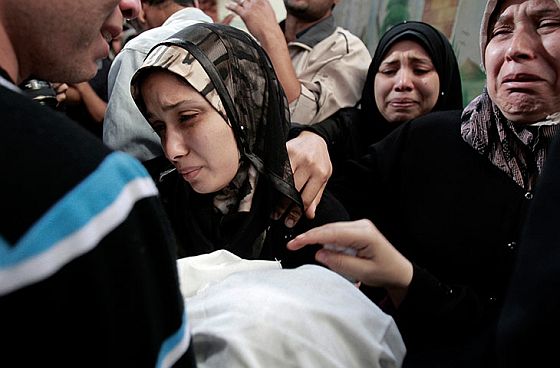
The bodies of four young children lay on two metal trays in the morgue, covered in dust and blood. A crowd of onlookers outside became increasingly distressed as the body of the children’s mother was wheeled in, covered in blankets.
The strike was originally thought to have been aimed at a Hamas official, Mohamed Dalou.
In all, 84 Palestinians, about half of them civilians, have been killed in the five-day onslaught and 720 have been wounded. Three Israeli civilians have died from Palestinian rocket fire and dozens have been wounded.
An American rabbi’s outrage at Israel’s assault on Gaza

The parents of an 11-month-old child, Omar Misharawi, killed in an Israeli strike hold his body at his funeral in Gaza City.
Rabbi Brant Rosen writes: Israel’s military assault on Gaza in 2008-09 represented an important turning point in my own relationship with Israel. I recall experiencing a new and previously unfamiliar feeling of anguish as Israel bombarded the people living in that tiny, besieged strip of land over and over, day after day after day. While I certainly felt a sense of tribal loyalty to the Israelis who withstood Qassam rocket fire from Gaza, I felt a newfound sense of concern and solidarity with Gazans who I believed were experiencing nothing short of oppression during this massive military onslaught.
And now it’s happening again. Only this time I don’t think the term “anguish” quite fits my mindset. Now it’s something much closer to rage.
It’s happening again. Once again 1.7 million people, mostly refugees, who have been living in what amounts to the world’s largest open air prison, are being subjected to a massive military assault at the hands of the world’s most militarized nation, using mostly US-made weapons. And our President is not only looking on – he is defending Israel’s onslaught by saying it has a right to “self-defense in light of the barrage of rocket attacks being launched from Gaza against Israeli civilians.”
Let’s be clear: this tragedy didn’t start with the Qassams. It didn’t start with the election of Hamas. And it didn’t start with the “instability” that followed Israel’s withdrawal from Gaza.
No, this is just the latest chapter of a much longer saga that began in 1947-48, when scores of Palestinians were ethnically cleansed from their cities and villages in the coastal plain and lower Galilee and warehoused in a tiny strip of land on the edge of the Mediterranean. [Continue reading…]
Voices of Israel: ‘The people demand war’
On November 15 some anti-war organizations held an anti-war demonstration in Tel Aviv against the latest massacre in Gaza. This is some footage from the counter demonstration. The bearded man giving a speech in this video is Michael Ben Ari, an Israeli Knesset member.
Gilad Sharon: ‘Flatten all of Gaza’
In the Jerusalem Post, Gilad Sharon, son of former Israeli prime minister Ariel Sharon, writes: Why do our citizens have to live with rocket fire from Gaza while we fight with our hands tied? Why are the citizens of Gaza immune? If the Syrians were to open fire on our towns, would we not attack Damascus? If the Cubans were to fire at Miami, wouldn’t Havana suffer the consequences? That’s what’s called “deterrence” – if you shoot at me, I’ll shoot at you. There is no justification for the State of Gaza being able to shoot at our towns with impunity. We need to flatten entire neighborhoods in Gaza. Flatten all of Gaza. The Americans didn’t stop with Hiroshima – the Japanese weren’t surrendering fast enough, so they hit Nagasaki, too.Gilad Sharon
There should be no electricity in Gaza, no gasoline or moving vehicles, nothing. Then they’d really call for a ceasefire.
Were this to happen, the images from Gaza might be unpleasant – but victory would be swift, and the lives of our soldiers and civilians spared.
If the government isn’t prepared to go all the way on this, it will mean reoccupying the entire Gaza Strip. Not a few neighborhoods in the suburbs, as with Cast Lead, but the entire Strip, like in Defensive Shield, so that rockets can no longer be fired.
There is no middle path here – either the Gazans and their infrastructure are made to pay the price, or we reoccupy the entire Gaza Strip. Otherwise there will be no decisive victory. And we’re running out of time – we must achieve victory quickly. The Netanyahu government is on a short international leash. Soon the pressure will start – and a million civilians can’t live under fire for long. This needs to end quickly – with a bang, not a whimper.
Up w/ Chris Hayes: Israel and Gaza
Visit NBCNews.com for breaking news, world news, and news about the economy
Bradley Manning deserves Americans’ support for military whistleblowing
Desmond Tutu, Mairead Corrigan-Maguire and Adolfo Pérez Esquivel write: Last week, PFC Bradley Manning offered to accept responsibility for releasing classified documents as an act of conscience – not as charged by the US military. As people who have worked for decades against the increased militarization of societies and for international cooperation to end war, we have been deeply dismayed by his treatment. The military under the Obama administration has displayed a desire to over-prosecute whistleblowing with life-in-prison charges including espionage and “aiding the enemy”, a disturbing decision which is no doubt intended to set an example.
We have dedicated our lives to working for peace because we have seen many faces of armed conflict and violence, and we understand that no matter the cause of war, civilians always bear the brunt of the cost. With today’s advanced military technology and the continued ability of business and political elites to filter what information is made public, there exists a great barrier to many citizens being fully aware of the realities and consequences of conflicts in which their country is engaged.
Responsible governance requires fully informed citizens who can question their leadership. For those citizens worldwide who do not have direct, intimate knowledge of war, yet are still affected by rising international tensions and failing economies, WikiLeaks releases attributed to Bradley Manning have provided unparalleled access to important facts.
Revealing covert crimes in Iraq and Afghanistan and corporations’ pervasive influence in governance, this window into the realities of modern international relations has changed the world for the better. While some of these documents may demonstrate how much work lies ahead in terms of securing international peace and justice, they also highlight the potential of the internet as a forum for citizens to participate more directly in civic discussion and creative government accountability projects. [Continue reading…]
Hamas, Gaza, and the Arab Spring — an interview with Mark Perry

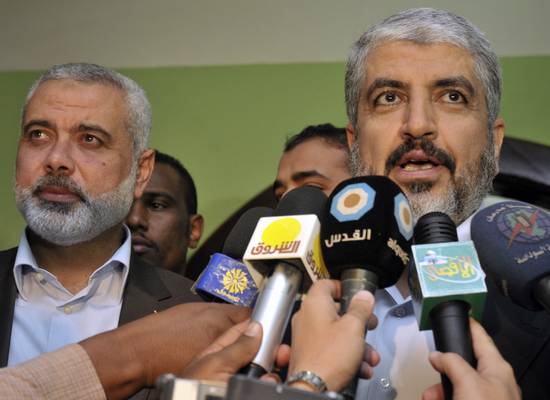
Ismail Haniyah and Khaled Meshaal
No one in Washington has a better understanding of Hamas than Mark Perry. He’s been in communication with the Palestinian resistance movement’s leadership for much of the last two decades.
As bombs rain down on Gaza we are again reminded of the ruthlessness with which Israel controls and takes away the lives of Palestinians, but at such a juncture there seems to be all the more reason to try and understand Israel’s nemesis in Gaza. This morning I posed a few questions to Mr Perry that, at least to my mind, seem to have been left out from much of the analysis of the current conflict.
Paul Woodward: As the latest Israeli assault on Gaza has unfolded, there has been a considerable amount of speculation about how this plays into Benjamin Netanyahu’s political calculations as he approaches elections in Israel due to take place in January. Much less has been said about the political contest currently taking place inside Hamas. Can you describe that contest and talk about how this might have affected the choices being made by the Hamas leadership inside Gaza?

Mark Perry
The disagreement surfaced in August of last year when Hamas signaled its disapproval of Bashar Assad’s handling of the Syrian uprising by refusing to mount demonstrations among Palestinians in Syrian on his behalf. The movement then moved its headquarters from Damascus. Mr Haniyeh took exception to this decision and criticized the politburo for their actions. Then, in February, Meshaal and Haniyah had a confrontation over Haniyah’s decision to travel to Tehran to show “solidarity” with the “Axis of Resistance.” Meshaal attempted to dissuade him from making the visit. Haniyah attended the conference, but his subsequent visit to other Arab capitals, was not a success. They signaled their disapproval of his views, allowing him to meet with only minor officials.
Haniyah also strongly disagreed with Meshaal’s handling of the reconciliation negotiations with Mahmoud Abbas. Meshaal took a more moderate line with Fatah than his Gaza colleagues, believing the continued divisions between the two movements could become permanent — and fatal to the Palestinian national cause. Haniyah accused him of making unilateral decisions without seeking consensus among his colleagues.
While it’s difficult to know exactly how this has played out on the ground in the recent crisis, Haniyah and his allies have worked to strengthen their claims of being the most credible leaders of Palestinian resistance — a claim that has been enhanced by Israel’s recent offensive. Ironically, or perhaps not (especially for those of us who follow this kind of thing), Israel singled out for assassination a Hamas leader in Gaza who was closer to Meshaal’s vision than Haniyeh’s. That is to say: Israel’s assassination strengthened Hamas’s radical wing. But then, perhaps, “they shall have wars, and pay for their presumption.”
Woodward: With the Muslim Brotherhood now in power in Egypt, why has the border with Gaza remained mostly closed?
Perry: I have a tentative and unsatisfactory answer. The Sinai is a security mess for Egypt’s new government, their economy is in crisis, the salafist current remains remarkably resilient, the Gaza leadership remains unpredictable and the last thing that President Morsi needs is a fight with Israel. Morsi is not Mubarak, he supports the Palestinian cause. But just now, he prefers quiet. He gets that by controlling the border, not throwing it open. And without stability, Egypt’s economy will be finished — and so will he.
Woodward: Qatar just promised to invest $400 million in Gaza. It looks like that probably won’t be enough to even cover the cost of the damage from Israel’s latest airstrikes. As much as the Qataris along with Hamas’s other nominal allies might voice their support for the Palestinian resistance, do you think the latest violence will make it more difficult for Hamas to secure financial support?
Perry: Hamas has made its choice. It had to choose between Assad and the Syrian people, and it chose the Syrian people. It had to choose Iran’s money or its own principles, and it chose its principles. It did this long before Qatar came to its aid. This is not the hallmark of a radical group bent on violence and terror. It is the sign of a mature political movement that represents the best interests of the Palestinian people.
We need to recognize what has happened in the Arab world — both within Arab governments as well as inside its most important political movements. The Arab Spring has taken hold, top to bottom, through all of these societies. Hamas’s leadership, to their credit, has responded to these changes by adopting policies in line with the views of the vast majority of their people: for accountability and transparency. This is not a perfect organization led by charm school graduates, but it is capable of making rational and politically mature decisions.
This pragmatism and maturity is not a secret to other regional leaders. Khaled Meshaal is welcome in Ankara, Cairo and Doha — where his views are solicited. Israelis read his speeches and talk to his followers: by arresting them in order to do so. I believe that he, and the people around him, hold the key to resolving the longest standing and most intransigent conflict in the region.
In Iraq, our senior military commanders determined that we could “not shoot our way to victory” and shaped a political opening to the insurgency. In so doing, we extracted ourselves from a divisive, bankrupting and spirit sapping war. Why not do that now? We can maintain our strong support of Israel, but we should not allow them to hold our interests in the region, and our friendship with badly needed Arab allies, hostage to their decisions.
My belief is that, when this crisis subsides, Arab governments will throw money at Hamas.
Woodward: Having severed its ties to Syria, how much support does Hamas still get from Iran?
Perry: The shift away from Iran has been significant. The last monetary support that Hamas received from Iran was in March. The movement then announced that they would not be a party to any future Iranian-Israeli conflict.
You hear all the time that Hamas is an Iranian proxy. It’s not true. And it’s not true when it comes to Hamas’s rocket arsenal. I am very skeptical of reports about Hamas’s capabilities. Let’s not kid ourselves, compared to Israel, their weapons are primitive. Hamas has reportedly received Fajr 3 and Fajr 5 rockets from Iran smuggled through the Sudan. I assume the reports are reliable, but even so Hamas has no more than 70 to 100 of them, and probably fewer now.
No one is denying that a rocket fired from Gaza is lethal. But the idea that Hamas is specifically targeting Israeli civilians with these rockets is preposterous. The rockets have no sophisticated guidance systems, but are cobbled together in Gaza workshops from parts received elsewhere, stuck into tubes and then “fired in the general direction” of Israel.
Woodward: Beyond the goal of survival, what do you think Hamas’s aims are right now?
Perry: To retain and strengthen its position as the premier Palestinian political movement. But its moderate leadership knows this can only be done by successfully forging a reconciliation agreement with Fatah, while recognizing the finality of the Arab Spring — which has swept aside governments that failed to reflect and meet the needs of their people. Khaled Meshaal and his allies inside of the Hamas political bureau know that without increased transparency, and a free, fair and open exchange of ideas among and between its younger and aspiring supporters, the vision of a free Palestine cannot be met.
Woodward: Do you think that the Hamas leadership in Gaza are currently acting in the interests of the local population?
Perry: No.
Woodward: Are missiles aimed at Tel Aviv and Jerusalem advancing Hamas’s cause or are its military and political wings currently undermining each other?
Perry: Supporters of Palestinian freedom should not allow their beliefs to blind them to the realities of Palestinian politics. A police state is a police state: whether it is enforced by Abu Mazen’s American trained NSF [National Security Force] in the West Bank, or Hamas gunmen in Gaza. I am not a Palestinian and have no say in how Palestinians choose to govern themselves. But that they have a right to govern themselves is not in question. Free, fair and open elections, the right to dissent, freedom of speech and the right to petition your leaders for a redress of grievances are not American ideas, but universal principles. Abu Mazen needs to open his jails. So too does Ismail Haniyah.
Critics of that position will respond that my views do not take into account the vicious and ongoing oppression of the Palestinians by Israel — or the continuing siege of Gaza imposed by a ruthless Israeli leadership that vowed, openly, to put the people of Gaza “on a diet.” They’re wrong. I have seen the suffering first hand. But the “freedom can wait until the revolution is won” crowd are the same people who support Bashar Assad. A right postponed is a right denied. It is not a contradiction to support the right of the Palestinian people to defend themselves while advocating that their leaders recognize and respond to their needs.
Are Hamas’s military and political wings undermining each other? Ironically, again, Israel’s latest operation has actually accomplished the impossible — it has stitched together a divided leadership and people around a common cause. Abu Mazen, Ismail Haniyah, Salam Fayaad and Khaled Meshaal have different strategies for gaining Palestinian freedom. But when it comes to defending their own people, those divisions and differences disappear. As they have now.
—
Mark Perry is a Washington-based author and reporter. His most recent book is Talking To Terrorists. His forthcoming book (Basic Books, 2013) is a study of the relationship between President Franklin Roosevelt and General Douglas MacArthur. Perry served as an unofficial advisor to PLO Chairman and Palestinian President Yasser Arafat from 1989 to 2004.

Obama backs Israel’s use of disproportionate force in Gaza
Reuters reports: U.S. President Barack Obama said on Sunday he fully supported Israel’s right to defend itself and called for an end to the firing of missiles into Israel by militants inside Gaza in order for a peace process to go ahead.
“There’s no country on earth that would tolerate missiles raining down on its citizens from outside its borders,” he said. “We are fully supportive of Israel’s right to defend itself.”
If the right of self-defense is not being exercised, it is recognized as a universal principle that applies to individuals and states, including Israel. But when President Obama expresses his support for Israel’s right to defend itself at this time, the principle cannot be divorced from the means through which it is being applied. Only those who choose to obscure the facts speak about Israel’s rights without questioning its methods of defense.
When ‘self-defense’ is used as a license for the use of disproportionate force, the transition has been crossed from defense to aggression and those who voice their support for Israel’s right to defend itself become accessories to Israel’s crimes.
The Institute for Middle East Understanding has put together a useful fact sheet on Israel’s use of disproportionate force which makes clear that this is a doctrine that guides Israel’s military operations — not merely the outcome of unpredictable escalation in the heat of conflict.
Since November 14, when Israel assassinated Hamas leader Ahmed Jabari, further escalating an already bloody week that began with the killing of a 12-year-old Palestinian boy during an Israeli raid on November 8, at least 52 Palestinians have been killed in Gaza, including at least 16 civilians, ten children among them. During the same period, three Israeli civilians have been killed in southern Israel.
This disparity in civilian casualties is representative of a historic pattern, with a disproportionate number of Palestinian and other Arab civilians killed and wounded in virtually every phase of the conflict since Israel’s creation in 1948.
Although Israeli officials stress that the Israeli military carries out “surgical strikes” and goes to great lengths to avoid civilian casualties, evidence documented by human rights organizations shows that Israel has repeatedly and deliberately used disproportionate force – a war crime – as a tactic to kill enemy fighters, minimize the risk of injury to Israeli soldiers during military operations, and to establish “deterrence.” In recent years, the Israeli military has formulated this as the “Dahiya Doctrine.”
To put the casualty figures of the current violence into context, the IMEU offers the following fact sheet on Israel’s use of disproportionate force and an overview of Palestinian and Israeli casualty figures since the First Intifada.
FACT SHEET: THE “DAHIYA DOCTRINE” & ISRAEL’S USE OF DISPROPORTIONATE FORCE
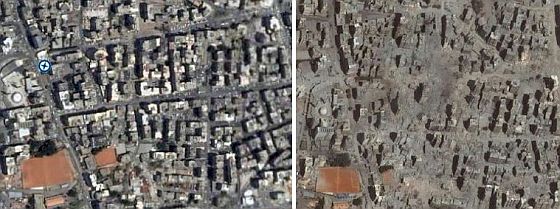
- A central tenet of Israeli military policy is “deterrence.” This is embodied in the so-called “Dahiya Doctrine,” which dictates the use of overwhelming and disproportionate firepower and the targeting of government and civilian infrastructure during military operations. It received its name from the Dahiya neighborhood of Beirut, a stronghold of Hezbollah, which Israel destroyed almost completely during its assault on Lebanon in the summer of 2006.
- In October 2008, Gabi Siboni, Director of the Military and Strategic Affairs Program at Tel Aviv University’s Institute for National Security Studies (INSS), a quasi-governmental think tank with close ties to the Israeli political and military establishments, published a policy paper entitled “Disproportionate Force: Israel’s Concept of Response in Light of the Second Lebanon War.” It stated:
‘With an outbreak of hostilities [with Hezbollah], the IDF will need to act immediately, decisively, and with force that is disproportionate to the enemy’s actions and the threat it poses. Such a response aims at inflicting damage and meting out punishment to an extent that will demand long and expensive reconstruction processes.
‘Israel’s test will be the intensity and quality of its response to incidents on the Lebanese border or terrorist attacks involving Hezbollah in the north or Hamas in the south. In such cases, Israel again will not be able to limit its response to actions whose severity is seemingly proportionate to an isolated incident. Rather, it will have to respond disproportionately in order to make it abundantly clear that the State of Israel will accept no attempt to disrupt the calm currently prevailing along its borders. Israel must be prepared for deterioration and escalation, as well as for a full-scale confrontation. Such preparedness is obligatory in order to prevent long term attrition.’

Dahiya, Beirut, before and after Israel's 2006 carpet bombing.
Issandr El Amrani writes: The Obama administration is asking regional powers to help restrain Hamas but they won’t restrain Israel. It claims to be for de-escalation but will not urge it. De-escalation might work if on one side the Arabs and Turkey use their influence on Hamas to end the rocket fire, and on the other the Europeans and Americans use their influence in Israel to end its missile, bomb and aircraft attacks and urge them not to carry out ground operations that would make this even more deadly.
It’s not even a question of changing their position towards Hamas. It’s a question of making it clear that a ground invasion will lead to the same catastrophic results as during Cast Lead and will further sour the regional scene the interests of all concerned.
But this ever-more-disappointing president can’t even bring himself or his advisors to say they would oppose such a development or urge Israel to forego ground operations.
Pathetic — and a signal to the Egyptians, Turks and others that there is no business to be done with this administration.
How Obama has failed his own supporters
In “An open letter to the President from a bereaved sister,” Abby Okrent writes:
Dear Mr. President,
My younger brother was an early believer in you. He worked for your Senate campaign. At the age of 25, he ran the GOTV campaign in North Carolina, delivering an improbable victory for you in a Southern state that helped give you your first term. This year, slightly less bright-eyed but nonetheless a believer, he was working on your campaign again when he died suddenly, a brilliant, energetic 29 year old, dead in his tracks. You know this. You called my parents. Your campaign, to my greatest appreciation and respect, brought grief counselors for his coworkers, dedicated a corner of the office and much of your fundraising efforts to him, and bussed his coworkers to join the hundreds of others at his funeral.
You may not know that after his sudden passing, many of his friends quit their jobs, moved, changed their lives to continue working on your campaign in his memory. One of these friends ran your GOTV effort in Ohio, delivering a close swing state that resulted in the race being called for you early. My mom and I joined these efforts in Ohio, door-knocking until right before the polls closed, pounding the pavement in Alex’s memory and in hopes of your next presidency. Despite my disappointment in some of your stances, I proudly kept my Ohio for Obama sticker on my jacket.
Until yesterday. Mr. President, when the bombs began raining on Gaza again and you reiterated Israel’s “right to defend itself”, I took that sticker off my jacket. Later, you called Prime Minister Netanyahu and asked him to “use restraint,” as though he were a glutton at a feast, rather than an elected official of a powerful military nation, using your own country’s weaponry to engage in a one-sided assault. Mr. President, you are the most powerful man in the world. You do not need to politely request anything of Mr. Netanyahu; you can stop him by ending U.S. military aid to Israel until Israel complies with international and U.S. law. Mr. Netanyahu and his right-wing allies in the U.S. actively campaigned against your re-election, assuming that Governor Romney would be better positioned to give them carte blanche to violate Palestinian human rights and start regional wars. It is not to them that you now need to prove your allegiance, but to we the people who knocked doors for you, who made phone calls for you, who died getting you this 4 years more of opportunity. [Continue reading…]
The ongoing failure of Israel’s military thinking
Yagil Levy writes: Israel assassinated its subcontractor, the one who took care of its security in the Gaza Strip, Aluf Benn says in a Haaretz article (November 14 ) about the killing of Hamas’ military chief, Ahmed Jabari. Indeed. Israel has done it again. Its history is fraught with the overuse of military force that has weakened the sovereignty of political entities with which it could have crystallized the rules of the game to improve its security. And the more these entities were weakened, the more Israel escalated its hits and weakened them still further.
In the same way, during its first years of statehood Israel weakened the regimes in Egypt and Jordan, which had tried to seal their borders against the penetration of infiltrators. Israel was not satisfied with this and hit them hard with retaliatory raids. The regimes did not collapse: Egypt sought an alliance with the Soviet Union, which merely weakened Israel’s security; Jordan was saved by the pressure the West brought to bear on Israel. Had these regimes been weakened even further, the borders with them would have been even less secure.
In the 1970s, similar reasoning led Israel to strengthen its reactions to hostile acts on the part of Palestinian organizations from Lebanon. Thus it contributed to the weakening of Lebanese sovereignty and later to its disintegration and the formation of a Palestinian ministate in southern Lebanon. And when this ministate grew stronger and was successfully holding back activities against Israel, the latter attacked it without any pretext, during the first Lebanon war in 1982. Once again, a political and military vacuum was created which drew Israel into a bloody war of attrition.
After Israel’s gradual withdrawals, a ministate led by Hezbollah was formed in southern Lebanon, which stuck to the rules of the game and maintained quiet on the northern border between 2000-2006. But Israel also wished to destroy this entity without reason, and without sufficient pretext, in the Second Lebanon War. Fortunately, military weakness prevented a diplomatic failure that would have been created had this entity indeed disintegrated and southern Lebanon turned into a no-man’s-land.
The same process took place in areas overseen by the Palestinian Authority. The gradual escalation in Israel’s reaction to the events of the second intifada led to the collapse of the PA which, between 1996 and 2000, had effectively thwarted terror against Israel – to a large extent thanks to Israel’s contribution toward strengthening it. After its collapse, terror grew stronger and it was only the rebuilding, however limited, of the PA in the West Bank that contributed to restraining it from 2005.
The weakening of the PA contributed to the growth of the Hamas ministate in the Gaza Strip. But just as it created the infrastructure that made it possible to restrain the other armed organizations in Gaza – and to ensure relative quiet in the south – Israel once again took steps to weaken it through actions that eroded Hamas’ sovereignty (for example, the security strip inside Gaza ), to say nothing of the economic blockade. And now the assassination of Jabari, the most effective military leader in Gaza, will merely weaken the sovereignty of Hamas and strengthen its rivals.
When military thinking is paramount, diplomatic possibilities are pushed to the sidelines – such as the assumption that sometimes it is worthwhile working toward bolstering the sovereignty of the rival. Because the stronger its military and political infrastructure becomes, so its responsibility to the population under its control increases its interest in tranquillity. The rival translates this tranquillity into activities for the good of its citizens, which in turn strengthen its legitimacy and thus also its ability to impose authority on the armed organizations.
The bolstering of the sovereignty is achieved in different ways, including military forbearance. Ignoring this logic leads to military action, which does not take into account the fact that the overuse of force will lead to the opposite result from the one hoped for. That is what is happening now.
Video: Al Jazeera reporters on Gaza-Israel conflict
Israeli air strikes hit media centres in Gaza City
The Guardian reports: Israeli military planes struck two media headquarters in Gaza City in the early hours of Sunday morning, injuring six people including a cameraman, who lost a leg.
A number of media organisations are based in the al-Shawa building, including al-Quds television, which is associated with Islamic Jihad. Khader al-Zahhar, a cameraman with al-Quds TV, had his leg amputated as a result of injuries sustained in the attack.
A second air strike struck another media complex in the city, the al-Shuruq building. It houses Sky News, the al-Arabiya news network, Dubai TV and an office of al-Aqsa TV, which is affiliated with Hamas.
Sky News reporter Sam Kiley was sleeping in the offices when the missile struck shortly before 7am. “The missile hit the floor above us. There was a big flash of light and the sound of breaking glass.”
In a statement, the Israeli Defence Forces said: “A communications antenna used by Hamas to carry out terror activity against the state of Israel, was … targeted.” [Continue reading…]
Egypt’s political forces call on Morsi to ‘freeze’ all relations with Israel
Al Ahram reports: Egypt’s political forces, including the majority Freedom and Justice Party (FJP), demand the Egyptian government and president immediately move to revise the Egypt-Israel Peace Treaty amid Israel’s ongoing onslaught on the Gaza Strip.
They also call on the Arab League to activate the joint Arab Defence Treaty and for the Egyptian government and all Arab and Islamic governments to take immediate punitive action to stop Israel’s sustained attack on Palestinians in Gaza.
After nearly five hours of discussions at the headquarters of the FJP, during a meeting dubbed “Emergency parties meeting to support Gaza,” a lengthy joint statement was issued by all attendees.
The statement began by expressing condolences for the martyrs of Gaza killed in the Israeli assault that it described as a flagrant violation of international law and charters.
FJP President Mohamed Saad Al-Katatni, who headed the meeting, read the statement: “Revolutionary Egypt is no longer a strategic treasure for the enemy and is now biased to and supportive of Arab citizens everywhere, especially the Palestinians. Political parties and forces call on the Egyptian government to take concrete steps to stop the Zionist assault on the besieged Palestinian people in the Gaza Strip. They welcomed President Mohamed Morsi’s decision to withdraw Egypt’s ambassador from the occupation state.”
Political forces also called on Morsi to “freeze all relations with the Zionist entity, whether diplomatic, political, economic or security, and leave the Rafah border crossing permanently open. They urge Arab and Islamic governments and international organisations to take punitive measures against the Zionist enemy to end the assault on Gaza,” according to the statement.