The Guardian reports: A bomb exploded outside the gates of the US consulate in Libya’s second city, Benghazi, on Tuesday night, in the first attack on an American diplomatic target in the country since the fall of Gaddafi.
There were no casualties reported and the explosion caused damage to the surrounding wall but a US embassy spokesman in Tripoli said they were still waiting for a full damage assessment.
He said the culprits were unknown but that security has been tightened around US diplomatic missions in both Benghazi and the capital, Tripoli.
“The United States deplores the attack on the mission in Benghazi,” said the spokesman. “We want a full investigation.”
Suspicion will fall on jihadist militias operating in the eastern Libyan city, who came to prominence in April when they were filmed using hammers to smash tomb stones and monuments at the Commonwealth Graves cemetery in the city.
After the senior al Qaeda leader, Abu Yahya al-Libi, was assassinated in a drone attack on Monday, Noman Benotman, a former senior member of the Libyan Islamic Fighting Group (LIFG) who spent significant time with al-Libi in the 1990s, spoke to CNN. Benotman says that al-Libi had significant influence with al Qaeda in the Islamic Maghreb (AQIM), al Qaeda’s North African affiliate. CNN reported: “With his death, it is possible there may be a backlash by pro al Qaeda forces in Libya. According to several sources, al Qaeda has developed a presence in eastern Libya, where it has recruited and trained several hundred fighters.”

CNET reports: Google hasn’t been shy about wagging its finger at China recently. And in what appears to be another veiled snipe at Chinese authorities, the tech company says it is now warning users if state-sponsored phishing or malware attacks appear to have targeted their Gmail accounts.
“We are constantly on the lookout for malicious activity on our systems, in particular attempts by third parties to log into users’ accounts unauthorized,” Eric Grosse, vice president of security engineering at Google, wrote in a blog post today. “When we have specific intelligence — either directly from users or from our own monitoring efforts — we show clear warning signs and put in place extra roadblocks to thwart these bad actors.”
In such cases, a notice will appear at the top of the Gmail page that says “Warning: We believe state-sponsored attackers may be attempting to compromise your account or computer.”
If that warning appears, it doesn’t mean the account was successfully hijacked. It just means that the account appears to have been a target, and that Google is urging the account holder to change the password and set up additional security precautions.
Most people who use Google are confused about what Google is — they think it’s a search engine. It’s not. It’s a digital platform that connects advertisers to consumers. Access to consumers is the ‘product’ that Google sells. So when the company introduces a new security feature such as this new hacking warning, we should keep in mind that rather than this simply being some public spirited effort to protect the interests of Google’s users, more likely it’s also been conceived as a gambit intended to serve Google’s commercial interests. It will serve those interests by fostering a sense among users and potential users, that gmail is more secure than it probably is.
If, as will be the case for the vast majority of people who check their gmail accounts, no warning message appears about state-sponsored hacking, does that imply that ones account is secure? I don’t think so. It might not currently be subject to phishing or malware attacks from the Chinese or any other foreign government, but does that also mean that the prying eyes of the NSA are being kept out? Not according to NSA whistleblower William Binney.

Haaretz reports: U.S. President Barack Obama told a delegation of the U.S. Orthodox Jewish community at the White House on Tuesday that his administration is decidedly more attentive to Israel than it is to the Palestinians.
Obama was speaking at a meeting between White House Chief of Staff Jack Lew and leaders of the Orthodox Jewish community, including Dr. Simcha Katz, Rabbi Steven Burg and Nathan Diament of the Orthodox Union.
Meeting participants who wished to remain nameless told Haaretz that the delegation asked Obama what lessons he has learned from events related to the Israel-Palestine peace process, and that the U.S. president said that it is very difficult, and that there are many possibilities for misunderstanding. There is only tension because both sides feel pressured to compromise, he said.
Obama also said that he understands the Prime Minister Benjamin Netanyahu wants no restraints, like the leader of any country. He assured his guests that he and Netanyahu get along well on a personal level – but that Netanyahu does not want to appear weak.
Miko Peled writes: In early June 1967, as I cowered with my mother and sisters in the “safest” room of our house near Jerusalem — the downstairs bathroom — we feared the worst. None of us imagined that the war that had just begun would end in six days. It was inconceivable that the Israeli army would destroy three Arab armies, kill upward of 15,000 Arab soldiers (at a cost of 700 Israeli casualties), triple the size of the state of Israel and, for the first time in two millenniums, give the Jewish people control over the entire land of Israel, including the crown jewel, the Old City of Jerusalem.
Many believe now, as they believed then, that Israel was forced to initiate a preemptive strike in 1967 because it faced an existential threat from Arab armies that were ready — and intending — to destroy it. As it happens, my father, Gen. Matti Peled, who was the Israel Defense Forces’ chief of logistics at the time, was one of the few who knew that was not so. In an article published six years later in the Israeli newspaper Maariv, he wrote of Egypt’s president, who commanded the biggest of the Arab armies: “I was surprised that Nasser decided to place his troops so close to our border because this allowed us to strike and destroy them at any time we wished to do so, and there was not a single knowledgeable person who did not see that. From a military standpoint, it was not the IDF that was in danger when the Egyptian army amassed troops on the Israeli border, but the Egyptian army.” In interviews over the years, other generals who served at that time confirmed this, including Ariel Sharon and Ezer Weitzman.
In 1967, as today, the two power centers in Israel were the IDF high command and the Cabinet. On June 2, 1967, the two groups met at IDF headquarters. The military hosts greeted the generally cautious and dovish prime minister, Levi Eshkol, with such a level of belligerence that the meeting was later commonly called “the Generals’ Coup.” [Continue reading…]
The New York Times reports: Former President Hosni Mubarak’s health has deteriorated so sharply since he was sentenced to life in prison on Saturday that the authorities are close to a decision to return him to a hospital outside the penal system, Interior Ministry officials said on Wednesday
Before his sentencing, Mr. Mubarak had been confined to hospitals but not jailed. Relocating Mr. Mubarak, 84, would stoke five days of street protests over the verdicts handed down against him and several top security officials last weekend in a trial for corruption and the killing of protesters.
On Wednesday, the state news agency said that Mr. Mubarak had suffered several heart attacks, a nervous breakdown, high blood pressure and severe depression since his transfer to a prison hospital. He was in the hospital’s intensive care unit and on a ventilator, the state news agency said.
Security officials said Wednesday that an Interior Ministry medical committee had examined him and recommended moving him to a military hospital or other medical center.
An extraordinary crowd of tens of thousands flooded central squares of the capital and other cities Tuesday night in scenes rivaling the early days of the protests that brought him down. And the outrage has become a powerful but unpredictable variable in the runoff set for June 16 and 17 to decide Egypt’s first competitive presidential election in which Mr. Mubarak’s last prime minister, Ahmed Shafik, faces Mohamed Morsi of the Muslim Brotherhood, Egypt’s largest Islamist group.
The Transit of Venus was reminder of what a tiny speck of rock we live upon. A third of the way closer to the Sun than we are, our sister speck is only slightly smaller than the Earth.
The campaign to eliminate al Qaeda certainly appears to be building up to some kind of “mission accomplished” moment.
Will that come when Ayman al-Zawahiri is assassinated? And will it come just as the November U.S. presidential election approaches?
It’s hard not to get the distinct impression that President Obama is itching to claim the political reward of being able to declare that al Qaeda has been defeated.
Obama’s latest trophy is the killing of Abu Yahya al-Libi who CNN’s Paul Cruickshank says “is universally admired in jihadist circles and among the younger generation of al Qaeda leaders. Charismatic, intelligent, a religious scholar – and with the extra qualification of having escaped from U.S. custody in Afghanistan – his loss is ‘a cataclysmic blow’ to al Qaeda, according to analysts who follow the group.”
Leah Farrall questions that conclusion.
I wonder if those who think this is a victory (and those supporting the strategy of extrajudicial killings more generally) have given ample thought to the fact that he along with others who have been assassinated were actually a moderating force within a far more virulent current that has taken hold in the milieu. And yes, given his teachings I do note a certain irony in this, but sadly, it’s true.
What is coming next is a generation whose ideological positions are more virulent and who owing to the removal of older figures with clout, are less likely to be amenable to restraining their actions. And contrary to popular belief, actions have been restrained. Attacks have thus far been used strategically rather than indiscriminately. Just take a look at AQ’s history and its documents and this is blatantly clear.
In the years to come, owing to this generation being killed off, this type of restraint will disappear; in fact it is clearly already heading in this direction. A significant part of this change is directly attributable to the counter terrorism strategies being employed today.
Jeffrey R. Young writes: The paper “Industrial Society and Its Future” makes the case that modern technology has restricted freedom, ruined the environment, and caused untold human suffering. People have become overstressed and oversocialized. Humanity, the author writes, is at a crossroads, and we can either turn the clock back to a happier, more primitive time or face destruction.
The author has occasionally been praised for understanding the unforeseen consequences of technology in modern life. Kevin Kelly, a co-founder of Wired magazine who, even though he disagrees with the author’s conclusion, devotes a section of his latest book to these ideas, calling the paper “one of the most astute analyses” of technological systems he has ever read.
But for the most part the 35,000-word manifesto, first published in September 1995, has been dismissed as a rant.
That’s because the author is Ted Kaczynski, also known as the Unabomber, who terrorized academics for nearly 20 years by sending a series of mail bombs that killed three people and injured 23. His demand, accepted by authorities in the hope that granting it would unearth clues to his whereabouts, was for a major newspaper to publish that manifesto.
Media profiles from the time of his capture, several months after the manifesto’s publication, paint Kaczynski as a kind of comic-book villain, a scruffy loner in a hooded sweatshirt whose failure in relationships drove him to insane acts of violence.
But when David F. Skrbina, a lecturer in philosophy at the University of Michigan here, read the manifesto in The Washington Post on the day it was published, he saw value in the message. He was particularly impressed by its clarity of argument and its references to major scholars on the philosophy of technology. He saw a thinker who wrongly turned to violence but had an argument worthy of further consideration. That argument certainly wasn’t perfect in Skrbina’s view, and he had some questions. Why not just reform the current system rather than knock it down? What was Kaczynski’s vision of how people should live?
In November 2003, Skrbina mailed a letter to Kaczynski, then as now in a supermax prison in Colorado, asking those and other questions designed “to challenge him on his views, to press him.”
So began a correspondence that has spanned more than 150 letters and has led Skrbina to help compile a book of Kaczynski’s writings, called Technological Slavery, released in 2010. The book is a kind of complete works of this violent tech skeptic, including the original manifesto, letters to Skrbina answering the professor’s questions, and other essays written from the Unabomber’s prison cell.
Today, Skrbina is something like a friend to Kaczynski. And he’s more than that. The philosophy lecturer from Dearborn serves as the Unabomber’s intellectual sparring partner, a distributor of his writings to a private e-mail list of contacts, and at times even an advocate for his anti-tech message.
In more than 15 years at The Chronicle, I’ve never had so many sources refuse to talk to me for an article. Many people I reached out to simply didn’t return my calls and e-mail messages.
To Skrbina, that’s evidence of a societal taboo against saying anything negative about technology. But reactions to Kaczynski are not just about ideas. People died, and many others suffered serious injuries, in Kaczynski’s pipe-bomb blasts. He has become such a symbol of dangerous irrationality that a climate-change skeptics’ group, the Heartland Institute, recently used his face on a billboard that read, “I still believe in Global Warming.”
And there’s the chance that a serious consideration of the Unabomber’s ideas could encourage others to send bombs to get attention. At times, that thought made me want to spike this story. In recent months copycat killers citing the Unabomber as their inspiration sent mail bombs to nanotechnology professors in Mexico, publishing their own antitechnology manifesto. A killer in Norway who gunned down dozens of students at a camp last year wrote a manifesto that included phrases lifted from Kaczynski’s.
Yet the Unabomber’s warnings about the dehumanizing nature of technology are popping up in more and more serious books and articles these days—even if most of the writers don’t cite Kaczynski directly.
What can be learned from the Unabomber? And just as important, should we be listening to an admitted killer in the first place? [Continue reading…]
In a DER SPIEGEL interview, Nobel Prize-winning psychologist Daniel Kahneman discusses the innate weakness of human thought, deceptive memories and the misleading power of intuition.
SPIEGEL: Professor Kahneman, you’ve spent your entire professional life studying the snares in which human thought can become entrapped. For example, in your book, you describe how easy it is to increase a person’s willingness to contribute money to the coffee fund.
Kahneman: You just have to make sure that the right picture is hanging above the cash box. If a pair of eyes is looking back at them from the wall, people will contribute twice as much as they do when the picture shows flowers. People who feel observed behave more morally.
SPIEGEL: And this also works if we don’t even pay attention to the photo on the wall?
Kahneman: All the more if you don’t notice it. The phenomenon is called “priming”: We aren’t aware that we have perceived a certain stimulus, but it can be proved that we still respond to it.
SPIEGEL: People in advertising will like that.
Kahneman: Of course, that’s where priming is in widespread use. An attractive woman in an ad automatically directs your attention to the name of the product. When you encounter it in the shop later on, it will already seem familiar to you.
SPIEGEL: Isn’t erotic association much more important?
Kahneman: Of course, there are other mechanisms of advertising that also act on the subconscious. But the main effect is simply that a name we see in a shop looks familiar — because, when it looks familiar, it looks good. There is a very good evolutionary explanation for that: If I encounter something many times, and it hasn’t eaten me yet, then I’m safe. Familiarity is a safety signal. That’s why we like what we know.
SPIEGEL: Can these insights also be applied to politics?
Kahneman: Of course. For example, one can show that anything that reminds people of their mortality makes them more obedient. [Continue reading…]
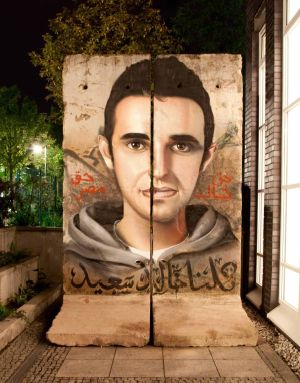
Amro Ali writes: On 6 June 2012, I will join countless others in commemorating the second anniversary of the death of Khaled Saeed, the twenty-eight-year-old Alexandrian who was beaten to death by plain-clothed policemen. The screams of Khaled echoed through Egypt and sparked the rapid countdown to the 2011 Egyptian Revolution.Khaled Saeed painting on the Berlin Wall by graffiti artist Andreas von Chrzanowski, photo by Joel Sames
Khaled was the neighbor down the street whom I, admittedly, paid little attention to. Yet his posthumous transformation from another face in the neighborhood to revolutionary poster child has become a source of both inspiration and concern. Inspiring in that he has given a focus and impetus to Egypt’s revolution, and concern in that his mythologization considerably conceals the real problems that the many “Khaled Saeeds” of Egypt face.
Khaled has been distorted almost beyond recognition. To understand the extent of this, based on interviews from friends, associates and my familiarity and understanding of the district, I attempt to provide a descriptive account of his life up until that fateful night in June 2010. The facts of his life are contrasted with his mythologization and the polarizing effects of both. His death was not just indicative of the corrupt and brutal police state; Khaled’s life was symptomatic of the widespread despair that continues to plague Egypt’s youth and that manifests in a plethora of symptoms from drug abuse to the strong desire to emigrate. The reconstruction of Khaled Saeed perpetuates self-defeating myths that, by elevating him into a figure with saint–like qualities, minimizes and simplifies the dynamics of his life that led up to his death.
Khaled’s tragedy was a turning point in my life. I first wrote about Khaled Saeed shortly after his death in an article titled, “Egypt’s Collision Course with History.” On the day Khaled died, I was in Australia reflecting on my late father who had died two years earlier on 6 June 2008, near to where Khaled passed away. When the news of Khaled’s death reached me, it shook my world. It was not just the manner of Khaled’s death that had disturbed me, but the deep reach of President Hosni Mubarak’s repressive police state into a neighborhood where I had grown up and idealized as a beacon of harmony. Up until then, I naively thought that such things happened to other people, in the slums, Islamist strongholds, in prisons, on the news, Alexandria’s rural outskirts, any “other area.” My area became that “other area.” [Continue reading…]

Meredith Tax writes: Why is it so hard for people in the anti-war movement to hold two ideas in their heads at the same time? Can’t we want to end the war in Afghanistan and at the same time practice solidarity with its victims?
As the Taliban, prompted by Pakistan’s ISI, becomes ever more aggressive, Afghan women and civil society campaigners are asking for support to protect the gains they’ve made, but nobody in the US government – or the left – seems to be listening.
Obama’s realpolitik has replaced the Bush administration’s rhetoric about bringing democracy to the region. “Afghan good enough” is the magic phrase in Washington. If this entails throwing women overboard, hey, that’s realpolitik. In March, 2011, Rajiv Chandrasekaran of the Washington Post asked a senior State Department officer what the policy would be towards women as the US withdrew. The answer:
“Gender issues are going to have to take a back seat to other priorities … There’s no way we can be successful if we maintain every special interest and pet project. All those pet rocks in our rucksack were taking us down.”
The war has cost too much in lives and money to be sustainable, and no one questions that it has been badly managed. The latest US blunder, according to Human Rights Watch, has been to make a huge strategic investment in the Afghan Local Police force; unfortunately, the ALP is full of rapists and thugs who are not held accountable for their crimes. The latest horror story concerns Lal Bibi, an 18-year-old girl abducted by an ALP leader in Kunduz province, chained to a wall, and raped, beaten and tortured for five days in revenge for an offense by a distant cousin. Normally, Lal Bibi’s family would have killed her – they may yet do so – but they have gone public and are trying to get justice. Meanwhile, the US military continues to express confidence in the Afghan Local Police.
And if its misjudgment is behind the ALP, the US is equally to blame for the rise of the Taliban; together with Saudi Arabia and Pakistan, the US funded them and gave them weapons in the late 1970s, when they wanted a proxy to fight the Soviets. Thus the US people have some responsibility to make sure that the result of all this intervention is not the Talibanization of the Karzai government.
Further, Obama has committed us to financial aid to Afghanistan for the forseeable future. What kind of financial aid should the US be giving, and what conditions should it place on such aid?
The anti-war movement isn’t discussing these issues. It simply echoes the position of the Obama administration – out as soon as possible and no questions asked. The movement’s entire attention seems to be focused on drones, as if wanting to end the war precludes thinking constructively about peace. [Continue reading…]
The Telegraph reports: The door to Dr Mousab Azzawi’s clinic, on the Mediterranean coast of Syria, was always open to anyone who needed help. But, operating in the heartland of the feared Shabiha militia, there were some patients the doctor would have preferred not to treat.
“They were like monsters,” said Dr Azzawi, who worked in Latakia. “They had huge muscles, big bellies, big beards. They were all very tall and frightening, and took steroids to pump up their bodies.
“I had to talk to them like children, because the Shabiha likes people with low intelligence. But that is what makes them so terrifying – the combination of brute strength and blind allegiance to the regime.”
As President Bashar al-Assad’s country continues its savage slide towards full-blown civil war, the violent, dark and secretive world of the Shabiha is coming out into the open.
Nine days ago, 108 people were butchered by the Shabiha in the town of Houla. The pro-Assad thugs went through the village, house to house, and slit the throats of anyone they came across – including 49 children. Exactly a week later, the Shabiha pulled 12 factory workers off a bus in the town of Qusayr, 40 miles to the south; tied their hands behind their backs, and shot them in the head.