The Associated Press reports: When Sandra Tamari arrived at Israel’s international airport, she received an unusual request: A security agent pushed a computer screen in front of her, connected to Gmail and told her to “log in.”
The agent, suspecting Tamari was involved in pro-Palestinian activism, wanted to inspect her private email account for incriminating evidence. The 42-year-old American of Palestinian descent refused and was swiftly expelled from the country.
Tamari’s experience is not unique. In a cyber-age twist on Israel’s vaunted history of airport security, the country has begun to force incoming travelers deemed suspicious to open personal email accounts for inspection, visitors say.
Targeting mainly Muslims or Arabs, the practice appears to be aimed at rooting out visitors who have histories of pro-Palestinian activism, and in recent weeks, has led to the expulsion of at least three American women.
It remains unclear how widespread the practice is.
However, asked about Tamari’s claims, the Shin Bet security agency confirmed she had been interrogated and said its agents acted in accordance with the law.
Israel has a long history of using ethnic profiling, calling it a necessary evil resulting from its bitter experience with terrorist attacks. Arab travelers and anyone else seen as a risk are often subjected to intense questioning and invasive inspections, including strip searches.
Pankaj Mishra writes: Perhaps it is time to ask again: who is Barack Obama? And how has Pakistan featured in his worldview? The first question now seems to have been settled too quickly, largely because of the literary power of Obama’s speeches and writings. His memoir, Dreams From My Father, was quickened by the drama of the self-invented man from nowhere – the passionate striving, eloquent self-doubt and ambivalence that western literature, from Stendhal to Naipaul, has trained us to identify with a refined intellect and soul. Not surprisingly, Obama’s careful self-presentation seduced some prominent literary fictionists, inviting comparisons to James Baldwin.
Later biographies of Obama, published after he became president, have complicated the picture of him as the possessor of diversely sourced identities (Kenya, Indonesia, Hawaii, Harvard). David Maraniss’s new biography shows that at college the bright student from Hawaii’s closest friends were Pakistanis, and he carried around a dog-eared copy of Ralph Ellison’s Invisible Man.
But Obama also began early, as one girlfriend of his reported to her diary, to “strike out”, “shedding encumbrances, old images”. “Do you think I will be president of the United States?” he asked a slightly bemused Pakistani friend, who then witnessed “Obama slowly but carefully distancing himself from the Pakistanis as a necessary step in establishing his political identity”.
“For years,” Maraniss writes, “Obama seemed to share their attitudes as sophisticated outsiders who looked at politics from an international perspective. But to get to where he wanted … he had to change.” Obama’s Pakistani friend recalls: “The first shift I saw him undertaking was to view himself as an American in a much more fundamental way.”
In an incorrigibly rightwing political culture, this obliged Obama to always appear tougher than his white opponents. During his 2008 presidential debates with John McCain, Obama often startled many of us with his threats to expand the war in Afghanistan to Pakistan. More disquietingly, he claimed the imprimatur of Henry Kissinger, who partnered Richard Nixon in the ravaging of Cambodia, paving the way for Pol Pot, while still devastating Vietnam.
It can’t be said Obama didn’t prepare us for his murderous spree in Pakistan. It is also true that drone warfare manifests the same pathologies – racial contempt, paranoia, blind faith in technology and the superstition of body counts – that undermined the US in Vietnam.
But of course “force”, as James Baldwin pointed out during Kissinger and Nixon’s last desperate assault on Indochina, “does not reveal to the victim the strength of his adversary. On the contrary, it reveals the weakness, even the panic of his adversary and this revelation invests the victim with patience”. [Continue reading…]
Russ Baker writes: On his first day in office, President Obama signed a government-wide directive — widely reported by the media — establishing a whole new level of commitment to openness and transparency. The administration has made some real strides. But arguably not on the most sensitive — and hence most important — matters.
On April 9, federal agencies were supposed to post updates to their Open Government Plans, this according to Cass Sunstein, administrator of the Office of Information and Regulatory Affairs, writing on the White House blog. Some agencies, including the Environmental Protection Agency, did so. But others, such as the Department of Labor , did not — and still have not. NARA [the National Archives and Records Administration] is one of those that has not complied.
As the expression goes, sunshine is the best disinfectant. Opening up the nooks and crannies of government to public view was supposed to aid the process of discovering and rooting out the rot. This would, we were assured, help return Washington to the people. Obama selected Sunstein, a Harvard professor and old friend, to oversee this effort.
Not long ago, when I asked to discuss this with Sunstein, I was told he was “not available” for interviews.
Here’s the exchange:
From: Russ Baker Sent: Wednesday, April 11, 2012 11:12 PM To: Sunstein, Cass R. Subject: interview request
Mr. Sunstein, wonder if I might be able to do a phone interview with you about Open Records policy?
From: Strom, Shayna L. Sent: Thursday, April 12, 2012 12:25 PM To: Russ Baker Subject: FW: interview request
Unfortunately, Administrator Sunstein is unavailable for an interview. That said, you might try the Archivist of the United States at NARA? Best of luck!
Warmly,
Shayna
From: Russ Baker Sent: Thursday, April 12, 2012 12:33 PM To: Strom, Shayna L. Subject: RE: interview request
Is he generally unavailable for interviews? What is the policy on that? Seems relevant given that this is about open government.
From: Strom, Shayna L. Sent: Thursday, April 12, 2012 5:00 PM To: Russ Baker Cc: Mack, Moira K. Subject: RE: interview request
No, he’s not generally unavailable—but the Archivist is intimately involved in one of our big open government initiatives (records modernization), so he’s just a particularly good person to speak to on this.
So the person in charge of the overall governmental effort on open records wants me to talk to the person running one of the agencies that is … having difficulties complying with the spirit if not letter of Obama’s announcement.
Actually, Sunstein has good reason to lay low. Watch this slightly raw video [see below] of someone confronting him about a paper he wrote a few years ago. In it, he actually advocated for “cognitive infiltration” of groups that espouse alternative views on controversial issues like the events of Sept. 11 (i. e, conspiracy theories).
Here’s a quote from Sunstein’s paper:
[W]e suggest a distinctive tactic for breaking up the hard core of extremists who supply conspiracy theories: cognitive infiltration of extremist groups, whereby government agents or their allies (acting either virtually or in real space, and either openly or anonymously) will undermine the crippled epistemology of those who subscribe to such theories. They do so by planting doubts about the theories and stylized facts that circulate within such groups, thereby introducing beneficial cognitive diversity.
Sunstein is a sort of caricature of everything people don’t like and don’t trust about government. The fact that he’s in charge of “open government” speaks volumes. [Continue reading…]
Jason Leopold writes: Hesham opened the envelope at the bar, expecting a green card. Instead, it was a subpoena from a federal prosecutor, which would force him to testify–against his brother.
He thought about fleeing to Norway or Poland with his wife and daughter. But it would be much easier to cross the border into Canada in his Cadillac Escalade and avoid the hassle of airport security and the possibility that his name would pop up on the no-fly list. In Canada, he could start over again. Raise farm animals or something. Change his name. Never look back. Hesham had played this fantasy out in his head dozens of times since he had quit working as a confidential informant for the FBI.
“This is what you wanted from me all along, isn’t it?” Hesham asked the FBI agent who handed him the envelope. “You guys used me.”
When he’d been living in Portland, Oregon, Hesham had agreed to infiltrate mosques and spy on other Muslims because his FBI handler led him to believe she could help him obtain a green card. She didn’t, and he cut off contact with the agency when he moved to a small town in Florida. But they had found him again.
“No way,” Hesham said.
“You don’t have a choice,” the agent told Hesham. “Testify or go back to jail.”
Hesham stared at the agent. He didn’t say a word. His eyes started to twitch, which happens whenever he gets angry. He stood up, pulled his wallet out of his back pocket, placed a $20 bill under his whiskey glass and walked outside to light a cigarette. He paced the parking lot, cursing his brother’s name. Two FBI agents and a special agent with the US Army’s Criminal Investigation Command watched him from a distance.
Hesham flicked his cigarette butt and walked back toward them. Going back to jail wasn’t an option. He was afraid he would never get out and would never see his wife and daughter again.
“When do I need to do this?” Hesham asked the agents.
“Probably in a few weeks,” the Army special agent said. “We’ll either stop by or call you.”
Hesham got into his car and tore out of the parking lot, his tires screeching. He felt weak, trapped and ashamed. Hesham hoped his brother would forgive him for ratting him out.
Hesham Mohamed Hussain Abu Zubaidah is the younger brother of Zayn al-Abidin Mohamed Husayn, better known to the world as the high-value Guantanamo detainee “Abu Zubaidah,” whom the US government has for more than a decade claimed was “one of the highest-ranking members of the al-Qaeda terrorist organization” and “involved in every major terrorist operation carried out by al-Qaeda,” including the 9/11 attacks [1].
Research I was conducting on the accused terrorist led me to Hesham. I had stumbled across a three-year-old comment on a blog post left by someone who identified himself as Hesham.
“Yes that is my brother and I live in Oregon,” the commenter said. “Do you think I should have been locked away for 2 years with no charges for a [sic] act of a sibling? I am the younger brother of Zayn and I live in the USA. Tell me what you think.”
I was blown away. A search of his name on Google turned up only 28 results, including another comment posted by a person using Hesham’s name, as well as one by a person identifying herself as Hesham’s wife. Who was Hesham, and why hadn’t we heard of him before? [Continue reading…]
Glenn Greenwald writes: In February, the Bureau of Investigative Journalism documented that after the U.S. kills people with drones in Pakistan, it then targets for death those who show up at the scene to rescue the survivors and retrieve the bodies, as well as those who gather to mourn the dead at funerals: “the CIA’s drone campaign in Pakistan has killed dozens of civilians who had gone to help rescue victims or were attending funerals.” As The New York Timessummarized those findings: “at least 50 civilians had been killed in follow-up strikes after they rushed to help those hit by a drone-fired missile” while “the bureau counted more than 20 other civilians killed in strikes on funerals.”
This repellent practice continues. Over the last three days, the U.S. has launched three separate drone strikes in Pakistan: one on each day. As The Guardian reports, the U.S. has killed between 20 and 30 people in these strikes, the last of which, early this morning, killed between 8 and 15. It was the second strike, on Sunday, that targeted mourners gathered to grieve those killed in the first strike:
At the time of the attack, suspected militants had gathered to offer condolences to the brother of a militant commander killed during another US unmanned drone attack on Saturday. The brother was one of those who died in the Sunday morning attack. The Pakistani officials said two of the dead were foreigners and the rest were Pakistani.
Note that there is no suggestion, even from the “officials” on which these media reports (as usual) rely, that the dead man was a Terrorist or even a “militant.” He was simply receiving condolences for his dead brother. But pursuant to the standards embraced by President Obama, the brother — without knowing anything about him — is inherently deemed a “combatant” and therefore a legitimate target for death solely by virtue of being a “military-age male in a strike zone.” Of course, killing family members of bombing targets is nothing new for this President: let’s recall the still-unresolved question of why Anwar Awlaki’s 16-year-old American son, Abdulrahman, was killed by a U.S. drone attack in Yemen two weeks after his father was killed. [Continue reading…]
ACLU: In November 2001, the National Security Agency began illegally intercepting Americans’ phone calls and emails without warrants or suspicion of wrongdoing. In 2008, Congress amended the Foreign Intelligence Surveillance Act (FISA), rubber-stamping this warrantless wiretapping program and giving the NSA power to conduct dragnet surveillance of Americans’ international communications. Continue reading →
The Independent reports: Some of the world’s biggest stars – from Madonna to the Red Hot Chili Peppers – are being accused of putting profit before principle in a growing backlash against artists performing in Israel.
Campaigners angry at human rights abuses against the Palestinian people – symbolised by Israel’s policy of demolishing the homes of Palestinians and allowing Israeli settlers to take over their land – are demanding a boycott of Israeli venues in a campaign that echoes the 1980s protests against South Africa and the infamous venue Sun City.
Last week Madonna came under fire for her decision to perform in Israel to kick off her world tour last Thursday. “By performing in Israel, Madonna has consciously and shamefully lent her name to fig-leafing Israel’s occupation and apartheid and showed her obliviousness to human rights,” said Omar Barghouti of the Palestinian Campaign for the Academic and Cultural Boycott of Israel.
Attempts by Madonna to deflect criticism by offering free tickets to local campaigners backfired, with a number rejecting the offer. Boycott from Within, an Israeli campaign group, accused the singer of “a blatant attempt at whitewashing Israeli crimes”. Mr Barghouti added: “As we’ve learned from the South African struggle for freedom, entertaining Israeli apartheid should never be mislabelled as singing for peace.” The star’s publicist did not respond to requests for comment.
Rami Khouri writes: It must be depressing for Kofi Annan, the United Nations-Arab League envoy to Syria, to hear at every turn that the “Annan plan” for resolving the conflict is dead, and that country will soon plunge into a full-fledged sectarian civil war. My impression is that Annan is resolute, and is just now nearing the make-or-break point of his difficult mission. He has sketched out a path of critical steps – including local, regional and global actors – needed to avert all-out war and instead peacefully negotiate future governance arrangements.
I get this impression from talks this week with authoritative sources close to the Annan mission, who underscore the urgency of action to damp down the use of violence across Syria, to start implementing the plan’s points, and to rebuild enough trust for a political negotiation.
Beyond the escalating violence, an added element of urgency is that the international community may not see this as an open-ended process, but might pull the plug soon if violence continues, I was told. Therefore the urgency now is to get all parties to start complying with the six points of the Annan plan, including a cease-fire, release of prisoners and pullback of heavy weapons from urban areas.
This clearly requires pressure from outside parties, which is why the Annan team is exploring possible ways to bring “intense external pressure” on President Bashar Assad’s regime to start complying with the cease-fire terms.
That pressure must come primarily from Russia, but the Annan team is also in touch regularly with others who support Syria, such as Iran and China. The hope is that if the key external parties – in this case the United States and Russia – can reach minimum agreement with others in the international community on the importance of collective action to nudge the parties to comply with the Annan plan, Syria might be spared a devastating explosion of violence that engulfs the whole country and perhaps spills over to neighboring countries. [Continue reading…]
The National reports: Khaled Meshaal is standing for re-election to lead Hamas four months after announcing he would step down.
The decision is a setback for hardliners in the Islamist movement who have criticised Mr Meshaal’s recent reforms, which include dismantling Hamas’s headquarters in Damascus, reconciling with its Palestinian rival Fatah and tentatively embracing unarmed struggle against Israel.
Hamas’ senior leadership refused to accept Mr Meshaal’s decision in January not to seek another term as the group’s Political Bureau head, sources say.
They persuaded him to remain in his post and run for re-election in an upcoming secret party ballot, the sources say.
“Meshaal is still the head of Hamas and he has majority approval from the group, from both the leaders inside Gaza and abroad,” said a Hamas official in Gaza, who spoke on condition of anonymity.
Mr Meshaal agreed to stay in his job and he “is considered one of the candidates to lead the group for the election.” the official said.
His continued leadership could have implications for Hamas’s orientation in a region divided between strengthened Sunni Islamist parties and the revolutionary-Islamist axis of Shiite Iran and Hizbollah and the regime in Syria.
Luke Mogelson writes: When the stranger unbolted the cell door and whispered for them to hurry, Rahim assumed that somewhere in the prison a fight must have broken out. It was the middle of the night, and normally the heavy metal door remained locked until the morning call to prayer. For the past five months, Rahim had shared this cell, in Kandahar’s Sarposa Prison, with five other captured insurgents, two of whom he’d fought alongside in the fiercely contested district of Panjwai. Now, from where they lay on old blankets and cushions on the floor, all five gazed uncertainly at the man standing in their doorway. “We are your friends,” the man said. “There is a tunnel over here. Come quickly and get inside it.”
Rahim and his cellmates stepped into the prison’s dimly lit lime green corridor. At the passageway’s far end, a metal gate sealed the cell-block entrance. Every ten feet or so, solid black doors led to more communal cells. Nearly 500 Taliban occupied this part of Sarposa, called the political block. Some were military commanders and shadow-government officials, others hardened foot soldiers and young recruits. Their arrests represented years of effort by coalition forces to quell a resuscitated insurgency and impose some semblance of law in one of the least stable regions in Afghanistan. Following the stranger down the long hall, Rahim noticed that most of the cells were now empty.
The group made its way quietly but without too much concern for the guards; Sarposa’s officers seldom patrolled the political block. Once in the morning and once in the evening they came to take attendance; otherwise, the Taliban were left to care for themselves. Within the block’s three contiguous wings, a council of elders resolved disputes, prisoners knitted blankets and clothes for those lacking them, and in an enclosed courtyard a detained imam led prayers five times a day. The cells themselves were lavishly furnished with comfort items delivered in large plastic bags by visitors every weekend—cushions, blankets, rugs, electric fans, and lamps. Periodic security checks invariably uncovered mobile phones secreted in the floors and walls. Since the Taliban consider music un-Islamic, radios were nonexistent. Instead, for amusement, inmates flipped over metal soup bowls and beat them in time with religious chants. As Rahim and his cellmates moved down the corridor, their footfalls were mu±ed by such a drumming.
Near the gated entrance at the end of the corridor, the stranger ushered the group into a cell adorned with old maps, embroidered tapestries, and a mirror hanging from a coatrack, decorated with an etching of an AK-47. A blue carpet had been pulled back from one corner of the cell to reveal a triangular hole in the floor. Rahim approached the jagged opening and peered inside. The striated walls tunneled down through half a foot of concrete, through an equally thin layer of foundational stone, and finally through some six feet of brown earth. Several prisoners gathered at its edge. Some were young fighters; a few were geriatrics or amputees. Rahim was in his early twenties but had lost his left leg a year earlier to an IED and now used a prosthesis. He watched an old man toss his crutches aside and lower himself into the floor. Rahim did the same.
The dirt below was dry and soft. It was so crowded that when Rahim fell to his knees and started to crawl, he bumped into the man ahead of him. As he inched forward, another prisoner jumped into the hole behind him. On all fours, his back scraping against the ceiling, Rahim wormed his way forward. Whoever had burrowed the passage had installed a series of light bulbs that hung from an electrical cord. But by now many of the bulbs had shattered, broken by passing prisoners, and pieces of glass littered the tunnel floor. After a few hundred feet, it was almost completely dark. [Continue reading…]
The Associated Press reports: NATO has concluded agreements with Central Asian nations allowing it to evacuate vehicles and other military equipment from Afghanistan and completely bypass Pakistan, which once provided the main supply route for coalition forces.
Secretary-General Anders Fogh Rasmussen said Monday that Uzbekistan, Kyrgyzstan and Kazakhstan had agreed to allow the reverse transport of alliance equipment. Since NATO already has an agreement with Russia, the deal will allow it to ship back to Europe tens of thousands of vehicles, containers and other items through the overland route when the evacuation picks up pace later this year.
Pakistan shut down the southern supply routes six months ago after U.S. airstrikes accidentally killed 24 Pakistani soldiers at two border posts, forcing NATO to switch almost completely to the so-called Northern Distribution Network.
After months of stalemate, Pakistani leaders last month signaled that negotiations on the supply routes were progressing, just in time to secure an invitation to the weekend NATO summit in Chicago. But since then the two sides have made little progress in the talks, officials said.
The announcement on Monday appears to indicate that Washington and the allies are now preparing for the possibility that the supply link through Pakistan, said to be about six times cheaper than its northern alternative, may not be reopened at all.
Magdi Abdelhadi writes: For the first time in Egypt’s history the pharaoh is behind bars. But the joy was not unalloyed. Some of his most powerful henchmen, the backbone of his police state, were acquitted of killing the protesters and are now free. That’s why Tahrir Square in Cairo and other cities have erupted in anger.
What also infuriated the public was that Mubarak was found guilty not of what he did, but rather of what he did not do. That’s how seemingly preposterous (but apparently technically correct) the verdict is. The former president was proven guilty of something like “serious dereliction of duty”: he failed to stop the killing of protesters.
The absence of incriminating evidence – as cited by Judge Ahmed Rifaat – was the most shockingly appalling of all facts, considering that Egyptians, in fact the whole world, saw on their television screens how the police shot and mauled the protesters last year.
The verdict should not have come as a surprise for those who followed the trial closely. The prosecutors failed to provide material proof (there was some circumstantial evidence on the type of weapons and ammunition issued to the anti-riot police) of specific orders from top police chiefs to the boots on the ground. At one point, the prosecutors publicly complained to the court that the police and intelligence services had refused to co-operate with the investigation.
The question now is why those agencies and the men who control them (all of them Mubarak-era appointees) have not been charged with “severe dereliction of duty” or, even worse, obstruction of justice. The answer is simple: they still rule Egypt. [Continue reading…]
The Guardian reports: Members of an elite unit set up by the Libyan government to rein in the country’s rival militia forces have been accused of kidnapping and severely beating one of the country’s foremost surgeons.
The abduction appears further evidence that 10 months after taking over, Libya’s new interim government has failed to curb human rights abuses, and is seemingly incapable of controlling either the militias or its own security force. It comes as the country faces its first national elections later this month – a key test of whether Libya is heading towards democracy or violent secessionism.
Salem Forjani, a heart surgeon working for the health ministry, was seized on 17 May when he went to Tripoli medical centre – the city’s largest hospital – on orders of the health minister to remove the director, who was accused of links with the Gaddafi regime.
Instead, he was confronted by members of the government’s supreme security committee (SSC) waiting in the director’s office, who dragged Forjani through the hospital, beating him so badly he lost consciousness in front of horrified staff.
A fellow medic photographed Forjani being carried, his shirt off, spreadeagled, down the hospital’s ambulance ramp while an SSC soldier threatened to shoot unarmed hospital security staff giving chase. [Continue reading…]
As Israel implements a law aimed at stemming the flow of Africans entering the Jewish state from the south, Interior Minister Eli Yishai says Israel must protect itself from a demographic threat. Africans pose such a threat, Yishai says, because they don’t recognize that Israel belongs to “the white man.”
Aryeh Eldad, one of Yishai’s colleagues in the Knesset, wants immigrants to be shot on sight if they attempt to cross the border.
Reuters reports: Tens of thousands of migrants, mostly from Sudan and Eritrea, have arrived in Israel in the past three years, and the pace has picked up to about 2,000 a month since December, for a total of 60,000 since the influx began.
Many migrants say they are fleeing persecution or war, but few have been granted formal asylum or refugee status, leaving many with temporary visas, subsisting on wages from menial jobs, swelling the ranks of the poor.
“The problem of the infiltrators must be solved and we will solve it,” Prime Minister Benjamin Netanyahu said last month, in remarks aimed at calming protests against migrants in Tel Aviv.
Yishai, of the ultra-Orthodox Shas party, told the newspaper Maariv on Friday he saw the African arrivals, many of whom are Muslims or Christians, as a demographic threat.
“The infiltrators along with the Palestinians will quickly bring us to the end of the Zionist dream,” Yishai said, adding that Israel had its own health and welfare issues. “We don’t need to import more problems from Africa.”
“Most of those people arriving here are Muslims who think the country doesn’t belong to us, the white man,” Yishai said in the interview with Maariv.
Aryeh Eldad, a right-wing lawmaker, urged Israel to order its troops to open fire on any infiltrators who penetrated its borders, rather than only at those suspected of being armed.
Are you as smart as a crow? Take this test to find out.
I’m proud to say I got it right the first time — but I probably had an advantage: I tamed two crows when I was a kid so I’ve spent some time staring them in the eye.
As a nine-year-old had I been growing up in an indigenous tribe on another continent I dare say my feat of being able to call a crow from a tree and have it swoop down and land on my outstretched arm might have set me on course for training as a shaman. Instead, after one of these crows swooped down to examine what kind of tasty morsel was tucked inside a baby stroller, protests from a distraught mother meant that these over-inquisitive crows were no longer welcome in our neighborhood. I had to promptly take the crows away and let them cause trouble some place else.
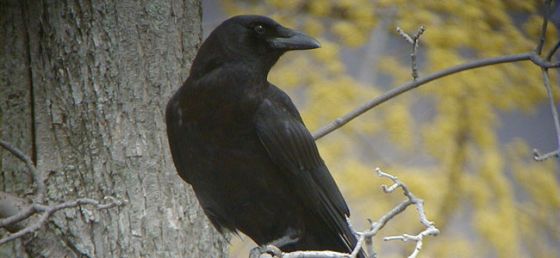
Forty-five years ago crows were under-appreciated. Now they are recognized as among the most intelligent creatures on the planet, able to pass on knowledge from one generation to the next and with tool-making skills that surpass those of chimpanzees. (To learn more, watch the video below.) Perhaps most intriguing, crows are able to recognize individual human faces. While we find it difficult to tell one crow from another, they can spot the differences between us from hundreds of feet away.
Professor John Marzluff at the University of Washington has studied crows’ face recognition abilities and speculates that crows need to be able to differentiate between people so that they can spot individuals who pose a threat. Robert Krulwich, describing Marzluff’s explanation for this aspect of crow intelligence, says: “It pays for a crow to pay attention, while we people, we are not threatened or helped by individual crows. So they need to know about us but we don’t need to know about them individually. And that’s what I call the crow paradox.”
I’ll come back to this paradox shortly, but I don’t find the idea very persuasive that crows need to be able to spot dangerous people.
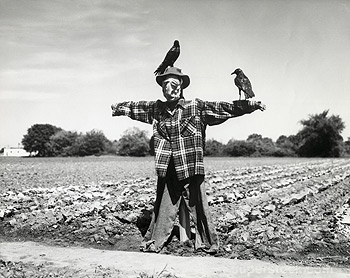
The ancient and continued use of scarecrows is a testament to the enduring need of farmers to scare crows along with farmers’ stubborn persistence in using a technique that is largely ineffective. For the wary crow, the truly dangerous farmer is all too easy to spot — not by his face but by unmistakable warnings he often posts: shot crows strung up like mascots promising a similar fate to those who venture too near to his valuable crops.
A crow’s ability to recognize a human face may actually have nothing to do with a need to to differentiate individual people from one another. It may instead be a by-product of the fine level of discrimination crows need to be able to differentiate one crow from another inside their own complex social systems.
For the eye to which no two crows look alike, the differences between any two much larger people must seem all the more extreme. As for why crows would hone in on facial differences, it would be for exactly the same reason that people do: because we change attire and the face is the one feature of appearance and identity that maintains day-to-day continuity.
Returning then to Krulwich’s supposed crow paradox — that they need to be able to differentiate among us individually while we have no need to be able to distinguish one crow from another — there is in this idea a very anthropomorphic image of social structure where important individuals stand out and the unimportant blend into a homogenous mass. The implication is that the crow pays attention to the dangerous person while ignoring everyone else.
This is a very human idea — that some people don’t matter — and reflects a social deficit we incur by constructing social structures that stretch far beyond our perceptual horizons.
For the crow and probably every other non-human social animal, the world, circumscribed by the reach of the senses, is not filtered through preoccupations about a wider world. We, on the other hand, are perpetually inattentive to our immediate surroundings because we place our attention elsewhere — on thoughts, feelings, memories, expectations — on the things that we tell ourselves matter most.
Through this bifurcation between that which matters and that which supposedly doesn’t, we lose the keen alertness in which for birds and animals a much wider spectrum of the present, bound within a perceptual horizon, always matters.





 I’ll come back to this paradox shortly, but I don’t find the idea very persuasive that crows need to be able to spot dangerous people.