Issandr El Amrani writes: There’s been some buzz over the last day or so over a proposal for a national charter by secular, liberal, non-felool forces (aka most of the small parties in the Egyptian parliament) as well as several ideas over some kind of deal with the remaining presidential candidates on the shape of government. I keep seeing stipulations such as “no MB prime minister” or “vice-presidents from outside the MB” that makes it clear that these initiatives are largely targeted at candidate Mohammed Mursi. I barely see anything about negotiating with candidate Ahmed Shafiq.
I also — and I believe this is a big omission — see no details about restricting the powers of the military, getting rid of SCAF and retiring the generals who currently serve on it, overhauling the General Intelligence Services, or anything else that has been considered largely beyond the pale of political and media discourse since the fall of Hosni Mubarak. It kind of reinforces the feeling that a) most political activists seem to think the greatest threat is the Islamists, since many of the points are about preserving a secular state, b) there is not much courage out there (at least among the professional politicians) about raising the issue of the deep state, the military and the security services. Is this resignation, perception of what’s realistic, of lack of imagination?
Daniel Levy writes: The economic and political news out of Europe may be grim, but on the diplomatic front Europe is leading what may be the most consequential negotiations of 2012 – the so-called E3+3 talks with Iran. Those talks are being managed by the EU foreign policy chief, Catherine Ashton, and shepherded by the European External Action Service’s trouble-shooter, Helga Schmid.
Accounts from all sides suggest that Ashton and Schmid are making rather a good fist of it – the Iranians are still at the table (with a third round of talks scheduled for Moscow in mid-June) – and that the countries participating have remained sufficiently united to avoid descending into mutual recriminations. No easy task given how high the stakes are, the history of failed talks, the tensions within participants and the curveballs that Israel, the US Congress and Iran itself have a habit of throwing.
That’s all good and dandy, but the Europeans may soon have to make a decisive call on substance rather than management. What does Europe want out of these talks? At the Pollyanna-ish end of the spectrum would be a definitive, implementable and sustainable deal laying to rest nuclear suspicions towards Iran and opening a door to western-Iranian co-operation across a range of issues (think Afghanistan, Horn of Africa security, and possibly Syria and Iraq; but even Pollyanna might balk at co-operation on Israel/Palestine or democracy promotion). While the contours for such a deal exist (variations on Iran’s right to enrich being recognised, being limited and being verified), the political realities in 2012 – notably in the US and Iran – decisively undermine this prospect.
The opposite end of that scale would see talks as intended to expose Iranian malfeasance, helping to maintain international commonality of purpose as sanctions are ratcheted up further. If the ultimate goal is regime change induced by economic strangulation or Iranian capitulation (as opposed to negotiated compromise), or even to provoke Iran as a justification for military intervention, then this makes sense. Yet it is hard to view this as being the desired European outcome.
Which brings us to what is desirable and achievable in 2012. The best, realistic prognosis for these talks is that they deliver a partial enrichment freeze in return for partial sanctions relief. Short of that, the goal is more talks – improving mutual understanding for when there is greater political room for compromise – in Iran, the US or both. Crucially, military action is averted. [Continue reading…]
David Hearst writes: If there is one constant in a crisis-strewn world, it is that the humanitarian situation in Yemen just gets worse. This time last year, Yemen’s dictator Ali Abdullah Saleh was beating a long rearguard retreat against his eventual ouster. Oxfam had just issued a report saying that one third of Yemenis suffered from hunger and chronic malnutrition.
Today, Saleh is out and his relatives are in the process of being prised from the key positions he put them in. Shortly after al-Qaida’s attack on a rehearsal for a military parade on Monday, from which over 100 soldiers have now died, two of Saleh’s relatives were demoted from the central security forces and the interior ministry, including Saleh’s nephew Yahya. In April, it took 19 days of defiance, before Saleh’s half brother, General Mohammed Saleh al-Amar resigned his command of the Yemeni air forces. If anyone is in charge of Yemen these days its most likely to be the US ambassador who regularly heaps praise on the man they made president Abd-Rabbu Mansour Hadi.
But whether Hadi turns out to be his own man or another Hamid Karzai makes little difference to the general suffering. This week, seven aid agences (Care, International Medical Corps, Islamic Relief, Merlin, Mercy Corps, Oxfam and Save the Children) said that 44% of the population – 10 million people – were going hungry. One quarter of them were in need of urgent emergency aid. Wherever you turn, another red light flashes. The UN Office for the Co-ordination of Humanitarian Affairs (Ocha) said that nearly a million children under five were suffering from acute malnutrition and over one quarter of them could die.
Reuters reports: President Barack Obama is gambling that his administration’s failure to act forcefully to stem the bloody crisis in Syria won’t become an election-year liability – and that looks for now like a good bet, with Americans weary of war and focused on the struggling U.S. economy.
A weekend massacre of civilians in Syria has again laid bare the lack of appetite on the part of Washington and many of its allies for military action against Syrian President Bashar al Assad.
It has also given presumptive Republican presidential nominee Mitt Romney a new opening to try to paint Obama as soft on U.S. foes and timid in asserting American global leadership.
But with most Americans opposed to another large-scale U.S. military commitment overseas and the Syria crisis barely registering for many U.S. voters, Obama’s aides and supporters believe he can weather attacks on the issue.
Polls in recent months have shown between two-thirds and three-quarters of voters opposed to U.S. intervention. Not even human rights groups are demanding major military action.
And Republicans themselves are divided on the right course of action in Syria and how much political capital Washington should invest there.
“Americans are war-weary, Americans are focused on our own economy, Americans want us to invest in our future,” Democratic U.S. Senator Mark Udall said in a conference call with reporters during a trip to the Middle East. “I don’t think this is at the top of Americans’ list of concerns.”
Reuters reports: The gunmen arrived shortly before dusk, some in uniform and some in plain clothes, before herding whole families into rooms and killing them in cold blood, according to survivors.
“They entered our homes … men wearing fatigues herding us like sheep in the room and started spraying bullets at us,” said an apparently injured woman in a video released by activists.
“My father died and my brother, my mother’s only son. Seven sisters were killed,” the woman said, lying next to another injured woman and near a baby with a chest wound.
The United Nations says 108 people were killed in the May 25 massacre, nearly half of them children, outraging a world long numbed by 14 months of relentless bloodshed since the start of a popular uprising against Syrian President Bashar al-Assad.
The events are disputed. The West blames Assad’s forces, while Syria accuses its opponents, whom it refers to as Islamist “terrorists”.
But video footage and accounts of activists, survivors, rights groups and United Nations observers in Syria, provide a harrowing narrative of the violence in the Houla region, about 20 km (13 miles) northwest of the city of Homs.
Crucially, the U.N. monitors say the evidence appears to contradict the government’s denial that its forces and allied militia were behind the slayings.
Activists and survivors said soldiers and pro-Assad “shabbiha” militiamen from the president’s minority Alawite sect carried out the onslaught on the Sunni Muslim villagers.
The Guardian reports: Russia has made clear that it will block UN support for foreign military intervention in Syria, scotching slim hopes that the massacre of more than 100 people at Houla would break the impasse in the international response to the continuing violence.
Moscow’s crucial support for Syria’s president, Bashar al-Assad, has not changed after confirmation from a UN human rights body that 108 people, including 49 children under the age of 10, were killed in the weekend incident near Homs, mostly in summary killings by the feared shabiha militia, linked to the Assad regime.
“We have always said that we are categorically against any intervention in the Syrian conflict from the outside, as this would only worsen the situation and would lead to unpredictable consequences both for Syria itself and the region on the whole,” said Gennady Gatilov, Russia’s deputy foreign minister.
UN security council pressure on Syria was “premature,” Gatilov said, adding that Russia would use its veto to block any initiatives on foreign military interference.
Seumas Milne writes: More than a decade after George W Bush launched it, the “war on terror” was supposed to be winding down. US military occupation of Iraq has ended and Nato is looking for a way out of Afghanistan, even as the carnage continues. But another war – the undeclared drone war that has already killed thousands – is now being relentlessly escalated.
From Pakistan to Somalia, CIA-controlled pilotless aircraft rain down Hellfire missiles on an ever-expanding hit list of terrorist suspects – they have already killed hundreds, perhaps thousands, of civilians in the process.
At least 15 drone strikes have been launched in Yemen this month, as many as in the whole of the past decade, killing dozens; while in Pakistan, a string of US attacks has been launched against supposed “militant” targets in the past week, incinerating up to 35 people and hitting a mosque and a bakery.
The US’s decision to step up the drone war again in Pakistan, opposed by both government and parliament in Islamabad as illegal and a violation of sovereignty, reflects its fury at the jailing of a CIA agent involved in the Bin Laden hunt and Pakistan’s refusal to reopen supply routes for Nato forces in Afghanistan. Those routes were closed in protest at the US killing of 24 Pakistani soldiers last November, for which Washington still refuses to apologise.
Wajid Shamsul Hasan, Pakistan’s high commissioner in London, describes the latest US escalation as “punitive”. But then Predators and Reapers are Barack Obama’s weapons of choice and coercion, deployed only on the territory of troublesome US allies, such as Pakistan and Yemen – and the drone war is Obama’s war. [Continue reading…]
Reuters reports: President Barack Obama’s administration appears set to notify the U.S. Congress of plans to arm a fleet of Italian MQ-9 Reaper drones, a step that may spur a wider spread of remotely piloted hunter-killer aircraft.
The administration could move ahead within two weeks on the proposal to let Italy join Britain in deploying U.S. drones with weapons such as laser-guided bombs and Hellfire missiles, U.S. officials said.
Italy has a fleet of six Reapers. The sale of the technology to arm them, including bomb racks and “weaponization” kits costing up to $17 million, would help the United States redistribute the burden of its global military operations as the Pentagon’s budget is being squeezed by deficit-reduction requirements.
Aides to Obama have been informally consulting the House of Representatives’ and Senate’s foreign affairs committees about the proposed sale to Italy since last year, congressional staff said.
The latest such period of “pre-consultations” ended May 27 without a move to block the sale, according to the Wall Street Journal, which first reported the coming formal notification to lawmakers.
A transfer to Italy would make it harder for the United States to deny armed-drone technology if asked for it by other members of the 28-country NATO alliance or by close U.S. partners such as South Korea, Japan and Australia, arms-sale analysts said.
“I think that if you sell armed drones to Italy, you will very likely make a decision that any member of NATO that wants them can also get them,” said a former congressional staff member who followed the issue.
Some lawmakers fear that a decision to arm Italian drones may spur overseas sales of related technology by Israel, Russia and China.
The Jerusalem Post reports: In comments that could be construed as suggesting that Israel is behind the “Flame” virus, the latest piece of malicious software to attack Iranian computers, Vice Premier Moshe Ya’alon on Tuesday said that “whoever sees the Iranian threat as a serious threat would be likely to take different steps, including these, in order to hurt them.”
Speaking in an interview with Army Radio, Ya’alon further hinted that Jerusalem was behind the cyber attack, saying “Israel is blessed to be a nation possessing superior technology. These achievements of ours open up all kinds of possibilities for us.”
The virus, dubbed “Flame,” effectively turns every computer it infects into the ultimate spy. It can turn on PC microphones to record conversations taking place near the computer, take screenshots, log instant messaging chats, gather data files and remotely change settings on computers.
Security experts from the Russian Kaspersky Lab, who announced Flame’s discovery on Monday, said it is found in its highest concentration in Iranian computers. It can also be found in other Middle Eastern locations, including Israel, the West Bank, Syria and Sudan.
The virus has been active for as long as five years, as part of a sophisticated cyber warfare campaign, the experts said.
It is the most complex piece of malicious software discovered to date, according to Kaspersky Lab’s senior security researcher Roel Schouwenberg, who said he did not know who built Flame.
In the early years of George Bush’s presidency when it was easy to question the intellectual abilities of a commander in chief who so frequently mangled his sentences, his neoconservative advisers often attributed to Bush a key “insight” that he had immediately after the 9/11 attacks: that America was at war. The neocons’ rather transparent aim was to portray Bush as an astute wartime leader rather than a dumb neocon puppet.
As Barack Obama ran to replace Bush, he had his own “insight”: that the ill-defined war on terrorism could be won if narrowed to the more specific goal of defeating al Qaeda. Moreover, defeating al Qaeda, as far as Obama was concerned, had less to do with winning an ideological struggle for hearts and minds. Al Qaeda could be defeated simply by systematically assassinating its leaders and upper ranks. And although Obama had the political sophistication not to employ a clownish gimmick as had Bush with his set of most-wanted playing cards for identifying Iraq’s Baathist regime, Obama seems to have shared Bush’s view that his enemies were finite in number and could be defeated through a process of elimination.
Obama does not seem to be troubled by the question that Donald Rumsfeld famously and sensibly posed: “Are we creating more terrorists than we’re killing?”
When Obama started implementing his strategy of eliminating al Qaeda, relying principally on drone missile attacks, Al-Qaeda in the Arabian Peninsula barely existed. But as Obama’s drone war has expanded from Pakistan to Yemen, AQAP has not only grown but in size as a militant fighting force but it now also controls significant areas of territory. And it isn’t just winning in the battlefield but also winning popular support.
If Obama sticks to his strategy of trying to kill his way to victory, he may eventually feel forced to adopt a tactic that would be impossible to justify politically or ethically: large-scale bombing of al Qaeda-controlled cities.
Across the vast, rugged terrain of southern Yemen, an escalating campaign of U.S. drone strikes is stirring increasing sympathy for al-Qaeda-linked militants and driving tribesmen to join a network linked to terrorist plots against the United States.
After recent U.S. missile strikes, mostly from unmanned aircraft, the Yemeni government and the United States have reported that the attacks killed only suspected al-Qaeda members. But civilians have also died in the attacks, said tribal leaders, victims’ relatives and human rights activists.
“These attacks are making people say, ‘We believe now that al-Qaeda is on the right side,’ ” said businessman Salim al-Barakani, adding that his two brothers — one a teacher, the other a cellphone repairman — were killed in a U.S. strike in March.
Since January, as many as 21 missile attacks have targeted suspected al-Qaeda operatives in southern Yemen, reflecting a sharp shift in a secret war carried out by the CIA and the Joint Special Operations Command that had focused on Pakistan.
But as in the tribal areas of Pakistan, where U.S. drone strikes have significantly weakened al-Qaeda’s capabilities, an unintended consequence of the attacks has been a marked radicalization of the local population.
The evidence of radicalization emerged in more than 20 interviews with tribal leaders, victims’ relatives, human rights activists and officials from four provinces in southern Yemen where U.S. strikes have targeted suspected militants. They described a strong shift in sentiment toward militants affiliated with the transnational network’s most active wing, al-Qaeda in the Arabian Peninsula, or AQAP.
“The drone strikes have not helped either the United States or Yemen,” said Sultan al-Barakani, who was a top adviser to former president Ali Abdullah Saleh. “Yemen is paying a heavy price, losing its sons. But the Americans are not paying the same price.”
In 2009, when President Obama was first known to have authorized a missile strike on Yemen, U.S. officials said there were no more than 300 core AQAP members. That number has grown in recent years to 700 or more, Yemeni officials and tribal leaders say. In addition, hundreds of tribesmen have joined AQAP in the fight against the U.S.-backed Yemeni government.
As AQAP’s numbers and capabilities have grown, so has its reach and determination. That was reflected in a suicide bombing last week in the capital, Sanaa, that killed more than 100 people, mostly Yemeni soldiers.
On their Web sites, on their Facebook pages and in their videos, militants who had been focused on their fight against the Yemeni government now portray the war in the south as a jihad against the United States, which could attract more recruits and financing from across the Muslim world. Yemeni tribal Web sites are filled with al-Qaeda propaganda, including some that brag about killing Americans.
“Every time the American attacks increase, they increase the rage of the Yemeni people, especially in al-Qaeda-controlled areas,” said Mohammed al-Ahmadi, legal coordinator for Karama, a local human rights group. “The drones are killing al-Qaeda leaders, but they are also turning them into heroes.”
In a PBS Frontline report which first aired last night, the intrepid reporter Ghaith Abdul-Ahad ventured into al Qaeda territory.
Is AQAP destined to self destruct in a similar way that al Qaeda in Iraq ended up defeating itself, as David Ignatius suggests?
Yemen’s own secular militants who have been leading a separatist movement do not see AQAP’s support diminishing. Indeed, Jemajem, a militant leader with nom de guerre of “the Guevara of south Yemen,” predicts that it won’t be long before al Qaeda gains control of Aden — a strategically placed port city with one million residents.
Earlier this month, Abdul-Ahad described how Jemajem recently counseled fellow fighters.
“Look at our brothers the mujahideen in Ja’ar,” he said to the group gathered in Aden. “They carried weapons and liberated their lands and they have created order. They created something out of nothing. Do you know how? Because the youth of al-Qaida fight for a cause while we in the Hirak haven’t put our beliefs in our hearts. We have to sacrifice and die.”
At this, some of the assembled young revolutionaries rolled their eyes: most are secular activists who chew qat and smoke, and have little to do with religion.
“Do you want a sharia state?” asked one. “We are fighting for a civil state here. The jihadis won’t bring us that.”
“I don’t want an Islamic state but the jihadis are coming,” said Jemajem. He drew a circle on a cushion. “Look, the jihadis are surrounding Aden, they have taken the east [Zanjibar and Ja’ar] and are now attacking checkpoints in the north. Some of their men are already inside the city.”
The battle for Aden was coming soon, Jemajem said, and the separatists would be making a mistake to resist them.
“I told our leaders that when the jihadis take Aden, I won’t send my men to die fighting them,” he said.
“If young men lose hope in our cause they will be looking for an alternative. And our hopeless young men are joining al-Qaida.”
The Guardian reports: Julian Assange has lost his appeal against extradition to Sweden at the supreme court.
By a majority of five to two, the justices decided that a public prosecutor was “judicial authority” and that therefore his arrest warrant had been lawfully issued.
But lawyers for the WikiLeaks founder submitted an urgent request to the supreme court asking for permission to challenge one of the points made in the judgment.
Assange, who is facing charges of sexual assault and rape, was not in court. There was no legal requirement for him to be present. According to his solicitor, Gareth Peirce, he was stuck in traffic.
The court granted Assange’s lawyers 14 days to present their arguments that crucial issues related to Article 31 of the Vienna convention, on which the majority of the justices based their decision, were not raised during the hearing.
Michael Wolff writes: I can connect a few more Blair-Murdoch dots, beyond what Blair offered this week to the Leveson inquiry.
By the time Tony Blair flew out to Hyman Island in 1995 to address a News Corp conference, Murdoch was sick of the Tories. He believed that he had lost his preferential position with John Major’s government – so assiduously courted with Margaret Thatcher – that he was condescended to, and wasn’t taken seriously.
Blair was right in his testimony: Murdoch isn’t out to cut deals with his political allies. He’s not lobbying. Yes, he’ll expect to be able to call on you if need be (for a deal as big as BSkyB, for instance), but mostly, he’s looking for a much more pervasive sense of comfort and confidence. What he wants is: 1) access – a near-constant availability to him, his executives, and his editors; 2) receptivity – you’ve got to take the Murdoch worldview into account; treat it seriously; cross it cautiously; and understand the power behind it.
The Blair gambit – perhaps, the key gambit of his career – was to try to offer this to Murdoch. [Continue reading…]
Owen Bennett-Jones writes: The story of the People’s Mujahedin of Iran, also known as the Mujahedin e Khalq (MEK), is all about the way image management can enable a diehard enemy to become a cherished ally. The MEK is currently campaigning to be officially delisted in the US as a terrorist organisation. Once off the list it will be free to make use of its support on Capitol Hill in order to become America’s most favoured, and no doubt best funded, Iranian opposition group.
The last outfit to achieve something similar was the Iraqi National Congress, the lobby group led by Ahmed Chalabi that talked of democracy and paved the way for the US invasion of Iraq by presenting Washington with highly questionable ‘evidence’ of weapons of mass destruction and Saddam Hussein’s links with al-Qaida. Then, as George Bush took the US to war, all that remained for the INC and its leaders was to sit back and prepare for government. Many in Washington believe that, for better or worse, the US will go to war with Iran and that the MEK will have a role to play. But first they will have to persuade Hillary Clinton to take the group off the US’s official terrorist list. Some of Clinton’s officials are urging her to keep the MEK on it but some of the big beasts in Washington are angrily demanding that she delist. After an exhaustive inter-agency process the MEK file is now in her in-tray. Recent State Department statements indicate that she is likely to delist the group.
Formed in the 1960s as an anti-imperialist, Islamist organisation with socialist leanings, dedicated to the overthrow of the shah, the MEK originally stood not only for Islamic revolution but also for such causes as women’s rights – an appealing combination on Iran’s university campuses. It went on to build a genuine popular base and played a significant role in overthrowing the shah in 1979. It was popular enough for Ayatollah Khomeini to feel he had to destroy it; throughout the 1980s he instigated show trials and public executions of its members. The MEK retaliated with attacks on senior clerical leaders inside Iran.
Fearing for their lives, MEK members fled first to Paris and later to Iraq, where Saddam Hussein, desperate for allies in the war with Iran, provided them with millions of dollars of funding as well as tanks, artillery pieces and other weapons. He also made land available to them. Camp Ashraf became their home, a citadel in the desert, 80 kilometres north of Baghdad and an hour’s drive from the Iranian border. Since the 1970s, the MEK’s rhetoric has changed from Islamist to secular, from socialist to capitalist, from pro-revolution to anti-revolution. And since Saddam’s fall it has portrayed itself as pro-American, peaceful and dedicated to democracy and human rights. Continual reinvention can be dangerous, however, and the new, pro-Iranian Iraqi government is under pressure from Tehran to close down Camp Ashraf, which has grown over three decades to the size of a small town. And it’s not just Iran. Many Iraqis too bear grudges against the MEK, not only for having worked alongside Saddam Hussein but also for having taken part in his violent suppression of the Kurds and Shias. [Continue reading…]
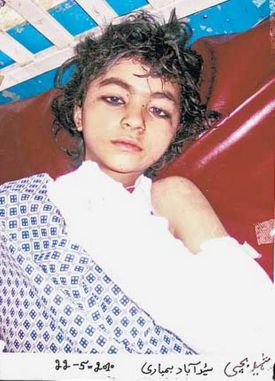
Jefferson Morley writes: Around midnight on May 21, 2010, a girl named Fatima was killed when a succession of U.S.-made Hellfire missiles, each of them five-feet long and traveling at close to 1,000 miles per hour, smashed a compound of houses in a mountain village of Mohammed Khel in North Waziristan along the Afghanistan-Pakistan border. Wounded in the explosions, which killed a half dozen men, Fatima and two other children were taken to a nearby hospital, where they died a few hours later.
Behram Noor, a Pakistani journalist, went to the hospital and took a picture of Fatima shortly before her death. Then, he went back to the scene of the explosions looking for evidence that might show who was responsible for the attack. In the rubble, he found a mechanism from a U.S.-made Hellfire missile and gave it to Reprieve, a British organization opposed to capital punishment, which shared photographs of the material with Salon. Reprieve executive director Clive Stafford Smith alluded to the missile fragments in an Op-Ed piece for the New York Times last fall. They have also been displayed in England.
“Forensically, it is important to show how the crime of murder happened (which is what it is here),” said Stafford Smith in an email. “One almost always uses the murder weapon in a case. But perhaps more important, I think this physical proof — this missile killed this child — is important to have people take it seriously.”
In the religious rhetoric used by al-Qaida’s online allies, Fatima was a “martyr.” In a statement quoted by Long War Journal, the al-Ansara forum said the senior al-Qaida commander Mustafa Abu Yazid had been killed in a “convoy of martyrs on the road with his wife and three daughters and his granddaughter; men, women and children; neighbors and loved ones.” But Fatima was not Yazid’s daughter, according to Noor, who reported from the scene. She was the daughter of another man who lost two wives and three children in the barrage.
In the euphemistic jargon of Washington, Fatima was “collateral damage” in the successful effort to assassinate Yazid, an Egyptian jihadist also known as Saeed al-Masri. In disregard for the official secrecy that envelops the drone war, U.S. intelligence officials leaked the classified details of the attack, telling the New York Times that they considered Yazid to be al-Qaida’s “No. 3 leader.” Relying on similar sources, the Washington Post said that al-Masri was the group’s “chief organizational manager.” Unlike other news organizations reporting on the attack, neither the Post nor the Times mentioned that women and children had been killed in the attack. [Continue reading…]
This website or its third-party tools use cookies, which are necessary to its functioning. By closing this banner, you agree to the use of cookies.