Syria opposition group is routed and divided

The New York Times reports: The main Syrian exile opposition group suffered a serious fracture on Wednesday as several prominent members resigned, calling the group autocratic, dominated by the Muslim Brotherhood and powerless to help Syrian rebels as government forces, having flushed insurgent strongholds in the north, swept into the rebellious southern city of Dara’a.

The government’s near-complete takeover of the cities of Homs and Idlib fueled frustration with the exile group, the Syrian National Council, said one activist who had resigned, Kamal al-Labwani, a respected dissident released from Syrian prison last year halfway through a 12-year sentence.

Activists have said hundreds of people were killed in Homs alone as rebel fighters, their pleas for weapons unanswered, were heavily outgunned by the Syrian military.

“What happened in Homs is betrayal,” Mr. Labwani said in an interview. “There is a sense of irresponsibility on the part of the council.”

The council, he added, was in danger of causing splits in Syrian society by failing to create a single rebel military command under its control, leaving individual militias to seek their own sources of help. He accused Muslim Brotherhood members within the exile opposition of “monopolizing funding and military support.”

The 270-member council has been plagued by internal disagreements. A member of its executive committee, Samir Nachar, played down the latest frictions, saying the members had not submitted formal resignations and were simply frustrated at their exclusion from a meeting with the United Nations special envoy, Kofi Annan.

But this time the departing members include some well-known members with deep credibility among Syrians both inside and outside the country, including Mr. Labwani and Haitham Maleh, an executive committee member and lawyer in his 80s who served many years in prison after defending Syrian dissidents, including Muslim Brotherhood members.

Mr. Maleh could not be reached for comment, but told Al Jazeera that he had resigned because of chaos within the group and doubt over what it could accomplish, adding, “We have not gotten very far in working to arm the rebels.”


Facebooktwittermail

Secret Assad emails lift lid on life of Syrian leader’s inner circle

The Guardian reports: Bashar al-Assad took advice from Iran on how to handle the uprising against his rule, according to a cache of what appear to be several thousand emails received and sent by the Syrian leader and his wife.

The Syrian leader was also briefed in detail about the presence of western journalists in the Baba Amr district of Homs and urged to “tighten the security grip” on the opposition-held city in November.

The revelations are contained in more than 3,000 documents that activists say are emails downloaded from private accounts belonging to Assad and his wife Asma.

The messages, which have been obtained by the Guardian, are said to have been intercepted by members of the opposition Supreme Council of the Revolution group between June and early February.

The documents, which emerge on the first anniversary of the rebellion that has seen more than 8,000 Syrians killed, paint a portrait of a first family remarkably insulated from the mounting crisis and continuing to enjoy a luxurious lifestyle.

They appear to show the president’s wife spending thousands of dollars over the internet for designer goods while he swaps entertaining internet links on his iPad and downloads music from iTunes.

As the world watched in horror at the brutal suppression of protests across the country and many Syrians faced food shortages and other hardships, Mrs Assad spent more than £10,000 on candlesticks, tables and chandeliers from Paris and instructed an aide to order a fondue set from Amazon.

Facebooktwittermail

Libya to take control of borders from militias

AFP reports: Libya’s government said Wednesday it is preparing to take over control of its border crossings and airports, including in Tripoli, from former rebels that fought to oust Moamer Kadhafi.

Government spokesman Nasser al-Manaa said the topic was discussed at a meeting on Tuesday between the government, the ruling National Transitional Council and militia leaders.

After the meeting, “the thwars (former rebels) agreed to provide the airports and border points” to the authorities, Manaa told a news conference in the Libyan capital.

“The government will today begin the process of taking control” of these facilities, including Tripoli airport and the port of Misrata, in an “important step to strengthen confidence in the state,” he said.

BBC News reports: Two British journalists who were detained by a Libyan militia group last month have been handed over to the Libyan Interior Ministry.

Nick Davies-Jones and Gareth Montgomery-Johnson work for the Iranian news channel Press TV.

They were detained on 22 February and accused of working in the country illegally.

The UK embassy in Tripoli said it was following developments closely and providing full consular support.

The sister of Mr Montgomery-Johnson, Mel Gribble, said the UK Foreign Office had confirmed to her that the two men were no longer being held by the militia.

Bloomberg reports: Libya’s bourse, closed for more than a year as armed conflict ended Muammar Qaddafi’s four- decade rule, resumes trading of nine stocks today and aims to list at least three more in 2012 as the economy stabilizes.

The Libyan Stock Exchange, whose average daily trading totaled no more than 400,000 dinars ($318,000) a day prior to closing in February 2011, will trade most of the 12 previously listed shares such as United for Insurance, General Manager Ahmed Karoud said in an interview yesterday. Three to four initial public offerings are likely this year, he said.

Libya, North Africa’s biggest oil producer, has restored 75 percent of pre-war production levels, pumping as much as 1.2 million barrels a day, Prime Minister Abdurrahim el-Keib said this month. The economy, which the International Monetary Fund said in January may have contracted by 60 percent last year, is projected to recover in 2012, “concurrent with an improvement in the security situation,” the fund said.

“There’s stability in Libya,” Karoud said in an interview at his office yesterday. “The stock market will be one of the economic activities in the coming period in order to reconstruct Libya.”

The bourse, located in the capital Tripoli, remains small, with a market value of about $3.1 billion compared with $65.8 billion for the Egyptian market, North Africa’s biggest.

While the tumble in growth may have slowed, political tension remain. Mustafa Abdel Jalil, the head of the National Transitional Council, said March 7 he is ready to defend national unity by force. His remarks came a day after political and tribal leaders declared a semi-autonomous region in the country’s oil-rich east.

“We are going to require more stability in the country — this is a must,” Rami Sidani, the Dubai-based head of Middle East and North Africa investments at Schroder Investment Management, said by telephone yesterday. “We perceive Libya as a great place that offers great growth potential eventually but we believe it’s at a very early stage given the political uncertainty we see at the moment.”

Facebooktwittermail

U.S. officials continue to conceal the identity and now whereabouts of accused soldier

Over three days after 16 Afghan citizens were murdered, U.S. military officials have still not revealed the identity of the American soldier who is believed to have shot them.

Earlier today the Associated Press reported:

Afghan lawmakers have demanded that the shooter, identified by U.S. officials as a staff sergeant, face a public trial inside Afghanistan. They have called on Afghan President Hamid Karzai to suspend any negotiations with the U.S. on a long-term military pact until this happens.

“No final decision has been made yet” on the location of the trial, said Col. Gary Kolb, a U.S. military spokesman in Afghanistan.

“We have done court martials in Afghanistan before, so we have the capability,” Kolb said. “They’ll take a look at all the circumstances and determine if they do it here or if it goes back to the States.”

The AP now reports that the soldier has been whisked out of the country:

The soldier was taken aboard a U.S. military aircraft to a “pretrial confinement facility” in another country, the official said, but would not confirm if that meant an American military base or another type of facility. The official spoke anonymously because the information had not yet been publicly announced.

The official did not provide a reason for the move, saying only that legal proceedings would continue outside of Afghanistan.

Facebooktwittermail

If Netanyahu doesn’t strike Iran, will he launch another war on Gaza instead?

Did Benjamin Netanyahu return from his recent trip to Washington with some unsatisfied bloodlust?

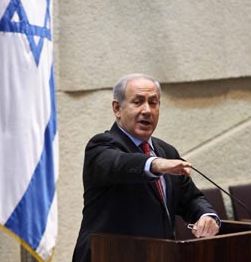
It seems increasingly unlikely that Israel will go it alone and attack Iran’s nuclear facilities without American support. In the Knesset today, Netanyahu said: “Over time we will discover that our relationship with the United States is becoming stronger and closer.”
That’s the kind of statement one might expect from a prime minister who’s reconciling himself to the idea that the current U.S. president will probably be around for a lot longer than the Israeli leader had initially hoped.

As much as he might trumpet Obama’s recognition that Israel has the right to defend itself, Netanyahu’s emphasis on Israel’s autonomy looks more than anything else like a way of justifying his deference to American demands to give sanctions and diplomacy a chance.

But if under pressure from the U.S. and from his own military and intelligence advisers the Israeli prime minister has been forced back down somewhat from his aggressive posture towards Iran, no doubt he wants to do it in a way through which he can avoid losing face.

If Netanyahu can’t order bombs to be dropped on Iran, then maybe he can satisfy his need to look strong by slaughtering Palestinians instead.

Here’s how he now justifies that latest (and next?) round of blood-spilling:

“Make no mistake,” he stated, “Gaza is Iran. The missiles are Iran, the money is Iran, the infrastructure is Iran and in many cases the instruction are form Iran. Gaza is a front post for Iran.

“Iran has been allowed into Gaza – and will take it out of Gaza,” he continued. Netanyahu’s speech was interrupted several times by Arab MKs, who were called to order by Knesset Speaker Reuven Rivlin.

“Our enemies must know that Israel will not tolerate an Iranian terror base in Gaza Strip and sooner or later it will be ripped out.”

And what will this “ripping” entail? Cast Lead Two?

The fact that Hamas has very publicly parted ways with Iran is apparently of no consequence to those in Israel who have a religious devotion to symbols of hatred. That Hamas even went so far as to say that it would not involve itself in a war between Israel and Iran, supposedly means nothing.

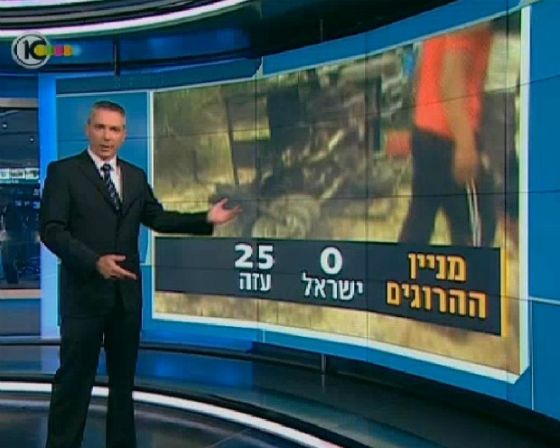
The constituency that Netanyahu is reaching out to is presumably the same one that responds well to images like this:

Ami Kaufman, at +972, caught this. It shows Alon Ben David, the military correspondent for Israel’s Channel 10, presenting the “score” from this weekend’s violence: “Death toll: Israel: 0, Gaza: 25”

Facebooktwittermail

Why is President Obama keeping a journalist in prison in Yemen?

Jeremy Scahill writes: On February 2, 2011, President Obama called Yemeni President Ali Abdullah Saleh. The two discussed counterterrorism cooperation and the battle against Al Qaeda in the Arabian Peninsula. At the end of the call, according to a White House read-out, Obama “expressed concern” over the release of a man named Abdulelah Haider Shaye, whom Obama said “had been sentenced to five years in prison for his association with AQAP.” It turned out that Shaye had not yet been released at the time of the call, but Saleh did have a pardon for him prepared and was ready to sign it. It would not have been unusual for the White House to express concern about Yemen’s allowing AQAP suspects to go free. Suspicious prison breaks of Islamist militants in Yemen had been a regular occurrence over the past decade, and Saleh has been known to exploit the threat of terrorism to leverage counterterrorism dollars from the United States. But this case was different. Abdulelah Haider Shaye is not an Islamist militant or an Al Qaeda operative. He is a journalist.

Unlike most journalists covering Al Qaeda, Shaye risked his life to travel to areas controlled by Al Qaeda and to interview its leaders. He also conducted several interviews with the radical cleric Anwar al Awlaki. Shaye did the last known interview with Awlaki just before it was revealed that Awlaki, a US citizen, was on a CIA/JSOC hit list. “We were only exposed to Western media and Arab media funded by the West, which depicts only one image of Al Qaeda,” recalls his best friend Kamal Sharaf, a well-known dissident Yemeni political cartoonist. “But Abdulelah brought a different viewpoint.”

Shaye had no reverence for Al Qaeda, but viewed the group as an important story, according to Sharaf. Shaye was able to get access to Al Qaeda figures in part due to his relationship, through marriage, to the radical Islamic cleric Abdul Majid al Zindani, the founder of Iman University and a US Treasury Department–designated terrorist. While Sharaf acknowledged that Shaye used his connections to gain access to Al Qaeda, he adds that Shaye also “boldly” criticized Zindani and his supporters: “He said the truth with no fear.”

While Shaye, 35, had long been known as a brave, independent-minded journalist in Yemen, his collision course with the US government appears to have been set in December 2009. On December 17, the Yemeni government announced that it had conducted a series of strikes against an Al Qaeda training camp in the village of al Majala in Yemen’s southern Abyan province, killing a number of Al Qaeda militants. As the story spread across the world, Shaye traveled to al Majala. What he discovered were the remnants of Tomahawk cruise missiles and cluster bombs, neither of which are in the Yemeni military’s arsenal. He photographed the missile parts, some of them bearing the label “Made in the USA,” and distributed the photos to international media outlets. He revealed that among the victims of the strike were women, children and the elderly. To be exact, fourteen women and twenty-one children were killed. Whether anyone actually active in Al Qaeda was killed remains hotly contested. After conducting his own investigation, Shaye determined that it was a US strike. The Pentagon would not comment on the strike and the Yemeni government repeatedly denied US involvement. But Shaye was later vindicated when Wikileaks released a US diplomatic cable that featured Yemeni officials joking about how they lied to their own parliament about the US role, while President Saleh assured Gen. David Petraeus that his government would continue to lie and say “the bombs are ours, not yours.” [Continue reading…]

Facebooktwittermail

Obama needs to go whole mile on Iran diplomacy

Vali Nasr writes: Last week, President Barack Obama skillfully shifted the debate on Iran, pushing back against “idle talk of war” and making the case for diplomacy.

To make it work, the U.S. now needs a clear road map to show allies and the American people how serious and sustained talks with Iran can bear fruit.

Since November, the administration’s policy of applying pressure to compel Iran to negotiate has rushed instead toward conflict. A worrying International Atomic Energy Agency report on Iran’s nuclear activity in that month prompted a new round of crippling sanctions against Iran’s central bank and oil industry. Iran responded by threatening to close the Strait of Hormuz and cut off oil sales to parts of Europe. Israel and the U.S. administration’s Republican critics concluded that the one- two punch of sanctions and talks wasn’t working, and it was time to go to war.

The president stood his ground to get the pressure-and-talk strategy back on track, and there are some hopeful signs that he did the right thing. Iranian Supreme Leader Ayatollah Ali Khamenei endorsed Obama’s defense of diplomacy, describing the U.S. president’s talk of a window of opportunity as “good words.” He also repeated his 1995 fatwa that building nuclear weapons is a “great sin.”
Clear Signal

This was meant as a clear signal to the international community that Iran would not cross Obama’s red line. Equally important, Khamenei’s intervention put an end to talk inside Iran that the country should now build nuclear weapons to protect itself against further Western pressure and any potential military attack. The fatwa and a straightforward letter from Iran’s chief nuclear negotiator, Saeed Jalili, declaring Iran’s readiness to resume talks has given the U.S. administration hope that this time, diplomacy may succeed. After all, the environment for the talks today is better than at any other time since Obama took office in 2009. Economic pressure on Iran is cutting to the bone, and a grave crisis looms if things don’t change.

At the same time, Iran’s parliamentary elections on March 2 to some extent repaired the political damage that Khamenei suffered in the 2009 election fiasco, when Iranian authorities jailed opposition leaders and violently suppressed large-scale protests against ballot-box fraud. The appearance of normality on voting day this month and the mandate Khamenei received when his supporters trounced those of President Mahmoud Ahmadinejad have left the supreme leader stronger. Ahmadinejad’s drubbing means there is now only one decision maker in Tehran — and to everyone’s relief, it is not Ahmadinejad. [Continue reading…]

Facebooktwittermail

The killing of Zuhair al-Qaissi exposes Israel’s attitude to its supreme court

Mya Guarnieri writes: The recent escalation between Israel and Gaza began after Israeli forces assassinated Zuhair al-Qaissi, a leader of the Popular Resistance Committees (PRC), a militant group composed of members of various Palestinian parties. Haaretz noted that the PRC was “the organisation that captured Gilad Shalit”, the Israeli soldier who was freed in October 2011. The army says that al-Qaissi was behind the August 2011 attack that took place on the Israeli-Egyptian border – even though the PRC denied involvement and it was later revealed that the militants came from Sinai, not Gaza.

While army sources took care to point out al-Qaissi’s alleged involvement in the August 2011 incident, his assassination wasn’t just an act of punishment. No, Israel killed him on the basis of secret evidence – evidence that is not subject to legal or judicial review – that supposedly proves that al-Qaissi was planning a terror attack. Never mind that the Israeli supreme court’s December 2006 ruling placed numerous restrictions on such assassinations.

Fatmeh el-Ajou, an attorney with Adalah, the legal centre for Arab minority rights in Israel, explains that while the judgment did not place a blanket prohibition on targeted killings, it stated that the decision to carry out an assassination must be made on a case-by-case basis, “depending on the evidence that [security forces] have”. But, without seeing the security forces’ secret evidence, it’s impossible to know if al-Qaissi was indeed planning an attack, and if the army was in line with the 2006 ruling. There’s no transparency in this so-called democracy and, without transparency, there is no accountability to the state’s highest court. “From the perspective of human rights law,” el-Ajou adds, “assassinations are not legitimate … They should only be carried out if there is a ‘ticking bomb.’ [Suspects] should be brought to trial.”

Facebooktwittermail

Why I am leaving Goldman Sachs

Greg Smith is resigning today as a Goldman Sachs executive director and head of the firm’s United States equity derivatives business in Europe, the Middle East and Africa. In an op-ed for the New York Times, Smith describes as the company’s toxic and destructive culture.

What are three quick ways to become a leader? a) Execute on the firm’s “axes,” which is Goldman-speak for persuading your clients to invest in the stocks or other products that we are trying to get rid of because they are not seen as having a lot of potential profit. b) “Hunt Elephants.” In English: get your clients — some of whom are sophisticated, and some of whom aren’t — to trade whatever will bring the biggest profit to Goldman. Call me old-fashioned, but I don’t like selling my clients a product that is wrong for them. c) Find yourself sitting in a seat where your job is to trade any illiquid, opaque product with a three-letter acronym.

Today, many of these leaders display a Goldman Sachs culture quotient of exactly zero percent. I attend derivatives sales meetings where not one single minute is spent asking questions about how we can help clients. It’s purely about how we can make the most possible money off of them. If you were an alien from Mars and sat in on one of these meetings, you would believe that a client’s success or progress was not part of the thought process at all.

It makes me ill how callously people talk about ripping their clients off. Over the last 12 months I have seen five different managing directors refer to their own clients as “muppets,” sometimes over internal e-mail. Even after the S.E.C., Fabulous Fab, Abacus, God’s work, Carl Levin, Vampire Squids? No humility? I mean, come on. Integrity? It is eroding. I don’t know of any illegal behavior, but will people push the envelope and pitch lucrative and complicated products to clients even if they are not the simplest investments or the ones most directly aligned with the client’s goals? Absolutely. Every day, in fact.

It astounds me how little senior management gets a basic truth: If clients don’t trust you they will eventually stop doing business with you. It doesn’t matter how smart you are.

These days, the most common question I get from junior analysts about derivatives is, “How much money did we make off the client?” It bothers me every time I hear it, because it is a clear reflection of what they are observing from their leaders about the way they should behave. Now project 10 years into the future: You don’t have to be a rocket scientist to figure out that the junior analyst sitting quietly in the corner of the room hearing about “muppets,” “ripping eyeballs out” and “getting paid” doesn’t exactly turn into a model citizen.

Facebooktwittermail

Saudi protests spread to different cities

Al-Akhbar reports: Protests have spread to a number of cities in Saudi Arabia following the suppression of a demonstration held by female students at a university last Wednesday, the Arab Network for Human Rights Information (ANHRI) said on Tuesday.

The Cairo-based NGO released a statement saying the anger of students has spread and “gone beyond [the city of] Abha to larger parts of the Kingdom of Saudi Arabia,” where “several protests have taken place in the cities of Riyadh, al-Namas, Ar’ar, Qatif, and al-Rabeeah.”

Tensions have been high since security forces cracked down on a group of female students demanding reform at the King Khaled University last week.

Facebooktwittermail

The plight of Syria

The Associated Press reports: In northern Syria, the Observatory and another activist group, the Local Coordination Committees, reported intense clashes between government troops and rebels in the town of Maaret al-Numan, in Idlib province, on Sunday night.

The U.N. refugee agency said 230,000 Syrians have fled their homes since the uprising against Assad’s regime began last year. The U.N. says more than 7,500 people have been killed in the past 12 months.

Panos Moumtzis, the UNHCR’s coordinator for Syria said 30,000 people have already fled to Turkey, Lebanon and Jordan and “on a daily basis hundreds of people are still crossing into neighboring countries.”

Moumtzis said at least 200,000 people were also displaced within the country, according to the Syrian Arab Red Crescent.

BBC diplomatic correspondent Jonathan Marcus writes: Since the outset of the Syria crisis in March 2011 there has been little appetite for outside military intervention. This has been based on two assessments.

Firstly, that the situation on the ground in Syria is in many ways very different from that in Libya – the opposition is much more divided, the government’s security forces are much stronger, and Syria’s air defences are more effective.

Secondly, there has been a view that the implications of toppling President Bashar al-Assad could prompt a much wider wave of instability in the region.

Unlike Libya, Syria – both politically and geographically – is a central player in the Arab world, and sectarianism and instability there could threaten both Lebanon and Iraq.

Then, of course, there is the fundamental legal problem. Constrained by Russian and Chinese vetoes at the UN Security Council, there is no possibility of getting a resolution to authorise force.

That has not always mattered in the past. Nato troops went into Kosovo, after all, to halt systematic abuses by Serbian forces.

But the absence of legal authorisation certainly precludes action when there is little enthusiasm for it in the first place.

So what are we to make of calls from senior Republican politicians in the US, like Senator John McCain, urging air strikes against Syrian security forces?

Joshua Landis, director of the Centre for Middle East Studies at the University of Oklahoma, says: “Despite the growing chorus of politicians calling for US leadership in Syria, the Obama administration is adamant that Washington should not take the lead, but follow regional partners, Saudi Arabia and Turkey.”

Mr Landis argues that the simple fact is that the Obama administration sees no strong reason to intervene.

“US officials are unanimous in arguing that the Assad regime is doomed and can only hang on for a limited time, with or without increased US support for the Syrian opposition. I think they are right in this analysis.”

“This means that the US has no compelling national security interest in jumping into the Syrian civil war that is emerging. The regime’s days are numbered.”

Facebooktwittermail

… as if it were our own citizens

“The United States takes this as seriously as if it was our own citizens, and our children, who were murdered,” President Obama said today, referring to the 16 Afghan citizens who were apparently killed by a single American soldier before dawn on Sunday morning. “We’re heartbroken over the loss of innocent life.”

Yet more than two days after the shooting, the Pentagon has still not named the suspect.

Contrast this with the 2011 Tuscon shooting in which six people died and Jared Lee Loughner’s name and photo were being published by every mainstream media outlet within hours.

The unnamed soldier responsible for Sunday’s massacre will likely become the only American soldier whose name the people of Afghanistan never forget.

As much as the White House and the Pentagon work to present this turn of events as an aberration, it will for most Afghans and much of the world come to symbolize America’s involvement in a country few Americans knew anything about before 9/11 and just as few care much about now.

Once this soldier’s name is eventually made public it seems likely that whatever motivated him to go on a brutal yet systematic rampage, his actions will be portrayed as the product of the singular workings of his own mind or damaged brain. The Pentagon will present this as the story of soldier X — not the closing chapter in an ill-conceived war.

But there might be another reason the suspect has not already been named.

Two of the villagers who lost relatives insist that at least two soldiers took part in the shootings, according to the Associated Press.

One Afghan guard saw a U.S. soldier leave the base at 1.30am. This guard’s replacement also saw a soldier leave at 2.30am. It has yet to be determined whether this was the same soldier.

In the event that there was indeed more than one soldier involved in the shooting, the narrative of an aberrant possibly brain-damaged individual, falls apart.

This would not only be a mass murder but also a conspiracy and it could no longer be attributed to the cognitive or moral degeneration of one mind.

The more slowly the facts emerge, the more one has to wonder whether it is because they are so hard to determine or because there is looming fear about where the facts might lead.

Facebooktwittermail

What if democracy is just an illusion?

John Stoehr writes: Karl Marx never visited the United States, but he nevertheless understood the country, because he understood capitalism. As you know, there’s no American ideology that’s mightier than capitalism. Equality, justice and the rule of law are nice and all, but money talks.

In their 1846 book The German Ideology, Marx and co-author Frederick Engels took a look at human history and made a plain but controversial observation. In any given historical period, the ideas that people generally think are the best and most important ideas are usually the ideas of the people in charge. If you have a lot of money and own a lot of property, then you have the power to propagandise your worldview and you have incentive to avoid appearing as if you’re propagandising your worldview. Or, as Marx and Engels would put it: The ruling ideas of every epoch are the ideas of the ruling class.

The ideas of the one per cent become the dominant ideas because the one per cent convinces the 99 per cent that its ideas are the only rational and universally valid ideas. Consider free-market capitalism. The idea says that growth provides prosperity to all, that government governs best when it governs least, so there’s no need to discuss the redistribution of wealth. That’s neoliberalism and that idea has been the only acceptable economic policy since the Clinton era. Former Federal Reserve Chairman Alan Greenspan was its greatest champion. After the collapse of the housing market, he said he was dead wrong. Even so, the idea remains dominant. Why? Forgive me for pointing out the obvious, but the ruling class happens to make a lot of money from a free market.

Americans tend to look askance at Marx and I don’t blame them. He was, after all, the father of socialism, as well as the guy associated with Josef Stalin, who was, you know, a homicidal totalitarian dictator. But as philosopher John Gray has noted, Marx got a lot wrong about Marxism but he got a lot right about capitalism. He understood that ideas don’t exist in bubbles – they have a concrete material context and have a human cost.

The late Steve Jobs, for instance, was a man of ideas. He was widely considered a visionary and a prophet of technology, and Jobs took great pains to encourage that way of thinking. After his death, however, Mike Daisey, the acclaimed playwright and monologuist, revealed something about Jobs that should have been plain to see – Jobs’ prophecies came at the expense of poor Chinese sweatshop workers who make iPads and other Apple products for middle-class Americans to buy at affordable prices. The Great Man theory of history is more like intellectual cover (or what Marx called the illusions of the ruling class), for the exploitation of labour. [Continue reading…]

Facebooktwittermail

Diplomacy with Iran: Hey, what’s the hurry?

Tony Karon writes: Such is the chasm between Washington and Tehran that last week’s comments by Iran’s Supreme Leader Ayatullah Ali Khamenei on President Barack Obama’s recent speech verged on geopolitical flirting: “We heard two days ago that the U.S. president said that (they) are not thinking about war with Iran,” said Khamenei. “These words are good words and an exit from delusion.” He also spoke of a “window of opportunity” for a diplomatic solution to the standoff over Iran’s nuclear program — echoing President Obama’s sentiments in his address to the America Israel Public Affairs Committee (AIPAC).

Nobody expects that the exchange marks the beginning of a beautiful friendship, of course, but both sides may have reasons to at least keep the other interested in a protracted courtship.Obama had certainly issued something of a diplomatic come-on, noting appreciatively in an interview with The Atlantic that the Supreme Leader had reiterated just weeks ago that nuclear weapons are “a sin against Islam” and that Iran doesn’t want them. “The point is that for them to prove to the international community that their intentions are peaceful and that they are, in fact, not pursuing weapons, is not inconsistent with what they’ve said,” Obama said. “So it doesn’t require them to knuckle under to us. What it does require is for them to actually show to the world that there is consistency between their actions and their statements.”

Such soothing words across the epic divide are hardly naive: Both men are well aware of the difficulty they’ll face in securing any rapprochement, and neither may be particularly interested in a long-term relationship. Obama emphasized that Iran would have to earn the trust of the international community regardless of its statements, and his Administration also painted Khamenei’s comments on nuclear weapons being “sinful” as if they had come in response to the growing pain inflicted by sanctions. (In fact, Khamenei was simply reiterating a position he’d first publicized in an August 2005 fatwa.) Khamenei scolded Obama for suggesting that sanctions would bring Iran to its knees, and warned that Iran would not bow under pressure and threats.

The fact that both sides are expressing some openness to tamping down tensions — and plan to resume nuclear talks through the format of the P5+1, a group comprising the U.S., Britain, France, Germany, China and Russia that negotiates nuclear issues with Iran — has certainly reassured oil markets, which fell last week on the news of renewed negotiations after being ratcheted up by war talk. Curiously enough, though, whereas Iran is typically accused of “playing for time” at the negotiating table, this time around the P5+1 may have their own reasons for taking things slowly. While Iran is steadily acquiring the technological capability that would enable it to create a bomb, Western powers don’t believe Tehran is racing to build nuclear weapons. And they have become increasingly concerned in recent months about stopping Israel from launching a potentially disastrous war by bombing Iran’s nuclear facilities.

Facebooktwittermail

Latest Israeli assault on Gaza was “mini-drill” prior to attack on Iran

What was initially described as an operation designed to foil a “major terror attack” is now being described as a “mini-drill” in preparation for an Israel attack on Iran, Reuters reports.

Israel has emerged from the past few days of fighting with Palestinians in Gaza more confident that its advanced missile shield and civil defenses can perform well in any war with Iran.

Describing how the flare-up in violence had provided an impromptu opportunity to test out Israel’s defenses, one Israeli official said on Tuesday it gave useful indicators for any potential conflict with Tehran: “In a sense, this was a mini-drill,” the official said, speaking on condition of anonymity.

“There are significant differences, of course, but the basic principles regarding the ‘day after’ scenarios are similar,” the official added, alluding to Iran’s threat to respond to any “pre-emptive strike” on its nuclear facilities by firing missiles at Israel.

Employing a similar doctrine of pre-emption against Palestinians, Israel killed two senior militants in a Gaza air strike on Friday, accusing them of planning a major attack on its citizens through the territory of neighboring Egypt.

Subsequent violence killed another 23 Palestinians and wounded three Israelis before a truce took hold on Tuesday.

That southern Israel weathered the scores of short-range rockets coming in from Gaza, with sirens summoning around a million citizens to cover and the Iron Dome aerial shield providing extra protection, was savored – warily – by Israeli defense officials.

“The Israeli home front has shown once more that it can deal with the challenges,” the armed forces’ commander, Lieutenant-General Benny Gantz, told reporters.

Though he described the cumulative threat from surrounding armies and guerrillas as “significant and abundant”, Gantz said: “I am convinced that our enemies understand the balance we have between a comfortable defense capability and our offensive capabilities, which we will use as required.”

Facebooktwittermail