The origins and future of Occupy Wall Street

Mattathias Schwartz, writing for the New Yorker, traces the genesis of Occupy Wall Street, identifies a few individuals — such as Adbusters‘ Kalle Lasn and Micah M White — who certainly had a catalytic role in the movement’s formation, but finds that so far, it remains leaderless.

Those who were around at the beginning of the Occupy Wall Street movement talk about the old “vertical” left versus the new “horizontal” one. By “vertical,” they mean hierarchy and its trappings—leaders, demands, and issue-specific rallies. They mean social change as laid out by Saul Alinsky’s “Rules for Radicals” and Barack Obama’s “Dreams from My Father,” where outside organizers spur communities to action. “Horizontal” means leaderless—like the 1999 W.T.O. protests in Seattle, the Arab Spring, and even the Tea Party. Anyone can show up at a general assembly and claim a piece of the movement. This lets people feel important immediately, and gives them implicit permission to take action. It also gives a disproportionate amount of power to people like Sage [a homeless New Yorker who scornfully calls his fellow Zuccotti Park occupants, “tourists”].

One influence that is often cited by the movement is open-source software, such as Linux, an operating system that competes with Microsoft Windows and Apple’s OS but doesn’t have an owner or a chief engineer. A programmer named Linus Torvalds came up with the idea. Thousands of unpaid amateurs joined him and then eventually organized into work groups. Some coders have more influence than others, but anyone can modify the software and no one can sell it. According to Justine Tunney, who continues to help run OccupyWallSt.org, “There is leadership in the sense of deference, just as people defer to Linus Torvalds. But the moment people stop respecting Torvalds, they can fork it”—meaning copy what’s been built and use it to build something else.

In mid-October, supporters in Tokyo, Sydney, Madrid, and London held rallies; encampments sprang up in almost every major American city. Nearly all of them modelled themselves on the New York City General Assembly: with no official leaders, rotating facilitators, and no fixed set of demands. Today, endorsements of the Occupy movement can be found everywhere, from anarchist graffiti on bank walls to Al Gore’s Twitter feed. On a rain-smeared cardboard sign near the shattered window of an Oakland coffee shop that had been destroyed by a cadre of anarchists during a nighttime clash with police, someone wrote, “We’re sorry, this does not represent us.” Below that, someone else wrote, “Speak for yourself.”

At times, horizontalism can feel like utopian theatre. Its greatest invention is the “people’s mike,” which starts when someone shouts, “Mike check!” Then the crowd shouts, “Mike check!,” and then phrases (phrases!) are transmitted (are transmitted!) through mass chanting (through mass chanting!). In the same way that poker ritualizes capitalism and North Korea’s mass games ritualize totalitarianism, the people’s mike ritualizes horizontalism. The problem, though, comes when multiple people try to summon the mike simultaneously. Then it can feel a lot like anarchy.

The politics of the occupation run parallel to the mainstream left—the people’s mike was used to shout down Michele Bachmann and Governor Scott Walker, of Wisconsin, in early November. But, in the end, the point of Occupy Wall Street is not its platform so much as its form: people sit down and hash things out instead of passing their complaints on to Washington. “We are our demands,” as the slogan goes. And horizontalism seems made for this moment. It relies on people forming loose connections quickly—something that modern technology excels at.

Events in New York seemed to bear out Lasn’s hunch that the temporary eviction of the protesters from Zuccotti Park was an opportunity rather than a defeat. The organizers were quickly able to regroup and agree that they should return to the park, despite the newly enforced ban on tents. Last Thursday, the movement mounted one of its largest protests to date. Demonstrators tried to shut down the New York Stock Exchange (they failed), organized a sit-in at the base of the Brooklyn Bridge, and tussled with police in Zuccotti Park. More than two hundred people were arrested. Similar Day of Action protests temporarily blocked bridges in Chicago, St. Louis, Detroit, Houston, Milwaukee, Portland, and Philadelphia.

No matter what happens next, the movement’s center is likely to shift from the N.Y.C.G.A. [New York City General Assembly], just as it shifted from Adbusters, and form somewhere else, around some other circle of people, ideas, and plans. “This could be the greatest thing that I work on in my life,” Justine Tunney, of OccupyWallSt.org, said. “But the movement will have other Web sites. Over the coming weeks and months, as other occupations become more prominent, ours will slowly become irrelevant.” She sounded as though the irrelevance of her project were both inevitable and desirable. “We can’t hold on to any of that authority,” she continued. “We don’t want to.”


Facebooktwittermail

Egypt on the edge

Wendell Steavenson writes: It was Friday today, and Tahrir Square was packed. It was in a mix of every mood I have seen it in over the past ten months: politically focussed, “The people want to topple the Marshal!”; carnival-like, with face painters and food stalls; determined, with tents and supplies and field hospitals; organized, with volunteers checking bags and I.D.s at the entrances; thuggish, with plenty of knots of young kids from poor neighborhoods; and creative: a new sign had been erected for Mohamed Mahmoud Street, renaming it, “The Street of the Eyes of Freedom”—a reference to the many who had lost their eyesight from police birdshot.

The army has built a wall out of concrete blocks on Mohamed Mahmoud Street. Doctors in white coats stand on top, as a volunteer cease-fire line. In the streets and alleys leading up to the charred stretch where the tear gas and rocks rained over between protesters and police for five days, protesters now man barbed-wire barricades, stopping kids and passersby from coming too close and provoking the authorities. The police have withdrawn; the army has replaced them, and there is a truce. But the wall that separates the crowds on Tahrir from the Military Council is actually a gulf of generation, perception, and culture. The violence may have stopped for the moment, but the clarion call for a transfer to civilian rule has not.

The Military Council is laboring under the belief that they are protecting the state of Egypt. The protesters on Tahrir see that they are protecting only the regime. Yesterday, I went to see Hossan Baghat, who runs the Egyptian Initiative for Personal Rights, an N.G.O. Baghat listed the litany of human-rights abuses, military trials, the harassment of bloggers and journalists, the interference of state and private media, the persecution of the human rights community (an investigation has been opened into the foreign funding of N.G.O.s in Egypt; he was expecting a legal summons imminently before the Square blew up again). We talked about the ongoing “bogus charges” leveled at those arrested over the past few days; the American Egyptian journalist Mona Eltahawy, held for twelve hours, her arm broken and badly groped; and worried about my friend Jehane Noujaim, a documentary filmmaker who has since been released.

He said he had recently seen the Clint Eastwood biopic about J. Edgar Hoover. “It’s almost identical!” He told me wryly. “Someone who thinks, ‘Only I am patriotic,’ that enemies within are undermining the country, and that citizens don’t have all the information that they have—now they may be against them, but one day they will be grateful. In their minds, they are protecting Egypt from outsiders.”

This mindset was illustrated in a press conference yesterday, when generals from the Military Council denied any responsibility for the recent violence or mismanagement of the transitional political process. “Egypt is not Tahrir Square,” Major General Mukhtar el-Mallah declared. “We will not relinquish power because of a slogan-chanting crowd.” Ignoring the hundreds of thousands on the square and appealing to the “silent majority” is the same mistake Mubarak made. Then they repeated the old shibboleth about third parties and foreign agendas agitating trouble to weaken Egypt, and announced a new Prime Minister, a seventy-eight-year-old former Prime Minister under Mubarak, a dinosaur with dyed black hair hauled out of retirement. The Square shrugged and rolled its eyes.

Facebooktwittermail

‘Preacher of the revolution’ electrifies Tahrir crowds

AFP reports: Once the preacher of a quiet mosque on the edge of Tahrir Square, Mazhar Shahin has become one of the most recognisable faces of the protests that ousted president Hosni Mubarak in February and which now call for the military to step down.

A roar of approval swept through the tens of thousands of demonstrators in Tahrir Square on Friday when Shahin called for the ruling generals to hand power to a government named by the protesters.

“The revolution is the one that thinks, the revolution is the one that decides, it is the one that judges,” said the cleric in his Friday prayer sermon.

“Our revolution was a body without a head. Today, the revolution will have a head,” he said of a proposed civilian government that includes opposition luminaries such as former UN nuclear watchdog chief Mohamad ElBaradei.

With his cropped beard and white turban wrapped around a red fez, Shahin looks like the traditional government-appointed mosque preacher who, for years under Mubarak’s rule extolled the regime’s virtues.

But the sheikh has become a thorn in the side of the country’s rulers — first Mubarak, and now the ruling generals — with his vigorous denunciations of their abuses and calls for protesters to hold firm to their demands.

“Few of the revolution’s demands have been met,” he told the protesters on Friday. “The people insist on completing their revolution. Either we live in dignity, or we die here in Tahrir.”

Facebooktwittermail

Egypt army officers join anti-junta protesters

Press TV reports: In Cairo, up to a million people gathered on Friday in and around Liberation Square, the focal point of a popular revolution which toppled the four-decade regime of former dictator Hosni Mubarak in February.

The protesters called for an end to the rule of the Supreme Council of Armed Forces which took over after Mubarak’s ouster, and voiced their opposition to SCAF’s nomination of Mubarak-era official Kamal el-Ganzouri as prime minister.

The calls were soon joined by Egyptians army officers, who supported popular demands for a civilian government and opposed the junta choice to head the transitional government.

“The Supreme Council of Armed Forces does not reflect the whole Egyptian army,” said Egyptian Army Captain Ahmed Shouman. “We must be in cohesion with the Egyptian people once again. This is the best way. We must resort to the essence of the revolution,” he stressed.

Shouman expressed regret about the crackdown on anti-junta protesters over the past days and described it as a sign of the despair of the remnants of the Mubarak regime, who want to stay in power.

The captain recalled that the people’s demand since the start of the uprising in Egypt has been the establishment of a civilian government. He then called for the formation of a “real parliament” representing the Egyptian people and their demands.

Facebooktwittermail

Pro-regime rally denounces Egypt’s ‘enemies’

The Guardian reports: Thumping his shoe against a poster of a television host, Ahmed Magdi called on the gathering crowd below to denounce Egypt’s enemies and back what he said was the only group that could hold the country together.

Beneath the overpass he was using as a pulpit, thousands of protesters were streaming into a roundabout in west central Cairo, to support the fragile state’s military rulers.

The flag- and banner-waving protesters, who by late afternoon was around 20,000-strong, were a varied lot. Some openly yearned for the Mubarak days. Others were standard-bearers of the 25 January revolution that overthrew the veteran leader. Another group championed Egypt’s – eventual – democratic transition; yet others thought that the military leadership should remain indefinitely.

Their common denominator was that none of them thought the Scaf (Supreme Command of the Armed Forces) should be run out of town. All instead appeared to believe the country’s combustible streets would rapidly ignite if the junta ceded power to a revived uprising that they variously described as “reckless”, “stupid” or “naive”.

But as crowds grew throughout a mild, hazy afternoon, those on the pro-regime rally seemed to know they were losing the numbers game. Though well-attended, their rally was dwarfed by renewed scenes of people power at Tahrir Square, where it all began 11 months ago.

The retort was simple. “They say they have one million, well we have 85 million,” said Mona el-Gemayel, from a nearby neighbourhood in the suburb of Abbasiya. “These people are not taking to the streets because the uncertainty scares them. People need someone to guide their steps in such times.”

Gemayel’s words had echoes of the last words uttered by former Egyptian intelligence chief Omar Suleiman when he announced that Hosni Mubarak was stepping down. Ever since, Suleiman has stayed clear of the limelight. However, now Scaf supporters hold photos of the Mubarak man in a plaintive plea for stability.

Many openly said the best way forward for Egypt was to return to a bygone era. All the senior members of Scaf were well represented on posters and in chants. And few in the boisterous crowd would countenance the idea that security forces were killing or maiming unarmed civilians in Tahrir Square.

Facebooktwittermail

Egypt’s Muslim Brotherhood continues to alienate itself from the people

Amira Nowaira writes: As the brutal crackdown against peaceful protesters in Cairo and several other Egyptian cities continued unabated for six days running, the Muslim Brotherhood stayed out of the fray, declaring clearly that it would not join the protests.

In deciding to stay away from these protests, the Brotherhood may have committed its gravest mistake to date. The footage showing a dead protester being dragged by a security officer and dumped near a rubbish heap, appearing on many satellite channels and the internet, has not only shocked and enraged Egyptians, but it has sent them out on to the streets in their thousands to protest against this outrage.

In going out they had no political calculations in mind and no gains to make. They simply wanted their voices to be heard. By staying away, the Brotherhood has sent the message that it rated its self-interest higher than Egyptian blood and its decision has angered many Egyptians, including some of its own members.

While this highlights the rift that has been growing over the past few months between the Brotherhood and a significant segment of the population, it also brings to light the various challenges facing the Brotherhood since the overthrow of Mubarak.

The first is that after having worked for most of its history as an underground movement, the Brotherhood has suddenly found itself exposed to the public gaze. While such exposure has afforded its members far more visibility and freedom of movement than they have ever enjoyed, it has also made them the object of public scrutiny, criticism and at times even scorn.

Facebooktwittermail

Van Jones and Democratic Party operatives: You do not represent the Occupy Movement

Kevin Zeese writes: The corporate media is anointing a false leader of the Occupy Movement in Van Jones of Rebuild the Dream. 

The former Obama administration official, who received a golden parachute at Princeton and the Democratic think tank Center for American Progress when he left the administration, is doing what Democrats always do—see the energy of an independent movement, race to the front, then lead it down a dead end and essentially destroy it. Jones is doing the dirty work of a Democratic operative and while he and other Dem front groups pretend to support Occupiers, their real mission is to co-opt it. 

Glenn Greenwald says in a recent blog, “White House-aligned groups such as the Center for American Progress have made explicity clear that they are going to try to convert OWS into a vote-producing arm for the Obama 2012 campaign.”

Before he ran to the front of the Occupy Movement, Jones’ Rebuild the Dream had been saying that its first task was to elect Democrats. Now he is claiming there will be 2000 “99% candidates” in 2012. These Democrats will be re-branded as part of the 99% movement. Democrats will now be re-labeled and marketed as part of the 99% movement. Republican operatives did the same thing to the Tea Party.  Tea Party candidates, who often used to be corporate “Club for Growth” candidates, ran in the Republican Party.  See, e.g. Senator Pat Toomey – before and after.

Jones is urging the Occupy Movement to “mature” and move on to an electoral phase. This would only make us a sterile part of the very problem we oppose. The electoral system is a corrupt mirage where only corporate-approved candidates are allowed to be considered seriously. At Occupy Washington, DC, we recognize that putting our time, energy and resources into elections will not produce the change we want to see. What we need to do right now is build a dynamic movement supported by independent media that stands in stark contrast to both corporate-bought-and-paid-for parties.  

Facebooktwittermail

Petroleum junkies of the world, unite!

Craig Collins writes: It took me years to realize that our supercharged lifestyle depends on a vanishing supply of fossil fuels and cannot possibly be reproduced on a global scale. If the people of China lived like Americans, there would be more cars in China than there are in the entire world today. Their cars would need all of the oil the world produces plus fifteen million extra barrels a day. China would consume two-thirds of the world’s grain harvest, burn more coal than the entire world uses today and use twice as much paper. And this is just China. The Earth simply does not have enough land, water and hydrocarbons for everyone to live the high-energy lifestyle of Americans. In fact, America’s coveted lifestyle is running on empty and on the verge of going bust, like the boomtowns that became ghost towns after the gold rush panned out.

Throughout the 20th century, the world was preoccupied with modernity, progress, science and technology, yet no one was crediting the amazing energy source that made it all possible. Even today, we routinely underestimate and overlook the unique characteristics that have made fossil fuels the energy source that has utterly transformed human life on this planet.

Fossil fuels are the most concentrated, versatile, inexpensive energy source ever discovered. Energy is the capacity to do work and we have harnessed fossil fuels to do unbelievable amounts of it. There are about 23,000 human labor hours (12.5 years at 40 hours per week) in every barrel of oil and humans use about 85 million barrels of oil every day. Just one gallon of gas can do as much work as 350 to 500 hours of hard human labor. How much would you expect to be paid for 350 to 500 hours of hard work? At $15 an hour, your labor would be worth between $5,250 and $7,500 dollars. Now compare that with how much you spend for a gallon of gas.

Modern industry and agriculture would be impossible without fossil fuels. According to Michael Pollan, it takes about ten calories of fossil energy to produce and transport each calorie of supermarket food we eat. In the United States, food typically travels between 1,500 and 2,500 miles from farm to plate. Supermarkets and fast food chains survive on a life support system of cheap fossil fuels. Agricultural machinery, irrigation systems, petrochemical pesticides and fertilizers, huge centralized feedlots, slaughterhouses, food processors and refrigerated storage all rely on hydrocarbons – as do the trucks, ships, trains and planes that move food around the world.

Facebooktwittermail

The nationally coordinated crackdown on the Occupy movement

Naomi Wolf writes: US citizens of all political persuasions are still reeling from images of unparallelled police brutality in a coordinated crackdown against peaceful OWS protesters in cities across the nation this past week. An elderly woman was pepper-sprayed in the face; the scene of unresisting, supine students at UC Davis being pepper-sprayed by phalanxes of riot police went viral online; images proliferated of young women – targeted seemingly for their gender – screaming, dragged by the hair by police in riot gear; and the pictures of a young man, stunned and bleeding profusely from the head, emerged in the record of the middle-of-the-night clearing of Zuccotti Park.

But just when Americans thought we had the picture – was this crazy police and mayoral overkill, on a municipal level, in many different cities? – the picture darkened. The National Union of Journalists and the Committee to Protect Journalists issued a Freedom of Information Act request to investigate possible federal involvement with law enforcement practices that appeared to target journalists. The New York Times reported that “New York cops have arrested, punched, whacked, shoved to the ground and tossed a barrier at reporters and photographers” covering protests. Reporters were asked by NYPD to raise their hands to prove they had credentials: when many dutifully did so, they were taken, upon threat of arrest, away from the story they were covering, and penned far from the site in which the news was unfolding. Other reporters wearing press passes were arrested and roughed up by cops, after being – falsely – informed by police that “It is illegal to take pictures on the sidewalk.”

In New York, a state supreme court justice and a New York City council member were beaten up; in Berkeley, California, one of our greatest national poets, Robert Hass, was beaten with batons. The picture darkened still further when Wonkette and Washingtonsblog.com reported that the Mayor of Oakland acknowledged that the Department of Homeland Security had participated in an 18-city mayor conference call advising mayors on “how to suppress” Occupy protests.

To Europeans, the enormity of this breach may not be obvious at first. Our system of government prohibits the creation of a federalised police force, and forbids federal or militarised involvement in municipal peacekeeping.

I noticed that rightwing pundits and politicians on the TV shows on which I was appearing were all on-message against OWS. Journalist Chris Hayes reported on a leaked memo that revealed lobbyists vying for an $850,000 contract to smear Occupy. Message coordination of this kind is impossible without a full-court press at the top. This was clearly not simply a case of a freaked-out mayors’, city-by-city municipal overreaction against mess in the parks and cranky campers. As the puzzle pieces fit together, they began to show coordination against OWS at the highest national levels.

Facebooktwittermail

Egypt’s army is hijacking the revolution

Shashank Joshi writes: This week, Egypt exploded for one simple reason: its army crossed the line. The Egyptian military, buoyed by its apparent role as saviour of the revolution, judged that it could manipulate the country’s democratic transition to keep its privileges intact. It was wrong.

Over the last ten months, Egypt’s ruling body, the Supreme Council of the Armed Forces (SCAF), has re-imposed martial law, assaulted journalists, imprisoned people without charge and with impunity, and sharply curtailed rights of assembly and freedom of expression. Then, early this month, the government went one step too far: it released a set of “supra-constitutional principles” that would have imposed tight limits on the scope of Egypt’s new constitution.

Those principles accorded the military the status of “protector of constitutional legitimacy”, which was – quite reasonably – interpreted as a “right to launch coups”. SCAF was to be given the exclusive right to scrutinize its own budget, the right to manage “all the affairs of the armed forces” without accountability to elected legislators, and a veto over any laws relating to the army.

In short, SCAF, led by the increasingly mistrusted Field Marshal Tantawi, wants to create a political model resembling the Turkey of the 1980s or Pakistan of today – an eviscerated democracy with no control over its national security policy, weighed down by a bloated and self-serving military-industrial apparatus.

Facebooktwittermail

White House urges Egypt’s military to yield power

The New York Times reports: The White House on Friday threw its weight behind Egypt’s resurgent protest movement, urging for the first time the handover of power by the interim military rulers in the Obama administration’s most public effort yet to steer the course of the Egyptian democracy.

“The United States strongly believes that the new Egyptian government must be empowered with real authority immediately,” the White House said in a statement.

“Most importantly, we believe that the full transfer of power to a civilian government must take place in a just and inclusive manner that responds to the legitimate aspirations of the Egyptian people, as soon as possible.”

The White House released the statement as tens of thousands of demonstrators poured into Tahrir Square for what is expected to be the biggest display of anger in a week of protests against the military’s intention to retain power even after parliamentary elections that are scheduled to begin on Monday.

The statement is a significant escalation of the international pressure on the generals because the United States is among the Egyptian military’s closest allies and biggest benefactors, contributing more than $1.3 billion a year in aid.

Facebooktwittermail

Egypt’s doomed election

Andrew Reynolds writes: Egypt, the largest and most important country to overthrow its government during the Arab Spring, is careening toward a disastrous parliamentary election that begins on Nov. 28 and could bring the country to the brink of civil war.

As protesters fill Tahrir Square once again and violence spreads throughout Cairo, the military government’s legitimacy is becoming even more tenuous. The announcement Tuesday of a “National Salvation Government” may stem the violence for now, but the coming vote will not lead to a stable democracy.

The election is likely to fail, not because of vote-stealing or violence, but because the rules cobbled together by Egypt’s military leaders virtually guarantee that the Parliament elected will not reflect the votes of the Egyptian people.

While advising civil society groups and political parties on election issues earlier this year in Cairo, I found that the voices of Egyptians who were at the forefront of the revolution were stifled during the secretive election-planning process.

On countless occasions, political parties went to the ruling military council to object to drafts of the electoral law and were brushed off with piecemeal changes. Civic groups concerned about the representation of women and minorities were not even given a seat at the table. And the United Nations, which played a major role in assisting Tunisia with its election, was denied access to election planners in Cairo.

Facebooktwittermail

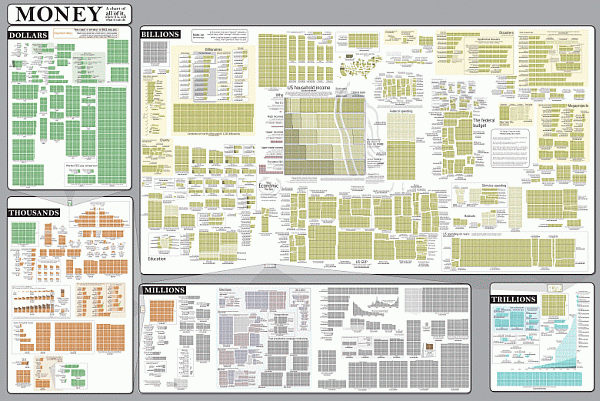
Money: A chart of almost all of it, where it is, and what it can do

Audrey Watters writes: Randall Monroe of xkcd has created an infographic titled “Money: A Chart of Almost All of It, Where It Is and What It Can Do.” It’s an incredible visualization representing trillions of dollars — what money is spent on (everything from iPads to charity to federal expenditures), and how money is earned (for individuals, corporations, charities, governments, etc.).

Click on either image below to study the full chart:

Facebooktwittermail

Bob Schieffer, Ron Paul and journalistic ‘objectivity’

Glenn Greenwald writes: CBS News‘s Bob Schieffer is the classic American establishment TV journalist: unfailingly deferential to the politically powerful personalities who parade before him, and religiously devoted to what he considers his own “objectivity,” which ostensibly requires that he never let his personal opinions affect or be revealed by his journalism. Watch how thoroughly and even proudly he dispenses with both of those traits when interviewing Ron Paul last Sunday on Face the Nation regarding Paul’s foreign policy views. In this 7-minute clip, Schieffer repeatedly mocks, scoffs at, and displays his obvious contempt for, two claims of Paul’s which virtually no prominent politician of either party would dare express: (1) American interference and aggression in the Muslim world fuels anti-American sentiment and was thus part of the motivation for the 9/11 attack; and (2) American hostility and aggression toward Iran (in the form of sanctions and covert attacks) are more likely to exacerbate problems and lead to war than lead to peaceful resolution, which only dialogue with the Iranians can bring about:

You actually believe 9/11 was America’s fault? Your plan to deal with the Iranian nuclear program is to be nicer to Iran? This interview is worth highlighting because it is a vivid case underscoring several points about the real meaning of the much-vaunted “journalistic objectivity”:

(1) The overarching rule of “journalistic objectivity” is that a journalist must never resolve any part of a dispute between the Democratic and the Republican Parties, even when one side is blatantly lying. They must instead confine themselves only to mindlessly describing what each side claims and leave it at that. Their refusal to label Mitt Romney’s first campaign ad as dishonest — even though it wildly misquoted Obama — is a perfect example; so, too, was their refusal to call torture “torture” on the ground that Bush officials called it something else. This is also what The Washington Post‘s Congress reporter Paul Kane meant in his widely disparaged attack this week on those who condemn the media’s “cult of balance”; when Kane defended the political media’s trite, reflexive both-parties-are-at-fault coverage of the Super Committee’s failure by saying “news coverage should always strive to present both sides of the story,” what he means is: whenever Democratic and GOP leaders say different things, it’s the job of opinion writers — but not us objective reporters — to say what the truth is; our job is simply to faithfully write down what each side says and go home.

To these types of journalists, “objectivity” compels that lies and truths be treated equally and never resolved — that is, when the dispute is between the two parties (they allow themselves exceptions to this mandate — their overt swooning for George Bush and contempt for Al Gore in 2000 was probably the most blatant example, and they also eagerly seize every opportunity presented by sex scandals to self-righteously rail against a political figure because sex is apolitical and thus entails no danger of being accused of political bias — but, in general, mindless neutrality in disputes among the two parties is the prime commandment of their objectivity religion).

Facebooktwittermail

Saudi Arabia: Four men killed as Shia protests against the state intensify

Patrick Cockburn reports: Four men have been killed in protests this week by the Shia minority in eastern Saudi Arabia in the most serious outbreak of violence in the Kingdom since the start of the Arab Spring.

The Saudi Interior Ministry said yesterday that two of those who died had been shot in an exchange of fire between police and gunmen who had “infiltrated” the funeral of another protester killed earlier in the week.

The latest shootings show that protests by members of the two-million-strong Shia community, mostly concentrated in the oil-rich Eastern Province, are escalating. The Interior Ministry says that “a number of security checkpoints and vehicles have since Monday been increasingly coming under gunfire attacks in the Qatif region by assailants motivated by foreign orders”. It threatened harsh measures against anybody breaking the law.

Hamza al-Hassan, an opposition activist, said that the latest violence started last weekend when Nasser al-Mheishi, 19, was killed at a checkpoint near Qatif, an oasis which is a Shia centre. Mr Hassan says that “he was killed and left for three or four hours on the ground because the government refused to let his family collect the body”. This led to mass protests in and around the city of Qatif in which a second man, Ali al-Feifel, 24, was shot dead by police, doctors were quoted as saying by news agencies. The Saudi Interior Ministry could not be reached for comment on the allegations.

Facebooktwittermail

Buy Nothing Day — or get pepper-sprayed at Walmart

Adbusters’ 2007 Buy Nothing Day ad that all the networks refused to air.

The Los Angeles Times reports: Matthew Lopez went to the Wal-Mart in Porter Ranch on Thursday night for the Black Friday sale but instead was caught in a pepper-spray attack by a woman who authorities said was “competitive shopping.”

Lopez described a chaotic scene in the San Fernando Valley store among shoppers looking for video games soon after the sale began.

“I heard screaming and I heard yelling,” said Lopez, 18. “Moments later, my throat stung. I was coughing really bad and watering up.”

Lopez said customers were already in the store when a whistle signaled the start of the Black Friday sale at 10 p.m., sending shoppers hurtling in search of deeply discounted items.

Lopez said that by the time he arrived at the video games, the display had been torn down. Employees attempted to hold back the scrum of shoppers and pick up merchandise even as customers trampled the video games and DVDs strewn on the floor.

“It was absolutely crazy,” he said.

Another customer said screams erupted after about 100 people waiting in line to snag Xbox gaming consoles and Wii video games got into a shoving match.

Alejandra Seminario, 24, said she was waiting in line to grab some toys at the store around 9:55 p.m. when people the next aisle over started shouting and ripping at the plastic wrap encasing gaming consoles, which was supposed to be opened at 10 p.m.

“People started screaming, pulling and pushing each other, and then the whole area filled up with pepper spray,” the Sylmar resident said. “I guess what triggered it was people started pulling the plastic off the pallets and then shoving and bombarding the display of games. It started with people pushing and screaming because they were getting shoved onto the boxes.”

The pepper spray wafted through the air, Seminario said, and she breathed some in and started coughing. Her face also started itching.

“I did not want to get involved. I was too scared. I just stayed in the toy aisle,” she said.

By the time she and her husband, 27-year-old Cesar Seminario, got to the cash register 20 minutes later with a Wii gaming console and some Barbie dolls, the air was still smelling of pepper spray, she said.

Wal-Mart employees were taking statements near the front of the store from about eight customers who had been pepper-sprayed, Seminario said. “After we paid, we saw five that were in really bad shape,” she said. “They had been sprayed in the face, it looked like, and they had swelling of the face, really extreme swelling of face, redness, coughing.”

Nakeasha Contreras, 20, of North Hollywood, said she arrived at midnight and hadn’t heard what happened. Even if she had, she said, she wouldn’t have minded: “I don’t care. I’m still getting my TV. I’ve never seen Wal-Mart so crazy, but I guess it could have been worse.”

Facebooktwittermail