NEWS: CIA’s ambitious post-9/11 spy plan crumbles

CIA’s ambitious post-9/11 spy plan crumbles

The CIA set up a network of front companies in Europe and elsewhere after the Sept. 11 attacks as part of a constellation of “black stations” for a new generation of spies, according to current and former agency officials.

But after spending hundreds of millions of dollars setting up as many as 12 of the companies, the agency shut down all but two after concluding they were ill-conceived and poorly positioned for gathering intelligence on the CIA’s principal targets: terrorist groups and unconventional weapons proliferation networks.

The closures were a blow to two of the CIA’s most pressing priorities after the 2001 terrorist attacks: expanding its overseas presence and changing the way it deploys spies.

The companies were the centerpiece of an ambitious plan to increase the number of case officers sent overseas under what is known as “nonofficial cover,” meaning they would pose as employees of investment banks, consulting firms or other fictitious enterprises with no apparent ties to the U.S. government. [complete article]

Facebooktwittermail

NEWS-VIEWS ROUNDUP: February 15

Is the US really bringing stability to Baghdad?

… any true assessment of the happiness or misery of Iraqis must use a less crude index than the number of dead and injured. It must ask if people have been driven from their houses, and if they can return. It must say whether they have a job and, if they do not, whether they stand a chance of getting one. It has to explain why so few of the 3.2 million people who are refugees in Syria and Jordan, or inside Iraq, are coming back.

In a first, Ahmadinejad to visit Iraq next month
Iranian President Mahmoud Ahmadinejad will travel to Iraq next month in the first such visit by a leader of the Islamic Republic, Iraqi officials said Thursday, adding that Iran had postponed a fourth round of talks with the United States to discuss Iraq’s security.

Invited by Iraqi President Jalal Talabani, Ahmadinejad is scheduled to arrive March 2 for a visit of two to three days to discuss bilateral relations, the officials said. He will also meet with Prime Minister Nouri al-Maliki.

The two neighbors fought an intense eight-year conflict in the 1980s during the rule of Saddam Hussein. But the ascent of a Shiite-dominated government in Iraq after the 2003 U.S.-led invasion ushered in a new era of friendship with overwhelmingly Shiite Iran.

The door to Iraq’s oil opens

The cynosure of Western eyes at the meeting of the Organization of Petroleum Exporting Countries, commonly known as OPEC, in Abu Dhabi, the United Arab Emirates, last December 5 was an unexpected personality – Iraqi Oil Minister Hussain al-Shahristani.
But that wasn’t a chance occurrence. By the time OPEC gathered in Vienna six weeks later, it was beyond doubt that Shahristani was on the way to becoming a celebrity in the West.

Shahristani is “a rare thing” in politics, to quote Toby Lodge, the well-known scholar on Iraq at the International Institute of Strategic Studies in London – “not too religious, not too political, not too secular, not too pro-American Shi’ite who [Grand Ayatollah Ali] Sistani would talk to”.

But for the ease with which Shahristani traversed in his later years the dividing line that separates religiosity and idealism from worldliness and pragmatism, Shahristani would have become a cult figure for human-rights activists, given his extraordinary background as a top nuclear scientist who turned a stubborn dissident, and then a reckless jail breaker from Saddam Hussein’s Abu Ghraib prison where he was tortured and tucked away in solitary confinement for an impossibly long 10 years till 1991.

Hezbollah chief warns Israel of wide war
Hezbollah’s leader threatened Thursday to strike Israel anywhere in the world in retaliation for what he said was its role in assassinating Imad Mughniyah, a Hezbollah commander blamed by the United States and Israel for killing hundreds in bombings, kidnappings and hijackings over a quarter-century.

In a video speech broadcast to thousands of mourners in a spare but sprawling tent in southern Beirut, Hasan Nasrallah said that because Israel had struck beyond what he called the “traditional battlefield” of Lebanon and Israel, it risked a borderless war with the Shiite Muslim group. Israel has denied involvement in the car bombing Tuesday that killed the 45-year-old Mughniyah in a tony neighborhood of Damascus, the Syrian capital.

“You have crossed the borders,” he said in the speech, which was vehement even by Nasrallah’s fiery standards. “Zionists, if you want this type of open war, then let it be, and let the whole world hear: We, like all other people, have a sacred right to defend ourselves, and everything we can do to defend ourselves, we will do.”

Top Pakistan lawyer in vote rigging tape row
Worries about vote rigging in Monday’s general election in Pakistan deepened yesterday when Human Rights Watch released an audio tape in which the government’s top lawyer allegedly predicts the vote will be “massively rigged”.

The recording, which was posted on the internet, features a voice identified as the attorney general, Abdul Malik Qayyum, advising a friend about which party to approach for a nomination in the parliamentary election.

“They will massively rig to get their own people to win. If you can get a ticket from these guys, take it,” he said in apparent reference to President Pervez Musharraf’s ruling party.

Where feudalism lives on

The main contest in the Pakistani general election on February 18 is seemingly between the Pakistan People’s Party (PPP), led by late Benazir Bhutto’s husband, Asif Zardari; the pro-Musharraf Pakistan Muslim League-Q (“Q” for “Qaid-e Azam”, the honorific for the state’s founder, Muhammad Ali Jinnah); and the opposition Pakistan Muslim League-N (“N” for Nawaz Sharif, former prime minister).

But no matter which party wins most seats and governs alone or in coalition, and which becomes the opposition, the privileges of feudal lords dominating the overwhelmingly rural society will remain intact.

The roots of feudal dominance lie in history. The Pakistan Muslim League, the parent of its present two versions, is the descendant of the All India Muslim League (AIML). Formed in 1906 to promote loyalty to the British Crown while advancing Muslim interests, the AIML was led by Muslim grandees and feudal lords. It was not until 1940 that it demanded partition of the Indian sub-continent, with Muslim majority areas constituting independent states. Unlike the anti-imperialist Indian National Congress, it lacked an economic programme favouring small and landless peasants, and trade unions for industrial workers.

How ‘inevitable’ got outmaneuvered

What happened to Hillary Clinton?

Last fall, she was the “inevitable” nominee whose “machine” would raise scads of cash and push her to an early victory. She demonstrated poise and knowledge in debates, and party leaders lined up behind her, fearful of missing her fast-moving train.

But this narrative was flawed from the beginning. Her campaign has suffered from profound organizational failures, small mistakes that took on larger import and miscalculations that have put her in a position where to survive, she must defeat Barack Obama in both Texas and Ohio next month.

McCain calls for Obama to use public financing
Hammering Senator Barack Obama for a fourth straight day, Senator John McCain said here on Friday that he expects Senator Obama to abide by his pledge use public financing for his general election if Mr. McCain does so as well.

“It was very clear to me that Senator Obama had agreed to having public financing of the general election campaign if I did the same thing,” he said after a town hall meeting here. “I made the commitment to the American people that if I was the nominee of my party, I would go the route of public financing. I expect Senator Obama to keep his word to the American people as well.”

Asked if he would use public financing even if Mr. Obama did not, he said: “If Senator Obama goes back on his commitment to the American people, then obviously we have to rethink our position. Our whole agreement was we would take public financing if he made that commitment as well. And he signed a piece of paper, I’m told, that made that commitment.”

Barack Obama’s secret weapon plots a new course for election victory
Steve Hildebrand describes himself as a “big fat goof” who is scared of flying. But, as the chief author of Barack Obama’s grassroots strategy, he is helping to rewrite America’s campaign rulebook.

While Hillary Clinton has won most of the key contests that she has made a priority, Mr Obama is leading the race for delegates because he has picked up most of the other states. “We have competed in large and small states — primaries and caucuses — and not let any state go by,” Mr Hildebrand explains in an interview with The Times. “It’s beyond me why the Clinton campaign did not do the same.”

Facebooktwittermail

NEWS-VIEWS ROUNDUP: February 14

When we torture

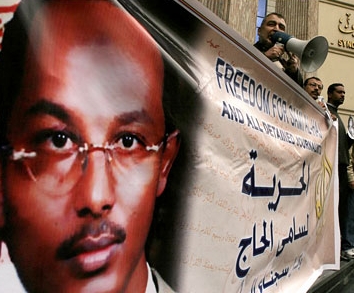
sami-al-hajj.jpgThe most famous journalist you may never have heard of is Sami al-Hajj, an Al Jazeera cameraman who is on a hunger strike to protest abuse during more than six years in a Kafkaesque prison system.

Mr. Hajj’s fortitude has turned him into a household name in the Arab world, and his story is sowing anger at the authorities holding him without trial.

That’s us. Mr. Hajj is one of our forgotten prisoners in Guantánamo Bay.

If the Bush administration appointed an Under Secretary of State for Antagonizing the Islamic World, with advice from a Blue Ribbon Commission for Sullying America’s Image, it couldn’t have done a more systematic job of discrediting our reputation around the globe. Instead of using American political capital to push for peace in the Middle East or Darfur, it is using it to force-feed Mr. Hajj.

US official admits waterboarding presently illegal
A senior official in the Bush justice department said for the first time today that the controversial interrogation tactic is currently illegal.

The waterboarding remarks by Stephen Bradbury, head of the justice department office of legal counsel, caused a stir in America because they go further than more uncertain opinions on the legality of the tactic voiced by the CIA director and attorney general.

London bombs justify ‘torture’, says Bush
President George Bush cited the London July 7 bombings in an interview broadcast last night to justify his support for waterboarding, an interrogation technique widely regarded as torture.

In an interview with the BBC he said information obtained from alleged terrorists helped save lives, and the families of the July 7 victims would understand that. Bush said waterboarding, which simulates drowning, was not torture and is threatening to veto a congressional bill that would ban it.

Duet in Damascus – is it déja vu?

Duet in Beirut by former Mossad operative Mishka Ben-David is a work of fiction, but owes its wealth of detail to the author’s intelligence experience. Published in Hebrew six years ago, it describes a Mossad hit team traveling to Beirut, stalking the head of Hizbullah’s foreign terror department and assassinating him in a car bombing. Perhaps unfortunately for Mughniyeh, it was not translated into Arabic; had he read it, he might have taken greater precautions.

Ben-David said Wednesday that he had modeled his terror overlord, “Abu Khaled,” on two men: Hamas political bureau head Khaled Mashaal, and Mughniyeh, long Hizbullah’s chief of foreign terror operations.

While Ben-David is careful to say that Israel may not have been behind Mughniyeh’s killing, he does detail several examples of how the planned killing of the fictional Abu Khaled might mirror the death of Mughniyeh.

Roiled Hezbollah chief throws down the gauntlet

When Hassan Nasrallah quotes David Ben-Gurion to emphasize to Israel that “if it loses one war, it will collapse,” or the Winograd report to impress his supporters with the fact that Israel lost the fight against several thousand Hezbollah fighters, we can once more be impressed that he and his advisers follow what is going on in Israeli society far more closely than Israel follows developments in Lebanon. But Nasrallah also knows that sharp rhetoric and expert usage of language are no substitute for a plan of action.

He presented his plan Thursday in his speech by setting the rules for war against Israel: “If you want an open-ended war, it will be an open-ended war,” and he also explained what this would entail. Because Hezbollah blames Israel for the assassination of Imad Mughniyah, which it claims occured “outside the natural arena of the war” (in other words Syria and not in Lebanon), the organization considers it legitimate to use the same method and target Israel outside the “natural arena”: not directly on Israeli territory but against Israeli targets abroad. Thus, Nasrallah absolved himself of the rules he followed for years, according to which he was conducting a war of Lebanese liberation against Israeli occupation. Henceforth, he is adopting a war on behalf of the organization, not in the name of Lebanon, against Israel’s existence.

Iraq successes hang in the balance

We have heard a lot in the past year about the Sunni Awakening movement in Al Anbar province in western Iraq, the development of a Concerned Local Citizens program (also known as the Sons of Iraq program) in Baghdad, and the unilateral cease-fire called by Moqtada al-Sadr’s Mahdi Army Shia militias. These three developments have not only been key to American military gains, but they also are central to the possibility of successful civil society and the prospects for transitioning from the military mission. [Deputy assistant secretary of defense for Middle East affairs, Mark] Kimmitt frankly calls all of these developments in 2007 a “surprise.” They are also factors most outside of U.S. control.

“The success of the surge was not pre-ordained nor has the surge succeeded according to plan,” Kimmitt says. “No one last December had any ideas that we would see a Sunni Awakening movement, nobody knew that the … [Mahdi Army] would declare a ceasefire …”

Bush’s Iraq calculus

The last thing the Bush White House would want, you might think, would be to make the 2008 presidential election a referendum on the unpopular war in Iraq. The 2006 congressional elections were such a referendum, and the Republicans got hammered.

But President Bush, newly confident that his troop-surge strategy is working, is taking steps that are likely to guarantee another Iraq-driven election. He favors keeping a big U.S. force in Iraq through the November elections, probably close to the pre-surge level of 130,000 troops. That large presence will draw Democratic fire — and it will make the presidential contest all the more a test between a pro-war Republican nominee and an antiwar Democrat.

Iran postpones talks with U.S. on Iraq
American officials ratcheted up the accusations against Iran today as Tehran postponed another round of negotiations with the United States over security in Iraq.

The development came as the Iraqi government announced that Iranian President Mahmoud Ahmadinejad would arrive March 2 for a two-day visit, the first such trip by an Iranian leader since the two countries fought a devastating war in the 1980s that killed or injured an estimated 1 million people.

The United States and Iran, already locked in a dispute over Tehran’s nuclear program, have long traded blame for the bloodshed in Iraq. But U.S. officials softened their tone late last year, backing away from sweeping accusations that Iran is orchestrating the funding, training and equipping of Shiite Muslim militants who have battled U.S. soldiers here.

In a reversal, U.S. agrees to produce data pointing to Iran’s nuclear ambitions
The Bush administration has agreed to turn over to international inspectors intelligence data it has collected that it says proves Iran worked on developing a nuclear weapon until a little more than four years ago, according to American and foreign diplomats.

The decision reverses the United States’ longstanding refusal to share the data, citing the need to protect intelligence sources.

The administration acted as the International Atomic Energy Agency is scheduled to issue a report as early as next week on Iran’s past nuclear activities. Administration officials hope that the nuclear inspectors can now confront Iran with what the Americans believe is the strongest evidence that the Iranians had a nuclear program.

Facebooktwittermail

NEWS-VIEWS ROUNDUP: February 13

Anguish of the Stolen Generations
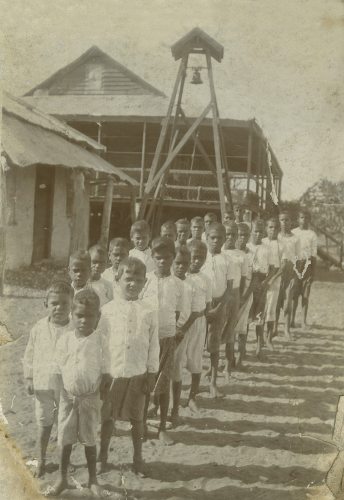
stolen-generation.jpgWith torment still in his voice, Frank Byrne recalls the day six decades ago when he was taken from his mother and their community in Christmas Creek, Western Australia.

He was just five at the time, and his mother, Maudie Yooringun, had long feared the day that the government would come to seize him – and he would be “stolen”.

“The government came to Christmas Creek where we had a mud house and told me I was been taken away,” he said.

“My mum was completely ignored. She was not a human. That’s what they thought in those days. The government fella said: ‘I am your total guardian’.”

“You could see the sorrow in my mother’s eye. I could see the tears rolling down as she was driven away. I was held there by a couple of blokes as the truck went away.”

A week later Frank saw his mother again. But that was to be the last time he ever saw her alive.

Australia apology to Aborigines
The Australian government has made a formal apology for the past wrongs caused by successive governments on the indigenous Aboriginal population.

Prime Minister Kevin Rudd apologised in parliament to all Aborigines for laws and policies that “inflicted profound grief, suffering and loss”.

He singled out the “Stolen Generations” of thousands of children forcibly removed from their families.

When words aren’t enough
National Aboriginal Alliance spokesman Les Malezer last weekend said the apology was “not enough”. But even the alliance is prepared to defer compensation.

From a strategic angle, these indigenous leaders are fooling themselves or their constituents. If they were serious about compensation, the time to address it is at the same time as the apology. Blackfellas will get the words, the whitefellas will keep the money. And by Thursday the Stolen Generations and their apology will be over as a political issue.

*

The war against tolerance
Walid Shoebat, Kamal Saleem and Zachariah Anani are the three stooges of the Christian right. These self-described former Muslim terrorists are regularly trotted out at Christian colleges—a few days ago they were at the Air Force Academy—to spew racist filth about Islam on behalf of groups such as Focus on the Family. It is a clever tactic. Curly, Larry and Mo, who all say they are born-again Christians, engage in hate speech and assure us it comes from personal experience. They tell their audiences that the only way to deal with one-fifth of the world’s population is by converting or eradicating all Muslims. Their cant is broadcast regularly on Fox News, including the Bill O’Reilly and Neil Cavuto shows, as well as on numerous Christian radio and television programs. Shoebat, who has written a book called “Why We Want to Kill You,” promises in his lectures to explain the numerous similarities between radical Muslims and the Nazis, how “Muslim terrorists” invaded America 30 years ago and how “perseverance, recruitment and hate” have fueled attacks by Muslims.

Israel embassies on high alert following Mughniyah killing
Israel’s security services have issued orders to its embassies and delegations abroad to be on high alert following the assassination of Hezbollah terror leader Imad Mughniyah on Wednesday, anticipating the possibility that Hezbollah will try to carry out a major attack against Israeli or Jewish targets worldwide in response to the killing.

Whoever killed Mughniyah showed impressive capabilities
In the case of the killing of Mughniyah we can draw two opposing conclusions. One is that the killing created shock and awe in Hezbollah and damaged its self-confidence. There is no doubt that the killing sent an unequivocal message to Nasrallah that maybe he should lower his profile of arrogance and self-confidence.
[…]
The second conclusion is that in the long run Hezbollah will clearly recover from the killing and return to functioning normally as a political movement with its own militia that has an organization for carrying out terror attacks.

Israel plans to build in East Jerusalem
Israel on Tuesday unveiled plans to build 1,120 apartments for Jews in East Jerusalem, a move Palestinians called a setback for U.S.-backed peace negotiations.

The announcement by Housing Minister Zeev Boim appeared to be aimed at placating the Shas religious party, which had vowed to quit the coalition government if it conceded anything to the Palestinians on Jerusalem.

Arab states plan TV crackdown
In a collective effort to curb satellite channels such as al-Jazeera, Arab states have adopted a charter that authorises individual countries to penalise media organisations deemed to have offended political and religious leaders or to have damaged social harmony and national unity.

Only Qatar, home to al-Jazeera, refused to endorse the document citing the need to study it further to ascertain that it did not ­conflict with its legislation.

Muqtada, the man who would be ayatollah
As a political and military force, Iraq’s Shi’ite Sadrist movement has undergone a number of radical transformations since 2003, when its leader Muqtada al-Sadr surprisingly emerged as a leading political figure. Muqtada’s recent decision to continue with his seminary studies and graduate as an ayatollah at the conservative seminary school of Najaf underpins a major change in the movement’s structure that could have serious repercussions for the future of Iraq.

Against the backdrop of changing political alliances between Kurds and Sunnis, Muqtada is transforming his movement into a new political phenomenon with implications for the country’s political structure and security dynamics. The consequences are also immense for Shi’ite Iraq, posing serious challenges to the conservative clerical establishment in Najaf.

Muqtada’s attempt to become an ayatollah follows his earlier call to suspend operations by his militia, the Jaish al-Mahdi (The Mahdi Army, or JaM) in the summer of 2007. Together with his decision to study in Najaf, this has marked a decisive new beginning in the organizational structure and leadership dynamics of the Mahdi militia.

McCain votes against waterboarding ban
Today, the Senate brought the Intelligence Authorization Bill to the floor, which contained a provision from Sen. Dianne Feinstein (D-CA) establishing one interrogation standard across the government. The bill requires the intelligence community to abide by the same standards as articulated in the Army Field Manual and bans waterboarding.

Just hours ago, the Senate voted in favor of the bill, 51-45.

Earlier today, ThinkProgress noted that Sen. John McCain (R-AZ), a former prisoner of war, has spoken strongly in favor of implementing the Army Field Manual standard. When confronted today with the decision of whether to stick with his conscience or cave to the right wing, McCain chose to ditch his principles and instead vote to preserve waterboarding.

Senate passes interrogation ban
The Senate voted 51 to 45 on Wednesday afternoon to ban waterboarding and other harsh interrogation methods used by the Central Intelligence Agency against high-level terrorism suspects.

Senate Republicans generally opposed the bill, but several of them also did not want to cast a vote that could be construed as supporting torture, and so were relying on President Bush to make good on a threat to veto legislation limiting C.I.A. interrogation techniques.

The prohibition of harsh interrogation techniques is part of a wider intelligence authorization bill and would restrict all American interrogators to techniques allowed in the Army Field Manual, which bars the use of physical force.

In tribal Pakistan, religious parties are foundering
Senator Asfandyar Wali, the leader of an opposition party, the Awami National Party, is campaigning for the elections next week from the safety of his bed, under a quilt and propped up on bolsters for his bad back at his country home outside Peshawar.

Ill health aside, Mr. Wali is staying home because suicide bombers are seeking to kill him, his party has been warned by high-level government officials. There have been two bomb attacks on his party’s election gatherings in the last week. Two candidates have been killed, one in a suicide bombing and one in a shooting in Karachi.

Yet despite the attacks and the limited campaigning, his party is expected to do well in the parliamentary elections on Monday. The religious parties that for the last five years have governed the North-West Frontier Province and Baluchistan Province, which border Afghanistan and the tribal areas, are foundering.

Facebooktwittermail

NEWS-VIEWS ROUNDUP: February 12

Senate passes bill to expand U.S. spying powers
After more than a year of heated political wrangling, the Senate handed the White House a major victory Tuesday by voting to broaden the government’s spy powers after giving legal protection to phone companies that cooperated in President Bush’s warrantless eavesdropping program.

Amnesty Day for Bush and lawbreaking telecoms
(Glenn Greenwald) — [The Senate bill] has two simple purposes: (1) to render retroactively legal the President’s illegal spying program by legalizing its crux: warrantless eavesdropping on Americans, and (2) to stifle forever the sole remaining avenue for finding out what the Government did and obtaining a judicial ruling as to its legality: namely, the lawsuits brought against the co-conspiring telecoms. In other words, the only steps taken by our political class upon exposure by the NYT of this profound lawbreaking is to endorse it all and then suppress any and all efforts to investigate it and subject it to the rule of law.

U.S. Jewish leader worried by thrust of White House campaigns
The head of the Conference of Presidents of Major American Jewish Organizations, Malcolm Hoenlein, expressed concern Tuesday regarding the atmosphere that has surrounded Democratic Senator Barack Obama’s campaign for president, while making it clear he has no problem with Obama himself.

“All the talk about change, but without defining what that change should be is an opening for all kind of mischief,” Hoenlein said at a press conference in Jerusalem. Obama has made change a central theme in his campaign.

The blind giant of the Middle East
(David Grossman) — More and more it looks as if the things that set Israel going at its birth have lost their potency — its concept and its daring, its confidence in its purpose and values, its desire to create a country that would not only be a refuge for the Jewish people, but that would also transform Jewish existence into a modern civil state. Now, 60 years after Israel was founded, it must find new substance that will fuel its way forward. Without re-creating itself, it will not be able to stay in motion. Too many things, outside and inside, will hinder it. The time will come when Israel will not have the strength to overcome them.

Palestinian revenge was inevitable
(Ahmed Yousef) — Last week’s bombing in Dimona was the first martyrdom operation committed by Hamas in more than five years. For some time, we have been warning the world that the relentless pressure on our people would eventually tell. In the last two months, more than a hundred people have been killed by the Israeli occupation forces in the Gaza Strip, including many civilians, women and children.

Thirty people have died in the last month for lack of medical care brought on by the embargo. Only two weeks ago, we saw the appalling sight of over 40 women and children seriously injured when an Israeli F-16 dropped an enormous bomb in the middle of the densely populated Gaza City, a few meters from a wedding party. This kind of atrocity, piled onto the daily death toll, has finally tested the patience of Palestinians, and after lengthy restraint, revenge was inevitable.

To many in Israel and the West, this act of resistance will be judged in isolation. They will no doubt say that it justifies the inhumane embargo on the people of Gaza and the arrests of more than 500 people and daily torture of innocents in the West Bank by both Israelis and the puppet government imposed on us by the U.S.. What they seem to forget is that just in the last two years, 2,000 Palestinians have been killed by Israeli military action and thousands more injured. The cold-blooded fact is that the ratio of Palestinian deaths to Israelis is now over 40 to 1.

Palestinian questions peace progress
The U.S.-backed Palestinian prime minister said Monday that time is running short to demonstrate progress in the Israeli-Palestinian peace talks President Bush launched to fanfare last fall.

“Unless there is tangible progress in the period immediately ahead” on a list of pledges made by Israel, “I think, honestly, it would require that we begin to really call this for what it is,” Palestinian Prime Minister Salam Fayyad said.

Focus of detainee trial is likely to suit Bush
Harsh interrogations and Guantánamo Bay, secret prisons and warrantless eavesdropping, the war against Al Qaeda and the one in Iraq. On issue after issue, President Bush has showed little indication that he will shrink from the most controversial decisions of his tenure.

With the decision to charge six Guantánamo detainees with the attacks of Sept. 11, 2001, and to seek the death penalty for the crimes, many of those issues will now be back in the spotlight. In an election year, that appears to be exactly where Mr. Bush wants the focus to be.

Asia’s hidden arms race
(John Feffer) — While in the news sunshine prevails, in the shadows an already massive regional arms race is threatening to shift into overdrive. Since the dawn of the twenty-first century, five of the six countries involved in the Six Party Talks have increased their military spending by 50% or more. The sixth, Japan, has maintained a steady, if sizeable military budget while nonetheless aspiring to keep pace. Every country in the region is now eagerly investing staggering amounts of money in new weapons systems and new offensive capabilities.

The arms race in Northeast Asia undercuts all talk of peace in the region. It also sustains a growing global military-industrial complex. Northeast Asia is where four of the world’s largest militaries — those of the United States, China, Russia, and Japan — confront each other. Together, the countries participating in the Six Party Talks account for approximately 65% of world military expenditures, with the United States responsible for roughly half the global total.

Here is the real news that should hit the front pages of papers today: Wars grip Iraq, Afghanistan, and large swathes of Africa, but the heart of the global military-industrial complex lies in Northeast Asia. Any attempt to drive a stake through this potentially destabilizing monster must start with the militaries that face one another there.

The law on the powers of governorates
(Reidar Visser) — Whenever Iraqi politics becomes difficult to classify according to the ethno-sectarian mindset preferred by most Western commentators, interest in what is going on in Baghdad seems to dwindle. Little wonder, then, that for the past few weeks, somewhat esoteric news items (like a visit to Iraq by Angelina Jolie) have dominated press reports from Iraq. The two truly significant developments during the past month have received less coverage: the attempts to agree on a general budget, as well as efforts to pass a law on the powers of governorates nor organised in a [federal] region.

America’s green policy vacuum
It’s been a year since Al Gore’s An Inconvenient Truth packed theaters and won an Oscar. And a good year it has been for the green movement. Venture capital firms poured a record $2.6 billion into clean tech startups in the first three quarters of 2007. Meanwhile, the green buzz has only grown louder. This year, green building construction starts are projected to reach $12 billion. And both Senator Hillary Clinton and Senator Barack Obama have made a greener economy a key plank in their Presidential campaigns.

It’s enough to make you believe an optimistic report that estimates the green economy could produce as many as 40 million jobs and $4.53 trillion in annual revenue by 2030. To put those numbers in perspective, consider this: In 2006, according to a November report commissioned by the American Solar Energy Society (hardly a disinterested body), companies in renewable energy and energy efficiency industries accounted for 8.5 million jobs and generated $970 billion in revenues. The report based that scenario on “aggressive, sustained public policies at the federal and state level during the next two decades.” (It also included growth scenarios based on current government spending levels and on a moderate increase.)

Despite the undeniable green momentum, a $4 trillion-plus U.S. green economy is far from likely—even in 22 years—because there simply is no “aggressive, sustained” federal policy. The federal government has failed to create and adequately fund the programs that would make the U.S. a world leader. And that’s what the government should be trying to do, for reasons that go far beyond rising carbon levels. The U.S. risks falling way behind other countries in the development of green technologies. On its current course, this country could trade oil dependence for reliance on alternative energy products built by other nations already far ahead of it.

Facebooktwittermail

CAMPAIGN 08 & EDITOR’S COMMENT: The Obama cult

And Obama wept

Inspiration is nice. But some folks seem to be getting out of hand.

It’s as if Tom Daschle descended from on high saying, “Be not afraid; for behold I bring you good tidings of great joy which shall be to all the people: for there is born to you this day in the city of Chicago a Savior, who is Barack the Democrat.”

Obama supporter Kathleen Geier writes that she’s “getting increasingly weirded out by some of Obama’s supporters. On listservs I’m on, some people who should know better – hard-bitten, not-so-young cynics, even – are gushing about Barack…

Describing various encounters with Obama supporters, she writes, “Excuse me, but this sounds more like a cult than a political campaign. The language used here is the language of evangelical Christianity – the Obama volunteers speak of ‘coming to Obama’ in the same way born-again Christians talk about ‘coming to Jesus.’…So I say, we should all get a grip, stop all this unseemly mooning over Barack, see him and the political landscape he is a part of in a cooler, clearer, and more realistic light, and get to work.” [complete article]

Editor’s Comment — Among independently minded people there’s a natural tendency when meeting the force of a crowd, to want to move the opposite way — or at least stand in place and not get swept along in the flow. Popularity so rarely seems to be an index of good judgment. Thus it’s easy to see why the Obama current provokes a measure of skepticism. Sure, I can see his charisma and I can hear his eloquence, says the skeptic, but give me the hard facts. I need some specifics. I need to know what this man will do if we put him in the White House.

It’s a curious form of realism this. It seems to say, I attach more significance to what a politician promises, than I do to what I can assess of his or her character. It seems to imply that a checklist of the correct policy positions is a reliable indicator of what might happen.

I’m inclined to believe that Obama is realistic enough to know that the time to make the boldest declarations and the time to act as a progressive leader comes after receiving a mandate. Seeking and receiving a mandate for change opens up a whole lot of possibilities.

Facebooktwittermail

NEWS-VIEWS ROUNDUP: February 11

No Manchurian candidate

I believe Barack Obama is a strong but not uncritical supporter of Israel. That is what the Middle East needs from an American leader: the balance implied by a two-state solution.

Yet it’s a tough position for Obama to hold in this presidential campaign because his Jewish credentials are under intense scrutiny.
[…]
Jews should get over the scaremongering: Obama is no Manchurian. Nor is he blind to the fact that backing Israel is not enough if the backing gives carte blanche for the subjugation of another people.

Behind Obama and Clinton

Voters on the progressive wing of the Democratic Party are rightly disappointed by the similarity of the foreign policy positions of the two remaining Democratic Party presidential candidates, Senator Hillary Clinton and Senator Barack Obama. However, there are still some real discernable differences to be taken into account. Indeed, given the power the United States has in the world, even minimal differences in policies can have a major difference in the lives of millions of people.

Clinton wins tacit support of Israeli establishment
Among mainstream Israeli commentators, there is little argument that the outgoing Republican Administration, with its invasion of Iraq, war against terrorism and strong line against Iran, has been the closest yet to Israel’s own world view.

Yet although the race to succeed Mr Bush has narrowed to a choice between John McCain, Hillary Clinton and Barack Obama, the Republican candidate is not the one the Israeli establishment would most like to see in the White House.

That unofficial honour goes to Senator Clinton, who Palestinians accuse of taking an increasingly one-sided approach to the Middle East conflict. Visiting the region in 2005 as senator for New York, Senator Clinton shunned the Palestinians completely, meeting only Israeli leaders and hearing and expressing only Israeli positions. She particularly galled Palestinians by enthusiastically backing the 700-kilometre complex of walls and fences that Israel is building inside the West Bank.

Barack Obama makes his case
Asked what he thinks is the biggest difference between himself and Senator Hillary Clinton, Obama told Kroft, “I think Senator Clinton is smart and can be an effective advocate. But I think that the biggest difference is that Senator Clinton accepts the rules of the game as they are set up. She accepts money from PACs and lobbyists. I don’t accept that politics has to be driven by those special interests and lobbyists.”

For Clinton, Ohio and Texas emerge as key states to win
Senator Hillary Rodham Clinton and her advisers increasingly believe that, after a series of losses, she has been boxed into a must-win position in the Ohio and Texas primaries on March 4, and she has begun reassuring anxious donors and superdelegates that the nomination is not slipping away from her, aides said on Monday.

Mrs. Clinton held a buck-up-the-troops conference call on Monday with donors, superdelegates and other supporters; several said afterward that she had sounded tired and a little down, but determined about Ohio and Texas.

Israel’s secret success

If we cannot summon the determination it would take for a complete pullback, might the world, led by the United States, try to force us to withdraw? It might, but it probably won’t, so we are most likely looking at some sort of single state, bi-national state or confederation. What matters is that we are acting from a position of strength, and we ought to be investing our energy and creativity in working out a long-term solution with the Palestinians that will be acceptable to both of us.

What we should not be doing is what we are doing now: besieging and blacking out Gaza, killing and arresting dozens of Palestinians in the occupied territories every month, and constructing walls and fences between us and our neighbors.

The most recent suicide bombing in southern Israel has predictably prompted calls for a new barrier along our 145-mile Egyptian border. This is unreasonable. Walls, as recent events have shown, can be breached. Palestinian terrorism against civilians has decreased over the past years, even though the barrier separating Israel and the West Bank has many large gaps. It is illogical to suppose that this incomplete wall is the factor that has reduced terrorism.

Israeli minister: We should level Gaza neighborhoods
Tempers heated Sunday as cabinet ministers discussed the ongoing Qassam fire on Sderot and the situation in Gaza.

Interior Minister Meir Sheetrit suggested obliterating a Gaza neighborhood in response to Saturday’s Qassam fire on Sderot, saying “any other country would have already gone in and level the area, which is exactly what I thing the IDF should do – decide on a neighborhood in Gaza and level it.”

IDF to step up Gaza assassinations
The Israel Defense Forces and the Shin Bet internal security service are preparing to step up assassinations against key Hamas figures in the Gaza Strip in response to the continued Qassam rocket attacks against Sderot. The renewed campaign of targeted killings is not likely, at this stage, to include members of the Hamas political leadership.

Hamas leaders go into hiding as Israel plans targeted killings
Leaders of the ruling Hamas movement in the Gaza Strip have scaled back their public appearances and stepped up other security measures, fearing Israeli assassination attempts in response to a wave of Palestinian rocket attacks on southern Israel, Hamas officials said Monday.

New Hamas tactic: Bomb Israel into a truce
The message: henceforth, every Israeli operation will result in a similar response. Hamas is hoping that Israel will agree, after repeated bombing of Sderot, to a tahdiye (calm) in the territories, and even believe they can bring about an end to the arrests that the IDF is carrying out in the West Bank.

Behind the Hamas decision lies the assumption that the Israeli leadership is wary of a large-scale ground operation. This is based on the traumatic experience of the Second Lebanon War and Israeli concern that it may suffer heavy casualties. Senior officials in the Islamic organization believe that Prime Minister Ehud Olmert is too concerned with his political future to risk initiating a broad IDF operation in the Strip.

Gates endorses pause in Iraq troop withdrawals
Defense Secretary Robert M. Gates on Monday publicly endorsed the concept of holding steady the troop levels in Iraq, at least temporarily, after the departure this summer of five extra combat brigades sent last year as part of “the surge.”

America’s failure in Afghanistan
US Secretary of Defense Robert Gates has been putting pressure on Germany to up its commitment to the NATO mission in Afghanistan. But some in Germany say it is America’s violence, not Berlin’s reluctance, that is the problem.

Flawed by design

…most of the NATO nations agreed to send troops on the premise that they’d be engaged in peacekeeping, not warfighting.

Then, in the spring of 2006, the Taliban threw a wrench in the works by staging offensives throughout southern Afghanistan—a huge area, about the size of Germany—after four years of relative calm. (Actually, they’d been infiltrating the region all this time; they resumed their offensives only to resist the returning Western troops.)

The alliance isn’t “evolving into a two-tiered alliance,” as Gates said. When it comes to Afghanistan, it’s been that kind of alliance from the start. As the fighting has grown fiercer, the inadequacies of this crazy quilt have become clearer.

NATO at twilight

NATO is no longer a fighting organization. Keeping the Americans in, the Germans down and the Russians out no longer demands the sort of exertion that was required half a century ago. If the alliance retains any value, it is as an institution for consolidating European integration and prosperity.

No amount of browbeating by the United States is going to change that. The Bush administration is kidding itself if it expects Europeans to save the day in Afghanistan. To think of NATO as a great alliance makes about as much sense as thinking of Pittsburgh as the Steel City or of Detroit as the car capital of the world. It’s sheer nostalgia.

Welcome to Cyberwar Country, USA
When a reporter enters the Air Force office of William Lord, a smile comes quickly to the two-star general’s face as he darts from behind his immaculate desk to shake hands. Then, as an afterthought, he steps back and shuts his laptop as though holstering a sidearm.

Lord, boyish and enthusiastic, is a new kind of Air Force warrior — the provisional chief of the service’s first new major command since the early 1990s, the Cyber Command. With thousands of posts and enough bandwidth to choke a horse, the Cyber Command is dedicated to the proposition that the next war will be fought in the electromagnetic spectrum, and that computers are military weapons. In a windowless building across the base, Lord’s cyber warriors are already perched 24 hours a day before banks of monitors, scanning Air Force networks for signs of hostile incursion.

Musharraf’s approval rating plummets
A week before Pakistanis vote in parliamentary elections, President Pervez Musharraf’s popularity has hit an all-time low and opposition parties seem capable of a landslide victory that could jeopardize his efforts to cling to power, according to a poll to be released Monday.

Facebooktwittermail

NEWS-VIEWS ROUNDUP: February 10

The next president should open up the Bush Administration’s record

In 2005, then-Deputy Attorney General James Comey told colleagues at the Justice Department that they would be “ashamed” when a legal memorandum on forceful interrogation of prisoners eventually became public. In fact, however, disclosure of such secret Bush Administration documents may be the only way to begin to overcome the palpable shame that is already felt by many Americans at the thought that their government has engaged in abusive interrogations, secret renditions or unchecked surveillance.

The next President will have the authority to declassify and disclose any and all records that reflect the activities of executive branch agencies. Although internal White House records that document the activities of the outgoing President and his personal advisers will be exempt from disclosure for a dozen years or so, every Bush Administration decision that was actually translated into policy will have left a documentary trail in one or more of the agencies, and all such records could be disclosed at the discretion of the next President.

“Something is happening” — Obama’s movement for change

Profound transformative change, like that ushered in by the New Deal or created by the vision of the New Frontier/Great Society, can only come about because of the powerful demands of mass social movements that both pressure for change and create the conditions for its realization. When Barack Obama says, “We have been waiting for so long for the time when we could finally expect more from our politics, when we could give more of ourselves and feel truly invested in something bigger than a candidate or cause. This is it: We are the ones we’ve been waiting for, we are the ones that we seek” – he is both empowering his supporters, and challenging them to become the instruments of radical transformation. And it has worked, at least so far.

Obama wins Maine, giving him 4 victories in weekend
Senator Barack Obama defeated Senator Hillary Rodham Clinton in the Maine caucuses on Sunday, giving him his fourth victory this weekend as he headed into three more state contests on Tuesday.

Milton Viorst on Israel’s tragic predicament

In opening his stunning memoir, “Dark Hope: Working for Peace in Israel and Palestine,” David Shulman declares: “I am an Israeli. I live in Jerusalem. I have a story, not yet finished, to tell.” It is a very sad story, of a society gone astray with power, and of decent Israelis in despair over the failure of their efforts to save it from itself. The story, as Shulman says, is not yet over, but he asks whether its end is not already determined. Is tragedy inevitable? Can Israel right its course to achieve its once glowing promise as a refuge and as a nation?

Shulman’s memoir is not unique in raising these questions. Two recent books share his foreboding: “Lords of the Land: The War Over Israel’s Settlements in the Occupied Territories, 1967-2007,” a careful work of scholarship by Idith Zertal and Akiva Eldar, and “Toward an Open Tomb: The Crisis of Israeli Society,” a stinging essay by Michel Warschawski. Shulman and Zertal are college professors, Eldar is a journalist, Warschawski is a peace activist. All are Israeli Jews. Whatever the stylistic differences of their books, they are equally unforgiving of Israel for placing its future in stark jeopardy.

The Gaza Strip blockade could seriously harm Israel’s economy
In 2006, for example, total Israeli exports to the 60 million or so residents of France stood at slightly more than $1 billion. Israeli exports to the same amount of people in Italy stood at just below $1 billion. Very fine statistics. But total exports to both of these countries, which rank among the eight richest countries in the world, are equal to Israel’s exports to the 3.5 million people of the West Bank and Gaza Strip, according to the Central Bureau of Statistics. This is more than 6 percent of all Israeli exports, excluding diamonds. Despite all the intifadas, the Palestinian Authority is the second biggest customer of Israeli exports, after the United States.

Iraq’s tidal wave of misery

A tidal wave of misery is engulfing Iraq — and it isn’t the usual violence that Americans are accustomed to hearing about and tuning out. To be sure, it’s rooted in that violence, but this tsunami of misery is social and economic in nature. It dislodges people from their jobs, sweeps them from their homes, tears them from their material possessions, and carries them off from families and communities. It leaves them stranded in hostile towns or foreign countries, with no anchor to resist the moment when the next wave of displacement sweeps over them.

The victims of this human tsunami are called refugees if they wash ashore outside the country or IDPs (“internally displaced persons”) if their landing place is within Iraq’s borders. Either way, they are normally left with no permanent housing, no reliable livelihood, no community support, and no government aid. All the normal social props that support human lives are removed, replaced with…nothing.

Standoff in an Iraqi province

A potential security crisis loomed Saturday in troubled Diyala province as significant numbers of a U.S.-funded force of Sunni fighters left their posts, demanding the ouster of the provincial police chief.

“You can imagine what danger will face the region in the next days,” said Abu Talib, commander of 2,000 to 3,000 so-called Sons of Iraq fighters. His men, many of them former insurgents, turned against the militant group Al Qaeda in Iraq last year under the Awakening banner.

Memo blasts State Dept. Iraq effort
In a confidential memo, a long-time Republican operative who has served in the U.S. Embassy in Baghdad for the past year says the State Department’s efforts in Iraq are so poorly managed they “would be considered willfully negligent if not criminal” if done in the private sector.

‘An intolerable fraud’

An envelope arrived in our office the other day. It had the bulky, tawdry look of junk mail: pink and lavender Easter eggs, a plastic address window and a photo of a young man in fatigue shorts using crutches to stand on his only leg. “Thousands of severely wounded troops are suffering,” it read. “Will you help them this Easter?”

It was a plea for money from the Coalition to Salute America’s Heroes, one of the worst private charities — but hardly the only — that have been shamefully milking easy cash from the suffering and heartache caused by the wars in Afghanistan and Iraq.

U.S. loses prison camp records of bin Laden’s driver
The U.S. military has lost a year’s worth of records describing the Guantanamo interrogation and confinement of Osama bin Laden’s driver, a prosecutor said at the Yemeni captive’s war court hearing on Thursday.

Lawyers for the driver, Salim Ahmed Hamdan, asked for the records to support their argument that prolonged isolation and harassment at the Guantanamo prison have mentally impaired him and compromised his ability to aid in his defense on war crimes charges.

“All known records have been produced with the exception of the 2002 Gitmo records,” one of the prosecutors, Navy Lt. Cmdr. Timothy Stone, told the court. “They can’t find it.”

Truth or terrorism? The real story behind five years of high alerts
The Bush administration has never shied from playing the fear card to distract the American public from scandal or goad them into supporting a deeply flawed foreign policy. Here a history of the administration’s most-dubious terror alerts — including three consecutive Memorial Day scare-a-thons — all of which proved far less terrifying than the screamer headlines they inspired.

Saudi royal Prince Bandar Bin Sultan’s assets frozen
Prince Bandar Bin Sultan, the former Saudi Arabian ambassador to America, has been hit by a court order in effect freezing some of his US assets, as part of a class-action lawsuit over bribery allegations at British defence giant BAE Systems.

Don’t believe myths about sharia law

The women had no doubt. Educated, young, articulate, they had one aim: to turn their country into a real Islamic state, run according to their interpretation of Islamic law, the shariat. Only then, they said, would they be protected from the chaos and violence of the modern world. Only then would there be an end to corruption and misgovernment. Only then would the country assume its true place as a Muslim nation.

The women were speaking in Rawalpindi, the crowded northern Pakistani city. All members of an Islamist party, they believed that the current system in Pakistan, where a secular legal system co-exists uncomfortably with a religious one, was doomed to failure. The coming of shariat was, they told me, inevitable.

Sharia sensibilities

The blizzard of controversy that has attended the Archbishop of Canterbury’s remarks about the “inevitability” of parts of Islamic law being introduced in Britain has thrown a rare spotlight on this country’s existing sharia councils.

The erroneous caricature of sharia as synonymous with stoning or flogging is a million miles from the reality in Britain. The councils’ judgments have no statutory basis in law, with participants abiding by rulings voluntarily, and the vast majority of cases concern relatively unremarkable divorce applications.

Facebooktwittermail

NEWS, OPINION & EDITOR’S COMMENT: The atrophy of conscience

Anybody’s guess

It’s been a banner week for water-boarding. This centuries-old practice of simulated drowning to extract false confessions and false testimony has really benefited of late from a good old legal reassessment and a smoking-hot PR campaign. In the course of a few short years, water-boarding has morphed from torture that unquestionably violates both federal and international law to an indispensable tool in the fight against terror. [complete article]

Waterboarding should be prosecuted as torture: U.N.

The controversial interrogation technique known as waterboarding and used by the United States qualifies as torture, the U.N. human rights chief said on Friday.

“I would have no problems with describing this practice as falling under the prohibition of torture,” the U.N. High Commissioner for Human Rights, Louise Arbour, told a news conference in Mexico City. [complete article]

Cheney defends U.S. use of waterboarding

The debate over waterboarding flared Thursday on Capitol Hill, with the CIA director raising doubts about whether it’s currently legal and the attorney general refusing to investigate U.S. interrogators who have used the technique on terror detainees.

Vice President Dick Cheney, meanwhile, said “it’s a good thing” that top al Qaeda figures underwent the harsh interrogation tactic in 2002 and 2003, claiming they were forced to give up information that helped protect the country and saved “thousands” of American lives. [complete article]

Justice Dept. ‘cannot’ probe waterboarding, Mukasey says

The attorney general yesterday rejected growing congressional calls for a criminal investigation of the CIA’s use of simulated drownings to extract information from its detainees, as Vice President Cheney called it a “good thing” that the CIA was able to learn what it did from those subjected to the practice.

The remarks reflected a renewed effort by the Bush administration to defend its past approval of the interrogation tactic known as waterboarding, which some lawmakers, human rights experts and international lawyers have described as illegal torture. [complete article]

CIA chief doubts tactic to interrogate is still legal

Gen. Michael V. Hayden, the director of the Central Intelligence Agency, told a Congressional committee on Thursday that waterboarding may be illegal under current law, despite assertions this week from the director of national intelligence and the White House that the harsh interrogation method may be used in the future.

General Hayden said that while “all the techniques we’ve used have been deemed to be lawful,” laws have changed since waterboarding was last used nearly five years ago.

“It is not included in the current program, and in my own view, the view of my lawyers and the Department of Justice, it is not certain that the technique would be considered to be lawful under current statute,” General Hayden said before the House Intelligence Committee. [complete article]

Waterboarding: Two questions for Michael Hayden

My questions for Mr. Hayden are simple. Firstly, if it’s true that only three detainees were subjected to waterboarding, then why did a number of “former and current intelligence officers and supervisors” tell ABC News in November 2005 that “a dozen top al-Qaeda targets incarcerated in isolation at secret locations on military bases in regions from Asia to Eastern Europe” were subjected to six “Enhanced Interrogation Techniques,” instituted in mid-March 2002?

According to the ABC News account, the six techniques used by the CIA on the “dozen top al-Qaeda targets” were “The Attention Grab,” “Attention Slap,” “The Belly Slap” and three other techniques that are particularly worrying: “Long Time Standing,” “The Cold Cell,” and, of course, “Waterboarding.”

“Long Time Standing” was described as “among the most effective [techniques],” in which prisoners “are forced to stand, handcuffed and with their feet shackled to an eye bolt in the floor for more than 40 hours.” The ABC News report added, “Exhaustion and sleep deprivation are effective in yielding confessions.” In “The Cold Cell,” the prisoner “is left to stand naked in a cell kept near 50 degrees. Throughout the time in the cell the prisoner is doused with cold water.”

The description of “Waterboarding” was as follows: “The prisoner is bound to an inclined board, feet raised and head slightly below the feet. Cellophane is wrapped over the prisoner’s face and water is poured over him. Unavoidably, the gag reflex kicks in and a terrifying fear of drowning leads to almost instant pleas to bring the treatment to a halt.” [complete article]

Editor’s Comment — There’s a simple reason why the simple-minded don’t think that waterboarding is torture. In “real” torture, the person being tortured is the innocent victim; the torturer is the evil party. When Cheney ventured over to the dark side it was in order to give good people the freedom to do bad things to bad people. If the person being tortured is bad, then it can’t be torture. It’s perverse logic but it explains how a vice president with a twisted mind can have a “clean” conscience.

Facebooktwittermail

EDITORIAL: Point of view

Point of view

On yesterday’s confessions page, the New York Times, with due humility and a heavy heart acknowledged that it had been unwittingly complicit in the ultimate journalistic crime. On Tuesday, a front-page article dealt with the case of Abdul Razzaq Hekmati, an Afghan war hero who died recently after five years detention in Guantanamo. The article included in the byline the name of a journalist who the editors of the Times were shocked and dismayed to discover was a man with a point of view.

Andy Worthington, a freelance journalist who worked on the article under contract with The New York Times and was listed as its co-author, did some of the initial reporting but was not involved in all of it, and The Times verified the information he provided.

The Times stands by the information in the article but it doesn’t want to stand by Mr Worthington. Why? Because, “he takes the position that Guantanamo is part of what he describes as a cruel and misguided response by the Bush administration to the Sept. 11 attacks. He has also expressed strong criticism of Guantanamo in articles published elsewhere.” Had the Times been aware that Mr Worthington was guilty of having an “outspoken position” his name would not have been allowed to enter the hallowed territory reserved for opinionless truth seekers like Judith Miller.

Facebooktwittermail

NEWS ROUNDUP: February 7

Injury from blast killed Bhutto, report says
Investigators from Scotland Yard have concluded that Benazir Bhutto, the Pakistani opposition leader, died after hitting her head as she was tossed by the force of a suicide blast, not from an assassin’s bullet, officials who have been briefed on the inquiry said Thursday. …

It is unclear how the Scotland Yard investigators reached such conclusive findings absent autopsy results or other potentially important evidence that was washed away by cleanup crews in the immediate aftermath of the blast, which also killed more than 20 other people.

Secret talks led to Pakistan cease-fire
Two Pakistani officials said Thursday that their government held secret talks with Taliban fighters and tribal elders near the Afghan border before a cease-fire just announced by the militants. …

Tehrik-e-Taliban is led by Baitullah Mehsud, an al-Qaida-linked commander based in South Waziristan whom Musharraf’s government has blamed for a series of suicide attacks across Pakistan, including the Dec. 27 assassination of former Prime Minister Benazir Bhutto.

CIA destroyed tapes as judge sought interrogation data
At the time that the Central Intelligence Agency destroyed videotapes of the interrogations of operatives of Al Qaeda, a federal judge was still seeking information from Bush administration lawyers about the interrogation of one of those operatives, Abu Zubaydah, according to court documents made public on Wednesday.

The court documents, filed in the case of Zacarias Moussaoui, appear to contradict a statement last December by Gen. Michael V. Hayden, the C.I.A. director, that when the tapes were destroyed in November 2005 they had no relevance to any court proceeding, including Mr. Moussaoui’s criminal trial.

It was already known that the judge in the case, Leonie M. Brinkema, had not been told about the existence or destruction of the videos. But the newly disclosed court documents, which had been classified as secret, showed the judge had still been actively seeking information about Mr. Zubaydah’s interrogation as late as Nov. 29, 2005.

New charges of Gitmo torture
Khan’s lawyers are armed with more than 500 pages of top-secret notes taken during recent sessions with their client at Guantanamo; they will use the material to describe his interrogation and detention to the Intelligence Committee. Though details are highly classified, his lawyers claim that he and others were tortured and videotaped, charges that Hayden and other CIA officials deny. On Feb. 5, Hayden admitted to Congress that the CIA had used waterboarding on Khaled Sheik Mohammed and two others. The CIA continues to assert that it does not engage in torture.

Mosul situation veers from ‘Baghdad model’
The battle for Mosul that will play out in the coming weeks and months could be a very different struggle than the successful U.S. campaigns against al-Qaeda militants in Baghdad and elsewhere.

Baghdad and much of Iraq are slowly coming under the control of U.S. and Iraqi forces. This city of 1.8 million people remains an urban stronghold for al-Qaeda in Iraq.

Obama: The shock of the red

Take a look at what happened on Tuesday in the nearly all-white counties of Idaho, a place where the Aryan Nations once placed a boot print of hate — “the international headquarters of the white race,” as they called it.

The neo-Nazis are long gone. But in Kootenai County, where the extremists were holed up for several decades, a record number of Democrats trudged through heavy snow on Super Duper Tuesday to help pick the next president. Guess what: Senator Barack Obama took 81 percent of Kootenai County caucus voters, matching his landslide across the state. He won all but a single county.

Manufacturer in $2 million acord wth U.S. on deficient Kevlar in military helmets
A North Dakota manufacturer has agreed to pay $2 million to settle a suit saying it had repeatedly shortchanged the armor in up to 2.2 million helmets for the military, including those for the first troops sent to Iraq and Afghanistan.

Twelve days before the settlement with the Justice Department was announced, the company, Sioux Manufacturing of Fort Totten, was given a new contract of up to $74 million to make more armor for helmets to replace the old ones, which were made from the late 1980s to last year.

Veterans not entitled to mental health care, U.S. lawyers argue
Veterans have no legal right to specific types of medical care, the Bush administration argues in a lawsuit accusing the government of illegally denying mental health treatment to some troops returning from Iraq and Afghanistan.

The arguments, filed Wednesday in federal court in San Francisco, strike at the heart of a lawsuit filed on behalf of veterans that claims the health care system for returning troops provides little recourse when the government rejects their medical claims.

Sex asault sit v. Halliburton klled
A mother of five who says she was sexually harassed and assaulted while working for Halliburton/KBR in Iraq is headed for a secretive arbitration process rather than being able to present her case in open court.

A judge in Texas has ruled that Tracy Barker’s case will be heard in arbitration, according to the terms of her initial employment contract.

The CIA operation that should have prevented the Iraq war
When Saad Tawfiq watched Colin Powell’s presentation to the United Nations on February 5 2003 he shed bitter tears as he realised he had risked his life and those of his loved ones for nothing.

As one of Saddam Hussein’s most gifted engineers, Tawfiq knew that the Iraqi dictator had shut down his nuclear, chemical and biological weapons programmes in 1995 — and he had told his handlers in US intelligence just that.

And yet here was the then US secretary of state — Tawfiq’s television was able to received international news through a link pirated from Saddam’s spies next door — waving a vial of white powder and telling the UN Security Council a story about Iraqi germ labs.

Clarity sught on electronics searches
Nabila Mango, a therapist and a U.S. citizen who has lived in the country since 1965, had just flown in from Jordan last December when, she said, she was detained at customs and her cellphone was taken from her purse. Her daughter, waiting outside San Francisco International Airport, tried repeatedly to call her during the hour and a half she was questioned. But after her phone was returned, Mango saw that records of her daughter’s calls had been erased.

A few months earlier in the same airport, a tech engineer returning from a business trip to London objected when a federal agent asked him to type his password into his laptop computer. “This laptop doesn’t belong to me,” he remembers protesting. “It belongs to my company.” Eventually, he agreed to log on and stood by as the officer copied the Web sites he had visited, said the engineer, a U.S. citizen who spoke on the condition of anonymity for fear of calling attention to himself.

In my view: Iraqi blogger

When I first immigrated to the US in 2005, I was interested in foreign policy issues and spent most of my time working to end the occupation of Iraq and stop the blind support and unlimited aid to Israel.

Then I had a life-changing incident in 2006, when I was stopped at an airport in New York and prevented from boarding to my airplane because my T-shirt had the words “we will not be silent” in both Arabic and English printed on it.

A TSA [transportation security officer] told me that coming to a US airport with Arabic words on my T-shirt was equivalent to visiting a bank while wearing a shirt that read “I’m a robber”.

Facebooktwittermail

NEWS & VIEWS ROUNDUP: February 6

5 myths about neoconservatism

The neocon saga couldn’t be more American. It’s a tempestuous drama of Jewish assimilation, from immigrant obscurity on the Lower East Side to the rise of a new foreign policy establishment that sees the United States as the avatar of democracy and foe of genocide. What truly animates the neocons is what they see as the lesson of the Holocaust: that it could have been avoided if the Western democracies had found the courage to stop Hitler in the late 1930s. This helps explain Perle and former undersecretary of defense Douglas J. Feith’s antipathy toward the State Department, which tried to stymie U.S. recognition of Israel at its founding in 1948. Neocons such as Norman Podhoretz scorn the State Department as filled with WASPs who seek to cozy up to the Arab states instead of recognizing Israel’s strategic value and moral importance as a bastion of democracy in a sea of tyranny.

What’s more, the neocons are often to the right of Israel’s government. Feith and National Security Council aide Elliott Abrams scoffed at the idea of land-for-peace talks with the Palestinians, for instance, and Wolfowitz pushed for an invasion of Iraq for which even Ariel Sharon demonstrated no particular enthusiasm. The neocons aren’t Israel’s best advocates, either: The Iraq war has emboldened Iran, fanned the flames of jihadism and made Israel less, not more, secure. Contrary to Wolfowitz’s arguments, the road to peace in Israel turned out not to run through Baghdad.

Shia call on Mehdi Army to take up arms again in Iraq

In the alleys of the ancient district of al-Salaikh in Baghdad, a Shia family fought a fierce gun battle with Sunni militiamen who tried to stop them reoccupying their house from which they had been forced to flee months earlier.

The Shia family got the worst of the fighting and, after suffering seven dead, sent a desperate message asking for help to the Mehdi Army, the powerful Shia militia of the Shia cleric Muqtada al-Sadr that once would have rushed to defend them. On this occasion, however, the local Mehdi Army commander turned them down, saying: “We can do nothing because we are under orders not to break the ceasefire.”

It is this six-month ceasefire, declared on 29 August last year by Mr Sadr, which American commanders say is responsible for cutting much of the violence in Iraq. But the ceasefire will expire in the next few weeks and political and military leaders loyal to Mr Sadr are advising him not to renew it.

Three were waterboarded, CIA chief confirms

Appearing before the Senate Select Committee on Intelligence, Hayden said the CIA had ceased using waterboarding nearly five years ago, but he made a vigorous case for preserving the agency’s ability to use “enhanced” interrogation techniques.

Information provided by two of the waterboarded prisoners, Mohammed and Zubaydah, accounted for 25% of the human intelligence reports circulated by the CIA on Al Qaeda in the five years after the Sept. 11 attacks, Hayden said.

Editor’s Comment — Presumably, before the Director of the CIA went up to Capitol Hill he got some pre-game coaching. Did he get it from Coach Bush this time around? We know that Bush authorized Hayden’s account. Maybe Bush even went so far as to recommend referencing the 25%.

A quarter of the human intelligence. Sounds like a lot — at least I imagine it sounds like a lot to Bush.

But then again, if a quarter of the human intelligence on al Qaeda over a five-year period came from two men who were held captive for most of that period, and if one of them was, as the FBI said, “insane, certifiable,” a quarter probably amounts to a big chunk of a thimbleful.

AP confirms secret camp inside Gitmo

Somewhere amid the cactus-studded hills on this sprawling Navy base, separate from the cells where hundreds of men suspected of links to al-Qaida and the Taliban have been locked up for years, is a place even more closely guarded — a jailhouse so protected that its very location is top secret.

For the first time, the top commander of detention operations at Guantanamo has confirmed the existence of the mysterious Camp 7. In an interview with The Associated Press, Rear Adm. Mark Buzby also provided a few details about the maximum-security lockup.

Hamas’ Iran envoy: More attacks on Israel coming

Israel can expect a wave of suicide bombings inside its 1967 borders, not just the West Bank, Hamas’ representative in Iran said Wednesday. The announcement came as Palestinian militants from the Gaza Strip launched at least 10 Qassam rockets into Israel, lightly wounding a two-year-old girl and 12-year-old girl.

In a statement on Hamas’ Internet site signed by the organization’s delegate to Iran, Dr. Abu-Osama Abed Al-Ma’ati, the suicide attack that occurred earlier this week in Dimona was described as the beginning of a new wave of similar actions.

“We ceased to carry out these attack for a year, but the enemy persisted with its aggression and the violations to the cease-fire. The Dimona attack is a message. That message is that Iz al-Din al-Qassam has renewed the suicide attacks,” the message said, referring to the Islamist organization’s military wing.

Senior Hamas officials have said that the organization uses such online announcements to declare a change in tactics or policy. Showing consistency with the organization’s line from Iran, Hamas’ spokesmen in Gaza said the organization will continue to mount “resistance” and carry on with the suicide attacks.

Editor’s Comment — For the last few years, there has been in the West a small constituency of voices insisting that Western governments need to take account of the political reality of the major Islamist movements. The call has gone out: talk to Hamas, to Hezbollah, to the Muslim Brotherhood — ignoring them won’t make them go away. Hamas’ latest move is sure to make that small constituency shrink even smaller.

The terrorists’ paper trail in Iraq

More than 600 captured personnel files of foreigners who joined the terrorist group known as Al Qaeda in Iraq tell the individual stories of Muslim extremists who made the difficult journey to Iraq—and most likely died or were captured there.

According to the paperwork, Abdallah Awlad al-Tumi met his recruiter at a large mosque in Dublin. Al-Tumi, who was 36, took a flight from Turkey to Syria before entering Iraq, carrying his marriage certificate, a knife, and $5,000 in cash. His occupation back home: “massage specialist.”

But the records, which were analyzed and released by the Combating Terrorism Center at the U.S. Military Academy at West Point, also point out a trait that has been unique to al Qaeda and many of its offshoots: They are surprisingly bureaucratic. “Al Qaeda is different from any other terror group in history because it was so large and had such a sophisticated logistical structure,” says Bruce Hoffman, an expert on terrorist groups who teaches at Georgetown University. “It’s a bureaucratic pathology.”

The president who would be king

is spiraling downward. Terrorist strikes in Kabul and an assassination campaign against local officials, schoolteachers and religious figures in the southern provinces have illustrated the reach of the Taliban and the vulnerability of the government.

The common reaction of the United States and Afghanistan’s other foreign backers has been to call for more international troops and to reaffirm their commitment to the government of President Hamid Karzai. But this approach has done little to alter the situation, because the root causes of Afghanistan’s deepest ills lie elsewhere.

Perhaps the biggest problem is that Afghanistan’s 2004 Constitution is inappropriate and ineffective. The strong presidential system it embodies has not served the country well.

The hyphenated American

In the parlance of hyphenated identities, Nelson Agelvis would be an ‘American-Venezuelan’. He was born in Venezuela, grew up in Kansas City, speaks with an American Midwest twang, and now teaches media studies in Caracas. But he says such labels, and hyphenated identities in general, are “uniquely American.”

We listen together to Super Tuesday coverage on the radio of his Ford Explorer. As American pundits ponder the possibility of the “first female president”, or “the first African-American president,” Nelson wonders aloud if such distinctions cause the U.S. more harm than good.

Five reasons Hillary should be worried

Hillary Clinton survived a Super Tuesday scare. But there are five big reasons the former first lady should be spooked by the current trajectory of the campaign.

Longtime Clinton friends say she recognizes the peril in careening between near-death primary night experiences and small-bore victories.

Although the friends did not have details, they believe she may go ahead with the campaign shake-up she had been planning just before her surprise victory in New Hampshire.

Obama claims delegate lead

In a surprise twist after a chaotic Super Tuesday, Sen. Barack Obama (D-Ill.) passed Sen. Hillary Rodham Clinton (D-N.Y.) in network tallies of the number of delegates the candidates racked up last night.

The Obama camp now projects topping Clinton by 13 delegates, 847 to 834.

NBC News, which is projecting delegates based on the Democratic Party’s complex formula, figures Obama will wind up with 840 to 849 delegates, versus 829 to 838 for Clinton.

Obama on pace to raise $30 mil in Feb

Barack Obama’s campaign is on track to raise another $30 million in February, sources close to the Illinois senator say, while Hillary Rodham Clinton’s spokesman revealed Wednesday that she had loaned her campaign $5 million.

Insiders in both campaigns say the growing financial disparity virtually ensures that Obama will be able to significantly outspend Clinton in the critical primaries to come.

Even before all the Super Tuesday votes were counted, Obama began airing advertisements in Nebraska, Virginia, the District of Columbia, Maryland and Maine — the next round of primary and caucus states — before Clinton did.

Languages evolve in sudden leaps, not creeps

Language evolves in sudden leaps, according to a statistical study of three major language groups. The finding challenges the slow-and-steady model held by many linguists and matches evidence that genetic evolution follows a similar path.

Mark Pagel from the University of Reading in the UK and colleagues applied statistical tools commonly used in biology to the analysis of three of the world’s major language groups: Indo-European, Austronesian, and Bantu.

By comparing commonly used words within each language group, they were able to identify the extent to which languages within a group diverged from the others. This enabled them to build a family tree, charting the divergence of one “mother tongue” into hundreds of daughter languages.

Facebooktwittermail

NEWS ROUNDUP: February 5

Time runs out for an Afghan held by the U.S.

Abdul Razzaq Hekmati was regarded here as a war hero, famous for his resistance to the Russian occupation in the 1980s and later for a daring prison break he organized for three opponents of the Taliban government in 1999.

But in 2003, Mr. Hekmati was arrested by American forces in southern Afghanistan when, senior Afghan officials here contend, he was falsely accused by his enemies of being a Taliban commander himself. For the next five years he was held at the American military base in Guantánamo Bay, Cuba, where he died of cancer on Dec. 30.

The fate of Mr. Hekmati, the first detainee to die of natural causes at Guantánamo, who fruitlessly recounted his story several times to American officials, demonstrates the enduring problems of the tribunals at Guantánamo, say Afghan officials and others who knew him.

Afghan officials, and some Americans, complain that detainees are effectively thwarted from calling witnesses in their defense, and that the Afghan government is never consulted on the detention cases, even when it may be able to help. Mr. Hekmati’s case, officials who knew him said, shows that sometimes the Americans do not seem to know whom they are holding. Meanwhile, detainees wait for years with no resolution to their cases.

U.S. says no one too young for Guantanamo court

If the U.S. Congress intended to try children as war criminals, it would have explicitly authorized that in the 2006 law that serves as a framework for the Guantanamo court, Kuebler said.

But a U.S. Department of Justice attorney, arguing for the prosecution, said that if Congress intended to exclude juveniles from the Guantanamo war court, it would have explicitly written that, because lawmakers knew Khadr could face charges. Instead, Congress wrote the law using the term “person,” which legally refers to “anyone born alive,” Justice Department attorney Andy Oldham said.

In the dark hole of a Pakistani prison

A citizen is hauled away by security forces one day. His family grows desperate. The state won’t say where he is being held – or even if he is being held.

It’s got the whiff of Guantanamo, right? It does, but this time it’s an American who is being held, and the dank, windowless cell is in Pakistan.

The victim is Dr. Safdar Sarki, a Pakistani-American physician. It is now known that he’s being held in a prison in Zhob, a Pakistani backwater, and suffers from severe medical problems caused by beatings and shacklings.

Review: The Commission – The Uncensored History of the 9/11 Commission

The official ineptitude uncovered by the commission is shocking. Dubbed “Kinda-Lies-a-Lot” by the Jersey Girls, Ms. Rice comes across as almost clueless about the terrorist threat. “Whatever her job title, Rice seemed uninterested in actually advising the president,” Mr. Shenon writes. “Instead, she wanted to be his closest confidante — specifically on foreign policy — and to simply translate his words into action.”

The C.I.A. has some inkling that Osama bin Laden is stirring to strike the United States, but for many crucial months fails to tell the F.B.I. that two terrorists (who later turned out to be 9/11 hijackers) are actually in the United States. The popular image of the C.I.A. as dashing and all-knowing is for the movies only. After much dickering with the White House, former New Jersey Gov. Thomas H. Kean, the mild-mannered patrician who succeeded Mr. Kissinger as commission chairman, is allowed to read pre-9/11 copies of the President’s Daily Brief, the C.I.A.’s digest of its most important secrets. “He found himself terrified by what he was reading, really terrified,” Mr. Shenon writes. “There was almost nothing in them.”

Of the briefings, Mr. Kean said, “They were garbage,” adding, “There really was nothing there — nothing, nothing.”

The lights have been turned off

One after another, the final lights are being turned off, and a moral gloom is falling upon us as we stand at the edge of an abyss. Just last week, three more lights were turned off. The Winograd Report did not come out clearly against the fact that Israel embarked on a pointless war; the Supreme Court authorized collective punishment and the attorney general concluded that the killing of 12 Israeli citizens and someone from the territories by the police does not warrant a trial. The final keepers of order, the lighthouses of justice and law, are reconciling themselves with the most serious injustices of the institutions of authority and no one so much as utters a word about it. The upsetting and depressing crop of a single week has drawn the moral portrait of the country.

As expected, the Winograd Committee became irrelevant. It avoided dealing with the first question that should have been on its agenda: Was there any justification for embarking on the war? A committee that says nothing about a country that declares war on its neighbor, kills a thousand of its citizens, causes mass destruction, makes use of horrific munitions and continues to kill dozens of innocents to this day – is a derelict committee.

Hamas claims responsibility for blast

Israel appeared to face a heightened threat from Palestinian suicide bombings on Tuesday after the military wing of Hamas officially claimed responsibility for a lethal blast the day before at a shopping center in the southern town of Dimona.

The claim by the Qassam Brigades wing of Hamas, the militant Islamic group, signaled a possible end to its self-imposed moratorium on such attacks that had lasted more than three years.

Hamas said its bombers came from the city of Hebron in the southern West Bank, contradicting earlier accounts that the Dimona bombers were from Gaza. But Israeli officials also expressed concern that potential attackers may be making their way into the country from the Egyptian Sinai, taking advantage of a recent 11-day breach of the border between Gaza and Egypt. Egyptian forces resealed the border on Sunday.

Sunni vs Shia: the real bloody battle for Baghdad

A teenage boy was arrested recently for the attempted rape of a girl his own age in a school in west Baghdad. He admitted he had chosen the particular girl as his victim “because I knew she was a Sunni and nobody would protect her”. The boy was mistaken in his belief that he was beyond the law, mainly because the girl’s uncle was a senior officer in the army. But his words explain why Iraq’s Sunni minority feel so vulnerable since they lost power to the Shia majority when Saddam Hussein was overthrown five years ago.

Reconciliation between Sunni and Shia, seen by the US as essential for political progress in Iraq, is not happening. The difficulty in introducing measures to conciliate members of the old regime is illustrated by the way in which a new law, originally designed to ease the path of former Baath party members into government jobs will, in practice, intensify the purge against them.

The framers of the law wanted Baathists to be able to get their jobs back in the Iraqi military, security services and elsewhere. But the Iraqi parliament has a Shia majority, and the legislation signed into law last Sunday will make it more difficult for the former Baathists to work for the government.

Facebooktwittermail

CAMPAIGN 08: An Obama sweep?

An Obama sweep? What are the possibilities?

What would a sweep look like? Obama would not have to win every state or every delegate, but he would have to dominate the map in a manner that left no doubt that Democratic primary and caucus voters prefer his candidacy to that of the woman who not long ago was busy outlining her Democratic National Convention acceptance speech.

To do this, Obama would has to begin by winning California convincingly. That’s possible. He’s moved even or ahead most Golden State polls. Clinton is drawing huge crowds and working the state aggressively; and Obama’s decision to focus most of his campaigning elsewhere in the final days is risky. But if Obama gets California and reaps the benefits of the broader focus, he is on his way to the kind of day that could transform American politics. [complete article]

Raising Obama

Obama’s good looks and soft-spoken willingness to ponder aloud some of the inanities of modern politics have masked the hard inner core and unyielding ambition that have long burned beneath the surface shimmer. He is not, and never has been, soft. He’s not laid-back. He’s not an accidental man. His friends and family may be surprised by the rapidity of his rise, but they’re not surprised by the fact of it. [complete article]

Facebooktwittermail

ANALYSIS: The Pentagon’s $713 billion budget

What’s really in the U.S. military budget?

… as the Pentagon’s budget documents note up front, in the “Summary Justification,” Congress has yet to approve $102 billion left over from the supplemental for FY 2008. And so—in terms of how much Congress is being asked to authorize this year—that brings us to $713 billion.

But let’s delve into the Pentagon’s base line figure—the $515.4 billion that has nothing directly to do with the wars in Iraq and Afghanistan. What’s in there? Do the U.S. armed forces really need that much for the everyday maintenance of national security?

About a quarter of that sum—$125.2 billion—is for personnel costs: understandable. Another third—$180 billion—is for operations and maintenance of equipment (a bit more mysterious, since this is apart from the O&M costs brought on by the war). But a larger sum still—$184 billion—is for what the Pentagon calls “major weapons systems.”

This includes $45.6 billion for military aircraft, including $6.7 billion to buy 16 more F-35 stealth planes. The F-35 is still in its early stages; the Pentagon has, to date, spent only about one-tenth of what it estimates to be a $300 billion program. It’s not too late to ask if we need such a costly, sophisticated fighter jet, given that air-to-air combat is not likely to be a major element of future wars and, to the extent that it might be, we’re way ahead—in numbers and technology—of any prospective foe. Or let’s accept the proposition that China’s air force is going to be a formidable rival by the year 2020: Do we need to tear full-speed ahead on the F-35 now? Could we slow the program down and see how things shape up? [complete article]

Facebooktwittermail

FEATURE: What did Israel bomb in Syria?

A strike in the dark

Shortly after the [Israeli] bombing [in Syria, last September], a Chinese envoy and one of the Bush Administration’s senior national-security officials met in Washington. The Chinese envoy had just returned from a visit to Tehran, a person familiar with the discussion told me, and he wanted the White House to know that there were moderates there who were interested in talks. The national-security official rejected that possibility and told the envoy, as the person familiar with the discussion recalled, “‘You are aware of the recent Israeli statements about Syria. The Israelis are extremely serious about Iran and its nuclear program, and I believe that, if the United States government is unsuccessful in its diplomatic dealings with Iran, the Israelis will take it out militarily.’ He then told the envoy that he wanted him to convey this to his government—that the Israelis were serious.

“He was telling the Chinese leadership that they’d better warn Iran that we can’t hold back Israel, and that the Iranians should look at Syria and see what’s coming next if diplomacy fails,” the person familiar with the discussion said. “His message was that the Syrian attack was in part aimed at Iran.” [complete article]

Facebooktwittermail

NEWS & ANALYSIS: Iran’s permanent security headache and frail economy

Iran tries to make up lost ground

The conventional wisdom, particularly in the United States, is that Iran has gained from the US’s invasion of Iran’s neighbors since the events of September 11, 2001. Yet, a careful reading of the changing security calculus caused by the exponential increase in the US’s military presence in Iran’s vicinity leads to the opposite conclusion.

Sure, Iran has gained from the fall of the Taliban in Afghanistan and Saddam Hussein and his dreaded Sunni Ba’athist regime in Iraq, yet the problem with the standard analyses, for example by the US’s ambassador to the United Nations, Zalmay Khalilzad, is that even though they are couched in the language of “balance of power”, nonetheless these analyses are tainted by a major gap. That is, forgetting the US superpower’s role in the equation that, on balance, has tipped the scales away from Iran, in a word, amounting to a net loss for the country.

Until now, no one in the US has questioned what has become an article of faith in the US media and a kind of self-evident truth to so many US politicians, such as former secretary of state Henry Kissinger and former national security advisor Zbigniew Brzezinski. [complete article]

A frail economy raises pressure on Iran’s rulers

In one of the coldest winters Iranians have experienced in recent memory, the government is failing to provide natural gas to tens of thousands of people across the country, leaving some for days or even weeks with no heat at all. Here in the capital, rolling blackouts every night for a month have left people without electricity, and heat, for hours at a time.

The heating crisis in this oil-exporting nation is adding to Iranians’ increasing awareness of the contrast between their growing influence abroad and frailty at home, according to government officials, diplomats and political analysts interviewed here.

From fundamentalists to reformists, people here are talking more loudly about the need for a more pragmatic approach, one that tones down the anti-Western rhetoric, at least a bit, and focuses more on improving management of the country and restoring Iran’s economic health. [complete article]

Facebooktwittermail

OPINION: Pakistan’s history is suffering

Pakistan kicked me out. Others were less lucky

The police came for me on a cold, rainy Tuesday night last month. They stood in front of my home in Islamabad, four men with hoods pulled over their heads in the driving rain. The senior officer, a tall, clean-shaven man, and I recognized one another from recent protests and demonstrations. Awkwardly, almost apologetically, he handed me a notice ordering my immediate expulsion from Pakistan. Rain spilled off a nearby awning and fell loudly into puddles.

I asked, somewhat obtusely, what this meant. “I am here to take you to the airport,” the officer shrugged. “Tonight.”

The document he’d given me provided no explanation for my expulsion, but I immediately felt that there was some connection to the travels and reporting I had done for a story published two days earlier in the New York Times Magazine, about a dangerous new generation of Taliban in Pakistan. I had spent several months traveling throughout the troubled areas along the border with Afghanistan, including Quetta (in Baluchistan province) and Dera Ismail Khan, Peshawar and Swat (all in the North-West Frontier Province). My visa listed no travel restrictions, and less than a week earlier, President Pervez Musharraf had sat before a roomful of foreign journalists in Islamabad and told them that they could go anywhere they wanted in Pakistan.

The truth, however, is that foreign journalists are barred from almost half the country; in most cases, their visas are restricted to three cities — Islamabad, Lahore and Karachi. In Baluchistan province, which covers 44 percent of Pakistan and where ethnic nationalists are fighting a low-level insurgency, the government requires prior notification and approval if you want to travel anywhere outside the capital of Quetta. Such permission is rarely given. And the Federally Administered Tribal Areas (FATA), where the pro-Taliban militants are strong, are completely off-limits. Musharraf’s government says that journalists are kept out for their own security. But meanwhile, two conflicts go unreported in one of the world’s most vital — and misunderstood — countries. [complete article]

Facebooktwittermail