
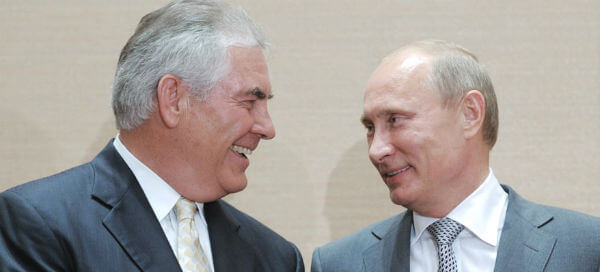
Rex Tillerson, Exxon chief with close ties to Russia, is expected to be Trump’s pick for secretary of state

The New York Times reports: Rex W. Tillerson, the chief executive of Exxon Mobil, whose extensive deal-making for the energy giant has plunged him into global politics from Yemen to Russia, is expected to be offered the secretary of state post this weekend by President-elect Donald J. Trump, according to two people close to Mr. Trump’s transition team.

Mr. Tillerson, 64, has spent the past 41 years at Exxon, where he began as a production engineer and went on to strike deals around the world for a company that explores, buys and sells oil and gas in some of the globe’s most troubled corners.

Those travels have engendered close ties with a number of world leaders, notably President Vladimir V. Putin of Russia, who has known Mr. Tillerson for more than two decades, and who awarded him the country’s Order of Friendship in 2013. The next year, Washington’s relationship with Moscow was plunged into a deep freeze with Russia’s annexation of Crimea and its shadow war in eastern Ukraine, a problem that Mr. Tillerson would inherit. [Continue reading…]

Steve Horn notes: Exxon, the top U.S. producer of oil and gas and a well-documented funder of climate science denial, actually leases more land in Russia than it does in the U.S.

“Exxon boosted its Russian holdings to 63.7 million acres in 2014 from 11.4 million at the end of 2013, according to data from U.S. regulatory filings,” reported Bloomberg in March 2014. “That dwarfs the 14.6 million acres of rights Exxon holds in the U.S., which until last year was its largest exploration prospect.”

Exxon, though headquartered in Irving, Texas near Dallas, is a sprawling “private empire” with assets spread across the globe. When asked about building more U.S. refineries to protect the U.S. economy and consumers from fuel shortages, former CEO and chairman Lee Raymond put Exxon’s view of itself and its loyalty to the U.S. bluntly.

“I’m not a U.S. company, and I don’t make decisions based on what’s good for the U.S,” Raymond is quoted as saying in the 2012 book Private Empire: ExxonMobil and American Power by Steve Coll. [Continue reading…]

Stay informed. Click below to sign up for daily email updates from War in Context:

sign up now

Facebooktwittermail

Trump transition team for Energy Department seeks names of employees involved in climate meetings

The Washington Post reports: Donald Trump’s transition team has issued a list of 74 questions for the Energy Department, asking agency officials to identify which employees and contractors have worked on forging an international climate pact as well as domestic efforts to cut the nation’s carbon output.

The questionnaire requests a list of those individuals who have taken part in international climate talks over the past five years and “which programs within DOE are essential to meeting the goals of President Obama’s Climate Action Plan.”

Trump and his team have vowed to dismantle specific aspects of Obama’s climate policies, and Trump has questioned the reality of climate change. The questionnaire, which one Energy Department official described as unusually “intrusive” and a matter for departmental lawyers, has raised concern that the Trump transition team is trying to figure out how to target the people, including civil servants, who have helped implement policies under Obama.

Thousands of scientists have signed petitions calling on the president-elect and his team to respect scientific integrity and refrain from singling out individual researchers whose work might conflict with the new administration’s policy goals. This potential clash could prompt a major schism within the federal government, with many career officials waging a battle against incoming political appointees.

While there have been many instances of political appointees and career scientists clashing in various administrations, what is novel is the request for the names of so many individual scientists, and the fact that it comes during the transition period, before the Trump administration has even taken power. This may be a signal of even more intense politicization after the inauguration. [Continue reading…]

Facebooktwittermail

Trump, McConnell, Putin, and the triumph of the will to power

Jonathan Chait writes: Of the many things that resulted in Donald Trump’s election, from Hillary Clinton’s own errors to James Comey’s extraordinary insinuations against her in the contest’s final stages, Russian hacking played a meaningful enough role to tilt a razor-tight contest. Russia successfully riled up Bernie Sanders die-hards against the Democratic Party by leaking minor intrigue that fueled their suspicions, aggravating a Clinton liability with young voters that never healed. They also dribbled out enough emails in the succeeding months to keep stories using the word “emails” in the lead of Hillary Clinton news, adding more smoke to the haze of scandal that permeated coverage of her campaign.

We now know with near-certainty that Russia did this with the goal of electing Trump president. During the campaign, this reality was not quite certain enough to be reported as fact. Trump, of course, insisted there was no evidence Russia even had a hand in the attacks, let alone with the goal of helping him. (It “could be somebody sitting on their bed that weighs 400 pounds.”) Elements of the left decried suspicions of Russia’s role as “neo-McCarthyism.” The Nation editorialized, “ liberal-media elites have joined with the Clinton campaign in promoting the narrative of a devious Russian cyber-attack.” Others on the left insisted that the substance of the stolen emails command far more importance than their provenance, which in any case was disputed and unknowable. On October 31, the New York Times reported that the attack was probably “aimed at disrupting the presidential election rather than electing Mr. Trump.”

Friday, the Washington Post reported that the CIA had concluded well before November that Russia specifically sought to elect Trump. The CIA’s analysis is obviously not infallible, but it fits with a wide array of other evidence. Russia had a clear motive: chilly relations with the Democratic administration that had orchestrated sanctions against it, close ties with Donald Trump and several of his advisers, and a series of pro-Russian positions from Trump on such issues as Crimea, NATO, and Vladimir Putin’s human rights abuses. Russia also hacked the Republican National Committee but declined to release any of the contents. The disruption was intentionally one-sided. The CIA’s conclusion merely lends incrementally more confidence to a deduction that was already fairly obvious.

What is more interesting in the Post story is the response of various officials to the revelations. The Obama administration declined to publicize, wary of being seen as intervening on Clinton’s behalf. Instead, it devised a fallback plan. Concerned that Russia might attempt to hack into electronic voting machines, it gathered a bipartisan group of lawmakers to hear the CIA’s report, in the hopes that they would present a united front warning Russia not to disrupt the election. According to the Post, Republican Majority Leader Mitch McConnell “raised doubts about the underlying intelligence and made clear to the administration that he would consider any effort by the White House to challenge the Russians publicly an act of partisan politics.” Other Republicans refused to join the effort for reasons that can only be understood as a desire to protect the Republican ticket from any insinuation, however well-founded, that Russia was helping it.

Even the most cynical observer of McConnell — a cynical man to his bones — would have been shocked at his raw partisanship. Presented with an attack on the sanctity of his own country’s democracy by a hostile foreign power, his overriding concern was party over country. Obama’s fear of seeming partisan held him back from making a unilateral statement without partisan cover. No such fear restrained McConnell. This imbalance in will to power extended to the security agencies. The CIA could have leaked its conclusion before November, but held off. The FBI should have held off on leaking its October surprise, but plunged ahead. [Continue reading…]

Facebooktwittermail

Trump, mocking claim that Russia hacked election, at odds with GOP

The New York Times reports: An extraordinary breach has emerged between President-elect Donald J. Trump and the national security establishment, with Mr. Trump mocking American intelligence assessments that Russia interfered in the election on his behalf, and top Republicans vowing investigations into Kremlin activities.

Mr. Trump, in a statement issued by his transition team on Friday evening, expressed complete disbelief in the intelligence agencies’ assessments.

“These are the same people that said Saddam Hussein had weapons of mass destruction,” Mr. Trump’s team said, adding that the election was over and that it was time to “move on.”

Though Mr. Trump has wasted no time in antagonizing the agencies, he will have to rely on them for the sort of espionage activities and analysis that they spend more than $70 billion a year to perform.

At this point in a transition, a president-elect is usually delving into intelligence he has never before seen and learning about C.I.A. and National Security Agency abilities. But Mr. Trump, who has taken intelligence briefings only sporadically, is questioning not only analytic conclusions, but also their underlying facts. [Continue reading…]

Facebooktwittermail

‘We are dead either way’: Agonizing choices for Syrians in Aleppo

The New York Times reports: He had long been one of the more optimistic anti-government residents of the besieged, rebel-held section of Aleppo, trying to buoy others’ spirits even as loyalist forces closed in. But as the Syrian Army and allied militias took more and more territory in an apparently decisive offensive during the week, Yasser Hmeish, an accountant for the local medical council, grew frantic.

Soldiers seized his neighborhood on Wednesday while he worked at a clinic blocks away. Several of Mr. Hmeish’s neighbors were brought into the clinic wounded, but died before he could ask what had happened to his family.

“I don’t know anything, anything about them,” Mr. Hmeish said in an audio message, in one of scores of exchanges we had with people inside east Aleppo as the offensive unfolded. “We are about to die or be arrested.”

After years of bombing and months under siege, rebels had lost more than three-quarters of their territory in eastern Aleppo by the end of the week, throwing thousands of civilians and fighters into chaos. We followed the events in real time from Beirut, monitoring social media and talking via WhatsApp, Skype, telephone and other media with doctors, fighters, housewives, local council members, antigovernment activists, aid workers and others, including on the government side. All were people we had gotten to know through years of covering Syria’s bloody civil war.

They confided their dilemmas over whether to flee to government-held areas or stay put until the bitter end, a choice that split up many families. They described escalating bombardment and attacks that have killed women and children trying to reach safe ground. They revealed deepening rifts among rebel groups, and between fighters and civilians, over whether and how to surrender. [Continue reading…]

Facebooktwittermail

The Senate torture report must be saved

Senators Carl Levin and Jay Rockefeller write: In President Obama’s final national security speech on Tuesday, he spoke about the importance of staying true to our values, of not returning to torture, and of transparency. Now, in his remaining time in office, he has an opportunity to take action to advance these goals and to do something of great importance for the public’s understanding of our history. He has the ability to protect the Senate Intelligence Committee’s full 6,700-page report on torture from being lost, perhaps forever.

Given President-elect Donald J. Trump’s unconscionable campaign pledge to “bring back waterboarding” and “a hell of a lot worse” — acts that would be illegal if carried out — President Obama’s leadership on this issue has never been more important.

Drawing on our decades of work in the Senate and our chairmanships of the Armed Services and Intelligence Committees, we are calling on President Obama to preserve the full torture report as a matter of profound public interest. We are not asking him to necessarily agree with all of the report’s findings, though we certainly hope he does, but we are asking him to protect it as an important piece of history.

The president could do this simply by allowing departments and agencies that already possess the document to enter it as a federal record, making it much more difficult for a future administration to erase. [Continue reading…]

Facebooktwittermail

The violent costs of the global palm-oil boom

Jocelyn C. Zuckerman writes: Just after nine o’clock on a Tuesday morning in June, an environmental activist named Bill Kayong was shot and killed while sitting in his pickup truck, waiting for a traffic light to change in the Malaysian city of Miri, on the island of Borneo. Kayong had been working with a group of villagers who were trying to reclaim land that the local government had transferred to a Malaysian palm-oil company. A few days after the murder, the police identified Stephen Lee Chee Kiang, a director and major shareholder of the company, Tung Huat Niah Plantation, as a suspect in the crime, but Kiang flew to Australia before he could be questioned by authorities. (Three other individuals were eventually charged in the case.) Around the world, environmental and human-rights activists added Kayong’s death to the tally of violent incidents connected to the production of palm oil, which has quietly become one of the most indispensable substances on Earth.

The World Wildlife Fund says that half of the items currently on American grocery-store shelves contain some form of palm oil. (“You’re soaking in it,” went the old tagline of the palm-oil-based dish detergent Palmolive.) The move away from trans fats in processed foods was a particular boon for the industry — semi-solid at room temperature, palm oil emerged as an ideal swap-in for the partially hydrogenated oils formerly used to enhance the texture, flavor, and shelf life of products like cookies and crackers. Since 2002, when a report from the National Academy of Sciences found a link between trans fats and heart disease, palm-oil imports to the U.S. have risen four hundred and forty-six per cent, and have topped a million metric tons in recent years. In addition to its widespread use in processed foods, the oil palm plant, Elaeis guineensis, lurks in one form or another in many cosmetics and personal-care products, such as shampoos, soaps, and lipsticks. It’s also used in animal feeds and industrial materials, and, increasingly, as a biofuel.

Elaeis guineensis is native to West Africa, and while its cultivation has spread recently in Central and South America and across equatorial Africa, eighty-five per cent of the palm oil produced today comes from Indonesia or Malaysia. Rising palm-oil exports have helped both countries make enormous economic strides in the past few decades, but the growth has come at a cost: deforestation rates in both places have been listed among the highest in the world. The habitat destruction brought about by palm-oil production has helped push scores of the region’s species, including orangutans and Sumatran elephants, rhinos, and tigers, to the brink of extinction. And, mostly thanks to palm-oil production, Indonesia can boast some of the world’s highest levels of greenhouse-gas emissions.

Yet it is violence — against local populations, farmers, and activists — that has human-rights groups closely watching the palm-oil industry. [Continue reading…]

Facebooktwittermail

Russia hacked Republican National Committee but kept data, U.S. concludes

The New York Times reports: American intelligence agencies have concluded with “high confidence” that Russia acted covertly in the latter stages of the presidential campaign to harm Hillary Clinton’s chances and promote Donald J. Trump, according to senior administration officials.

They based that conclusion, in part, on another finding — which they say was also reached with high confidence — that the Russians hacked the Republican National Committee’s computer systems in addition to their attacks on Democratic organizations, but did not release whatever information they gleaned from the Republican networks.

In the months before the election, it was largely documents from Democratic Party systems that were leaked to the public. Intelligence agencies have concluded that the Russians gave the Democrats’ documents to WikiLeaks.

Republicans have a different explanation for why no documents from their networks were ever released. Over the past several months, officials from the Republican committee have consistently said that their networks were not compromised, asserting that only the accounts of individual Republicans were attacked. On Friday, a senior committee official said he had no comment. [Continue reading…]

Facebooktwittermail

Donald Trump takes aim at U.S. Intelligence

CNN reports: President-elect Donald Trump’s transition team slammed the CIA Friday, following reports the agency has concluded that Russia intervened in the election to help him win.

In a stunning response to widening claims of a Russian espionage operation targeting the presidential race, Trump’s camp risked an early feud with the Intelligence community on which he will rely for top secret assessments of the greatest threats facing the United States.

“These are the same people that said Saddam Hussein had weapons of mass destruction,” the transition said in a terse, unsigned statement.

“The election ended a long time ago in one of the biggest Electoral College victories in history. It’s now time to move on and ‘Make America Great Again.'” [Continue reading…]

Facebooktwittermail

Donald Trump receives far fewer intelligence briefings than most of his recent predecessors

Reuters reports: President-elect Donald Trump is receiving an average of one presidential intelligence briefing a week, according to U.S. officials familiar with the matter, far fewer than most of his recent predecessors.

Although they are not required to, presidents-elect have in the past generally welcomed the opportunity to receive the President’s Daily Brief (PDB), the most highly classified and closely held document in the government, on a regular basis.

It was not immediately clear why Trump has decided not to receive the intelligence briefings available to President Barack Obama more frequently, or whether that has made any difference in his presidential preparations.

An official on the transition team said on Thursday that Trump has been receiving national security briefings, including “routine” PDBs and other special briefings, but declined to specify their content or frequency, saying these matters were classified.

Trump has asked for at least one briefing, and possibly more, from intelligence agencies on specific subjects, one of the officials said. The source declined to identify what subjects interested the president-elect, but said that so far they have not included Russia or Iran. [Continue reading…]

Facebooktwittermail

Russia intervened in election to help Donald Trump win, CIA has concluded

The Washington Post reports: The CIA has concluded in a secret assessment that Russia intervened in the 2016 election to help Donald Trump win the presidency, rather than just to undermine confidence in the U.S. electoral system, according to officials briefed on the matter.

Intelligence agencies have identified individuals with connections to the Russian government who provided WikiLeaks with thousands of hacked emails from the Democratic National Committee and others, including Hillary Clinton’s campaign chairman, according to U.S. officials. Those officials described the individuals as actors known to the intelligence community and part of a wider Russian operation to boost Trump and hurt Clinton’s chances.

“It is the assessment of the intelligence community that Russia’s goal here was to favor one candidate over the other, to help Trump get elected,” said a senior U.S. official briefed on an intelligence presentation made to U.S. senators. “That’s the consensus view.”

The Obama administration has been debating for months how to respond to the alleged Russian intrusions, with White House officials concerned about escalating tensions with Moscow and being accused of trying to boost Clinton’s campaign. [Continue reading…]

Aaron Blake writes: The report highlights and exacerbates the increasingly fraught situation in which congressional Republicans find themselves with regard to Russia and Trump. By acknowledging and digging into the increasing evidence that Russia helped — or at least attempted to help — tip the scales in Trump’s favor, they risk raising questions about whether Trump would have won without Russian intervention.

Trump, after all, won by a margin of about 80,000 votes cast across three states, winning each of the decisive states by less than one percentage point. So even a slight influence could have plausibly made the difference, though we’ll never be able to prove it one way or another.

While saying that Russia clearly tried to help Trump doesn’t inherently call into question the legitimacy of Trump’s win —earlier Friday, the White House made sure to emphasize that it’s not making that case — it’s not hard to connect the dots. And Trump and his party know it. [Continue reading…]

Facebooktwittermail

Republicans ready to launch wide-ranging probe of Russia, despite Trump’s stance; Obama orders intel review

The Washington Post reports: Leading Senate Republicans are preparing to launch a coordinated and wide-ranging probe into Russia’s alleged meddling in the U.S. elections and its potential cyberthreats to the military, digging deep into what they view as corrosive interference in the nation’s institutions.

Such an aggressive approach puts them on a direct collision course with President-elect Donald Trump, who downplays the possibility Russia had any role in the November elections — arguing that a hack of the Democratic National Committee emails may have been perpetrated by “some guy in his home in New Jersey.” The fracture could become more prominent after Trump is inaugurated and begins setting foreign policy. He has already indicated that the country should “get along” with Russia since the two nations have many common strategic goals.

But some of Trump’s would-be Republican allies on Capitol Hill disagree. Senate Armed Services Committee Chairman John McCain (Ariz.) is readying a probe of possible Russian cyber-incursions into U.S. weapons systems, and he said he has been discussing the issue with Senate Select Intelligence Committee Chairman Richard Burr (N.C.), with whom he will be “working closely” to investigate Russia’s suspected interference in the U.S. elections and cyberthreats to the military and other institutions. Senate Majority Leader Mitch McConnell (R-Ky.) has been apprised of the discussions. Burr did not respond to requests for comment.

Senate Foreign Relations Committee Chairman Bob Corker (R-Tenn.) also said he intends to hold hearings next year into alleged Russian hacking. Corker is on Trump’s shortlist for secretary of state, according to the Trump transition team.

Trump transition officials could not be reached for comment.

The loudest GOP calls for a Russia probe are coming from McCain and Sen. Lindsey Graham (R-S.C.). Both have taken a hard line on Russia and have been highly critical of Trump, particularly his praise of President Vladimir Putin. [Continue reading…]

The Washington Post reports: President Obama has ordered a “full review” of Russian hacking during the November election, as pressure from Congress has grown for greater public understanding of exactly what Moscow did to interfere in the electoral process.

“We may have crossed into a new threshold, and it is incumbent upon us to take stock of that, to review, to conduct some after-action, to understand what has happened and to impart some lessons learned,” Obama’s counterterrorism and homeland-security adviser, Lisa Monaco, told reporters at a breakfast hosted by the Christian Science Monitor.

Obama wants the report before he leaves office on Jan. 20, Monaco said. [Continue reading…]

Stay informed. Click below to sign up for daily email updates from War in Context:

sign up now

Facebooktwittermail

Hostile states pose ‘fundamental threat’ to Europe, says MI6 chief

The Guardian reports: The head of the British intelligence agency MI6, Alex Younger, has said cyber-attacks, propaganda and subversion from hostile states pose a “fundamental threat” to European democracies, including the UK.

In a rare speech by an MI6 chief while in office, Younger did not specifically name Russia but left no doubt that this was the target of his remarks. Russia has been accused of interfering in the US presidential election and there are concerns it could do the same in French and German elections next year.

He did mention Russia in relation to Syria, portraying Russian military support for the country’s president, Bashar al-Assad, in the takeover of Aleppo and elsewhere as potentially creating a long-term problem that could increase radicalisation.

“In Aleppo, Russia and the Syrian regime seek to make a desert and call it peace. The human tragedy is heartbreaking,” Younger said.

Russia has moved ever closer to centre stage for the US and UK intelligence agencies over the last year. During the US election campaign Donald Trump said he would seek to engage in some sort of discourse with Vladimir Putin, the Russian president. [Continue reading…]

Facebooktwittermail

Anti-Islam Dutch politician Geert Wilders found guilty of discrimination

The Washington Post reports: A Dutch court found anti-Islam politician Geert Wilders guilty Friday of insulting an ethnic group and inciting discrimination after he led chants against Moroccans, a conviction he promptly denounced as “madness.”

Wilders, the controversial leader of the Netherlands’ far-right Freedom Party (PVV), said he plans to appeal the verdict delivered by a panel of three “hating” judges. His party is leading in polls ahead of the country’s upcoming general election in March.

“Three PVV hating judges declare that Moroccans are a race and convict me and half of the Netherlands. Madness,” he wrote in a Twitter message after the verdict.

In March 2014, Wilders sparked outrage at a rally in The Hague after asking supporters whether they wanted more or fewer Moroccan immigrants in the Netherlands.

After the crowd chanted, “Fewer! Fewer!” Wilders responded: “We’re going to organize that.” More than 6,400 people filed official complaints to the police, a sampling of which were read out in court.

The court imposed no punishment on Wilders, saying the conviction was punishment enough. The prosecution wanted to impose a fine of 5,000 euros ($5,288). [Continue reading…]

Facebooktwittermail

Taliban seeks recognition for Qatar office, direct talks with U.S.

VOA reports: Afghanistan’s Taliban has demanded official recognition for its political office in Qatar, direct talks with the United States and removal of senior members from a U.N. blacklist, describing these as preliminary steps to peacefully ending its insurgency.

A Qatar-based Taliban spokesman, Sohail Shaheen, has asserted the presence of U.S.-led foreign troops in Afghanistan is the “root cause” of war and its continuation.

The “foreign occupation forces” are undermining the country’s sovereignty and freedom of its politics as well as the government, he added.

“That is why there is need for America and its allies to come to the table for direct talks with the Islamic Emirate (the Taliban) for negotiating an end to the occupation,” Shaheen said.

If peace is the objective of the other side, he asserted, then the Taliban must be allowed to open its “Political Office” in Qatar and names of its senior members be removed from the U.N. black list. [Continue reading…]

Facebooktwittermail

Yemen conflict: The view from the Saudi side

BBC News reports: Saudi Arabia is at war.

You wouldn’t know it on the peaceful streets of its capital, Riyadh, but hundreds of miles to the south the civil war that has torn apart neighbouring Yemen is spilling over the border into Saudi towns and villages.

Saudi officials say more than 500 of their citizens have been killed by the Yemen war, a number dwarfed by the thousands killed in Yemen itself, but still a shock for this otherwise tranquil kingdom that is home to the holiest sites in Islam and is also the world’s biggest oil producer.

We visited the ruins of a girls’ elementary school in the village of Khawber, hit by a Houthi missile in the middle of the night.

In the shattered classroom the school clock lay on the floor, its hands stopped at the moment the missile exploded.

We met badly injured villagers, maimed by flying shrapnel when a Houthi rocket struck their mosque, and we were given rare access to a Saudi army Patriot anti-missile battery, placed in the desert facing Yemen, that has been intercepting ballistic missiles fired at Saudi Arabia’s southern towns.

These Soviet-era missiles are aimed at the towns of Najran, Abha, Gizan, Khamis Mushayt and even, according to the Saudis, at the holy city of Mecca.

These ageing but still deadly Russian-made missiles belong to a stockpile amassed by the Yemeni army over the years and now taken over by the Houthis.

The weapons include Scud B missiles with a payload of nearly one tonne of high explosives, and the smaller Tochka with a payload of 482kg of explosives.

Saudi officers showed us the remnants of a downed Tochka, still bearing Cyrillic writing on its fuselage.
Between 6 June 2015 and 26 November 2016 the Saudi authorities have recorded 37 ballistic missiles fired from Yemen across the border into Saudi airspace.

Yet the damage to Saudi Arabia pales before the destruction next door in Yemen. [Continue reading…]

Facebooktwittermail
