Daily Archives: December 7, 2007

NEWS & ANALYSIS: Destroying evidence of war crimes

CIA destroyed 2 tapes showing interrogations

The Central Intelligence Agency in 2005 destroyed at least two videotapes documenting the interrogation of two Qaeda operatives in the agency’s custody, a step it took in the midst of Congressional and legal scrutiny about its secret detention program, according to current and former government officials.

The videotapes showed agency operatives in 2002 subjecting terrorism suspects — including Abu Zubaydah, the first detainee in C.I.A. custody — to severe interrogation techniques. The tapes were destroyed in part because officers were concerned that video showing harsh interrogation methods could expose agency officials to legal risks, several officials said. [complete article]

Obstruction of justice at the CIA

Let’s first focus on this question: Why is this evidence being destroyed? The answer is painfully acknowledged. The CIA leadership and other senior administration officials are fully cognizant of the fact that the use of a number of specific practices which these tapes almost certainly document, to-wit: waterboarding, long-time standing, hypothermia, psychotropic drugs and sleep deprivation in excess of two days, are serious crimes under American law and the law of almost all nations. Consequently, those who have used them and those who have authorized their use will almost certainly ultimately face criminal prosecution at some point in the future. The Administration’s attempts to immunize the perpetrators have failed. Any purported grant of a pardon by President Bush will be legally ineffective, because Bush himself is a collaborator in the scheme. And there is no statute of limitations. Therefore the prospect of prosecution is hardly far-fetched. It is a virtual certainty. So the evidence is being destroyed precisely because it would be used as evidence of criminal acts in a prosecution of administration figures and those acting under their direction. Therefore, this is a conscious, calculated obstruction of justice. [complete article]

See also, CIA destroyed videos showing interrogations (WP), Marty Lederman – includes Hayden’s message to CIA employees (Balkinization), and This is a banana republic (Andrew Sullivan).

Facebooktwittermail

ANALYSIS, OPINION & EDITOR’S COMMENT: Iran’s new Arab friends

Iran’s new Gulf friends

A curious event took place in the Gulf as the new National Intelligence Estimate appeared in Washington, undermining the Bush administration’s threats and angry rhetoric by revealing that Iran had suspended in nuclear weapons program back in 2003.

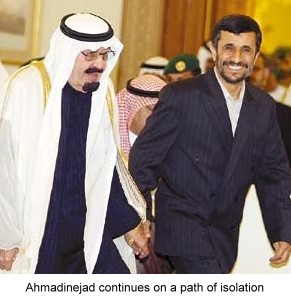
king-abdullah-with-president-ahmadinejad.jpgThe arch-demon of President Bush’s rhetoric, Iran’s President Mahmoud Ahmedinejad, was sitting politely in a conference room with the Arab leaders of the Gulf Cooperation Council. He was all sweetness and light and neighborly good manners, offering a regional security pact and a 12-point cooperation plan, including free trade and joint investments in oil and gas.

Ahmedinejad was so courteous that the GCC leaders hailed his “gestures of goodwill.” Qatar’s Prime Minister Skeikh Hamad al Thani, whose emirate hosted the summit, said, “If Iran was serious in its positive intentions, we can develop our relations for the sake of regional stability.” [complete article]

The new chapter and taking poison

There are good foundations for cooperative and friendly relations between the Gulf state and Iran; there are also good reasons to justify the conflicts and caution between the two sides of the Arab Gulf. The region is passing through a gray phase in which interests and goals are too intertwined. The only way to put friendship and cooperation ahead of conflict and caution is by direct dialogue. [complete article]

GCC to launch common market in January

Leaders of the six-member Gulf Cooperation Council (GCC) yesterday announced their plan to launch a common market in January 2008 and a currency union by 2010 in addition to maintaining their currencies’ peg to the US dollar. [complete article]

See also, As Dubai heats up, is Israel frozen out? (The Forward).

Editor’s Comment — While some headlines in the US press are still pushing the old narrative (such as the LA Times’Report on Iran fuels Arab fears“), the image across the Middle East is somewhat different. Mahmoud Ahmadinejad might not be universally popular, but President Bush is deluding himself if he thinks that Iran can now be isolated. Neither should the significance of Ahmadinejad’s overtures to the GCC be underestimated. The GCC (an acronym that will be unfamiliar to most Americans) might be made up of mostly small and autocratic states but this bloc also happens to be a financial superpower possessing more than double the available investment funds of China.

Facebooktwittermail

ANALYSIS & OPINION: A new approach to Iran

Why containing Iran won’t work: Washington’s flawed new Middle East strategy

The Middle East is a region continuously divided against itself. In the 1960s, radical Arab regimes contested the legitimacy and power of traditional monarchical states. In the 1970s, Islamic fundamentalists rejected the prevailing secular order and sought to set the region on the path to God. In the 1980s, much of the Arab world supported the genocidal Saddam Hussein as he sought to displace Iran’s theocratic regime. Today, the Middle East is fracturing once more, this time along sectarian and confessional lines, with Sunnis clamoring to curb Shiite ascendance. Again and again, in the name of preserving the balance of power, U.S. policy has taken sides in the region’s conflicts, thus exacerbating tensions and widening existing cleavages. Beyond the Arab-Israeli conflict, the United States has shown limited interest in mediating conflicts, settling disputes, or bringing antagonists together. Washington sided with the conservative monarchies against Arab socialist republics, acquiesced in the brutal suppression of fundamentalist opposition by secular governments, buttressed Saudi power and the Iraqi war machine to temper Ayatollah Ruhollah Khomeini’s Islamist rage. It is now courting Sunni regimes to align against Iran and its resurgent Shiite allies. Every time, as Washington has become mired in the Middle East’s rivalries, its goal of stabilizing the region has slipped further away.

Instead of focusing on restoring a former balance of power, the United States would be wise to aim for regional integration and foster a new framework in which all the relevant powers would have a stake in a stable status quo. The Bush administration is correct to sense that a truculent Iran poses serious challenges to U.S. concerns, but containing Iran through military deployment and antagonistic alliances simply is not a tenable strategy. Iran is not, despite common depictions, a messianic power determined to overturn the regional order in the name of Islamic militancy; it is an unexceptionally opportunistic state seeking to assert predominance in its immediate neighborhood. Thus, the task at hand for Washington is to create a situation in which Iran will find benefit in limiting its ambitions and in abiding by international norms.

Dialogue, compromise, and commerce, as difficult as they may be, are convincing means. An acknowledgment by the U.S. government that Tehran does indeed have legitimate interests and concerns in Iraq could get the two governments finally to realize that they have similar objectives: both want to preserve the territorial integrity of Iraq and prevent the civil war there from engulfing the Middle East. Resuming diplomatic and economic relations between Iran and the United States, as well as collaborating on Iraq, could also be the precursor of an eventual arrangement subjecting Iran’s nuclear program to its obligations under the Nuclear Nonproliferation Treaty. If Iran enjoyed favorable security and commercial ties with the United States and was at ease in its region, it might restrain its nuclear ambitions. [complete article]

After the Iran NIE

Since the NIE’s release, Bush has emphasized the passages of the report that continue to sound warning bells. But this effort will be dismissed as—and, in fact, will be—lame propaganda unless he also acknowledges, and embraces, the positive passages.

If Bush wants the rest of the world to acknowledge the caveats, he has to acknowledge—and act on—the main message. In other words, if he wants Russia, China, and the European Union to continue the diplomatic pressure on Iran, he has to offer Iran diplomatic inducements. Pressure may be needed to keep the Iranians from resuming their nuclear-weapons program. But negotiations should be started, as a reward for halting their program—and the prospect of further rewards should be held out if they unwind their program still further.

Bush should have started serious talks with Iran two years ago, for a variety of reasons. The NIE offers two additional, compelling reasons for starting them now. [complete article]

The zero-sum fiasco

Bush’s woefully misguided invasion and occupation of Iraq in 2003, carried out under false pretences, has not only drained the United States treasury, but reduced Washington’s standing in the Middle East in a way not yet fully grasped by most commentators. Whereas Washington once played off Tehran against Baghdad, while involved in a superpower zero-sum game with the Soviet Union, the Bush administration is now engaged in a zero-sum game, as a virtual equal, with Iran. That is, America’s loss has become Iran’s automatic gain, and vice-versa. [complete article]

A new Chinese red line over Iran

The highly respected former Australian foreign minister Gareth Evans has assessed after a recent visit to Tehran and meetings with top Iranian officials that the outlines of a deal are emerging and the NIE “gives us the chance to break out of this impasse [of Iran insisting on its right to enrich]”. He suggested that the “red line” should no longer be the issue of enrichment, but could be between the “civilian and military capability” of NPT signatories, and if such a new red line would hold, “it would not matter whether Iran was capable of producing its own nuclear fuel”.

Evans added, “That [red] line will hold if we can get Iran to accept a highly intrusive monitoring, verification and inspection regime” with additional safeguards, and if Iran could be persuaded to “stretch out over time the development of its enrichment capability and to have any industrial-scale activity conducted not by Iran but by an international consortium”.

Evan assesses that Iran is “capable of being persuaded” if incentives include the lifting of sanctions and normalization of relations with the US. Evans concluded: “This is a country seething with both national pride and resentment against past humiliations, and it wants to cut a regional and global figure by proving its sophisticated technological capability. One only wishes that something less sensitive than the nuclear fuel cycle had been chosen to make that point.” [complete article]

Facebooktwittermail

NEWS: Republicans want intelligence to their liking

Review of Iran intelligence to be sought

Senate Republicans are planning to call for a congressional commission to investigate the conclusions of the new National Intelligence Estimate on Iran as well as the specific intelligence that went into it, according to congressional sources.

The move is the first official challenge, but it comes amid growing backlash from conservatives and neoconservatives unhappy about the assessment that Iran halted a clandestine nuclear weapons program four years ago. It reflects how quickly the NIE has become politicized, with critics even going after the analysts who wrote it, and shows a split among Republicans.

Sen. John Ensign (R-Nev.) said he plans to introduce legislation next week to establish a commission modeled on a congressionally mandated group that probed a disputed 1995 intelligence estimate on the emerging missile threat to the United States over the next 15 years. [complete article]

Facebooktwittermail

NEWS & ANALYSIS: Israel and American Jewish organizations respond to NIE

Israel warns Iran to co-operate or pay price

Israel has warned Iran to either co-operate with the West over its uranium enrichment program or face military action.

Ron Prosor, Israel’s newly appointed ambassador to Britain and one of his country’s leading experts on Iran’s nuclear program, said that Tehran could enrich enough uranium to make an atomic bomb by 2009.

“At the current rate of progress, Iran will reach the technical threshold for producing fissile material by 2009,” he said.

“This is a global threat and it requires a global response.

“It should be made clear that if Iran does not co-operate, then military confrontation is inevitable. It is either co-operation or confrontation.”

Mr Prosor, who served Ehud Olmert, the Israeli Prime Minister, as his senior adviser on Iran, said that time for resolving the nuclear issue was rapidly running out. But he was non-committal about the possibility of Israel launching military action. [complete article]

Intel bombshell sends community scrambling to hold line on Iran threat

American Jewish groups are scrambling to reformulate their message on Iran following the release this week of a new American intelligence report that states with “high confidence” that Tehran halted its nuclear weapons program four years ago.

In a conference call Tuesday hurriedly arranged by the umbrella body of Jewish organizations, communal leaders decided to immediately send letters to the presidential candidates from both parties, urging them to continue pushing for sanctions against Iran.

According to participants in the conference call, concern is high that the unexpected conclusions drawn in the National Intelligence Estimate not only may lead Washington to withdraw the threat of military action against Iran but may also erode the recently reached international consensus on pressuring Iran to abandon its nuclear ambitions. [complete article]

Israeli policy on Tehran unchanged by American assessment

Israel will continue reviewing the implications of the U.S. intelligence assessment that Iran has no nuclear program, and will not stop its diplomatic and public relations efforts against the Iranian bomb, government officials decided yesterday.

The statement came after a meeting called by Prime Minister Ehud Olmert to discuss the significance of the U.S. National Intelligence Estimate.

Olmert said at the meeting that Israel’s strict working assumption had not changed. [complete article]

Is Iran NIE a blessing in disguise for Israel?

The US National Intelligence Estimate’s assertion that Iran currently does not have a nuclear weapons program has caused much frustration in Israel. Deputy Defense Minister Ephraim Sneh referred to the report as a lie at a recent breakfast in New York, and Infrastructure Minister Binyamin Ben-Eliezer reportedly “doesn’t buy” its findings.

Though the report aggravates Israel’s effort to compel Washington to pursue an increasingly harsh line against Tehran, all is not lost for Israel. In fact, despite these initial knee-jerk reactions, the NIE may very well end up being a blessing in disguise for the Jewish state by pulling Israel out of its state of paralysis vis-à-vis Iran.

Israel has long been at odds with Washington’s intelligence agencies. It started sounding the alarm bells on Iran’s nuclear program back in 1991, arguing that in the post-Cold War world, Iran and Shi’ite fundamentalism were emerging as the new strategic threat to the Middle East.

The Israeli warnings were met with great skepticism and surprise within the Beltway. After all, only a few years earlier – at a time when Iran’s revolutionary fervor was still riding high – the Israelis had gone to great lengths to bring Iran and the US back on talking terms, dismissing all notions that Iran was a threat. [complete article]

Facebooktwittermail

NEWS, ANALYSIS & EDITOR’S COMMENT: Missile defense against what?

Europe’s missile shield: NIE casualty?

TThat the new U.S. intelligence assessment of Iran’s nuclear program has put the kibosh on hawkish calls for a military response has been discussed to death, but there’s been very little focus on a second potential casualty: the U.S. plan to base ground-based missile defenses in Poland and the Czech Republic. The plan to station interceptor missiles in Poland and tracking radars in the Czech Republic is regarded warily by citizens of those countries, and with outright hostility by the Russians who see it as aimed at blunting their own missile capability in the event of a showdown with the U.S. The plan has helped freeze U.S.-Russia ties to Cold War levels of enmity, with President Vladimir Putin just last week suspending Russia’s participation in 1990s Conventional Forces in Europe treaty.

Against the barrage of criticism from the Russians, Pentagon officials have always insisted that the purpose of the missile-defense system is to protect Europe and the U.S. from an Iranian missile attack. “It’s not the Russians that we’re worried about,” Air Force Lieutenant General Henry “Trey” Obering, chief of the Pentagon’s Missile Defense Agency, said over breakfast earlier this year. “It is the Iranian missiles that we’re worried about.” But if the best those missiles could carry is conventional explosives, the case for deploying the missile defense system in the face of the heavy diplomatic cost and financial burden ($4 billion through 2013) becomes increasingly dubious. For one thing, the Pentagon faces mounting bills of tens of billions of dollars to “reset” the U.S. military — replacing everything worn out in Afghanistan and Iraq — over the coming decade. [complete article]

Russia alleges U.S. ‘rollback’ on anti-missile plan

The United States has backed away from proposals it made orally in October to allay Russian fears about the deployment of a missile defense system in Eastern Europe, Russia’s foreign minister, Sergei Lavrov, alleged Wednesday.

Lavrov said an oral proposal to permanently station Russian officers at sites in Poland and the Czech Republic to ensure that the system’s radar would not be used to peer into Russian airspace was withdrawn when the United States submitted its proposals to Moscow in writing last month.

“We received the document, and unfortunately a serious rollback from what we agreed upon was evident,” Lavrov said at a news conference Wednesday in his first detailed comments on the U.S. written proposals. “The issue no longer concerns the permanent presence of Russian officers at possible facilities . . . in the Czech Republic and Poland.” [complete article]

Editor’s Comment — I’m not sure why I haven’t read anyone else make this observation, but there’s always seemed to me to be a glaring contradiction that the administration on the one hand asserts that Iran will never be allowed to possess nuclear weapons, while on the other hand argues to its European allies that they need a missile defense shield for protection against Iranian ballistic missiles. Either the shield was always presumed to be unnecessary or it was always presumed that efforts to prevent Iran acquiring nuclear weapons would fail. The Pentagon’s claim that the “missile-defense program is not geared to any kind of specific defense against a specific weapon,” is baloney.

Facebooktwittermail

INTERVIEW: Israel has to take the first step

“Israel has to take the first step”

A revived road-map? A photo-opportunity? Or a real possibility for peace? “The key is in Israeli hands. Israel is the occupier and Israel has to take the first step”. Gideon Levy, left-wing Israeli journalist of Haaretz, former spokesman for Shimon Peres (1978 -1982), and, according to the French newspaper Le Monde, “a thorn in Israel’s side”, does not beat around the bush when talking about the recent Annapolis peace conference. Not overly optimistic on its likely outcomes, although conceding that it offers a glimmer of hope, Levy urges both Israeli and Palestinian leaders to take a leap forward by abandoning brinkmanship and approaching peace with courage. [complete article]

Facebooktwittermail