Daily Archives: December 20, 2007

NEWS, OPINION & EDITOR’S COMMENT: Torture tapes — Watergate of our times?

CIA to cooperate with House on tapes

The Central Intelligence Agency has agreed to make documents related to the destruction of interrogation videotapes available to the House Intelligence Committee and to allow the agency’s top lawyer, John A. Rizzo, to testify about the matter, Congressional and intelligence officials said Wednesday.

But it remained unclear whether Jose A. Rodriguez, who as chief of the agency’s clandestine service ordered the tapes destroyed in 2005, would testify. Officials said Mr. Rodriguez’s appearance before the committee might involve complex negotiations over legal immunity at a time when the Justice Department and the intelligence agency were reviewing whether the destruction of the tapes broke any laws.

The agreement marked at least a partial resolution of a standoff between the Bush administration and Congress. [complete article]

See also, Bush faces questions about CIA tapes (AP) and White House: NYT wrong about CIA tapes (CNN).

Torture tapes are the Watergate of our times

In an administration facing an ocean of scandal on multiple and multiplying fronts, this scandal above all will be the Watergate of our times because it involves extremely probable crimes of torture, extremely probable obstructions of justice, and a steady stream of revelations that will only escalate until the inevitable special prosecutor is named. [complete article]

Editor’s Comment — Starting with the most obvious difference between the torture tapes and the Watergate tapes, the latter were tampered with while the former were destroyed — call it a Watergate lesson-learned. But perhaps more important is the political context. America in the early ’70s had the capacity to be shocked and the willingness to challenge power. Back in those days, the New York Times had the guts to defy the White House by publishing the Pentagon Papers. Now the White House asks them to change a subheading and the paper of record meekly says, OK. As for Congress, is an anemic Democratic “opposition” ready to challenge the administration, no-holds-barred? That really would be shocking.

Facebooktwittermail

NEWS & EDITOR’S COMMENT: In Iraq, division will undermine reconciliation

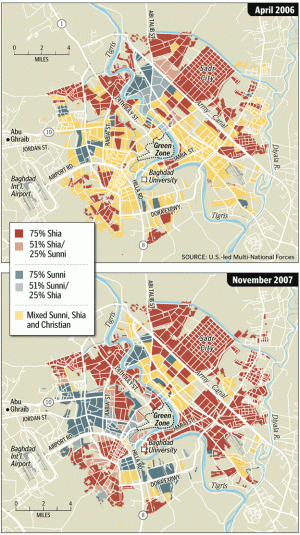
Editor’s Commentchanging-baghdad.gif — The good news coming out of Iraq is that most Iraqis see an end to the U.S. occupation as being the key to national reconciliation. The bad news is that the damage done to Iraq’s social frabric over the last five years is going to be extremely difficult to repair. The problem is starkly depicted in these two maps of Baghdad. In the space of eighteen months, the city has transformed from being predominently made up of mixed neighborhoods (depicted in yellow), to being sharply divided between Shia and Sunni sectors. Now, colliding with this division are returning refugees:

A small fraction of the millions of refugees who fled Iraq have come back. While the government trumpeted their return as proof of newfound security, migration experts said most of them were forced back by expired visas and depleted savings…

The American military has expressed deep concerns about the Iraqi government’s ability to feed and house its returnees, or manage people who wish to reclaim their homes. It is widely feared that property disputes or efforts to return to newly homogenized neighborhoods could set off fresh waves of sectarian attacks.

For most Iraqi refugees, the trip home is just the beginning of their troubles. Many return to find their homes destroyed or filled with squatters, most of them displaced people themselves. But the government committee that decides property disputes is charged with hearing only cases that predate the invasion of 2003.

Strategy that is making Iraq safer was snubbed for years

[A] USA TODAY investigation shows that the strategy now used to defeat the bombmaking networks and stabilize Iraq was ignored or rejected for years by key decision-makers. As early as 2004, when roadside bombs already were killing scores of troops, a top military consultant invited to address two dozen generals offered a “strategic alternative” for beating the insurgency and IEDs.

That plan and others mirroring the counterinsurgency blueprint that the Pentagon now hails as a success were pitched repeatedly in memos and presentations during the following two years, at meetings that included then-Defense secretary Donald Rumsfeld, Secretary of State Condoleezza Rice and Vice President Cheney’s chief of staff, Lewis “Scooter” Libby.

The core of the strategy: Clear insurgents from key areas and provide security to win over Iraqis, who would respond by helping U.S. forces break IED networks and defeat the insurgency.

Bush administration officials, however, remained wedded to the idea that training the Iraqi army and leaving the country would suffice. Officials, including Cheney, insisted the insurgency was dying. Those pronouncements delayed the Pentagon from embracing new plans to stop IEDs and investing in better armored vehicles that allow troops to patrol more freely, documents and interviews show.

Even after the Pentagon began committing substantial resources to combat IEDs, USA TODAY found, its spending focused mostly on high-tech devices with limited utility. Some silver-bullet solutions, such as microwave beams designed to destroy IEDs before they blew up, never worked.

By the time the Pentagon moved to a counterinsurgency strategy at the end of last year, the bombs had been the top killer of U.S. troops for three years, claiming more than 1,160 lives. To date, they are responsible for more than 60% of combat deaths. [complete article]

Facebooktwittermail

NEWS & EDITOR’S COMMENT: Torture complex uncovered

Torture house, mass graves discovered in Iraq

Coalition forces found 26 bodies buried in mass graves and a bloodstained “torture complex,” with chains hanging from walls and ceilings and a bed connected to an electrical system, the military said Wednesday.
[…]
The complex was in an area thought to be an al Qaeda in Iraq haven and operating base, the military said. Iraqis had told the military about the site during an earlier operation.

“Evidence of murder, torture and intimidation against local villagers was found throughout the area,” the military statement said. [complete article]

Editor’s Comment — The unfortunate but predictable effect of a report such as this is that it will empower those who want to argue that “their torture is worse than ours.” But the more important question is this: Have their torturers been empowered by ours? To imagine that Abu Ghraib, Guantanamo, Bagram, renditions and secret CIA prisons have had little impact on the outlook of America’s enemies (and friends) is both ignorant and naive.

Facebooktwittermail

NEWS & EDITOR’S COMMENT: Promoting democracy in Israel; war on Hamas

Adalah center says it may seek supranational regime in ‘all historic Palestine’

The Arab minority rights center, Adalah, is considering a proposal calling for a “democratic constitution for a supranational regime in all of historic Palestine,” including the territory of Israel and the Palestinian Authority. This constitutes a shift from the proposed Democratic Constitution that Adalah offered as a constitution for Israel.

While it is not clear when this change occurred, Adalah sources said Wednesday that the effort does not aim to do away with Israel or delegitimize its existence.

Adalah announced in its monthly newsletter Wednesday that it seeks to establish a group of international experts, including Palestinians and Israelis, to help “finalize the text of the Democratic Constitution.”

In its proposal for a constitution for all historic Palestine, Adalah points to the European Convention on Human Rights as a model. [complete article]

For Israel’s Arab citizens, isolation and exclusion

Fatina and Ahmad Zubeidat, young Arab citizens of Israel, met on the first day of class at the prestigious Bezalel arts and architecture academy in Jerusalem. Married last year, the couple rents an airy house here in the Galilee filled with stylish furniture and other modern grace notes.

But this is not where they wanted to live. They had hoped to be in Rakefet, a nearby town where 150 Jewish families live on state land close to the mall project Ahmad is building. After months of interviews and testing, the town’s admission committee rejected the Arab couple on the grounds of “social incompatibility.” [complete article]

Editor’s Comment — The difference between Israel and South Africa is that the South African whites took pride in their racism and thus gave it a name and a rationale. Most Israeli Jews on the other hand are too attached to their pluralistic Western image and thus an approach described as ensuring “social compatibility” refuses to accept its real name: apartheid.

Israelis cool to an offer from Hamas on a truce

Officials in the Israeli prime minister’s office reacted coolly on Wednesday to an indirect approach by the Hamas leader in Gaza offering talks on a truce.

The offer was relayed through an Israeli reporter, Sleman al-Shafhe, of Channel 2 television. On a news broadcast on Tuesday night, Mr. Shafhe said Ismail Haniya, the leader of the Hamas government in Gaza, had called him earlier in the day to convey a message to the Israelis.

According to Mr. Shafhe, Mr. Haniya said he had the ability to stop the rocket fire directed at Israel from Gaza, on condition that Israel stopped the killing of Palestinians there and lifted the blockade of Gaza.

Mr. Haniya’s call followed Israeli military strikes that killed at least 10 Palestinians in Gaza between Monday night and Tuesday morning, in a concerted effort to suppress the rocket fire. Eight of those killed were from Islamic Jihad, which has been responsible for most of the recent rocket fire, and included a top commander of the group’s military wing, Israeli officials said. [complete article]

Israeli operations in Gaza meet little resistance in Washington

As Israel stepped up air attacks on Gaza this week, the Bush administration refrained from blocking any measures or criticizing Israel’s activity.

The Israeli Air Force last week renewed the practice known as “targeted killing” against members of the Palestinian Islamic Jihad group in Gaza. Israeli officials have said in recent weeks that if rocket fire against Israeli towns is not stopped, further escalation might be imminent, including a full-scale ground incursion into the Hamas-controlled strip.

Administration officials have directed all the blame for the deteriorating situation in Gaza onto Hamas, which seized control of the area in June. Israel, according to diplomatic sources in Washington, was not asked to scale down its actions or to refrain from a ground operation. “I haven’t heard of any red light,” an Israeli official said. The administration’s policy since the recent Annapolis, Md., peace summit entails a two-pronged approach toward the Palestinian Authority. On one hand, Washington will allow Israel to take tough measures against Hamas-ruled Gaza. On the other hand, assistance will be increased to the government of Fatah leader Mahmoud Abbas in the West Bank. At a December 17 donor conference in Paris, the administration pledged $550 million in aid to Abbas’s P.A., an amount that exceeds any previous American financial assistance to the Palestinians. [complete article]

Facebooktwittermail

NEWS: Syria turned away A.Q. Khan

Syria spurned atom smuggler approach in 2001: Assad

Syria rebuffed a possible approach in 2001 from Pakistani-led traffickers in nuclear arms technology, President Bashar al-Assad said.

In an interview with Austrian daily Die Presse, Assad said an unnamed person delivered to Syria a letter purportedly from A.Q. Khan, the now-disgraced father of Pakistan’s atom bomb who supplied Iran, Libya and North Korea with nuclear parts and know-how.

“At the beginning of 2001 someone brought us a letter from a certain Khan. We did not know if the letter was genuine or a forgery by Israel to lure us into a trap,” Assad was quoted by Die Presse on Wednesday as saying. [complete article]

Facebooktwittermail