Daily Archives: January 7, 2008

NEWS, ANALYSIS & OPINION: Bush heads to Middle East

Remember him? Bush begins Middle East tour

Voters in the United States may have switched their attention to the contest to find his successor, but George Bush will embark on an ambitious nine-day tour of the Middle East tomorrow in a last desperate effort to salvage a legacy from two terms in office overshadowed by a catastrophic foreign policy that has earned him the distinction of being one of the worst presidents in the country’s history.

The Bush legacy will not be peace in the Middle East nor an end to conflict in Iraq, but it could be a political earthquake among voters so dismayed by the mess he has made of America’s foreign policy and fearful of economic recession that they are deserting his party in droves.

As he prepares to board a plane for Israel and wrap himself in the tattered flag of victory in Iraq, Mr Bush’s real legacy to the American people is evident in the disillusionment on display in New Hampshire. [complete article]

See also, Army of 8,000 to protect George Bush visit (Telegraph).

Israel’s false friends

Once again, as the presidential campaign season gets underway, the leading candidates are going to enormous lengths to demonstrate their devotion to the state of Israel and their steadfast commitment to its “special relationship” with the United States.

Each of the main contenders emphatically favors giving Israel extraordinary material and diplomatic support — continuing the more than $3 billion in foreign aid each year to a country whose per capita income is now 29th in the world. They also believe that this aid should be given unconditionally. None of them criticizes Israel’s conduct, even when its actions threaten U.S. interests, are at odds with American values or even when they are harmful to Israel itself. In short, the candidates believe that the U.S. should support Israel no matter what it does. [complete article]

A hostile president

George Bush is coming to Israel this week. He will take pleasure in his visit. One can assume that there are few prime ministers with a giant photo of themselves with the U.S. president hanging on the wall in their home, as our Ehud Olmert boasted last week that he does, to his exalted guest, the comic Eli Yatzpan. There are also few other countries where the lame duck from Washington would not be greeted with mass demonstrations; instead, Israel is making great efforts to welcome him graciously. The man who has wreaked such ruin upon the world, upon his country, and upon us is such a welcome guest only in Israel. [complete article]

Israel warns of Iranian missile peril for Europe

Iran is developing nuclear missiles capable of reaching beyond its enemies in the Middle East to Europe, President George Bush will be warned when he visits Israel and the Palestinian territories for the first time since entering the White House. [complete article]

Israel to brief George Bush on options for Iran strike

Israeli intelligence is understood to agree that the [nuclear weapon] project was halted around the time of America’s invasion of Iraq, but has “rock solid” information that it has since started up again.

While security officials are reluctant to reveal all their intelligence, fearing that leaks could jeopardise the element of surprise in any future attack, they are expected to present the president with fresh details of Iran’s enrichment of uranium – which could be used for civil or military purposes – and the development of missiles that could carry nuclear warheads. [complete article]

Israel not honoring pledge, Olmert says

Israel has failed to keep its pledge to stop enlarging Jewish settlements in the West Bank, Prime Minister Ehud Olmert acknowledged in an interview published Friday, addressing a criticism he expects to hear next week from President Bush.

“Every year all the settlements in all the territories [of the West Bank] continue to grow,” Olmert told the Jerusalem Post. “There is a certain contradiction in this between what we’re actually seeing and what we ourselves promised. . . . We have obligations related to settlements and we will honor them.” [complete article]

Nudged by Bush, Israel talks of removing illegal outposts

Pressed by President Bush to keep promises to destroy illegal settler outposts, Israeli leaders said Friday that they hoped to take action after his visit to the region next week.

The awkward exchange through the news media exemplified the importance of Israel’s relationship to the United States and the way in which Washington can sometimes push it to take controversial steps that benefit the Palestinians, who have little diplomatic weight of their own. [complete article]

Hamas confirms: Swiss probed possibility of talks with Israel

The “Swiss Document”, as it was dubbed Tuesday by Former Palestinian Foreign Minister and top Hamas official, Mahmoud al-Zahar, in fact exists. This refers to a deceleration of intent, drafted by Swiss officials, paving the way for negotiations between Israel and Hamas.

Palestinian President Mahmoud Abbas (Abu Mazen) confirmed the existence of the “Swiss Document” Monday, and stated that the Swiss had mediated direct negotiations between Israel and Hamas. In his comments Tuesday, however, al-Zahar noted that there were no direct talks between Israel and Hamas. [complete article]

Just going to work, Palestinians and Israelis travel different roads

Before they set out for work each morning, neighbors Naim Darwish, a Palestinian Muslim, and Jacob Steinmetz, an Israeli Jew, begin their days in quiet meditation.

In the pre-dawn chill, Darwish sets his Muslim prayer rug on the floor facing Mecca. In the soft morning light, Steinmetz throws on his prayer shawl and turns toward Jerusalem. Then the lives of these West Bank neighbors diverge.

It takes Steinmetz about half an hour to drive and hitchhike the 20 miles to the West Bank office where he works as an Israeli government attorney. If he’s lucky, it takes Darwish two-and-a-half hours to travel the 30 miles to his computer engineering job at a Palestinian high-tech company in Ramallah. [complete article]


Facebooktwittermail

NEWS: Iranians grab attention; Hormuz incident produces brief blip in the markets

U.S. describes confrontation with Iranian boats

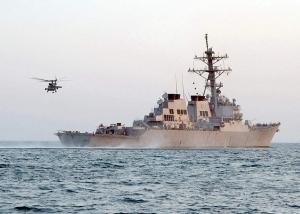
uss-hopper.jpgOne Defense Department official, who spoke on the condition of anonymity to describe early reports from the Navy’s regional headquarters in Bahrain, said that the Iranian boats made a radio threat that the American ships would explode.

“The five Iranian fast boats essentially came in and charged the ships,” the Defense Department official said. The verbal warnings heard in English over the internationally recognized bridge-to-bridge radio channel said, “I am coming at you, and you will explode in a few minutes,” the official said.

A few minutes later, one of the Iranian boats placed two white boxes, possibly meant to be taken for mines, in the wake of one of the Navy ships, which caused another of the American vessels to take evasive action.

“Whether they’re just testing us to learn about our procedures, or actually trying to initiate an incident, we don’t know,” the official said.

The five fast boats were identified by Defense Department officials as belonging to Iran’s Islamic Revolutionary Guards Corps. Traditionally, the Revolutionary Guards’ maritime forces have operated in a far more hostile manner than the regular Iranian Navy.

“We have found in the past that the regular Iranian Navy was a courteous and professional organization, and our relations are as we would have with any other navy in the world,” said one Pentagon official who has studied the issue. “The I.R.G.C. Navy has a tendency to act in these unprofessional ways, and to be very provocative at times.”

Last March, Revolutionary Guards sailors captured 15 British sailors in waters the British insisted were international, and held them for nearly two weeks. [complete article]

Hotdogs and brinkmanship

There’s a fair bit of speculation on Iranian motives today, from Blake Hounsell wondering if the IRGC commanders are doing some oil-market speculating to talk of a “Gulf of Tonkin” exersize and the inevitable Rightwing calls to bomb, bomb, bomb Iran. Others see this incident as being connected to the US nomination races (no, really – everything is about the races for some folk) or to Bush’s Mid-East visit.

While the latter is the most likely if this event – not unusual except for one Iranian redneck on a radio – was deliberately singled out for orders to that effect by some senior commander, I’m going with Dave Schuler’s take – dumb hotdogs playing brinkmanship games.

I think it’s more likely that it’s just a bunch of IRG’s horsing around, taunting the Great Satan. You can’t peddle that sort of stuff for a generation or more without it having some effects.

On both sides, Dave. [complete article]

Diplomatic two-step in Iran

Tehran in recent days reshuffled its diplomatic team in key Middle East posts. It has cut short the tenure of its ambassador to Syria after just a two-year stint, replacing him with another hard-core loyalist of President Mahmoud Ahmadinejad. The Tehran government has also announced the departure of its point man on Iraq to a post in far-flung Japan.

The moves have sparked speculation that Ahmadinejad wants more control over the country’s foreign policy on Iraq and Lebanon.

But they could also just be complicated maneuvers to consolidate power within the ruling elite’s treacherous factional politics. [complete article]

Oil shrugs off Iran-US bounce, falls below $97

Oil fell more than $1 to below $97 a barrel on Monday, handing back gains triggered by reports of fresh tensions between Iran and the United States. [complete article]

Facebooktwittermail

NEWS & ANALYSIS: Pakistan says no (again) to foreign troops; Pakistan’s ethnic faultlines

Pakistan says won’t let in foreign troops

Pakistan will not allow any country to conduct military operations on its territory, officials said on Monday, rejecting a report that said the United States was considering authorising its forces to act in Pakistan.

The New York Times said on Sunday the U.S. government was considering expanding the authority of the CIA and the military to conduct far more aggressive covert operations in Pakistan.

The U.S. officials considering the move were concerned over intelligence reports that al Qaeda and the Taliban were more intent on destabilising Pakistan, the newspaper said.

Pakistani government and military officials dismissed the report and said Pakistan would not permit any such action.

“Pakistan’s position in the war on terror has been very clear — that any action on Pakistani soil will be taken only by Pakistani forces and Pakistani security agencies,” said Foreign Ministry spokesman Mohammad Sadiq.

“No other country will be allowed to carry out operations in Pakistan. This has been conveyed at the highest level,” he said. [complete article]

Waziristan: the hub of al-Qaida operations

The killing of eight tribal elders involved in peace negotiations in the Waziristan region of Pakistan is the first flash of violence in the area for about six months.

The bloodshed unfolded in a series of attacks between Sunday night and Monday morning around Wana, the lawless capital which is a hotbed of al-Qaida linked violence.

The Pakistani military reported attacks on two “peace committee” offices in Wana and the nearby Shikai Valley, a rugged mountain retreat where soldiers discovered a network of al-Qaida safehouses in 2005.

The bloodletting underscores the collapse of government authority in Waziristan, where 100,000 troops are deployed, and the perils run by those engaged in controversial efforts to broker peace between the government and well-armed militants. [complete article]

Strains intensify in Pakistan’s ethnic patchwork

To Khaled Chema, an unemployed 32-year-old living in a sprawling slum of this mega-city by the sea, Benazir Bhutto wasn’t assassinated because she opposed extremism and advocated democracy. She was killed because, like him, she was a Sindhi.

And just as her father did before her, Bhutto died a long way from home — in the back yard of the Punjabi establishment. Her assassination has inflamed long-simmering resentments among ethnic minorities toward the dominant Punjabis.

In Pakistan — a federation of four provinces, each associated with a different ethnic group — the issue of ethnic identity has long been troublesome, imperiling the unity of the state.

In Baluchistan, many people are in open revolt. Pashtuns in North-West Frontier Province have joined their clansmen on the Afghan side of the border in a bloody insurgency against both governments.

Now, Bhutto’s assassination in Rawalpindi, a key city in Punjab province and the home of the military, has endangered the uneasy balance in which Sindhis suppressed their ethnic-nationalist desires because they knew that one of their own was among the most popular politicians in the country. [complete article]

Facebooktwittermail

FEATURES: The next president’s foreign policy challenges

The Democratic foreign policy wars

At the Des Moines Register presidential debate in December, Barack Obama was asked how voters could expect him to provide a “break from the past” when many of his top foreign policy advisers were holdovers from the Clinton Administration. Obama gracefully parried the challenge by saying he was willing to take good advice from several previous administrations, not just Bill Clinton’s. But the question did reflect a common suspicion that despite all his talk about providing “change,” the Obama campaign’s differences with Hillary Clinton on foreign policy may be more stylistic than substantive.

It’s true that a number of Obama’s key advisers–like former National Security Adviser Tony Lake, former Assistant Secretary of State Susan Rice and former Navy Secretary Richard Danzig–held prominent positions under Bill Clinton. At the same time, Obama’s team includes some of the most forward-thinking members of the Democratic foreign policy establishment–like Joseph Cirincione and Lawrence Korb of the Center for American Progress, the party’s leading experts on nonproliferation and defense issues, respectively, along with former counterterrorism czar Richard Clarke and Carter Administration National Security Adviser Zbigniew Brzezinski. Added to the mix are fresh faces who were at times critical of the Clinton Administration, like Harvard professor Samantha Power, author of “A Problem From Hell”, a widely acclaimed history of US responses to genocide. These names suggest that Obama may be more open to challenging old Washington assumptions and crafting new approaches. [complete article]

Trouble ahead

When taking the oath of office on January 20 2009, the next president of the United States will be assuming responsibility for the most difficult, dangerous and complex set of foreign-policy challenges ever to face a newcomer to the White House. Whatever is then happening in Iraq, Iran, Afghanistan, Pakistan, and the Arab-Israel peace process, it is safe to predict that George W. Bush will, in each case, be passing on to his successor either a daunting piece of unfinished business or a full-blown crisis.

Moreover, in dealing with that morass, the US will need help from a world where its reputation is scraping bottom, from an enfeebled United Nations and from allies whose confidence in America’s stewardship of its own power and their interests has been profoundly shaken. Although Bush has been making an effort to mend fences, and hopes to score some diplomatic points in his final year as president, his bungled occupation of Iraq and his swaggering disregard for international institutions and opinion during his first term still rankle around the world. Many of his fellow leaders are counting the days until he steps down (381 from today). [complete article]

Facebooktwittermail

OPINION: Fighting terrorism with terrorists

Fighting terrorism with terrorists

In the fall of 2002, the Indonesian island of Bali, once known for its luscious beaches and vibrant Hindu culture, became synonymous with terror and radicalism. After a massive bombing in Bali’s nightclub district killed more than 200 people, the world suddenly realized what many locals had known for years: Indonesia, the largest Muslim nation on Earth, faced a serious internal terror threat.

Even before the Bali attack, Indonesia had suffered a wave of bombings in the winter of 2000, and earlier that year someone had bombed the Jakarta Stock Exchange. The Al Qaeda affiliate Jemaah Islamiah was actively recruiting across the archipelago, establishing radical schools to train a young generation of jihadis and planning attacks in Indonesia and throughout the region, including in the Philippines and Thailand.

But today, Indonesia has become a far different kind of example. Even as terrorism continues to grow more common in nations from Pakistan to Algeria, Indonesia is heading in the opposite direction, destroying its internal terrorist networks and winning the broader public battle against radicalism. And it has done so not only by cracking heads but by using a softer, innovative plan that employs former jihadis to wean radicals away from terror. [complete article]

Facebooktwittermail

OPINION: Second thoughts on Charlie Wilson’s War

Second thoughts on Charlie Wilson’s War

I have some personal knowledge of Congressmen like Charlie Wilson (D-2nd District, Texas, 1973-1996) because, for close to twenty years, my representative in the 50th Congressional District of California was Republican Randy “Duke” Cunningham, now serving an eight-and-a-half year prison sentence for soliciting and receiving bribes from defense contractors. Wilson and Cunningham held exactly the same plummy committee assignments in the House of Representatives — the Defense Appropriations Subcommittee plus the Intelligence Oversight Committee — from which they could dole out large sums of public money with little or no input from their colleagues or constituents.

Both men flagrantly abused their positions — but with radically different consequences. Cunningham went to jail because he was too stupid to know how to game the system — retire and become a lobbyist — whereas Wilson received the Central Intelligence Agency Clandestine Service’s first “honored colleague” award ever given to an outsider and went on to become a $360,000 per annum lobbyist for Pakistan. [complete article]

Facebooktwittermail

NEWS & REVIEW: Taxi to the Dark Side

The power of authority: a dark tale

Frank Gibney was old and sick and a little more than a month away from dying. But he was filled with righteous anger, and he had some things to say. He told his son, the documentary filmmaker Alex Gibney, to unplug a noisy oxygen machine and to grab a video camera.

The older Mr. Gibney, a journalist and scholar who died in April, had served as a naval interrogator in World War II. In a moving statement that serves as a sort of coda to “Taxi to the Dark Side,” a new documentary about the Bush administration’s interrogation policies in the post-9/11 world, he said it had never occurred to him to use brutal techniques on the Japanese prisoners in his custody.

“We had the sense that we were on the side of the good guys,” Frank Gibney said, seething. “People would get decent treatment. And there was the rule of law.”

There would seem to be an enormous distance between the Bagram Air Base in Afghanistan, where the central events in “Taxi to the Dark Side” take place, and Enron’s headquarters in Houston, where the machinations of white-collar criminals brought down the giant energy company and became the backdrop for Mr. Gibney’s entertaining 2005 documentary, “Enron: The Smartest Guys in the Room.” But Mr. Gibney said the two projects have common themes.

“The subject of corruption unites my films,” he said. “‘Enron’ was about economic corruption, and ‘Taxi’ is about the corruption of the rule of law.” [complete article]

Padilla sues John Yoo over detention

Jose Padilla, the American citizen who was held in military detention for more than three years as an enemy combatant, filed a lawsuit Friday against a former Justice Department lawyer who helped provide the legal justifications for what the suit says was Mr. Padilla’s unconstitutional confinement and “gross physical and psychological abuse.”

The lawyer, John C. Yoo, now a law professor at the University of California, Berkeley, wrote or helped prepare a series of legal memorandums on interrogations and the treatment of detainees after the Sept. 11 attacks. [complete article]

Foiling U.S. plan, prison expands in Afghanistan

As the Bush administration struggles for a way to close the military prison at Guantanamo Bay, Cuba, a similar effort to scale down a larger and more secretive American detention center in Afghanistan has been beset by political, legal and security problems, officials say.

The American detention center, established at the Bagram military base as a temporary screening site after the invasion of Afghanistan in 2001, is now teeming with some 630 prisoners — more than twice the 275 being held at Guantanamo. [complete article]

Facebooktwittermail

NEWS: Key “Sunni Awakening” leader killed

Suicide bomber kills key Sunni leader in Baghdad

A suicide bomber assassinated a key leader of American-backed militia forces in a Sunni stronghold of Baghdad on Monday morning, the latest attack on nationalist Sunnis who have recently allied themselves with American troops. That attack, and a second bomb that exploded minutes later, killed at least six and wounded another 26 in total, hospital officials said.

The killing of the militia leader, Col. Riyadh al-Samarrai, on the fringes of north Baghdad’s Adhamiyah district, was one of the most significant attacks so far on leaders of former Sunni insurgents who have banded into militias, known as Awakening groups, to fight extremist militants.

Colonel Samarrai was one of the leaders of the Sunni Awakening movement in Adhamiyah, and was also a close aide and a security adviser to the head of the Sunni Endowment, which oversees Iraq’s Sunni mosques and is one of the most powerful Sunni institutions in Iraq. [complete article]

Facebooktwittermail