As Israel’s Prime Minister, Benjamin Netanyahu, and Palestinian Authority President Mahmoud Abbas, meet at the United Nations today, “both sides have made clear that they’ll essentially be humoring Obama, showing up because the President of the United States expects it of them and not to relaunch long-stalled ‘final status’ peace negotiations, as the administration had hoped,” writes Tony Karon at Time magazine.
The conventional wisdom among most seasoned observers of the conflict is that the status quo is untenable — that at some point both sides will have to arrive at a mutually acceptable way of implementing a two-state solution.
The process that might lead to that point is as murky as ever.
The possibility that receives less consideration is that Israelis, living in a country forged through war — a country that has never really known peace — having become resigned to the apparent necessity of remaining on a perpetual war footing, have now reached a point where war is more than tolerable: it is acceptable.
War is what created Israel, has allowed it to exist and will guarantee its perpetuation. Many Israelis may pay lip-service to the notion that peace is desirable, yet it is their willingness to engage in war that makes them feel safe.
For Ariel Siegelman, an Israeli soldier who fought in Gaza in a special forces unit of the IDF, the key lesson from the 2006 war in Lebanon was this: “We learned that we had been living in an imaginary world and that the most dangerous type of war is the one that you call peace. We learned that we are not in fact in a ‘peace process’ at all. We are at war.”
In the Washington Post just this week, Jackson Diehl pointed out that even as the UN’s damning report on the war on Gaza brought renewed critical attention to the most recent conflict, “Operation Cast Lead, as the three-week operation is known in Israel, is generally regarded by the country’s military and political elite as a success.” (Diehl, with apparent satisfaction, predicted: “As for the Goldstone report [PDF], the heat it briefly produced last week will quickly dissipate”.)
Claiming that the wars in Lebanon and Gaza had for Israel both been qualified successes, Diehl suggested that Israel is far less fearful than are most of its allies about picking a fight with Iran.
… as with Gaza, even a partial and short-term reversal of the Iranian nuclear program may look to Israelis like a reasonable benefit — and the potential blowback overblown.
Americans who do not share Diehl’s neoconservative perspective, don’t need to ask themselves whether they share Israel’s view of itself; they simply need to decide whether the United States has a responsibility (or any legitimate excuse) for sustaining Israel’s war machine.
Without American arms, the Jewish state will not be starved of materiel — there are plenty of non-US arms manufacturers who would happily pick up the new demand.
The only issue is whether we should regard Israel’s wars as ours.
* * *
Israel’s military might and its fighting forces have been celebrated by Israelis and Israel’s supporters through numerous songs and videos. Here are a few:
“After the Second Lebanon War, we learned some very valuable lessons. We learned that we had been living in an imaginary world and that the most dangerous type of war is the one that you call peace. We learned that we are not in fact in a ‘peace process’ at all. We are at war.
“Today the question is still asked, ‘But how do we WIN?’ And that is another question coming directly from a Western mindset. There is no such thing as winning in this new kind of war. The war is ongoing, with periods of more violence and periods of less violence, during which the enemy regroups and plans his next attack. When we feel the enemy is getting strong, we must be prepared to make preemptive strikes, hard and fast at key targets, with viciousness, as the enemy would do to us. Only then can we acquire, not peace, but sustained periods of relative calm.” — Ariel Siegelman
The Gaza experience was very different from the Lebanon War and even those of us who were there are trying to fully understand why. Lebanon was a wake-up call for Israelis and was the result of many years of foolish thinking. Since the so-called “Middle East Peace Process” began in the early 1990s with the Oslo Accords, many Palestinian children were raised on ideals of jihad (holy war) and hatred of Israel and the West, while Israeli children were generally taught that “peace is on the horizon”. A euphoric and asinine attitude persisted on the Israeli street throughout the 1990s, leading to the problems that we experienced in Lebanon. The Israeli political echelons and the upper ranks of the army had not established any real plans for entering Lebanon because they wanted to believe that, just like Jordan and Egypt, we had another border about which we could begin to relax. The Israeli public wanted to believe that we really were getting closer to peace. Not only was the army unprepared on a tactical level, but, since the threat was largely marginalized, the equipment that was available to reservists during the Second Lebanon War was far from adequate. Furthermore, the reservists themselves were generally psychologically and physically unprepared for war. They had lived for at least six years—since Israel pulled out of southern Lebanon in 2000—in a bubble of “peace”. In 2004, the army had claimed that we would never go back to Lebanon.
A New Kind of War
After the Second Lebanon War, we learned some very valuable lessons. We learned that we had been living in an imaginary world and that the most dangerous type of war is the one that you call peace. We learned that we are not in fact in a “peace process” at all. We are at war. On their own accord, many reservists began formidable fitness programs. The army invested in state-of-the-art equipment for us. We began planning for possible wars and attacks that might occur at any or all of our borders. And the whole army became much more serious about training again. The debacle of Lebanon set the stage for the success of Gaza. If there is one thing that Israelis are good at, it is taking lessons from their losses and being creative on the battlefield.
The Israel Defense Force (IDF) developed a different mentality toward Gaza. Lebanon, before the war, was very quiet and even boring, giving the perception that it was not a threat. Gaza, on the other hand, was always considered a hot zone. Certainly since Lebanon, we were told that “it [was] not a matter of IF, it [was] a matter of WHEN.” As Special Forces operators we were often crossing into the Strip and we knew the enemy. Now, after the Gaza war, the world has developed a perception that Hamas is not nearly on the level of Hezbollah. That in itself shows how successful we were—and lucky. Hamas is NOT a ragtag group of thugs. They are a vicious, well-trained, well-supplied, motivated, and creative fighting force. They are an unconventional army, no less capable than Hezbollah. The difference between Lebanon and Gaza is simply how Israel adapted to the enemy. Lebanon reminded each individual soldier that he has to be a warrior. It reminded the army that good intelligence and well thought out plans with realistic goals are key elements to the solution. It reminded the home front that we are still in a “war process” and it reminded the government that ego has no place in war and that politicians who are incompetent at military actions should step aside and allow those who know to take charge.
A new kind of enemy has become formidable over the last ten years. Western armies can look to Lebanon and Gaza to gain lessons for operating against this enemy. Even now, the Western concept of warfare is quite conventional, prompting us to think that if we can capture territory, and certainly if we can neutralize the enemy’s leadership, we will win. And we are confused when, no matter how well we do on the battlefield, the enemy continues and even increases its attacks. What we have not yet come to grips with is that the enemy is not playing by our rules. The new war is unconventional and is motivated by ideology. The enemy cannot hope to match Western technology, so he operates in a way to make the technology relatively meaningless. He simply refuses to meet the conventional army on the battlefield. The Western army invades enemy lands with almost no resistance, even captures the enemy’s leadership, developing the erroneous conception that victory has been achieved. Only then do the conventional soldiers begin being blown up by an enemy that cannot be identified or differentiated from the civilian population. The conventional soldier has no idea of how to operate in this environment because he is looking for a uniformed foe. A nine year-old child with a bomb does not fit the Western model of “combatant” and takes soldiers by surprise. The conquest of territory by a Western army only brings new targets closer to the terrorist so that he does not need to travel as far to blow up Western targets. It does not serve to bring the enemy to his knees. Likewise, Middle Eastern societies are tribal in nature and are fiercely proud of their ideology. They will not play chess with a conventional army, accepting defeat simply because their king is captured or their territory is occupied.
Lebanon: What NOT to do
Lebanon is a perfect example of the wrong way to confront the problems that the West faces in this new kind of war. The challenges that US forces face in Iraq are comparable. Let’s forget about the lack of Israeli leadership in 2006 and simply analyze the strategy. Israeli soldiers understood that the goals upon entering Lebanon were to destroy Hezbollah and end rocket attacks from the northern border. These goals were difficult to achieve and set Israel up for failure. Hezbollah, like any terrorist movement, is an ideology, and unless you are willing to kill everyone, an ideology cannot be toppled through military conquest. There only had to be one vigilant team left alive who held to its creed for Israel to fail in achieving its goals. Likewise, the moment that one rocket hit Israel from Lebanon after it withdrew to its own borders, Hezbollah would be victorious. Israel fell into the age-old trap that has caused much larger and seemingly stronger armies to be defeated by their unconventional foes: a poor evaluation of the enemy. It made no difference how much destruction Lebanon incurred or how many men Hezbollah lost. Perception is the deciding factor in this new kind of war. Hezbollah came out of the war appearing strong and, therefore, gained the respect of the world. Once the Israeli army entered from the south, the only real strategy for achieving its elusive goals was to reach the Litani River with ground forces, sweeping through Lebanese villages and towns. The Western military model had the Israelis convinced that by moving from one line on the map to another, all of the territory in between would be “conquered”. In the unconventional model, every moment that the army was moving forward, they provided ample targets to Hezbollah, who were attacking while retreating. They did not have to hold territory and they did not need to kill or injure huge numbers of Israeli soldiers. They only had to instill fear in the conventional force, a sense of hopelessness in the Israeli home front, and frustration in the military ranks. There are no front lines or rear lines in the new kind of war; the enemy will hit you from behind just as quickly (if not more quickly) as he will hit you from the front, and if you understand how the enemy operates, you can combat his ability to achieve his objectives.
Gaza: The Learning Curve
The lessons of Lebanon were immediately put into practice in preparing for the next conflict. The Special Forces (SF) were always very adept at urban warfare tactics, and during missions in the West Bank we operated ferociously, pulling missions almost every night. This combat experience produced a very high level of operational knowledge which trickled down through army doctrine for how to deal with our enemies. The regular army, and certainly the reserves, were lacking in their fighting skills in general until after Lebanon. In 2006, army leadership put new policies into action. The army supplied new gear to almost all combat units. Reservists had never seen such good equipment and their duty stopped being a vacation and became intensified training. The construction of an urban warfare training facility was completed in the desert, at about the same time that the Second Lebanon War was being fought. This facility is, perhaps, the most advanced urban warfare training facility in the world. It is built like the other facilities that we use, just much bigger. It resembles a real Arab city with Middle Eastern architecture, complete with mosques, schools, hospitals, large multi-story buildings, streets, squares, alleys, and vehicles. This offered the first opportunity for large scale training that allowed us to practice the concert of war, with SF, regular infantry, tanks, and artillery all operating together as a symphony. There is a strict training rotation that has all combat units drilling open-field combat techniques and urban warfare every few months. For almost three years, there were no illusions; we knew that we were training for Gaza. Unlike Lebanon, we knew that when we entered Gaza, the military goals and the execution of the missions in order to reach those goals would be methodical and well-prepared.
The IDF entered Gaza with realistic goals—significantly reduce Hamas’ ability to inflict damage on Israel and Israeli targets. We were told specifically that our goal was NOT to topple Hamas and was NOT to destroy all of its capabilities. Those goals would have been too difficult to achieve and would have set us up for defeat and a blow to the morale of the army and the nation. Likewise, the tactics would be unconventional. We were not to think in terms of conquest and holding territory. Concepts of front and rear lines had no place in this war. We were to frustrate and attack at the morale of the enemy, fighting much like he would fight us. The only rule was, don’t fight by the rules. The IDF went in, simply to wreak havoc on Hamas without getting into any situations that could afford our enemies the opportunity to achieve anything that would resemble a victory. We were to keep them at arm’s length, not attempt to engage them in combat, and use anything within our means to destroy them. And when Israel decided the desired perception had been reached (because perception is everything in these kinds of conflicts), we pulled out. Unlike Hezbollah, Hamas came out of this conflict without the world taking them very seriously. Even though Hamas was still shooting missiles into Israel, in a desperate attempt to save face, its capabilities had been seriously reduced and Israel had achieved its goals.
A New Kind of Success
It is not good training, technology, or strategy that makes bullets miss their targets or causes your eye to notice a trip-wire. For those experiences, I have to thank the Big Guy upstairs. He and I became very close during those cold nights. With all of our training and preparation, we were still afraid to go into Gaza. We knew the enemy and we had lost men even in the last year to their ambushes. When we were entering the Strip, we were fully prepared for high casualties. In Gaza they were waiting for us; they were looking for a fight. There were snipers, teams that were waiting to ambush us with anti-tank rockets, Improvised Explosive Devices (IEDs), booby traps, and mortars falling around us.
The successes that we saw in Gaza resulted from a combination of an appropriate response to the new kind of enemy, a healthy Israeli attitude that fiercely guarded its men and its right to stop intolerable attacks against its people, and protection from the Almighty, which some people call “luck”. I saw an attitude that I have been waiting to see for a long time from a nation that has too often apologized for every move that it makes. Today the question is still asked, “But how do we WIN?” And that is another question coming directly from a Western mindset. There is no such thing as winning in this new kind of war. The war is ongoing, with periods of more violence and periods of less violence, during which the enemy regroups and plans his next attack. When we feel the enemy is getting strong, we must be prepared to make preemptive strikes, hard and fast at key targets, with viciousness, as the enemy would do to us. Only then can we acquire, not peace, but sustained periods of relative calm.
Ariel Siegelman is Vice President of Security Training for The Draco Group, a service provider in advanced security and training. He served in the Israel Defense Force, Special Forces, as a counter terror operative, counter terror sniper and counter terror instructor, and remains active in these capacities in the Reserves. He can be reached at ariel@thedracogroup.com
This article originally appeared on The Colloquium, a US Army Combined Arms Center blog, March, 2009.
In yesterday’s Washington Post, deputy editorial page editor Jackson Diehl presented his case on how Israel “won” the war in Gaza and how this bodes well for the Israel’s prospects in the event that it launches an attack on Iran.
Reviving neocon hubris from days of yore, Diehl poo poos the dire predictions that some have made about the consequences of an attack on Iran’s nuclear facilities, saying: “even a partial and short-term reversal of the Iranian nuclear program may look to Israelis like a reasonable benefit — and the potential blowback overblown.”
To make his case, Diehl cites the lull in rocket attacks from post-war Gaza as proof of the “success” of the war.
Israel’s satisfaction starts with a simple set of facts. Between April 2001 and the end of 2008, 4,246 rockets and 4,180 mortar shells were fired into Israel from Gaza, killing 14 Israelis, wounding more than 400 and making life in southern Israel intolerable. During what was supposed to be a cease-fire during the last half of 2008, 362 rockets and shells landed. Meanwhile, between late 2000 and the end of 2008, Israeli forces killed some 3,000 Gazans.
Since April there have been just over two dozen rocket and mortar strikes — or less than on many single days before the war. No one has been seriously injured, and life in the Israeli town of Sderot and the area around it has returned almost to normal. Israeli attacks in Gaza have almost ceased, too: Since the end of the mini-war, 29 Palestinians, two of whom were civilians, have been killed by Israeli action.
A “ceasefire” during which 362 attacks occurred doesn’t sound like much of a ceasefire — except for the fact that Diehl is grossly misrepresenting the numbers. 324 of those attacks occurred after Israel unilaterally broke the ceasefire on November 4, 2008.
When, after ignoring the subject for several days, the New York Times finally got around to making an editorial pronouncement on the war on Gaza, it trotted out what is among most inattentive observers the conventional wisdom:
Hamas never fully observed the cease-fire that went into effect on June 19 and Israel never really lived up to its commitment to ease its punishing embargo on Gaza.
In fact, Hamas’ compliance with the ceasefire was stunningly disciplined. Don’t take my word for it. The proof comes from the Israeli government.
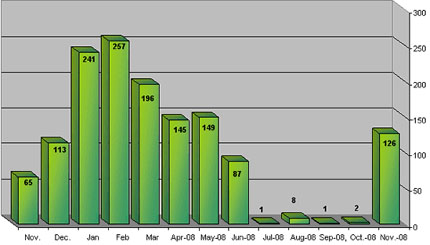
Look at this graph provided by the Israeli Foreign Ministry showing rocket attacks from Gaza per month during 2008.
From January through June there were an average of 179 rocket attacks per month. From July through October there were an average of 3 rocket attacks per month.
For the residents of Sderot, those months were indeed a period of calm. But the calm ended when Israel unilaterally broke the ceasefire right after the US elections and just before Hamas and Fatah sat down for crucial reconciliation talks in Cairo.
If Israel, as it would currently have the world believe, was so strongly in favor of extending the six-month ceasefire, why did it attach so little value to what had already been accomplished? Why did it not acknowledge the effectiveness with which Hamas was holding up its side of the bargain? Why did it not demonstrate that it valued the calm by lifting or at least easing the economic embargo on Gaza in a significant way?
All Israel accomplished was to confirm Hamas’ suspicions — suspicions shared by most Palestinians — that Israel cannot be trusted.
Did it matter to the Israelis that they could be damned by their own statistics? Apparently so, for within a few days of my drawing attention to the success of the truce, the Ministry of Foreign Affairs had removed the evidence.
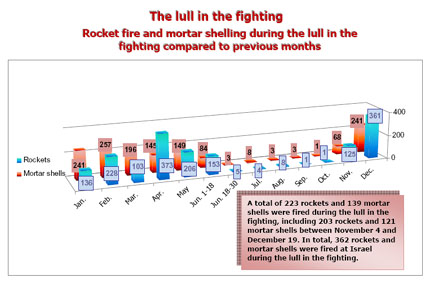
Now that the Israeli propaganda machine is revved up to full throttle, the image of an effective truce no longer suits the Israeli government’s purposes. Instead it has become more convenient to try and hide the numbers — with numbers! The foreign ministry has thus removed the simple graph shown above and replaced it with this:
In the earlier image, graph blocks dramatically portrayed the rise and fall in rocket fire rates. In the revised image, blocks of equal size (containing numbers) are used to obscure the graph. The effect, clearly intended, is to try and portray the lull as really nothing more than a minor undulation in a period of unremitting attacks.
The message Israel now wants to sell is that the truce never really worked. Instead of acknowledging that the truce effectively collapsed when Israel launched Operation “Double Challenge” on November 5, the rocket fire that followed that Israeli raid is being used to obscure the fact that rocket fire had effectively been curtailed up to that point.*
On the IDF Spokesman web site, a post on rocket statistics simply omits the part of the record that Israel now finds inconvenient to acknowledge:
Between Hamas’ takeover and the start of the Tahadiya (State of Calm), (June 14, 2007 – June 16, 2008), there was an average of over 361 attacks per month—an increase of an additional 350%.
On Nov. 4 – 5, Israel launched Operation “Double Challenge”, targeting a tunnel Hamas was building as part of a plan to kidnap Israeli soldiers.
From the end of Operation “Double Challenge” until the end of the Tahadiya, (Nov. 4 – Dec. 19, 2008) a period of only a month and a half, there were 170 mortars, 255 Qassams, and 5 Grads fired upon Israel’s civilian population centers.
Since the end of the Tahadiya (Dec. 19, 2009) until the beginning of Operation “Cast Lead,” (Dec. 27, 2008) a period of little more than a week, there were approximately 300 mortars and rockets fired onto Israel.
Since the begining of Operation “Cast Lead”, there have been an additional 500 launches, 284 of which have been verified as rockets (both Qassams and Grads), and 113 as mortars.
Was four months of calm really worthless? Given that it became the precursor to war, the answer now apparently is yes.
But it didn’t have to turn out this way. The effectiveness with which Hamas enforced a truce should have provided the impetus for Israel to lift its economic siege of Gaza.
Instead, we are once again witness to Israel’s seemingly insatiable appetite for war, even while it never tires of professing its love of peace.
* Should anyone doubt that the Israeli raid (official declarations about Israel’s commitment to the truce notwithstanding) constituted a unilateral breach of the truce, consider what Israel and the world’s response would have been in the event that the raid had been launched from Gaza. Hamas gunmen conducted a raid inside Israeli territory, killing six Israeli soldiers.
That wouldn’t have been described as a breakdown in the truce; it would have been regarded as an act of war.
This website or its third-party tools use cookies, which are necessary to its functioning. By closing this banner, you agree to the use of cookies.